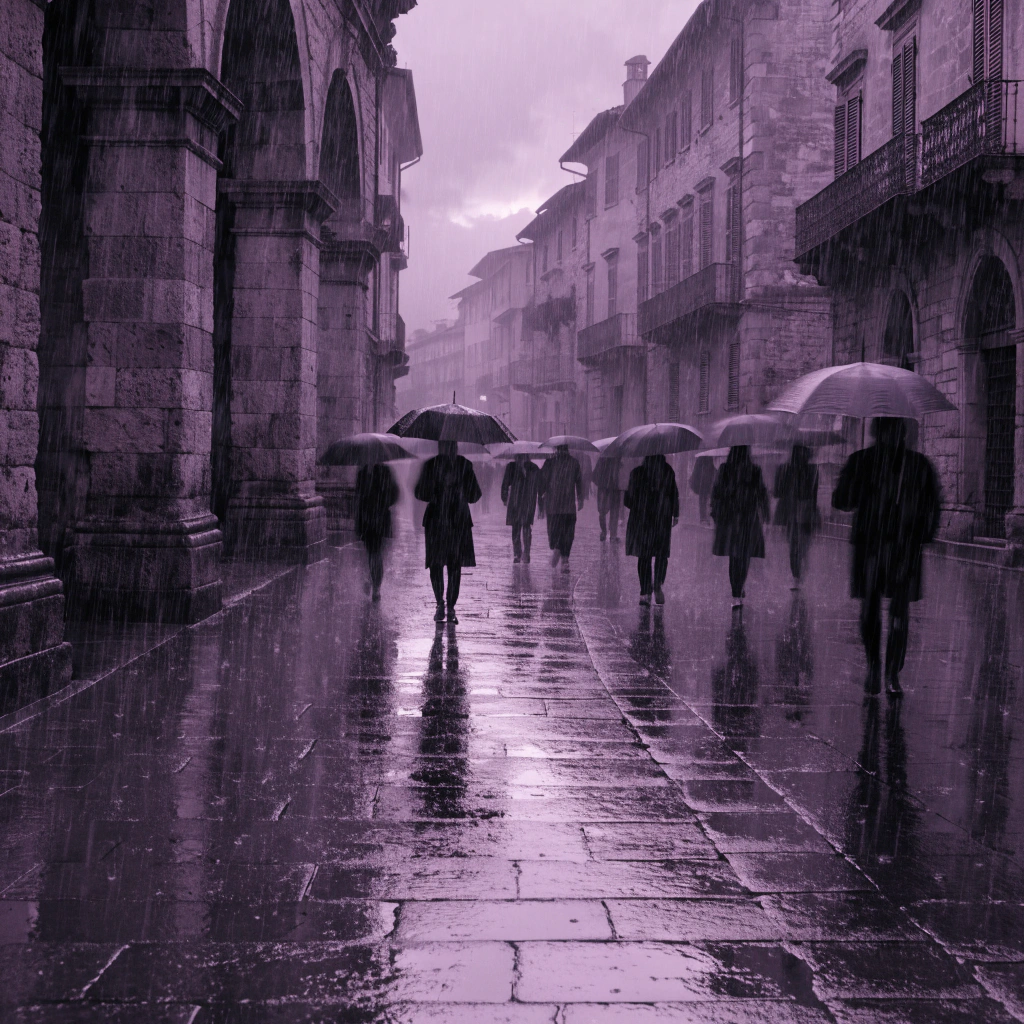
A Special Walk in Italy
In Italy, people love a special tradition. It is called "La Passeggiata." This name means "the little walk." Every evening, people go outside. They walk in the city center or in the main square.
Men, women, and children walk together. They talk to friends and neighbors. They wear nice clothes for the walk. Usually, the walk is before dinner. It is a very slow walk.
This tradition is very important in Italy. It is a time for family and friends. People see many people. They smile and say "hello." Italy is a beautiful country for a walk.
Point grammaire
Structure: Present Simple 'To Be'
"This tradition is very important in Italy."
We use 'is' with singular subjects like 'tradition' to describe a fact or a state. It is one of the most common verbs in English.
Structure: Present Simple (Habits)
"They talk to friends and neighbors."
We use the base form of the verb (talk) for plural subjects like 'they'. This pattern describes things people do regularly.
Teste ta compréhension
10 questions · A1 Débutant · 1 aperçu gratuit
Teste ce que tu as appris dans cet article. Réponds à toutes les questions pour gagner des XP !
What is 'La Passeggiata'?
Tu veux terminer le quiz ?
9 questions supplémentaires t'attendent. Inscris-toi gratuitement pour débloquer le quiz complet et gagner des XP !
S'inscrire gratuitementTu as dj un compte ? Connexion
Bien joué !
Continue à pratiquer !
Déjà terminé — pas de XP supplémentaire
Inscris-toi pour gagner des XPDétail des questions
What is 'La Passeggiata'?
Ta réponse:
Bonne réponse: A little walk
The walk usually happens in the morning.
Ta réponse:
Bonne réponse: Faux
What is a 'neighbor'?
Ta réponse:
Bonne réponse: A person who lives near you
Italy is a beautiful _____ for a walk.
Ta réponse:
Bonne réponse: country
The Beautiful Italian Walk
Every evening in Italy, people do something very special. They go for a walk called 'La Passeggiata.' This means 'the little walk' in English. It is a famous tradition in many Italian towns.
Between 5:00 PM and 8:00 PM, the streets become very busy. People leave their homes and go to the main square. Families walk together, and friends meet to talk. You can see young children and older grandparents.
This walk is not for exercise. People wear their best clothes because they want to look nice. They walk slowly and look at the shop windows. Many people stop to buy a gelato or a coffee. They talk about their day and enjoy the beautiful weather.
In the past, this was the best way to meet new people. Today, it is still a great way to see friends. It is slower than a normal walk, but it is much more social. It is a beautiful part of Italian life.
Point grammaire
Structure: Comparative Adjectives
"It is slower than a normal walk, but it is much more social."
We use comparatives to compare two things. For short words, we add '-er' (slow -> slower). For long words, we use 'more' (more social).
Structure: Past Simple of 'To Be'
"In the past, this was the best way to meet new people."
We use 'was' or 'were' to talk about situations in the past. 'Was' is the past form of 'am' and 'is'.
Teste ta compréhension
11 questions · A2 mentaire · 1 aperçu gratuit
Teste ce que tu as appris dans cet article. Réponds à toutes les questions pour gagner des XP !
When does 'La Passeggiata' usually happen?
Tu veux terminer le quiz ?
10 questions supplémentaires t'attendent. Inscris-toi gratuitement pour débloquer le quiz complet et gagner des XP !
S'inscrire gratuitementTu as dj un compte ? Connexion
Bien joué !
Continue à pratiquer !
Déjà terminé — pas de XP supplémentaire
Inscris-toi pour gagner des XPDétail des questions
When does 'La Passeggiata' usually happen?
Ta réponse:
Bonne réponse: Between 5:00 PM and 8:00 PM
The main reason for the walk is to get fast exercise.
Ta réponse:
Bonne réponse: Faux
What does the word 'square' mean?
Ta réponse:
Bonne réponse: An open area in a town
Between 5:00 PM and 8:00 PM, the streets become very _____.
Ta réponse:
Bonne réponse: busy
Why do people wear their best clothes?
Ta réponse:
Bonne réponse: Because they want to look nice
La Passeggiata : Le Rituel Social Italien
En Italie, il existe une tradition sociale très chère et visible : la Passeggiata. Littéralement, ce mot signifie « la petite marche », mais c'est bien plus qu'une simple promenade. Chaque soir, généralement entre 17h00 et 20h00, juste avant le dîner, les habitants de toutes les villes et villages italiens sortent de chez eux pour participer à ce rituel.
Que ce soit dans les Alpes au nord ou sous le soleil du sud, les Italiens de tous âges se retrouvent. Ils se promènent lentement dans le « centro storico », le centre historique de leur ville, souvent le long de la rue piétonne principale ou autour de la place centrale. Ce n'est pas une course ; c'est un moment de détente et d'observation. Les gens s'habillent élégamment, car la Passeggiata est aussi une occasion de se montrer et de voir les autres.
Cette tradition a toujours été un pilier de la vie communautaire. C'est un moment où les familles se réunissent, les amis discutent, et les célibataires cherchent peut-être l'amour. On y croise des enfants jouant, des adolescents riant et des personnes âgées échangeant les dernières nouvelles. La Passeggiata est une pause quotidienne, un moment pour se connecter avec sa communauté et ressentir le pouls de la vie locale. Elle n'est pas seulement une promenade, elle est l'âme de la vie sociale italienne, un événement qui a été conservé à travers les générations et qui continue d'unir les gens aujourd'hui.
Point grammaire
Structure: Le Passé Composé
"Cette tradition a toujours été un pilier de la vie communautaire."
Le passé composé est utilisé pour parler d'actions ou d'événements passés qui sont terminés. Il se forme avec l'auxiliaire « avoir » ou « être » au présent, suivi du participe passé du verbe principal.
Structure: Les Pronoms Relatifs (qui, que)
"C'est un moment où les familles se réunissent, les amis discutent, et les célibataires cherchent peut-être l'amour. Elle n'est pas seulement une promenade, elle est l'âme de la vie sociale italienne, un événement qui a été conservé à travers les générations et qui continue d'unir les gens aujourd'hui."
Les pronoms relatifs comme « qui » et « que » permettent de relier deux phrases en évitant la répétition. « Qui » est utilisé pour le sujet du verbe qui suit, et « que » est utilisé pour l'objet direct.
Teste ta compréhension
11 questions · B1 Intermédiaire · 1 aperçu gratuit
Teste ce que tu as appris dans cet article. Réponds à toutes les questions pour gagner des XP !
Quel est le sens littéral du mot « Passeggiata » ?
Tu veux terminer le quiz ?
10 questions supplémentaires t'attendent. Inscris-toi gratuitement pour débloquer le quiz complet et gagner des XP !
S'inscrire gratuitementTu as dj un compte ? Connexion
Bien joué !
Continue à pratiquer !
Déjà terminé — pas de XP supplémentaire
Inscris-toi pour gagner des XPDétail des questions
Quel est le sens littéral du mot « Passeggiata » ?
Ta réponse:
Bonne réponse: La petite marche
La Passeggiata a lieu uniquement dans les grandes villes italiennes.
Ta réponse:
Bonne réponse: Faux
Que signifie le mot « pilier » dans le contexte de l'article ?
Ta réponse:
Bonne réponse: Ce qui est très important et soutient une idée
Les participants à la Passeggiata s'habillent souvent _____.
Ta réponse:
Bonne réponse: élégamment
Quel est l'un des buts principaux de la Passeggiata ?
Ta réponse:
Bonne réponse: Se connecter avec la communauté
The Art of the Italian Stroll: Understanding La Passeggiata
In the heart of every Italian town, as the sun begins its gradual descent, a remarkable transformation occurs. This daily ritual, known as 'La Passeggiata,' is far more than a simple evening stroll; it is a sophisticated social performance that has defined Italian communal life for centuries. Typically occurring between the hours of five and eight in the evening, this tradition involves residents of all generations congregating in the historic center to walk slowly along the main pedestrian thoroughfares. This movement is not directed toward a specific destination; rather, the journey itself is the objective.
While an outsider might perceive this activity merely as a form of light exercise, the practice is deeply rooted in the concept of 'bella figura'—the art of presenting one’s best self to the world. Consequently, participants are often dressed with meticulous care, reflecting an aesthetic standard that transcends mere fashion. This emphasis on appearance facilitates a complex dance of social observation, as individuals acknowledge neighbors, exchange brief greetings, and subtly evaluate the changes in their community. It is a time for public display where the private lives of citizens momentarily intersect in the shared space of the piazza.
Furthermore, the ritual serves as a vital mechanism for social cohesion, ensuring that the elderly remain visible and integrated within the community while the younger generation learns the nuances of local etiquette. Unlike the structured environment of an office or a school, the street provides a neutral ground where hierarchies are softened. Despite the rise of digital communication and the allure of social media, La Passeggiata remains an enduring pillar of Italian identity. It provides a spontaneous forum for political debate, romantic encounters, and family bonding that cannot be replicated through a screen.
The rhythmic pace of the walk, which is never rushed, encourages a meditative state that contrasts sharply with the frantic nature of modern globalized life. Were this tradition to disappear, the very fabric of Italian urban existence would be significantly diminished. In an era where many societies are becoming increasingly fragmented, this communal experience highlights the profound human need for physical presence and shared public spaces. Ultimately, the stroll is a testament to the Italian belief that life should be savored collectively, rather than consumed in isolation, proving that some traditions are too essential to be abandoned.
Point grammaire
Structure: Passive Voice
"the practice is deeply rooted in the concept of 'bella figura'"
The passive voice is used here to focus on the practice itself rather than the people performing it. It is formed using the verb 'to be' plus the past participle.
Structure: Relative Clauses
"The rhythmic pace of the walk, which is never rushed, encourages a meditative state"
This non-defining relative clause provides extra information about the 'pace of the walk'. It is separated by commas and uses 'which' to refer back to the noun.
Structure: Second Conditional (Inverted)
"Were this tradition to disappear, the very fabric of Italian urban existence would be significantly diminished."
This is a formal version of 'If this tradition were to disappear'. The inversion of 'were' and the subject creates a more academic and hypothetical tone.
Teste ta compréhension
11 questions · B2 Intermédiaire supérieur · 1 aperçu gratuit
Teste ce que tu as appris dans cet article. Réponds à toutes les questions pour gagner des XP !
What is the primary objective of La Passeggiata according to the text?
Tu veux terminer le quiz ?
10 questions supplémentaires t'attendent. Inscris-toi gratuitement pour débloquer le quiz complet et gagner des XP !
S'inscrire gratuitementTu as dj un compte ? Connexion
Bien joué !
Continue à pratiquer !
Déjà terminé — pas de XP supplémentaire
Inscris-toi pour gagner des XPDétail des questions
What is the primary objective of La Passeggiata according to the text?
Ta réponse:
Bonne réponse: The act of walking and socializing itself
La Passeggiata is a modern tradition that started with the rise of social media.
Ta réponse:
Bonne réponse: Faux
What does the word 'aesthetic' refer to in the article?
Ta réponse:
Bonne réponse: A concern with beauty and appearance
The ritual serves as a vital mechanism for social _____, keeping the elderly integrated.
Ta réponse:
Bonne réponse: cohesion
What does the concept of 'bella figura' involve?
Ta réponse:
Bonne réponse: Presenting one's best self to the public
Beyond the Promenade: The Sociocultural Significance of La Passeggiata
In towns and cities scattered across the Italian peninsula, as the sun initiates its slow, golden descent, an ephemeral yet pervasive transformation occurs within the urban fabric. This is the hour of 'La Passeggiata', a ritualized promenade that transcends the mundane requirements of physical exertion. Far from being a mere constitutional, it represents a sophisticated choreography of social interaction, wherein the 'centro storico' is repurposed as a grand stage for the manifestation of collective identity. Seldom does one witness such a seamless integration of public space and private identity as during these twilight hours. The streets, often centuries old and steeped in historical significance, serve as an open-air sanctuary for discourse, observation, and mutual recognition. This practice is not merely a stagnant relic of a bygone era; rather, it is a living testament to the resilience of Italian communal life in the face of increasing digital isolation and the encroachment of globalized consumerism.
It is the concept of 'bella figura' that dictates the unspoken sartorial requirements and behavioral norms of the evening. This term, which encapsulates a meticulous attention to outward appearance and social grace, ensures that the promenade remains a heightened aesthetic experience. This curation of self is not merely a matter of vanity; it is a profound social obligation to contribute to the collective beauty of the town. Participants do not merely walk; they present a curated version of themselves to their peers, engaging in a silent, visual dialogue that reaffirms their place within the local social hierarchy. While some critics might dismiss this display as inherently ostentatious or superficial, a more nuanced analysis reveals it to be a surprisingly egalitarian exercise. Regardless of socio-economic status, the piazza remains accessible to all, fostering a sense of belonging that is increasingly rare in the context of modern urban planning.
Furthermore, the preservation of communal bonds through the ritual of the walk prevents the total atomization of society. In an age where social media often acts as a surrogate for physical presence, La Passeggiata offers a tangible and necessary counterpoint. It facilitates the spontaneous exchange of local news, the bridging of generational divides as the elderly walk alongside the youth, and the reinforcement of regional heritage. The rhythmic, unhurried pace of the walk allows for a depth of conversation and reflection that the frantic nature of contemporary life typically precludes. Moreover, the architectural layout of Italian towns, typically centered around a primary piazza, is fundamental to the success of this tradition. The environment encourages the 'gaze'—the act of both seeing and being seen—which serves as a form of social glue. This mutual observation acts as an informal mechanism for social cohesion, where the community self-regulates and celebrates its continued existence.
Ultimately, the enduring popularity of this tradition suggests that the fundamental human need for physical connection and public affirmation remains undiminished. While globalization may threaten to homogenize local customs, the Italian promenade stands as a bastion of cultural continuity. It serves as a poignant reminder that the essence of a vibrant community is not found within its static infrastructure, but in the deliberate, shared movements and interactions of its people. As the lights of the trattorias begin to flicker on, the walkers slowly disperse, yet the social fabric has been subtly reinforced for another day.
Point grammaire
Structure: Inversion
"Seldom does one witness such a seamless integration of public space and private identity as during these twilight hours."
Inversion is used here for emphasis by placing a negative adverbial ('Seldom') at the start, followed by the auxiliary verb 'does' before the subject 'one'.
Structure: Cleft Sentences
"It is the concept of 'bella figura' that dictates the unspoken sartorial requirements and behavioral norms of the evening."
An 'It-cleft' focuses on a specific noun phrase ('the concept of bella figura') to highlight it as the primary cause or agent within the sentence.
Structure: Nominalisation
"The preservation of communal bonds through the ritual of the walk prevents the total atomization of society."
Nominalisation turns verbs like 'preserve' and 'atomize' into nouns ('preservation', 'atomization'), creating a more formal, academic tone typical of C1 English.
Teste ta compréhension
12 questions · C1 Avancé · 1 aperçu gratuit
Teste ce que tu as appris dans cet article. Réponds à toutes les questions pour gagner des XP !
What is the primary role of the 'centro storico' during La Passeggiata?
Tu veux terminer le quiz ?
11 questions supplémentaires t'attendent. Inscris-toi gratuitement pour débloquer le quiz complet et gagner des XP !
S'inscrire gratuitementTu as dj un compte ? Connexion
Bien joué !
Continue à pratiquer !
Déjà terminé — pas de XP supplémentaire
Inscris-toi pour gagner des XPDétail des questions
What is the primary role of the 'centro storico' during La Passeggiata?
Ta réponse:
Bonne réponse: A stage for the manifestation of collective identity
The author suggests that La Passeggiata is a stagnant relic with no relevance to modern life.
Ta réponse:
Bonne réponse: Faux
Which word describes a belief in equality for all participants in the ritual?
Ta réponse:
Bonne réponse: Egalitarian
The walk prevents the total _____ of society by maintaining communal bonds.
Ta réponse:
Bonne réponse: atomization
According to the text, how does 'bella figura' affect the participants?
Ta réponse:
Bonne réponse: It dictates their attention to appearance and social grace.
The architectural layout of Italian towns is fundamental to the tradition's success.
Ta réponse:
Bonne réponse: Vrai
La Passeggiata : Une Anthropologie du Rituel Social Italien à l'Époque Contemporaine
« La Passeggiata », terme qui, dans sa simplicité étymologique, désigne une « petite promenade », transcende néanmoins cette acception rudimentaire pour s'ériger en un phénomène socioculturel d'une complexité et d'une résilience remarquables au sein du tissu identitaire italien. Loin d'être une simple déambulation vespérale, ce rituel, immuable quoique subtilement évolutif, constitue un pilier fondamental de la cohésion sociale, un spectacle vivant où se déploient les strates profondes de l'italianité.
Chaque soir, entre dix-sept et vingt heures, avant que ne s'amorce le sacro-saint repas du soir, les citadins et villageois de toutes générations, depuis les confins alpins jusqu'aux rives ensoleillées de la Sicile, convergent vers les artères névralgiques de leur localité. Il s'agit invariablement du « centro storico », de la via principale devenue piétonne, ou de la piazza centrale, véritables scènes à ciel ouvert où se joue cette pièce quotidienne. Ce n'est point une marche hâtive dictée par une quelconque contrainte utilitaire ; au contraire, la lenteur est de mise, une cadence mesurée qui invite à l'observation méticuleuse et à l'interaction délibérée.
L'essence de la Passeggiata réside dans son caractère ostensiblement social. Elle n'est pas tant une affaire d'aller d'un point A à un point B qu'un acte de « voir et être vu ». Les participants, souvent parés de leurs atours les plus soignés, s'engagent dans une chorégraphie informelle où les salutations se multiplient, les nouvelles s'échangent, et les liens communautaires se resserrent. C'est un moment privilégié pour l'affichage des appartenances sociales, la validation des statuts, et l'affirmation d'une identité collective face à l'altérité du monde extérieur. En ce sens, la Passeggiata opère comme un mécanisme de régulation sociale, un baromètre des dynamiques interpersonnelles au sein de la communauté.
On pourrait soutenir que ce rituel, à première vue désuet dans nos sociétés contemporaines obsédées par la vitesse et l'efficacité, incarne en réalité une forme de résistance douce. Face à l'hégémonie de la connectivité numérique et à l'individualisation croissante, la Passeggiata offre un espace tangible de reconnexion humaine. Elle force une décélération salutaire, une pause réflexive dans le tourbillon de l'existence moderne, rappelant l'importance inaliénable du temps partagé et de la présence physique. N'est-ce pas là une quête paradoxale de modernité que de s'ancrer dans des traditions séculaires pour mieux appréhender les défis de l'époque ?
L'analyse de ce phénomène révèle également des dimensions anthropologiques plus profondes. La Passeggiata peut être interprétée comme un rite de transition, marquant le passage de la sphère publique et laborieuse de la journée à l'intimité domestique de la soirée. C'est une sorte de sas social, permettant une décompression psychologique et une préparation à l'ingestion du repas, lui-même un événement familial et social capital en Italie. La fluidité des échanges, la légèreté des conversations, et l'atmosphère détendue qui y règnent contribuent à une forme d'osmose collective, un sentiment d'appartenance quasi fusionnel.
Nonobstant les mutations sociétales profondes qui ont jalonné le XXe et le début du XXIe siècle – urbanisation galopante, diversification des loisirs, omniprésence des écrans – cette coutume ancestrale a su, non sans une certaine plasticité, perdurer. Bien que ses modalités puissent varier légèrement d'une région à l'autre, voire d'une génération à l'autre, son essence demeure intacte. Les jeunes, loin de la délaisser entièrement, l'adaptent, y intégrant parfois des éléments plus contemporains, mais reconnaissent implicitement sa valeur intrinsèque comme socle identitaire.
En définitive, « La Passeggiata » n'est pas un simple folklore touristique, mais une manifestation vivante d'un « art de vivre » profondément enraciné. Elle est un témoignage éloquent de la capacité d'une culture à préserver ses rituels les plus significatifs face à l'érosion du temps et aux pressions de la modernité. Elle nous invite à méditer sur la valeur inestimable des interactions humaines directes et sur la sagesse inhérente aux rythmes lents qui, peut-être, sont la véritable clé d'une existence équilibrée et riche de sens. Il est impératif que l'on continue de l'observer et de l'analyser pour saisir pleinement les nuances de la vie sociale italienne.
Point grammaire
Structure: Le subjonctif après une expression impersonnelle de nécessité
"Il est impératif que l'on continue de l'observer et de l'analyser pour saisir pleinement les nuances de la vie sociale italienne."
Le subjonctif est employé ici après une expression impersonnelle (il est impératif que) qui marque une nécessité, une obligation ou un jugement subjectif. Il est formé à partir du radical de la 3e personne du pluriel de l'indicatif présent, avec des terminaisons spécifiques (e, es, e, ions, iez, ent).
Structure: La forme négative soutenue "ne... point"
"Ce n'est point une marche hâtive dictée par une quelconque contrainte utilitaire ; au contraire, la lenteur est de mise..."
« Ne... point » est une forme de négation plus soutenue et archaïque que « ne... pas ». Elle est souvent utilisée dans un registre littéraire ou formel pour insister sur l'absence ou la réfutation, conférant une certaine élégance au propos et une nuance plus catégorique.
Structure: L'inversion du sujet dans une interrogation rhétorique
"N'est-ce pas là une quête paradoxale de modernité que de s'ancrer dans des traditions séculaires pour mieux appréhender les défis de l'époque ?"
L'inversion du sujet (verbe-sujet) est caractéristique des interrogations directes en français, mais elle est également employée dans les questions rhétoriques comme celle-ci. Elle sert à interpeller le lecteur et à renforcer l'argumentation, suggérant que la réponse est évidente sans pour autant l'attendre formellement.
Teste ta compréhension
12 questions · C2 Maîtrise · 1 aperçu gratuit
Teste ce que tu as appris dans cet article. Réponds à toutes les questions pour gagner des XP !
Quel est le but principal de la Passeggiata, au-delà d'une simple promenade ?
Tu veux terminer le quiz ?
11 questions supplémentaires t'attendent. Inscris-toi gratuitement pour débloquer le quiz complet et gagner des XP !
S'inscrire gratuitementTu as dj un compte ? Connexion
Bien joué !
Continue à pratiquer !
Déjà terminé — pas de XP supplémentaire
Inscris-toi pour gagner des XPDétail des questions
Quel est le but principal de la Passeggiata, au-delà d'une simple promenade ?
Ta réponse:
Bonne réponse: Renforcer les liens sociaux et l'identité communautaire.
La Passeggiata est décrite comme une marche rapide et hâtive.
Ta réponse:
Bonne réponse: Faux
Que signifie le mot "hégémonie" dans le contexte de l'article ?
Ta réponse:
Bonne réponse: Une domination ou une influence prépondérante.
La Passeggiata opère comme un mécanisme de régulation ______.
Ta réponse:
Bonne réponse: sociale
À quelle période de la journée la Passeggiata a-t-elle généralement lieu ?
Ta réponse:
Bonne réponse: Entre 17h et 20h, avant le dîner.
L'article affirme que les jeunes générations ont totalement délaissé la Passeggiata.
Ta réponse:
Bonne réponse: Faux

