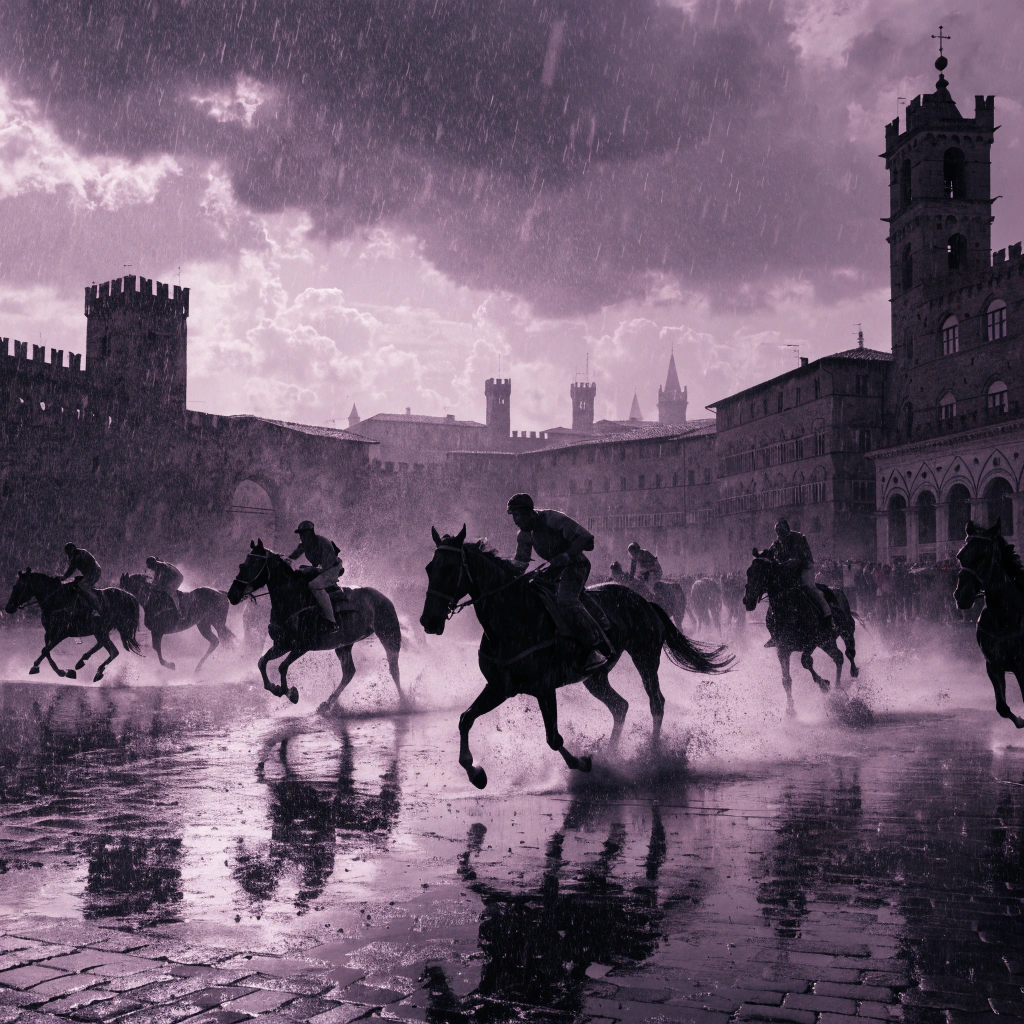
The Famous Horse Race of Siena
Siena is a beautiful city in Italy. It has a famous horse race. It is called the Palio. The race happens two times every year. It is in July and August.
Ten horses run in the race. They represent different parts of the city. These parts are called Contrade. The race is very fast. It is in the main square. The square is the Piazza del Campo.
The winner gets a big silk flag. People in Siena love the Palio. They wear colorful clothes and sing songs. It is a very special tradition.
Point grammaire
Structure: Present Simple (to be)
"Siena is a beautiful city in Italy."
We use 'is' for singular subjects like 'Siena' or 'it'. It describes a permanent fact or state.
Structure: Present Simple (plural verbs)
"Ten horses run in the race."
For plural subjects like 'horses', we use the base form of the verb. We do not add an 's' at the end.
Teste ta compréhension
10 questions · A1 Débutant · 1 aperçu gratuit
Teste ce que tu as appris dans cet article. Réponds à toutes les questions pour gagner des XP !
Where is the city of Siena?
Tu veux terminer le quiz ?
9 questions supplémentaires t'attendent. Inscris-toi gratuitement pour débloquer le quiz complet et gagner des XP !
S'inscrire gratuitementTu as dj un compte ? Connexion
Bien joué !
Continue à pratiquer !
Déjà terminé — pas de XP supplémentaire
Inscris-toi pour gagner des XPDétail des questions
Where is the city of Siena?
Ta réponse:
Bonne réponse: Italy
The horse race happens every month.
Ta réponse:
Bonne réponse: Faux
What is a 'race'?
Ta réponse:
Bonne réponse: A competition of speed
The winner gets a big silk _____.
Ta réponse:
Bonne réponse: flag
The Famous Horse Race of Siena
Siena is a beautiful city in Tuscany, Italy. Every year, thousands of people visit to see a famous horse race. This race is called the Palio. It happens twice a year, on July 2nd and August 16th.
The race takes place in the Piazza del Campo. This is the main square of the city. The city is divided into seventeen neighborhoods called "Contrade." Each district has its own flag and colors. In every race, only ten districts compete. The rivalry between them is very strong because everyone wants to win.
The race is very short. It usually lasts only ninety seconds, but it is very exciting. The riders ride their horses without saddles. The winner does not get money. Instead, they receive a special silk painting called the "Drappellone." For the people of Siena, the Palio is more than a race. It is a tradition that is older than many modern countries. It is the heart of their history and identity.
Point grammaire
Structure: Comparatives
"It is older than many modern countries."
We use 'older than' to compare two things. For short adjectives, we add '-er' and use the word 'than'.
Structure: Present Simple for Regular Events
"It happens twice a year, on July 2nd and August 16th."
We use the present simple for things that happen regularly. Add an 's' to the verb for singular subjects like 'it'.
Teste ta compréhension
11 questions · A2 mentaire · 1 aperçu gratuit
Teste ce que tu as appris dans cet article. Réponds à toutes les questions pour gagner des XP !
Where is the city of Siena located?
Tu veux terminer le quiz ?
10 questions supplémentaires t'attendent. Inscris-toi gratuitement pour débloquer le quiz complet et gagner des XP !
S'inscrire gratuitementTu as dj un compte ? Connexion
Bien joué !
Continue à pratiquer !
Déjà terminé — pas de XP supplémentaire
Inscris-toi pour gagner des XPDétail des questions
Where is the city of Siena located?
Ta réponse:
Bonne réponse: In Italy
The Palio horse race happens every month.
Ta réponse:
Bonne réponse: Faux
What is a 'Contrada'?
Ta réponse:
Bonne réponse: A neighborhood or district
The riders ride their horses without _____.
Ta réponse:
Bonne réponse: saddles
What does the winner receive?
Ta réponse:
Bonne réponse: A silk painting
The Palio di Siena: Italy's Most Exciting Horse Race
Have you ever seen a horse race that lasts only ninety seconds but is prepared for months? This is the Palio di Siena, a famous tradition in Italy. It has been celebrated for centuries in the beautiful city of Siena. The race is held twice every year, once in July and once in August, attracting thousands of tourists from all over the world.
The city is divided into seventeen districts, which are called 'contrade'. However, only ten districts are chosen to participate in each race. Every contrada has its own flag, colors, and mascot, such as a caterpillar, a forest, or even a dragon. The people who live in these neighborhoods are very passionate about their identity. Ancient rivalries still exist between them, which makes the atmosphere in the city very exciting and sometimes tense.
The race takes place in the Piazza del Campo, the main square of the city. Before the race begins, a magnificent parade is organized to show the history and military pride of Siena. Then, the jockeys ride their horses bareback, which means they ride without a saddle. The track is dangerous and the horses run very fast around the tight corners of the square. Interestingly, the winner is the horse that crosses the finish line first, even if the jockey has fallen off during the race!
The prize is a silk banner called the 'Drappellone', which is painted by a different artist every year. For the people of Siena, winning the Palio is the greatest honor possible. They celebrate for weeks with large outdoor dinners and songs. It is a tradition that has survived for a long time because it represents the heart and soul of the Sienese people.
Point grammaire
Structure: Passive Voice
"The city is divided into seventeen districts."
The passive voice is used when the focus is on the action or the object rather than the person doing it. It is formed using 'to be' + past participle.
Structure: Relative Clauses
"The winner is the horse that crosses the finish line first."
Relative clauses provide more information about a noun. We use 'that' or 'which' for things and animals, and 'who' for people.
Teste ta compréhension
11 questions · B1 Intermédiaire · 1 aperçu gratuit
Teste ce que tu as appris dans cet article. Réponds à toutes les questions pour gagner des XP !
How many times a year does the Palio di Siena take place?
Tu veux terminer le quiz ?
10 questions supplémentaires t'attendent. Inscris-toi gratuitement pour débloquer le quiz complet et gagner des XP !
S'inscrire gratuitementTu as dj un compte ? Connexion
Bien joué !
Continue à pratiquer !
Déjà terminé — pas de XP supplémentaire
Inscris-toi pour gagner des XPDétail des questions
How many times a year does the Palio di Siena take place?
Ta réponse:
Bonne réponse: Twice a year
All seventeen districts of Siena compete in every single race.
Ta réponse:
Bonne réponse: Faux
What does 'magnificent' mean?
Ta réponse:
Bonne réponse: Extremely impressive
The jockeys ride their horses _____, which means they do not use a saddle.
Ta réponse:
Bonne réponse: bareback
What is the 'Drappellone'?
Ta réponse:
Bonne réponse: A silk banner given as a prize
Beyond the Race: The Cultural Significance of the Palio di Siena
The Palio di Siena is not merely a horse race; it is a profound manifestation of Sienese identity that has endured for centuries. Occurring twice annually in the heart of the city, this event transforms the iconic Piazza del Campo into a high-stakes arena where ancient rivalries are settled. While spectators might perceive it as a brief sporting spectacle, for the locals, the Palio represents a lifelong commitment to their 'Contrada', or neighborhood.
Each of the seventeen Contrade possesses its own distinct emblem, colors, and history. However, only ten are permitted to participate in a single race, selected through a rigorous process of rotation and luck. This exclusion only serves to heighten the tension between neighboring districts, who view each other as fierce adversaries rather than mere competitors. Consequently, the atmosphere in the weeks leading up to the event is characterized by a mixture of anxiety and exuberant celebration.
Preparation for the race involves intricate rituals that blend the secular with the sacred. Before the horses take to the track, they are brought into the local churches to be blessed, a practice that highlights the deep-seated religious devotion inherent in the tradition. It is often said that if a horse were to enter the church and remain calm, it would be a favorable omen for the upcoming race.
The race itself lasts approximately ninety seconds, yet the intensity of those moments is unparalleled. Riders compete bareback, navigating the treacherous curves of the square at breakneck speeds. Interestingly, a horse can still be declared the winner even if its rider has fallen off, provided it crosses the finish line first with its head adornment intact. This rule underscores the belief that the horse, rather than the human, is the true protagonist of the event.
Upon the conclusion of the race, the victorious Contrada is awarded the 'Drappellone', a silk banner that is cherished as a sacred relic. For the winners, the triumph ensures months of festivities, whereas the losers must endure the taunts of their rivals until the next opportunity for redemption arises. Ultimately, the Palio is more than a competition; it is the heartbeat of Siena, ensuring that the city's medieval legacy remains vibrant in the modern era.
Point grammaire
Structure: Passive Voice
"ancient rivalries are settled."
The passive voice is used here to focus on the result of the action rather than the specific individuals performing it. It is formed using the verb 'to be' followed by the past participle of the main verb.
Structure: Second Conditional (Hypothetical)
"if a horse were to enter the church and remain calm, it would be a favorable omen"
This pattern describes a hypothetical or unlikely situation. It uses 'if' with the past subjunctive ('were to') and 'would' plus the base verb in the result clause.
Structure: Non-defining Relative Clause
"the 'Drappellone', a silk banner that is cherished as a sacred relic."
This adds extra descriptive information about a noun. It is usually set off by commas and provides more detail without being essential to identifying the noun.
Teste ta compréhension
11 questions · B2 Intermédiaire supérieur · 1 aperçu gratuit
Teste ce que tu as appris dans cet article. Réponds à toutes les questions pour gagner des XP !
How are the ten Contrade selected for each race?
Tu veux terminer le quiz ?
10 questions supplémentaires t'attendent. Inscris-toi gratuitement pour débloquer le quiz complet et gagner des XP !
S'inscrire gratuitementTu as dj un compte ? Connexion
Bien joué !
Continue à pratiquer !
Déjà terminé — pas de XP supplémentaire
Inscris-toi pour gagner des XPDétail des questions
How are the ten Contrade selected for each race?
Ta réponse:
Bonne réponse: Through a process of rotation and luck
A horse must have its rider on its back when crossing the finish line to be declared the winner.
Ta réponse:
Bonne réponse: Faux
What does the word 'adversaries' mean in the context of the article?
Ta réponse:
Bonne réponse: Fierce opponents or enemies
The race takes place in the iconic Piazza del _____.
Ta réponse:
Bonne réponse: Campo
What is the 'Drappellone'?
Ta réponse:
Bonne réponse: A silk banner given to the winner
The Palio di Siena: An Atavistic Pulse in a Modern World
To the uninitiated observer, the Palio di Siena might appear as a mere three-minute equestrian sprint around a dirt-packed square. However, such a reductionist view fails to grasp the labyrinthine complexities of a tradition that has survived, largely unchanged, since the 17th century. It is not the speed of the horses that defines the Palio, but rather the intricate web of social stratification and historical continuity it represents. This biannual event is far more than a sporting contest; it is a manifestation of the Sienese soul, a visceral expression of identity that defies the homogenizing forces of the twenty-first century.
At the heart of this spectacle lie the seventeen 'Contrade', or districts, whose boundaries were codified in 1729. These are not merely geographical units but sovereign entities with their own flags, constitutions, and ancestral loyalties. Membership in a Contrada is a lifelong commitment, often superseding national or political affiliations. Seldom does one encounter a modern urban environment where parochialism is so meticulously preserved. The perpetuation of these ancient rivalries ensures that the Palio remains a living organism rather than a stagnant museum piece. The Contrade function as mutual aid societies, providing a social safety net that reinforces the hegemony of local tradition over global trends.
The race itself takes place in the Piazza del Campo, a shell-shaped architectural marvel that serves as the city's civic soul. Twice a year, this space is transformed into a tumultuous arena where ten horses and their jockeys—often hired mercenaries known as 'fantini'—compete for the 'Drappellone'. This silk banner, while physically ephemeral, carries immense symbolic weight. The atmosphere is thick with a fervor that borders on the religious; indeed, the horses are blessed inside the Contrada churches prior to the race. It is this intersection of the sacred and the profane that gives the Palio its unique, almost supernatural, intensity.
Critics often point to the inherent dangers of the race, citing the frequency of equine injuries as an anachronistic disregard for animal welfare. However, for the Sienese, the Palio is sacrosanct. They argue that the horses are treated with a devotion that far exceeds that of professional racing circuits. This tension between historical preservation and contemporary ethics creates a nuanced debate about the limits of cultural heritage. Furthermore, strategic maneuvering is as vital as the race itself. Subterfuge and bribery are not only common but are considered legitimate components of the competition. It is the tactical alliances formed between Contrade that often determine the outcome, long before the first hoof hits the tuff.
Ultimately, the Palio di Siena serves as a profound vestige of a medieval past thriving in a globalized world. It highlights the human need for belonging and the desire to maintain a distinct identity. Whether viewed as a sporting event, a religious rite, or a sociopolitical drama, the Palio remains an unparalleled testament to the enduring power of community. The preservation of these customs suggests that even in our digital age, the visceral connection to one’s roots remains an essential human requirement.
Point grammaire
Structure: Negative Inversion
"Seldom does one encounter a modern urban environment where parochialism is so meticulously preserved."
Inversion is used after negative or restrictive adverbs (like 'seldom') to add emphasis. The auxiliary verb comes before the subject, creating a more formal and dramatic tone.
Structure: It-Cleft Sentences
"It is not the speed of the horses that defines the Palio, but rather the intricate web of social stratification."
Cleft sentences focus on a specific part of the information. Using 'It is... that' highlights the specific cause or defining factor of a situation.
Structure: Nominalisation
"The preservation of these customs suggests that even in our digital age, the visceral connection to one’s roots remains essential."
Nominalisation turns verbs (preserve) into nouns (preservation). This is a hallmark of C1 writing, making the text sound more academic, objective, and dense.
Teste ta compréhension
12 questions · C1 Avancé · 1 aperçu gratuit
Teste ce que tu as appris dans cet article. Réponds à toutes les questions pour gagner des XP !
What does the author suggest is the primary definition of the Palio?
Tu veux terminer le quiz ?
11 questions supplémentaires t'attendent. Inscris-toi gratuitement pour débloquer le quiz complet et gagner des XP !
S'inscrire gratuitementTu as dj un compte ? Connexion
Bien joué !
Continue à pratiquer !
Déjà terminé — pas de XP supplémentaire
Inscris-toi pour gagner des XPDétail des questions
What does the author suggest is the primary definition of the Palio?
Ta réponse:
Bonne réponse: A complex social and historical manifestation of identity.
The boundaries of the seventeen Contrade have changed frequently since the 18th century.
Ta réponse:
Bonne réponse: Faux
Which word describes something that is considered too important to be changed or criticized?
Ta réponse:
Bonne réponse: Sacrosanct
The use of _____ and bribery is considered a legitimate part of the race strategy.
Ta réponse:
Bonne réponse: subterfuge
Why does the author mention 'fantini'?
Ta réponse:
Bonne réponse: To describe the hired mercenaries who ride the horses.
The 'Drappellone' is a physical prize that holds significant symbolic value for the winners.
Ta réponse:
Bonne réponse: Vrai
The Atavistic Pulse: Deciphering the Socio-Anthropological Fabric of the Palio di Siena
To the uninitiated observer, the Palio di Siena may appear as a mere vestigial remnant of medieval pageantry, a fleeting equestrian sprint around a dirt-packed piazza. However, were one to delve beneath the surface of this biannual spectacle, one would uncover a complex, subterranean web of socio-political machinations that define the very quintessence of Sienese identity. The Palio is not an event staged for the delectation of tourists; rather, it is a visceral manifestation of the 'Contrade'—the seventeen historic districts whose rivalries have simmered for centuries. Seldom does a tradition so profoundly dictate the psychological and social landscape of a modern urban center as the Palio does in Siena.
The race itself, held on July 2nd and August 16th, is ostensibly a contest of speed, yet the velocity of the horses is often secondary to the labyrinthine negotiations known as 'partiti'. These clandestine agreements between Contrade involve bribery, strategic alliances, and occasionally, the deliberate sabotage of a rival. It is a world where the ends justify the means, and where the 'Drappellone'—the coveted silk banner—represents a triumph not just of athleticism, but of diplomatic cunning. To understand the Palio is to acknowledge that the jockey is often a mercenary, a figure of suspicion whose loyalty is purchased, whereas the horse, or 'barbero', is the sacred vessel of the district’s hopes. Should the horse cross the finish line first, even without its rider, the victory remains valid, underscoring the idiosyncratic logic that governs this ancient ritual.
Critically, the Palio serves as a temporal bridge, an anachronism that thrives in the heart of a globalized Italy. While the modern world retreats into the digital and the ephemeral, the Sienese remain tethered to the soil of the Piazza del Campo. The preparation for the race involves a liturgical devotion that borders on the religious; horses are blessed within the local churches of their respective Contrade, an act that might seem blasphemous to the orthodox, yet perfectly coherent within the Sienese worldview. This intersection of the sacred and the profane creates a tension that is palpable in the scorching Tuscan air.
Furthermore, the psychological impact of the Palio on the Sienese citizenry cannot be overstated. From birth, an individual is subsumed into the identity of their Contrada, a communal belonging that provides a sense of continuity in an increasingly fragmented world. The 'atavistic' nature of the race—referring to the recurrence of ancestral traits—is evident in the raw emotion displayed by the 'Contradaioli'. When their district loses, the grief is not performative; it is a genuine, existential crisis. Conversely, a victory triggers a period of Dionysian celebration that can last for months.
One might argue that the Palio is a controlled outlet for human aggression, a ritualized sublimation of conflict that prevents actual violence. By channeling ancient animosities into the race, the city maintains a precarious yet functional social equilibrium. However, this academic hedging does little to capture the sheer sensory overload of the event: the thundering hooves, the kaleidoscopic flags, and the deafening roar of the crowd. It is a spectacle that defies easy categorization, existing simultaneously as a sport, a religious rite, and a political battleground. Ultimately, the Palio di Siena remains a testament to the enduring power of local identity, a fierce assertion that history is not a static record of the past, but a living, breathing, and occasionally violent force in the present.
Point grammaire
Structure: Inversion with Negative Adverbs
"Seldom does a tradition so profoundly dictate the psychological and social landscape of a modern urban center as the Palio does in Siena."
When using negative or restrictive adverbs like 'seldom', 'never', or 'rarely' at the beginning of a sentence for emphasis, the auxiliary verb comes before the subject.
Structure: Mixed Conditional / Subjunctive Mood
"Were one to delve beneath the surface of this biannual spectacle, one would uncover a complex, subterranean web of socio-political machinations."
The use of 'Were one to...' is a formal way to express a hypothetical condition in the present or future, emphasizing the unlikely or investigative nature of the action.
Structure: Academic Hedging
"One might argue that the Palio is a controlled outlet for human aggression, a ritualized sublimation of conflict that prevents actual violence."
Academic hedging uses modal verbs (might, could) and introductory phrases to distance the author from a definitive claim, making the argument more nuanced and scholarly.
Teste ta compréhension
12 questions · C2 Maîtrise · 1 aperçu gratuit
Teste ce que tu as appris dans cet article. Réponds à toutes les questions pour gagner des XP !
According to the article, what is the primary role of the 'partiti' in the Palio?
Tu veux terminer le quiz ?
11 questions supplémentaires t'attendent. Inscris-toi gratuitement pour débloquer le quiz complet et gagner des XP !
S'inscrire gratuitementTu as dj un compte ? Connexion
Bien joué !
Continue à pratiquer !
Déjà terminé — pas de XP supplémentaire
Inscris-toi pour gagner des XPDétail des questions
According to the article, what is the primary role of the 'partiti' in the Palio?
Ta réponse:
Bonne réponse: To facilitate clandestine negotiations and strategic alliances.
The victory of a Contrada is invalidated if the jockey falls off the horse before the finish line.
Ta réponse:
Bonne réponse: Faux
What does the word 'ephemeral' suggest about the modern world in the text?
Ta réponse:
Bonne réponse: It is fleeting and lacks lasting connection.
The author describes the Palio as an _____, thriving as a remnant of the past in a globalized modern Italy.
Ta réponse:
Bonne réponse: anachronism
How does the author characterize the Sienese people's relationship with their Contrada?
Ta réponse:
Bonne réponse: As an existential identity that begins at birth.
The author suggests that the Palio might function as a way to prevent real violence by ritualizing aggression.
Ta réponse:
Bonne réponse: Vrai

