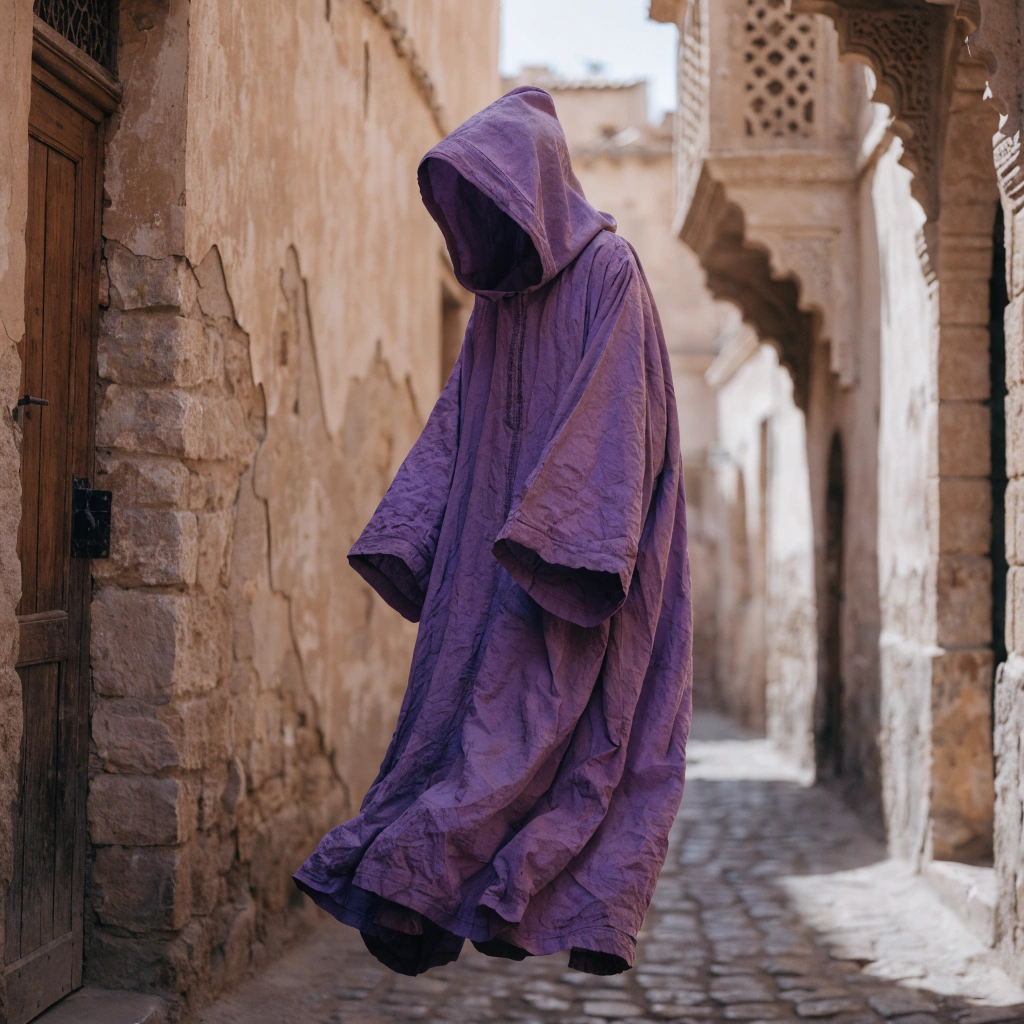
The Moroccan Djellaba
The djellaba is a very special dress in Morocco. It is long and has a hood. The hood is pointed. Men and women wear this dress every day.
The djellaba is comfortable. In the summer, it is cool. In the winter, it is warm. People wear it for work and for festivals.
There are many colors. Some are blue, white, or brown. There are many beautiful decorations on the dress. Everyone in Morocco loves the djellaba. It is a symbol of their culture.
Grammar Spotlight
Pattern: Present Simple (be)
"The djellaba is a very special dress in Morocco."
We use 'is' with singular subjects like 'the djellaba' to describe facts or states. It is the most common verb for descriptions.
Pattern: Present Simple (regular verbs)
"Men and women wear this dress every day."
We use the base form of the verb 'wear' for plural subjects like 'men and women' to talk about habits or routines.
Test Your Understanding
10 questions · A1 Beginner · 1 free preview
Test what you learned from this article. Answer all questions to earn XP!
What is the djellaba?
Want to finish the quiz?
9 more questions are waiting for you. Sign up free to unlock the full quiz and earn XP!
Sign Up FreeAlready have an account? Sign In
Question Breakdown
What is the djellaba?
Your answer:
Correct answer: A traditional dress
Only men wear the djellaba in Morocco.
Your answer:
Correct answer: False
What does 'hood' mean?
Your answer:
Correct answer: A part that covers the head
In the summer, the djellaba is _____.
Your answer:
Correct answer: cool
The Djellaba: A Famous Moroccan Robe
The Djellaba is a very famous piece of clothing in Morocco. It is a long, loose robe with long sleeves. It also has a special pointed hood. In many countries, people only wear traditional clothes for weddings, but in Morocco, people wear the Djellaba every day.
Both men and women wear this garment. However, the styles are different. Men usually wear simple colors like white or gray. Women often choose brighter colors and beautiful decorations.
The Djellaba is popular because it is very comfortable. In the summer, it protects people from the hot sun. In the winter, the material is thicker and warmer. It is better than modern clothes because it works for all seasons.
Today, the Djellaba is a symbol of Moroccan identity. Young people and old people both love it. It is a bridge between the past and the present because it stays fashionable.
Grammar Spotlight
Pattern: Comparatives
"In the winter, the material is thicker and warmer."
We add '-er' to short adjectives to compare two things. We use 'thicker' and 'warmer' to show how winter material is different from summer material.
Pattern: Connectors of Reason (Because)
"The Djellaba is popular because it is very comfortable."
We use 'because' to explain the reason for something. It connects the result (it is popular) with the reason (it is comfortable).
Test Your Understanding
11 questions · A2 Elementary · 1 free preview
Test what you learned from this article. Answer all questions to earn XP!
Who wears the Djellaba in Morocco?
Want to finish the quiz?
10 more questions are waiting for you. Sign up free to unlock the full quiz and earn XP!
Sign Up FreeAlready have an account? Sign In
Question Breakdown
Who wears the Djellaba in Morocco?
Your answer:
Correct answer: Men and women
In Morocco, people only wear the Djellaba for weddings.
Your answer:
Correct answer: False
What does 'protect' mean?
Your answer:
Correct answer: To keep something safe
The Djellaba has a pointed ____ on the back.
Your answer:
Correct answer: hood
Why is the Djellaba good for summer?
Your answer:
Correct answer: Because it protects people from the sun
The Djellaba: A Timeless Symbol of Moroccan Identity
The Djellaba is a traditional Moroccan garment that is famous all over the world. It is a long, loose robe with full sleeves and a unique pointed hood called a "qob." This hood is very useful because it protects the wearer from the hot sun in the desert or the cold wind in the Atlas Mountains. For many centuries, the Djellaba has been an essential part of daily life in Morocco, representing a deep connection to the country's history.
In most countries, traditional clothes are only worn on special occasions like weddings, but in Morocco, the Djellaba is still seen every day in every city. It is a unisex garment, which means it is worn by both men and women. However, there are some important differences in style. Men’s Djellabas are often made in neutral colors like white, grey, or brown to keep a simple look. In contrast, women’s Djellabas have been designed with bright colors and beautiful embroidery, making them look very decorative and artistic.
The Djellaba is appreciated by Moroccans because it is both comfortable and elegant. The fabric changes with the seasons; it is often made of heavy wool for the winter or light cotton for the summer. In recent years, modern designers have updated the style to make it more fashionable for young people who live in big cities like Casablanca or Marrakech. They use new patterns and shorter lengths, but the basic shape remains the same. Even though modern Western clothes are very popular today, the Djellaba has not disappeared from the streets. It remains a powerful symbol of Moroccan identity and a source of pride for the people.
Grammar Spotlight
Pattern: Passive Voice (Present Simple)
"In most countries, traditional clothes are only worn on special occasions."
The passive voice is used when the action or the object is more important than the person doing it. It is formed using 'am/is/are' and the past participle of the verb.
Pattern: Present Perfect
"For many centuries, the Djellaba has been an essential part of daily life in Morocco."
The present perfect connects the past to the present. It is formed with 'have/has' and the past participle to show that a situation started in the past and still exists now.
Test Your Understanding
11 questions · B1 Intermediate · 1 free preview
Test what you learned from this article. Answer all questions to earn XP!
What is the 'qob'?
Want to finish the quiz?
10 more questions are waiting for you. Sign up free to unlock the full quiz and earn XP!
Sign Up FreeAlready have an account? Sign In
Question Breakdown
What is the 'qob'?
Your answer:
Correct answer: A unique pointed hood
The Djellaba is only worn by men in Morocco.
Your answer:
Correct answer: False
What does the word 'neutral' mean in the text?
Your answer:
Correct answer: Not strong or bright colors
The Djellaba has a unique _____ hood that protects the wearer from the sun.
Your answer:
Correct answer: pointed
Why is the hood of the Djellaba useful?
Your answer:
Correct answer: To protect from the sun and the wind
The Djellaba: A Timeless Symbol of Moroccan Identity
While many traditional garments across the globe have been relegated to the archives of history or reserved exclusively for ceremonial occasions, the Moroccan djellaba continues to thrive as a cornerstone of daily life. This long, loose-fitting robe, characterized by its iconic pointed hood known as the 'qob', represents a sophisticated blend of utilitarian design and aesthetic elegance. Historically, the djellaba served as a protective shield against the elements—shielding the wearer from the scorching Saharan sun in summer and the biting cold of the Atlas Mountains in winter. The 'qob' is particularly ingenious, acting as both a head covering and a convenient pocket for carrying small items like bread or personal belongings.
Furthermore, the garment serves as a fascinating case study in gendered fashion evolution. Traditionally, men’s djellabas were constructed from heavy, neutral-toned wool, emphasizing modesty and functionality. Conversely, the female version has undergone a remarkable transformation over recent decades. Modern Moroccan women often opt for vibrant silks and intricate embroidery, known as 'sfifa', transforming the djellaba into a haute couture item that is frequently showcased on international runways. Nevertheless, despite these aesthetic shifts, the fundamental silhouette remains unchanged, preserving a sense of national continuity. The craftsmanship involved in creating a high-quality djellaba is immense, often requiring weeks of meticulous hand-stitching by skilled artisans who have inherited their techniques through generations.
The choice of fabric is dictated by the seasons, reflecting the garment’s deep connection to the Moroccan climate. In the humid coastal regions, lightweight cotton or linen is preferred, whereas the mountainous interior necessitates the use of thick, hand-spun wool. This wool, often sourced from local sheep, is treated with natural oils to provide a degree of water resistance, demonstrating the practical wisdom embedded in traditional attire. Furthermore, the colors chosen for the djellaba often carry social significance; for instance, white is frequently worn during religious festivals to symbolize purity.
The enduring popularity of the djellaba can be attributed to its remarkable versatility and the way it bridges the gap between different social strata. It is not uncommon to see a high-ranking official wearing a refined djellaba over a formal suit, or a young student pairing a casual version with modern sneakers. This juxtaposition of the traditional and the contemporary illustrates the fluid nature of Moroccan identity in an increasingly globalized world. In conclusion, the djellaba is far more than a mere piece of clothing; it is a living testament to Morocco's ability to balance heritage with modernity. By adapting to the shifting demands of fashion while maintaining its core functional attributes, the djellaba has secured its place as an indispensable symbol of the nation's cultural fabric.
Grammar Spotlight
Pattern: Present Perfect Passive
"While many traditional garments across the globe have been relegated to the archives of history..."
This structure is used to describe past actions where the focus is on the object receiving the action rather than the person doing it. It is formed using 'have/has + been + past participle'.
Pattern: Reduced Relative Clauses (Past Participle)
"This long, loose-fitting robe, characterized by its iconic pointed hood known as the 'qob'..."
A reduced relative clause provides additional information about a noun without using 'which' or 'that'. The past participle 'characterized' acts as an adjective here.
Pattern: Contrastive Adverbs
"Conversely, the female version has undergone a remarkable transformation over recent decades."
Adverbs like 'conversely' are used in formal writing to introduce a statement that contrasts with the previous one. It helps organize complex arguments clearly.
Test Your Understanding
11 questions · B2 Upper Intermediate · 1 free preview
Test what you learned from this article. Answer all questions to earn XP!
What is the primary function of the 'qob' as mentioned in the text?
Want to finish the quiz?
10 more questions are waiting for you. Sign up free to unlock the full quiz and earn XP!
Sign Up FreeAlready have an account? Sign In
Question Breakdown
What is the primary function of the 'qob' as mentioned in the text?
Your answer:
Correct answer: It serves as a hood and a storage pocket.
The basic silhouette of the djellaba has changed drastically to keep up with modern fashion.
Your answer:
Correct answer: False
What does the word 'meticulous' mean in the context of the article?
Your answer:
Correct answer: Extremely careful and precise
The djellaba remains a _____ of Moroccan identity, surviving even as other traditional garments disappear.
Your answer:
Correct answer: cornerstone
Why is wool often used for djellabas in the mountainous regions?
Your answer:
Correct answer: To provide warmth and water resistance.
The Sartorial Resilience of the Djellaba: Navigating Tradition and Modernity
Seldom does a garment transcend the boundary between functional utility and cultural iconography as effortlessly as the Moroccan Djellaba. While the relentless tide of globalization has largely homogenized international fashion, the Djellaba remains an unwavering fixture of the Maghreb’s social fabric. This long, loose-fitting outer robe, characterized by its full sleeves and iconic pointed hood, is not merely a vestige of the past preserved for ceremonial display; rather, it is a living, breathing component of contemporary Moroccan identity. The ubiquity of the garment across all strata of society serves as a testament to its enduring relevance in a rapidly changing world.
The enduring appeal of the Djellaba lies in its remarkable versatility and pragmatic design. Historically, the garment served as a shield against the elements—the thick wool of the 'bziwi' style providing warmth in the Atlas Mountains, while lighter cotton or linen iterations offered respite from the scorching Saharan sun. It is this confluence of climatic necessity and aesthetic grace that has ensured its survival across centuries. Unlike Western silhouettes that often emphasize the contours of the human form, the Djellaba prioritizes a modest, fluid silhouette, reflecting the Islamic values of the region while offering unparalleled comfort.
Furthermore, the nuances of the Djellaba reveal a complex social hierarchy and a rich tapestry of artisanal expertise. For men, the garment is often characterized by its understated elegance, typically rendered in neutral tones and adorned with subtle 'sfifa'—the intricate hand-braided trim. Conversely, the feminine Djellaba has undergone a radical transformation over the past few decades. What was once a relatively plain outdoor cover-up has evolved into a sophisticated fashion statement, featuring vibrant silks, elaborate embroidery, and beadwork that rivals haute couture. This dichotomy between the masculine austerity and feminine opulence highlights the garment's ability to adapt to shifting social paradigms.
Central to the Djellaba’s identity is the 'qob'. Far from being a mere stylistic flourish, the hood serves a dual purpose: it protects the wearer from wind and rain, and traditionally, it functioned as a makeshift pocket for transporting bread or grain. It is the qob that distinguishes the Moroccan Djellaba from similar robes found elsewhere in the Arab world, such as the jellabiya of the Levant or the thobe of the Gulf. The preservation of these traditional elements, despite the influx of fast fashion, underscores a collective commitment to cultural continuity.
However, the continued relevance of the Djellaba is not without its challenges. The painstaking process of hand-stitching a high-quality garment is increasingly threatened by the mass production of cheaper, machine-made alternatives. Yet, there is a growing movement among young Moroccan designers to reinterpret the Djellaba for the 21st century, blending traditional craftsmanship with avant-garde sensibilities. By doing so, they ensure that the garment remains not just a symbol of heritage, but a vibrant, evolving expression of Moroccan modernity. In conclusion, the Djellaba’s resilience is a testament to its profound cultural resonance—a sartorial bridge that connects the ancestral past with an aspirational future.
Grammar Spotlight
Pattern: Negative Inversion
"Seldom does a garment transcend the boundary between functional utility and cultural iconography as effortlessly as the Moroccan Djellaba."
Used for emphasis or dramatic effect at the start of a sentence. When 'Seldom' begins the clause, the auxiliary verb (does) must come before the subject (a garment).
Pattern: Cleft Sentence
"It is the qob that distinguishes the Moroccan Djellaba from similar robes found elsewhere in the Arab world."
This structure is used to focus on a specific piece of information. By starting with 'It is...', the writer emphasizes the 'qob' as the defining characteristic.
Pattern: Nominalization
"The preservation of these traditional elements, despite the influx of fast fashion, underscores a collective commitment to cultural continuity."
Using a noun phrase (The preservation of...) instead of a verb (Preserving...) creates a more formal, academic tone typical of C1 writing.
Test Your Understanding
12 questions · C1 Advanced · 1 free preview
Test what you learned from this article. Answer all questions to earn XP!
According to the text, why has the Djellaba survived despite globalization?
Want to finish the quiz?
11 more questions are waiting for you. Sign up free to unlock the full quiz and earn XP!
Sign Up FreeAlready have an account? Sign In
Question Breakdown
According to the text, why has the Djellaba survived despite globalization?
Your answer:
Correct answer: Due to its balance of practical use and aesthetic value.
The feminine Djellaba has remained largely unchanged and plain over the last few decades.
Your answer:
Correct answer: False
What does 'sartorial' refer to?
Your answer:
Correct answer: Clothing and tailoring
The pointed hood, known as the _____, distinguishes the Moroccan version from other regional robes.
Your answer:
Correct answer: qob
What is the 'dichotomy' mentioned in the third paragraph?
Your answer:
Correct answer: The difference between simple male styles and ornate female styles.
The text suggests that modern Moroccan designers are abandoning tradition for avant-garde styles.
Your answer:
Correct answer: False
The Djellaba: A Semiotic Tapestry of Moroccan Vestimentary Tradition
To perceive the Moroccan djellaba as merely a functional shroud against the elements is to overlook the profound socio-cultural narrative woven into its very fibers. Far from being an anachronistic relic of a bygone era, this loose-fitting robe serves as a vibrant, breathing testament to a national identity that has resisted the encroaching tides of globalized sartorial homogenization. It is a quintessential symbol of Morocco, a garment that navigates the delicate interstices between the sacred and the profane, the urban and the rural, and the ancient and the contemporary. Its enduring presence in the Moroccan landscape suggests a resilience that warrants scholarly interrogation.
Historically, the djellaba’s lineage is deeply rooted in the primordial Berber cultures of the Maghreb. Originally fashioned from coarse wool to protect the wearer against the biting chill of the Atlas Mountains and the searing heat of the Sahara, its utilitarian origins are indisputable. However, as the garment migrated into the burgeoning urban centers of Fez and Marrakech, it underwent a metamorphosis. Should the observer venture into the labyrinthine medinas today, they would witness an evolution of the djellaba that reflects a sophisticated artisanal opulence. The introduction of silk, intricate 'sfifa' embroidery, and the refined 'bziwi' fabric has elevated the garment from a simple protective layer to a high-status vestimentary statement.
Central to the djellaba’s silhouette is the 'qob', the distinctive pointed hood. While its primary function may appear to be protection against sun or rain, it historically served as a utilitarian receptacle for grain or bread. More significantly, it acts as a semiotic marker. The way the hood is draped, or the specific style of the needlework accompanying it, can signal the wearer's regional affiliation or social standing. Seldom has a garment managed to preserve such a high degree of symbolic utility while adapting to the exigencies of modern life. It is widely contended that the djellaba’s unisex nature further reinforces its role as a unifying national emblem. Although subtle dichotomies exist—men’s djellabas often favor a more restrained palette and minimalist tailoring, whereas women’s variants may embrace a kaleidoscope of colors and exuberant embellishments—the fundamental structure remains a shared heritage.
In the contemporary era, the djellaba faces the dual pressure of Westernization and the rapid pace of fast fashion. Yet, it has not merely survived; it has flourished through a process of creative reinterpretation. Moroccan couturiers have successfully integrated the djellaba into the global fashion lexicon, ensuring that the garment remains relevant for the younger generation. Were it not for this constant aesthetic negotiation, the djellaba might have been relegated to the status of a costume. Instead, it remains a living artifact. The preservation of this tradition is not a rejection of modernity, but rather a deliberate assertion of cultural particularity. In a world increasingly defined by the fluidity of identity, the djellaba provides a tangible anchor, a reminder that the past is never truly behind us, but is instead worn upon our shoulders.
Grammar Spotlight
Pattern: Inverted Conditional (Should)
"Should the observer venture into the labyrinthine medinas today, they would witness an evolution of the djellaba..."
This is a formal alternative to 'If the observer should venture'. It uses inversion to create a more scholarly and hypothetical tone, common in C2 level academic writing.
Pattern: Negative Inversion
"Seldom has a garment managed to preserve such a high degree of symbolic utility..."
When a sentence starts with a negative or restrictive adverb like 'seldom', the subject and auxiliary verb are inverted. This is used for rhetorical emphasis.
Pattern: Passive Reporting Verbs
"It is widely contended that the djellaba’s unisex nature further reinforces its role..."
This structure (It + is + past participle + that) is used to express a general opinion or academic consensus without identifying a specific subject, adding a layer of objective distance.
Test Your Understanding
12 questions · C2 Mastery · 1 free preview
Test what you learned from this article. Answer all questions to earn XP!
What is the primary argument regarding the djellaba's survival in modern Morocco?
Want to finish the quiz?
11 more questions are waiting for you. Sign up free to unlock the full quiz and earn XP!
Sign Up FreeAlready have an account? Sign In
Question Breakdown
What is the primary argument regarding the djellaba's survival in modern Morocco?
Your answer:
Correct answer: It has flourished through constant aesthetic negotiation and reinterpretation.
The author suggests that the djellaba's hood (qob) has only ever served a decorative purpose.
Your answer:
Correct answer: False
Which word best describes the 'most perfect example' of something?
Your answer:
Correct answer: Quintessential
The djellaba suggests a _____ that warrants scholarly interrogation.
Your answer:
Correct answer: resilience
How does the author characterize the difference between men's and women's djellabas?
Your answer:
Correct answer: They share a fundamental structure but differ in palette and embellishment.
The djellaba's origins can be traced back to Berber cultures.
Your answer:
Correct answer: True
