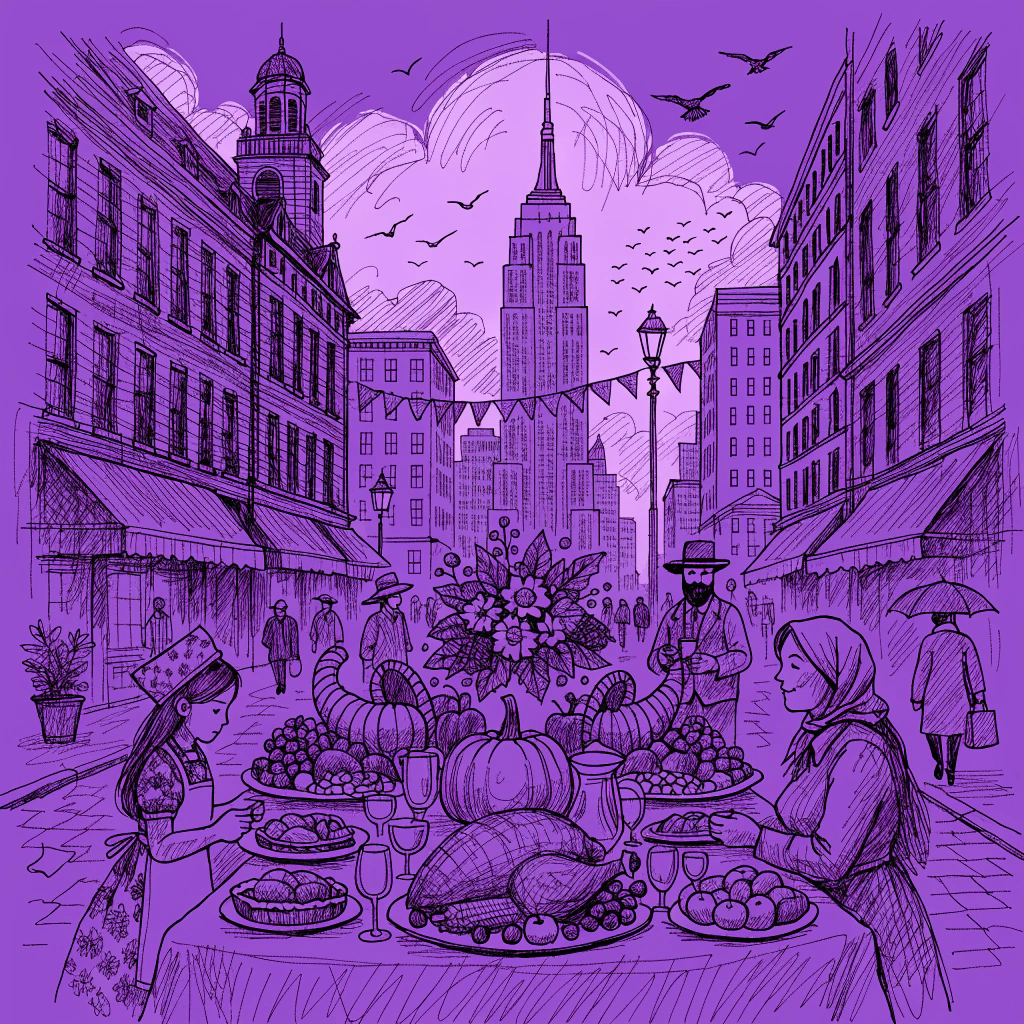
Thanksgiving in America
Thanksgiving is a famous holiday in the United States. People celebrate this day on the fourth Thursday of November. It is a special time for family and friends.
On Thanksgiving, many people have a big dinner. They eat turkey, vegetables, and potatoes. Families sit together at a large table. They talk and laugh.
People also say "thank you" for many things. They are happy to be together. Some people watch parades or football on TV. It is a very beautiful day in America.
Grammar Spotlight
Pattern: Present Simple for Facts
"People celebrate this day on the fourth Thursday of November."
We use the present simple to talk about things that are always true or happen regularly. In this sentence, 'celebrate' is the base form of the verb for 'people'.
Pattern: Adjectives before Nouns
"It is a beautiful day in America."
In English, we usually put the adjective (describing word) before the noun. Here, 'beautiful' describes the 'day'.
Test Your Understanding
10 questions · A1 Beginner · 1 free preview
Test what you learned from this article. Answer all questions to earn XP!
When is Thanksgiving?
Want to finish the quiz?
9 more questions are waiting for you. Sign up free to unlock the full quiz and earn XP!
Sign Up FreeAlready have an account? Sign In
Question Breakdown
When is Thanksgiving?
Your answer:
Correct answer: In November
People eat turkey on Thanksgiving.
Your answer:
Correct answer: True
What does 'large' mean?
Your answer:
Correct answer: Big
Families sit _____ at a large table.
Your answer:
Correct answer: together
Thanksgiving: A Day of Gratitude
Thanksgiving is a very important holiday in the United States. People celebrate it on the fourth Thursday of November every year. It is a special time because families and friends travel long distances to be together. They want to say thank you for the good things in their lives.
The holiday started a long time ago in 1621. The Pilgrims from England and the Wampanoag people had a big harvest dinner together. Today, most Americans eat a traditional meal. They usually have a large turkey, potatoes, and pumpkin pie. This meal is bigger than a normal dinner, and everyone feels very full afterwards.
Before the meal, some people watch parades on TV or play American football. Many people also help others by giving food to those who need it. It is a happy day because the atmosphere is warm and friendly. It is the official start of the winter holiday season in America.
Grammar Spotlight
Pattern: Past Simple
"The holiday started a long time ago in 1621."
We use the past simple to talk about finished actions in the past. To form regular verbs, we usually add '-ed' to the end of the verb.
Pattern: Comparatives
"This meal is bigger than a normal dinner."
We use comparatives to compare two things. For short adjectives like 'big', we add '-er' and use the word 'than' after it.
Test Your Understanding
11 questions · A2 Elementary · 1 free preview
Test what you learned from this article. Answer all questions to earn XP!
When do people in the United States celebrate Thanksgiving?
Want to finish the quiz?
10 more questions are waiting for you. Sign up free to unlock the full quiz and earn XP!
Sign Up FreeAlready have an account? Sign In
Question Breakdown
When do people in the United States celebrate Thanksgiving?
Your answer:
Correct answer: On the fourth Thursday of November
Americans usually eat turkey for their Thanksgiving meal.
Your answer:
Correct answer: True
What does 'harvest' mean?
Your answer:
Correct answer: Collecting crops from the fields
Families and friends _____ long distances to be together.
Your answer:
Correct answer: travel
Who had the first harvest dinner together in 1621?
Your answer:
Correct answer: The Pilgrims and the Wampanoag people
Thanksgiving: A Time for Gratitude in America
Thanksgiving is a famous American holiday which is celebrated on the fourth Thursday of November. For many families, it is the most important time of the year because it focuses on gratitude and togetherness. Although it started as a religious event, it has evolved into a secular celebration that people of all backgrounds enjoy.
The history of the holiday dates back to 1621. During this time, a harvest feast was shared by the English Pilgrims and the Wampanoag people. They had survived a difficult year and wanted to give thanks for their food. Today, this story is remembered as a symbol of cooperation between different cultures, even though the history is complex.
Modern traditions usually involve a large meal. Turkey is the most common dish, which is often served with stuffing, cranberry sauce, and mashed potatoes. For dessert, pumpkin pie is a favorite choice. Many people have traveled long distances to reach their family homes, making it one of the busiest travel periods in the United States.
Besides the food, Americans enjoy several other activities. In New York City, a massive parade is organized by a famous department store, featuring giant balloons. Many families also watch American football games on television. Since Thanksgiving is always on a Thursday, most people have a long weekend. It is a time when people reflect on the good things they have experienced during the year. This holiday marks the official start of the winter season.
Grammar Spotlight
Pattern: Passive Voice
"Thanksgiving is a famous American holiday which is celebrated on the fourth Thursday of November."
The passive voice is used when the action is more important than the person doing it. It is formed using the verb 'to be' and the past participle.
Pattern: Present Perfect
"Many people have traveled long distances to reach their family homes."
The present perfect connects the past to the present. It is used here to describe an action that has happened recently or multiple times before now.
Test Your Understanding
11 questions · B1 Intermediate · 1 free preview
Test what you learned from this article. Answer all questions to earn XP!
When is Thanksgiving celebrated in the United States?
Want to finish the quiz?
10 more questions are waiting for you. Sign up free to unlock the full quiz and earn XP!
Sign Up FreeAlready have an account? Sign In
Question Breakdown
When is Thanksgiving celebrated in the United States?
Your answer:
Correct answer: The fourth Thursday of November
Thanksgiving remains a strictly religious holiday today.
Your answer:
Correct answer: False
What does 'gratitude' mean?
Your answer:
Correct answer: Feeling thankful
Turkey is the most common _____, which is often served with stuffing.
Your answer:
Correct answer: dish
What is organized in New York City during Thanksgiving?
Your answer:
Correct answer: A massive parade
Thanksgiving: A Multifaceted Celebration of Gratitude and Heritage
Thanksgiving is widely regarded as the most significant secular holiday in the United States, observed annually on the fourth Thursday of November. While its historical origins are rooted in a 1621 harvest feast shared between the Wampanoag people and the English Pilgrims, the contemporary observance of Thanksgiving has transcended its colonial context. Today, it serves as a multifaceted commemoration of gratitude, family, and cultural heritage, marking the official commencement of the winter festive season.
One of the most remarkable aspects of Thanksgiving is its ability to unite a diverse population within a singular cultural framework. Because it is not strictly tied to a specific religious affiliation, it allows Americans of all backgrounds—regardless of their personal beliefs—to participate in a shared national experience. The holiday emphasizes universal themes of togetherness and reflection, encouraging individuals to acknowledge the positive aspects of their lives amidst the challenges of the year. Should one travel across the United States during this week, they would undoubtedly witness the immense logistical undertaking of millions of families reuniting, making it one of the busiest and most chaotic travel periods of the calendar year.
The traditional Thanksgiving meal is an integral component of the celebration, symbolizing abundance and the spirit of hospitality. Families typically gather around a centerpiece of roasted turkey, which is often accompanied by seasonal vegetables, stuffing, and various regional delicacies that reflect the country’s diverse culinary map. This feast is not merely about physical consumption; it is a ritual that reinforces social bonds and provides a vital space for storytelling across different generations. Furthermore, the day is characterized by various cultural traditions that extend beyond the dining room, such as massive public parades featuring elaborate floats and professional American football games, both of which have become synonymous with the holiday’s festive atmosphere.
In a broader socio-cultural sense, Thanksgiving acts as a vital precursor to the upcoming winter holidays, setting the tone for the month of December. It provides a necessary pause in the fast-paced modern lifestyle, allowing for a collective moment of stillness and appreciation. Although the historical narrative of the first Thanksgiving is often simplified or romanticized in popular culture, contemporary discussions increasingly include the perspectives of Indigenous peoples. These conversations offer a more nuanced understanding of the holiday's complex legacy and the historical interactions between settlers and native tribes. Ultimately, Thanksgiving remains a cornerstone of American identity, successfully blending historical reflection with a forward-looking spirit of hope, community, and national unity.
Grammar Spotlight
Pattern: Inversion in Conditionals
"Should one travel across the United States during this week, they would undoubtedly witness the immense logistical undertaking of millions of families reuniting."
This formal structure replaces 'If one should travel...' by moving the auxiliary verb to the beginning. It is used in B2/C1 English to provide a more academic or sophisticated tone.
Pattern: Passive Voice for Impersonal Statements
"Thanksgiving is widely regarded as the most significant secular holiday in the United States..."
The passive voice (is + past participle) is used here to express a general opinion or widely held belief without focusing on a specific person who holds that opinion.
Pattern: Present Perfect for Recent Evolution
"...the contemporary observance of Thanksgiving has transcended its colonial context."
The present perfect (has + past participle) connects a past change to the present state of the holiday, emphasizing the result of that evolution.
Test Your Understanding
11 questions · B2 Upper Intermediate · 1 free preview
Test what you learned from this article. Answer all questions to earn XP!
What is the primary reason Thanksgiving is able to unite such a diverse population?
Want to finish the quiz?
10 more questions are waiting for you. Sign up free to unlock the full quiz and earn XP!
Sign Up FreeAlready have an account? Sign In
Question Breakdown
What is the primary reason Thanksgiving is able to unite such a diverse population?
Your answer:
Correct answer: It focuses on secular themes rather than specific religious affiliations.
The article suggests that Thanksgiving is primarily a religious holiday.
Your answer:
Correct answer: False
What does the word 'transcended' mean in the context of the article?
Your answer:
Correct answer: To have gone beyond or exceeded original limits.
In a socio-cultural sense, the holiday acts as a vital _____ to the upcoming winter season.
Your answer:
Correct answer: precursor
When did the original harvest feast involving the Wampanoag and Pilgrims take place?
Your answer:
Correct answer: 1621
The Paradox of Plenty: Deconstructing the Modern Thanksgiving Narrative
Rarely has a holiday in the American canon elicited such profound cultural resonance as Thanksgiving. Observed on the fourth Thursday of November, it serves as a temporal anchor, signaling the transition into the winter festivities. While the popular imagination often conjures a pastoral image of the 1621 harvest feast, the historical reality of the interaction between the English Pilgrims and the Wampanoag people is a complex paradigm of cross-cultural diplomacy and survival. It is this intricate tapestry of history, rather than a simplistic fable, that provides the foundation for the contemporary celebration. The evolution of Thanksgiving into a secular cornerstone of American identity reflects a broader societal trend toward the nominalization of communal values. What was once a localized observance of gratitude for subsistence has morphed into a ubiquitous national event. This shift is not merely about the consumption of poultry; rather, it is the deliberate cultivation of togetherness in an increasingly fragmented world. However, the juxtaposition of this supposed egalitarian spirit with the frantic consumerism of the following day, known as 'Black Friday,' presents a jarring contradiction. The commodification of gratitude seems at odds with the solemnity of the occasion. Furthermore, modern discourse has increasingly emphasized the need for reconciliation regarding the holiday's origins. For many Indigenous communities, the day serves as a National Day of Mourning, a stark reminder of the displacement and suffering that followed the initial settlement. Consequently, the contemporary Thanksgiving narrative is undergoing a significant transformation. It is no longer just about the vestiges of a colonial past, but about acknowledging historical grievances while striving for a more inclusive future. Despite these critiques, the holiday remains an ephemeral moment of pause. In a culture driven by productivity, the act of sitting down for a shared meal becomes a radical gesture of presence. The ephemeral nature of the gathering—often involving extensive travel and logistical feats—underscores the value placed on kinship. Ultimately, the enduring power of Thanksgiving lies in its capacity to evolve, allowing for both the celebration of abundance and the critical reflection on the history that made that abundance possible.
Grammar Spotlight
Pattern: Negative Inversion
"Rarely has a holiday in the American canon elicited such profound cultural resonance as Thanksgiving."
When using negative or restrictive adverbs like 'rarely' at the start of a sentence for emphasis, the auxiliary verb and subject are inverted.
Pattern: It-Cleft Sentence
"It is this intricate tapestry of history, rather than a simplistic fable, that provides the foundation for the contemporary celebration."
Cleft sentences are used to focus on a specific part of the information. The structure 'It is + [focused element] + that/who...' emphasizes the subject.
Pattern: Nominalization
"The evolution of Thanksgiving into a secular cornerstone of American identity reflects a broader societal trend toward the nominalization of communal values."
Nominalization involves turning verbs or adjectives into nouns. This creates a more formal, academic tone suitable for C1 analysis.
Test Your Understanding
12 questions · C1 Advanced · 1 free preview
Test what you learned from this article. Answer all questions to earn XP!
What does the author identify as a 'jarring contradiction' in the text?
Want to finish the quiz?
11 more questions are waiting for you. Sign up free to unlock the full quiz and earn XP!
Sign Up FreeAlready have an account? Sign In
Question Breakdown
What does the author identify as a 'jarring contradiction' in the text?
Your answer:
Correct answer: The juxtaposition of egalitarian spirit with Black Friday consumerism
The author suggests that the popular image of the 1621 feast is a completely accurate historical representation.
Your answer:
Correct answer: False
Which word refers to something lasting for a very short time?
Your answer:
Correct answer: Ephemeral
The holiday serves as a ______ anchor, signaling the transition into winter.
Your answer:
Correct answer: temporal
Why is Thanksgiving referred to as a National Day of Mourning by some?
Your answer:
Correct answer: To remember the displacement and suffering of Indigenous peoples
The text argues that sitting down for a shared meal can be seen as a 'radical gesture' in a productivity-driven culture.
Your answer:
Correct answer: True
The American Harvest: A Socio-Historical Deconstruction of Thanksgiving
Were one to survey the American cultural landscape, few observances would appear as quintessentially ingrained as Thanksgiving. While the vernacular narrative often reduces the holiday to a simplistic tableau of 1621 Pilgrims and Wampanoag sharing a harvest feast, a more rigorous analysis reveals a complex confluence of national myth-making and secular ritual. Thanksgiving serves as a temporal anchor, marking the transition into the winter solstice festivities, yet its significance transcends mere seasonal change. It functions as a teleological instrument, reinforcing a sense of historical continuity and collective identity within an increasingly pluralistic society.
At its core, the holiday represents a secular liturgy of gratitude. Unlike many other American public holidays, Thanksgiving remains largely untethered from specific religious orthodoxy, allowing it to encompass a broad demographic spectrum. This inclusivity is not merely accidental but is central to the holiday’s hegemony in the American psyche. It offers a moment of shared domestic intimacy, where the consumption of the eponymous turkey and its traditional accompaniments serves as a symbolic act of communion. However, the commodification of this domesticity—manifested in the frenzy of 'Black Friday'—suggests a tension between the holiday’s stated ideals of gratitude and the capitalist imperatives of the modern era.
Furthermore, the historical paradigm of Thanksgiving has undergone significant scholarly scrutiny in recent decades. The traditional account, often criticized for its Eurocentric bias, frequently elides the devastating impact of colonization on the indigenous populations. Consequently, for many, the holiday is not a celebration of harvest but a vestigial reminder of systemic displacement. This has led to the emergence of the 'National Day of Mourning,' a counter-narrative that challenges the state-sanctioned optimism of the fourth Thursday of November. It might be posited that the holiday’s endurance lies in its ability to absorb these critiques, evolving from a rigid historical commemoration into a more fluid space for national introspection.
Seldom has a holiday been so effective at bridging the gap between the private and public spheres. From the macro-level of the Macy’s Thanksgiving Day Parade to the micro-level of the family dinner, the holiday orchestrates a synchronized performance of national belonging. Despite the inevitable political friction that may arise at the dinner table, the overarching theme remains one of reconciliation and togetherness. As the official kickoff to the winter holiday season, it establishes an emotional baseline for the months to follow, emphasizing the importance of social cohesion over individualistic pursuits.
In conclusion, Thanksgiving is far more than a mere vestige of colonial history; it is a dynamic socio-cultural phenomenon. It reflects the ongoing American project of self-definition, balancing the weight of historical culpability with the aspiration for a unified future. Whether viewed through the lens of economic consumption, historical critique, or domestic tradition, Thanksgiving remains a pivotal moment in the American calendar, demanding both celebration and critical reflection. Should the holiday continue to adapt to the shifting demographics and values of the nation, it will likely remain the cornerstone of American civil religion for generations to come.
Grammar Spotlight
Pattern: Inversion for emphasis
"Seldom has a holiday been so effective at bridging the gap between the private and public spheres."
When negative or restrictive adverbs like 'seldom' or 'never' start a sentence, the auxiliary verb and subject are inverted to create a formal, emphatic tone common in C2 academic writing.
Pattern: The Subjunctive Mood
"Were one to survey the American cultural landscape, few observances would appear as quintessentially ingrained as Thanksgiving."
The 'were' subjunctive is used here in a conditional structure without 'if'. It expresses a hypothetical situation in a formal and scholarly manner.
Pattern: Academic Hedging
"It might be posited that the holiday’s endurance lies in its ability to absorb these critiques."
Using 'might be posited' allows the author to suggest a theory without making an absolute claim. This is a hallmark of high-level analytical prose to maintain objectivity.
Test Your Understanding
12 questions · C2 Mastery · 1 free preview
Test what you learned from this article. Answer all questions to earn XP!
According to the article, why is Thanksgiving's lack of religious orthodoxy significant?
Want to finish the quiz?
11 more questions are waiting for you. Sign up free to unlock the full quiz and earn XP!
Sign Up FreeAlready have an account? Sign In
Question Breakdown
According to the article, why is Thanksgiving's lack of religious orthodoxy significant?
Your answer:
Correct answer: It allows the holiday to be inclusive of a broad demographic spectrum.
The author suggests that the commodification of Thanksgiving through 'Black Friday' aligns perfectly with the holiday's stated ideals of gratitude.
Your answer:
Correct answer: False
Which word describes the dominance of a particular social group or idea?
Your answer:
Correct answer: Hegemony
The holiday functions as a _____ instrument, reinforcing historical continuity.
Your answer:
Correct answer: teleological
What is the 'National Day of Mourning' intended to represent?
Your answer:
Correct answer: A counter-narrative to the state-sanctioned optimism of Thanksgiving.
The author concludes that Thanksgiving is a static remnant of colonial history that does not adapt to modern values.
Your answer:
Correct answer: False
