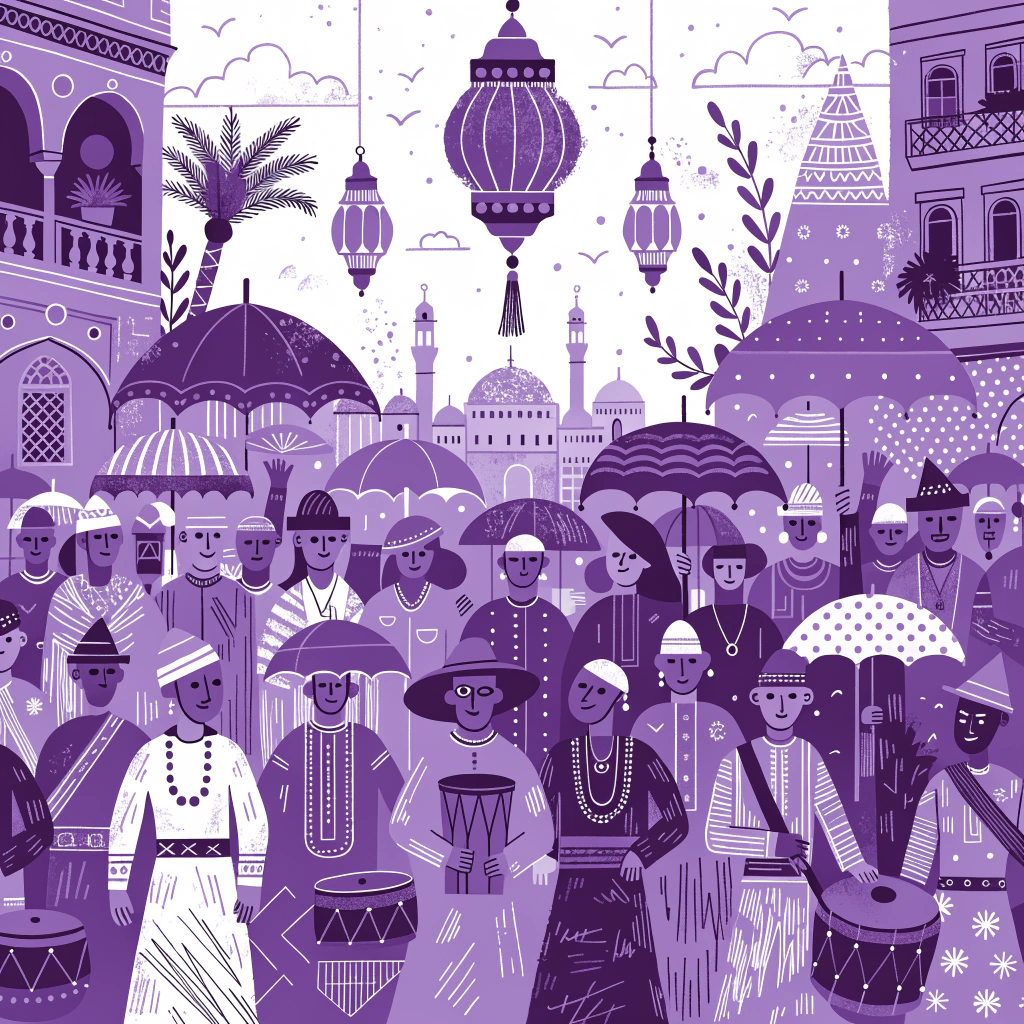
Throne Day in Morocco
Morocco celebrates Throne Day on July 30th. It is a very important holiday. It celebrates King Mohammed VI. He became King in 1999.
People are happy on this day. There are many flags in the streets. People wear traditional clothes. They see parades and listen to music.
The King gives a speech to the people. Families eat special food together. This holiday shows that people love their country and their King. It is a day of unity and joy.
Grammar Spotlight
Pattern: Present Simple (be)
"It is a very important holiday."
We use 'is' with 'it' to describe facts or states. The pattern is Subject + is + adjective/noun.
Pattern: Present Simple (plural actions)
"People wear traditional clothes."
With plural subjects like 'people', we use the base form of the verb. We do not add '-s' to the verb.
Test Your Understanding
10 questions · A1 Beginner · 1 free preview
Test what you learned from this article. Answer all questions to earn XP!
When is Throne Day celebrated in Morocco?
Want to finish the quiz?
9 more questions are waiting for you. Sign up free to unlock the full quiz and earn XP!
Sign Up FreeAlready have an account? Sign In
Question Breakdown
When is Throne Day celebrated in Morocco?
Your answer:
Correct answer: July 30th
The King gives a speech to the people on this holiday.
Your answer:
Correct answer: True
What is a 'flag'?
Your answer:
Correct answer: A piece of cloth that represents a country
People wear _____ clothes on Throne Day.
Your answer:
Correct answer: traditional
Throne Day: A Special Celebration in Morocco
Throne Day is the most important national holiday in Morocco. Every year, people celebrate it on July 30th. This special day started in 1999 when King Mohammed VI became the leader of the country. He followed his father, King Hassan II, after he passed away.
During the holiday, Moroccan cities are more colorful than usual because there are flags everywhere. People put red and green flags on their houses, schools, and shops. In the streets, there are big parades with horses and traditional music. At night, families go outside to watch beautiful fireworks in the sky.
The King also gives a famous speech on television. He talks about the history and the future of Morocco. Many people wear their best traditional clothes, like the djellaba, because they are proud of their culture. This holiday is important because it brings all Moroccans together. It is a happy time for families and a symbol of unity for the whole country.
Grammar Spotlight
Pattern: Past Simple
"This special day started in 1999 when King Mohammed VI became the leader of the country."
We use the past simple to talk about finished actions in the past. For regular verbs, we add -ed, but many common verbs like 'become' (became) are irregular.
Pattern: Comparatives
"During the holiday, Moroccan cities are more colorful than usual because there are flags everywhere."
We use 'more' + long adjective + 'than' to compare two things. Here, the cities on Throne Day are compared to the cities on a normal day.
Test Your Understanding
11 questions · A2 Elementary · 1 free preview
Test what you learned from this article. Answer all questions to earn XP!
When do Moroccans celebrate Throne Day?
Want to finish the quiz?
10 more questions are waiting for you. Sign up free to unlock the full quiz and earn XP!
Sign Up FreeAlready have an account? Sign In
Question Breakdown
When do Moroccans celebrate Throne Day?
Your answer:
Correct answer: July 30th
King Mohammed VI became the leader in 1999.
Your answer:
Correct answer: True
What does 'colorful' mean?
Your answer:
Correct answer: Having many different colors
King Mohammed VI became the _____ of the country in 1999.
Your answer:
Correct answer: leader
What can people see in the sky at night?
Your answer:
Correct answer: Fireworks
Celebrating Throne Day in Morocco
Throne Day is a very special celebration that takes place every year on July 30th in Morocco. It marks the day when King Mohammed VI officially became the monarch in 1999, following the death of his father. Since that time, the holiday has been celebrated as a powerful symbol of national unity and historical pride. It is considered the most important secular holiday in the Moroccan calendar.
In the morning, official ceremonies are held in the capital city, Rabat. The King usually gives a speech that is broadcast on television and radio to the entire nation. In this speech, he talks about the progress which has been made in the country over the past year. Many important social projects have been completed because of the government's dedicated work. People across Morocco listen carefully to his words because the King is a highly respected figure who represents the history of the Alaouite dynasty.
The streets are beautifully decorated with red and green flags, which represent the Moroccan identity. In many cities, large parades are organized and musicians play traditional songs in public squares. Families often gather to share a large meal, such as couscous, and enjoy the festive atmosphere together. It is a time when the bond between the monarch and the citizens is renewed through these joyful events.
Moroccans who live abroad also celebrate this day with their local communities around the world. They feel a strong connection to their homeland during this holiday. Although it is a secular holiday, it carries deep meaning for everyone who loves their country. It is a day to reflect on past achievements and look forward to a bright future for the kingdom. The celebration shows how much the people value their traditions and their leadership.
Grammar Spotlight
Pattern: Passive Voice
"In the morning, official ceremonies are held in the capital city, Rabat."
The passive voice is formed using 'be' + past participle. It is used here to focus on the event itself rather than who specifically is organizing it.
Pattern: Relative Clauses
"The streets are beautifully decorated with red and green flags, which represent the Moroccan identity."
Relative clauses start with relative pronouns like 'which' or 'who'. They are used to add extra information about a noun without starting a new sentence.
Test Your Understanding
11 questions · B1 Intermediate · 1 free preview
Test what you learned from this article. Answer all questions to earn XP!
When is Throne Day celebrated in Morocco?
Want to finish the quiz?
10 more questions are waiting for you. Sign up free to unlock the full quiz and earn XP!
Sign Up FreeAlready have an account? Sign In
Question Breakdown
When is Throne Day celebrated in Morocco?
Your answer:
Correct answer: July 30th
Throne Day marks the anniversary of the King's accession to the throne.
Your answer:
Correct answer: True
What does 'monarch' mean?
Your answer:
Correct answer: A king or queen
The King usually gives a _____ that is broadcast on television.
Your answer:
Correct answer: speech
In which city are the official ceremonies held?
Your answer:
Correct answer: Rabat
Throne Day: A Symbol of Unity and Modernization in Morocco
Throne Day, celebrated annually on July 30th, represents the most significant secular holiday in the Moroccan calendar. This occasion marks the official anniversary of King Mohammed VI’s accession to the throne in 1999, succeeding his father, King Hassan II. Beyond the festive atmosphere, the day serves as a powerful symbol of national unity and the historical continuity of the Alaouite dynasty, which has ruled the kingdom for centuries. Consequently, it is a moment where the historical bond between the monarchy and the Moroccan people is reaffirmed through both formal protocols and public celebrations.
The observance is characterized by a blend of traditional ceremonies and modern reflections on the nation's progress. One of the most critical events is the 'Bay’ah' or the ceremony of allegiance. During this event, government officials and local representatives gather to renew their loyalty to the King. This tradition is not merely a formality; it is viewed by many political analysts as a foundational element of Morocco’s political stability. Furthermore, the King typically delivers a televised speech to the nation, outlining the strategic vision for the country’s future and evaluating the achievements of the past year.
Since his accession, King Mohammed VI has implemented various reforms aimed at modernization. Under his leadership, Morocco has seen substantial improvements in its infrastructure, including the expansion of high-speed rail networks and the development of the Tanger-Med port. These projects have enhanced Morocco's diplomatic and economic standing on the global stage. Moreover, social reforms, particularly regarding women's rights and family law, have been introduced to foster a more inclusive society. While challenges remain, the period of his reign is often associated with a drive toward economic prosperity and social development.
In addition to the official proceedings, the Moroccan public participates in spontaneous celebrations across the country. Major cities are adorned with national flags and lights, while parades and concerts take place in public squares. This widespread participation highlights the emotional connection that many citizens feel toward the monarchy. In conclusion, Throne Day is more than just a public holiday; it is an institutional pillar that bridges Morocco’s rich historical heritage with its aspirations for a modern, prosperous future.
Grammar Spotlight
Pattern: Present Passive Voice
"The observance is characterized by a blend of traditional ceremonies."
The passive voice is used here to focus on the holiday itself rather than the people celebrating it. It is formed using 'is/are' followed by the past participle of the verb.
Pattern: Present Perfect Simple
"King Mohammed VI has implemented various reforms aimed at modernization."
The present perfect connects a past action (the reforms) to the present situation. It is formed with 'has/have' and the past participle.
Pattern: Defining and Non-defining Relative Clauses
"...the Alaouite dynasty, which has ruled the kingdom for centuries."
This non-defining relative clause provides extra information about the dynasty. It is separated by commas and uses 'which' as the relative pronoun.
Test Your Understanding
11 questions · B2 Upper Intermediate · 1 free preview
Test what you learned from this article. Answer all questions to earn XP!
What does Throne Day primarily commemorate?
Want to finish the quiz?
10 more questions are waiting for you. Sign up free to unlock the full quiz and earn XP!
Sign Up FreeAlready have an account? Sign In
Question Breakdown
What does Throne Day primarily commemorate?
Your answer:
Correct answer: The anniversary of King Mohammed VI's accession
Throne Day is considered a religious holiday in Morocco.
Your answer:
Correct answer: False
What does 'allegiance' mean?
Your answer:
Correct answer: Loyalty or commitment to a leader
The King typically delivers a televised _____ to the nation during the holiday.
Your answer:
Correct answer: speech
What is the 'Bay’ah' ceremony?
Your answer:
Correct answer: A ceremony where officials renew their loyalty
The Monarchical Anchor: Decoding the Sociopolitical Significance of Morocco’s Throne Day
The consolidation of national identity through the commemoration of historical milestones remains a cornerstone of Moroccan political life. Every July 30th, the Kingdom of Morocco observes Throne Day, an occasion that transcends mere pageantry to serve as a profound reaffirmation of the country’s institutional architecture. Marking the official anniversary of the accession of His Majesty King Mohammed VI in 1999, the holiday represents a pivotal juncture where the historical legacy of the Alaouite dynasty converges with contemporary aspirations for reform. It is the enduring symbiosis between the throne and the citizenry that defines the Moroccan nation-state, providing a sense of continuity in a region often characterized by volatility.
Central to the festivities is the 'Bay'ah' or the ceremony of allegiance. This ritual, steeped in centuries of tradition, involves representatives from across the kingdom’s provinces reaffirming their loyalty to the monarch. While critics might view such ceremonies as an archaic vestige of the past, proponents argue that they facilitate a unique form of social cohesion. The ceremony functions not merely as a display of power, but as a symbolic renewal of the social contract between the ruler and the ruled. Seldom has a monarch managed to traverse the tightrope between ancestral customs and the exigencies of globalized progress so deftly. Through this delicate balance, the monarchy positions itself as both the guardian of spiritual values and the engine of modern development.
Furthermore, the annual Throne Day speech serves as a critical diagnostic tool for the nation’s trajectory. Far from being a series of platitudes, the royal address often outlines the strategic priorities for the coming year, addressing everything from judicial reform to economic disparities. The nominalisation of complex political goals into actionable policy frameworks allows the state to mobilize resources effectively. This year’s celebrations highlight the unprecedented infrastructure projects and diplomatic shifts that have characterized the King's reign. By analyzing these milestones, one can discern a clear paradigm shift toward a more proactive, Atlantic-facing foreign policy and a diversified domestic economy.
Ultimately, Throne Day is less about the glorification of an individual and more about the celebration of a collective historical narrative. The holiday acts as a temporal bridge, linking the storied past of the Alaouite dynasty to a future envisioned through the lens of the 'New Development Model.' In an era where global political structures are increasingly fragmented, the Moroccan model offers a compelling study in how traditional authority can be leveraged to foster national stability and progressive change. The day concludes with a sense of shared purpose, reminding the populace that while the challenges of the 21st century are formidable, the foundations upon which the kingdom stands remain remarkably resilient.
Grammar Spotlight
Pattern: Cleft Sentences
"It is the enduring symbiosis between the throne and the citizenry that defines the Moroccan nation-state."
Cleft sentences are used to focus on a specific part of the sentence. In this case, 'It is... that' emphasizes the relationship as the defining characteristic.
Pattern: Negative Inversion
"Seldom has a monarch managed to traverse the tightrope between ancestral customs and the exigencies of globalized progress so deftly."
Using a negative or limiting adverb like 'Seldom' at the beginning of a sentence requires inverting the auxiliary verb and the subject to add rhetorical emphasis.
Pattern: Nominalisation
"The consolidation of national identity through the commemoration of historical milestones remains a cornerstone of Moroccan political life."
Nominalisation turns verbs and adjectives into nouns (e.g., 'consolidate' to 'consolidation'). This creates a more formal, academic tone typical of C1 level writing.
Test Your Understanding
12 questions · C1 Advanced · 1 free preview
Test what you learned from this article. Answer all questions to earn XP!
According to the article, what is the primary purpose of the 'Bay'ah' ceremony?
Want to finish the quiz?
11 more questions are waiting for you. Sign up free to unlock the full quiz and earn XP!
Sign Up FreeAlready have an account? Sign In
Question Breakdown
According to the article, what is the primary purpose of the 'Bay'ah' ceremony?
Your answer:
Correct answer: To renew the social contract through a symbolic display of loyalty
The author suggests that the annual Throne Day speech is mostly composed of empty platitudes.
Your answer:
Correct answer: False
Which word best describes 'the urgent needs or demands' of a situation?
Your answer:
Correct answer: Exigencies
The holiday represents a pivotal _____ where historical legacy and modern aspirations meet.
Your answer:
Correct answer: juncture
What does the text identify as a 'cornerstone' of Moroccan political life?
Your answer:
Correct answer: The consolidation of national identity through historical milestones
The article claims that the Moroccan model leverages traditional authority to encourage progressive change.
Your answer:
Correct answer: True
The Sovereign Covenant: Synthesizing Tradition and Modernity in the Moroccan Throne Day
The commemoration of Throne Day in Morocco, observed annually on July 30th, transcends the mere celebration of a political anniversary; it serves as a profound ontological anchor for the Moroccan state. Marking the official accession of King Mohammed VI in 1999, the occasion is less an exercise in hagiography than a critical reaffirmation of the 'Bay'ah'—the traditional oath of allegiance that binds the sovereign to the citizenry. This symbiotic relationship is not merely a vestige of a bygone era but a dynamic synthesis of historical continuity and contemporary governance. To understand the significance of this day is to delve into the inextricable link between the Alaouite dynasty and the Moroccan national consciousness.
Lest one should perceive the festivities as purely ceremonial, it is imperative to acknowledge the socio-political undercurrents that inform the event. The Alaouite dynasty, having presided over Morocco for centuries, derives its legitimacy from a blend of religious authority and historical longevity. Throne Day, therefore, functions as a mechanism for the accretion of national unity. In an age where the forces of globalization often threaten to dilute local identities, the Moroccan monarchy positions itself as the quintessence of stability. Were the institution to falter in its symbolic duties, the pluralistic components of Moroccan society—ranging from the Rif to the Sahara—might find their common denominator diminished.
The discourse surrounding Throne Day often employs academic hedging, acknowledging that while the monarchy is a central pillar, its evolution is subject to the exigencies of modern statecraft. Critics might argue that such displays of veneration are anachronistic in a democratic age; however, proponents suggest that the monarchy acts as a sacrosanct arbiter above the fray of partisan politics. This prerogative allows the King to navigate complex geopolitical landscapes while maintaining internal hegemony. The festivities themselves, characterized by the 'Allegiance Ceremony' (La Cérémonie de l'Allégeance), involve regional representatives reaffirming their loyalty, a ritual that underscores the decentralized yet unified nature of the realm.
Furthermore, the King’s speech on Throne Day is a highly anticipated rhetorical event. It typically outlines the strategic trajectory of the kingdom, addressing issues of economic disparity, judicial reform, and regional sovereignty. The language used is often elevated, utilizing sophisticated rhetorical devices to bridge the gap between the divine right traditionally associated with the throne and the pragmatic requirements of a 21st-century economy. The Alaouite line, tracing its lineage back to the Prophet Muhammad, provides a spiritual dimension to the King's role as 'Amir al-Mu'minin'. During the ceremony, the King, clad in a traditional white jellaba and mounted on a horse, receives the homage of the 'Ulama' and local dignitaries. This visual tableau is a powerful signifier of the kingdom's resilience against the centrifugal forces of modernity. Should the monarch fail to address these pressing concerns, the symbolic weight of the holiday would undoubtedly be compromised.
In conclusion, Throne Day is a multifaceted phenomenon that encapsulates the Moroccan paradox: a nation deeply rooted in tradition yet aggressively pursuing modernization. It is a day when the ephemeral nature of political trends meets the enduring legacy of a millennium-old state. As the kingdom looks toward the future, the celebration remains a vital instrument for reinforcing the social contract, ensuring that the bond between the throne and the people remains not only intact but invigorated.
Grammar Spotlight
Pattern: Negative Purpose Clause with 'Lest'
"Lest one should perceive the festivities as purely ceremonial, it is imperative to acknowledge the socio-political undercurrents."
Used to express fear that something might happen or to show purpose in avoiding an outcome. It is followed by 'should' or the base form of the verb (subjunctive).
Pattern: Inverted Second Conditional
"Were the institution to falter in its symbolic duties, the pluralistic components of Moroccan society might find their common denominator diminished."
A formal alternative to 'If the institution were to falter'. This inversion places the auxiliary verb at the start to increase the hypothetical or academic tone.
Pattern: Academic Hedging with Modals and Contrastive Adverbs
"Critics might argue that such displays of veneration are anachronistic; however, proponents suggest that the monarchy acts as a sacrosanct arbiter."
This structure uses 'might' and 'suggest' to distance the author from absolute claims, presenting multiple viewpoints in a scholarly and balanced manner.
Test Your Understanding
12 questions · C2 Mastery · 1 free preview
Test what you learned from this article. Answer all questions to earn XP!
What does the author suggest is the primary function of Throne Day beyond being a simple anniversary?
Want to finish the quiz?
11 more questions are waiting for you. Sign up free to unlock the full quiz and earn XP!
Sign Up FreeAlready have an account? Sign In
Question Breakdown
What does the author suggest is the primary function of Throne Day beyond being a simple anniversary?
Your answer:
Correct answer: An ontological anchor and reaffirmation of national allegiance
The article claims that the Alaouite dynasty's legitimacy is based solely on modern democratic elections.
Your answer:
Correct answer: False
Which word describes something that is impossible to separate?
Your answer:
Correct answer: Inextricable
The King’s speech typically outlines the strategic _____ of the kingdom.
Your answer:
Correct answer: trajectory
How does the author characterize the 'Allegiance Ceremony'?
Your answer:
Correct answer: As a decentralized ritual that underscores national unity
The King's role as 'Amir al-Mu'minin' provides a spiritual dimension to his authority.
Your answer:
Correct answer: True
