









maine in 30 Sekunden
- Maine is a northeastern U.S. state known for its rugged Atlantic coastline and vast forests.
- It is famous for maritime history, lighthouses, and being the primary source of American lobster.
- Maine is the only state bordering just one other state (New Hampshire) and is the easternmost in the U.S.
- Culturally, it is associated with outdoor recreation, independent politics, and a stoic, nature-loving lifestyle.
- Geographical Context
- Maine is the largest of the six New England states by land area, yet it remains one of the most sparsely populated states in the eastern U.S.
We decided to spend our summer vacation exploring the coastal towns of Maine, starting from Portland and driving all the way up to Bar Harbor.
- Economic Significance
- The economy of Maine is heavily dependent on natural resources, including forestry, agriculture—specifically blueberries—and the commercial fishing of lobster and groundfish.
The Maine lobster industry is a multi-million dollar enterprise that supports thousands of families along the coast.
- Cultural Identity
- Mainers are often described as having a 'Yankee' sensibility, characterized by frugality, hard work, and a dry sense of humor.
Many famous writers have found inspiration in the quiet, atmospheric landscapes of Maine.
The rugged beauty of Maine is best experienced by hiking the trails of Acadia National Park.
During the winter, Maine becomes a snowy wonderland, perfect for skiing and snowmobiling.
- Prepositional Usage
- Always use 'in' for location within the state and 'to' for movement toward it. 'Up to Maine' is a common regional colloquialism for those traveling from the south.
If you want the freshest seafood, you must visit a shack on the coast of Maine.
- Adjectival Function
- When used as an adjective, it identifies the origin of products, animals, or people. 'Maine-made' is a popular label for local crafts.
The Maine Coon is one of the largest domesticated cat breeds in the world.
- Possessive Form
- Use 'Maine's' to indicate ownership or a characteristic belonging to the state.
Maine's fall foliage is considered some of the most vibrant in the world.
The governor of Maine gave a speech about the importance of renewable energy.
He grew up in a small logging community in northern Maine.
- In Literature
- Maine serves as a primary setting for authors like Stephen King, Elizabeth Strout, and E.B. White, who wrote 'Charlotte's Web' on his Maine farm.
The author spent his summers in Maine, which deeply influenced the atmosphere of his novels.
- In News and Politics
- Maine is often cited in political science for its implementation of ranked-choice voting at the state level.
All eyes were on Maine during the election as the results of the second congressional district were tallied.
- In Culinary Arts
- The term 'Maine Lobster' is a protected brand that guarantees the seafood was caught in the cold waters of the Gulf of Maine.
The restaurant's specialty is a classic Maine lobster roll served with melted butter.
Scientists are studying the rising water temperatures in the Gulf of Maine.
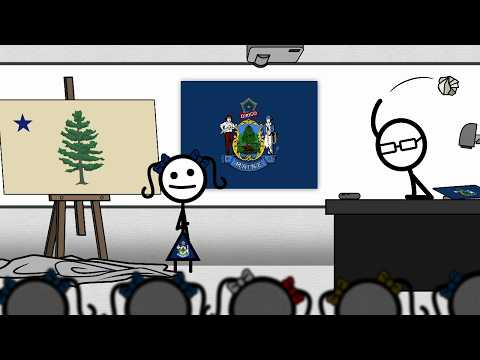
The Maine state flag features a pine tree and a North Star.
- Homophone Confusion
- Do not confuse 'Maine' (the state) with 'main' (primary) or 'mane' (hair on a horse's neck).
Incorrect: The main reason I moved to main was for the lobster. Correct: The main reason I moved to Maine was for the lobster.
- Abbreviation Errors
- Ensure you use 'ME' for Maine. 'MA' is Massachusetts, and 'MI' is Michigan.
When filling out the shipping form, she accidentally selected MN instead of ME.
- Article Usage
- Avoid saying 'the Maine' unless it is followed by a noun like 'coast' or 'government'.
Incorrect: I am visiting the Maine this fall. Correct: I am visiting Maine this fall.
Many people think Maine is part of Canada because of its northern location.
The Maine weather can be very harsh for those not used to the cold.
- New England
- A regional term that includes Maine, New Hampshire, Vermont, Massachusetts, Rhode Island, and Connecticut.
Of all the states in New England, Maine has the most dramatic coastline.
- The Pine Tree State
- The official nickname of Maine, highlighting its vast forest cover.
Welcome to the Pine Tree State, also known as Maine.
- Down East
- A regional term specifically referring to the coastal region of Maine, especially from Penobscot Bay to the Canadian border.
We took a boat tour to see the puffins in Down East Maine.
Maine is often compared to the Canadian Maritimes due to their shared maritime culture.
The Maine wilderness is a prime location for moose sightings.
How Formal Is It?
Wusstest du?
Maine is the only state in the United States whose name is just one syllable long.
Aussprachehilfe
- Pronouncing the final 'e' (e.g., 'main-ee').
- Confusing it with 'mine' (long 'i' sound).
- Over-emphasizing the 'n' sound.
Schwierigkeitsgrad
Easy to recognize as a proper noun.
Spelling is simple but requires the silent 'e'.
Simple one-syllable pronunciation.
Can be confused with 'main' or 'mane' in speech.
Was du als Nächstes lernen solltest
Voraussetzungen
Als Nächstes lernen
Fortgeschritten
Wichtige Grammatik
Proper Noun Capitalization
Always capitalize Maine.
Prepositions of Place
Use 'in' for Maine (in Maine).
Possessive Proper Nouns
Maine's coastline is beautiful.
Adjectival Nouns
Maine lobster (Maine acts as an adjective).
Silent E Rule
The 'e' in Maine is silent, making the 'a' long.
Beispiele nach Niveau
I want to visit Maine.
Je veux visiter le Maine.
Maine is a proper noun, so it starts with a capital letter.
Maine is very cold.
Le Maine est très froid.
Use 'is' to describe the state.
He lives in Maine.
Il habite dans le Maine.
Use the preposition 'in' for location.
Maine has many trees.
Le Maine a beaucoup d'arbres.
Maine is the subject of the sentence.
We saw a lighthouse in Maine.
Nous avons vu un phare dans le Maine.
A1 learners should recognize common landmarks.
Do you like Maine?
Aimes-tu le Maine ?
Question form with 'do'.
Maine is in the USA.
Le Maine est aux États-Unis.
Basic factual statement.
I ate lobster in Maine.
J'ai mangé du homard dans le Maine.
Past tense 'ate'.
Maine is known as the Pine Tree State.
Le Maine est connu comme l'État du pin.
Passive voice 'is known as'.
They are traveling to Maine this summer.
Ils voyagent dans le Maine cet été.
Present continuous for future plans.
Maine is famous for its rocky coast.
Le Maine est célèbre pour sa côte rocheuse.
Adjective 'famous' followed by 'for'.
Is Maine bigger than New Hampshire?
Le Maine est-il plus grand que le New Hampshire ?
Comparative 'bigger than'.
My family went to Maine for vacation.
Ma famille est allée dans le Maine pour les vacances.
Past tense 'went'.
You can see moose in Maine.
On peut voir des élans dans le Maine.
Modal verb 'can' for possibility.
Maine's winters are very long.
Les hivers du Maine sont très longs.
Possessive form 'Maine's'.
Portland is the largest city in Maine.
Portland est la plus grande ville du Maine.
Superlative 'the largest'.
Acadia National Park is located in Maine.
Le parc national d'Acadia est situé dans le Maine.
Geographical location phrase.
The Maine lobster industry is very important.
L'industrie du homard du Maine est très importante.
Maine used as an adjective.
Maine became a state in 1820.
Le Maine est devenu un État en 1820.
Historical fact in past simple.
If you visit Maine, you should try the blueberries.
Si vous visitez le Maine, vous devriez goûter les bleuets.
First conditional structure.
Maine borders Canada to the north.
Le Maine borde le Canada au nord.
Verb 'borders' for geography.
The weather in Maine can change quickly.
Le temps dans le Maine peut changer rapidement.
Adverb 'quickly' modifying 'change'.
Maine is the easternmost state in the country.
Le Maine est l'État le plus à l'est du pays.
Superlative 'easternmost'.
Many writers live in Maine for the peace and quiet.
Beaucoup d'écrivains vivent dans le Maine pour le calme et la tranquillité.
Prepositional phrase 'for the peace and quiet'.
Maine's economy relies heavily on tourism and natural resources.
L'économie du Maine repose largement sur le tourisme et les ressources naturelles.
Verb 'relies on' with adverb 'heavily'.
The rugged beauty of Maine has inspired countless artists.
La beauté sauvage du Maine a inspiré d'innombrables artistes.
Present perfect 'has inspired'.
Maine is the only state that borders exactly one other state.
Le Maine est le seul État qui ne borde qu'un seul autre État.
Relative clause 'that borders...'.
The population of Maine is quite small compared to its land area.
La population du Maine est assez faible par rapport à sa superficie.
Comparison phrase 'compared to'.
Maine was originally part of Massachusetts before gaining independence.
Le Maine faisait initialement partie du Massachusetts avant de gagner son indépendance.
Participle phrase 'before gaining'.
The Maine coast is dotted with hundreds of small islands.
La côte du Maine est parsemée de centaines de petites îles.
Passive voice 'is dotted with'.
Mainers are known for their resilience and independent spirit.
Les habitants du Maine sont connus pour leur résilience et leur esprit indépendant.
Collective noun 'Mainers'.
The Gulf of Maine is warming faster than most other oceans.
Le golfe du Maine se réchauffe plus vite que la plupart des autres océans.
Comparative adverb 'faster than'.
Maine's unique political landscape often serves as a national bellwether.
Le paysage politique unique du Maine sert souvent d'indicateur national.
Metaphorical use of 'bellwether'.
The literary tradition of Maine is deeply intertwined with its landscape.
La tradition littéraire du Maine est profondément liée à son paysage.
Passive voice 'is intertwined with'.
Maine's demographics present significant challenges for rural healthcare.
La démographie du Maine présente des défis importants pour les soins de santé ruraux.
Abstract noun 'demographics'.
The socio-economic divide between coastal and inland Maine is stark.
La fracture socio-économique entre le Maine côtier et intérieur est frappante.
Adjective 'stark' for contrast.
Maine was the first state to implement ranked-choice voting statewide.
Le Maine a été le premier État à mettre en œuvre le vote par choix classé à l'échelle de l'État.
Infinitive of purpose 'to implement'.
The environmental preservation of Maine's North Woods is a subject of intense debate.
La préservation environnementale des North Woods du Maine est un sujet de débat intense.
Complex noun phrase as subject.
Maine's maritime history is preserved in numerous museums along the coast.
L'histoire maritime du Maine est préservée dans de nombreux musées le long de la côte.
Prepositional phrase 'along the coast'.
The stoic character of Maine residents is often reflected in regional folklore.
Le caractère stoïque des résidents du Maine se reflète souvent dans le folklore régional.
Adjective 'stoic' describing character.
Maine's admission to the Union was a pivotal moment in the antebellum era.
L'admission du Maine à l'Union a été un moment charnière de l'ère d'avant-guerre.
Historical terminology 'antebellum era'.
The rugged topography of Maine necessitates a robust infrastructure for winter travel.
La topographie accidentée du Maine nécessite une infrastructure robuste pour les déplacements hivernaux.
Formal verb 'necessitates'.
Maine's legislative innovations often precede broader national shifts in policy.
Les innovations législatives du Maine précèdent souvent des changements de politique nationaux plus larges.
Verb 'precede' indicating temporal order.
The cultural hegemony of the 'Down East' identity permeates Maine's tourism industry.
L'hégémonie culturelle de l'identité 'Down East' imprègne l'industrie du tourisme du Maine.
Sophisticated vocabulary 'hegemony' and 'permeates'.
Maine's ecological diversity is a microcosm of the broader Northern Appalachian region.
La diversité écologique du Maine est un microcosme de la région plus large des Appalaches du Nord.
Metaphorical use of 'microcosm'.
The tension between conservation and industrial development is palpable in Maine's forestry sector.
La tension entre conservation et développement industriel est palpable dans le secteur forestier du Maine.
Adjective 'palpable' for emphasis.
Maine's linguistic idiosyncrasies offer a rich field for dialectological study.
Les idiosyncrasies linguistiques du Maine offrent un champ riche pour l'étude dialectologique.
Academic terminology 'idiosyncrasies' and 'dialectological'.
The profound isolation of certain Maine communities has preserved archaic social structures.
L'isolement profond de certaines communautés du Maine a préservé des structures sociales archaïques.
Adjective 'archaic' for historical depth.
Häufige Kollokationen
Häufige Phrasen
— Traveling northward to the state of Maine.
We're heading up to Maine for the long weekend.
— The coastal region of Maine, especially the eastern part.
They own a small cottage in Down East Maine.
— Products that are manufactured or crafted within the state.
I prefer buying Maine-made furniture.
— A reference to the simple, practical lifestyle of Mainers.
He does things the Maine way—slowly and correctly.
— Often refers to the state's best products or people.
This seafood platter features Maine's finest catch.
— The formal name of the political entity.
The State of Maine was admitted to the Union in 1820.
— The distinctive way people from Maine speak.
He has a thick Maine accent that is hard to mimic.
— The vast, uninhabited forest areas of the state.
The Maine wilderness is perfect for a retreat.
— A specific sandwich made with lobster meat and butter or mayo.
Nothing beats a Maine lobster roll on a summer day.
— The election held in Maine to choose political candidates.
The Maine primary results were surprising this year.
Wird oft verwechselt mit
Main is an adjective meaning primary; Maine is a state.
Mane is the long hair on the neck of a horse or lion.
Mine is a possessive pronoun or a place where minerals are extracted.
Redewendungen & Ausdrücke
— A humorous Maine saying about the difficulty of navigating rural roads.
I asked for directions to the lake, and he just said, 'You can't get there from here.'
Informal / Regional— A phrase used to show resilience and community support in Maine.
After the storm, the town remained Maine strong.
Modern / Colloquial— A classic Maine way of saying 'yes' or 'I agree.'
Is it going to rain? Ayuh, looks like it.
Dialect— The state's official slogan, implying a better, simpler quality of life.
Sitting by the lake in Maine, I realized this is the way life should be.
Slogan— A playful (sometimes derogatory) term for a person from Maine.
He's a true Maine-iac; he loves the cold weather.
Slang— A term used by Mainers for people who move to Maine from elsewhere (usually the south).
The locals could tell he was a flatlander by his shoes.
Regional Slang— Thick, thorny bushes common in the Maine woods.
He got stuck in the puckerbrush while hunting.
Regional— The area immediately outside the door of a house, common in Maine speech.
Park your truck in the dooryard.
Regional— Very good; 'wicked' is a common intensifier in Maine and New England.
That lobster was wicked good!
Informal— While universal, often used in Maine regarding the frequent moose/deer road hazards.
When I asked him the question, he looked like a deer in the headlights.
GeneralLeicht verwechselbar
Homophones (sound the same).
Main is an adjective or noun meaning chief or principal. Maine is a specific U.S. state. You use 'main' for a street and 'Maine' for a place.
The main road leads to Maine.
Homophones (sound the same).
Mane refers to animal hair. Maine refers to the state. They have no shared meaning despite the same sound.
The lion has a thick mane, and it lives far from Maine.
Both are New England states.
Massachusetts is to the south of Maine and is much more densely populated. Maine was once part of Massachusetts.
We drove through Massachusetts to get to Maine.
Maine's only bordering state.
New Hampshire has a very short coastline, while Maine has a very long one. New Hampshire is known for its mountains (White Mountains).
Maine and New Hampshire are neighbors.
Both are rural New England states.
Vermont is landlocked (no ocean coast), while Maine is famous for its coast.
Vermont has maple syrup, but Maine has lobster.
Satzmuster
I like [Maine].
I like Maine.
[Maine] is [Adjective].
Maine is beautiful.
I am going to [Maine] for [Reason].
I am going to Maine for vacation.
[Maine] is known for its [Noun].
Maine is known for its lobster.
The [Noun] of [Maine] is [Adjective].
The economy of Maine is diverse.
Nowhere is [Noun] more [Adjective] than in [Maine].
Nowhere is the coastline more rugged than in Maine.
If I visit [Maine], I will [Verb].
If I visit Maine, I will see a lighthouse.
Despite the [Noun], [Maine] remains [Adjective].
Despite the cold, Maine remains a popular destination.
Wortfamilie
Substantive
Adjektive
Verwandt
So verwendest du es
Common in U.S. English, especially in travel and food contexts.
-
I am going to the Maine.
→
I am going to Maine.
You do not use the definite article 'the' before the names of most states, including Maine.
-
The main industry in Maine is fishing.
→
The main industry in Maine is fishing.
This is correct, but many people accidentally swap the spellings. 'Main' (primary) and 'Maine' (state).
-
I live in maine.
→
I live in Maine.
Maine is a proper noun and must always be capitalized.
-
Maine is in the west coast.
→
Maine is on the east coast.
Maine is the easternmost state in the U.S., located on the Atlantic (East) coast.
-
The Maine's coast is rocky.
→
The Maine coast is rocky. / Maine's coast is rocky.
Do not use 'The' before 'Maine's'. Choose either 'The Maine coast' or 'Maine's coast'.
Tipps
Don't Forget the E
Always remember the 'e' at the end of Maine. Without it, you are writing 'main,' which is a completely different word.
One Neighbor Only
Maine is the only U.S. state that borders just one other state (New Hampshire). This makes it easy to remember on a map.
One Syllable
Keep it short! Maine is just one syllable. Don't try to pronounce the 'e' or split the word into two sounds.
Lobster Capital
If you are writing about seafood, Maine is your go-to reference. It produces the majority of the lobster in the United States.
Proper Noun
Always capitalize the 'M' in Maine. It is a specific name of a state, not a general noun.
Going 'Up'
In American English, people almost always say they are going 'up to Maine' because it is at the top of the map.
Pine Tree State
Use the nickname 'The Pine Tree State' to add variety to your writing when referring to Maine.
Context Clues
When you hear 'main/Maine,' look for words like 'state,' 'lobster,' or 'coast' to know it refers to the place.
Postal Code
If you are writing an address, use 'ME' as the abbreviation. It is the official code for Maine.
1820
Remember the year 1820 if you are discussing Maine's history; it's when it officially became a state.
Einprägen
Eselsbrücke
Maine is the 'Main' state on the 'East' coast (the 'e' at the end stands for East).
Visuelle Assoziation
Imagine a giant pine tree growing out of a lobster trap on a rocky beach.
Word Web
Herausforderung
Try to name three things Maine is famous for without using the word 'lobster'.
Wortherkunft
The exact origin is debated, but it likely refers to the 'mainland' as opposed to the many islands off the coast.
Ursprüngliche Bedeutung: Mainland or 'The Main'.
English (Proper Noun)Kultureller Kontext
Be respectful when discussing the economic divide between coastal and rural Maine.
In the U.S., Maine is seen as the ultimate 'getaway' state for nature lovers.
Im Alltag üben
Kontexte aus dem Alltag
Travel
- Visit Maine
- Maine vacation
- Explore Maine
- Maine travel guide
Food
- Maine lobster
- Maine blueberries
- Maine seafood
- Maine-style
Geography
- Maine coast
- Northern Maine
- Gulf of Maine
- Maine border
Literature
- Set in Maine
- Maine author
- Maine setting
- Maine story
Weather
- Maine winter
- Maine snow
- Maine climate
- Maine summer
Gesprächseinstiege
"Have you ever visited Maine or any other New England states?"
"What comes to your mind first when you hear the word Maine?"
"Would you prefer to visit the Maine coast or the Maine woods?"
"Do you like Maine lobster, or do you prefer other types of seafood?"
"Have you read any books by Stephen King that are set in Maine?"
Tagebuch-Impulse
Describe a perfect day spent exploring the rocky coastline of Maine.
If you moved to Maine, what would be the biggest change in your lifestyle?
Compare the natural beauty of Maine with a place you have visited before.
Write a short story set in a small, foggy harbor town in Maine.
Why do you think Maine is called 'Vacationland'?
Häufig gestellte Fragen
10 FragenNo, Maine is a state in the United States. However, it borders Canada on three sides (north, east, and west), which sometimes causes confusion for those unfamiliar with U.S. geography. It became the 23rd U.S. state in 1820.
Maine is most famous for its delicious lobster, its rugged and beautiful rocky coastline, and its many lighthouses. It is also known for its vast forests, wild blueberries, and as the setting for many Stephen King novels.
Maine is pronounced as a single syllable, rhyming with 'rain' or 'plane'. The 'e' at the end is silent. It sounds exactly like the word 'main'.
It is called the Pine Tree State because approximately 90% of its land is covered by forests, and the white pine is the state tree. The pine tree also appears on the state flag and seal.
The capital of Maine is Augusta. While Portland is the largest city and a major cultural hub, Augusta serves as the center of the state government.
It depends on the season and location. Coastal towns can be quite expensive during the peak summer months, but the interior and visiting during the 'off-season' (spring or late fall) can be much more affordable.
Maine has four distinct seasons. Winters are typically long, cold, and snowy. Summers are mild and pleasant, making it a popular vacation spot. Fall is famous for its vibrant foliage, and spring is often wet and muddy.
Yes, it is possible to see the Northern Lights (Aurora Borealis) in Maine, especially in the northern parts of the state where there is less light pollution, though it is not a nightly occurrence.
A 'Mainer' is a person who lives in or is from the state of Maine. The term is used with pride and often implies a certain level of toughness and independence.
Absolutely! Maine is home to Acadia National Park and the northern terminus of the Appalachian Trail at Mount Katahdin. It offers some of the best hiking in the eastern United States.
Teste dich selbst 200 Fragen
Write a sentence about why someone might want to visit Maine.
Well written! Good try! Check the sample answer below.
Describe the geography of Maine in three sentences.
Well written! Good try! Check the sample answer below.
Compare the climate of Maine to the climate where you live.
Well written! Good try! Check the sample answer below.
Write a short paragraph about the importance of the lobster industry to Maine.
Well written! Good try! Check the sample answer below.
Explain the significance of Maine's admission to the Union in 1820.
Well written! Good try! Check the sample answer below.
Write a travel advertisement for a weekend in Portland, Maine.
Well written! Good try! Check the sample answer below.
Discuss how Maine's landscape has influenced American literature.
Well written! Good try! Check the sample answer below.
Describe a typical Maine winter day.
Well written! Good try! Check the sample answer below.
Write a letter to a friend inviting them to go hiking in Maine.
Well written! Good try! Check the sample answer below.
Explain the meaning of the term 'Down East'.
Well written! Good try! Check the sample answer below.
Discuss the environmental challenges facing the Gulf of Maine.
Well written! Good try! Check the sample answer below.
Write a dialogue between two people planning a trip to Maine.
Well written! Good try! Check the sample answer below.
Describe the appearance of a Maine lighthouse.
Well written! Good try! Check the sample answer below.
Explain why Maine is called the 'Pine Tree State'.
Well written! Good try! Check the sample answer below.
Write a short story opening set in a remote Maine cabin.
Well written! Good try! Check the sample answer below.
Discuss the role of tourism in Maine's economy.
Well written! Good try! Check the sample answer below.
Write three facts about Maine using the word 'Maine' in each sentence.
Well written! Good try! Check the sample answer below.
Explain the difference between 'main' and 'Maine'.
Well written! Good try! Check the sample answer below.
Describe the Maine state flag.
Well written! Good try! Check the sample answer below.
Write a summary of Maine's cultural identity.
Well written! Good try! Check the sample answer below.
Pronounce the word 'Maine' clearly.
Read this aloud:
Du hast gesagt:
Speech recognition is not supported in your browser. Try Chrome or Edge.
Describe what Maine looks like based on what you've learned.
Read this aloud:
Du hast gesagt:
Speech recognition is not supported in your browser. Try Chrome or Edge.
Talk about why Maine is a popular vacation spot.
Read this aloud:
Du hast gesagt:
Speech recognition is not supported in your browser. Try Chrome or Edge.
Explain the difference between 'main' and 'Maine' out loud.
Read this aloud:
Du hast gesagt:
Speech recognition is not supported in your browser. Try Chrome or Edge.
Discuss the pros and cons of living in a state like Maine.
Read this aloud:
Du hast gesagt:
Speech recognition is not supported in your browser. Try Chrome or Edge.
Describe the cultural importance of lobster to Maine.
Read this aloud:
Du hast gesagt:
Speech recognition is not supported in your browser. Try Chrome or Edge.
Talk about a famous person or book associated with Maine.
Read this aloud:
Du hast gesagt:
Speech recognition is not supported in your browser. Try Chrome or Edge.
Explain the geography of Maine to someone who has never heard of it.
Read this aloud:
Du hast gesagt:
Speech recognition is not supported in your browser. Try Chrome or Edge.
Discuss the impact of the maritime industry on Maine's history.
Read this aloud:
Du hast gesagt:
Speech recognition is not supported in your browser. Try Chrome or Edge.
Argue for or against the importance of preserving Maine's wilderness.
Read this aloud:
Du hast gesagt:
Speech recognition is not supported in your browser. Try Chrome or Edge.
Describe the feeling of a Maine winter.
Read this aloud:
Du hast gesagt:
Speech recognition is not supported in your browser. Try Chrome or Edge.
Talk about the different nicknames for Maine.
Read this aloud:
Du hast gesagt:
Speech recognition is not supported in your browser. Try Chrome or Edge.
Explain what 'Down East' means in your own words.
Read this aloud:
Du hast gesagt:
Speech recognition is not supported in your browser. Try Chrome or Edge.
Discuss the unique political system in Maine.
Read this aloud:
Du hast gesagt:
Speech recognition is not supported in your browser. Try Chrome or Edge.
Talk about the wildlife you might find in Maine.
Read this aloud:
Du hast gesagt:
Speech recognition is not supported in your browser. Try Chrome or Edge.
Describe the experience of visiting a Maine lighthouse.
Read this aloud:
Du hast gesagt:
Speech recognition is not supported in your browser. Try Chrome or Edge.
Discuss the demographic challenges Maine faces today.
Read this aloud:
Du hast gesagt:
Speech recognition is not supported in your browser. Try Chrome or Edge.
Explain the historical connection between Maine and Massachusetts.
Read this aloud:
Du hast gesagt:
Speech recognition is not supported in your browser. Try Chrome or Edge.
Talk about the significance of Acadia National Park.
Read this aloud:
Du hast gesagt:
Speech recognition is not supported in your browser. Try Chrome or Edge.
Describe a typical Maine meal.
Read this aloud:
Du hast gesagt:
Speech recognition is not supported in your browser. Try Chrome or Edge.
Listen to the sentence: 'Maine is a beautiful state.' Which state is mentioned?
Listen to the sentence: 'We are going up to Maine.' Which direction are they likely traveling?
Listen to the sentence: 'The Maine lobster is world-famous.' What is world-famous?
Listen to the sentence: 'It's a cold winter in Maine.' How is the weather?
Listen to the sentence: 'Augusta is the capital of Maine.' What is Augusta?
Listen to the sentence: 'The Maine coast is very rocky.' Describe the coast.
Listen to the sentence: 'Maine became a state in 1820.' When did it become a state?
Listen to the sentence: 'Stephen King lives in Bangor, Maine.' Where does he live?
Listen to the sentence: 'The Maine Coon is a large cat.' What is a Maine Coon?
Listen to the sentence: 'Acadia is in Maine.' Where is Acadia?
Listen to the sentence: 'Maine borders New Hampshire.' Which state does it border?
Listen to the sentence: 'The Pine Tree State is Maine.' What is the nickname?
Listen to the sentence: 'Maine's economy relies on tourism.' What does the economy rely on?
Listen to the sentence: 'The Gulf of Maine is cold.' How is the water?
Listen to the sentence: 'Mainers are independent.' How are the people described?
/ 200 correct
Perfect score!
Summary
Maine is a unique U.S. state that combines a massive maritime presence with a deep wilderness interior. It is essential to remember its spelling (with an 'e'), its location in New England, and its cultural symbols like the lobster and pine tree. Example: 'Maine's natural beauty makes it a top destination for hikers and seafood lovers alike.'
- Maine is a northeastern U.S. state known for its rugged Atlantic coastline and vast forests.
- It is famous for maritime history, lighthouses, and being the primary source of American lobster.
- Maine is the only state bordering just one other state (New Hampshire) and is the easternmost in the U.S.
- Culturally, it is associated with outdoor recreation, independent politics, and a stoic, nature-loving lifestyle.
Don't Forget the E
Always remember the 'e' at the end of Maine. Without it, you are writing 'main,' which is a completely different word.
One Neighbor Only
Maine is the only U.S. state that borders just one other state (New Hampshire). This makes it easy to remember on a map.
One Syllable
Keep it short! Maine is just one syllable. Don't try to pronounce the 'e' or split the word into two sounds.
Lobster Capital
If you are writing about seafood, Maine is your go-to reference. It produces the majority of the lobster in the United States.
Beispiel
I have always wanted to visit Maine in the autumn.
Verwandte Inhalte
In Videos ansehen
Im Kontext lernen
Dieses Wort in anderen Sprachen
Mehr Geography Wörter
abgeoency
C1systematisch analysieren oder nach geografischer Herkunft kategorisieren.
adjacency
B2Die Adjazenz der beiden Gebäude ermöglichte eine effiziente gemeinsame Nutzung der Heizsysteme.
africa
A1Afrika ist der zweitgrößte Kontinent der Erde und hat über 50 Länder.
agrarian
B2Bezieht sich auf bebautes Land, dessen Besitz oder ein auf Landwirtschaft basierendes Gesellschaftssystem. Beispiel: 'Die agrarische Gesellschaft war stark vom Wetter abhängig.'
agricultural
B2Landwirtschaftlich bezieht sich auf die Wissenschaft, Kunst oder Praxis des Ackerbaus und der Viehzucht.
alpine
B2Bezieht sich auf hohe Berge, insbesondere auf ihre Landschaften, Pflanzen oder Tiere. / Beschreibt Dinge, die in hohen Bergen vorkommen, wie Pflanzen, Tiere oder die Landschaft, oft oberhalb der Baumgrenze.
altitude
B2Das Flugzeug erreichte eine Reiseflughöhe von zehntausend Metern.
america
B1Amerika ist ein Land in Nordamerika, das oft als die Vereinigten Staaten bezeichnet wird.
antarctic
B2Bezieht sich auf den Südpol oder die ihn umgebenden Regionen. 'Die antarktische Tierwelt ist einzigartig.'
antarctica
A2Antarktis ist der südlichste Kontinent der Erde, der fast vollständig mit Eis bedeckt ist.

