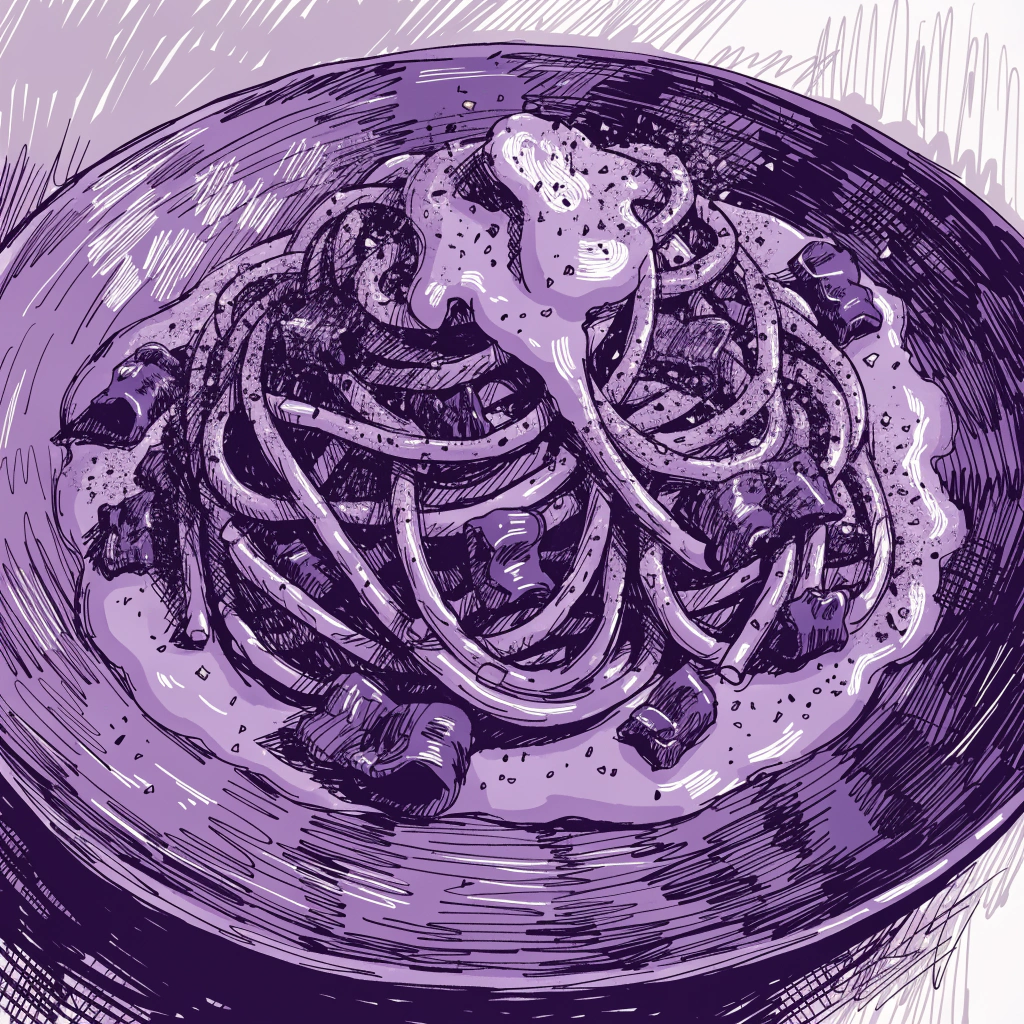
Pasta alla Carbonara: A Great Italian Meal
Pasta alla Carbonara is a famous food from Rome, Italy. It is very delicious and simple. People love this dish all over the world.
To make it, you need pasta, eggs, and cheese. You also need pork meat. Many people think charcoal burners made this food first. They worked in the mountains.
This meal is very creamy. It is a hearty dinner for families. You can find it in many Italian restaurants. It is a true Italian classic.
Gramática destacada
Patrón: Present Simple: To Be
"Pasta alla Carbonara is a famous food from Rome, Italy."
We use 'is' for a singular subject like 'Pasta'. This pattern tells us a fact about the subject.
Patrón: Present Simple: Regular Verbs
"People love this dish all over the world."
We use the base form of the verb 'love' for plural subjects like 'People'. It describes a general truth or habit.
Pon a prueba tu comprensión
10 preguntas · A1 Principiante · 1 vista previa gratis
Pon a prueba lo que aprendiste en este artículo. ¡Responde todas las preguntas para ganar XP!
Where is Pasta alla Carbonara from?
¿Quieres terminar el quiz?
9 preguntas más te esperan. ¡Regístrate gratis para desbloquear el quiz completo y ganar XP!
Regístrate gratis¿Ya tienes cuenta? Acceder
Desglose de preguntas
Where is Pasta alla Carbonara from?
Tu respuesta:
Respuesta correcta: Rome
Carbonara is a food from Italy.
Tu respuesta:
Respuesta correcta: Verdadero
What does 'delicious' mean?
Tu respuesta:
Respuesta correcta: Tastes very good
To make it, you need pasta, eggs, and _____.
Tu respuesta:
Respuesta correcta: cheese
The Story of Pasta alla Carbonara
Pasta alla Carbonara is a very famous dish from Rome, Italy. Many people love it because it is creamy and delicious. It is one of the most popular pasta recipes in the world.
To make Carbonara, you need simple ingredients. You use eggs, hard cheese, black pepper, and cured pork. In the past, these ingredients were easier to carry than fresh vegetables. This made the dish perfect for workers in the mountains.
There are many stories about its history. One popular story says that Carbonari, or charcoal burners, created the meal. They worked outside and needed a hearty meal for energy. Another story says it became popular after World War II.
Carbonara is simpler than other Italian recipes, but it is very tasty. When you visit Rome, you should try this amazing dish. It is a true masterpiece of Italian cooking.
Gramática destacada
Patrón: Past Simple
"They worked outside and needed a hearty meal for energy."
We use the Past Simple to talk about finished actions in the past. To form it for regular verbs, we usually add '-ed' to the end of the verb.
Patrón: Comparatives
"Carbonara is simpler than other Italian recipes, but it is very tasty."
We use comparatives to compare two things. For short adjectives like 'simple', we add '-er' and use the word 'than'.
Pon a prueba tu comprensión
11 preguntas · A2 Básico · 1 vista previa gratis
Pon a prueba lo que aprendiste en este artículo. ¡Responde todas las preguntas para ganar XP!
Where is Pasta alla Carbonara originally from?
¿Quieres terminar el quiz?
10 preguntas más te esperan. ¡Regístrate gratis para desbloquear el quiz completo y ganar XP!
Regístrate gratis¿Ya tienes cuenta? Acceder
Desglose de preguntas
Where is Pasta alla Carbonara originally from?
Tu respuesta:
Respuesta correcta: Rome
Carbonara is made with many fresh vegetables.
Tu respuesta:
Respuesta correcta: Falso
What does the word 'masterpiece' mean?
Tu respuesta:
Respuesta correcta: A work of great skill
To make Carbonara, you need _____ ingredients.
Tu respuesta:
Respuesta correcta: simple
According to one story, who created Carbonara?
Tu respuesta:
Respuesta correcta: Charcoal burners
The Mystery and Magic of Carbonara
Pasta alla Carbonara is a famous Roman dish that has become a symbol of Italian cooking. It has been enjoyed by Italians for many years and is now found on menus from London to New York. It is made with simple ingredients, but the result is a rich and creamy meal. Although it is very popular, the history of the dish is still a mystery.
One interesting theory is that the dish was invented by 'Carbonari,' who were charcoal burners in the mountains. These workers needed a hearty meal that was easy to carry. They used dried pasta, cured pork, and hard cheese, which are ingredients that do not spoil quickly. Another theory suggests that the recipe was created during World War II, when American soldiers brought eggs and bacon to Italy.
Many people think that cream is used to make the sauce, but this is a mistake. In a traditional recipe, which has been passed down through generations, the creaminess comes from mixing raw eggs with Pecorino Romano cheese. The pasta is tossed with the egg mixture while it is still hot, but it must not be cooked too much, or the eggs will scramble.
In recent years, Carbonara has been celebrated every year on 'Carbonara Day.' This event has been organized to protect the authentic recipe from modern changes. Today, food lovers from around the world share their photos of the dish on social media, proving that its popularity continues to grow. Whether you prefer the traditional version or a modern twist, Carbonara remains a masterpiece of Italian engineering. It shows how simple food can be transformed into something extraordinary.
Gramática destacada
Patrón: Passive Voice
"One interesting theory is that the dish was invented by 'Carbonari,' who were charcoal burners in the mountains."
The passive voice is used when the action is more important than the person who did it. It is formed using the verb 'to be' followed by the past participle of the main verb.
Patrón: Relative Clauses
"They used dried pasta, cured pork, and hard cheese, which are ingredients that do not spoil quickly."
Relative clauses provide extra information about a noun. We use 'which' to talk about things and 'who' to talk about people.
Pon a prueba tu comprensión
11 preguntas · B1 Intermedio · 1 vista previa gratis
Pon a prueba lo que aprendiste en este artículo. ¡Responde todas las preguntas para ganar XP!
Who were the 'Carbonari' mentioned in the article?
¿Quieres terminar el quiz?
10 preguntas más te esperan. ¡Regístrate gratis para desbloquear el quiz completo y ganar XP!
Regístrate gratis¿Ya tienes cuenta? Acceder
Desglose de preguntas
Who were the 'Carbonari' mentioned in the article?
Tu respuesta:
Respuesta correcta: Charcoal burners
Traditional Carbonara is made using heavy cream to create the sauce.
Tu respuesta:
Respuesta correcta: Falso
What does the word 'authentic' mean in the text?
Tu respuesta:
Respuesta correcta: Real and traditional
Carbonara remains a _____ of Italian engineering because it uses simple food.
Tu respuesta:
Respuesta correcta: masterpiece
Why did the charcoal burners use ingredients like dried pasta and hard cheese?
Tu respuesta:
Respuesta correcta: They did not spoil quickly
The Gastronomic Enigma: Deciphering the Heritage of Carbonara
Pasta alla Carbonara is frequently hailed as a masterpiece of Roman culinary engineering, representing a sophisticated synthesis of humble ingredients. Despite its global fame, the origins of this iconic dish remain shrouded in academic ambiguity, sparking intense debate among food historians. While many casual diners assume the recipe has ancient roots dating back to the Roman Empire, evidence suggests that its emergence is a relatively modern phenomenon. One prevalent theory attributes the invention to the 'Carbonari' or charcoal burners of the Apennine mountains. It is argued that these laborers required a substantial, high-energy meal that could be prepared using easily transportable ingredients such as dried pasta, cured pork, and hard cheese. However, many contemporary researchers remain skeptical of this narrative, pointing to the lack of written records prior to the mid-20th century.
An alternative, albeit controversial, hypothesis links the dish to the aftermath of World War II. According to this perspective, the recipe evolved when Italian chefs began to incorporate powdered eggs and bacon from Allied military rations into traditional pasta preparations. If the American soldiers had not brought these specific supplies to Rome in 1944, the version of Carbonara we recognize today might never have stabilized. This theory highlights the fluid nature of cultural heritage, where necessity frequently dictates culinary innovation. Regardless of which historical account one favors, the technical execution of the dish is undisputed. The authentic method relies on the emulsification of eggs and Pecorino Romano cheese, a process that requires precise temperature control to prevent the eggs from curdling.
Furthermore, the discourse surrounding Carbonara often centers on the concept of authenticity. Purists vehemently oppose the inclusion of cream, arguing that it compromises the integrity of the sauce's texture. In their view, the creaminess should be achieved solely through the mechanical action of whisking the pasta water with the fat and eggs. This commitment to traditionalism reflects a broader desire to preserve Italian identity in an era of globalization. Ultimately, Carbonara serves as more than just a meal; it is a complex intersection of history, sociology, and chemistry. Whether it was born in the soot of a charcoal fire or the scarcity of a post-war kitchen, its status as a pillar of Italian cuisine is firmly established.
Gramática destacada
Patrón: Passive Reporting Verbs
"It is argued that these laborers required a substantial, high-energy meal."
This structure is used to report opinions or beliefs in a formal, objective way. It uses 'It' + passive verb + 'that' to distance the writer from the claim.
Patrón: Third Conditional
"If the American soldiers had not brought these specific supplies to Rome in 1944, the version of Carbonara we recognize today might never have stabilized."
This is used to talk about hypothetical situations in the past. It follows the structure: If + past perfect, would/might + have + past participle.
Patrón: Relative Clauses with Prepositions
"This theory highlights the fluid nature of cultural heritage, where necessity frequently dictates culinary innovation."
The relative adverb 'where' (meaning 'in which') is used here to refer to a conceptual situation or context rather than a physical location.
Pon a prueba tu comprensión
11 preguntas · B2 Intermedio alto · 1 vista previa gratis
Pon a prueba lo que aprendiste en este artículo. ¡Responde todas las preguntas para ganar XP!
What is the primary reason some researchers doubt the 'Carbonari' theory?
¿Quieres terminar el quiz?
10 preguntas más te esperan. ¡Regístrate gratis para desbloquear el quiz completo y ganar XP!
Regístrate gratis¿Ya tienes cuenta? Acceder
Desglose de preguntas
What is the primary reason some researchers doubt the 'Carbonari' theory?
Tu respuesta:
Respuesta correcta: There is a lack of historical documentation before the 1940s.
Traditionalists believe that cream is an essential ingredient for a perfect Carbonara texture.
Tu respuesta:
Respuesta correcta: Falso
What does 'authenticity' mean in the context of this article?
Tu respuesta:
Respuesta correcta: Being genuine and true to traditional methods.
The sauce's texture is achieved through the _____ of eggs and cheese with pasta water.
Tu respuesta:
Respuesta correcta: emulsification
Which group's military supplies are linked to the post-war theory of Carbonara?
Tu respuesta:
Respuesta correcta: Allied forces
The Gastronomic Enigma: Deconstructing the Mythos of Pasta alla Carbonara
Seldom has a culinary creation sparked such fervent debate as the origins of Pasta alla Carbonara. While it is now heralded as a quintessential masterpiece of Roman engineering, its provenance remains shrouded in a contentious blend of folklore and historical ambiguity. The dish, characterized by its meticulous synthesis of cured pork, hard cheese, and eggs, represents a triumph of simplicity over excess, yet the narrative surrounding its inception is anything but straightforward. One prevalent theory attributes the dish to the 'Carbonari'—charcoal burners who supposedly prepared this hearty meal over open fires in the Apennine mountains. According to this tradition, the heavy dusting of black pepper was intended to resemble the charcoal dust that permeated their lives. However, many historians find this romanticized version of events to be largely anecdotal, lacking the concrete evidence required to solidify its place in history.
It was the post-World War II era that provided a more plausible, albeit less poetic, explanation for the dish’s sudden ubiquity. The hypothesis suggests that the arrival of Allied forces in Rome introduced an influx of bacon and powdered eggs, which local chefs then combined with indigenous pasta and cheese to cater to the tastes of American soldiers. This theory posits that Carbonara is not an ancient relic of the Roman countryside, but rather a modern invention born of necessity and cross-cultural exchange. Such a notion is often met with visceral resistance from traditionalists who view the dish as an immutable pillar of Italian heritage. The proliferation of various interpretations across the globe has only intensified this protective stance, leading to a rigid culinary dogma regarding the 'correct' ingredients.
In the eyes of a Roman purist, the use of cream is considered nothing short of a sacrilegious offense. The creamy texture must be achieved solely through the ephemeral window of time where the residual heat of the pasta emulsifies the egg and cheese mixture without curdling it. Furthermore, the debate between guanciale and pancetta continues to polarize the culinary community. While pancetta is more widely accessible, guanciale—cured pork cheek—is favored for its higher fat content and deeper flavor profile, which is essential for the dish's structural integrity. What is fascinating about this discourse is the realization that Carbonara’s identity is not defined by a static recipe, but by a continuous negotiation between tradition and innovation.
Ultimately, the enduring appeal of Carbonara lies in its inherent austerity. It is a dish that demands technical precision despite its humble components. The nominalization of its history—turning a simple meal into a 'cultural phenomenon'—reflects our collective desire to find meaning in the mundane. Whether it was born in the soot-stained camps of mountain workers or the ration-depleted kitchens of post-war Rome, Carbonara remains an evocative symbol of Italian resilience. It is the precise emulsification of fats and proteins that distinguishes a masterly Carbonara from a mediocre one, reminding us that in the realm of gastronomy, the simplest compositions often require the most sophisticated execution.
Gramática destacada
Patrón: Inversion with negative/limiting adverbials
"Seldom has a culinary creation sparked such fervent debate as the origins of Pasta alla Carbonara."
Used for emphasis and formal tone, the auxiliary verb 'has' moves before the subject 'a culinary creation' because the sentence begins with 'Seldom'.
Patrón: Cleft Sentences
"It is the precise emulsification of fats and proteins that distinguishes a masterly Carbonara from a mediocre one."
This structure (It + be + noun + relative clause) is used to focus on a specific part of the sentence, in this case, the process of emulsification.
Patrón: Nominalisation
"The nominalization of its history—turning a simple meal into a 'cultural phenomenon'—reflects our collective desire to find meaning in the mundane."
This involves turning verbs or adjectives into nouns (e.g., 'nominalization') to make writing more abstract, objective, and formal, typical of C1 academic style.
Pon a prueba tu comprensión
12 preguntas · C1 Avanzado · 1 vista previa gratis
Pon a prueba lo que aprendiste en este artículo. ¡Responde todas las preguntas para ganar XP!
What is the primary reason the 'Carbonari' theory is questioned by historians?
¿Quieres terminar el quiz?
11 preguntas más te esperan. ¡Regístrate gratis para desbloquear el quiz completo y ganar XP!
Regístrate gratis¿Ya tienes cuenta? Acceder
Desglose de preguntas
What is the primary reason the 'Carbonari' theory is questioned by historians?
Tu respuesta:
Respuesta correcta: It lacks concrete evidence and is viewed as anecdotal.
The use of cream is considered an essential technique by Roman traditionalists.
Tu respuesta:
Respuesta correcta: Falso
What does the word 'ubiquity' mean in the context of the article?
Tu respuesta:
Respuesta correcta: The state of being everywhere at once
The dish requires meticulous _____ of fats and proteins to achieve its texture.
Tu respuesta:
Respuesta correcta: emulsification
Which theory suggests Carbonara was influenced by American military rations?
Tu respuesta:
Respuesta correcta: The Post-World War II Hypothesis
Guanciale is preferred over pancetta because of its higher fat content.
Tu respuesta:
Respuesta correcta: Verdadero
The Carbonara Enigma: A Symphony of Roman Engineering and Historiographical Mystery
The culinary landscape of Rome is often perceived as an ossified museum of tradition, yet few dishes encapsulate the tension between historical enigma and gastronomic precision as poignantly as Pasta alla Carbonara. To the uninitiated, it is merely a symphony of pork, egg, and cheese; however, to the epicurean scholar, it represents a contentious intersection of socio-political history and molecular alchemy. Rarely has a culinary creation sparked such fervent historiographical debate, with theories of its provenance ranging from the rustic hearths of 19th-century charcoal burners to the pragmatic kitchens of post-war Italy. The dish exists as a juxtaposition of rudimentary elements and sophisticated execution, requiring a level of finesse that belies its humble appearance.
One prevailing narrative attributes the dish's inception to the 'Carbonari'—the charcoal burners of the Apennine Mountains. Proponents of this theory argue that the dish was a utilitarian necessity, composed of non-perishable staples that could be easily transported and prepared over a woodland fire. The heavy dusting of black pepper, a ubiquitous feature of the authentic recipe, is said to evoke the charcoal dust that permeated the lives of these laborers. In this context, Carbonara is viewed as a vestige of a bygone era, a culinary artifact of pastoral survival. Yet, despite the romanticism of this origin story, historical evidence remains frustratingly scant, leading many to dismiss it as a charming folklore rather than a verifiable fact.
A more contentious, albeit intellectually stimulating, hypothesis suggests that Carbonara is a relatively modern phenomenon, catalyzed by the Allied liberation of Rome in 1944. This theory posits that the juxtaposition of American military rations—namely powdered eggs and bacon—with local Italian pasta and cheese birthed the prototype of the dish we recognize today. While some Italian purists find this notion of American intervention sacrosanct, it aligns with the first documented mentions of the dish in the mid-20th century. Regardless of its exact birth, the transmutation of these rudimentary components into a silken emulsion requires a mastery of thermal dynamics. Were one to substitute the guanciale with pancetta, one might inadvertently invite the scorn of Roman purists, yet the idiosyncratic nature of the dish allows for minor regional variations that persist to this day.
The technicality of Carbonara lies not in the complexity of its ingredients, but in the ephemeral window of time during which the egg undergoes coagulation. It is the emulsion that defines the dish; a delicate balance where the residual heat of the pasta, the rendered fat of the guanciale, and the sharp salinity of Pecorino Romano create a cream-like consistency without the inclusion of dairy. This process demands an intuitive understanding of temperature, as the line between a silken sauce and scrambled eggs is perilously thin. It is this idiosyncrasy that elevates Carbonara from a simple meal to a feat of culinary engineering. Ultimately, Carbonara remains a testament to the Italian ability to find beauty in the essential, proving that even the most ubiquitous ingredients, when handled with reverence, can achieve a state of sublime elegance.
Gramática destacada
Patrón: Inversion for Emphasis
"Rarely has a culinary creation sparked such fervent historiographical debate."
Inversion of the subject and auxiliary verb occurs after negative or restrictive adverbs like 'rarely' or 'seldom' to add dramatic emphasis, typical of formal C2 writing.
Patrón: Second Conditional with Subjunctive 'Were'
"Were one to substitute the guanciale with pancetta, one might inadvertently invite the scorn of Roman purists."
The 'were' subjunctive is used in formal hypothetical structures to express a condition that is unlikely or imaginary. It replaces the standard 'if' clause for a more academic tone.
Patrón: Nominalization
"Regardless of its exact birth, the transmutation of these rudimentary components into a silken emulsion requires a mastery of thermal dynamics."
Nominalization involves turning verbs or adjectives into nouns (e.g., 'transmutation', 'inception'). This creates a more abstract and scholarly style, allowing for denser information packing.
Pon a prueba tu comprensión
12 preguntas · C2 Dominio · 1 vista previa gratis
Pon a prueba lo que aprendiste en este artículo. ¡Responde todas las preguntas para ganar XP!
What does the author suggest about the 'Carbonari' theory of the dish's origin?
¿Quieres terminar el quiz?
11 preguntas más te esperan. ¡Regístrate gratis para desbloquear el quiz completo y ganar XP!
Regístrate gratis¿Ya tienes cuenta? Acceder
Desglose de preguntas
What does the author suggest about the 'Carbonari' theory of the dish's origin?
Tu respuesta:
Respuesta correcta: It is a romanticized story lacking concrete evidence.
The author argues that Carbonara's complexity comes from its wide variety of exotic ingredients.
Tu respuesta:
Respuesta correcta: Falso
Which word describes something that is fleeting or lasts for a very short time?
Tu respuesta:
Respuesta correcta: Ephemeral
The conversion of simple ingredients into a creamy sauce is described as a form of molecular _____.
Tu respuesta:
Respuesta correcta: alchemy
What is the primary technical challenge when preparing Carbonara?
Tu respuesta:
Respuesta correcta: Managing the temperature to avoid scrambling the eggs.
The article suggests that some people believe American military rations influenced the creation of Carbonara.
Tu respuesta:
Respuesta correcta: Verdadero

