frodo 30 सेकंड में
- Frodo is the iconic protagonist of J.R.R. Tolkien's 'The Lord of the Rings,' a Hobbit who carries the One Ring to Mount Doom.
- He represents the 'reluctant hero' archetype, showing that even the smallest person can face great evil through courage and persistence.
- The name is often used metaphorically to describe someone carrying a heavy burden or undertaking a difficult, transformative journey.
- Frodo's story is a central pillar of modern fantasy literature, influencing countless characters and stories across all forms of media.
The word Frodo refers to the central protagonist of J.R.R. Tolkien's epic high-fantasy novel, The Lord of the Rings. While it is primarily a proper noun, its usage in modern English has transcended the boundaries of literature to become a symbolic reference for the 'unlikely hero' or the 'everyman' who carries a heavy, often invisible, burden. When people use the name Frodo in conversation, they are frequently invoking the image of a small, seemingly insignificant individual who is tasked with a monumental and perilous mission that affects the fate of the entire world. This character is a Hobbit, a fictional race of small humanoids known for their love of peace, quiet, and simple living, which makes his transition into a world-saving adventurer all the more poignant.
- Literary Archetype
- Frodo represents the reluctant hero. Unlike traditional warriors, his strength lies not in physical prowess but in moral fortitude and the ability to resist corruption, specifically the corruptive influence of the One Ring.
In a cultural context, mentioning Frodo often serves as a shorthand for discussing themes of friendship, sacrifice, and the loss of innocence. The journey Frodo takes from the idyllic Shire to the volcanic wasteland of Mordor is a metaphor for the difficult transitions one faces in life, where the weight of responsibility can change a person irrevocably. People use this reference in academic discussions about mythology, in casual conversations about cinema, and even in political or social commentary to describe someone standing up against overwhelming odds.
Even the smallest person can change the course of the future, a sentiment perfectly embodied by Frodo Baggins.
Furthermore, the name is synonymous with the concept of 'the quest.' In modern storytelling, any character who must travel a long distance to destroy a source of evil is often compared to Frodo. This comparison highlights the character's internal struggle; Frodo is not just fighting Orcs and Ringwraiths, but also the darkness within himself that the Ring attempts to exploit. This psychological depth is why the name remains relevant decades after the books were first published. It is a name that carries the weight of history, the beauty of friendship, and the tragedy of a hero who cannot truly return to the life he once knew.
- Cultural Impact
- The global success of Peter Jackson's film adaptations solidified Frodo's image in the public consciousness, making the name recognizable even to those who have never read Tolkien's original texts.
The name itself has interesting linguistic roots, often associated with the Old English word 'frōd,' meaning 'wise by experience.' This etymological connection underscores the character's development throughout the narrative. He begins as a sheltered youth and ends as a weary, wise, and scarred veteran of a spiritual and physical war. This transition is a key reason why the name is used to describe someone who has 'seen too much' or has been matured by hardship. Whether in fan fiction, literary criticism, or everyday metaphors, Frodo remains a cornerstone of the English-speaking world's mythological vocabulary.
The resilience shown by Frodo during his ascent of Mount Doom is often cited as the ultimate example of perseverance.
- Symbolism
- The Ring-bearer symbol: Frodo is often called the Ring-bearer, a title that signifies the burden of power and the isolation that comes with a unique and dangerous responsibility.
In many ways, the intern felt like Frodo, carrying the weight of the entire project on their shoulders while the senior managers argued.
Ultimately, Frodo is more than just a character; he is a vessel for Tolkien's philosophy on the nature of evil and the power of the ordinary. By using the name Frodo, speakers tap into a rich vein of storytelling that emphasizes that heroism is not about the absence of fear, but about moving forward despite it. This makes the name a powerful tool for inspiration and description in various communicative contexts, from high-level literary analysis to motivational speaking.
Using the name Frodo in a sentence requires an understanding of its context as a proper noun and its metaphorical potential. Most commonly, it appears in discussions regarding literature, film, or fantasy tropes. However, it can also be used in comparative structures to highlight specific traits in other people or characters. Because Frodo is a specific individual, the name is always capitalized and usually functions as the subject or object of a sentence. When used metaphorically, it often follows 'like' or 'as,' creating a simile that compares a real-world situation to the epic struggle found in Tolkien's work.
- Direct Reference
- This is the most straightforward use, referring directly to the character in the books or movies. Example: 'Frodo Baggins inherited the One Ring from his uncle, Bilbo.'
When constructing sentences about Frodo, writers often focus on his actions, his relationships (particularly with Samwise Gamgee), and his internal state. Because his journey is so well-known, sentences often involve verbs of movement, endurance, and resistance. For instance, 'Frodo journeyed across Middle-earth' or 'Frodo resisted the temptation of the Ring.' These sentences help build a narrative or descriptive picture of the character's role. In more complex grammatical structures, Frodo might be the focus of a passive construction, such as 'The heavy burden was carried by Frodo until the very end,' which emphasizes the weight of his task over his personal agency.
Without the loyalty of Sam, Frodo would never have reached the Cracks of Doom.
Metaphorical usage is where the name becomes a versatile tool for English speakers. You might say, 'I felt like Frodo entering the boardroom, surrounded by giants of industry.' Here, the name serves to evoke a sense of being small, out of place, yet carrying a significant responsibility. This type of usage is common in informal settings, blogs, and opinion pieces. It allows the speaker to convey a complex set of emotions and circumstances with a single, recognizable name. It is important to note that such metaphors work best when the listener is familiar with the source material; otherwise, the intended meaning of 'vulnerability paired with duty' might be lost.
- Comparative Usage
- Using the name to describe someone else's situation. Example: 'In this group project, you are the Frodo, and I am your Samwise.'
In creative writing, authors might use 'Frodo' as a benchmark for character development. A sentence like 'The protagonist's arc mirrored that of Frodo, beginning in peace and ending in a hard-won, weary wisdom' uses the name as a literary reference point. This helps readers quickly grasp the intended trajectory of a new character by aligning them with a well-established archetype. Additionally, the name can be used in possessive forms, such as 'Frodo's resolve' or 'Frodo's burden,' to focus on specific attributes that define the character's experience.
Many readers find Frodo's internal struggle more compelling than the external battles of the story.
- Thematic Sentences
- Sentences that explore the themes associated with the character. Example: 'Frodo represents the idea that even the most humble individual can possess extraordinary courage.'
The teacher asked the students to compare Frodo to other classic heroes like Odysseus or Beowulf.
Finally, the name can appear in humorous or lighthearted contexts. 'I'm just a Frodo looking for my Sam' is a common way to express a need for a loyal friend or partner. This versatility—from deep literary analysis to internet memes—makes the name Frodo a unique and powerful element of the English language. Whether you are describing a literal journey or a metaphorical one, the name provides a rich, evocative shorthand that resonates with millions of people worldwide.
The word Frodo is most frequently heard in environments where literature, film, and popular culture are discussed. Since the release of the Lord of the Rings film trilogy in the early 2000s, the name has become a household word, frequently appearing in casual conversations, media reviews, and academic lectures. You will hear it in bookstores, at fan conventions like Comic-Con, and in classrooms where English literature is taught. It is a staple of 'geek culture,' but its reach extends far beyond that, often surfacing in mainstream media as a point of reference for heroism and epic storytelling.
- Media and Reviews
- Film critics often mention Frodo when reviewing new fantasy movies, using him as a standard against which new protagonists are measured. You might hear a critic say, 'This character lacks the emotional depth of a Frodo Baggins.'
In educational settings, the name is used to discuss the 'Hero's Journey'—a narrative pattern identified by Joseph Campbell. Professors and students use Frodo as a primary example of the 'Call to Adventure' and the 'Ordeal.' Hearing the name in this context usually involves a deep dive into the character's psychological state and his role as a Christ-figure or a representation of the common soldier in World War I, reflecting Tolkien's own experiences. This academic usage elevates the name from a mere character label to a significant literary symbol.
During the podcast, the host compared the CEO's difficult decision to Frodo's choice to leave the Shire.
Social media and the internet are perhaps the most common places to encounter the name today. From memes about 'walking into Mordor' to discussions on Reddit about the nuances of Tolkien's lore, Frodo is a constant presence. In these digital spaces, the name is often used playfully. You might see a post saying, 'Me trying to finish this semester like Frodo trying to reach Mount Doom.' This demonstrates how the character's struggle has been internalized by the public as a relatable metaphor for any difficult task. The name has even entered the realm of naming pets; it is not uncommon to meet a dog or cat named Frodo, reflecting the character's small size and loyal nature.
- Pop Culture References
- Television shows like 'The Big Bang Theory' or 'Stranger Things' often reference Frodo to establish a character's interests or to make a joke about fantasy tropes.
In the travel industry, particularly in New Zealand, the name Frodo is heard constantly. Since the movies were filmed there, many tours are centered around 'Hobbiton' and other locations associated with Frodo's journey. Tour guides use the name to bring the landscape to life for tourists, connecting the physical beauty of the country with the fictional world of Middle-earth. This commercial use of the name shows its power as a brand and a cultural icon that can drive tourism and local economies.
The tour guide pointed to the hill and said, 'This is where Frodo first encountered the Black Rider.'
- Gaming Communities
- In tabletop RPGs like Dungeons & Dragons or in video games, players often reference Frodo when discussing character builds or quest structures, using him as the ultimate 'Halfling Rogue' or 'Quest-giver' archetype.
In the gaming forum, a user argued that Frodo is actually the most difficult character to play in the board game adaptation.
Finally, you might hear the name in motivational speeches. Speakers often use Frodo's story to encourage people to take the first step on their own journeys, emphasizing that you don't need to be a 'wizard' or a 'king' to make a difference. This broad range of contexts—from the high-brow academic to the low-brow meme—illustrates that Frodo is not just a name from a book, but a living part of the modern English lexicon, embodying universal themes that resonate across different cultures and age groups.
While the name Frodo is widely known, there are several common mistakes people make when using it, ranging from spelling errors to misunderstandings of the character's role and nature. One of the most frequent mistakes is confusing Frodo with his uncle, Bilbo Baggins. While both are Hobbits and both carried the One Ring, their stories and characters are distinct. Bilbo is the protagonist of The Hobbit, and his journey is more of a traditional adventure, whereas Frodo's journey in The Lord of the Rings is a much darker, more somber quest for the salvation of the world. Mixing them up can lead to confusion in literary discussions.
- Character Confusion
- Mistake: Saying Frodo found the Ring in a cave. Correction: Bilbo found the Ring; Frodo inherited it from Bilbo many years later.
Another common error involves the spelling and pronunciation of the name. Some people might mistakenly write 'Frodow' or 'Froda,' though these are less common among native speakers. More significantly, people often misinterpret Frodo's 'failure' at the end of the quest. A common mistake is to view Frodo as a weak character because he ultimately could not throw the Ring into the fire of his own volition. However, Tolkien himself clarified that the Ring's power was so absolute at that point that no mortal could have resisted it. Failing to understand this nuance can lead to a mischaracterization of Frodo as a failed hero rather than a tragic one who was pushed beyond human (or Hobbit) limits.
It is a mistake to think Frodo succeeded alone; without Gollum's intervention, the Ring would not have been destroyed.
In terms of grammar, a mistake often seen is the improper use of the possessive. Since 'Frodo' ends in a vowel, the possessive is simply 'Frodo's.' Some learners might get confused by other fantasy names ending in 's' (like Legolas) and apply the wrong rules. Additionally, when using 'Frodo' as a metaphor, people sometimes overextend the comparison. For example, calling someone 'the Frodo of the office' might be confusing if the person doesn't have a clear 'Ring' (a burden or task) or a 'Sam' (a loyal helper). A metaphor only works if the core elements of the reference are present, otherwise, it can feel forced or nonsensical.
- Thematic Misunderstanding
- Mistake: Assuming Frodo is a 'warrior' hero. Correction: Frodo is a 'sufferer' hero; his primary action is enduring pain and temptation, not fighting with a sword.
Furthermore, some readers mistake Frodo's departure at the end of the story as a simple 'happy ending.' In reality, his journey to the Undying Lands is a form of 'passing away' or retirement due to the deep physical and psychological wounds he sustained. Calling it a 'vacation' or a 'simple trip' misses the emotional weight of the character's sacrifice. He saved the Shire, but not for himself. Understanding this distinction is crucial for anyone writing an essay or engaging in a serious discussion about the character. Lastly, avoid the mistake of thinking Frodo is the 'main character' in a way that diminishes the other members of the Fellowship. While he is the protagonist, the story is an ensemble piece, and his role is specifically that of the Ring-bearer.
Many fans mistakenly believe Frodo is the only one who could have carried the Ring, but Sam carried it briefly as well.
- Grammatical Note
- When referring to multiple versions of the character (e.g., book vs. movie), use 'the book Frodo' or 'the movie Frodo' rather than 'Frodos'.
The essay pointed out that Frodo's name is often misspelled in fan-made subtitles.
By avoiding these common pitfalls, you can use the name Frodo more effectively and accurately in your writing and speech. Whether you are discussing his literary significance or using him as a metaphor for your own life's challenges, a precise understanding of who Frodo is—and who he isn't—will make your communication much more impactful and credible.
While Frodo is a unique proper noun, there are several words and phrases that can serve as alternatives or related terms depending on the context. If you are looking to avoid repeating the name in a piece of writing, or if you want to use a more descriptive term for the role he plays, you can use various epithets and synonyms derived from the text. Additionally, in a broader literary sense, there are other characters from different mythologies and stories that share similar traits with Frodo, providing a rich field for comparison and substitution.
- The Ring-bearer
- This is the most common formal title for Frodo within the story. It emphasizes his specific duty and the burden he carries. Example: 'The Ring-bearer felt the weight of his task growing heavier.'
- The Halfling
- A term used by the taller races of Middle-earth (like Men and Elves) to describe Hobbits. It highlights Frodo's small stature relative to the world around him.
In a metaphorical sense, if you want to describe someone like Frodo without using the name, you might use terms like 'the reluctant hero,' 'the everyman,' or 'the underdog.' These terms capture the essence of Frodo's character—someone who is not naturally suited for greatness but achieves it through necessity and moral strength. 'Underdog' is particularly useful in sports or business contexts, where a small competitor faces a massive opponent. 'Reluctant hero' is more suited for literary or cinematic analysis, describing a protagonist who would rather stay home but is forced into action.
The protagonist of the new novel is a classic reluctant hero, much like the famous Hobbit from the Shire.
When comparing Frodo to other characters, you might look at Harry Potter or Luke Skywalker. While they are different in many ways, they all share the 'Chosen One' trope, though Frodo is unique because he isn't 'chosen' by prophecy so much as by the circumstances of his inheritance and his own willingness to go. Another interesting comparison is with the character of Christian from John Bunyan's The Pilgrim's Progress. Both characters carry a literal and metaphorical burden on a journey toward a specific destination, representing a spiritual or moral quest. Using these comparisons can help clarify Frodo's role for someone who might be more familiar with other literary traditions.
- Mr. Baggins
- A more formal way to refer to him, often used by characters like Samwise (who calls him 'Mr. Frodo') or the Gaffer. It reflects the social structure of the Shire.
In modern slang or informal English, you might hear the term 'Hobbit' used as a generic descriptor for someone short or someone who enjoys a cozy, home-bound lifestyle. While not a direct synonym for Frodo, it carries the same cultural DNA. Similarly, the phrase 'carrying the ring' has become a localized idiom in some circles to mean carrying a secret or a heavy responsibility that others cannot share. These alternatives allow for a more nuanced expression of the ideas that Frodo embodies, ensuring that the speaker can tailor their language to the specific needs of their audience and context.
She was the underdog of the competition, a real-life Frodo facing a field of Goliaths.
- Comparison Table
-
- Frodo vs. Bilbo: Frodo is more serious and tragic; Bilbo is more adventurous and whimsical.
- Frodo vs. Sam: Frodo is the visionary and burden-bearer; Sam is the practical support and emotional anchor.
- Frodo vs. Aragorn: Frodo represents moral courage; Aragorn represents physical and leadership courage.
The professor argued that the Ring-bearer is a more accurate title for Frodo's role in the cosmic struggle.
Ultimately, whether you use the name Frodo or one of its many alternatives, you are tapping into a profound narrative tradition. The choice of word depends on whether you want to emphasize his identity, his race, his burden, or his narrative archetype. By understanding these options, you can communicate more precisely and creatively, enriching your vocabulary and your ability to engage with one of the most important stories of the 20th and 21st centuries.
How Formal Is It?
रोचक तथ्य
Tolkien originally considered the name 'Bingo' for the main character of 'The Lord of the Rings' before settling on the much more serious and resonant 'Frodo.' The name change reflects the shift in the story's tone from a children's adventure to an epic myth.
उच्चारण मार्गदर्शिका
- Pronouncing the 'o' at the end like 'oo' (Fro-doo).
- Adding an 'n' sound (Frondo).
- Misplacing the stress on the second syllable (fro-DO).
- Pronouncing the 'o' as a short 'ah' (Frah-do).
- Adding a 'w' sound at the end (Fro-dow).
कठिनाई स्तर
The name itself is easy to read, but the books it comes from are quite complex.
Simple to spell and use as a proper noun.
Requires correct pronunciation of the 'o' sounds to be understood.
Very recognizable in spoken English due to its unique sound.
आगे क्या सीखें
पूर्वापेक्षाएँ
आगे सीखें
उन्नत
ज़रूरी व्याकरण
Capitalization of Proper Nouns
Always write 'Frodo', never 'frodo'.
Possessive form of names ending in vowels
Frodo's ring, not Frodo' ring.
Using 'like' for similes
He was brave like Frodo.
Articles with specific versions of a character
The Frodo we see in the first movie is very young.
Appositives for character description
Frodo, the Ring-bearer, was tired.
स्तर के अनुसार उदाहरण
Frodo is a small Hobbit.
Frodo est un petit Hobbit.
Proper noun used as subject.
Frodo has a gold ring.
Frodo a un anneau d'or.
Simple present tense.
Frodo lives in a hole.
Frodo vit dans un trou.
Prepositional phrase 'in a hole'.
Frodo is very brave.
Frodo est très courageux.
Adjective 'brave' describing the subject.
Sam is Frodo's friend.
Sam est l'ami de Frodo.
Possessive 's.
Frodo goes to the mountain.
Frodo va à la montagne.
Verb 'goes' indicating movement.
Frodo is in a book.
Frodo est dans un livre.
Locative 'in a book'.
I like Frodo.
J'aime Frodo.
Direct object.
Frodo must destroy the evil ring.
Frodo doit détruire l'anneau maléfique.
Modal verb 'must' for obligation.
Frodo walked for many days.
Frodo a marché pendant plusieurs jours.
Past simple tense.
Frodo met a wizard named Gandalf.
Frodo a rencontré un magicien nommé Gandalf.
Past participle 'named' used as an adjective.
The ring was too heavy for Frodo.
L'anneau était trop lourd pour Frodo.
Adverb 'too' modifying the adjective 'heavy'.
Frodo and Sam climbed the mountain.
Frodo et Sam ont grimpé la montagne.
Compound subject.
Frodo wanted to stay at home.
Frodo voulait rester à la maison.
Infinitive 'to stay' as object.
Frodo saw many scary monsters.
Frodo a vu beaucoup de monstres effrayants.
Adjective 'scary' before noun 'monsters'.
Frodo is the hero of the story.
Frodo est le héros de l'histoire.
Definite article 'the' with 'hero'.
Frodo inherited the ring from his uncle Bilbo.
Frodo a hérité de l'anneau de son oncle Bilbo.
Verb 'inherited' with preposition 'from'.
Frodo felt the corruptive power of the ring.
Frodo a ressenti le pouvoir corrupteur de l'anneau.
Adjective 'corruptive' describing 'power'.
Despite his fear, Frodo volunteered to go to Mordor.
Malgré sa peur, Frodo s'est porté volontaire pour aller au Mordor.
Concession phrase 'Despite his fear'.
Frodo's journey was full of difficult choices.
Le voyage de Frodo était plein de choix difficiles.
Possessive 's with 'journey'.
The Ringwraiths were searching for Frodo.
Les Spectres de l'Anneau cherchaient Frodo.
Past continuous tense.
Frodo realized that he could not go back to his old life.
Frodo a réalisé qu'il ne pouvait pas retourner à sa vie d'avant.
Noun clause 'that he could not go back'.
Sam's loyalty helped Frodo complete the quest.
La loyauté de Sam a aidé Frodo à achever la quête.
Verb 'helped' followed by object and infinitive.
Frodo is often compared to other literary heroes.
Frodo est souvent comparé à d'autres héros littéraires.
Passive voice 'is compared'.
Frodo's resilience is the cornerstone of the narrative.
La résilience de Frodo est la pierre angulaire du récit.
Metaphorical use of 'cornerstone'.
The burden of the Ring began to weigh heavily on Frodo's mind.
Le fardeau de l'Anneau commença à peser lourdement sur l'esprit de Frodo.
Adverb 'heavily' modifying 'weigh'.
Frodo represents the ordinary person caught in extraordinary circumstances.
Frodo représente la personne ordinaire prise dans des circonstances extraordinaires.
Past participle 'caught' as a reduced relative clause.
Throughout the trilogy, Frodo undergoes a significant character arc.
Tout au long de la trilogie, Frodo subit un arc narratif significatif.
Preposition 'Throughout' for duration.
Frodo was reluctant to take the Ring, yet he accepted the responsibility.
Frodo était réticent à prendre l'Anneau, pourtant il a accepté la responsabilité.
Coordinating conjunction 'yet'.
The internal struggle Frodo faces is more intense than the external battles.
La lutte interne à laquelle Frodo fait face est plus intense que les batailles externes.
Comparative structure 'more... than'.
Frodo's mercy toward Gollum proved to be crucial in the end.
La pitié de Frodo envers Gollum s'est avérée cruciale à la fin.
Infinitive phrase 'to be crucial'.
Many readers identify with Frodo's sense of isolation.
De nombreux lecteurs s'identifient au sentiment d'isolement de Frodo.
Phrasal verb 'identify with'.
Frodo's psychological deterioration is masterfully depicted by Tolkien.
La détérioration psychologique de Frodo est magistralement dépeinte par Tolkien.
Adverb 'masterfully' modifying the passive verb.
The Ring acts as a catalyst for Frodo's loss of innocence.
L'Anneau agit comme un catalyseur pour la perte d'innocence de Frodo.
Noun 'catalyst' used metaphorically.
Frodo is a subversion of the traditional, invincible epic hero.
Frodo est une subversion du héros épique traditionnel et invincible.
Noun 'subversion' indicating a reversal of expectations.
The trauma Frodo endured left him unable to find peace in the Shire.
Le traumatisme que Frodo a enduré l'a laissé incapable de trouver la paix dans la Comté.
Adjective 'unable' following the object 'him'.
Frodo's journey can be interpreted as a spiritual pilgrimage.
Le voyage de Frodo peut être interprété comme un pèlerinage spirituel.
Modal passive 'can be interpreted'.
Tolkien uses Frodo to explore the limits of human endurance and will.
Tolkien utilise Frodo pour explorer les limites de l'endurance et de la volonté humaines.
Infinitive of purpose 'to explore'.
Frodo's eventual departure signifies the end of an era in Middle-earth.
Le départ final de Frodo signifie la fin d'une ère en Terre du Milieu.
Verb 'signifies' introducing a thematic conclusion.
The duality of Frodo's character is highlighted by his interaction with Gollum.
La dualité du personnage de Frodo est mise en évidence par son interaction avec Gollum.
Noun 'duality' referring to contrasting traits.
Frodo Baggins is the quintessential 'scars-bearer,' embodying the permanent toll of moral conflict.
Frodo Bessac est le 'porteur de cicatrices' par excellence, incarnant le tribut permanent du conflit moral.
Appositive phrase 'embodying the permanent toll...'.
The ontological weight of the One Ring gradually strips Frodo of his hobbit-like parochialism.
Le poids ontologique de l'Anneau Unique dépouille progressivement Frodo de son esprit de clocher typique des hobbits.
Adjective 'ontological' relating to the nature of being.
Frodo's failure at the Cracks of Doom serves as a profound commentary on the limitations of mortal agency.
L'échec de Frodo aux Crevasses du Destin sert de commentaire profond sur les limites de l'action mortelle.
Noun phrase 'limitations of mortal agency'.
The narrative trajectory of Frodo is one of hagiographic suffering rather than martial triumph.
La trajectoire narrative de Frodo est celle d'une souffrance hagiographique plutôt que d'un triomphe martial.
Adjective 'hagiographic' relating to the lives of saints.
In the Grey Havens, Frodo's departure represents a transcendental shift from the temporal to the eternal.
Aux Havres Gris, le départ de Frodo représente un passage transcendantal du temporel vers l'éternel.
Prepositional phrases 'from the temporal to the eternal'.
Tolkien's characterization of Frodo avoids the pitfalls of simplistic moral binary.
La caractérisation de Frodo par Tolkien évite les pièges d'un binarisme moral simpliste.
Noun phrase 'simplistic moral binary'.
Frodo's mercy is the ultimate pivot upon which the fate of Middle-earth turns.
La pitié de Frodo est le pivot ultime sur lequel tourne le destin de la Terre du Milieu.
Relative clause 'upon which...'.
The psychological realism of Frodo's trauma provides a stark contrast to the mythic backdrop of the story.
Le réalisme psychologique du traumatisme de Frodo offre un contraste saisissant avec le décor mythique de l'histoire.
Noun phrase 'psychological realism'.
सामान्य शब्द संयोजन
सामान्य वाक्यांश
— A popular slogan from the 1960s and 70s expressing support for the character's survival and ideals. It became a symbol of counter-culture.
You can still find 'Frodo Lives' graffiti in some old college towns.
— To be a loyal and indispensable helper to someone facing a great task. It implies a deep, supportive friendship.
I'll be your Samwise during this difficult project.
— A line from a song in the books, often associated with Frodo's journey and the nature of life as a continuous adventure. It suggests that one journey leads to another.
As Frodo knew, the road goes ever on, even when we are tired.
— A task that seems too big for the person assigned to it. It highlights the disparity between the individual and the challenge.
Fixing the company's budget is a Frodo-sized task for a junior accountant.
— Going into a very dangerous or unpleasant situation. It is often used humorously to describe a difficult workplace or event.
Walking into the meeting felt like Frodo entering Mordor.
— A difficult and lonely journey of responsibility. it suggests that the person must go through it alone or with very few others.
The CEO is on the Ring-bearer's path with this new merger.
— The act of showing kindness to an enemy, which later proves beneficial. It is a specific reference to his treatment of Gollum.
Showing Frodo's mercy to the competitor might actually help us later.
— Stepping out of one's comfort zone into the unknown. It is a metaphor for personal growth and adventure.
Moving to a new city was my way of leaving the Shire.
— A heavy responsibility that changes the person carrying it. It emphasizes the psychological weight of the task.
She carried Frodo's burden for years without complaining.
— A group of people working together on a vital mission. It refers to the Fellowship of the Ring.
Our team is like the nine companions, each with a different skill.
अक्सर इससे भ्रम होता है
Bilbo is Frodo's uncle. He found the ring, while Frodo had to destroy it.
Sam is Frodo's best friend. He helps Frodo but is not the primary Ring-bearer.
A common but inappropriate phonetic confusion; ensure clear pronunciation of the 'Fr' sound.
मुहावरे और अभिव्यक्तियाँ
— To bear a significant and often secret responsibility that affects many people. It implies a sense of duty and potential corruption.
In this family, she's the one carrying the ring.
Informal— Used to say that a task is much more difficult and dangerous than it sounds. It is a very famous internet meme.
You want to finish the marathon without training? One does not simply walk into Mordor.
Slang/Meme— To find a truly loyal friend who will stick by you through the worst times. It is a common expression of gratitude for friendship.
I'm so glad I found my Sam in you.
Informal— A situation where one's home or safe place is under threat. It refers to the 'Scouring of the Shire' chapter.
With the new tax laws, it feels like the Shire is burning.
Literary/Metaphorical— To retire, pass away, or leave a long-held position for a peaceful rest. it is a gentle way to describe a final departure.
After forty years at the school, the principal is going to the Grey Havens.
Euphemistic— Someone who comes from a respectable and comfortable background. It is used to contrast with their current difficult situation.
He may be a Baggins of Bag End, but he's acting like a warrior now.
Literary— A moment of sudden realization that you must take on a huge responsibility. It is the 'Call to Adventure'.
I had a Frodo moment when I realized I was the only one who could save the project.
Informal— A warning that trouble or enemies are nearby. It refers to Frodo's magical sword.
I can tell the boss is in a bad mood; Sting is glowing.
Humorous— To avoid the temptation of power or corruption. It is used in ethical discussions.
He had the chance to take the money, but he resisted the ring.
Metaphorical— A line from a poem about Aragorn but often associated with the journey of the Hobbits. It means that searching or traveling has its own purpose.
I'm just taking a gap year; remember, not all those who wander are lost.
Poeticआसानी से भ्रमित होने वाले
People often use the race name and the character name interchangeably.
Frodo is a specific individual; Hobbit is the name of his species.
Frodo is a Hobbit, but not all Hobbits are Frodo.
Both refer to the same person in the context of the story.
Frodo is his name; Ring-bearer is his title or role.
The Ring-bearer was Frodo Baggins.
It is his surname, shared with Bilbo.
Use 'Frodo' for the individual and 'Baggins' for the family or when being formal.
The Baggins family is well-known in the Shire.
Another name for his race.
Halfling is often used by outsiders; Hobbit is what they call themselves.
The men of Gondor called Frodo a Halfling.
A literary term for the main character.
Frodo is the specific character; protagonist is the technical role.
Frodo is the protagonist of the story.
वाक्य संरचनाएँ
Frodo is [adjective].
Frodo is small.
Frodo has a [noun].
Frodo has a ring.
Frodo must [verb] to [goal].
Frodo must go to Mordor to destroy the ring.
Despite [noun], Frodo [verb].
Despite his fear, Frodo continued his journey.
The [noun] of Frodo represents [abstract concept].
The suffering of Frodo represents the cost of war.
Frodo's [noun] is a subversion of [literary trope].
Frodo's failure is a subversion of the traditional hero's triumph.
If Frodo hadn't [verb], then [result].
If Frodo hadn't shown mercy, the quest would have failed.
Frodo is often seen as [noun].
Frodo is often seen as a tragic figure.
शब्द परिवार
संज्ञा
क्रिया
विशेषण
संबंधित
इसे कैसे इस्तेमाल करें
Common in literary and pop-culture contexts; rare in technical or scientific contexts.
-
frodow
→
Frodo
The name ends in a simple 'o', not 'ow'.
-
Frodo found the ring.
→
Bilbo found the ring; Frodo inherited it.
It is a common plot error to confuse the two Hobbits' roles.
-
Frodo is a dwarf.
→
Frodo is a Hobbit.
Dwarves and Hobbits are different races in Middle-earth. Dwarves are stockier and live in mountains.
-
Frodo's quest was easy.
→
Frodo's quest was perilous and difficult.
Using 'easy' ignores the central conflict of the story.
-
The Frodos journey.
→
Frodo's journey.
Incorrect use of plural instead of possessive.
सुझाव
Capitalization
Always capitalize Frodo as it is a proper noun. This is a basic rule of English grammar for names.
Audience Awareness
When using Frodo as a metaphor, make sure your audience knows the story. It's a very common reference in Western culture but might be less known elsewhere.
Vary Your Terms
Use 'the Ring-bearer' or 'the Hobbit' to avoid repeating 'Frodo' too many times in a paragraph. This makes your writing more professional.
Archetype Knowledge
Understand that Frodo is a 'reluctant hero.' Using this term in essays about him will show a higher level of literary understanding.
The Final 'O'
Ensure the final 'o' in Frodo is a clear 'oh' sound. Don't let it trail off into an 'uh' or 'oo' sound.
The 'Sam' Connection
If you call someone a Frodo, you are implying they need a Sam. The two characters are almost always linked in cultural references.
Tolkien's Influence
Remember that Frodo was influenced by Tolkien's time in WWI. This adds a layer of 'soldier's trauma' to the character.
Modern Settings
In creative writing, you can place a 'Frodo-like' character in a modern office or school to create a relatable underdog story.
Thematic Depth
When discussing Frodo, focus on 'mercy' and 'pity.' These are the traits that actually lead to his ultimate success.
Gaming References
In gaming, 'pulling a Frodo' might mean sneaking past enemies rather than fighting them. It's a useful shorthand.
याद करें
स्मृति सहायक
F-R-O-D-O: Friend of Ring, Often Doing Ordeals. This helps you remember his role and the nature of his journey.
दृश्य संबंध
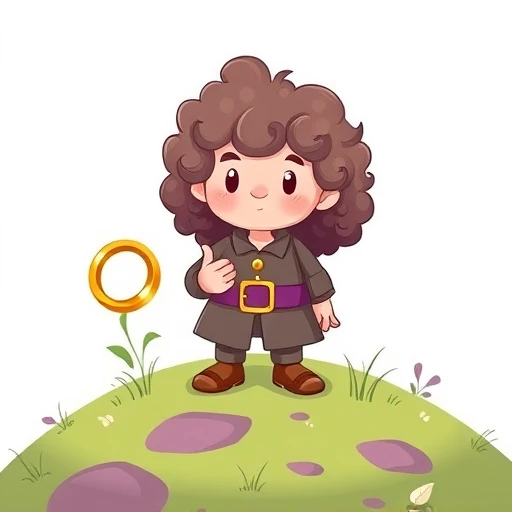
Imagine a small person with very large, hairy feet holding a glowing gold ring. The contrast between the small person and the powerful object is the key to Frodo.
Word Web
चैलेंज
Try to use the name 'Frodo' in a sentence that has nothing to do with books or movies. For example, use it as a metaphor for a difficult task at work or school.
शब्द की उत्पत्ति
The name was created by J.R.R. Tolkien for his fictional world. Tolkien, a philologist, often based his names on real linguistic roots. 'Frodo' is derived from the Old English word 'frōd,' which means 'wise by experience' or 'mature.' This is related to the Old Norse name 'Fróði.'
मूल अर्थ: Wise, experienced, or mature.
Germanic (Old English/Old Norse roots)सांस्कृतिक संदर्भ
The name is generally positive, but be careful not to use 'Hobbit' or 'Frodo' as a derogatory term for someone's height, as it can be seen as offensive.
In the UK and US, Frodo is a household name, often used in political cartoons to represent a small leader facing a big crisis.
असल ज़िंदगी में अभ्यास करें
वास्तविक संदर्भ
Literary Discussion
- Frodo's character development
- The role of the Ring-bearer
- Tolkien's protagonist
- Moral endurance in Frodo
Casual Conversation
- Like Frodo and Sam
- My own Mount Doom
- Leaving the Shire
- A Frodo moment
Film Reviews
- Elijah Wood's Frodo
- The portrayal of Frodo
- Frodo's journey on screen
- Cinematic Frodo
Motivational Speaking
- Even a Frodo can...
- Your personal quest
- Carrying your ring
- Finding your inner Hobbit
Gaming
- Playing as Frodo
- The Frodo questline
- Hobbit stats
- Ring-bearer mechanics
बातचीत की शुरुआत
"Who do you think is the real hero of the story, Frodo or Sam?"
"If you were Frodo, would you have been able to resist the power of the Ring?"
"Why do you think Frodo is such a popular character even after all these years?"
"In what ways can we compare Frodo's journey to the challenges we face in real life?"
"Do you prefer the way Frodo is described in the books or how he is shown in the movies?"
डायरी विषय
Describe a time when you felt like Frodo, carrying a responsibility that felt too big for you.
If you had to go on a quest like Frodo, who would you choose to be your Samwise and why?
Write about a 'Ring' in your life—something that is tempting but ultimately harmful.
How has the story of Frodo influenced your understanding of what it means to be brave?
Imagine Frodo lived in the modern world. What kind of job would he have and what would his 'Shire' look like?
अक्सर पूछे जाने वाले सवाल
10 सवालNo, Frodo is a Hobbit. Hobbits are a separate race in Tolkien's world, characterized by their small size, hairy feet, and long lifespans. They are related to humans but are distinct.
Frodo is the hero because he is the only one who can carry the Ring for so long without being immediately corrupted. His strength is his humility and lack of desire for power.
No, Frodo does not die at the end of the story. He leaves Middle-earth to go to the Undying Lands (Valinor) to find healing for his physical and emotional wounds.
His last name is Baggins. He is often referred to as Frodo Baggins to distinguish him from other Hobbits.
Elijah Wood played Frodo Baggins in the Peter Jackson film trilogy. His performance is widely praised for capturing Frodo's vulnerability.
Yes, in the books, Frodo is 50 years old when he sets out on his quest, though the Ring has kept him looking much younger. In the movies, he appears to be in his 20s.
His sword is named Sting. It is actually an Elven dagger that glows blue whenever Orcs or Goblins are nearby.
He had to leave because the One Ring was no longer safe there. The Dark Lord's servants, the Ringwraiths, were coming to find it.
Yes, Bilbo is Frodo's cousin, but Frodo often refers to him as his uncle because of the age difference and because Bilbo adopted him as his heir.
Technically yes, but it is a very unique and recognizable name. Most people use it for pets rather than children to avoid the heavy cultural associations.
खुद को परखो 191 सवाल
Write a short paragraph describing Frodo's appearance and personality.
Well written! Good try! Check the sample answer below.
Explain why Frodo is considered a 'reluctant hero'.
Well written! Good try! Check the sample answer below.
Compare Frodo to another famous hero from a book or movie.
Well written! Good try! Check the sample answer below.
Describe the relationship between Frodo and Samwise Gamgee.
Well written! Good try! Check the sample answer below.
Write a letter from Frodo to Bilbo about his journey.
Well written! Good try! Check the sample answer below.
Discuss the symbolic meaning of the One Ring in Frodo's life.
Well written! Good try! Check the sample answer below.
Explain why Frodo had to leave Middle-earth at the end of the story.
Well written! Good try! Check the sample answer below.
Write a short story about a modern-day 'Frodo' in a big city.
Well written! Good try! Check the sample answer below.
Describe the setting of the Shire and why it was important to Frodo.
Well written! Good try! Check the sample answer below.
Discuss the importance of mercy in Frodo's quest.
Well written! Good try! Check the sample answer below.
Write a review of Frodo's character arc in the trilogy.
Well written! Good try! Check the sample answer below.
How does Frodo's journey change him from the beginning to the end?
Well written! Good try! Check the sample answer below.
Write a dialogue between Frodo and Gollum.
Well written! Good try! Check the sample answer below.
Explain the role of Gandalf in Frodo's life.
Well written! Good try! Check the sample answer below.
Describe the dangers Frodo faced on his way to Mordor.
Well written! Good try! Check the sample answer below.
What can we learn from Frodo's perseverance?
Well written! Good try! Check the sample answer below.
Write a poem about Frodo, the Ring-bearer.
Well written! Good try! Check the sample answer below.
Discuss the theme of 'the small against the great' in Frodo's story.
Well written! Good try! Check the sample answer below.
How does the movie version of Frodo differ from the book version?
Well written! Good try! Check the sample answer below.
Write a journal entry from Frodo's perspective during his time in Mordor.
Well written! Good try! Check the sample answer below.
Describe Frodo Baggins to someone who has never heard of him.
Read this aloud:
तुमने कहा:
Speech recognition is not supported in your browser. Try Chrome or Edge.
Talk about a time you had to be brave like Frodo.
Read this aloud:
तुमने कहा:
Speech recognition is not supported in your browser. Try Chrome or Edge.
Do you think Frodo was a good leader? Why or why not?
Read this aloud:
तुमने कहा:
Speech recognition is not supported in your browser. Try Chrome or Edge.
Discuss the importance of having a friend like Samwise.
Read this aloud:
तुमने कहा:
Speech recognition is not supported in your browser. Try Chrome or Edge.
If you had a magic ring like Frodo, what would you do with it?
Read this aloud:
तुमने कहा:
Speech recognition is not supported in your browser. Try Chrome or Edge.
Explain the plot of The Lord of the Rings in three minutes.
Read this aloud:
तुमने कहा:
Speech recognition is not supported in your browser. Try Chrome or Edge.
Why do you think Frodo chose to go on the quest?
Read this aloud:
तुमने कहा:
Speech recognition is not supported in your browser. Try Chrome or Edge.
Talk about your favorite scene involving Frodo.
Read this aloud:
तुमने कहा:
Speech recognition is not supported in your browser. Try Chrome or Edge.
How does Frodo's size affect his journey?
Read this aloud:
तुमने कहा:
Speech recognition is not supported in your browser. Try Chrome or Edge.
Discuss the difference between a hero and a warrior using Frodo as an example.
Read this aloud:
तुमने कहा:
Speech recognition is not supported in your browser. Try Chrome or Edge.
Would you want to live in the Shire? Why or why not?
Read this aloud:
तुमने कहा:
Speech recognition is not supported in your browser. Try Chrome or Edge.
What is the most difficult part of Frodo's journey in your opinion?
Read this aloud:
तुमने कहा:
Speech recognition is not supported in your browser. Try Chrome or Edge.
How do you think Frodo felt when he had to leave his home?
Read this aloud:
तुमने कहा:
Speech recognition is not supported in your browser. Try Chrome or Edge.
Talk about the influence of Frodo on modern fantasy movies.
Read this aloud:
तुमने कहा:
Speech recognition is not supported in your browser. Try Chrome or Edge.
If you could meet Frodo, what would you ask him?
Read this aloud:
तुमने कहा:
Speech recognition is not supported in your browser. Try Chrome or Edge.
Discuss the ending of the story. Was it a happy ending for Frodo?
Read this aloud:
तुमने कहा:
Speech recognition is not supported in your browser. Try Chrome or Edge.
How does the ring change Frodo's personality?
Read this aloud:
तुमने कहा:
Speech recognition is not supported in your browser. Try Chrome or Edge.
Talk about the role of magic in Frodo's world.
Read this aloud:
तुमने कहा:
Speech recognition is not supported in your browser. Try Chrome or Edge.
Why is Frodo called the 'Ring-bearer'?
Read this aloud:
तुमने कहा:
Speech recognition is not supported in your browser. Try Chrome or Edge.
Explain why Frodo is a symbol of hope.
Read this aloud:
तुमने कहा:
Speech recognition is not supported in your browser. Try Chrome or Edge.
Listen to the description: 'He is small, has curly brown hair, and carries a heavy burden around his neck.' Who is being described?
Listen to the quote: 'I will take the Ring, though I do not know the way.' Who said this?
Listen to the sound of a sword clashing. In Frodo's story, what is the name of his sword?
Listen to the description of a peaceful village with round doors. What is this place called?
Listen to the name 'Baggins'. Which two characters share this name?
Listen to the word 'Hobbit'. How many syllables does it have?
Listen to the sentence: 'Frodo and Sam climbed the stairs of Cirith Ungol.' Where were they going?
Listen to the description of a wizard with a grey hat. Who is he?
Listen to the word 'Mordor'. What does it sound like to you?
Listen to the sentence: 'The Ring was destroyed in the fires of Mount Doom.' What happened to the Ring?
Listen to the name 'Elijah Wood'. What is his connection to Frodo?
Listen to the description of a creature saying 'My precious'. Who is it?
Listen to the word 'Fellowship'. What does it mean in the context of the story?
Listen to the sentence: 'Frodo felt a great weight on his heart.' Is this literal or metaphorical?
Listen to the description of a ship sailing away. Where is Frodo going?
/ 191 correct
Perfect score!
Summary
Frodo is the quintessential unlikely hero whose journey from the Shire to Mordor serves as a powerful metaphor for moral endurance, the corruptive nature of power, and the profound personal cost of self-sacrifice for the greater good. An example of this is how he is often cited in discussions about the 'Everyman' facing overwhelming odds.
- Frodo is the iconic protagonist of J.R.R. Tolkien's 'The Lord of the Rings,' a Hobbit who carries the One Ring to Mount Doom.
- He represents the 'reluctant hero' archetype, showing that even the smallest person can face great evil through courage and persistence.
- The name is often used metaphorically to describe someone carrying a heavy burden or undertaking a difficult, transformative journey.
- Frodo's story is a central pillar of modern fantasy literature, influencing countless characters and stories across all forms of media.
Capitalization
Always capitalize Frodo as it is a proper noun. This is a basic rule of English grammar for names.
Audience Awareness
When using Frodo as a metaphor, make sure your audience knows the story. It's a very common reference in Western culture but might be less known elsewhere.
Vary Your Terms
Use 'the Ring-bearer' or 'the Hobbit' to avoid repeating 'Frodo' too many times in a paragraph. This makes your writing more professional.
Archetype Knowledge
Understand that Frodo is a 'reluctant hero.' Using this term in essays about him will show a higher level of literary understanding.