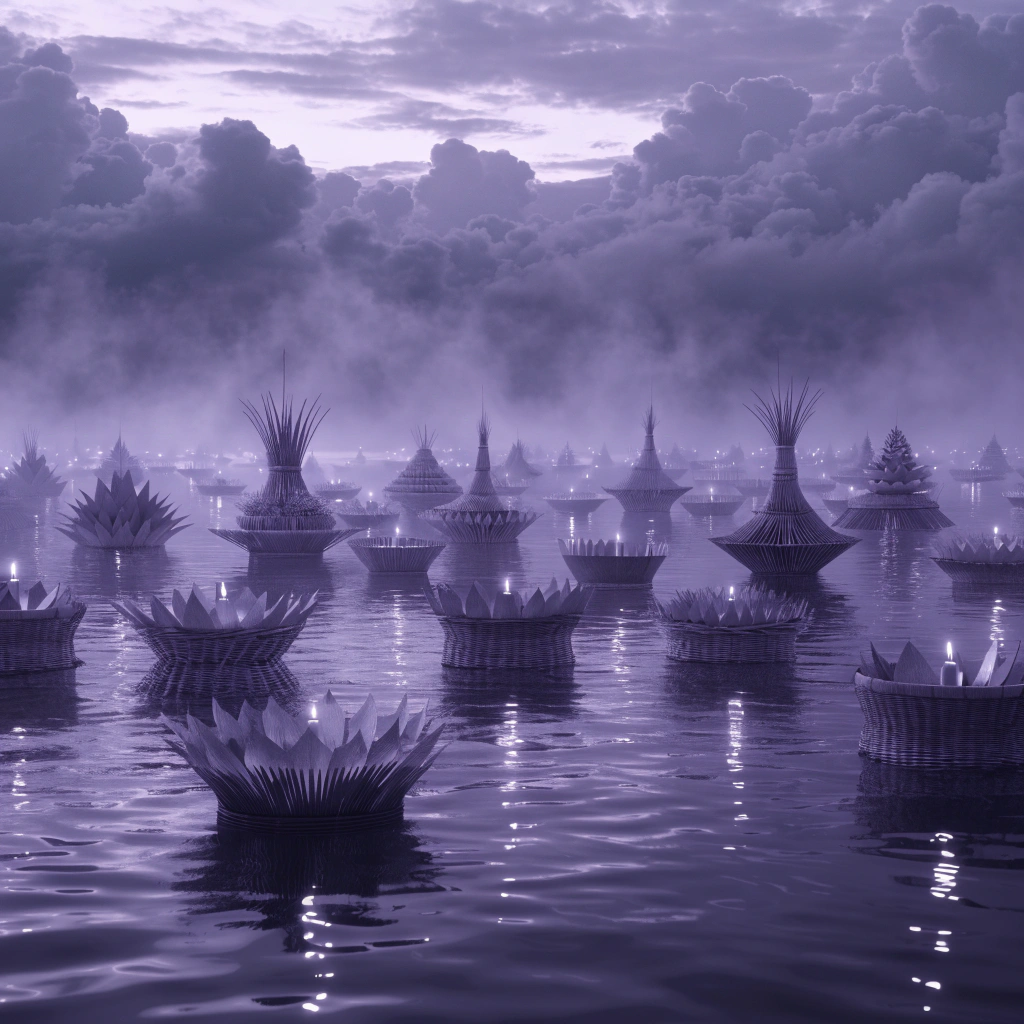
The Festival of Light in Thailand
Thailand has a beautiful festival. It is called Loy Krathong. People celebrate it in November. The moon is big and bright in the sky.
People make small boats. They call them 'krathongs'. The boats are made of banana leaves and flowers. There is a candle and incense on top of the boat.
People go to the river at night. They light the candle. They put the boat on the water. They say thank you to the water goddess. It is very pretty.
Grammar Spotlight
Pattern: Present Simple (to be)
"The moon is big and bright in the sky."
We use 'is' for one thing and 'are' for more than one thing. It describes how things look or what they are.
Pattern: Present Simple (Action Verbs)
"People go to the river at night."
We use the base form of the verb like 'go' or 'make' for plural subjects like 'people'. It describes facts or things that happen regularly.
Test Your Understanding
10 questions · A1 Beginner · 1 free preview
Test what you learned from this article. Answer all questions to earn XP!
In which country is this festival celebrated?
Want to finish the quiz?
9 more questions are waiting for you. Sign up free to unlock the full quiz and earn XP!
Sign Up FreeAlready have an account? Sign In
Question Breakdown
In which country is this festival celebrated?
Your answer:
Correct answer: Thailand
The festival happens in the morning.
Your answer:
Correct answer: False
What is a 'river'?
Your answer:
Correct answer: A long line of water
They put the boat on the _____.
Your answer:
Correct answer: water
The Festival of Lights in Thailand
Loy Krathong is a famous and beautiful festival in Thailand. People celebrate it every year on the full moon night in November. It is one of the most popular festivals in the country.
During this special night, people make small baskets called "krathongs." In the past, people only used banana leaves and wood to build them. Today, some baskets are more colorful than before because people use many bright flowers, incense sticks, and candles.
On the festival night, families go to rivers, lakes, or ponds together. They light the candle on their krathong and carefully put it on the water. They do this because they want to thank the Goddess of Water for her help. Many people also believe the krathong carries away their bad luck.
The rivers look brighter than usual because thousands of lights float on the water. It is a very peaceful and romantic time for everyone. Children and adults enjoy the night together because the atmosphere is magical.
Grammar Spotlight
Pattern: Comparatives (Adjectives)
"Today, some baskets are more colorful than before because people use many bright flowers."
We use 'more' + long adjective + 'than' to compare two things. For short adjectives, we add '-er' like 'brighter than'.
Pattern: Connectors: Because
"They do this because they want to thank the Goddess of Water for her help."
We use 'because' to give a reason for an action. It connects two parts of a sentence.
Test Your Understanding
11 questions · A2 Elementary · 1 free preview
Test what you learned from this article. Answer all questions to earn XP!
When do people celebrate Loy Krathong?
Want to finish the quiz?
10 more questions are waiting for you. Sign up free to unlock the full quiz and earn XP!
Sign Up FreeAlready have an account? Sign In
Question Breakdown
When do people celebrate Loy Krathong?
Your answer:
Correct answer: On the full moon in November
In the past, people only used banana leaves and wood to make krathongs.
Your answer:
Correct answer: True
What does the word 'peaceful' mean?
Your answer:
Correct answer: Quiet and calm
People light the _____ on their krathong before putting it on the water.
Your answer:
Correct answer: candle
Why do people put krathongs on the water?
Your answer:
Correct answer: To thank the Goddess of Water
Loy Krathong: The Festival of Lights in Thailand
Loy Krathong is one of the most beautiful festivals that is celebrated in Thailand every year. It usually takes place on the evening of the full moon in November, which is the 12th month of the Thai lunar calendar. During this special night, thousands of people gather near rivers, lakes, and canals to release small, floating baskets called 'krathongs' into the water.
These krathongs are traditionally handcrafted from the trunks and leaves of banana trees. They are decorated with colorful flowers, three incense sticks, and a single candle. In recent years, many people have started using bread or other biodegradable materials to protect the environment. This change has been welcomed by many who want to keep the rivers clean. The festival is primarily held to honor Phra Mae Khongkha, who is the Goddess of Water. By floating the krathongs, Thai people thank her for the water they use and ask for forgiveness for polluting the rivers during the year.
The sight of thousands of flickering candles on the water is truly magical. It has become a very romantic occasion, so many couples go to the river together to make a wish for their future. In some parts of Northern Thailand, the celebration is combined with 'Yi Peng.' During this event, people also release glowing lanterns into the sky, which creates a breathtaking view both above and below.
Although it is an ancient tradition, Loy Krathong remains a significant part of modern Thai culture. It is a time for families to spend time together and for communities to show respect to nature. If you ever visit Thailand during this season, you will see how this beautiful tradition has survived for centuries while adapting to the modern world.
Grammar Spotlight
Pattern: Passive Voice
"These krathongs are traditionally handcrafted from the trunks and leaves of banana trees."
The passive voice is used here because the action (making the krathong) is more important than who is doing it. It is formed using 'be' + past participle.
Pattern: Relative Clauses
"It usually takes place on the evening of the full moon in November, which is the 12th month of the Thai lunar calendar."
Relative clauses starting with 'which' or 'who' add extra information about a noun. In this case, 'which' provides more detail about the month of November.
Test Your Understanding
11 questions · B1 Intermediate · 1 free preview
Test what you learned from this article. Answer all questions to earn XP!
When does Loy Krathong usually take place?
Want to finish the quiz?
10 more questions are waiting for you. Sign up free to unlock the full quiz and earn XP!
Sign Up FreeAlready have an account? Sign In
Question Breakdown
When does Loy Krathong usually take place?
Your answer:
Correct answer: On the full moon in November
Thai people only use plastic to make krathongs today.
Your answer:
Correct answer: False
What does 'breathtaking' mean?
Your answer:
Correct answer: Extremely beautiful
Thousands of people gather near rivers to _____ small baskets into the water.
Your answer:
Correct answer: release
What is the primary purpose of floating a krathong?
Your answer:
Correct answer: To honor the Goddess of Water
Floating Gratitude: The Cultural and Environmental Significance of Loy Krathong
Loy Krathong, often referred to as Thailand’s most visually stunning festival, occurs annually on the full moon of the twelfth lunar month. While many tourists perceive it merely as a picturesque spectacle of flickering lights on water, the festival is deeply rooted in ancient traditions and complex spiritual beliefs. The term itself translates to "floating a basket," yet the practice encompasses far more than the simple act of releasing a vessel into a river.
Traditionally, these vessels, known as krathongs, are meticulously handcrafted from the trunk and leaves of a banana tree. They are adorned with intricate flower arrangements, incense sticks, and a single candle. Each element carries symbolic weight; for instance, the candle represents knowledge or wisdom, while the incense signifies purity. By launching these baskets, participants pay reverence to Phra Mae Khongkha, the Goddess of Water, expressing gratitude for her life-sustaining bounty and seeking atonement for the pollution of waterways throughout the year.
Moreover, the act of watching one’s krathong float away into the distance is a powerful metaphor for letting go of past grievances, anger, and misfortune. It is widely believed that if the candle remains lit until the basket disappears from sight, it heralds a year of prosperity and good fortune. Consequently, the festival serves as a psychological cleansing, allowing individuals to start anew with a purified spirit.
In recent years, however, the festival has faced scrutiny regarding its environmental impact. The massive influx of krathongs into rivers and canals has led to significant ecological challenges, particularly when non-biodegradable materials like Styrofoam are utilized. This has sparked a nationwide debate concerning the balance between preserving cultural heritage and ensuring environmental sustainability. In response, many contemporary Thais have shifted towards using bread-based or ice-based krathongs, which serve as food for fish or melt without leaving a trace.
Despite these modern adjustments, the essence of Loy Krathong remains unchanged. It continues to be a time for reflection, communal bonding, and a profound acknowledgement of humanity's dependence on the natural world. As the rivers glow with thousands of tiny flames, the festival serves as a poignant reminder of the delicate harmony between tradition and progress.
Grammar Spotlight
Pattern: Passive Voice
"Traditionally, these vessels, known as krathongs, are meticulously handcrafted from the trunk and leaves of a banana tree."
The passive voice is used here to focus on the objects (the vessels) rather than the people making them. It is formed using the verb 'to be' (are) and the past participle (handcrafted).
Pattern: Zero and First Conditional
"It is widely believed that if the candle remains lit until the basket disappears from sight, it heralds a year of prosperity and good fortune."
This structure describes a real possibility or a general belief. It uses 'if' followed by the present simple tense, indicating a predictable outcome based on a condition.
Pattern: Non-defining Relative Clauses
"In response, many contemporary Thais have shifted towards using bread-based or ice-based krathongs, which serve as food for fish or melt without leaving a trace."
The clause starting with 'which' provides extra information about the bread-based krathongs. It is separated by a comma because the sentence would still be grammatically complete without it.
Test Your Understanding
11 questions · B2 Upper Intermediate · 1 free preview
Test what you learned from this article. Answer all questions to earn XP!
What is the primary spiritual purpose of releasing a krathong according to the text?
Want to finish the quiz?
10 more questions are waiting for you. Sign up free to unlock the full quiz and earn XP!
Sign Up FreeAlready have an account? Sign In
Question Breakdown
What is the primary spiritual purpose of releasing a krathong according to the text?
Your answer:
Correct answer: To thank the Water Goddess and seek forgiveness for pollution
The festival is celebrated during the new moon phase of the lunar calendar.
Your answer:
Correct answer: False
Which word describes the ability to maintain something without damaging the environment?
Your answer:
Correct answer: Sustainability
The incense used in the festival specifically signifies _____.
Your answer:
Correct answer: purity
Why has the festival faced criticism in recent years?
Your answer:
Correct answer: Because of the negative impact of non-biodegradable materials on the environment
Ephemeral Vessels: The Paradox of Tradition and Sustainability in Loy Krathong
Seldom does a cultural phenomenon manage to capture the collective imagination of a nation as poignantly as Loy Krathong. Occurring on the full moon of the twelfth lunar month, this Thai festival transcends mere spectacle, embedding itself deeply in the spiritual and ecological consciousness of the populace. At its core, the ritual involves the release of 'krathongs'—meticulously crafted vessels traditionally fashioned from banana stalks and leaves—onto various water bodies across the kingdom. The intended purpose of this act is twofold: to pay homage to Phra Mae Khongkha, the Goddess of Water, for her life-giving bounty, and to symbolically relinquish one's misfortunes, grudges, and transgressions to the current.
It is the sheer intricacy of these floral arrangements that underscores the aesthetic significance of the event. To witness the transformation of a river into a shimmering tapestry of flickering candles is to experience a profound sense of temporal suspension. Each krathong, adorned with incense and flowers, represents a silent prayer or a hope for renewal. However, the contemporary iteration of Loy Krathong is not without its detractors. Critics argue that the commodification of the festival has led to an environmental catastrophe, as non-biodegradable materials, particularly styrofoam and plastic, often find their way into the delicate waterways. What was once a gesture of gratitude has, in some contexts, devolved into an ecological burden that the Goddess herself might find difficult to forgive.
Furthermore, the nominalisation of 'tradition' often masks the dynamic and sometimes contentious nature of cultural practices. While the use of styrofoam was once widespread due to its buoyancy and low cost, recent years have seen a resurgence in the use of organic materials, reflecting a burgeoning environmental awareness among the Thai youth. Never before has the tension between heritage and sustainability been so palpable. This ideological shift suggests that for a tradition to remain relevant in a globalized world, it must undergo a continuous process of re-evaluation and adaptation. The promotion of 'ice krathongs' or digital alternatives highlights a creative attempt to reconcile ancestral rites with modern ecological imperatives.
Moreover, the festival serves as a poignant reminder of the interconnectedness of human life and the natural world. By acknowledging our reliance on water for agriculture, transport, and daily sustenance, we are forced to confront the fragility of our ecosystems. The floating of a krathong is thus not merely a romanticized act of devotion but a nuanced acknowledgment of our environmental stewardship. As the candles drift downstream, they carry with them the hopes and fears of a society caught between the allure of its past and the exigencies of its future. Only by reconciling these disparate elements can Loy Krathong continue to flourish as a beacon of Thai cultural identity, ensuring that the light of tradition does not extinguish the health of the environment it seeks to honor.
Grammar Spotlight
Pattern: Negative Inversion
"Seldom does a cultural phenomenon manage to capture the collective imagination of a nation as poignantly as Loy Krathong."
This structure places a negative or restrictive adverbial at the beginning of the sentence for emphasis, followed by an auxiliary verb and then the subject. It is common in formal C1-level writing to create a dramatic effect.
Pattern: Cleft Sentences
"It is the sheer intricacy of these floral arrangements that underscores the aesthetic significance of the event."
Cleft sentences use 'It is/was... that' to focus on a specific part of the sentence. Here, it emphasizes 'the sheer intricacy' as the primary reason for the event's aesthetic importance.
Pattern: Nominalisation
"The commodification of the festival has led to an environmental catastrophe."
Nominalisation turns verbs or adjectives into nouns (e.g., 'commodify' to 'commodification'). This allows for more abstract, concise, and academic expression of complex ideas.
Test Your Understanding
12 questions · C1 Advanced · 1 free preview
Test what you learned from this article. Answer all questions to earn XP!
What is the primary spiritual motivation behind releasing a krathong?
Want to finish the quiz?
11 more questions are waiting for you. Sign up free to unlock the full quiz and earn XP!
Sign Up FreeAlready have an account? Sign In
Question Breakdown
What is the primary spiritual motivation behind releasing a krathong?
Your answer:
Correct answer: To honor the Water Goddess and release personal negativity
The author suggests that tradition must remain static and unchanging to be authentic.
Your answer:
Correct answer: False
Which word describes something that can be broken down naturally by the environment?
Your answer:
Correct answer: Biodegradable
The floating of a krathong is a nuanced acknowledgment of our environmental _____.
Your answer:
Correct answer: stewardship
What does the text identify as a major contemporary criticism of Loy Krathong?
Your answer:
Correct answer: The environmental impact of non-biodegradable waste
The festival takes place during the twelfth month of the lunar calendar.
Your answer:
Correct answer: True
The Ephemeral Radiance of Loy Krathong: A Convergence of Spiritual Propitiation and Modernity
Seldom does a cultural phenomenon encapsulate the duality of human existence as poignantly as Loy Krathong, Thailand’s ‘Festival of Lights.’ Celebrated on the full moon of the twelfth lunar month, this spectacle is far more than a mere aestheticized display of floating baskets; it is a profound ontological dialogue between the practitioner and the elemental forces of nature. Were the observer to scrutinize the ritual beyond its surface-level allure, they would discover a complex tapestry of religious syncretism, where Brahmanical roots and Buddhist philosophy intertwine to honor Phra Mae Khongkha, the Goddess of Water. The act of ‘loying’ (floating) a ‘krathong’ (a lotus-shaped vessel traditionally fashioned from banana trunks) represents a quintessential moment of spiritual catharsis. It is through the act of releasing the krathong that the individual ostensibly relinquishes their spiritual defilements, or ‘kilesa,’ allowing their misfortunes to drift away upon the river’s current.
Historically, the origins of Loy Krathong are shrouded in the mists of the Sukhothai era, though scholars argue its current form is a nineteenth-century reconstruction of older, vestigial rites. Regardless of its historiography, the festival remains inextricably linked to the Thai agrarian psyche. In a nation where water is the lifeblood of rice cultivation, the propitiation of water spirits is not merely a superstitious relic but a vital acknowledgment of human dependency on the environment. The flicker of thousands of candles upon the water’s surface creates a sense of evanescence, a visual metaphor for the Buddhist concept of ‘Anicca,’ or impermanence. Every meticulously crafted petal and every stick of incense serves as a temporary tribute, destined to be reclaimed by the very waters it seeks to honor.
However, the modern iteration of this rite is not without its deleterious consequences, posing a paradoxical challenge to contemporary Thai society. In recent decades, the sheer volume of vessels launched into Thailand’s fluvial networks has prompted a critical discourse regarding environmental sustainability. While the transition from non-biodegradable styrofoam back to traditional organic materials was a step toward mitigation, the sheer mass of decaying organic matter still causes significant oxygen depletion in urban waterways. This environmental toll has led some to advocate for a more symbolic, or even digital, participation in the festival—a move that traditionalists argue might dilute the ritual's tactile sanctity. The tension between preserving an ancient heritage and mitigating its ecological footprint exemplifies the broader global struggle to reconcile traditional practices with the exigencies of the Anthropocene.
Furthermore, the rampant commodification of Loy Krathong by the global tourism industry has shifted the festival’s gravity from a communal, localized act of merit-making to a staged performance of ‘Thainess.’ In bustling hubs like Bangkok and Chiang Mai, the spiritual quietude of the ritual is often eclipsed by pyrotechnic displays and beauty pageants. Yet, despite this commercial veneer, the core of the festival remains resilient. For many, the act of kneeling by a riverbank remains a deeply personal moment of reflection. The juxtaposition of the ancient and the modern—of biodegradable bread-krathongs being nibbled by fish while drones capture the scene from above—highlights the fluidity of culture. Ultimately, Loy Krathong survives because it offers a rare opportunity for collective introspection, reminding us that while our grievances may be ephemeral, our responsibility toward the waters that sustain us is eternal.
Grammar Spotlight
Pattern: Inversion with negative/restrictive expressions
"Seldom does a cultural phenomenon encapsulate the duality of human existence as poignantly as Loy Krathong."
When 'seldom' or other negative adverbs start a sentence for emphasis, the auxiliary verb is placed before the subject. This creates a formal, rhetorical tone typical of C2 writing.
Pattern: The Second Conditional with 'Were' (Inverted Subjunctive)
"Were the observer to scrutinize the ritual beyond its surface-level allure, they would discover a complex tapestry..."
This is a formal alternative to 'If the observer were to scrutinize'. It uses inversion to express a hypothetical condition, common in scholarly or analytical prose.
Pattern: Cleft Sentences for Emphasis
"It is through the act of releasing the krathong that the individual ostensibly relinquishes their spiritual defilements."
An 'It is... that...' cleft sentence focuses the reader's attention on a specific part of the information (the act of releasing). It highlights the importance of the method over the result.
Test Your Understanding
12 questions · C2 Mastery · 1 free preview
Test what you learned from this article. Answer all questions to earn XP!
What does the author suggest is the deeper 'ontological' purpose of Loy Krathong?
Want to finish the quiz?
11 more questions are waiting for you. Sign up free to unlock the full quiz and earn XP!
Sign Up FreeAlready have an account? Sign In
Question Breakdown
What does the author suggest is the deeper 'ontological' purpose of Loy Krathong?
Your answer:
Correct answer: A dialogue between humans and the elemental forces of nature.
The author claims that the current form of Loy Krathong is an exact, unaltered replica of Sukhothai era rituals.
Your answer:
Correct answer: False
Which word describes the process of turning a spiritual ritual into a commercial product?
Your answer:
Correct answer: Commodification
The author notes that organic materials still cause _____ depletion in urban waterways.
Your answer:
Correct answer: oxygen
According to the text, what does the 'evanescence' of the candles symbolize in Buddhist thought?
Your answer:
Correct answer: The concept of impermanence (Anicca).
The text suggests that the environmental impact of the festival has led some to favor digital alternatives.
Your answer:
Correct answer: True
