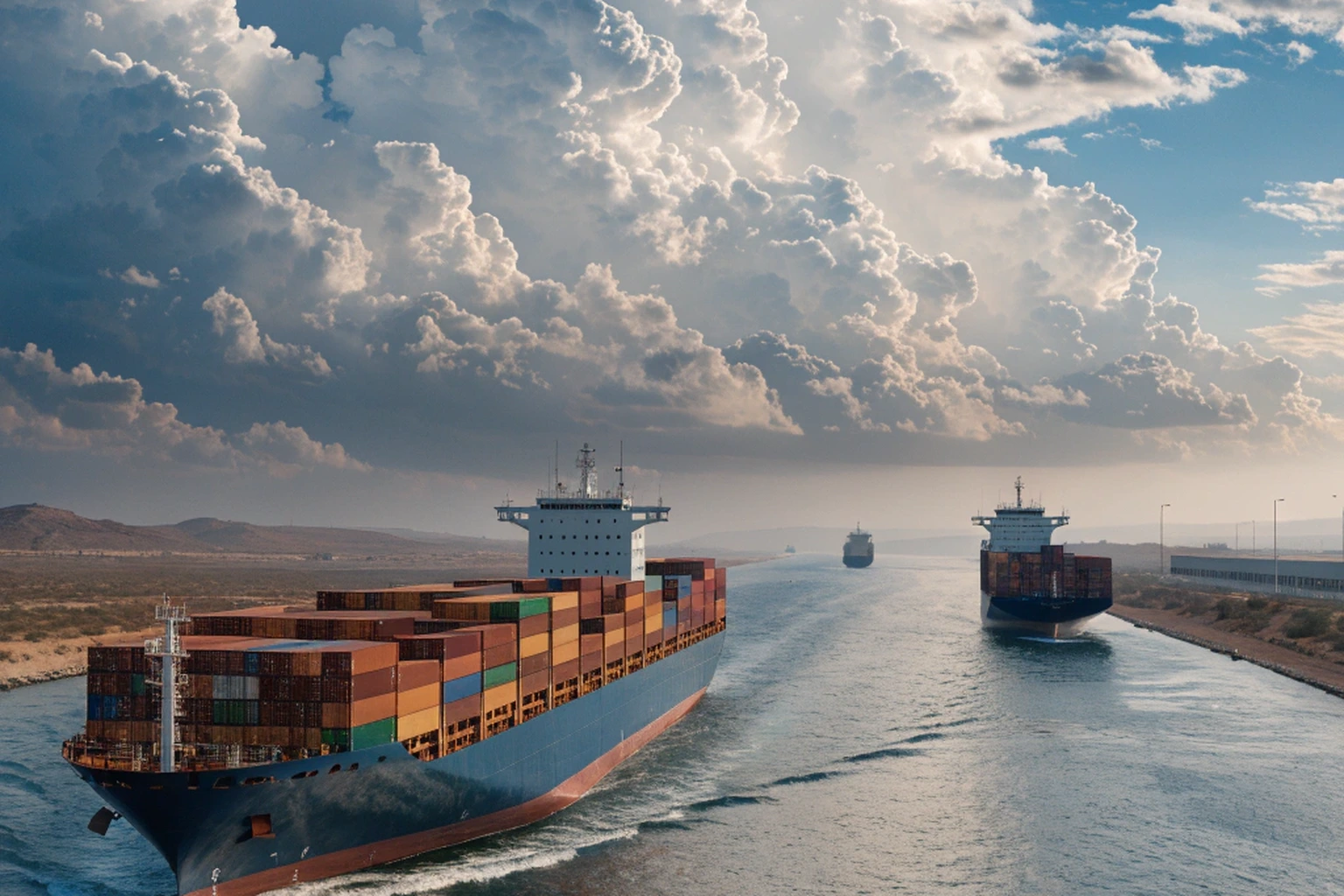
The Suez Canal: A Fast Waterway
The Suez Canal is in Egypt. It is a very big waterway. It connects the Mediterranean Sea and the Red Sea. This is very important for trade.
Many ships use the Suez Canal. The ships are big and carry many things. They carry cars, food, and clothes. The canal helps ships travel fast. It is a shortcut between Europe and Asia.
The canal is important for the world. It helps trade between many countries. It is a busy place every day.
Gramática destacada
Patrón: Present Simple: 'to be'
"The Suez Canal is in Egypt."
We use 'is' to describe one person or thing. It tells us what it is or where it is. For example, 'The apple is red'.
Patrón: Present Simple: Verb + s
"It connects the Mediterranean Sea and the Red Sea."
We add 's' to a verb when we talk about what 'it', 'he', or 'she' does. For example, 'She reads a book'.
Pon a prueba tu comprensión
10 preguntas · A1 Principiante · 1 vista previa gratis
Pon a prueba lo que aprendiste en este artículo. ¡Responde todas las preguntas para ganar XP!
Where is the Suez Canal?
¿Quieres terminar el quiz?
9 preguntas más te esperan. ¡Regístrate gratis para desbloquear el quiz completo y ganar XP!
Regístrate gratis¿Ya tienes cuenta? Acceder
Desglose de preguntas
Where is the Suez Canal?
Tu respuesta:
Respuesta correcta: Egypt
The Suez Canal is a small waterway.
Tu respuesta:
Respuesta correcta: Falso
What does 'ship' mean?
Tu respuesta:
Respuesta correcta: A very big boat for the sea
The canal helps ships travel ____.
Tu respuesta:
Respuesta correcta: fast
The Suez Canal: A Famous Shortcut
The Suez Canal is a very important waterway in Egypt. It connects the Mediterranean Sea and the Red Sea. It is a famous shortcut for ships because they do not have to travel around Africa. This makes their journeys much faster and shorter.
People opened the canal in 1869. It was a very big project for engineers at that time. Today, the canal is 193 kilometers long. It is the shortest route between Europe and Asia. Many ships use it every day because they want to save time and money.
Global trade is very important for the world. About 12% of all trade goes through the Suez Canal. Huge ships carry food, oil, and clothes through Egypt. The canal is more important now than in the past because more people buy things from different countries. It is a vital part of the Egyptian economy and helps the whole world.
Gramática destacada
Patrón: Past Simple
"People opened the canal in 1869."
We use the past simple to talk about finished actions in the past. For regular verbs, we usually add '-ed' to the end of the verb.
Patrón: Comparatives
"This makes their journeys much faster and shorter."
We use comparatives to compare two things. For short adjectives, we add '-er' to the end of the word.
Pon a prueba tu comprensión
11 preguntas · A2 Básico · 1 vista previa gratis
Pon a prueba lo que aprendiste en este artículo. ¡Responde todas las preguntas para ganar XP!
Where is the Suez Canal located?
¿Quieres terminar el quiz?
10 preguntas más te esperan. ¡Regístrate gratis para desbloquear el quiz completo y ganar XP!
Regístrate gratis¿Ya tienes cuenta? Acceder
Desglose de preguntas
Where is the Suez Canal located?
Tu respuesta:
Respuesta correcta: Egypt
The Suez Canal connects the Mediterranean Sea and the Red Sea.
Tu respuesta:
Respuesta correcta: Verdadero
What is a 'shortcut'?
Tu respuesta:
Respuesta correcta: A quicker way to get somewhere
Today, the canal is 193 _____ long.
Tu respuesta:
Respuesta correcta: kilometers
In which year did people open the canal?
Tu respuesta:
Respuesta correcta: 1869
The Vital Link: The Suez Canal and Global Trade
The Suez Canal is an artificial sea-level waterway in Egypt that connects the Mediterranean Sea to the Red Sea. It separates the African continent from Asia and provides the shortest maritime route between Europe and the lands lying around the Indian and western Pacific Oceans. Since it was opened in November 1869, the canal has changed global trade forever.
Before the canal existed, ships traveling from Europe to Asia had to sail around the southern tip of Africa. This journey was very long and dangerous. Today, the canal is used by thousands of vessels every year. It is estimated that about 12% of total global trade passes through this 193-kilometer passage. This includes essential goods such as crude oil, natural gas, machinery, and food products.
The canal is managed by the Suez Canal Authority, which is owned by the Egyptian government. In recent years, significant improvements have been made to the waterway. For example, a major expansion was completed in 2015. This project has increased the capacity of the canal, allowing more ships to pass through daily and reducing the waiting time significantly.
For Egypt, the canal is extremely important. It brings foreign currency into the country and creates jobs for many local people. However, the canal can be affected by global events. If a ship gets stuck, it can cause delays for the whole world. Despite these challenges, the Suez Canal remains a vital artery for international commerce. It is a symbol of human engineering that continues to connect the East and the West efficiently.
Gramática destacada
Patrón: Present Perfect Simple
"Since it was opened in November 1869, the canal has changed global trade forever."
We use the Present Perfect here to describe an action that started in the past (1869) and continues to have an effect or is still relevant in the present.
Patrón: Passive Voice
"Today, the canal is used by thousands of vessels every year."
The passive voice ('is used') is used here because the focus is on the object (the canal) rather than the subject (who uses it). It is common in formal descriptions.
Pon a prueba tu comprensión
11 preguntas · B1 Intermedio · 1 vista previa gratis
Pon a prueba lo que aprendiste en este artículo. ¡Responde todas las preguntas para ganar XP!
What two bodies of water does the Suez Canal connect?
¿Quieres terminar el quiz?
10 preguntas más te esperan. ¡Regístrate gratis para desbloquear el quiz completo y ganar XP!
Regístrate gratis¿Ya tienes cuenta? Acceder
Desglose de preguntas
What two bodies of water does the Suez Canal connect?
Tu respuesta:
Respuesta correcta: The Mediterranean Sea and the Red Sea
Before the canal, ships had to travel around the southern tip of Africa.
Tu respuesta:
Respuesta correcta: Verdadero
Which word means 'made by people, not natural'?
Tu respuesta:
Respuesta correcta: artificial
The canal is managed by the Suez Canal _____.
Tu respuesta:
Respuesta correcta: authority
When was the major expansion of the canal completed?
Tu respuesta:
Respuesta correcta: 2015
The Suez Canal: A Gateway to Global Trade
The Suez Canal is widely regarded as a masterpiece of modern engineering and a vital artery for global trade. Situated in Egypt, this artificial sea-level waterway connects the Mediterranean Sea to the Red Sea, effectively dividing the continents of Africa and Asia. Before its construction, ships traveling between Europe and Asia were forced to navigate around the Cape of Good Hope at the southern tip of Africa, a perilous journey that added weeks to their schedule and significantly increased transport costs.
The canal was officially opened in November 1869 after ten years of arduous construction. It was designed by the French diplomat Ferdinand de Lesseps, although the physical labor was primarily performed by tens of thousands of Egyptian workers. Despite the immense challenges faced during its creation, the canal revolutionized international commerce by dramatically reducing shipping distances. Today, it facilitates the passage of approximately 12% of global trade, serving as a conduit for energy resources, consumer goods, and raw materials.
Economically, the canal is a cornerstone of the Egyptian economy. It generates billions of dollars in annual revenue, providing essential foreign currency for the nation's development. In recent years, the Egyptian government has implemented significant modernization projects to maintain the canal's competitiveness. For instance, the 'New Suez Canal' project, which was inaugurated in 2015, deepened the main waterway and created a parallel channel. This expansion has allowed for two-way traffic and accommodated larger vessels, thereby increasing the canal's daily capacity and reducing waiting times.
However, the importance of the canal extends beyond mere economics; it is a symbol of strategic geopolitical power. Control over this passage has historically been a source of tension, yet it remains a neutral zone open to vessels of commerce from all nations in times of peace. As global supply chains become increasingly interconnected, the efficiency and security of the Suez Canal are more critical than ever. In conclusion, the Suez Canal is not just a body of water but a lifeline for the modern world, ensuring the smooth flow of goods across the globe.
Gramática destacada
Patrón: Passive Voice
"The canal was officially opened in November 1869."
The passive voice is used when the focus is on the action (opening the canal) rather than who performed the action. It is formed using the verb 'to be' + the past participle.
Patrón: Relative Clauses
"The 'New Suez Canal' project, which was inaugurated in 2015, deepened the main waterway."
Relative clauses provide extra information about a noun. In this example, 'which' adds non-essential details about the project without starting a new sentence.
Patrón: Present Perfect Simple
"This expansion has allowed for two-way traffic."
The present perfect simple is used to describe an action that happened in the past but has a result or relevance in the present. It is formed with 'have/has' + the past participle.
Pon a prueba tu comprensión
11 preguntas · B2 Intermedio alto · 1 vista previa gratis
Pon a prueba lo que aprendiste en este artículo. ¡Responde todas las preguntas para ganar XP!
Why was the Suez Canal constructed?
¿Quieres terminar el quiz?
10 preguntas más te esperan. ¡Regístrate gratis para desbloquear el quiz completo y ganar XP!
Regístrate gratis¿Ya tienes cuenta? Acceder
Desglose de preguntas
Why was the Suez Canal constructed?
Tu respuesta:
Respuesta correcta: To reduce the travel distance between Europe and Asia
The 'New Suez Canal' project allows for two-way traffic.
Tu respuesta:
Respuesta correcta: Verdadero
Which word means 'full of danger or risk'?
Tu respuesta:
Respuesta correcta: Perilous
The canal is considered a _____ of the Egyptian economy because it generates significant revenue.
Tu respuesta:
Respuesta correcta: cornerstone
What percentage of global trade passes through the canal?
Tu respuesta:
Respuesta correcta: 12%
The Suez Canal: A Geopolitical Artery of Global Trade
Rarely in the annals of engineering has a project redefined geography as profoundly as the Suez Canal. Since its inauguration in 1869, this artificial waterway has severed the land bridge between Africa and Asia, creating a maritime conduit that is indispensable to the modern world. Stretching 193 kilometers from Port Said on the Mediterranean to Suez on the Red Sea, the canal does not merely shorten travel distances; it fundamentally underpins the efficiency of international logistics.
Had this passage not been constructed, vessels traveling between Europe and Asia would be compelled to undertake the circumnavigation of Africa via the Cape of Good Hope. Such a detour would add thousands of kilometers to the journey, incurring exorbitant fuel costs and significantly extending delivery times. It is the sheer volume of goods traversing this narrow passage—accounting for approximately 12% of global trade and nearly 30% of global container traffic—that underscores its strategic paramountcy.
However, the canal represents more than a feat of excavation; it is a critical bottleneck in the global supply chain. As demonstrated by recent blockages, a momentary disruption in this artery can induce cascading delays across ports worldwide. What makes the canal particularly vulnerable is the increasing size of modern container ships, some of which are longer than the Eiffel Tower is tall. The navigation of these behemoths requires precision, and the margins for error are vanishingly small.
For Egypt, the canal is a potent symbol of national sovereignty and a vital source of foreign currency revenue. The government has heavily invested in the expansion of the waterway, aiming to accommodate two-way traffic and larger tonnage. These infrastructural enhancements reflect a recognition that the canal's relevance is not static but requires continuous adaptation to the evolving demands of maritime commerce. Critics might argue that reliance on a single route is precarious, yet the lack of viable alternatives ensures the Suez Canal remains the linchpin of East-West trade.
Ultimately, the Suez Canal serves as a barometer for the global economy. Its operations reflect the pulse of international relations, energy security, and consumer demand. As the world moves toward greener shipping solutions and grapples with geopolitical instability, the management of this waterway will remain a focal point of global attention. It is this duality—being both a local asset and a global necessity—that defines the enduring legacy of the Suez Canal.
Gramática destacada
Patrón: Inversion with Negative Adverbials
"Rarely in the annals of engineering has a project redefined geography as profoundly as the Suez Canal."
When a sentence starts with a negative adverbial (like 'Rarely', 'Never', 'Little'), the subject and auxiliary verb are inverted. This creates a dramatic effect and emphasizes the uniqueness of the situation.
Patrón: Cleft Sentences
"It is the sheer volume of goods traversing this narrow passage... that underscores its strategic paramountcy."
Cleft sentences (starting with 'It is/was... that...') are used to focus attention on a specific part of the sentence. Here, it emphasizes that the 'volume of goods' is the specific reason for the canal's importance.
Patrón: Participle Clauses
"Stretching 193 kilometers from Port Said... the canal does not merely shorten travel distances."
Participle clauses (starting with -ing verbs like 'Stretching') allow writers to combine information concisely. It provides background information about the subject (the canal) without needing a separate sentence.
Pon a prueba tu comprensión
12 preguntas · C1 Avanzado · 1 vista previa gratis
Pon a prueba lo que aprendiste en este artículo. ¡Responde todas las preguntas para ganar XP!
According to the article, what is a primary consequence of not having the Suez Canal?
¿Quieres terminar el quiz?
11 preguntas más te esperan. ¡Regístrate gratis para desbloquear el quiz completo y ganar XP!
Regístrate gratis¿Ya tienes cuenta? Acceder
Desglose de preguntas
According to the article, what is a primary consequence of not having the Suez Canal?
Tu respuesta:
Respuesta correcta: Ships would have to circle Africa, increasing costs and time.
The Suez Canal handles approximately 30% of the world's total global trade volume.
Tu respuesta:
Respuesta correcta: Falso
Which word means 'unreasonably high'?
Tu respuesta:
Respuesta correcta: Exorbitant
The canal is described as a critical ______ in the global supply chain, where disruption can cause delays.
Tu respuesta:
Respuesta correcta: bottleneck
What point does the author make about modern container ships?
Tu respuesta:
Respuesta correcta: Their massive size makes navigation difficult and risky.
The Egyptian government views the canal solely as a historical monument, not an economic asset.
Tu respuesta:
Respuesta correcta: Falso
The Arterial Pulse of Commerce: The Suez Canal’s Geopolitical Hegemony
Since its inauguration in 1869, the Suez Canal has not merely served as a navigational convenience but has established itself as the quintessential artery of globalized commerce. By bisecting the African and Asian continents, this engineering marvel rendered the arduous circumnavigation of the Cape of Good Hope obsolete for European-Asian trade. However, the canal’s significance transcends mere geography; it represents a geopolitical fulcrum upon which the stability of international markets precariously balances.
Ideally, such critical infrastructure would operate in a vacuum, immune to the vagaries of political strife or mechanical failure. Yet, reality paints a starker picture. The canal functions as a maritime bottleneck, a choke point where the immense velocity of modern capital is forced through a narrow desert corridor. The sheer volume of goods—accounting for approximately 12% of global trade—that traverses this waterway daily is staggering. Were the canal to cease operations, as was dramatically witnessed during the 2021 obstruction by the *Ever Given*, the repercussions would be immediate and catastrophic. That incident served as a potent reminder of the fragility inherent in our "just-in-time" global supply chains. It demonstrated that a single vessel, run aground by a gust of wind and perhaps a momentary lapse in judgment, could precipitate a crisis costing the global economy billions of dollars per day.
For Egypt, the canal is inextricably linked to national identity and economic sovereignty. The 2015 expansion, often heralded as the "New Suez Canal," was not only an effort to augment capacity and reduce waiting times but also a profound assertion of national pride. It is imperative that the canal be viewed not just as a toll-generating utility, but as a barometer of Egypt’s strategic relevance. The revenue generated is vital for the nation's coffers, providing a lifeline of hard currency, yet the pressure to maintain security and efficiency is immense. The Egyptian government must constantly balance the demands of international shipping conglomerates with the exigencies of domestic security.
Critics might argue that reliance on such a singular route is imprudent. Indeed, discussions regarding alternative routes, such as the thawing Arctic passages or revitalized rail links across Eurasia, have gained traction in recent years. Nevertheless, these alternatives remain fraught with their own logistical and geopolitical hurdles. For the foreseeable future, the Suez Canal remains without equal. The cost-benefit analysis overwhelmingly favors the maritime shortcut through Egypt, despite the inherent risks of regional instability or piracy.
The interplay between local stewardship and global dependency creates a unique tension. Egypt acts as the custodian of a global public good, a role that demands diplomatic dexterity. Should regional tensions flare, the canal’s security becomes a matter of international concern, prompting naval deployments and heightened rhetoric. Thus, the water flowing through the Suez is metaphorically thicker than the seawater it physically consists of; it is laden with the weight of history, power, and money.
To suggest that the canal’s relevance might diminish in the coming decades would be to underestimate the inertia of established trade routes. While the modes of propulsion may shift from heavy fuel oil to green hydrogen, and the ships themselves may become autonomous, the geographical logic that dictated the canal’s creation remains immutable. It stands as a testament to the enduring human desire to conquer geography in the service of trade.
Gramática destacada
Patrón: Inversion in Conditional Sentences
"Were the canal to cease operations, as was dramatically witnessed during the 2021 obstruction by the Ever Given, the repercussions would be immediate and catastrophic."
This is a formal way to express a hypothetical condition without using 'if'. The auxiliary verb 'Were' is placed before the subject 'the canal'. It is equivalent to 'If the canal were to cease operations...' and adds a tone of sophistication and formality.
Patrón: The Mandative Subjunctive
"It is imperative that the canal be viewed not just as a toll-generating utility, but as a barometer of Egypt’s strategic relevance."
The subjunctive mood is used here after an adjective expressing necessity ('imperative'). The verb 'be' remains in its base form, regardless of the subject. This structure emphasizes the importance of the action.
Patrón: Reporting Verbs in Passive Structures
"The 2015 expansion, often heralded as the "New Suez Canal," was not only an effort to augment capacity..."
The phrase 'heralded as' functions as a reduced relative clause (short for 'which was heralded as'). This passive construction shifts focus from who did the heralding to the expansion itself, typical of academic writing.
Pon a prueba tu comprensión
12 preguntas · C2 Dominio · 1 vista previa gratis
Pon a prueba lo que aprendiste en este artículo. ¡Responde todas las preguntas para ganar XP!
According to the article, what role does the Suez Canal play in global economics beyond simple geography?
¿Quieres terminar el quiz?
11 preguntas más te esperan. ¡Regístrate gratis para desbloquear el quiz completo y ganar XP!
Regístrate gratis¿Ya tienes cuenta? Acceder
Desglose de preguntas
According to the article, what role does the Suez Canal play in global economics beyond simple geography?
Tu respuesta:
Respuesta correcta: It acts as a geopolitical fulcrum for market stability.
The author suggests that alternative trade routes like the Arctic passage have made the Suez Canal largely obsolete.
Tu respuesta:
Respuesta correcta: Falso
Select the synonym for 'precipitate' as used in the text.
Tu respuesta:
Respuesta correcta: Trigger
The 2021 obstruction of the canal highlighted the fragility of 'just-in-time' global _____ chains.
Tu respuesta:
Respuesta correcta: supply
What does the author imply about the 2015 expansion of the canal?
Tu respuesta:
Respuesta correcta: It was an assertion of national pride as well as a logistical upgrade.
What does 'immutable' mean in the context of the article's conclusion?
Tu respuesta:
Respuesta correcta: Unchanging

