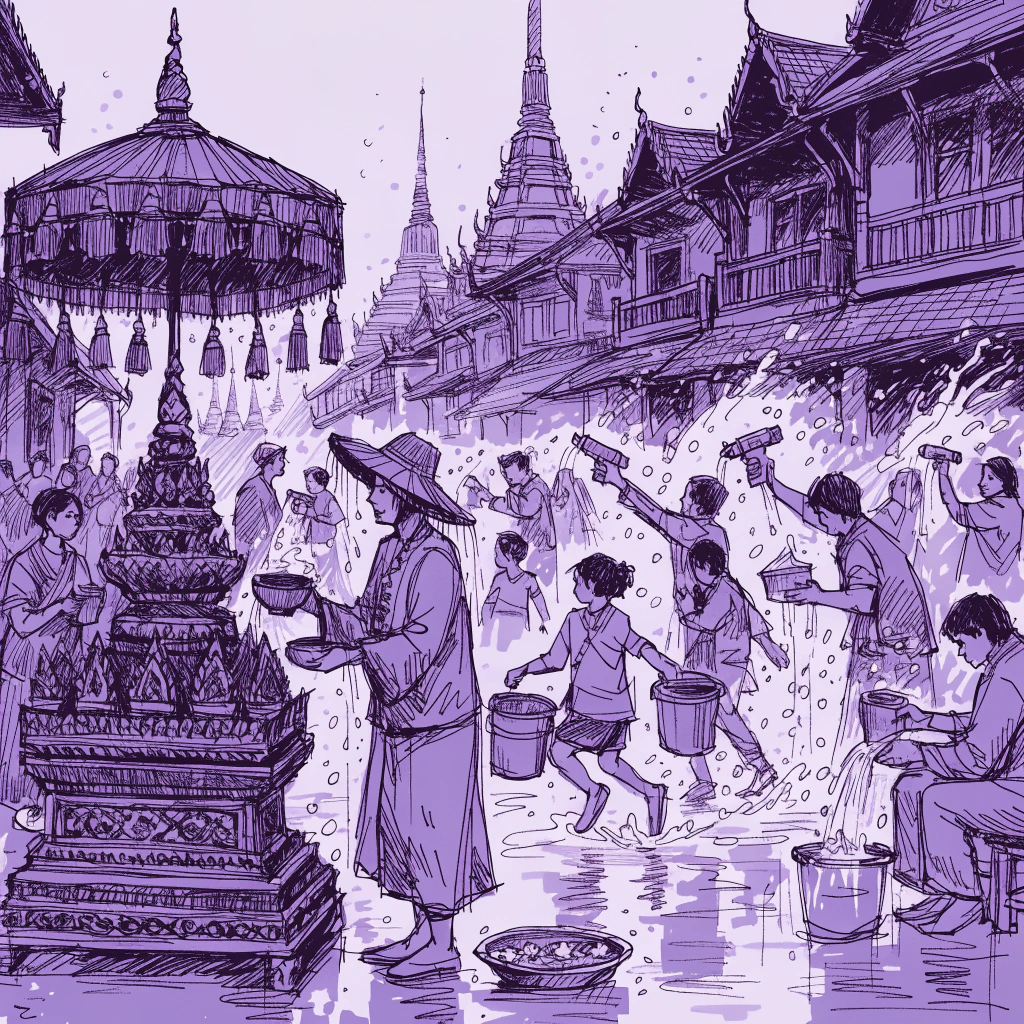
Songkran: The Water Festival
Songkran is the Thai New Year. It is in April every year. The weather in Thailand is very hot during this time. People celebrate for three days.
Water is very important for this festival. People splash water on each other. They use buckets and water guns. It is a big water fight in the street.
Families meet together. They visit temples and pray. They also clean their houses for a new start. Everyone is happy and smiles.
Gramática destacada
Patrón: Present Simple (to be)
"Songkran is the Thai New Year."
We use 'is' with singular subjects to describe facts. It shows what something is or how it feels.
Patrón: Present Simple (Action Verbs)
"People splash water on each other."
We use the base form of the verb with plural subjects like 'people'. This describes a regular activity during the festival.
Pon a prueba tu comprensión
10 preguntas · A1 Principiante · 1 vista previa gratis
Pon a prueba lo que aprendiste en este artículo. ¡Responde todas las preguntas para ganar XP!
When is Songkran?
¿Quieres terminar el quiz?
9 preguntas más te esperan. ¡Regístrate gratis para desbloquear el quiz completo y ganar XP!
Regístrate gratis¿Ya tienes cuenta? Acceder
Desglose de preguntas
When is Songkran?
Tu respuesta:
Respuesta correcta: In April
Songkran is in the winter when it is cold.
Tu respuesta:
Respuesta correcta: Falso
What does the word 'clean' mean?
Tu respuesta:
Respuesta correcta: To remove dirt from something
People splash _____ on each other during the festival.
Tu respuesta:
Respuesta correcta: water
Celebrating Songkran: The Thai New Year
Songkran is the most famous festival in Thailand. It happens every year from April 13th to 15th. This is the traditional Thai New Year. April is the hottest month in Thailand, so water is very important for everyone.
In the morning, people go to temples because they want to pray and give food to monks. They also clean their houses and statues of Buddha. Many people travel to their hometowns to see their families. They pour a little water on the hands of older family members. This shows respect and brings good luck for the new year.
But Songkran is also very fun and noisy! In the streets, people have huge water fights. They use buckets and water guns to splash each other. Songkran is more exciting than other holidays because everyone joins the party. It is a special time for cleansing and starting a new life. It is a beautiful celebration of Thai culture.
Gramática destacada
Patrón: Connectors: Because
"In the morning, people go to temples because they want to pray and give food to monks."
We use 'because' to give a reason for an action. It connects two parts of a sentence to explain why something happens.
Patrón: Comparatives: More + Adjective + Than
"Songkran is more exciting than other holidays because everyone joins the party."
For long adjectives like 'exciting', we use 'more' before the adjective and 'than' after it to compare two things.
Pon a prueba tu comprensión
11 preguntas · A2 Básico · 1 vista previa gratis
Pon a prueba lo que aprendiste en este artículo. ¡Responde todas las preguntas para ganar XP!
When is the Songkran festival celebrated?
¿Quieres terminar el quiz?
10 preguntas más te esperan. ¡Regístrate gratis para desbloquear el quiz completo y ganar XP!
Regístrate gratis¿Ya tienes cuenta? Acceder
Desglose de preguntas
When is the Songkran festival celebrated?
Tu respuesta:
Respuesta correcta: In April
Songkran is celebrated during the coldest month in Thailand.
Tu respuesta:
Respuesta correcta: Falso
What does the word 'respect' mean?
Tu respuesta:
Respuesta correcta: To show admiration for someone
April is the _____ month in Thailand.
Tu respuesta:
Respuesta correcta: hottest
What do people use to splash each other in the streets?
Tu respuesta:
Respuesta correcta: Buckets and water guns
Songkran: La Fiesta del Agua y la Renovación en Tailandia
Cada mes de abril, Tailandia se transforma con la llegada de Songkran, la celebración de su Año Nuevo tradicional. Esta fiesta, que marca un nuevo comienzo, es sin duda la más famosa y exuberante del país. Aunque las fechas oficiales son del 13 al 15 de abril, en algunas regiones las festividades pueden extenderse por una semana o incluso más.
La palabra 'Songkran' proviene del sánscrito y significa 'pasaje astrológico', refiriéndose al momento en que el sol entra en el signo zodiacal de Aries. Es un tiempo de profunda significación cultural y espiritual. Aunque internacionalmente se ha hecho famosa por las enormes batallas de agua en las calles, Songkran es mucho más que eso. Fundamentalmente, es una época de limpieza, renovación y gratitud.
Durante estos días, las familias tailandesas se reúnen, visitan templos y rinden homenaje a los ancianos. Una tradición importante es verter agua perfumada sobre las estatuas de Buda, lo que simboliza la purificación y la buena fortuna para el nuevo año. También se vierte agua suavemente sobre las manos de los mayores para mostrar respeto y recibir sus bendiciones. Estas prácticas reflejan la verdadera esencia de Songkran, que es un tiempo para "limpiar" lo viejo y dar la bienvenida a lo nuevo con esperanza y alegría.
Las batallas de agua, aunque divertidas, son una evolución moderna de la tradición de verter agua, que originalmente era un acto simbólico de purificación. Hoy en día, tanto locales como turistas participan con entusiasmo en estas guerras acuáticas masivas, creando una atmósfera de felicidad y unidad por todo el país. Es una experiencia inolvidable que combina la diversión con el respeto por las antiguas costumbres.
Gramática destacada
Patrón: La voz pasiva con 'se'
"Aunque internacionalmente se ha hecho famosa por las enormes batallas de agua en las calles, Songkran es mucho más que eso."
Usamos la voz pasiva con 'se' para describir una acción sin mencionar quién la realiza. Se forma con 'se' + un verbo en tercera persona del singular o plural, dependiendo del sujeto. Es muy común en español para hablar de costumbres o hechos generales.
Patrón: Oraciones de relativo con 'que'
"Esta fiesta, que marca un nuevo comienzo, es sin duda la más famosa y exuberante del país."
Las oraciones de relativo con 'que' se usan para añadir información sobre un sustantivo mencionado anteriormente. 'Que' funciona como un conector que se refiere al sustantivo y lo describe, evitando repetir palabras. Puede referirse a personas o cosas.
Pon a prueba tu comprensión
11 preguntas · B1 Intermedio · 1 vista previa gratis
Pon a prueba lo que aprendiste en este artículo. ¡Responde todas las preguntas para ganar XP!
¿Cuál es el significado original de la palabra 'Songkran'?
¿Quieres terminar el quiz?
10 preguntas más te esperan. ¡Regístrate gratis para desbloquear el quiz completo y ganar XP!
Regístrate gratis¿Ya tienes cuenta? Acceder
Desglose de preguntas
¿Cuál es el significado original de la palabra 'Songkran'?
Tu respuesta:
Respuesta correcta: Pasaje astrológico
Songkran solo se celebra durante tres días en toda Tailandia.
Tu respuesta:
Respuesta correcta: Falso
¿Qué significa 'exuberante'?
Tu respuesta:
Respuesta correcta: Que muestra gran alegría y vitalidad
Las familias tailandesas se reúnen, visitan templos y rinden _______ a los ancianos.
Tu respuesta:
Respuesta correcta: homenaje
¿Qué simboliza verter agua sobre las estatuas de Buda?
Tu respuesta:
Respuesta correcta: Purificación y buena fortuna
Songkran: More Than Just the World's Largest Water Fight
Songkran, the traditional Thai New Year, is widely recognized as one of the most exuberant festivals globally. Although many international visitors associate the event primarily with massive, city-wide water fights, its cultural significance runs much deeper. Rooted in ancient traditions, Songkran marks the sun’s transition into the zodiac sign of Aries, signifying a period of rejuvenation and fresh beginnings. Historically, the dates were determined by the lunar calendar, but they have now been fixed from April 13th to 15th to facilitate modern scheduling.
The essence of Songkran is fundamentally linked to the concept of cleansing. Water is used as a symbolic element to wash away the misfortunes of the past year, providing a clean slate for the future. Traditionally, this was a quiet affair where family members would gather to show reverence to their elders. Younger generations would pour scented water over the hands of parents and grandparents, seeking their blessings for the year ahead. Furthermore, visiting local temples to perform merit-making activities remains a core component of the celebration. These rituals exemplify the Thai value of 'Nam Jai', or spontaneous generosity.
However, the festival has undergone a significant transformation due to modernization and the influx of global tourism. In urban centers like Bangkok and Chiang Mai, the gentle pouring of water has evolved into high-energy street parties. While some critics argue that the spiritual meaning is being overshadowed by commercial interests, others suggest that the festival’s ability to adapt is what keeps it relevant in the 21st century. Consequently, the Thai government has made efforts to promote the 'traditional' aspects of Songkran alongside the modern festivities to ensure a balance between heritage and entertainment.
Ultimately, Songkran serves as a vital social glue, bringing families together from across the country. Despite the chaotic nature of the water battles, the underlying atmosphere is one of unity and joy. Whether one is participating in a solemn temple ceremony or navigating a water-soaked street, the spirit of the New Year is undeniable. It is an auspicious time that reflects the resilience of Thai culture, blending ancient customs with a contemporary zest for life. As long as the core values of respect and renewal are maintained, Songkran will continue to be a cherished highlight of the Southeast Asian calendar.
Gramática destacada
Patrón: Passive Voice
"Historically, the dates were determined by the lunar calendar, but they have now been fixed from April 13th to 15th."
The passive voice is used here because the focus is on the dates rather than who fixed them. It is formed using 'to be' + past participle.
Patrón: Contrastive Discourse Markers
"While some critics argue that the spiritual meaning is being overshadowed by commercial interests, others suggest that the festival’s ability to adapt is what keeps it relevant."
The marker 'While' is used at the beginning of the sentence to introduce a subordinate clause that contrasts with the main clause, showing two different perspectives.
Patrón: Present Participle Clauses
"Water is used as a symbolic element to wash away the misfortunes of the past year, providing a clean slate for the future."
The phrase 'providing a clean slate' is a participle clause used to express the result or consequence of the main action in the sentence.
Pon a prueba tu comprensión
11 preguntas · B2 Intermedio alto · 1 vista previa gratis
Pon a prueba lo que aprendiste en este artículo. ¡Responde todas las preguntas para ganar XP!
What is the primary spiritual purpose of using water during Songkran?
¿Quieres terminar el quiz?
10 preguntas más te esperan. ¡Regístrate gratis para desbloquear el quiz completo y ganar XP!
Regístrate gratis¿Ya tienes cuenta? Acceder
Desglose de preguntas
What is the primary spiritual purpose of using water during Songkran?
Tu respuesta:
Respuesta correcta: To symbolize the washing away of bad luck
The dates for Songkran are still decided every year by the moon's position.
Tu respuesta:
Respuesta correcta: Falso
What does the word 'auspicious' mean in the context of the article?
Tu respuesta:
Respuesta correcta: Suggesting a positive and successful future
Songkran marks the sun’s _____ into the zodiac sign of Aries.
Tu respuesta:
Respuesta correcta: transition
What does the term 'Nam Jai' refer to in Thai culture?
Tu respuesta:
Respuesta correcta: Spontaneous generosity
Songkran: The Aqueous Intersection of Ancient Ritual and Modern Revelry
Seldom does a festival encapsulate the profound dichotomy between spiritual solemnity and unbridled hedonism as poignantly as Songkran, the Thai New Year. Rooted in the Sanskrit term for 'astrological passage,' the celebration heralds the sun’s transition into Aries, marking a period of cosmic renewal. While the global consciousness predominantly associates the festival with the aqueous revelry of city-wide water fights, such a reductionist view overlooks the intricate tapestry of merit-making and ancestral veneration that forms its core. What distinguishes this celebration is not merely the drenching of unsuspecting passersby, but the symbolic purification it represents.
The preservation of cultural sanctity amidst the burgeoning commodification of the event has become a central discourse in contemporary Thai society. In recent decades, the transformation of Songkran from a localized, family-oriented observance into a global spectacle has sparked intense debate. Critics argue that the commercialization of the festival threatens to dilute its spiritual efficacy, reducing centuries-old rituals to mere entertainment for the masses. Conversely, proponents suggest that the festival’s evolution is a natural adaptation to a globalized world, allowing Thailand to project its soft power while simultaneously fostering a sense of national unity and joy.
Only through the lens of history can one truly appreciate the multifaceted nature of these festivities. At the crack of dawn, the air in local temples is thick with the scent of incense and the murmur of prayers. This is the time for merit-making, where devotees offer food to monks and perform the ritual of 'Song Nam Phra'—the bathing of Buddha images. It is the act of pouring water over the hands of elders, known as 'Rot Nam Dam Hua,' that perhaps best illustrates the festival’s emphasis on humility and gratitude. This gesture is not merely a sign of respect; it is an invocation of blessings for the year ahead, reinforcing the social fabric of the community.
However, the transition from these quiet, contemplative spaces to the cacophony of the streets is jarring. The aqueous battles that define the modern Songkran are a far cry from the gentle sprinkling of water intended to cleanse the soul. In urban centers like Bangkok and Chiang Mai, the scale of the water fights is staggering, often involving high-pressure hoses and massive ice buckets. The pervasive nature of this water-throwing has led to significant logistical challenges, ranging from water shortages in drought-prone years to a spike in road accidents. The government’s attempts to regulate these activities—such as banning high-pressure guns or enforcing 'dry zones'—often meet with mixed results, highlighting the difficulty of balancing public safety with the spirit of the celebration.
Furthermore, the socio-economic impact of Songkran cannot be overstated. As a primary driver of the tourism industry, the festival generates billions of baht in revenue, supporting countless livelihoods across the country. Yet, this economic windfall comes at a cost. The environmental footprint of the festival, particularly in terms of waste generation and water consumption, is a growing concern for environmentalists. The challenge for the future lies in the sustainable management of the festival, ensuring that the 'astrological passage' does not lead to ecological degradation.
Ultimately, the enduring appeal of Songkran lies in its ability to reconcile the weight of the past with the exuberance of the present. It is this tension between the sacred and the profane that defines the modern Songkran experience. As Thailand continues to navigate the complexities of the 21st century, the festival serves as a litmus test for the resilience of indigenous traditions. Whether experienced through a quiet prayer or a boisterous water fight, Songkran remains a vital component of the Thai identity, a testament to the nation’s capacity for renewal and its unwavering commitment to the preservation of its heritage.
Gramática destacada
Patrón: Negative Inversion
"Seldom does a festival encapsulate the profound dichotomy between spiritual solemnity and unbridled hedonism as poignantly as Songkran."
When a negative or restrictive adverbial (like 'seldom') starts a sentence, the subject and auxiliary verb are inverted. This is used for emphasis and is common in formal C1-level writing.
Patrón: It-Cleft Sentence
"It is the act of pouring water over the hands of elders... that perhaps best illustrates the festival’s emphasis on humility and gratitude."
Cleft sentences divide a single clause into two parts to focus on specific information. 'It is [focused part] that [rest of the sentence]' emphasizes the specific action of pouring water.
Patrón: Nominalization
"The preservation of cultural sanctity amidst the burgeoning commodification of the event has become a central discourse in contemporary Thai society."
Nominalization involves turning verbs (preserve, commodify) into nouns (preservation, commodification). This creates a more academic, abstract tone suitable for complex analysis.
Pon a prueba tu comprensión
12 preguntas · C1 Avanzado · 1 vista previa gratis
Pon a prueba lo que aprendiste en este artículo. ¡Responde todas las preguntas para ganar XP!
What is the primary dichotomy discussed in the introduction?
¿Quieres terminar el quiz?
11 preguntas más te esperan. ¡Regístrate gratis para desbloquear el quiz completo y ganar XP!
Regístrate gratis¿Ya tienes cuenta? Acceder
Desglose de preguntas
What is the primary dichotomy discussed in the introduction?
Tu respuesta:
Respuesta correcta: The contrast between spiritual solemnity and unbridled hedonism
Critics of Songkran's commercialization believe it enhances the festival's spiritual efficacy.
Tu respuesta:
Respuesta correcta: Falso
What does the ritual 'Rot Nam Dam Hua' primarily emphasize?
Tu respuesta:
Respuesta correcta: Humility and gratitude
Which word describes a division between two entirely different things?
Tu respuesta:
Respuesta correcta: Dichotomy
At the crack of dawn, the air in local temples is thick with the scent of _____.
Tu respuesta:
Respuesta correcta: incense
What is the meaning of 'Song Nam Phra'?
Tu respuesta:
Respuesta correcta: The bathing of Buddha images
Aqueous Catharsis and Ontological Renewal: The Socio-Cultural Tapestry of Songkran
Songkran, the vernal equinox of the Thai calendar, transcends the mere nomenclature of a New Year’s celebration; it represents a profound ontological shift in the collective consciousness of the Southeast Asian psyche. Etymologically derived from the Sanskrit 'saṃkrānti', signifying an astrological passage, the festival marks the sun’s ingress into Aries. Yet, to characterize this period solely through the lens of celestial mechanics would be to overlook the nuanced tapestry of ritualistic propitiation and communal catharsis that defines it. It is arguably the case that Songkran serves as the quintessential mechanism for maintaining social equilibrium in a rapidly modernizing state.
Historically, the festival served as a period of terrestrial and spiritual cleansing. Were one to traverse the rural heartlands of Thailand during this hiatus, one would witness a meticulous adherence to tradition that belies the perfunctory nature of modern urban life. The act of pouring water—not in the boisterous, aqueous fusillades seen in Bangkok’s commercial districts, but in the gentle lustration of Buddha images and the hands of elders—serves as a poignant metaphor for the washing away of past transgressions and the ushering in of auspiciousness. This dichotomy between the sacrosanct and the profane is central to understanding Songkran’s contemporary iteration. The water is not merely a coolant against the sweltering April heat; it is a medium of grace.
Furthermore, the festival provides a unique vantage point from which to observe the syncretism of Animist, Hindu, and Buddhist traditions. It is a period of liminality, where the rigid hierarchies of daily life are momentarily suspended, allowing for a democratization of space through the medium of water. Critics might posit that the modern spectacle has succumbed to the vicissitudes of globalization, transforming a spiritual rite into a hedonistic commodity. However, such a perspective risks oversimplification. Even amidst the cacophony of the water fights, the underlying ethos of 'sanuk'—the Thai concept of joyful living—remains inextricably linked to merit-making and filial piety. The playful exterior does not necessarily negate the internal spiritual intent.
The sociological implications of Songkran are equally compelling. It facilitates a mass migration, a homecoming of sorts, as the diaspora of the capital returns to ancestral provinces. This movement underscores the primacy of the family unit and the enduring strength of regional idiosyncrasies. It is here, in the quietude of the village temple, that the ephemeral nature of the celebration is most keenly felt. The construction of sand pagodas, for instance, serves as a symbolic restitution for the dust carried away on the soles of worshippers’ feet throughout the year—a delicate, transitory tribute to the cyclical nature of existence.
In conclusion, Songkran remains a quintessential expression of Thai identity. It is a period where the past is not merely remembered but actively re-enacted through a series of highly codified performances. Whether viewed as an exuberant display of aqueous play or a somber reflection on the transience of life, it continues to serve as a vital mechanism for social cohesion and spiritual rejuvenation in an increasingly fragmented world. To dismiss it as mere revelry is to ignore the profound cultural resilience it represents.
Gramática destacada
Patrón: Second Conditional with 'Were' Inversion
"Were one to traverse the rural heartlands of Thailand during this hiatus, one would witness a meticulous adherence to tradition."
This formal inversion replaces 'If one were to traverse'. It is used in academic or literary English to express a hypothetical condition with a high degree of formality and elegance.
Patrón: Academic Hedging with Modal Verbs
"Critics might posit that the modern spectacle has succumbed to the vicissitudes of globalization."
Using 'might posit' instead of 'state' or 'say' allows the writer to present a viewpoint without fully committing to its absolute truth, a hallmark of C2-level analytical writing.
Patrón: The Subjunctive 'Be' in Passive Structures
"Whether viewed as an exuberant display of aqueous play or a somber reflection..."
While this is a reduced participle clause, the underlying logic follows the subjunctive mood of considering possibilities ('Whether it be viewed...'). It allows for the juxtaposition of two contrasting interpretations.
Pon a prueba tu comprensión
12 preguntas · C2 Dominio · 1 vista previa gratis
Pon a prueba lo que aprendiste en este artículo. ¡Responde todas las preguntas para ganar XP!
What does the author suggest is a common misconception about the modern celebration of Songkran?
¿Quieres terminar el quiz?
11 preguntas más te esperan. ¡Regístrate gratis para desbloquear el quiz completo y ganar XP!
Regístrate gratis¿Ya tienes cuenta? Acceder
Desglose de preguntas
What does the author suggest is a common misconception about the modern celebration of Songkran?
Tu respuesta:
Respuesta correcta: It has completely lost its spiritual significance due to globalization.
The etymology of 'Songkran' is rooted in the movement of the sun into a specific zodiac sign.
Tu respuesta:
Respuesta correcta: Verdadero
Which word describes the 'quality of ambiguity' during a rite of passage?
Tu respuesta:
Respuesta correcta: Liminality
The construction of sand pagodas is described as a symbolic _____ for the dust carried away by worshippers.
Tu respuesta:
Respuesta correcta: restitution
According to the text, what does the act of pouring water over the hands of elders symbolize?
Tu respuesta:
Respuesta correcta: A metaphor for washing away past transgressions.
The author argues that the playful nature of Songkran (sanuk) is fundamentally disconnected from religious merit-making.
Tu respuesta:
Respuesta correcta: Falso
¡Hola, Tailandia! Fiesta de Agua
Hola. Mira Tailandia. Hay una fiesta grande. Se llama Songkran. Es en abril. Tres días: 13, 14, 15. Hay mucha agua. La gente juega con agua. Están felices. Sonríen. Es Año Nuevo. ¡Feliz Songkran!
Gramática destacada
Patrón: Hay (There is/are)
"Hay una fiesta grande."
La palabra 'hay' significa 'existe' o 'está presente'. Se usa para decir que algo existe. Es una forma simple y muy útil para describir lo que ves.
Pon a prueba tu comprensión
9 preguntas · A0 Pre-principiante · 1 vista previa gratis
Pon a prueba lo que aprendiste en este artículo. ¡Responde todas las preguntas para ganar XP!
¿Cómo se llama la fiesta?
¿Quieres terminar el quiz?
8 preguntas más te esperan. ¡Regístrate gratis para desbloquear el quiz completo y ganar XP!
Regístrate gratis¿Ya tienes cuenta? Acceder
Desglose de preguntas
¿Cómo se llama la fiesta?
Tu respuesta:
Respuesta correcta: Songkran
La fiesta es en mayo.
Tu respuesta:
Respuesta correcta: Falso
¿Qué significa 'agua'?
Tu respuesta:
Respuesta correcta: Water

