









hexagon en 30 segundos
- A hexagon is a six-sided polygon found frequently in nature, mathematics, and engineering due to its unique structural efficiency and ability to tile surfaces perfectly.
- The term 'hexagon' specifically refers to a flat, two-dimensional shape, while 'hexagonal' is the adjective used to describe three-dimensional objects or patterns with six sides.
- Regular hexagons have equal sides and 120-degree angles, making them a staple of geometry education and a key component in the design of tools like hex wrenches.
- From the microscopic structure of snowflakes and carbon rings to the massive storm on Saturn, the hexagon is a fundamental shape in the physical universe.
The word hexagon refers to a specific polygon in geometry that is defined by having exactly six sides and six vertices. In the realm of mathematics and design, the hexagon is considered one of the most efficient shapes in existence. When we talk about a regular hexagon, we are describing a figure where every side is the same length and every internal angle is exactly 120 degrees. This mathematical precision allows hexagons to fit together perfectly without leaving any gaps, a property known as tessellation. This is why you will see hexagons used extensively in both natural structures and human engineering. People use this word most frequently when discussing geometry, architecture, organic chemistry, and even board game design. For instance, in a high school geometry class, a teacher might ask students to calculate the area of a hexagon using the perimeter and the apothem. In a more casual setting, someone might describe the pattern on a bathroom floor as being made of small white hexagons.
- Geometric Classification
- A hexagon is a two-dimensional polygon. It belongs to the family of shapes that includes triangles, quadrilaterals, and pentagons, but specifically occupies the sixth position in the sequence of regular polygons based on side count.
The architect decided to use a hexagon as the primary motif for the building's floor plan to maximize the usable space while maintaining structural integrity.
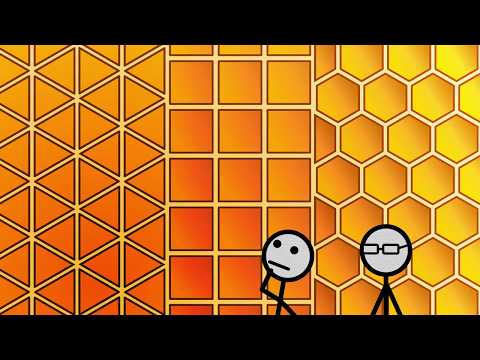
In nature, the hexagon is famously associated with honeybees. Bees construct their honeycombs using hexagonal cells because this shape requires the least amount of wax to provide the maximum amount of storage space for honey. This biological efficiency is a prime example of natural engineering. Furthermore, the hexagon appears in the molecular structure of many organic compounds, such as benzene, which is represented as a hexagonal ring of carbon atoms. When you hear scientists or engineers use the word, they are often referring to these structural advantages. In the world of sports and games, many strategy board games use a hexagonal grid instead of a square grid because it allows for more consistent movement between adjacent cells, as every neighbor shares an edge and is equidistant from the center.
- Structural Utility
- The hexagon is utilized in engineering for its high strength-to-weight ratio. Honeycomb sandwich structures, which use a hexagonal core, are common in aerospace and automotive industries to create lightweight yet incredibly strong panels.
During the chemistry lecture, the professor drew a perfect hexagon on the chalkboard to represent the carbon backbone of a glucose molecule.
Beyond science and math, the hexagon has found its way into popular culture and design. Many modern logos use hexagonal borders to convey a sense of stability, technology, and interconnectedness. In fashion, hexagonal patterns are often seen in textiles and jewelry, providing a geometric aesthetic that feels both ancient and futuristic. When people use the word hexagon in these contexts, they are tapping into the shape's inherent balance and symmetry. Whether you are looking at a snowflake under a microscope, which naturally forms a hexagonal crystal structure, or looking at a stop sign (which is actually an octagon, a common point of confusion), understanding the hexagon helps you recognize the mathematical patterns that govern the physical world around us.
- Visual Identification
- To identify a hexagon quickly, count the points or vertices. A regular hexagon will look like two trapezoids joined at their widest base, creating a balanced, six-pointed perimeter.
The giant storm at the north pole of Saturn is shaped like a massive hexagon, a phenomenon that continues to fascinate planetary scientists.
The carpenter used a hexagon template to cut the tiles for the kitchen backsplash, ensuring they would interlock perfectly.
In the game of Settlers of Catan, each resource tile is a hexagon, allowing the board to be rearranged in various configurations.
Using the word hexagon correctly involves understanding its role as a noun and its relationship to other geometric terms. In most sentences, 'hexagon' acts as the subject or object, describing a physical object or a mathematical concept. For example, you might say, 'The hexagon is a common shape in nature.' Here, it is the subject. Alternatively, in the sentence 'She drew a hexagon on the paper,' it serves as the direct object. Because it is a countable noun, you must use articles like 'a', 'an', or 'the', or use the plural form 'hexagons' when referring to more than one. When describing the properties of the shape, you often use it in conjunction with numbers and measurements, such as 'a hexagon with sides of five centimeters.'
- Grammatical Function
- As a noun, 'hexagon' can be modified by adjectives to provide more detail. Common modifiers include 'regular' (all sides equal), 'irregular' (sides of different lengths), 'perfect', 'geometric', or 'symmetrical'.
The student was asked to identify the hexagon among a variety of different polygons on the worksheet.
In technical writing, 'hexagon' is often part of compound phrases or used to describe complex structures. You might encounter phrases like 'hexagonal prism' or 'hexagonal tiling.' While 'hexagon' is the noun, 'hexagonal' is the adjective form used to describe other objects. For instance, 'The bolt has a hexagonal head.' It is important to distinguish between the two. Use 'hexagon' when referring to the shape itself and 'hexagonal' when the shape is a characteristic of something else. In descriptive writing, you can use 'hexagon' to create vivid imagery, comparing objects to the shape to help the reader visualize them. A phrase like 'the hexagon of light on the floor' suggests a very specific, sharp-edged illumination.
- Prepositional Usage
- 'Hexagon' is frequently used with the preposition 'of'. For example, 'a pattern of hexagons' or 'the shape of a hexagon'. It can also be used with 'in', as in 'The atoms are arranged in a hexagon.'
If you look closely at the snowflake, you will see that its core is a tiny, crystalline hexagon.
When writing about hexagons in a mathematical context, precision is key. You might write about the 'interior angles of a hexagon' or the 'area of a regular hexagon.' In these cases, the word is part of a formal vocabulary. However, in creative writing, you can use the word more metaphorically. You might describe a group of six people standing in a circle as forming a 'human hexagon.' This uses the geometric term to provide a clear mental picture of their arrangement. Always ensure that the context supports the use of such a specific term; if the shape is not clearly six-sided, using 'hexagon' might confuse the reader. In summary, whether you are describing a bolt, a bee's nest, or a mathematical proof, 'hexagon' is a versatile noun that brings geometric clarity to your sentences.
- Pluralization and Agreement
- When using the plural 'hexagons', ensure the verb agrees. 'These hexagons are blue' is correct, whereas 'These hexagons is blue' is not. The plural form is simply created by adding an 's'.
The quilt was composed of hundreds of colorful fabric hexagons sewn together in a complex mosaic.
The map was divided into a grid of hexagons, each representing one square mile of terrain.
Can you calculate the perimeter of this hexagon if each side measures three inches?
You are likely to encounter the word hexagon in several distinct environments, ranging from educational settings to specialized professional fields. In schools, it is a staple of the mathematics curriculum, introduced as early as elementary school and revisited in depth during high school geometry. Teachers use it to explain the properties of polygons and the concept of symmetry. Beyond the classroom, you will hear this word frequently in the world of design and architecture. Architects might discuss hexagonal floor plans or structural elements, while interior designers might talk about hexagonal tiles for bathrooms or kitchens. In these contexts, the word is used to describe a specific aesthetic and functional choice that emphasizes modern, clean lines and efficient use of space.
- Scientific Discourse
- In chemistry and biology, 'hexagon' is used to describe the arrangement of molecules and cells. You will hear it in discussions about carbon rings, crystal lattices, and the structural biology of organisms like bees and certain viruses.
'The carbon atoms in this molecule form a stable hexagon,' explained the chemist during the seminar.
Another common place to hear the word is in the gaming community. Many tabletop strategy games, such as 'Warhammer' or 'Civilization' (in its digital form), utilize a hexagonal grid system. Gamers and game designers will frequently use the term 'hex' as a shorthand for hexagon. You might hear someone say, 'Move your unit three hexes to the north.' This usage has become so common that 'hex' is often treated as a synonym for the shape in gaming contexts. Similarly, in the world of hardware and tools, you will hear about 'hex keys' or 'hex bolts.' These are tools and fasteners designed with a hexagonal shape to allow for a secure grip and high torque. If you are at a hardware store, you might ask an associate, 'Where can I find a set of hex wrenches?'
- Hardware and Engineering
- In mechanical engineering, the hexagon is the standard shape for nuts and bolt heads. This is because the six-sided shape provides multiple angles for a wrench to grip, making it easier to turn in tight spaces.
'We need to tighten the hexagon nut on the axle before we can test the machine,' the lead engineer shouted over the noise.
In the media, you might hear 'hexagon' in documentaries about nature or space. Narrators often point out the hexagonal patterns in beehives or the mysterious hexagonal storm on Saturn. These programs use the word to highlight the fascinating ways that mathematics appears in the natural universe. Furthermore, in news reports about technology, you might hear about 'hexagonal' pixel arrangements in advanced displays or the hexagonal structure of graphene, a material touted for its incredible strength and conductivity. In all these instances, the word 'hexagon' serves as a bridge between abstract mathematical concepts and tangible, real-world applications. Whether you are listening to a lecture, playing a game, or fixing a bike, the hexagon is a shape that is frequently mentioned and universally understood.
- Nature Documentaries
- Documentaries often use the hexagon to illustrate 'optimal packing' in nature. The shape is presented as evidence of the efficiency found in biological systems, such as the eyes of insects.
The narrator noted that the compound eye of a dragonfly is made of thousands of tiny hexagon lenses, providing a wide field of vision.
The puzzle required the player to fit each hexagon into the corresponding slot on the board to unlock the next level.
In the world of art, the hexagon is often used to create complex, repeating patterns that are visually stimulating.
One of the most common mistakes people make when using the word hexagon is confusing it with other polygons, particularly the pentagon and the octagon. A pentagon has five sides, while an octagon has eight. It is helpful to remember the prefixes: 'penta-' means five, 'hexa-' means six, and 'octa-' means eight. Misidentifying a shape can lead to errors in mathematical calculations or confusion in descriptive writing. For example, calling a stop sign a hexagon is a frequent error; stop signs are actually octagons. Another common mistake is assuming that all hexagons are 'regular.' While the image of a regular hexagon with equal sides is the most common, any six-sided closed figure is technically a hexagon, even if its sides and angles are unequal.
- Prefix Confusion
- Mistaking 'hexa-' (6) for 'hepta-' (7) or 'penta-' (5) is a frequent slip-up. Always double-check the number of sides before naming the shape.
Incorrect: 'The five-sided hexagon was difficult to draw.' (Correct: pentagon)
Another area of confusion involves the adjective form 'hexagonal.' Sometimes people use the noun 'hexagon' when they should use the adjective. For instance, saying 'a hexagon bolt' is common in casual speech, but 'a hexagonal bolt' is more grammatically correct because the word is describing a property of the bolt. Additionally, in the context of three-dimensional shapes, people sometimes mistakenly call a 'hexagonal prism' simply a 'hexagon.' A hexagon is a flat, 2D shape, while a prism is a 3D object with hexagonal bases. Keeping the dimensionality in mind is crucial for accurate communication, especially in technical or scientific fields where the difference between a plane and a solid is significant.
- Noun vs. Adjective
- Using 'hexagon' as an adjective (e.g., 'a hexagon pattern') is a minor error that is often overlooked in casual conversation but should be avoided in formal writing. Use 'hexagonal' instead.
Incorrect: 'The honeybee built a hexagon cell.' (Correct: hexagonal cell or a cell shaped like a hexagon)
Spelling can also be a minor hurdle. Some learners might misspell it as 'hexigon' or 'hexagone.' The correct spelling is 'hexagon,' ending in '-on.' Pronunciation mistakes are less common but can occur if the emphasis is placed on the wrong syllable. The stress should be on the first syllable: HEX-a-gon. Finally, avoid using 'hexagon' to describe any shape that just looks 'pointy' or 'complex.' Precision is the hallmark of geometric terms. If a shape has seven sides, it is a heptagon, and calling it a hexagon is factually incorrect. In professional settings, such as engineering or architecture, these distinctions are vital, as they affect measurements, materials, and structural integrity. By being mindful of these common pitfalls, you can use the word 'hexagon' with confidence and accuracy.
- Dimensionality Errors
- Confusing a 2D hexagon with a 3D hexagonal prism is a common conceptual mistake. Remember that a hexagon exists only on a flat surface.
Incorrect: 'The crystal was a perfect hexagon.' (Correct: hexagonal crystal, as crystals are 3D objects)
The student mistakenly labeled the octagon as a hexagon during the geometry quiz.
Don't confuse the hexagon with a heptagon, which has seven sides and is much rarer in nature.
When you want to describe a shape or structure but 'hexagon' doesn't quite fit, or if you want to vary your vocabulary, there are several related terms you can use. The most direct alternatives are other polygon names, which vary based on the number of sides. If you are looking for a more general term, 'polygon' itself is a good choice, as it encompasses all multi-sided flat shapes. If you want to emphasize the number of sides without using the formal Greek-derived term, you can use the phrase 'six-sided figure.' This is often more accessible in casual conversation or when explaining concepts to children. In technical contexts, you might use 'hexahedron' if you are referring to a six-faced 3D solid (like a cube), though this is a different geometric category.
- Polygon Comparisons
- Pentagon: 5 sides. Used for the U.S. defense headquarters.
- Heptagon: 7 sides. Rarely seen in common objects.
- Octagon: 8 sides. The shape of a standard stop sign.
While a hexagon has six sides, a pentagon has only five, making it less efficient for tiling a flat surface.
In the world of patterns and textures, 'honeycomb' is a very common synonym for a hexagonal arrangement. If you describe a pattern as a 'honeycomb pattern,' everyone will immediately visualize a grid of interlocking hexagons. This is a more evocative and descriptive term than simply saying 'hexagonal grid.' Another related term is 'tessellation,' which refers to the way shapes fit together without gaps. While not a synonym for hexagon, hexagons are the most famous example of a shape that can tessellate perfectly. In chemistry, the term 'ring' is often used as a shorthand for hexagonal molecular structures, such as the 'benzene ring.' Using these alternatives can help you tailor your language to your audience and the specific context of your writing.
- Descriptive Alternatives
- Honeycomb: Evokes nature and biological efficiency.
- Six-sided: Simple, clear, and non-technical.
- Grid: Often used when many hexagons are joined together.
The designer chose a honeycomb motif for the wallpaper to give the room a natural, organic feel.
For those interested in more obscure or specialized terms, 'sexangle' is an archaic synonym for hexagon, though it is almost never used today. In the context of crystals and minerals, you might hear about 'trigonal' or 'rhombohedral' systems, which are related to hexagonal structures but have different internal symmetries. Understanding these nuances allows you to be more precise. For example, while a snowflake is hexagonal, its growth is governed by the 'hexagonal crystal system.' By knowing these similar words and alternatives, you can avoid repetitive language and ensure that your descriptions are as accurate and engaging as possible. Whether you are writing a technical report or a creative story, choosing the right word for the shape is essential for clear communication.
- Comparison Table
Term Nuance Hexagon Formal, geometric, precise. Honeycomb Natural, structural, visual. Six-sided Plain, descriptive, simple.
Instead of a simple square, the logo featured a stylized hexagon to represent the company's six core values.
The geologist identified the rock formation as a series of hexagonal columns formed by cooling lava.
The soccer ball's surface is made of both hexagons and pentagons stitched together to form a sphere.
How Formal Is It?
Dato curioso
The word entered Middle French as 'hexagone' before being adopted into English in the late 16th century.
Guía de pronunciación
- Pronouncing it as 'hex-a-GONE' with a long 'o'.
- Adding an extra syllable like 'hex-a-ga-non'.
- Confusing the 'x' sound with a 's' sound.
- Mumbling the middle 'a' so it sounds like 'hex-gon'.
- Stress on the second syllable instead of the first.
Nivel de dificultad
The word is easy to recognize in text due to its distinct spelling.
Spelling 'hexagon' correctly can be tricky for beginners, but the structure is simple.
Pronunciation is straightforward once the stress on the first syllable is learned.
The 'hex' sound is very distinctive and easy to catch in conversation.
Qué aprender después
Requisitos previos
Aprende después
Avanzado
Gramática que debes saber
Countable Nouns
I have one hexagon. You have two hexagons.
Adjective Placement
The blue hexagon is on the table.
Definite vs Indefinite Articles
A hexagon has six sides. The hexagon I drew is red.
Subject-Verb Agreement
The hexagons are small. The hexagon is large.
Compound Adjectives
It is a hexagon-shaped box.
Ejemplos por nivel
I can draw a red hexagon.
Je peux dessiner un hexagone rouge.
Use 'a' before 'hexagon'.
The bee lives in a hexagon.
L'abeille vit dans un hexagone.
Noun acting as the object of a preposition.
Is this a hexagon?
Est-ce un hexagone ?
Question form using 'is'.
Count the sides of the hexagon.
Compte les côtés de l'hexagone.
Imperative sentence.
The hexagon has six sides.
L'hexagone a six côtés.
Simple present tense.
I see a blue hexagon.
Je vois un hexagone bleu.
Adjective 'blue' before the noun.
This hexagon is small.
Cet hexagone est petit.
Demonstrative 'this' with a singular noun.
Draw a hexagon with a pencil.
Dessine un hexagone avec un crayon.
Prepositional phrase 'with a pencil'.
A regular hexagon has equal sides.
Un hexagone régulier a des côtés égaux.
Adjective 'regular' modifies 'hexagon'.
The floor tiles are shaped like a hexagon.
Les carreaux du sol ont la forme d'un hexagone.
Simile using 'shaped like'.
She cut the paper into a hexagon.
Elle a découpé le papier en un hexagone.
Preposition 'into' showing transformation.
There are many hexagons in the honeycomb.
Il y a beaucoup d'hexagones dans le rayon de miel.
Plural form 'hexagons'.
The hexagon is a common geometric shape.
L'hexagone est une forme géométrique courante.
Definite article 'the' for general statements.
My favorite shape is the hexagon.
Ma forme préférée est l'hexagone.
Subject complement.
Can you find the hexagon in this picture?
Peux-tu trouver l'hexagone dans cette image ?
Modal verb 'can' for ability.
He colored each hexagon a different color.
Il a colorié chaque hexagone d'une couleur différente.
Determiner 'each' with singular noun.
A hexagon can be divided into six equilateral triangles.
Un hexagone peut être divisé en six triangles équilatéraux.
Passive voice 'can be divided'.
The internal angles of a regular hexagon are 120 degrees.
Les angles internes d'un hexagone régulier sont de 120 degrés.
Possessive 'of a regular hexagon'.
The nut has a hexagon shape to fit the wrench.
L'écrou a une forme d'hexagone pour s'adapter à la clé.
Noun used as a modifier.
We used a hexagon grid for our strategy game.
Nous avons utilisé une grille d'hexagones pour notre jeu de stratégie.
Compound noun 'hexagon grid'.
The architect incorporated a hexagon into the window design.
L'architecte a incorporé un hexagone dans le design de la fenêtre.
Past tense 'incorporated'.
Snowflakes often have a basic hexagon structure.
Les flocons de neige ont souvent une structure de base en hexagone.
Adverb 'often' modifying the verb.
Is the area of this hexagon larger than the square?
L'aire de cet hexagone est-elle plus grande que celle du carré ?
Comparative 'larger than'.
The pattern consists of interlocking hexagons.
Le motif se compose d'hexagones imbriqués.
Verb 'consists of' followed by plural noun.
The hexagon is the most efficient shape for packing cells together.
L'hexagone est la forme la plus efficace pour assembler des cellules.
Superlative 'the most efficient'.
Saturn's north pole features a persistent hexagon-shaped storm.
Le pôle nord de Saturne présente une tempête persistante en forme d'hexagone.
Compound adjective 'hexagon-shaped'.
The molecular structure of benzene is a perfect hexagon.
La structure moléculaire du benzène est un hexagone parfait.
Scientific context.
The pavement was made of hexagonal stones, forming a giant hexagon.
Le pavé était fait de pierres hexagonales, formant un hexagone géant.
Participial phrase 'forming a giant hexagon'.
Engineers use hexagon cores in honeycomb panels for strength.
Les ingénieurs utilisent des noyaux en hexagone dans les panneaux en nid d'abeille pour la solidité.
Technical plural usage.
The symmetry of a hexagon makes it aesthetically pleasing.
La symétrie d'un hexagone le rend esthétiquement plaisant.
Abstract noun 'symmetry' as the subject.
Each vertex of the hexagon was marked with a coordinate.
Chaque sommet de l'hexagone était marqué d'une coordonnée.
Passive voice 'was marked'.
The crystals grew in the shape of a hexagon due to the cooling rate.
Les cristaux ont poussé en forme d'hexagone en raison de la vitesse de refroidissement.
Causal phrase 'due to'.
The hexagon serves as a fundamental unit in modular architectural theory.
L'hexagone sert d'unité fondamentale dans la théorie architecturale modulaire.
Formal verb 'serves as'.
The mathematical properties of the hexagon allow for optimal space-filling.
Les propriétés mathématiques de l'hexagone permettent un remplissage optimal de l'espace.
Complex subject 'The mathematical properties of the hexagon'.
A hexagon's perimeter is easily calculated if it is regular.
Le périmètre d'un hexagone est facilement calculé s'il est régulier.
Possessive 'hexagon's'.
The study analyzed the hexagonal binning of data points across the map.
L'étude a analysé le regroupement hexagonal des points de données sur la carte.
Specialized terminology 'hexagonal binning'.
The hexagon's prevalence in nature suggests an underlying physical efficiency.
La prévalence de l'hexagone dans la nature suggère une efficacité physique sous-jacente.
Abstract noun 'prevalence'.
The artist used the hexagon to symbolize the interconnectedness of life.
L'artiste a utilisé l'hexagone pour symboliser l'interconnexion de la vie.
Infinitive of purpose 'to symbolize'.
The telescope's mirror is composed of eighteen smaller hexagon segments.
Le miroir du télescope est composé de dix-huit segments d'hexagone plus petits.
Passive construction 'is composed of'.
The researchers investigated the hexagon's role in crystal lattice stability.
Les chercheurs ont étudié le rôle de l'hexagone dans la stabilité du réseau cristallin.
Formal research context.
The honeycomb conjecture provides a rigorous proof for the hexagon's efficiency.
La conjecture du nid d'abeille fournit une preuve rigoureuse de l'efficacité de l'hexagone.
Highly technical subject matter.
The hexagon's geometry is central to the study of two-dimensional manifolds.
La géométrie de l'hexagone est centrale dans l'étude des variétés bidimensionnelles.
Specialized academic field.
The atmospheric dynamics creating the Saturnian hexagon remain a subject of debate.
La dynamique atmosphérique créant l'hexagone saturnien reste un sujet de débat.
Complex noun phrase as subject.
The hexagon's role in the close-packing of spheres is a cornerstone of crystallography.
Le rôle de l'hexagone dans l'empilement compact de sphères est une pierre angulaire de la cristallographie.
Metaphorical use of 'cornerstone'.
The architect's use of the hexagon challenged traditional notions of orthogonal space.
L'utilisation de l'hexagone par l'architecte a défié les notions traditionnelles d'espace orthogonal.
Contrastive terminology 'orthogonal'.
The hexagon's inherent symmetry is exploited in the design of high-gain antennas.
La symétrie inhérente de l'hexagone est exploitée dans la conception d'antennes à gain élevé.
Passive voice 'is exploited'.
The paper explores the hexagon's emergence in self-organizing chemical systems.
L'article explore l'émergence de l'hexagone dans les systèmes chimiques auto-organisés.
Abstract concept 'emergence'.
The hexagon's structural integrity is paramount in the fabrication of carbon nanotubes.
L'intégrité structurelle de l'hexagone est primordiale dans la fabrication de nanotubes de carbone.
Adjective 'paramount' for emphasis.
Sinónimos
Antónimos
Colocaciones comunes
Frases Comunes
— Describing something that has six sides.
The pool was built in the shape of a hexagon.
— Many six-sided shapes arranged together.
The quilt had a beautiful pattern of hexagons.
— Things placed in a way that forms a hexagon.
The atoms were in a hexagonal arrangement.
— A redundant but common way to emphasize the number of sides.
It is a simple six-sided hexagon.
— A hexagon where all sides are the same.
The logo is a regularly shaped hexagon.
— Hexagons that fit together like a puzzle.
The floor was made of interlocking hexagons.
— A design that uses the hexagon as its main element.
The building has a hexagon-based design.
Se confunde a menudo con
A pentagon has five sides, while a hexagon has six. People often mix up the prefixes.
An octagon has eight sides. Stop signs are octagons, not hexagons.
A heptagon has seven sides. It is much less common than a hexagon.
Modismos y expresiones
— A variation of 'round peg in a square hole,' meaning someone who doesn't fit in.
He felt like a round peg in a hexagonal hole at the new job.
informal— A metaphorical phrase sometimes used in biology to describe the balance of nature.
Bees are essential to the hexagon of life.
literary— A playful pun used when someone is confused by a geometry problem.
I'm completely hexed by this hexagon calculation!
slang— A play on 'two sides to every story,' implying a situation is very complex.
In this case, there are six sides to every story, just like a hexagon.
informal— Meaning something is very secure or difficult to move.
That lid is as tight as a hexagon nut.
informal— A place that is very busy, like a beehive made of hexagons.
The office was a honeycomb of activity.
metaphorical— Often used when describing a perfect hexagon.
The tiles were laid with geometric precision.
formal— Often refers to bees and their hexagonal creations.
The bee is nature's architect, building perfect hexagons.
poetic— Sometimes used in design to refer to the stability of the hexagon.
This structure relies on the power of six.
rhetorical— A metaphor for ideas that fit together perfectly, like hexagons.
Her arguments were like tessellated thoughts.
literaryFácil de confundir
Both start with 'hexa-'.
A hexagon is a solid shape with six sides; a hexagram is a six-pointed star shape.
The Star of David is a hexagram, not a hexagon.
Both refer to the number six.
A hexagon is a 2D shape (flat); a hexahedron is a 3D shape (solid), like a cube.
A cube is a type of hexahedron.
They are different parts of speech.
Hexagon is a noun (the shape); hexagonal is an adjective (describing something else).
The tile is hexagonal.
It is a shorthand.
Hex can mean a hexagon, but it can also mean a magical spell or a curse.
The witch put a hex on the hexagon-shaped box.
Sounds similar.
A hectagon (or hectogon) has 100 sides, which is very different from six.
A hectagon is almost a circle, unlike a hexagon.
Patrones de oraciones
This is a [color] hexagon.
This is a green hexagon.
A hexagon has [number] sides.
A hexagon has six sides.
The [object] is shaped like a hexagon.
The mirror is shaped like a hexagon.
Hexagons are used in [field] because [reason].
Hexagons are used in engineering because they are strong.
The [property] of the hexagon allows for [outcome].
The symmetry of the hexagon allows for perfect tiling.
The emergence of the hexagon in [system] suggests [theory].
The emergence of the hexagon in cloud patterns suggests complex fluid dynamics.
Can you [verb] the hexagon?
Can you draw the hexagon?
There are [number] hexagons in the [place].
There are many hexagons in the hive.
Familia de palabras
Sustantivos
Verbos
Adjetivos
Relacionado
Cómo usarlo
Common in educational, technical, and design contexts.
-
Calling an octagon a hexagon.
→
Stop signs are octagons (8 sides).
People often use 'hexagon' as a generic word for any 'pointy' shape with many sides. Always count to six.
-
Spelling it 'hexigon'.
→
Hexagon
The word ends in '-agon', similar to pentagon and octagon. The 'a' is often unstressed, leading to spelling errors.
-
Using 'hexagon' as an adjective.
→
Hexagonal
While 'hexagon tile' is common, 'hexagonal tile' is the correct grammatical form for an adjective.
-
Confusing hexagon with hexagram.
→
Hexagon (shape) vs Hexagram (star).
A hexagon is the solid polygon; a hexagram is the star shape. They are related but different.
-
Thinking all hexagons must be regular.
→
Irregular hexagons exist.
Any closed shape with six straight sides is a hexagon, even if the sides are not equal lengths.
Consejos
Count the Sides
Whenever you see a shape, count the sides slowly. If you reach six, it is a hexagon. This simple habit prevents confusion with pentagons or octagons.
Use the Adjective
Try using 'hexagonal' instead of 'hexagon' when describing objects. For example, say 'hexagonal tiles' instead of 'hexagon tiles' to sound more natural.
Look for Honeycombs
Associate the word hexagon with a beehive. It is the most common and memorable example of the shape in the real world.
Angle Sum
Remember that the angles of a hexagon add up to 720 degrees. This is double the angles of a square (360), which can help you remember.
The 'X' Factor
Remember that 'six' and 'hexagon' both have an 'x'. This is a great way to never forget how many sides the shape has.
Hex Grids
If you play strategy games, notice the 'hex' grid. This is a practical application of hexagons that makes movement more realistic.
Molecular Rings
In chemistry, look for the six-sided rings. These are hexagons and are very important in organic chemistry.
Modular Design
Notice how modern buildings sometimes use hexagonal windows or rooms. This is often done for structural strength and a unique look.
Hex Keys
Check your tool kit for 'hex keys'. Using the tools will help you remember the shape and its name through physical touch.
Snowflake Symmetry
In the winter, remember that every snowflake has a hexagonal base. This is a beautiful way to see math in nature.
Memorízalo
Mnemotecnia
Think of 'HEX' and 'SIX'. Both have an 'X'. A HEXagon has SIX sides.
Asociación visual
Imagine a beehive. Every little room in the beehive is a perfect hexagon. This connects the word to a very common natural image.
Word Web
Desafío
Look around your room right now. Can you find anything that is a hexagon or has a hexagonal pattern? If not, try to draw three different hexagons: one small, one large, and one irregular.
Origen de la palabra
Derived from the Ancient Greek word 'hexágōnon'.
Significado original: Literally 'six-angled'.
Indo-European (Greek roots).Contexto cultural
The word is purely technical and geometric; it has no negative or sensitive connotations.
In English-speaking countries, the hexagon is most commonly associated with school math and the 'hex' tools found in every garage.
Practica en la vida real
Contextos reales
Mathematics Class
- calculate the area
- measure the angles
- draw a regular hexagon
- identify the polygon
Nature Study
- honeycomb cells
- snowflake structure
- basalt columns
- insect eyes
Home Improvement
- hexagonal tiles
- hex wrench
- hexagon nut
- floor pattern
Board Games
- hex grid
- move two hexes
- hexagonal tile
- game board
Chemistry
- carbon ring
- benzene hexagon
- molecular structure
- atomic arrangement
Inicios de conversación
"Have you ever noticed how many hexagons there are in nature, like in honeycombs?"
"Do you prefer square tiles or hexagon tiles for a bathroom floor?"
"Did you know that France is often called 'The Hexagon' because of its shape?"
"What is the hardest part about calculating the area of a hexagon for you?"
"Have you ever seen the giant hexagonal storm on the planet Saturn?"
Temas para diario
Describe three things in your daily life that are shaped like a hexagon and why that shape is useful for them.
If you were an architect, how would you use the hexagon shape in a building design?
Write a short story about a bee who discovers a hexagon that isn't part of a honeycomb.
Explain the difference between a hexagon and an octagon to someone who has never heard of them.
Reflect on why you think the hexagon is considered such an efficient shape in nature.
Preguntas frecuentes
10 preguntasA hexagon has exactly six sides. It also has six angles and six vertices. This is the defining characteristic of the shape.
A regular hexagon is a hexagon where all six sides are the same length and all six internal angles are equal to 120 degrees. It is perfectly symmetrical.
The most famous example is a honeycomb made by bees. You can also find hexagons in snowflakes, the eyes of some insects, and certain rock formations like basalt columns.
Bees use hexagons because they are the most efficient shape for storage. They use the least amount of wax to create the most space, and the shapes fit together perfectly without any gaps.
The sum of the internal angles of any simple hexagon is 720 degrees. You can calculate this using the formula (n-2) x 180, where n is the number of sides.
No, a standard stop sign is an octagon, which has eight sides. This is a very common mistake.
A hexagon is a polygon with six sides. A hexagram is a six-pointed star, often formed by two overlapping triangles.
Yes, hexagons can tile a flat surface perfectly without leaving any gaps. This is why they are popular for floor and wall tiles.
A hex wrench, also known as an Allen key, is a tool used to turn bolts and screws that have a hexagonal socket in their head.
The area of a regular hexagon can be calculated using the formula: Area = (3√3 / 2) × side². Alternatively, you can divide it into six equilateral triangles and find their total area.
Ponte a prueba 200 preguntas
Write a sentence using the word 'hexagon' to describe a honeycomb.
Well written! Good try! Check the sample answer below.
Explain why a hexagon is an efficient shape.
Well written! Good try! Check the sample answer below.
Describe a regular hexagon's properties.
Well written! Good try! Check the sample answer below.
Compare a hexagon to an octagon.
Well written! Good try! Check the sample answer below.
Write a short story about a hexagon-shaped planet.
Well written! Good try! Check the sample answer below.
How do you use a hex wrench?
Well written! Good try! Check the sample answer below.
Describe the nickname of France and why it is used.
Well written! Good try! Check the sample answer below.
Write a sentence using 'hexagonal' as an adjective.
Well written! Good try! Check the sample answer below.
Explain the difference between a hexagon and a hexagram.
Well written! Good try! Check the sample answer below.
What is the sum of the angles in a hexagon? Show the calculation.
Well written! Good try! Check the sample answer below.
Describe a snowflake using the word 'hexagon'.
Well written! Good try! Check the sample answer below.
Write a formal sentence about hexagons in chemistry.
Well written! Good try! Check the sample answer below.
How would you identify a hexagon in a group of shapes?
Well written! Good try! Check the sample answer below.
Describe a game board that uses hexagons.
Well written! Good try! Check the sample answer below.
Write a sentence about the storm on Saturn.
Well written! Good try! Check the sample answer below.
Explain the term 'tessellation' using hexagons.
Well written! Good try! Check the sample answer below.
What are the benefits of hexagonal packing?
Well written! Good try! Check the sample answer below.
Write a sentence using the plural 'hexagons'.
Well written! Good try! Check the sample answer below.
Describe a hex bolt.
Well written! Good try! Check the sample answer below.
Why is the hexagon important in engineering?
Well written! Good try! Check the sample answer below.
Pronounce the word 'hexagon' clearly.
Read this aloud:
Dijiste:
Speech recognition is not supported in your browser. Try Chrome or Edge.
Describe a hexagon to a friend in three sentences.
Read this aloud:
Dijiste:
Speech recognition is not supported in your browser. Try Chrome or Edge.
Explain the difference between a hexagon and a pentagon.
Read this aloud:
Dijiste:
Speech recognition is not supported in your browser. Try Chrome or Edge.
Tell a story about a bee building a hexagon.
Read this aloud:
Dijiste:
Speech recognition is not supported in your browser. Try Chrome or Edge.
Discuss why hexagons are used in floor tiles.
Read this aloud:
Dijiste:
Speech recognition is not supported in your browser. Try Chrome or Edge.
Describe the shape of France using the word 'hexagon'.
Read this aloud:
Dijiste:
Speech recognition is not supported in your browser. Try Chrome or Edge.
Explain how to calculate the perimeter of a hexagon.
Read this aloud:
Dijiste:
Speech recognition is not supported in your browser. Try Chrome or Edge.
Talk about the hexagonal storm on Saturn.
Read this aloud:
Dijiste:
Speech recognition is not supported in your browser. Try Chrome or Edge.
Pronounce the adjective 'hexagonal' correctly.
Read this aloud:
Dijiste:
Speech recognition is not supported in your browser. Try Chrome or Edge.
Explain why hexagons are efficient in nature.
Read this aloud:
Dijiste:
Speech recognition is not supported in your browser. Try Chrome or Edge.
Give three examples of hexagonal objects.
Read this aloud:
Dijiste:
Speech recognition is not supported in your browser. Try Chrome or Edge.
Ask a question about a hexagon.
Read this aloud:
Dijiste:
Speech recognition is not supported in your browser. Try Chrome or Edge.
Describe a pattern of hexagons.
Read this aloud:
Dijiste:
Speech recognition is not supported in your browser. Try Chrome or Edge.
Explain what a hex key is.
Read this aloud:
Dijiste:
Speech recognition is not supported in your browser. Try Chrome or Edge.
Compare a hexagon to a circle.
Read this aloud:
Dijiste:
Speech recognition is not supported in your browser. Try Chrome or Edge.
Talk about hexagons in chemistry.
Read this aloud:
Dijiste:
Speech recognition is not supported in your browser. Try Chrome or Edge.
Discuss the symmetry of a hexagon.
Read this aloud:
Dijiste:
Speech recognition is not supported in your browser. Try Chrome or Edge.
Explain the word 'tessellation' to a child.
Read this aloud:
Dijiste:
Speech recognition is not supported in your browser. Try Chrome or Edge.
Describe a snowflake's shape.
Read this aloud:
Dijiste:
Speech recognition is not supported in your browser. Try Chrome or Edge.
Say 'The hexagon has six sides' three times fast.
Read this aloud:
Dijiste:
Speech recognition is not supported in your browser. Try Chrome or Edge.
Listen to the description: 'This shape has six sides and is found in beehives.' What is the shape?
Listen to the sentence: 'The internal angles are 120 degrees.' Which shape is being described?
Listen to the word: 'Hexagonal'. Is this a noun or an adjective?
Listen to the phrase: 'The Hexagon of France'. What does this refer to?
Listen to the number: '720'. What does this represent in a hexagon?
Listen to the tool name: 'Hex key'. What shape is the socket it fits into?
Listen to the material name: 'Graphene'. What is its atomic shape?
Listen to the fact: 'Bees use this shape for honey.' What is the shape?
Listen to the comparison: 'It has more sides than a pentagon but fewer than an octagon.' What is it?
Listen to the instruction: 'Draw a regular hexagon.' What must be true about the sides?
Listen to the term: 'Benzene ring'. What shape is it?
Listen to the pronunciation: 'HEX-a-gon'. Which syllable is loudest?
Listen to the sentence: 'The tiles are interlocking hexagons.' Do the tiles have gaps?
Listen to the location: 'Saturn's north pole'. What shape is the storm there?
Listen to the word: 'Hexagram'. Does it have six sides or six points?
/ 200 correct
Perfect score!
Summary
The hexagon is a six-sided polygon that represents the pinnacle of geometric efficiency. Its ability to tessellate without gaps makes it essential for natural structures like honeycombs and human innovations like aerospace panels and structural engineering.
- A hexagon is a six-sided polygon found frequently in nature, mathematics, and engineering due to its unique structural efficiency and ability to tile surfaces perfectly.
- The term 'hexagon' specifically refers to a flat, two-dimensional shape, while 'hexagonal' is the adjective used to describe three-dimensional objects or patterns with six sides.
- Regular hexagons have equal sides and 120-degree angles, making them a staple of geometry education and a key component in the design of tools like hex wrenches.
- From the microscopic structure of snowflakes and carbon rings to the massive storm on Saturn, the hexagon is a fundamental shape in the physical universe.
Count the Sides
Whenever you see a shape, count the sides slowly. If you reach six, it is a hexagon. This simple habit prevents confusion with pentagons or octagons.
Use the Adjective
Try using 'hexagonal' instead of 'hexagon' when describing objects. For example, say 'hexagonal tiles' instead of 'hexagon tiles' to sound more natural.
Look for Honeycombs
Associate the word hexagon with a beehive. It is the most common and memorable example of the shape in the real world.
Angle Sum
Remember that the angles of a hexagon add up to 720 degrees. This is double the angles of a square (360), which can help you remember.
Ejemplo
The bathroom floor was covered in small white hexagon tiles.
Contenido relacionado
Míralo en videos
Aprende en contexto
Más palabras de Math
addition
B2La adición es el acto de unir algo con otra cosa. También se refiere a la operación matemática de sumar.
bestagon
B1Un bestagon es un nombre divertido para un hexágono, considerado la mejor forma geométrica.
approximate
C1El prototipo intenta aproximar la funcionalidad del producto final.
amount
B1Una cantidad de algo, especialmente algo que no se puede contar, como un líquido o una cualidad abstracta.
metric
B2Un estándar de medición utilizado para evaluar, comparar y realizar un seguimiento del rendimiento, el progreso o la calidad.
count
A2Contar es determinar el número total de elementos en una colección.
hexagons
B1Los hexágonos son polígonos de seis lados que se encuentran en los panales de miel.
doublings
C1Las duplicaciones de la inversión generaron grandes beneficios a largo plazo.
infinite
B1El universo es infinito y está lleno de misterios.
plus
B1Dos más dos son cuatro.

