L'Hospitalité et les Salutations au Brésil
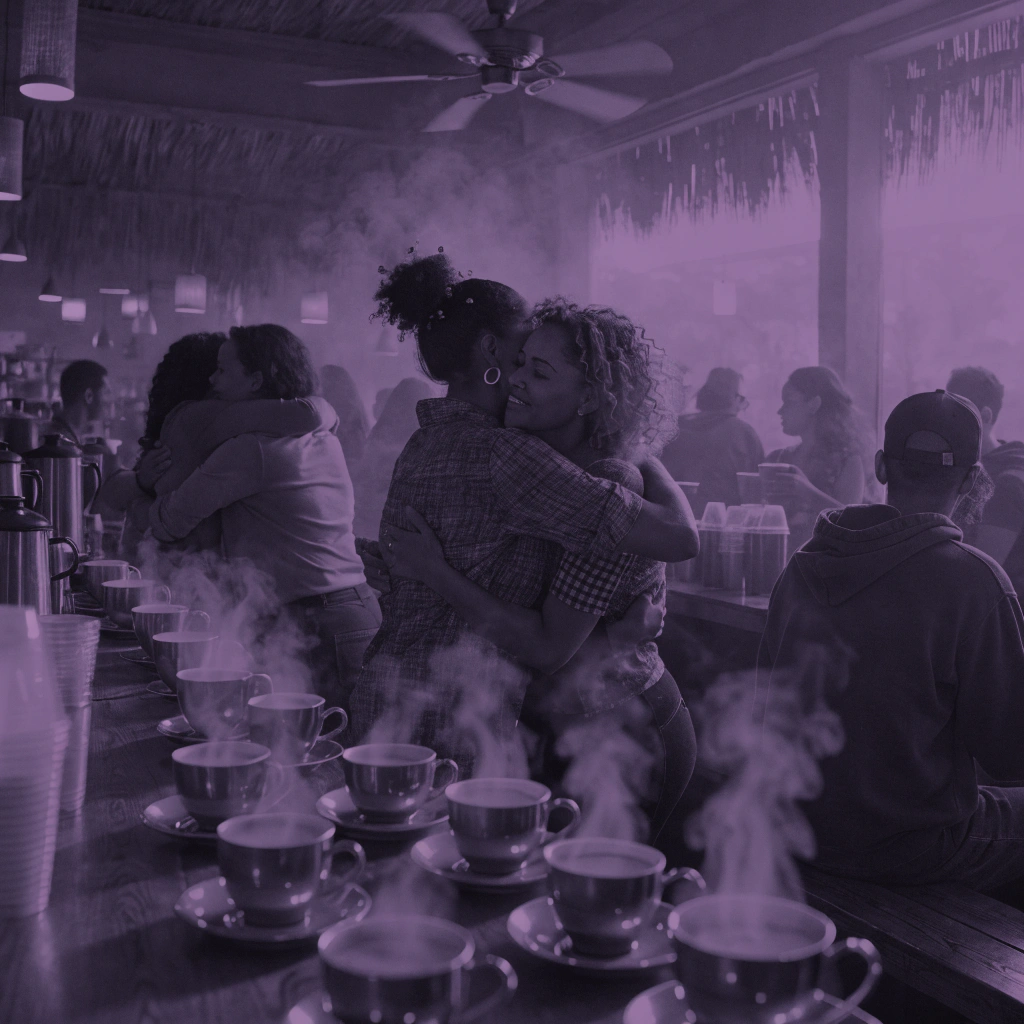
Le Brésil est un pays très accueillant. Les Brésiliens sont chaleureux et gentils. Ils aiment la « simpatia ». C'est une façon d'être ouvert avec les autres.
Les salutations sont importantes. Les hommes se serrent la main. Ils donnent aussi des tapes dans le dos. Les femmes font souvent des bises sur les joues. C’est un geste très amical.
Au Brésil, les gens parlent beaucoup. Ils sourient tout le temps. Les Brésiliens aiment inviter des amis à la maison. L'hospitalité est une grande tradition. C'est un pays de joie et de partage.
Point grammaire
Structure: Le verbe « être » au présent
"Le Brésil est un pays très accueillant."
On utilise le verbe « être » pour décrire une caractéristique ou un état. Au présent, pour la troisième personne du singulier (il/elle), on écrit « est ».
Structure: Le pluriel des noms et adjectifs
"Les Brésiliens sont chaleureux."
Pour parler de plusieurs personnes, on utilise l'article « les » et on ajoute souvent un « s » à la fin du nom. L'adjectif s'accorde aussi avec le nom.
Teste ta compréhension
10 questions · A1 Débutant · 1 aperçu gratuit
Teste ce que tu as appris dans cet article. Réponds à toutes les questions pour gagner des XP !
Comment sont les Brésiliens dans l'article ?
Tu veux terminer le quiz ?
9 questions supplémentaires t'attendent. Inscris-toi gratuitement pour débloquer le quiz complet et gagner des XP !
S'inscrire gratuitementTu as dj un compte ? Connexion
Bien joué !
Continue à pratiquer !
Déjà terminé — pas de XP supplémentaire
Inscris-toi pour gagner des XPDétail des questions
Comment sont les Brésiliens dans l'article ?
Ta réponse:
Bonne réponse: Ils sont chaleureux et gentils.
Au Brésil, les gens n'aiment pas parler.
Ta réponse:
Bonne réponse: Faux
Que signifie le mot 'maison' ?
Ta réponse:
Bonne réponse: Un lieu pour habiter
Les femmes font souvent des _____ sur les joues.
Ta réponse:
Bonne réponse: bises
The Warm Hearts of Brazil
Brazil is a very special country because the people are incredibly friendly. This warmth is called "simpatia." When you visit Brazil, you will see that social greetings are very important.
In many countries, people only shake hands. However, Brazilian greetings are more personal. Men usually shake hands, but they also hug each other. Women often kiss each other on the cheeks. In Rio de Janeiro, they give two kisses, but in São Paulo, they usually give only one.
Brazilians are also very hospitable. Last year, I visited a family in Brazil. They were kinder than my neighbors at home. They invited me for a big lunch and treated me like a friend. They wanted me to feel comfortable and happy.
Brazilians love to talk and spend time together. They are more open than people in more reserved cultures. Because of this, tourists always feel welcome. If you go to Brazil, you will make many new friends quickly.
Point grammaire
Structure: Comparatives
"They were kinder than my neighbors at home."
We use comparatives to show the difference between two things or people. For short adjectives, we add '-er' and use the word 'than' after it.
Structure: Connectors (Because)
"Brazil is a very special country because the people are incredibly friendly."
'Because' is a connector used to give a reason for something. It links a result with its cause in a single sentence.
Teste ta compréhension
11 questions · A2 mentaire · 1 aperçu gratuit
Teste ce que tu as appris dans cet article. Réponds à toutes les questions pour gagner des XP !
What is the special Brazilian warmth called?
Tu veux terminer le quiz ?
10 questions supplémentaires t'attendent. Inscris-toi gratuitement pour débloquer le quiz complet et gagner des XP !
S'inscrire gratuitementTu as dj un compte ? Connexion
Bien joué !
Continue à pratiquer !
Déjà terminé — pas de XP supplémentaire
Inscris-toi pour gagner des XPDétail des questions
What is the special Brazilian warmth called?
Ta réponse:
Bonne réponse: Simpatia
In Rio de Janeiro, people usually give only one kiss.
Ta réponse:
Bonne réponse: Faux
What does 'hospitable' mean?
Ta réponse:
Bonne réponse: Being generous and friendly to guests
Men usually shake hands and _____ each other.
Ta réponse:
Bonne réponse: hug
How many kisses do people in São Paulo usually give?
Ta réponse:
Bonne réponse: One
The Warm Heart of Brazil: Hospitality and Greetings
Brazil is famous for its beautiful beaches and sunshine, but the people have also been known for their incredible warmth for a long time. Visitors who travel to South America often notice that Brazilian culture is built on a concept called 'simpatia'. This beautiful word describes a unique mix of friendliness, openness, and a sincere desire to make everyone feel comfortable.
When you arrive in Brazil, you will quickly see that social greetings are very tactile and expressive. In many Western cultures, a formal handshake is the standard way to meet a new person. However, in Brazil, greetings have become much more personal and affectionate. Men usually exchange hearty handshakes, which are often accompanied by a friendly pat on the back or shoulder. Women, on the other hand, frequently exchange light kisses on the cheeks. This behavior is seen as a sign of respect and a way to build a genuine connection between people.
Brazilian hospitality is experienced in many different ways throughout the country. For example, guests are almost always offered a 'cafezinho', which is a small, strong cup of coffee, when they visit a home or even a business office. This tradition has been practiced by families for generations to show kindness. People who have visited Brazil often say that they felt like part of the family almost immediately. It is a wonderful place where strangers are treated like old friends, which makes the country very special for international travelers.
In conclusion, the way Brazilians interact with each other is a true reflection of their open hearts. Whether it is through a warm embrace or a simple cup of coffee, the art of hospitality is deeply rooted in their daily lives. These social customs have been preserved over time, ensuring that every visitor feels the famous Brazilian welcome.
Point grammaire
Structure: Passive Voice
"Brazilian culture is built on a concept called 'simpatia'."
The passive voice is used to focus on the person or thing receiving the action. It is formed using the verb 'to be' followed by the past participle of the main verb.
Structure: Present Perfect
"This tradition has been practiced by families for generations to show kindness."
The present perfect connects the past to the present. It is formed with 'have' or 'has' plus the past participle, and here it shows an action that started in the past and continues today.
Teste ta compréhension
11 questions · B1 Intermédiaire · 1 aperçu gratuit
Teste ce que tu as appris dans cet article. Réponds à toutes les questions pour gagner des XP !
What does the word 'simpatia' describe in Brazilian culture?
Tu veux terminer le quiz ?
10 questions supplémentaires t'attendent. Inscris-toi gratuitement pour débloquer le quiz complet et gagner des XP !
S'inscrire gratuitementTu as dj un compte ? Connexion
Bien joué !
Continue à pratiquer !
Déjà terminé — pas de XP supplémentaire
Inscris-toi pour gagner des XPDétail des questions
What does the word 'simpatia' describe in Brazilian culture?
Ta réponse:
Bonne réponse: A mix of friendliness, openness, and making others feel comfortable
In Brazil, social greetings are usually very formal and involve only a cold handshake.
Ta réponse:
Bonne réponse: Faux
What does the word 'tactile' mean in the context of the article?
Ta réponse:
Bonne réponse: Related to the sense of touch
Guests in a Brazilian home are almost always offered a small cup of _____.
Ta réponse:
Bonne réponse: coffee
How do Brazilian men often greet each other according to the text?
Ta réponse:
Bonne réponse: With a hearty handshake and a pat on the shoulder
The Nuances of Brazilian Simpatia: A Study in Social Warmth
Brazilian hospitality is internationally renowned for its exuberant and inclusive nature, often leaving visitors from more reserved cultures both charmed and slightly bewildered. At the core of this social fabric lies the concept of 'simpatia'—a term that encompasses friendliness, charisma, and an innate desire to make others feel valued. Unlike many Western societies where professional and personal boundaries are strictly maintained, Brazilian social interactions tend to prioritize emotional connection over formal protocol. This cultural trait is not merely about being polite; it is a fundamental aspect of how the society functions.
The most immediate manifestation of this warmth is found in greetings. While a standard handshake is acceptable in business environments, social settings demand a more tactile approach. Men who are acquainted often exchange hearty handshakes accompanied by a rhythmic pat on the back, known as a 'palmadinha'. For women, and between men and women, the 'beijinho' or air kiss is the standard. Interestingly, the number of kisses can serve as a geographical marker; in São Paulo, one kiss is common, whereas in Rio de Janeiro, two are the norm. Had a visitor not been briefed on these regional variations, they might find themselves awkwardly leaning in for a second kiss that never comes, or vice versa.
Furthermore, the notion of proximity plays a crucial role in Brazilian communication. Interpersonal space is significantly smaller than in Northern Europe or North America. This physical closeness is an essential component of building rapport and is perceived as a sign of trust rather than an intrusion. Consequently, maintaining a distance might be misinterpreted as coldness or a lack of interest. In conversation, it is common for Brazilians to touch the arm or shoulder of the person they are speaking to, reinforcing the bond between the speakers.
Hospitality in the Brazilian home is equally profound. The phrase 'fique à vontade' (make yourself at home) is not merely a polite cliché but a genuine invitation to integrate into the household. Hosts often go to great lengths to ensure their guests are well-fed and entertained, reflecting a generosity that is inherent in the national character. This openness facilitates social cohesion, allowing strangers to become friends with remarkable speed. Nevertheless, navigating these social waters requires an appreciation for nuance. Brazilian society relies heavily on non-verbal cues and the ability to read the 'atmosphere' of a room. Ultimately, the art of Brazilian hospitality is a sophisticated system of social integration that values the collective experience over individual isolation.
Point grammaire
Structure: Third Conditional (Inverted)
"Had a visitor not been briefed on these regional variations, they might find themselves awkwardly leaning in for a second kiss that never comes, or vice versa."
This structure uses 'Had' at the beginning to replace 'If' in a hypothetical past situation. It is used in formal writing to discuss imaginary consequences of past events.
Structure: Passive Voice
"Brazilian hospitality is internationally renowned for its exuberant and inclusive nature..."
The passive voice is used here to emphasize the reputation of the hospitality rather than who is doing the renowning. It consists of the verb 'to be' plus a past participle.
Structure: Relative Clauses with 'That'
"...reflecting a generosity that is inherent in the national character."
The relative clause 'that is inherent in the national character' provides essential information about the noun 'generosity'. It defines exactly what kind of generosity is being discussed.
Teste ta compréhension
11 questions · B2 Intermédiaire supérieur · 1 aperçu gratuit
Teste ce que tu as appris dans cet article. Réponds à toutes les questions pour gagner des XP !
What does the term 'simpatia' primarily describe in Brazilian culture?
Tu veux terminer le quiz ?
10 questions supplémentaires t'attendent. Inscris-toi gratuitement pour débloquer le quiz complet et gagner des XP !
S'inscrire gratuitementTu as dj un compte ? Connexion
Bien joué !
Continue à pratiquer !
Déjà terminé — pas de XP supplémentaire
Inscris-toi pour gagner des XPDétail des questions
What does the term 'simpatia' primarily describe in Brazilian culture?
Ta réponse:
Bonne réponse: A blend of friendliness, charisma, and valuing others
Standard handshakes are the only acceptable form of greeting in all Brazilian social settings.
Ta réponse:
Bonne réponse: Faux
What is the meaning of 'proximity' as used in the text?
Ta réponse:
Bonne réponse: Physical closeness in space
Brazilian social interactions tend to _____ emotional connection over formal protocol.
Ta réponse:
Bonne réponse: prioritize
How do greeting customs typically differ between Rio de Janeiro and São Paulo?
Ta réponse:
Bonne réponse: Rio typically uses two kisses while São Paulo uses one
The Paradox of Proximity: A Critical Appraisal of Brazilian Social Etiquette
Rarely has a cultural phenomenon been as misinterpreted by the casual observer as the exuberant nature of Brazilian hospitality. To the uninitiated, the tactile intensity of a standard greeting—the 'beijinho' or the robust 'abraço'—might initially appear as an unwarranted encroachment upon personal boundaries. However, such physical proximity serves as a fundamental pillar of social cohesion within the Lusophone giant. What defines these interactions is 'simpatia', a multifaceted concept that transcends mere superficial friendliness to encompass a profound psychological openness and a predisposition toward communal harmony.
It is this very openness that facilitates the 'jeitinho', a uniquely Brazilian mode of navigating social and bureaucratic hurdles through personal rapport and creative problem-solving. Not only does this inform interpersonal relationships, but it also dictates the rhythm of daily commerce and institutional navigation. Critics might argue that such pervasive informality masks a lack of professional rigor; yet, it is the prioritisation of human connection over clinical efficiency that renders the Brazilian experience so distinctive. Seldom do we see a society where the demarcation between stranger and confidant is so fluidly negotiated through the simple act of a greeting.
Indeed, the nominalisation of hospitality into a tangible social currency allows for a unique form of cultural diplomacy. It is through the lens of 'simpatia' that one must view the Brazilian penchant for extended social preambles before engaging in business. To bypass these rituals is to signal a lack of 'educação', a term which, in this context, refers less to formal schooling and more to one’s social refinement, empathy, and respect for the collective.
Furthermore, the nuance of the Brazilian greeting varies significantly across the vast geography of the nation, reflecting local histories and social tempos. While Cariocas in Rio de Janeiro might favour two or even three kisses on the cheek, Paulistanos in the industrial heart of São Paulo often settle for one. This regional fluidity underscores the adaptability of Brazilian social norms. Paradoxically, while the interactions are deeply tactile, they are governed by a complex, unspoken set of rules that ensure mutual respect and maintain social equilibrium.
Ultimately, the manifestation of Brazilian warmth is not merely a performance for the benefit of tourism or a relic of a simpler past. It is a deeply ingrained social mechanism that fosters resilience. In a society historically marked by significant socio-economic disparities, 'simpatia' serves as a levelling force, a way of asserting shared humanity in the face of systemic adversity. Thus, the Brazilian greeting is not just a gesture; it is an invitation to a shared social reality, predicated on the belief that no interaction is too small to warrant a genuine human connection. Through this lens, hospitality becomes an act of quiet defiance against the isolation of the modern age.
Point grammaire
Structure: Negative Inversion
"Rarely has a cultural phenomenon been as misinterpreted by the casual observer as the exuberant nature of Brazilian hospitality."
Inversion is used here by placing a negative adverbial at the start of the sentence, followed by the auxiliary verb and then the subject. This adds emphasis and a formal, sophisticated tone to the statement.
Structure: Cleft Sentence
"It is this very openness that facilitates the 'jeitinho', a uniquely Brazilian mode of navigating social and bureaucratic hurdles."
A cleft sentence focuses on specific information by using the 'It is/was... that' structure. It highlights 'openness' as the primary factor responsible for the 'jeitinho'.
Structure: Nominalisation for Abstract Analysis
"Indeed, the nominalisation of hospitality into a tangible social currency allows for a unique form of cultural diplomacy."
Nominalisation turns the action of being hospitable into a noun phrase, allowing the writer to discuss the concept as an abstract object of study, typical of C1 academic writing.
Teste ta compréhension
12 questions · C1 Avancé · 1 aperçu gratuit
Teste ce que tu as appris dans cet article. Réponds à toutes les questions pour gagner des XP !
What does the term 'educação' primarily signify in the context of Brazilian social interactions?
Tu veux terminer le quiz ?
11 questions supplémentaires t'attendent. Inscris-toi gratuitement pour débloquer le quiz complet et gagner des XP !
S'inscrire gratuitementTu as dj un compte ? Connexion
Bien joué !
Continue à pratiquer !
Déjà terminé — pas de XP supplémentaire
Inscris-toi pour gagner des XPDétail des questions
What does the term 'educação' primarily signify in the context of Brazilian social interactions?
Ta réponse:
Bonne réponse: Social refinement and empathy toward others
The article suggests that Brazilian hospitality is a performative act primarily designed for the tourism industry.
Ta réponse:
Bonne réponse: Faux
Which word describes the 'intrusion on a person's personal space'?
Ta réponse:
Bonne réponse: Encroachment
Seldom _____ we see a society where the demarcation between stranger and confidant is so fluidly negotiated.
Ta réponse:
Bonne réponse: do
According to the text, how do Paulistanos generally differ from Cariocas regarding greetings?
Ta réponse:
Bonne réponse: They typically settle for a single kiss on the cheek
The 'jeitinho' is described as a way to navigate bureaucratic hurdles using personal rapport.
Ta réponse:
Bonne réponse: Vrai
The Socio-Affective Architecture of Brazilian Interpersonal Dynamics
To traverse the sprawling urban landscapes of Brazil is to encounter a socio-affective architecture that defies the atomized individualism prevalent in much of the Global North. At the heart of this vibrancy lies the concept of 'simpatia'—a term often inadequately translated as mere friendliness, but which, in reality, constitutes a sophisticated cultural ethos of radical inclusion and warmth. Were one to scrutinize the minutiae of a standard greeting in Rio de Janeiro or Salvador, the immediate observation would be the profound collapse of physical distance. Unlike the prophylactic distance maintained in Northern European or North American contexts, Brazilian interactions are characterized by an effusive tactility. This is not merely a superficial display; it is an ontological commitment to the 'other', a visceral recognition of human interconnectedness.
The 'cordial man'—a sociological construct popularized by Sérgio Buarque de Holanda—suggests that Brazilian sociality is rooted in the primacy of the heart over the intellect. This paradigm does not imply a lack of cognitive rigor, but rather a cultural preference where emotional intelligence and interpersonal harmony are prioritized over rigid formalisms. This manifest conviviality is most palpable during the ritual of the 'beijinho' or small kiss. Depending on the region, one, two, or even three kisses may be exchanged on the cheek, ostensibly to facilitate a bond that transcends the transactional. It is essential that the visitor relinquish their preconceived notions of personal space to truly inhabit this social landscape. In São Paulo, a single kiss is standard, yet in Rio, the double kiss is the norm, often accompanied by a light embrace that signals an immediate, albeit temporary, inclusion into the speaker's inner circle.
Furthermore, the linguistic nuances of Brazilian Portuguese often mirror this warmth. The ubiquitous use of diminutives—'cafezinho', 'obrigadinho'—serves to soften the edges of reality, creating a linguistic environment of endearment and approachability. However, one must not mistake this for a lack of sophistication. On the contrary, navigating these social waters requires an acute sensitivity to tacit cues and a willingness to engage in reciprocity. The Brazilian host does not merely provide a service; they subsume the guest into the familial unit, providing a level of hospitality that can feel overwhelming to the uninitiated. This hospitality is a performative art, a dance of mutual recognition where the self is reflected and affirmed in the warmth of the collective.
Might it be that the Brazilian inclination toward proximity serves as a bulwark against the alienation of modernity? By fostering a culture where social greetings are elevated to an art form, Brazil maintains a visceral connection between its citizens. This socio-cultural lubricant, 'simpatia', allows for the navigation of a complex and often bureaucratic society with a sense of grace. For the expatriate or the traveler, the challenge lies in an empathic recalibration. To resist the embrace is to remain an outsider; to accept it is to undergo a transformation of one’s social identity. Ultimately, the art of Brazilian hospitality is a testament to the power of human connection, proving that even in a fragmented world, the heart remains the most potent tool for social cohesion.
Point grammaire
Structure: Inverted Conditional (Second/Third Conditional)
"Were one to scrutinize the minutiae of a standard greeting in Rio de Janeiro or Salvador, the immediate observation would be the profound collapse of physical distance."
This formal structure replaces 'If one were to...' by inverting the subject and the verb 'were'. It is used in academic or literary English to discuss hypothetical situations with a higher level of sophistication.
Structure: Subjunctive Mood with Essential/Imperative
"It is essential that the visitor relinquish their preconceived notions of personal space to truly inhabit this social landscape."
The base form of the verb 'relinquish' (without 's') is used following the adjective 'essential'. This mood expresses necessity, importance, or a requirement.
Structure: Rhetorical Questioning with Hedging
"Might it be that the Brazilian inclination toward proximity serves as a bulwark against the alienation of modernity?"
Using 'Might it be...' allows the author to propose a theoretical explanation without stating it as an absolute fact. It invites the reader to consider a possibility while maintaining academic caution.
Teste ta compréhension
12 questions · C2 Maîtrise · 1 aperçu gratuit
Teste ce que tu as appris dans cet article. Réponds à toutes les questions pour gagner des XP !
What does the author suggest about the concept of 'simpatia'?
Tu veux terminer le quiz ?
11 questions supplémentaires t'attendent. Inscris-toi gratuitement pour débloquer le quiz complet et gagner des XP !
S'inscrire gratuitementTu as dj un compte ? Connexion
Bien joué !
Continue à pratiquer !
Déjà terminé — pas de XP supplémentaire
Inscris-toi pour gagner des XPDétail des questions
What does the author suggest about the concept of 'simpatia'?
Ta réponse:
Bonne réponse: It is a complex cultural ethos of radical inclusion.
The 'cordial man' theory suggests that Brazilians prioritize logic over emotional harmony.
Ta réponse:
Bonne réponse: Faux
What is the meaning of 'subsume' as used in the text?
Ta réponse:
Bonne réponse: To absorb or include something into a larger entity.
The use of _____ in Brazilian Portuguese helps soften social interactions and create approachability.
Ta réponse:
Bonne réponse: diminutives
How do greeting rituals differ between São Paulo and Rio de Janeiro according to the text?
Ta réponse:
Bonne réponse: São Paulo typically uses one kiss, whereas Rio uses two.
The author believes that Brazilian hospitality can be perceived as overwhelming by those who are not used to it.
Ta réponse:
Bonne réponse: Vrai

