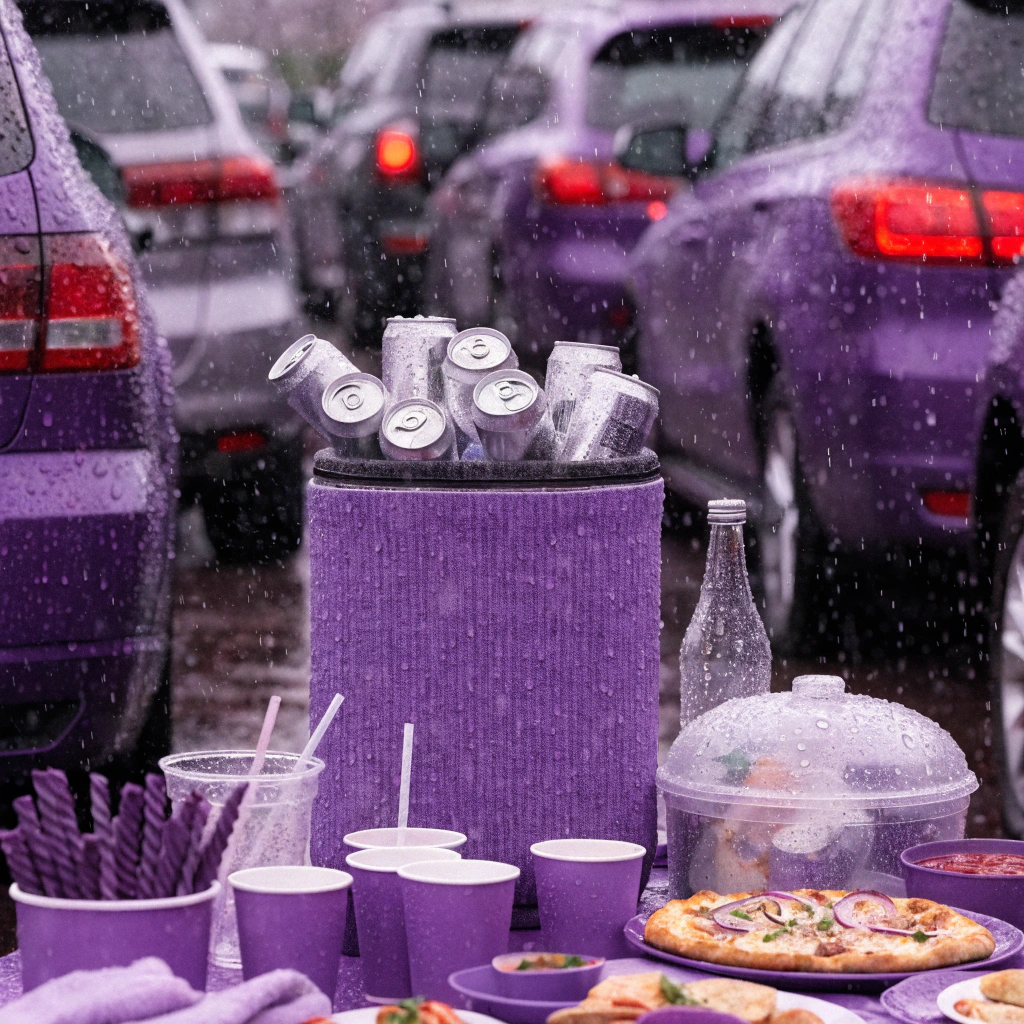
A Fun Party Before the Game
Many people in the USA love sports. They go to a football game. Before the game, they have a party in the parking lot. This is a tailgate.
People come in big cars and trucks. They open the back of the car. They bring food and drinks. Many people cook meat on a grill. They eat burgers and hot dogs.
Friends and family talk and play games. They wear the colors of their team. It is a happy time. Then, they go into the stadium to watch the game.
Grammar Spotlight
Pattern: Present Simple with 'They'
"They go to a football game."
We use the present simple to talk about habits or facts. When the subject is 'they', we use the base form of the verb without adding an 's'.
Pattern: Adjectives before Nouns
"People come in big cars."
In English, we put the describing word (adjective) before the object (noun). Here, 'big' tells us about the size of the 'cars'.
Test Your Understanding
10 questions · A1 Beginner · 1 free preview
Test what you learned from this article. Answer all questions to earn XP!
Where is the tailgate party?
Want to finish the quiz?
9 more questions are waiting for you. Sign up free to unlock the full quiz and earn XP!
Sign Up FreeAlready have an account? Sign In
Question Breakdown
Where is the tailgate party?
Your answer:
Correct answer: In the parking lot
The party happens after the game is finished.
Your answer:
Correct answer: False
What is a 'stadium'?
Your answer:
Correct answer: A large building for sports
They eat burgers and hot _____.
Your answer:
Correct answer: dogs
Tailgating: A Fun American Tradition
Tailgating is a very famous American tradition. It is a big party in a parking lot before a sports game. Fans usually meet hours before an American football game starts. They create a temporary community that is very vibrant and happy.
The name "tailgate" comes from pickup trucks. Fans lower the tailgate or open the back of their cars. They use this space to serve food and drinks. People cook delicious burgers and hot dogs on small grills. They also play games and talk to their friends.
This social gathering is important because it brings people together. Fans wear their team colors and sing songs. Sometimes, the party is more exciting than the game itself! This tradition started many years ago, and today it is a big part of the sports experience in the United States. It is a great way to socialize and have fun with other fans.
Grammar Spotlight
Pattern: Present Simple for Habits
"Fans usually meet hours before an American football game starts."
We use the present simple to talk about regular habits or traditions. For 'fans' (plural), we use the base form of the verb 'meet'.
Pattern: Comparatives with 'More'
"Sometimes, the party is more exciting than the game itself!"
For long adjectives like 'exciting', we use 'more' + adjective + 'than' to compare two things.
Test Your Understanding
11 questions · A2 Elementary · 1 free preview
Test what you learned from this article. Answer all questions to earn XP!
Where does tailgating usually happen?
Want to finish the quiz?
10 more questions are waiting for you. Sign up free to unlock the full quiz and earn XP!
Sign Up FreeAlready have an account? Sign In
Question Breakdown
Where does tailgating usually happen?
Your answer:
Correct answer: In a parking lot
Tailgating happens after the football game is finished.
Your answer:
Correct answer: False
What does 'fans' mean?
Your answer:
Correct answer: People who support a team
Fans _____ the back of their trucks to serve food.
Your answer:
Correct answer: lower
Why is it called tailgating?
Your answer:
Correct answer: Because of the back of pickup trucks
Tailgating: The Ultimate American Pre-Game Party
If you visit a sports stadium in the United States, you will likely see a sea of cars and trucks in the parking lot. This is where the tradition of "tailgating" happens. Tailgating is a social gathering which takes place before a game starts. It has become a quintessential part of American sports culture, especially for American football.
The name "tailgate" comes from the back of a truck, which is called a tailgate. Fans lower this part of their vehicle to create a small table for food and drinks. Although the exact origin is not known, it is believed that people have been tailgating since the very first football games in the 19th century.
Today, tailgating is more than just a quick snack. It is a large event where fans socialize for many hours. Delicious food like burgers and hot dogs are grilled on portable barbecues. Fans also play games like "cornhole" while they wait for the stadium doors to open. People who participate in these events are often very enthusiastic and wear their team's colors with pride.
For many, the party in the parking lot is just as important as the game itself. It is a time when a temporary community is built among strangers. Even if their teams are rivals, fans often share food and stories. This unique tradition shows that sports are not just about winning; they are about bringing people together to celebrate.
Grammar Spotlight
Pattern: Relative Clauses
"Tailgating is a social gathering which takes place before a game starts."
A relative clause uses 'which', 'that', or 'who' to give more information about a noun. Here, 'which' identifies the type of gathering being discussed.
Pattern: Present Perfect
"It has become a quintessential part of American sports culture."
The present perfect (have/has + past participle) is used for actions that started in the past and continue to be true or relevant now.
Test Your Understanding
11 questions · B1 Intermediate · 1 free preview
Test what you learned from this article. Answer all questions to earn XP!
Where does the practice of tailgating usually occur?
Want to finish the quiz?
10 more questions are waiting for you. Sign up free to unlock the full quiz and earn XP!
Sign Up FreeAlready have an account? Sign In
Question Breakdown
Where does the practice of tailgating usually occur?
Your answer:
Correct answer: In the parking lot
Tailgating is a social event that happens after the game has finished.
Your answer:
Correct answer: False
What does the word 'socialize' mean in the text?
Your answer:
Correct answer: To spend time with others for fun
Tailgating is a famous American _____ that involves food and sports.
Your answer:
Correct answer: tradition
Why is it called 'tailgating'?
Your answer:
Correct answer: Because it involves the back part of a truck
Beyond the Stadium: The Cultural Phenomenon of American Tailgating
In the United States, the excitement of a sporting event often begins long before the opening whistle is blown. This cultural phenomenon, known as tailgating, involves fans gathering in the parking lots surrounding stadiums to share food, drinks, and stories. While it is most commonly associated with American football, the tradition has evolved into a sophisticated ritual that transcends the sport itself. For many participants, the social experience in the parking lot is just as significant as the game taking place inside the arena.
The term 'tailgate' originates from the practice of lowering the rear door of a pickup truck to serve refreshments. However, modern tailgating has become far more elaborate than its humble beginnings. On game days, parking lots are transformed into vibrant, temporary communities where strangers are often welcomed with open arms. It is not unusual to see fans setting up professional-grade grills, large television screens, and even portable furniture to ensure their comfort. This dedication highlights the quintessential American spirit of hospitality and communal celebration. Some enthusiasts spend days preparing specialized menus that range from traditional burgers to complex regional cuisines, demonstrating that the culinary aspect is a vital component of the ritual.
Socially, tailgating fosters a unique sense of camaraderie among supporters. Regardless of their professional backgrounds, fans are united by their loyalty to a specific team. This shared identity allows for spontaneous interactions and the building of lifelong friendships. Many families have been attending these gatherings for generations, passing down specific recipes and traditions to their children. Consequently, the parking lot becomes a space where collective memory is preserved and celebrated. Furthermore, the atmosphere is often enhanced by music, games like 'cornhole,' and team-colored decorations, which collectively reinforce the festive mood before the stadium gates even open.
From an analytical perspective, tailgating serves as a vital bridge between the private and public spheres. It allows fans to claim a piece of public space and personalize it, creating a 'home away from home.' Although the primary objective is to support a team, the underlying motivation is often the desire for human connection in an increasingly digital world. As long as sports continue to bring people together, the tradition of tailgating will likely remain a cornerstone of American culture, proving that the journey to the game is often just as enjoyable as the destination.
Grammar Spotlight
Pattern: Passive Voice
"strangers are often welcomed with open arms."
The passive voice is used here to focus on the action being done to the strangers rather than who is doing it. It is formed using the verb 'to be' plus the past participle.
Pattern: Present Perfect Continuous
"Many families have been attending these gatherings for generations."
This tense emphasizes the duration of an action that started in the past and continues to the present. It is formed using 'have/has been' + the -ing form of the verb.
Pattern: Relative Clauses
"the atmosphere is often enhanced by music, games like 'cornhole,' and team-colored decorations, which collectively reinforce the festive mood."
The relative pronoun 'which' introduces a non-defining relative clause that provides extra information about the preceding list of items. It is separated from the main clause by a comma.
Test Your Understanding
11 questions · B2 Upper Intermediate · 1 free preview
Test what you learned from this article. Answer all questions to earn XP!
What is the primary purpose of tailgating according to the article?
Want to finish the quiz?
10 more questions are waiting for you. Sign up free to unlock the full quiz and earn XP!
Sign Up FreeAlready have an account? Sign In
Question Breakdown
What is the primary purpose of tailgating according to the article?
Your answer:
Correct answer: To socialize and share food before a game
The term 'tailgate' comes from the part of a pickup truck used to serve food.
Your answer:
Correct answer: True
What does 'camaraderie' mean?
Your answer:
Correct answer: Mutual trust and friendship
On game days, parking lots are transformed into vibrant, _____ communities.
Your answer:
Correct answer: temporary
What does the author suggest is the underlying motivation for tailgating today?
Your answer:
Correct answer: The desire for human connection in a digital world
The Pavement Pilgrimage: Deconstructing the American Tailgate
Rarely does an observer of American culture find a phenomenon as paradoxically primitive yet technologically sophisticated as the tailgate. While ostensibly a mere precursor to a sporting event, the practice represents an intricate tapestry of social cohesion and ritualistic indulgence. It is within the sprawling, sun-baked parking lots of stadiums that the rigid hierarchies of daily life dissolve into an ephemeral community of shared allegiance. The institutionalization of the tailgate has seen the simple lowering of a pickup truck's rear gate replaced by elaborate setups featuring satellite televisions and gourmet catering. The genesis of this tradition is often attributed to the inaugural intercollegiate football game in 1869, yet its modern manifestation is a far cry from those humble beginnings. What began as a pragmatic necessity—fans arriving via horse and carriage needing sustenance—has evolved into a multi-billion dollar industry. From a sociological perspective, the tailgate serves as a vital counterpoint to the increasing isolation of the digital era. Seldom do individuals from disparate socioeconomic backgrounds find such common ground as they do over a shared grill. This egalitarian spirit, however, is increasingly challenged by the aforementioned commercialization. The encroachment of corporate branding and 'premium' tailgating packages threatens to undermine the organic, grassroots essence of the gathering. Furthermore, the ritualistic nature of the event cannot be overstated. The meticulous preparation of specific regional delicacies—whether it be the smoked briskets of Texas or the bratwursts of Wisconsin—acts as a form of cultural preservation. Through the repetitive performance of these culinary traditions, fans reinforce their regional identities and generational ties. In conclusion, the American tailgate is far more than a pre-game party; it is a complex cultural artifact. It reflects the nation's penchant for spectacle, its deep-seated need for communal belonging, and the inevitable tension between tradition and commercial interests. As long as the stadium lights beckon, the pavement will continue to transform into a vibrant, if temporary, home for the faithful.
Grammar Spotlight
Pattern: Negative Inversion
"Rarely does an observer of American culture find a phenomenon as paradoxically primitive yet technologically sophisticated as the tailgate."
When a sentence starts with a negative or restrictive adverb like 'rarely', the subject and auxiliary verb are inverted. This is used for emphasis and is common in formal C1-level writing.
Pattern: Cleft Sentences
"It is within the sprawling, sun-baked parking lots of stadiums that the rigid hierarchies of daily life dissolve..."
A cleft sentence (It + is/was + [emphasized part] + that/who...) is used to focus on specific information. Here, it emphasizes the location where the social change occurs.
Pattern: Nominalisation
"The institutionalization of the tailgate has seen the simple lowering of a pickup truck's rear gate replaced by elaborate setups..."
Nominalisation involves turning verbs or adjectives into nouns (e.g., 'institutionalize' to 'institutionalization'). It creates a more formal, academic tone and allows for more complex ideas to be packed into a single sentence.
Test Your Understanding
12 questions · C1 Advanced · 1 free preview
Test what you learned from this article. Answer all questions to earn XP!
What does the author suggest about the relationship between socioeconomic status and tailgating?
Want to finish the quiz?
11 more questions are waiting for you. Sign up free to unlock the full quiz and earn XP!
Sign Up FreeAlready have an account? Sign In
Question Breakdown
What does the author suggest about the relationship between socioeconomic status and tailgating?
Your answer:
Correct answer: It provides a rare space where people from different backgrounds interact as equals.
The author believes that corporate involvement is purely beneficial for the tradition of tailgating.
Your answer:
Correct answer: False
What does 'egalitarian' mean in the context of the article?
Your answer:
Correct answer: Based on the principle of equality
The author describes the tailgate as an _____ community because it only exists for a short time around the game.
Your answer:
Correct answer: ephemeral
According to the article, how do regional delicacies like smoked brisket impact the event?
Your answer:
Correct answer: They function as a means of preserving regional and generational identity.
The tradition of tailgating is thought to have originated in the mid-19th century.
Your answer:
Correct answer: True
The Ephemeral Agora: Deciphering the Socio-Anthropological Fabric of American Tailgating
The American tradition of tailgating, while ostensibly a mere precursor to the main event of a sporting contest, arguably constitutes a more profound sociological artifact than the game itself. To the uninitiated, the spectacle of thousands of individuals congregating in a parking lot to consume caloric-dense fare amidst clouds of charcoal smoke might appear chaotic, or even primitive. However, should one apply a more rigorous analytical lens, it becomes evident that tailgating is a sophisticated ritual of communal liminality. It is within this asphalt sprawl that fans negotiate their social standing and forge identities that transcend their daily lives. Seldom does a mundane expanse of asphalt undergo so radical a metamorphosis as when a stadium parking lot prepares for the arrival of the faithful. This transition from a utilitarian parking space to a vibrant, albeit ephemeral, community is a testament to the human proclivity for collective identity.
Historically, the genesis of this practice is shrouded in a degree of ambiguity, though many scholars point to the first collegiate football game in 1869 as a potential point of origin. Regardless of its precise inception, the evolution of tailgating has mirrored broader shifts in American social stratification and technological advancement. What began as a vestigial necessity—travelers arriving via horse and buggy needing sustenance—has transformed into a hyper-organized display of cultural sovereignty. Central to this experience is the concept of commensality—the act of eating together. In an era increasingly characterized by digital isolation, the physical juxtaposition of strangers sharing a meal fosters a unique form of conviviality. This ritualized consumption serves to dissolve social barriers, creating a temporary egalitarian space where the only hierarchy is defined by team allegiance. It is through this collective commensality that the fan experience is truly solidified.
Theatricality also plays a pivotal role in the tailgate ethos. Participants often engage in elaborate displays of team loyalty, utilizing custom-designed recreational vehicles and sophisticated culinary equipment. Such displays are not merely for comfort; they serve as markers of dedication and status within the fan subculture. It is imperative that the participant acknowledge the unspoken codes of conduct that govern these gatherings: the generosity of spirit, the exchange of expert prognostications about the match, and the shared defense of the communal space. Furthermore, tailgating acts as a bridge between the private and public spheres. By bringing domestic activities—cooking and lounging—into a public lot, fans reclaim the urban landscape from its purely functional roots. This reclamation is particularly poignant in the context of modern sports, which are often criticized for their hyper-commercialization and the sterile environment of the stadium bowl.
However, one must not overlook the environmental and economic implications of such massive gatherings. The sheer volume of waste generated and the carbon footprint of thousands of idling vehicles present a stark contrast to the idyllic communal spirit. Academic hedging suggests that while tailgating fosters social cohesion, it also reinforces certain exclusionary practices, often predicated on economic access to the necessary equipment and tickets. Be it through the shared burger or the collective roar of a pre-game chant, the tailgate remains a bastion of grassroots authenticity. Ultimately, the tailgate represents a vital, if transient, pillar of American cultural identity. To understand the American sports fan, one must first understand the parking lot, for it is there that the true essence of the sport is cultivated long before the first whistle blows.
Grammar Spotlight
Pattern: Negative Inversion
"Seldom does a mundane expanse of asphalt undergo so radical a metamorphosis."
When a negative adverbial like 'seldom' starts a sentence for emphasis, the auxiliary verb moves before the subject. This structure is common in formal, academic writing to provide rhetorical weight.
Pattern: It-Cleft Sentences
"It is within this asphalt sprawl that fans negotiate their social standing."
Cleft sentences are used to focus on a specific part of the information. By using 'It is... that...', the author emphasizes the location (the asphalt sprawl) as the primary site of social negotiation.
Pattern: The Subjunctive Mood
"Be it through the shared burger or the collective roar of a pre-game chant..."
The 'be it' construction is a form of the subjunctive used to express 'whether it is'. It is a formal way to introduce various possibilities that lead to the same conclusion.
Test Your Understanding
12 questions · C2 Mastery · 1 free preview
Test what you learned from this article. Answer all questions to earn XP!
What is the primary analytical focus of the article regarding tailgating?
Want to finish the quiz?
11 more questions are waiting for you. Sign up free to unlock the full quiz and earn XP!
Sign Up FreeAlready have an account? Sign In
Question Breakdown
What is the primary analytical focus of the article regarding tailgating?
Your answer:
Correct answer: The socio-anthropological significance of the ritual.
The author suggests that tailgating is a purely chaotic event with no underlying social structure.
Your answer:
Correct answer: False
Which word describes the state of being 'in-between' or on a threshold during a ritual?
Your answer:
Correct answer: Liminality
The practice of eating together to foster social bonds is known as _____.
Your answer:
Correct answer: commensality
According to the text, how does tailgating affect the relationship between private and public spheres?
Your answer:
Correct answer: It brings domestic activities into the public urban landscape.
The author uses academic hedging to acknowledge that tailgating might have exclusionary aspects.
Your answer:
Correct answer: True
