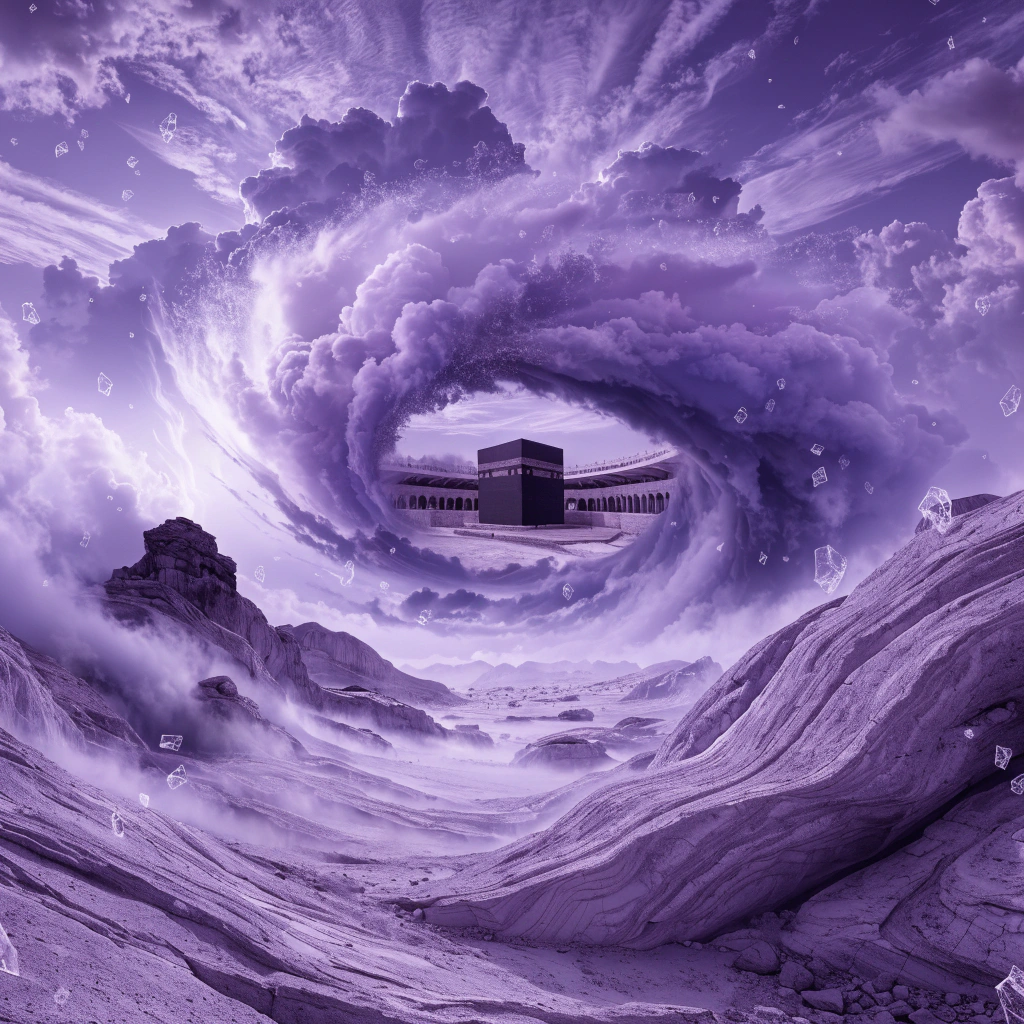
Hajj and Eid al-Adha in Saudi Arabia
Hajj is a big event in Saudi Arabia. Many people travel to Mecca every year. They are pilgrims. They pray and walk together. It is very special.
After Hajj, people celebrate Eid al-Adha. Families meet and eat together. They wear new clothes. They share food with poor people.
The government helps the people. There are big tents in Mina for the pilgrims. Everyone is happy and kind. It is a time for peace and prayer.
Grammatik-Spotlight
Muster: Present Simple (to be)
"Hajj is a big event in Saudi Arabia."
We use 'is' with singular subjects like Hajj to talk about facts. It describes what something is or how it feels.
Muster: Present Simple (plural verbs)
"Families meet and eat together."
With plural subjects like 'Families', we use the base form of the verb without an 's'. This describes things people do regularly.
Teste dein Verständnis
10 Fragen · A1 Anfänger · 1 kostenlose Vorschau
Teste, was du aus diesem Artikel gelernt hast. Beantworte alle Fragen und sammle XP!
Where do many people travel every year?
Möchtest du das Quiz beenden?
9 weitere Fragen warten auf dich. Registriere dich kostenlos, um das vollständige Quiz freizuschalten und XP zu sammeln!
Kostenlos registrierenHast du schon ein Konto? Anmelden
Gut gemacht!
Weiter üben!
Bereits abgeschlossen — keine zusätzlichen XP
Registriere dich, um XP zu verdienenFragenübersicht
Where do many people travel every year?
Deine Antwort:
Richtige Antwort: Mecca
Eid al-Adha happens before Hajj.
Deine Antwort:
Richtige Antwort: Falsch
What does 'share' mean?
Deine Antwort:
Richtige Antwort: To give some to others
People wear new _____ during Eid.
Deine Antwort:
Richtige Antwort: clothes
A Special Journey: Hajj and Eid al-Adha
Every year, millions of Muslims travel to Mecca in Saudi Arabia. This journey is called Hajj. It is one of the most important events in the world. People come from many different countries to pray and visit holy places together.
The Hajj lasts for several days. During this time, pilgrims stay in a very big tent city in Mina. This city is bigger than many normal towns! The Saudi government works hard to help everyone. They provide water, food, and doctors. It is a busy time, but people are very happy and kind to each other.
After Hajj, people celebrate Eid al-Adha. This is a special holiday for Muslims everywhere. Families meet to eat big meals and give gifts. People also help the poor by giving them meat and money. Last year, my friend went to Hajj. He said it was the most beautiful experience of his life because he met many new friends.
Grammatik-Spotlight
Muster: Comparatives (Adjective + -er + than)
"This city is bigger than many normal towns!"
We use comparatives to compare two things. For short adjectives, we add '-er' to the word and use 'than' before the second thing.
Muster: Past Simple (Irregular Verbs)
"Last year, my friend went to Hajj."
We use the past simple for actions that finished in the past. 'Went' is the irregular past form of the verb 'go'.
Teste dein Verständnis
11 Fragen · A2 Grundkenntnisse · 1 kostenlose Vorschau
Teste, was du aus diesem Artikel gelernt hast. Beantworte alle Fragen und sammle XP!
Where do millions of people travel for Hajj?
Möchtest du das Quiz beenden?
10 weitere Fragen warten auf dich. Registriere dich kostenlos, um das vollständige Quiz freizuschalten und XP zu sammeln!
Kostenlos registrierenHast du schon ein Konto? Anmelden
Gut gemacht!
Weiter üben!
Bereits abgeschlossen — keine zusätzlichen XP
Registriere dich, um XP zu verdienenFragenübersicht
Where do millions of people travel for Hajj?
Deine Antwort:
Richtige Antwort: Mecca
The Hajj lasts for only one hour.
Deine Antwort:
Richtige Antwort: Falsch
What is a 'journey'?
Deine Antwort:
Richtige Antwort: A long trip
Pilgrims stay in a very big _____ city in Mina.
Deine Antwort:
Richtige Antwort: tent
What do families do during Eid al-Adha?
Deine Antwort:
Richtige Antwort: They eat big meals and give gifts
A Journey of Faith: Hajj and Eid al-Adha in Saudi Arabia
Every year, millions of Muslims from around the world travel to Saudi Arabia for Hajj. This journey is one of the five pillars of Islam, which every adult Muslim should complete at least once if they are able. The pilgrims descend upon the holy city of Mecca to perform rituals that have been practiced for centuries.
The logistics of Hajj are quite amazing. Because so many people arrive at the same time, a vast tent city is built in Mina to house the pilgrims. Modern engineering has been used to ensure that the event is safe and comfortable for everyone. For example, large cooling systems are installed to help people deal with the heat. These services are provided by the Saudi government, which works hard to manage the crowds.
After the Hajj rituals are finished, Muslims everywhere celebrate Eid al-Adha. This is known as the 'Festival of Sacrifice.' It honors the story of Prophet Ibrahim, who was willing to sacrifice his son as an act of obedience to God. Today, families gather to share special meals and give meat to those who are less fortunate.
In Saudi Arabia, the atmosphere during this time is very special. Traditional hospitality is shown to all visitors, and streets are filled with people wearing white clothes called Ihram. This clothing represents equality, showing that everyone is the same before God. Hajj and Eid al-Adha have become symbols of unity and faith that connect the global Muslim community.
Grammatik-Spotlight
Muster: Relative Clauses
"This journey is one of the five pillars of Islam, which every adult Muslim should complete at least once if they are able."
We use relative clauses starting with 'which', 'who', or 'that' to give more information about a noun. In this case, 'which' adds detail about the journey mentioned before it.
Muster: Passive Voice
"These services are provided by the Saudi government..."
The passive voice is formed with the verb 'to be' and the past participle. We use it when the action or the object of the action is more important than the person performing it.
Teste dein Verständnis
11 Fragen · B1 Mittelstufe · 1 kostenlose Vorschau
Teste, was du aus diesem Artikel gelernt hast. Beantworte alle Fragen und sammle XP!
What is the main purpose of the tent city in Mina?
Möchtest du das Quiz beenden?
10 weitere Fragen warten auf dich. Registriere dich kostenlos, um das vollständige Quiz freizuschalten und XP zu sammeln!
Kostenlos registrierenHast du schon ein Konto? Anmelden
Gut gemacht!
Weiter üben!
Bereits abgeschlossen — keine zusätzlichen XP
Registriere dich, um XP zu verdienenFragenübersicht
What is the main purpose of the tent city in Mina?
Deine Antwort:
Richtige Antwort: To provide housing for pilgrims
Hajj rituals have only been practiced for a few years.
Deine Antwort:
Richtige Antwort: Falsch
What does 'hospitality' mean?
Deine Antwort:
Richtige Antwort: Being friendly and welcoming to guests
Modern _____ has been used to ensure the event is safe and comfortable.
Deine Antwort:
Richtige Antwort: engineering
What does the white clothing called 'Ihram' represent?
Deine Antwort:
Richtige Antwort: Equality
The Sacred Journey: Balancing Tradition and Modernity in the Hajj
Every year, the Kingdom of Saudi Arabia becomes the focal point of the Islamic world as millions of worshippers embark on the Hajj pilgrimage. As one of the five pillars of Islam, this spiritual journey is a mandatory religious duty for Muslims that must be carried out at least once in their lifetime, provided they are physically and financially capable. While the rituals are deeply rooted in ancient traditions dating back to the Prophet Ibrahim, the modern execution of Hajj is a testament to contemporary engineering and sophisticated logistical planning.
The scale of the event is truly staggering. To accommodate the massive influx of people, the Saudi government has developed an extensive infrastructure, including specialized transport networks and the vast tent city of Mina. If the government had not implemented these advanced measures over the last few decades, the logistical challenges would have been insurmountable. Today, pilgrims move through the holy sites with relative ease, facilitated by high-speed trains and cooled pedestrian tunnels. This blend of faith and technology ensures that the focus remains on spiritual devotion rather than the hardships of travel.
Following the completion of the Hajj rituals, the global Muslim community celebrates Eid al-Adha, known as the Festival of Sacrifice. This holiday commemorates the willingness of Ibrahim to sacrifice his son as an act of obedience to God. Throughout Saudi Arabia, the atmosphere during Eid is one of profound generosity and hospitality. Families gather to share meals, and a significant portion of meat from sacrificed livestock is distributed to the less fortunate, ensuring that the spirit of charity reaches all levels of society. Furthermore, the economic impact of this period is substantial, as it stimulates local businesses and fosters international cooperation.
In conclusion, the Hajj and Eid al-Adha represent a unique manifestation of unity and faith. The event is not merely a religious gathering but also a complex operation that requires constant evaluation and improvement. By successfully managing such a monumental task, the Kingdom demonstrates its commitment to preserving Islamic heritage while embracing the necessities of the modern world. For the pilgrims, the experience is often described as a transformative moment that offers a sense of renewal and global brotherhood.
Grammatik-Spotlight
Muster: Third Conditional
"If the government had not implemented these advanced measures over the last few decades, the logistical challenges would have been insurmountable."
This is used to talk about a hypothetical situation in the past and its imaginary result. It is formed using 'if + past perfect' and 'would have + past participle'.
Muster: Passive Voice (Present Perfect)
"This experience is often described as a transformative moment."
The passive voice is used here to focus on the experience itself rather than who is describing it. It uses 'is/are + past participle' for a general truth or state.
Muster: Relative Clauses
"...this spiritual journey is a mandatory religious duty for Muslims that must be carried out at least once in their lifetime."
The relative pronoun 'that' introduces a defining relative clause which provides essential information about the 'religious duty'.
Teste dein Verständnis
11 Fragen · B2 Obere Mittelstufe · 1 kostenlose Vorschau
Teste, was du aus diesem Artikel gelernt hast. Beantworte alle Fragen und sammle XP!
According to the article, what makes the modern Hajj possible despite the huge number of people?
Möchtest du das Quiz beenden?
10 weitere Fragen warten auf dich. Registriere dich kostenlos, um das vollständige Quiz freizuschalten und XP zu sammeln!
Kostenlos registrierenHast du schon ein Konto? Anmelden
Gut gemacht!
Weiter üben!
Bereits abgeschlossen — keine zusätzlichen XP
Registriere dich, um XP zu verdienenFragenübersicht
According to the article, what makes the modern Hajj possible despite the huge number of people?
Deine Antwort:
Richtige Antwort: Sophisticated engineering and logistical planning
The Saudi government has invested in high-speed trains to help pilgrims move between holy sites.
Deine Antwort:
Richtige Antwort: Richtig
What does the word 'insurmountable' mean in the context of the text?
Deine Antwort:
Richtige Antwort: Impossible to overcome
The article states that the Hajj is a _____ religious duty for those who are physically and financially capable.
Deine Antwort:
Richtige Antwort: mandatory
What is a primary social outcome of Eid al-Adha mentioned in the text?
Deine Antwort:
Richtige Antwort: The distribution of meat to the less fortunate
The Convergence of Faith and Infrastructure: Navigating the Hajj and Eid al-Adha
Seldom has the world witnessed such a profound convergence of spirituality and logistical prowess as that seen during the annual Hajj pilgrimage in Saudi Arabia. For the Kingdom, the management of this sacred event—one of the five pillars of Islam—is not merely a religious obligation but a sophisticated manifestation of modern engineering and traditional hospitality. As millions of pilgrims descend upon the holy city of Mecca, the logistical demands necessitate a level of coordination that challenges even the most advanced urban planning paradigms. This annual event requires the synchronization of transport, health services, and housing on a scale that is virtually unparalleled globally.
The transformation of the arid landscape of Mina into a sprawling, fireproof tent city represents a triumph of infrastructure. It is the sheer scale of this endeavor that often escapes the casual observer. Beyond the provision of basic shelter, the government must ensure the seamless flow of human traffic through the Jamarat Bridge—a multi-level structure designed specifically to mitigate the risks associated with high-density gatherings. Such logistical feats are underpinned by an unwavering commitment to the safety and well-being of the faithful, illustrating a unique synthesis of ancient ritual and cutting-edge technology. The meticulous planning involved ensures that the spiritual experience remains the central focus for every participant.
Central to the Hajj is the concept of egalitarianism. Clad in the simple white garments of Ihram, pilgrims from disparate socio-economic backgrounds stand as equals before their Creator. This stripping away of worldly status serves as a poignant reminder of human fragility and shared purpose. What defines the Hajj is not just the individual’s spiritual journey, but the collective experience of the Ummah, or global Muslim community. The rituals, from the circumambulation of the Kaaba to the standing at Arafat, are imbued with a sanctity that transcends the physical realm, fostering a sense of unity that persists long after the pilgrims return to their home countries.
Following the climax of the Hajj is Eid al-Adha, the Festival of Sacrifice. While the ritual commemorates Prophet Ibrahim’s devotion, its modern implementation involves a complex global network of philanthropy. The institutionalization of the sacrifice ensures that the resulting meat is distributed to the impoverished across the globe, transforming a local ritual into a significant act of international aid. This systematic approach to charity reflects a broader trend of nominalisation in religious practice, where abstract virtues are translated into concrete, manageable systems that address global food insecurity.
However, the Hajj is not without its challenges. The delicate balance between preserving the historical integrity of the holy sites and accommodating an ever-growing number of pilgrims remains a point of nuanced debate. Critics and proponents alike grapple with the implications of urban expansion in Mecca and the surrounding areas. Yet, despite these tensions, the Hajj remains an unparalleled testament to the enduring power of faith. It is through this meticulous planning and spiritual dedication that the Kingdom continues to host what is arguably the most significant and complex gathering on the planet.
Grammatik-Spotlight
Muster: Inversion with Negative Adverbials
"Seldom has the world witnessed such a profound convergence of spirituality and logistical prowess..."
This pattern places a negative adverbial at the start for emphasis. It requires switching the order of the subject and the auxiliary verb.
Muster: Cleft Sentences
"It is the sheer scale of this endeavor that often escapes the casual observer."
Cleft sentences use 'It is... that' to focus on a specific noun phrase, highlighting its importance within the sentence context.
Muster: Nominalisation
"The transformation of the arid landscape of Mina into a sprawling, fireproof tent city represents a triumph of infrastructure."
Nominalisation turns verbs like 'transform' into nouns like 'transformation'. This creates a more formal, academic tone suitable for complex analysis.
Teste dein Verständnis
12 Fragen · C1 Fortgeschritten · 1 kostenlose Vorschau
Teste, was du aus diesem Artikel gelernt hast. Beantworte alle Fragen und sammle XP!
What is the primary purpose of the Jamarat Bridge mentioned in the text?
Möchtest du das Quiz beenden?
11 weitere Fragen warten auf dich. Registriere dich kostenlos, um das vollständige Quiz freizuschalten und XP zu sammeln!
Kostenlos registrierenHast du schon ein Konto? Anmelden
Gut gemacht!
Weiter üben!
Bereits abgeschlossen — keine zusätzlichen XP
Registriere dich, um XP zu verdienenFragenübersicht
What is the primary purpose of the Jamarat Bridge mentioned in the text?
Deine Antwort:
Richtige Antwort: To mitigate risks in high-density crowds
The article suggests that the Hajj is managed using only traditional methods without modern technology.
Deine Antwort:
Richtige Antwort: Falsch
Which word describes the quality of being holy or sacred?
Deine Antwort:
Richtige Antwort: Sanctity
The stripping away of worldly status serves as a poignant _____ of human fragility.
Deine Antwort:
Richtige Antwort: reminder
How has the modern implementation of Eid al-Adha sacrifice changed according to the text?
Deine Antwort:
Richtige Antwort: It is now part of a global philanthropic network
What is the 'delicate balance' discussed in the final paragraph?
Deine Antwort:
Richtige Antwort: Balancing historical preservation with urban expansion
The Convergence of Devotion and Logistics: A Socio-Theological Analysis of the Hajj and Eid al-Adha
The Hajj, an annual circumambulation of the Kaaba, represents more than a mere religious obligation; it is a profound ontological journey that necessitates a convergence of spiritual fervor and logistical precision. For the millions who descend upon the holy city of Mecca, the pilgrimage serves as a quintessence of Islamic unity, transcending the myriad ethnic and socio-economic divisions that characterize the contemporary global landscape. Were one to examine the logistical underpinnings of this event, one would find a Herculean effort by the Saudi Arabian government to manage an ephemeral conglomeration of humanity that is unparalleled in its complexity and scale. It is imperative that the sanctity of the rituals be preserved while simultaneously ensuring the safety and efficacy of modern infrastructure. This administrative acumen is most visible in the sprawling tent city of Mina, a marvel of engineering designed to house millions of pilgrims in a controlled, yet spiritually conducive environment.
Central to the Hajj is the commemoration of Prophet Ibrahim’s unwavering faith, a narrative that finds its peak in the celebration of Eid al-Adha. This 'Festival of Sacrifice' is not merely a symbolic gesture of ritual slaughter but an enactment of profound altruism and social cohesion. The distribution of meat to the disenfranchised ensures that the spiritual benefits of the sacrifice permeate the entire social fabric, fostering a sense of collective responsibility. It is often argued, albeit with academic hedging, that the economic impact of the Hajj and Eid al-Adha acts as a significant catalyst for regional trade and development. However, the primary focus remains the internal transformation of the individual. The pilgrim, stripped of worldly status through the donning of the simple white ihram, undergoes a symbolic death and rebirth, emerging from the desert with a recalibrated moral compass.
Seldom has a logistical feat of this magnitude been sustained with such consistency over centuries. The transition from historical caravans to modern aviation has not diluted the sacrosanct nature of the journey; rather, it has amplified the challenges of maintaining a sense of intimacy amidst a sea of millions. The efficacy of the state's management is indispensable to the success of the pilgrimage, requiring constant innovation in crowd control and public health. Despite the inherent vicissitudes of managing such a diverse population, the overarching paradigm remains one of peace and submission. As the pilgrims depart, the resonance of the Hajj continues to echo through their communities, serving as a reminder of the delicate balance between temporal organization and eternal devotion. It is essential that the global community recognize the Hajj not just as a religious gathering, but as a sophisticated exercise in human cooperation and spiritual endurance.
Grammatik-Spotlight
Muster: The Subjunctive Mood
"It is imperative that the sanctity of the rituals be preserved while simultaneously ensuring the safety and efficacy of modern infrastructure."
The subjunctive 'be preserved' is used after adjectives of urgency or importance like 'imperative'. It omits the 's' in the third person and uses the base form of the verb.
Muster: Inversion with Negative Adverbials
"Seldom has a logistical feat of this magnitude been sustained with such consistency over centuries."
When a sentence begins with a negative or restrictive adverb like 'seldom', the subject and auxiliary verb are inverted to add emphasis and formal tone.
Muster: Second Conditional (Inverted / Formal)
"Were one to examine the logistical underpinnings of this event, one would find a Herculean effort by the Saudi Arabian government."
This structure replaces 'If one were to examine' with 'Were one to examine'. It is a highly formal way of expressing a hypothetical situation in the present or future.
Teste dein Verständnis
12 Fragen · C2 Meisterschaft · 1 kostenlose Vorschau
Teste, was du aus diesem Artikel gelernt hast. Beantworte alle Fragen und sammle XP!
According to the text, what is the 'ihram' primarily symbolic of?
Möchtest du das Quiz beenden?
11 weitere Fragen warten auf dich. Registriere dich kostenlos, um das vollständige Quiz freizuschalten und XP zu sammeln!
Kostenlos registrierenHast du schon ein Konto? Anmelden
Gut gemacht!
Weiter üben!
Bereits abgeschlossen — keine zusätzlichen XP
Registriere dich, um XP zu verdienenFragenübersicht
According to the text, what is the 'ihram' primarily symbolic of?
Deine Antwort:
Richtige Antwort: The removal of worldly status and a process of rebirth
The author suggests that modern aviation has diminished the sacred nature of the Hajj.
Deine Antwort:
Richtige Antwort: Falsch
Which word describes the 'temporary' nature of the gathering in Mecca?
Deine Antwort:
Richtige Antwort: Ephemeral
The distribution of meat during Eid al-Adha is described as an act of profound _____.
Deine Antwort:
Richtige Antwort: altruism
What does the author identify as the 'quintessence' of Islamic unity?
Deine Antwort:
Richtige Antwort: The Hajj pilgrimage
The text argues that the economic impact of the Hajj is often discussed with a degree of academic caution.
Deine Antwort:
Richtige Antwort: Richtig
Hajj und Eid al-Adha: Ein großes Fest
Das ist Hajj. Hajj ist ein großes Fest für Muslime. Es ist in Saudi-Arabien, in der Stadt Mekka. Viele Menschen gehen nach Mekka. Sie sind Pilger. Das Fest heißt Eid al-Adha. Es ist eine wichtige Zeit. Es ist ein gutes Fest für alle Muslime. Viele Pilger sind glücklich.
Grammatik-Spotlight
Muster: Verb 'sein' (ist)
"Hajj ist ein großes Fest."
Das Wort 'ist' kommt vom Verb 'sein'. Wir benutzen 'ist' für 'er', 'sie' oder 'es'. Es zeigt, wie etwas ist oder wo es ist. Zum Beispiel: 'Er ist glücklich.' oder 'Das ist ein Buch.'
Teste dein Verständnis
9 Fragen · A0 Vor-Anfänger · 1 kostenlose Vorschau
Teste, was du aus diesem Artikel gelernt hast. Beantworte alle Fragen und sammle XP!
Was ist Hajj?
Möchtest du das Quiz beenden?
8 weitere Fragen warten auf dich. Registriere dich kostenlos, um das vollständige Quiz freizuschalten und XP zu sammeln!
Kostenlos registrierenHast du schon ein Konto? Anmelden
Gut gemacht!
Weiter üben!
Bereits abgeschlossen — keine zusätzlichen XP
Registriere dich, um XP zu verdienenFragenübersicht
Was ist Hajj?
Deine Antwort:
Richtige Antwort: Ein Fest
Mekka ist in Saudi-Arabien.
Deine Antwort:
Richtige Antwort: Richtig
Viele ____ gehen nach Mekka.
Deine Antwort:
Richtige Antwort: Menschen

