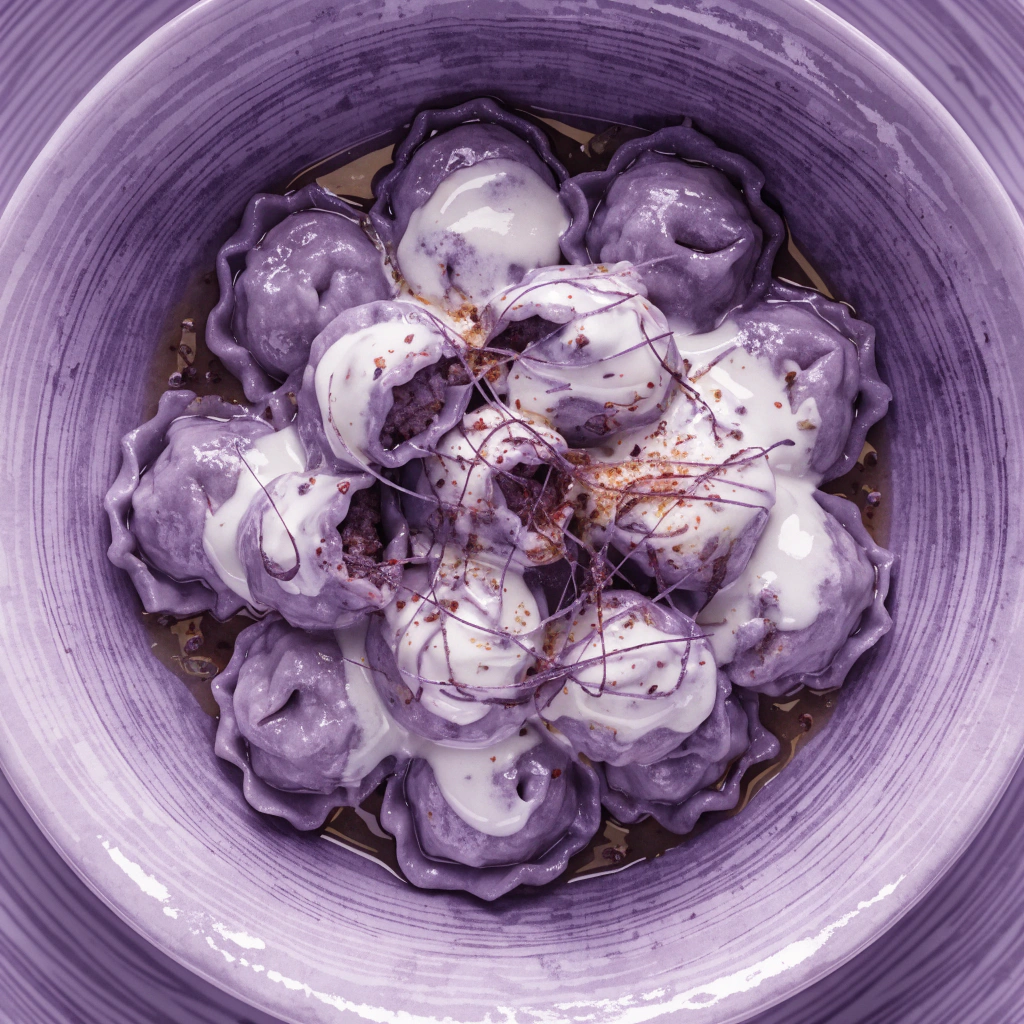
Mantı: Ein leckeres Essen aus der Türkei
Mantı ist ein türkisches Essen. Es ist wie kleine Nudeln. In der Türkei essen viele Leute Mantı gern. Mantı kommt aus Zentralasien. Es ist ein sehr altes Gericht.
Man macht Mantı mit Teig und Fleisch. Der Teig ist klein und oft rund. Das Fleisch ist oft Rindfleisch oder Lammfleisch. Man kocht Mantı in heißem Wasser.
Man isst Mantı oft mit Joghurt. Auch frischer Knoblauch und getrocknete Minze sind oft dabei. Manchmal gibt es auch eine rote Paprika-Soße. Mantı schmeckt sehr gut! Es ist ein beliebtes Gericht für Familien.
Grammatik-Spotlight
Muster: Nomen und Artikel (der, die, das)
"Mantı ist ein türkisches Essen. Der Teig ist klein. Die Türkei ist ein Land."
Im Deutschen haben Nomen ein Geschlecht: maskulin (der), feminin (die) oder neutral (das). Man muss den richtigen Artikel lernen. Zum Beispiel: 'das Essen', 'der Teig', 'die Türkei'.
Muster: Verben im Präsens (man macht, man isst)
"Man macht Mantı mit Teig. Man kocht Mantı in Wasser. Man isst Mantı mit Joghurt."
Das Verb 'machen', 'kochen' oder 'essen' beschreibt eine Handlung. 'Man' ist ein unpersönliches Pronomen. Es bedeutet 'jemand' oder 'Leute' im Allgemeinen. Das Verb steht in der dritten Person Singular.
Teste dein Verständnis
10 Fragen · A1 Anfänger · 1 kostenlose Vorschau
Teste, was du aus diesem Artikel gelernt hast. Beantworte alle Fragen und sammle XP!
Was ist Mantı?
Möchtest du das Quiz beenden?
9 weitere Fragen warten auf dich. Registriere dich kostenlos, um das vollständige Quiz freizuschalten und XP zu sammeln!
Kostenlos registrierenHast du schon ein Konto? Anmelden
Gut gemacht!
Weiter üben!
Bereits abgeschlossen — keine zusätzlichen XP
Registriere dich, um XP zu verdienenFragenübersicht
Was ist Mantı?
Deine Antwort:
Richtige Antwort: Ein türkisches Essen
Mantı ist ein neues Gericht.
Deine Antwort:
Richtige Antwort: Falsch
Was bedeutet 'Fleisch'?
Deine Antwort:
Richtige Antwort: Das Produkt von Tieren, das man isst
Man kocht Mantı in heißem ____.
Deine Antwort:
Richtige Antwort: Wasser
Mantı: Kleine Teigtaschen mit großer Geschichte
Mantı ist ein sehr beliebtes Gericht in der Türkei. Viele Leute sagen, es ist wie kleine türkische Ravioli. Aber wussten Sie, dass Mantı nicht nur aus der Türkei kommt? Seine Geschichte begann in Zentralasien, bei den nomadischen Völkern. Von dort kam es mit den Türken in viele Länder, auch in die Türkei.
Mantı ist besonders, weil die Teigtaschen sehr klein sind. In der Türkei macht man sie oft mit gewürztem Hackfleisch. Man kocht sie und serviert sie dann heiß. Dazu gibt es meistens Joghurt mit Knoblauch. Manchmal streut man auch getrocknete Minze oder Sumach darüber. Das gibt dem Gericht einen frischen und besonderen Geschmack.
Früher war Mantı auch am Hof des Osmanischen Reiches sehr beliebt. Es war ein wichtiges Essen und wurde oft bei Festen gegessen. Heute findet man Mantı in fast jedem türkischen Restaurant. Es ist ein traditionelles Gericht, das Generationen verbindet und viele Menschen glücklich macht. Es ist einfach köstlich!
Grammatik-Spotlight
Muster: Präsens als Zustand
"Mantı ist ein sehr beliebtes Gericht in der Türkei."
Wir benutzen das Präsens (ist) hier, um einen Zustand oder eine allgemeine Tatsache zu beschreiben. Es sagt uns, wie etwas jetzt ist oder immer ist. Man bildet es mit dem Verb 'sein' in der richtigen Form.
Muster: Vergleich mit 'wie'
"Viele Leute sagen, es ist wie kleine türkische Ravioli."
Wir benutzen 'wie', um zwei Dinge miteinander zu vergleichen. Es zeigt eine Ähnlichkeit. Man stellt das Wort 'wie' zwischen die zwei Dinge, die man vergleicht.
Teste dein Verständnis
11 Fragen · A2 Grundkenntnisse · 1 kostenlose Vorschau
Teste, was du aus diesem Artikel gelernt hast. Beantworte alle Fragen und sammle XP!
Woher kommt Mantı ursprünglich?
Möchtest du das Quiz beenden?
10 weitere Fragen warten auf dich. Registriere dich kostenlos, um das vollständige Quiz freizuschalten und XP zu sammeln!
Kostenlos registrierenHast du schon ein Konto? Anmelden
Gut gemacht!
Weiter üben!
Bereits abgeschlossen — keine zusätzlichen XP
Registriere dich, um XP zu verdienenFragenübersicht
Woher kommt Mantı ursprünglich?
Deine Antwort:
Richtige Antwort: Aus Zentralasien
Mantı-Teigtaschen sind bekannt dafür, sehr groß zu sein.
Deine Antwort:
Richtige Antwort: Falsch
Was bedeutet 'köstlich'?
Deine Antwort:
Richtige Antwort: Sehr gut schmeckend
Man isst Mantı oft mit Joghurt und ______.
Deine Antwort:
Richtige Antwort: Knoblauch
Welche Zutat ist oft in der Füllung von Mantı?
Deine Antwort:
Richtige Antwort: Hackfleisch
Mantı: Die kleinen türkischen Teigtaschen mit großer Geschichte
Mantı, oft als die türkische Ravioli bezeichnet, ist ein Gericht, das eine lange und faszinierende Geschichte hat. Es repräsentiert das nomadische Erbe der Turkstämme aus Zentralasien und hat sich bis in die moderne türkische Küche entwickelt. Obwohl es viele Variationen von Teigtaschen entlang der Seidenstraße gibt, zeichnet sich die türkische Version durch ihre winzige Größe und die besondere Kombination aus Joghurt und würzigen Soßen aus.
Die Zubereitung von Mantı ist eine Kunst für sich, die oft viel Geduld und Geschick erfordert. Traditionell werden die kleinen Teigtaschen von Hand geformt und mit einer würzigen Hackfleischfüllung versehen. Anschließend werden sie gekocht und typischerweise mit Knoblauchjoghurt, geschmolzener Butter, die mit Paprikapulver oder Minze gewürzt ist, und manchmal auch mit Sumach oder getrockneter Minze serviert.
Historisch gesehen war Mantı ein beliebtes Gericht am osmanischen Hof. Dort wurde es geschätzt und oft mit speziellen Toppings angeboten, die den Geschmack noch verfeinerten. Jede Region in der Türkei hat ihre eigene Art, Mantı zuzubereiten und zu servieren. Die bekannteste Variante kommt aus Kayseri, wo die Teigtaschen so klein sind, dass ein Löffel 40 Stück davon fassen können muss.
Heute ist Mantı nicht nur ein traditionelles Gericht, sondern auch ein Symbol für Gastfreundschaft und Familienzusammenkunft. Es wird oft zu besonderen Anlässen oder einfach als festliches Essen zubereitet. Viele türkische Familien haben ihre eigenen Rezepte, die von Generation zu Generation weitergegeben werden. Wer Mantı probiert, schmeckt nicht nur ein köstliches Essen, sondern auch ein Stück türkischer Kultur und Geschichte.
Grammatik-Spotlight
Muster: Relative Clauses (Relativsätze)
"Mantı ist ein Gericht, das eine lange und faszinierende Geschichte hat."
Relativsätze geben zusätzliche Informationen über ein Nomen. Sie beginnen mit einem Relativpronomen (z.B. 'der', 'die', 'das', 'welcher', 'welche', 'welches') und das Verb steht am Ende des Satzes. Sie sind wichtig, um Sätze genauer zu machen.
Muster: Passive Voice (Passiv)
"Mantı, oft als die türkische Ravioli bezeichnet, ist ein Gericht..."
Das Passiv wird verwendet, wenn die Handlung wichtiger ist als die Person oder Sache, die die Handlung ausführt. Es wird mit einer Form von 'werden' und dem Partizip II des Hauptverbs gebildet. Es hilft, formeller oder allgemeiner zu sprechen.
Teste dein Verständnis
11 Fragen · B1 Mittelstufe · 1 kostenlose Vorschau
Teste, was du aus diesem Artikel gelernt hast. Beantworte alle Fragen und sammle XP!
Was ist eine Besonderheit der türkischen Mantı-Version im Vergleich zu anderen Teigtaschen?
Möchtest du das Quiz beenden?
10 weitere Fragen warten auf dich. Registriere dich kostenlos, um das vollständige Quiz freizuschalten und XP zu sammeln!
Kostenlos registrierenHast du schon ein Konto? Anmelden
Gut gemacht!
Weiter üben!
Bereits abgeschlossen — keine zusätzlichen XP
Registriere dich, um XP zu verdienenFragenübersicht
Was ist eine Besonderheit der türkischen Mantı-Version im Vergleich zu anderen Teigtaschen?
Deine Antwort:
Richtige Antwort: Ihre winzige Größe und die Kombination aus Joghurt und würzigen Soßen.
Mantı war ein beliebtes Gericht am osmanischen Hof.
Deine Antwort:
Richtige Antwort: Richtig
Was bedeutet 'Geschick' im Kontext des Textes?
Deine Antwort:
Richtige Antwort: Die Fähigkeit, etwas gut zu tun
Die _____ von Mantı erfordert oft viel Geduld und Geschick.
Deine Antwort:
Richtige Antwort: Zubereitung
Woher kommt das nomadische Erbe von Mantı?
Deine Antwort:
Richtige Antwort: Aus Zentralasien
Die kulinarische Reise des Mantı: Ein Erbe der Seidenstraße
Mantı, oft als türkische Ravioli bezeichnet, ist ein Gericht, das die uralte nomadische Herkunft der turkischen Völker aus Zentralasien bis in die moderne türkische Küche trägt. Es ist weit mehr als nur eine Speise; es ist ein kulinarisches Zeugnis einer reichen Geschichte und kulturellen Verschmelzung, die über Jahrhunderte hinweg gepflegt wurde. Diese kleinen, gefüllten Teigtaschen sind ein fester Bestandteil der türkischen Gastronomie und spiegeln die Vielfalt und Tiefe der anatolischen Kochkunst wider.
Während Variationen von gefüllten Teigtaschen entlang der gesamten Seidenstraße existieren, zeichnet sich die türkische Version durch ihre winzige Größe und die spezifische Kombination aus Joghurt und würzigen Soßen als Beilagen aus. Historisch gesehen wurde Mantı ein bevorzugtes Gericht am osmanischen Hof, wo es oft mit spezialisierten Toppings wie Sumach oder getrockneter Minze serviert wurde. Die Kunst der Zubereitung, insbesondere die Faltung der winzigen Teigtaschen, galt als Maßstab für die Geschicklichkeit der Köchinnen und Köche. Man sagt, je kleiner die Mantı, desto geschickter die Köchin, da bis zu vierzig Teigtaschen auf einen Löffel passen müssten.
Die Zubereitung von Mantı ist ein aufwendiger Prozess, der Geduld und Präzision erfordert, aber das Ergebnis ist die Mühe zweifellos wert. Zunächst wird ein einfacher Teig aus Mehl, Wasser und Salz hergestellt, der dünn ausgerollt und in kleine Quadrate geschnitten wird. Die Füllung besteht traditionell aus fein gehacktem oder gemahlenem Lamm- oder Rindfleisch, das mit Zwiebeln, Salz und Pfeffer gewürzt ist. Jedes Teigquadrat wird sorgfältig mit einer winzigen Menge Füllung versehen und dann zu kleinen Päckchen gefaltet, deren Ränder fest verschlossen werden, um die Füllung während des Kochens zu bewahren.
Nach dem Formen werden die Mantı typischerweise in kochendem Salzwasser gegart, bis sie an die Oberfläche steigen und gar sind. Anschließend werden sie abgetropft und auf Tellern angerichtet. Der unverzichtbare Teil des Mantı-Erlebnisses sind jedoch die Beilagen. Eine großzügige Menge Knoblauchjoghurt wird über die warmen Mantı gegeben. Darüber träufelt man eine scharfe Buttersoße, die mit Paprikaflocken (Pul Biber) und oft auch mit getrockneter Minze verfeinert ist. Einige Regionen bevorzugen auch eine Tomatenmarksoße. Die Kombination aus dem weichen Teig, der herzhaften Füllung, dem kühlen, cremigen Joghurt und der würzigen, warmen Butter sorgt für ein komplexes Geschmackserlebnis, das sowohl erfrischend als auch sättigend ist.
Mantı ist nicht nur ein Gericht, sondern ein soziales Ereignis. Oft versammeln sich Familien, um gemeinsam die unzähligen Teigtaschen zu formen, was eine Tradition der Gemeinschaft und des Zusammenhalts darstellt. Es gibt auch regionale Variationen, wobei die Mantı aus Kayseri, einer Stadt in Zentralanatolien, als die berühmteste gelten. Dort sind sie besonders klein und werden manchmal sogar mit Kichererbsen serviert. Eine weitere Variante ist "Sini Mantısı", bei der die Mantı in einem großen Blech gebacken und dann mit Brühe übergossen werden.
Von den Steppen Zentralasiens über die prunkvollen Höfe des Osmanischen Reiches bis hin zu den heutigen Familientischen in der Türkei hat Mantı eine bemerkenswerte Entwicklung durchgemacht. Es ist ein Gericht, das Geschmäcker, Geschichte und Kultur auf einzigartige Weise miteinander verbindet und dessen tiefe Wurzeln es zu einem unverzichtbaren Bestandteil der türkischen Küche machen. Wer Mantı probiert, unternimmt eine kulinarische Reise durch die Zeit.
Grammatik-Spotlight
Muster: Passiv (Vorgangspassiv)
"Historisch gesehen wurde Mantı ein bevorzugtes Gericht am osmanischen Hof, wo es oft mit spezialisierten Toppings wie Sumach oder getrockneter Minze serviert wurde."
Das Vorgangspassiv wird verwendet, um eine Handlung oder einen Prozess zu beschreiben, bei der der Handelnde unbekannt ist oder unwichtig erscheint. Es wird mit einer Form von „werden“ und dem Partizip II des Verbs gebildet.
Muster: Relativsatz mit Genitiv-Relativpronomen (dessen/deren)
"Es ist ein Gericht, das Geschmäcker, Geschichte und Kultur auf einzigartige Weise miteinander verbindet und dessen tiefe Wurzeln es zu einem unverzichtbaren Bestandteil der türkischen Küche machen."
Relativsätze mit Genitiv-Relativpronomen (dessen für maskuline/neutrale Nomen, deren für feminine/Plural-Nomen) geben zusätzliche Informationen über den Besitz oder die Zugehörigkeit des Bezugswortes. Sie leiten einen Nebensatz ein und beziehen sich auf ein Nomen im Hauptsatz.
Muster: Konjunktiv II für indirekte Rede oder Vermutungen
"Man sagt, je kleiner die Mantı, desto geschickter die Köchin, da bis zu vierzig Teigtaschen auf einen Löffel passen müssten."
Der Konjunktiv II wird hier verwendet, um eine indirekte Aussage oder eine nicht gesicherte Information wiederzugeben, oft nach Verben des Sagens oder Denkens. Er drückt aus, dass die Aussage nicht direkt vom Sprecher stammt oder eine Vermutung ist.
Teste dein Verständnis
11 Fragen · B2 Obere Mittelstufe · 1 kostenlose Vorschau
Teste, was du aus diesem Artikel gelernt hast. Beantworte alle Fragen und sammle XP!
Was ist ein charakteristisches Merkmal der türkischen Mantı im Vergleich zu anderen Teigtaschen?
Möchtest du das Quiz beenden?
10 weitere Fragen warten auf dich. Registriere dich kostenlos, um das vollständige Quiz freizuschalten und XP zu sammeln!
Kostenlos registrierenHast du schon ein Konto? Anmelden
Gut gemacht!
Weiter üben!
Bereits abgeschlossen — keine zusätzlichen XP
Registriere dich, um XP zu verdienenFragenübersicht
Was ist ein charakteristisches Merkmal der türkischen Mantı im Vergleich zu anderen Teigtaschen?
Deine Antwort:
Richtige Antwort: Ihre besonders winzige Größe und die Kombination aus Joghurt und würzigen Soßen.
Die Zubereitung von Mantı ist ein sehr schneller und einfacher Prozess.
Deine Antwort:
Richtige Antwort: Falsch
Was bedeutet 'aufwendig' im Kontext des Artikels?
Deine Antwort:
Richtige Antwort: Viel Zeit, Mühe oder Kosten erfordernd
Mantı ist ein Gericht, das die uralte _______ Herkunft der turkischen Völker bis in die moderne türkische Küche trägt.
Deine Antwort:
Richtige Antwort: nomadische
Welche Stadt ist besonders bekannt für ihre Mantı-Variante?
Deine Antwort:
Richtige Antwort: Kayseri
The Culinary Palimpsest of Anatolia: Deconstructing the Legacy of Mantı
The culinary landscape of Anatolia is a complex palimpsest, where layers of nomadic heritage and imperial refinement coalesce into singular dishes. Seldom does a singular dish encapsulate the nomadic heritage of the Turkic peoples as poignantly as mantı. While the Silk Road facilitated the dispersion of dumplings across Eurasia—from the hearty pelmeni of the north to the delicate dim sum of the east—it was on the Anatolian plateau that this dish underwent a metamorphosis into a symbol of domestic prowess and courtly sophistication. The manifestation of mantı in Turkey is not merely a matter of sustenance; rather, it is a testament to the enduring influence of Central Asian roots on the modern Turkish identity. It was within the opulent kitchens of the Ottoman court that mantı underwent its most significant transformation, evolving from a robust nomadic staple into a refined delicacy fit for a Sultan. Historical records suggest that the Ottoman elite favored these minuscule parcels of dough, often filled with spiced lamb or chickpeas, viewing the meticulousness of their preparation as a marker of high status. This emphasis on size remains a cultural cornerstone today, particularly in the central province of Kayseri. Here, the definitive benchmark for a cook's skill is the ability to fit forty individual mantı into a single wooden spoon. Such labor-intensive craftsmanship serves as a silent language of hospitality and respect, reinforcing social bonds through the medium of dough and meat. The gastronomic allure of the dish lies in its intricate juxtaposition of temperatures and textures. Typically, the dumplings are boiled or steamed to a tender consistency before being smothered in a cold, garlic-infused yogurt. This thermal contrast is further heightened by the addition of a searing drizzle of burnt butter, infused with Aleppo pepper or paprika. The final flourish often involves a dusting of sumac or dried mint, providing a sharp acidity that cuts through the richness of the dairy. This nuanced layering of flavors reflects a sophisticated understanding of culinary balance that has been honed over centuries. In the contemporary era, the preparation of mantı often serves as a communal ritual, bringing families together for hours of rhythmic folding and pinching. Despite the encroachment of industrial food production, the preservation of this tradition highlights a collective resistance to the homogenization of global cuisine. The enduring popularity of mantı is not merely a result of its flavor profile, but rather its role as a cultural anchor, grounding a rapidly modernizing society in its ancestral past. To consume mantı is to engage with a history of migration, adaptation, and the relentless pursuit of culinary perfection.
Grammatik-Spotlight
Muster: Negative Inversion
"Seldom does a singular dish encapsulate the nomadic heritage of the Turkic peoples as poignantly as mantı."
Inversion is used for emphasis by placing a negative adverb at the beginning of the sentence followed by an auxiliary verb and then the subject.
Muster: Cleft Sentences
"It was within the opulent kitchens of the Ottoman court that mantı underwent its most significant transformation."
Cleft sentences use 'It + be + [emphasized part] + relative clause' to focus on specific information, in this case, the location of the transformation.
Muster: Nominalization
"The manifestation of mantı in Turkey is not merely a matter of sustenance."
Nominalization turns verbs (manifest) into nouns (manifestation) to create a more formal, academic tone typical of C1 level writing.
Teste dein Verständnis
12 Fragen · C1 Fortgeschritten · 1 kostenlose Vorschau
Teste, was du aus diesem Artikel gelernt hast. Beantworte alle Fragen und sammle XP!
What does the author imply by calling Anatolian cuisine a 'palimpsest'?
Möchtest du das Quiz beenden?
11 weitere Fragen warten auf dich. Registriere dich kostenlos, um das vollständige Quiz freizuschalten und XP zu sammeln!
Kostenlos registrierenHast du schon ein Konto? Anmelden
Gut gemacht!
Weiter üben!
Bereits abgeschlossen — keine zusätzlichen XP
Registriere dich, um XP zu verdienenFragenübersicht
What does the author imply by calling Anatolian cuisine a 'palimpsest'?
Deine Antwort:
Richtige Antwort: It consists of layers of history where traces of the past are still visible.
The author suggests that the size of mantı in Kayseri is an indicator of the cook's expertise.
Deine Antwort:
Richtige Antwort: Richtig
Which word is synonymous with 'opulent' as used in the text?
Deine Antwort:
Richtige Antwort: Luxurious
The author argues that the preparation of mantı acts as a collective _____ against the homogenization of global cuisine.
Deine Antwort:
Richtige Antwort: resistance
According to the text, what provides the 'thermal contrast' in a serving of mantı?
Deine Antwort:
Richtige Antwort: The cold yogurt and the hot burnt butter.
Mantı was originally a dish created for the Ottoman Sultans and had no prior history.
Deine Antwort:
Richtige Antwort: Falsch
The Gastronomic Semiotics of Mantı: A Culinary Palimpsest of Turkic Nomadism
To approach the subject of Turkish mantı is to engage with a culinary palimpsest, wherein layers of nomadic heritage, imperial refinement, and regional identity are intricately interwoven. Often colloquially termed 'Turkish ravioli,' such a reductive label fails to capture the profound epistemological weight the dish carries within the Anatolian cultural landscape. Originating from the expansive steppes of Central Asia, these dough-bound parcels represent a quintessential vestige of the Turkic itinerary across the Silk Road, evolving from a utilitarian staple of the saddlebag into a sophisticated emblem of Ottoman connoisseurship.
Central to the discourse on mantı is the concept of 'Kayseri mantı,' a variant whose prestige is predicated upon its diminutive scale. It is widely asserted that the culinary prowess of a prospective bride was historically evaluated by her ability to fit forty individual dumplings within a single spoon. While such an anecdote may border on the apocryphal, it underscores the cultural premium placed upon dexterity and meticulousness. Were one to scrutinize the labor-intensive process of folding these miniscule squares of unleavened dough, one would discern a ritualistic dedication to form that transcends mere sustenance.
Beyond the borders of Kayseri, the geography of mantı expands into diverse regional manifestations, each articulating a unique dialogue with local ecology. In the coastal regions of Sinop, for instance, the mantı assumes a more robust form, occasionally garnished with crushed walnuts—a departure from the ubiquitous yogurt that highlights the adaptability of the dish. This regional pluralism suggests that while the core concept remains constant, the execution is subject to the 'genius loci' of the Turkish provinces. Furthermore, the historical transition of mantı from a nomadic provision—easily dried and transported across vast distances—to an elaborate courtly delicacy reveals much about the socio-political evolution of the Turkic people. In the Topkapı Palace archives, records indicate that mantı was not merely a meal but a curated experience, often integrated into the complex protocols of imperial hospitality.
The architectural integrity of the mantı is complemented by a sophisticated interplay of garnishes, most notably the juxtaposition of garlic-infused yogurt and a piquant drizzle of burnt butter infused with Aleppo pepper or paprika. This contrast—the cooling acidity of the ferment against the thermal intensity of the spice—constitutes a sensory dialectic that distinguishes the Turkish iteration from its broader Eurasian cousins. Furthermore, the inclusion of sumac and dried mint provides a botanical counterpoint, hinting at the medicinal and aromatic proclivities of the Ottoman court.
From a sociological perspective, the preparation of mantı serves as a communal locus. The 'mantı açmak'—the rolling and filling of the dough—is frequently a collective endeavor, facilitating a space for oral tradition and social cohesion. It is here that the domestic sphere becomes a site of cultural transmission, where the nuances of the pedigree of the dish are preserved. Notwithstanding the encroachment of industrialization and the proliferation of frozen alternatives, the artisanal preparation of mantı remains a steadfast bastion of Turkish identity. In conclusion, mantı is not merely a gastronomic artifact but a living testament to the fluidity of cultural exchange. To consume mantı is to partake in a historical continuum, a flavor profile that has been refined over a millennium to reach its current state of sophisticated equilibrium.
Grammatik-Spotlight
Muster: Inverted Conditional (Subjunctive)
"Were one to scrutinize the labor-intensive process of folding these miniscule squares of unleavened dough, one would discern a ritualistic dedication to form that transcends mere sustenance."
This formal structure replaces 'If one were to...' by inverting the verb and subject. It is used in academic or literary English to express a hypothetical situation with a high degree of formality.
Muster: Passive Reporting Verbs (Academic Hedging)
"It is widely asserted that the culinary prowess of a prospective bride was historically evaluated by her ability to fit forty individual dumplings within a single spoon."
Using 'It is + past participle + that' allows the writer to present a common belief or theory without attributing it to a specific person. This is a hallmark of objective, scholarly prose.
Muster: Cleft Sentences for Emphasis
"It is here that the domestic sphere becomes a site of cultural transmission, where the nuances of the pedigree of the dish are preserved."
A cleft sentence divides a single clause into two parts to focus on specific information. By starting with 'It is here that...', the writer emphasizes the location or context of the action.
Teste dein Verständnis
12 Fragen · C2 Meisterschaft · 1 kostenlose Vorschau
Teste, was du aus diesem Artikel gelernt hast. Beantworte alle Fragen und sammle XP!
What is the primary thesis of the article regarding the nature of mantı?
Möchtest du das Quiz beenden?
11 weitere Fragen warten auf dich. Registriere dich kostenlos, um das vollständige Quiz freizuschalten und XP zu sammeln!
Kostenlos registrierenHast du schon ein Konto? Anmelden
Gut gemacht!
Weiter üben!
Bereits abgeschlossen — keine zusätzlichen XP
Registriere dich, um XP zu verdienenFragenübersicht
What is the primary thesis of the article regarding the nature of mantı?
Deine Antwort:
Richtige Antwort: It is a complex cultural artifact that reflects historical, social, and regional transitions.
The author suggests that the term 'Turkish ravioli' is an insufficient description of the dish's cultural depth.
Deine Antwort:
Richtige Antwort: Richtig
What does the word 'piquant' mean in the context of the article?
Deine Antwort:
Richtige Antwort: Having a pleasantly sharp or appetizing flavor.
According to the text, what does the 'spoon test' in Kayseri symbolize?
Deine Antwort:
Richtige Antwort: The cultural value placed on dexterity and precision.
The article claims that the use of yogurt is a universal garnish for all regional variations of mantı in Turkey.
Deine Antwort:
Richtige Antwort: Falsch
The author describes mantı as a culinary _____, implying it contains visible traces of its historical evolution.
Deine Antwort:
Richtige Antwort: palimpsest

