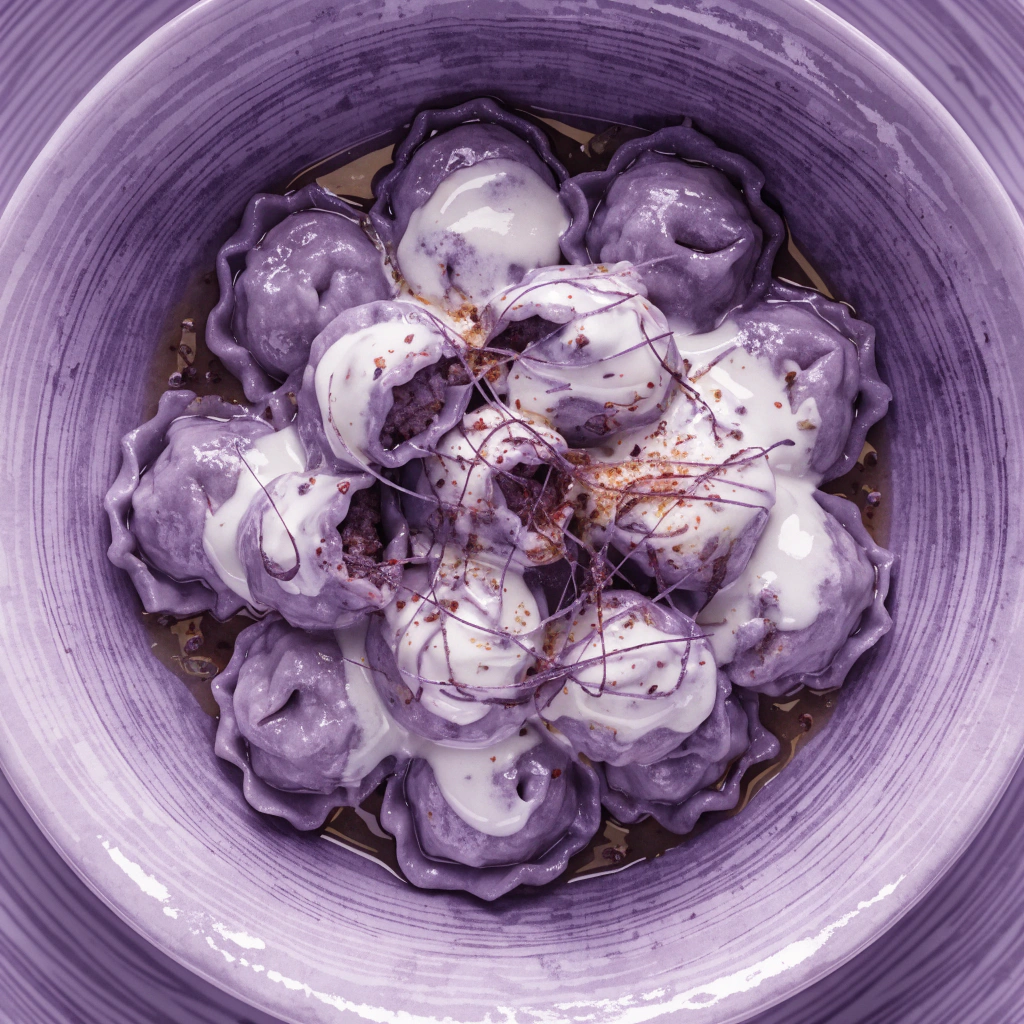
Delicious Mantı in Turkey
Mantı is a very popular food in Turkey. It is like small pasta with meat inside. Many people call it "Turkish ravioli." It is a very old and famous dish.
Families often make mantı together at home. It is a special time for them. The pieces of pasta are very small. Small pieces are the best.
You eat mantı with white yogurt and garlic. You also add red sauce or oil on top. It is very delicious! People in Turkey love this meal.
Gramática em destaque
Padrão: Present Simple 'to be'
"Mantı is a very popular food in Turkey."
We use 'is' with singular subjects to describe facts or states. It tells us what something is.
Padrão: Present Simple for habits
"You eat mantı with white yogurt and garlic."
We use the base form of the verb with 'you' to talk about general habits or how to eat something. It does not change for 'you'.
Teste sua compreensão
10 perguntas · A1 Iniciante · 1 pré-visualização grátis
Teste o que aprendeu neste artigo. Responda todas as perguntas para ganhar XP!
Where is Mantı a popular food?
Quer finalizar o quiz?
9 perguntas a mais estão esperando por você. Cadastre-se grátis para desbloquear o quiz completo e ganhar XP!
Cadastrar grátisJá tem conta? Entrar
Detalhamento das perguntas
Where is Mantı a popular food?
Sua resposta:
Resposta correta: Turkey
Mantı is a very new food.
Sua resposta:
Resposta correta: Falso
What does 'delicious' mean?
Sua resposta:
Resposta correta: Very good taste
Mantı is like small pasta with _____ inside.
Sua resposta:
Resposta correta: meat
Mantı: Um Sabor Antigo da Turquia
Mantı é um prato muito famoso na Turquia. Muitas pessoas dizem que é como um 'ravioli' turco. Ele vem de um povo antigo da Ásia Central, que viajou muito. Este prato chegou à Turquia há muito tempo e se tornou muito popular. Hoje, é uma comida tradicional e deliciosa.
O Mantı é pequeno, e isso é especial. Ele tem recheio de carne moída. Mas o que o torna ainda mais gostoso são os molhos. Normalmente, as pessoas comem Mantı com iogurte e temperos, como pimenta e hortelã seca. É diferente de outros pratos parecidos porque o tamanho e os molhos são únicos.
Na história, o Mantı era um prato importante na corte do Império Otomano. Os cozinheiros preparavam Mantı para o sultão e sua família. Hoje, as famílias turcas ainda fazem Mantı juntas, especialmente em ocasiões especiais. É uma comida que conecta o passado e o presente, e é uma parte importante da cultura turca.
Gramática em destaque
Padrão: Pretérito Perfeito Simples (Past Simple)
"Este prato **chegou** à Turquia há muito tempo e se **tornou** muito popular."
Usamos o pretérito perfeito simples para falar de ações que começaram e terminaram no passado. É como contar o que aconteceu em um momento específico, e a ação não continua no presente.
Padrão: Comparativo de Superioridade (mais... que)
"Mas o que o torna **ainda mais gostoso** são os molhos."
Usamos 'mais... que' para comparar duas coisas e dizer que uma tem mais de uma qualidade que a outra. A palavra 'ainda' antes de 'mais' serve para intensificar a comparação, significando 'muito mais'.
Teste sua compreensão
11 perguntas · A2 Elementar · 1 pré-visualização grátis
Teste o que aprendeu neste artigo. Responda todas as perguntas para ganhar XP!
Qual é uma característica especial do Mantı mencionada no texto?
Quer finalizar o quiz?
10 perguntas a mais estão esperando por você. Cadastre-se grátis para desbloquear o quiz completo e ganhar XP!
Cadastrar grátisJá tem conta? Entrar
Detalhamento das perguntas
Qual é uma característica especial do Mantı mencionada no texto?
Sua resposta:
Resposta correta: É pequeno e tem molhos especiais.
O Mantı é um prato novo na Turquia.
Sua resposta:
Resposta correta: Falso
O que significa 'recheio'?
Sua resposta:
Resposta correta: O que está dentro da comida.
O Mantı vem de um _____ antigo da Ásia Central.
Sua resposta:
Resposta correta: povo
Onde o Mantı era um prato importante na história?
Sua resposta:
Resposta correta: Na corte do Império Otomano.
Mantı: A Deliciosa Herança da Culinária Turca
Mantı, muitas vezes chamado de "ravioli turco", é um prato que carrega a antiga herança nômade dos povos turcos da Ásia Central para a moderna cozinha da Turquia. Embora existam variações de "dumplings" ao longo da Rota da Seda, a versão turca tem se distinguido por seu tamanho minúsculo e pela combinação específica de iogurte e coberturas de especiarias.
Historicamente, o mantı foi um prato muito apreciado na corte otomana, onde era frequentemente servido com acompanhamentos especializados, como sumagre ou hortelã seca. A preparação do mantı é uma arte que exige paciência. Pequenos pedaços de massa são recheados com uma mistura temperada de carne moída, geralmente de cordeiro ou carne bovina, e então são cuidadosamente dobrados e cozidos.
Depois de cozidos, os mantıs são tradicionalmente servidos com iogurte temperado com alho, um molho de manteiga derretida com pimenta vermelha, e frequentemente polvilhados com hortelã seca e sumagre. Essa combinação de sabores – a acidez do iogurte, o calor da pimenta e o frescor da hortelã – cria uma experiência gastronômica única que tem sido saboreada por gerações.
Atualmente, o mantı continua sendo um prato popular em toda a Turquia, especialmente em Kayseri, uma cidade conhecida por ter a versão mais famosa e os menores mantıs. É um testemunho da rica tapeçaria cultural e culinária do país, oferecendo um sabor da história em cada pequena mordida. Muitos turistas que visitam a Turquia têm se encantado com este prato autêntico e cheio de sabor.
Gramática em destaque
Padrão: Presente Perfeito Composto (Ter + Particípio)
"a versão turca tem se distinguido por seu tamanho minúsculo."
O Presente Perfeito Composto é usado para falar sobre ações passadas que têm uma conexão ou resultado no presente. Ele é formado com o verbo auxiliar 'ter' no presente e o particípio passado do verbo principal.
Padrão: Voz Passiva (Ser + Particípio)
"Mantı, muitas vezes chamado de "ravioli turco", é um prato que carrega a antiga herança."
A Voz Passiva é usada para enfatizar a ação ou o objeto que a sofre, em vez de quem a realiza. É formada com o verbo auxiliar 'ser' no tempo verbal adequado e o particípio passado do verbo principal, concordando em gênero e número com o sujeito.
Teste sua compreensão
11 perguntas · B1 Intermediário · 1 pré-visualização grátis
Teste o que aprendeu neste artigo. Responda todas as perguntas para ganhar XP!
De qual região os povos que deram origem ao mantı vieram originalmente?
Quer finalizar o quiz?
10 perguntas a mais estão esperando por você. Cadastre-se grátis para desbloquear o quiz completo e ganhar XP!
Cadastrar grátisJá tem conta? Entrar
Detalhamento das perguntas
De qual região os povos que deram origem ao mantı vieram originalmente?
Sua resposta:
Resposta correta: Ásia Central
O mantı turco é conhecido por ser grande e ter poucas coberturas.
Sua resposta:
Resposta correta: Falso
O que significa a palavra 'minúsculo'?
Sua resposta:
Resposta correta: Muito pequeno
Na corte otomana, o mantı era frequentemente servido com acompanhamentos especializados, como sumagre ou hortelã _____.
Sua resposta:
Resposta correta: seca
Qual cidade é especialmente famosa por ter a versão mais conhecida e os menores mantıs?
Sua resposta:
Resposta correta: Kayseri
The Culinary Heritage of Mantı: A Journey from Central Asia to the Ottoman Court
Mantı is often celebrated as the quintessential Turkish comfort food, yet its historical origins are far more complex than they might initially appear. This dish, which consists of small dough parcels filled with seasoned meat, serves as a culinary bridge between the ancient nomadic tribes of Central Asia and the sophisticated kitchens of the Ottoman Empire. Throughout history, the Silk Road facilitated the exchange of spices and techniques, leading to the various dumpling styles found across Eurasia. However, the Turkish version has been distinguished by its unique preparation and specific presentation, setting it apart from its counterparts in neighboring regions.
Historically, mantı was not merely a commoner's meal; it was highly regarded within the Ottoman court. Royal chefs would frequently compete to create the most miniature dumplings possible, as small size was considered a mark of culinary excellence and refinement. Legend has it that a skilled cook should be able to fit forty individual pieces of mantı onto a single spoon. This labor-intensive process highlights the cultural importance of the dish, where the effort invested in preparation directly reflects the level of hospitality offered to guests. Even today, the act of folding the dough is considered a communal activity that strengthens social bonds.
While several regional variations exist across Turkey, the most famous style originates from the city of Kayseri. These tiny dumplings are typically boiled and then served with a cold, garlic-infused yogurt. To complete the dish, a warm sauce made of melted butter and red pepper flakes is drizzled over the top, often accompanied by dried mint and sumac. This combination of contrasting temperatures and bold flavors creates a sophisticated profile that has been preserved for centuries. If you were to visit a traditional Turkish household, you would almost certainly be served this dish as a sign of respect.
In modern times, the significance of mantı extends beyond its nutritional value. Although industrial production has made it more accessible for everyday consumption, the handmade version is still preferred for its superior texture and historical influence. Consequently, mantı remains a vital part of Turkey’s edible heritage, representing both a link to the nomadic past and a staple of contemporary life. By analyzing its evolution, one can appreciate how a simple dumpling can embody the identity of an entire nation.
Gramática em destaque
Padrão: Present Perfect Passive
"the Turkish version has been distinguished by its unique preparation"
This is used to describe an action that happened at an unspecified time in the past and has a result in the present, focusing on the object rather than the doer. It is formed using 'has/have + been + past participle'.
Padrão: Relative Clauses
"This dish, which consists of small dough parcels filled with seasoned meat, serves as a culinary bridge"
A non-defining relative clause is used here to provide extra information about 'this dish'. It is separated by commas and uses 'which' for objects.
Padrão: Second Conditional
"If you were to visit a traditional Turkish household, you would almost certainly be served this dish"
This structure is used to imagine a hypothetical situation in the present or future. It uses 'If + past simple' and 'would + base verb'.
Teste sua compreensão
11 perguntas · B2 Intermediário superior · 1 pré-visualização grátis
Teste o que aprendeu neste artigo. Responda todas as perguntas para ganhar XP!
What historical trade route contributed to the spread of dumpling techniques to Turkey?
Quer finalizar o quiz?
10 perguntas a mais estão esperando por você. Cadastre-se grátis para desbloquear o quiz completo e ganhar XP!
Cadastrar grátisJá tem conta? Entrar
Detalhamento das perguntas
What historical trade route contributed to the spread of dumpling techniques to Turkey?
Sua resposta:
Resposta correta: The Silk Road
In the Ottoman court, larger dumplings were preferred because they showed more wealth.
Sua resposta:
Resposta correta: Falso
What does 'labor-intensive' mean in the context of making mantı?
Sua resposta:
Resposta correta: A process that requires a lot of time and physical effort
The most famous style of Turkish mantı originates from the city of _____.
Sua resposta:
Resposta correta: Kayseri
According to the article, why is the handmade version of mantı still preferred today?
Sua resposta:
Resposta correta: Because it has a superior texture and historical influence
The Culinary Palimpsest of Anatolia: Deconstructing the Legacy of Mantı
The culinary landscape of Anatolia is a complex palimpsest, where layers of nomadic heritage and imperial refinement coalesce into singular dishes. Seldom does a singular dish encapsulate the nomadic heritage of the Turkic peoples as poignantly as mantı. While the Silk Road facilitated the dispersion of dumplings across Eurasia—from the hearty pelmeni of the north to the delicate dim sum of the east—it was on the Anatolian plateau that this dish underwent a metamorphosis into a symbol of domestic prowess and courtly sophistication. The manifestation of mantı in Turkey is not merely a matter of sustenance; rather, it is a testament to the enduring influence of Central Asian roots on the modern Turkish identity. It was within the opulent kitchens of the Ottoman court that mantı underwent its most significant transformation, evolving from a robust nomadic staple into a refined delicacy fit for a Sultan. Historical records suggest that the Ottoman elite favored these minuscule parcels of dough, often filled with spiced lamb or chickpeas, viewing the meticulousness of their preparation as a marker of high status. This emphasis on size remains a cultural cornerstone today, particularly in the central province of Kayseri. Here, the definitive benchmark for a cook's skill is the ability to fit forty individual mantı into a single wooden spoon. Such labor-intensive craftsmanship serves as a silent language of hospitality and respect, reinforcing social bonds through the medium of dough and meat. The gastronomic allure of the dish lies in its intricate juxtaposition of temperatures and textures. Typically, the dumplings are boiled or steamed to a tender consistency before being smothered in a cold, garlic-infused yogurt. This thermal contrast is further heightened by the addition of a searing drizzle of burnt butter, infused with Aleppo pepper or paprika. The final flourish often involves a dusting of sumac or dried mint, providing a sharp acidity that cuts through the richness of the dairy. This nuanced layering of flavors reflects a sophisticated understanding of culinary balance that has been honed over centuries. In the contemporary era, the preparation of mantı often serves as a communal ritual, bringing families together for hours of rhythmic folding and pinching. Despite the encroachment of industrial food production, the preservation of this tradition highlights a collective resistance to the homogenization of global cuisine. The enduring popularity of mantı is not merely a result of its flavor profile, but rather its role as a cultural anchor, grounding a rapidly modernizing society in its ancestral past. To consume mantı is to engage with a history of migration, adaptation, and the relentless pursuit of culinary perfection.
Gramática em destaque
Padrão: Negative Inversion
"Seldom does a singular dish encapsulate the nomadic heritage of the Turkic peoples as poignantly as mantı."
Inversion is used for emphasis by placing a negative adverb at the beginning of the sentence followed by an auxiliary verb and then the subject.
Padrão: Cleft Sentences
"It was within the opulent kitchens of the Ottoman court that mantı underwent its most significant transformation."
Cleft sentences use 'It + be + [emphasized part] + relative clause' to focus on specific information, in this case, the location of the transformation.
Padrão: Nominalization
"The manifestation of mantı in Turkey is not merely a matter of sustenance."
Nominalization turns verbs (manifest) into nouns (manifestation) to create a more formal, academic tone typical of C1 level writing.
Teste sua compreensão
12 perguntas · C1 Avançado · 1 pré-visualização grátis
Teste o que aprendeu neste artigo. Responda todas as perguntas para ganhar XP!
What does the author imply by calling Anatolian cuisine a 'palimpsest'?
Quer finalizar o quiz?
11 perguntas a mais estão esperando por você. Cadastre-se grátis para desbloquear o quiz completo e ganhar XP!
Cadastrar grátisJá tem conta? Entrar
Detalhamento das perguntas
What does the author imply by calling Anatolian cuisine a 'palimpsest'?
Sua resposta:
Resposta correta: It consists of layers of history where traces of the past are still visible.
The author suggests that the size of mantı in Kayseri is an indicator of the cook's expertise.
Sua resposta:
Resposta correta: Verdadeiro
Which word is synonymous with 'opulent' as used in the text?
Sua resposta:
Resposta correta: Luxurious
The author argues that the preparation of mantı acts as a collective _____ against the homogenization of global cuisine.
Sua resposta:
Resposta correta: resistance
According to the text, what provides the 'thermal contrast' in a serving of mantı?
Sua resposta:
Resposta correta: The cold yogurt and the hot burnt butter.
Mantı was originally a dish created for the Ottoman Sultans and had no prior history.
Sua resposta:
Resposta correta: Falso
The Gastronomic Semiotics of Mantı: A Culinary Palimpsest of Turkic Nomadism
To approach the subject of Turkish mantı is to engage with a culinary palimpsest, wherein layers of nomadic heritage, imperial refinement, and regional identity are intricately interwoven. Often colloquially termed 'Turkish ravioli,' such a reductive label fails to capture the profound epistemological weight the dish carries within the Anatolian cultural landscape. Originating from the expansive steppes of Central Asia, these dough-bound parcels represent a quintessential vestige of the Turkic itinerary across the Silk Road, evolving from a utilitarian staple of the saddlebag into a sophisticated emblem of Ottoman connoisseurship.
Central to the discourse on mantı is the concept of 'Kayseri mantı,' a variant whose prestige is predicated upon its diminutive scale. It is widely asserted that the culinary prowess of a prospective bride was historically evaluated by her ability to fit forty individual dumplings within a single spoon. While such an anecdote may border on the apocryphal, it underscores the cultural premium placed upon dexterity and meticulousness. Were one to scrutinize the labor-intensive process of folding these miniscule squares of unleavened dough, one would discern a ritualistic dedication to form that transcends mere sustenance.
Beyond the borders of Kayseri, the geography of mantı expands into diverse regional manifestations, each articulating a unique dialogue with local ecology. In the coastal regions of Sinop, for instance, the mantı assumes a more robust form, occasionally garnished with crushed walnuts—a departure from the ubiquitous yogurt that highlights the adaptability of the dish. This regional pluralism suggests that while the core concept remains constant, the execution is subject to the 'genius loci' of the Turkish provinces. Furthermore, the historical transition of mantı from a nomadic provision—easily dried and transported across vast distances—to an elaborate courtly delicacy reveals much about the socio-political evolution of the Turkic people. In the Topkapı Palace archives, records indicate that mantı was not merely a meal but a curated experience, often integrated into the complex protocols of imperial hospitality.
The architectural integrity of the mantı is complemented by a sophisticated interplay of garnishes, most notably the juxtaposition of garlic-infused yogurt and a piquant drizzle of burnt butter infused with Aleppo pepper or paprika. This contrast—the cooling acidity of the ferment against the thermal intensity of the spice—constitutes a sensory dialectic that distinguishes the Turkish iteration from its broader Eurasian cousins. Furthermore, the inclusion of sumac and dried mint provides a botanical counterpoint, hinting at the medicinal and aromatic proclivities of the Ottoman court.
From a sociological perspective, the preparation of mantı serves as a communal locus. The 'mantı açmak'—the rolling and filling of the dough—is frequently a collective endeavor, facilitating a space for oral tradition and social cohesion. It is here that the domestic sphere becomes a site of cultural transmission, where the nuances of the pedigree of the dish are preserved. Notwithstanding the encroachment of industrialization and the proliferation of frozen alternatives, the artisanal preparation of mantı remains a steadfast bastion of Turkish identity. In conclusion, mantı is not merely a gastronomic artifact but a living testament to the fluidity of cultural exchange. To consume mantı is to partake in a historical continuum, a flavor profile that has been refined over a millennium to reach its current state of sophisticated equilibrium.
Gramática em destaque
Padrão: Inverted Conditional (Subjunctive)
"Were one to scrutinize the labor-intensive process of folding these miniscule squares of unleavened dough, one would discern a ritualistic dedication to form that transcends mere sustenance."
This formal structure replaces 'If one were to...' by inverting the verb and subject. It is used in academic or literary English to express a hypothetical situation with a high degree of formality.
Padrão: Passive Reporting Verbs (Academic Hedging)
"It is widely asserted that the culinary prowess of a prospective bride was historically evaluated by her ability to fit forty individual dumplings within a single spoon."
Using 'It is + past participle + that' allows the writer to present a common belief or theory without attributing it to a specific person. This is a hallmark of objective, scholarly prose.
Padrão: Cleft Sentences for Emphasis
"It is here that the domestic sphere becomes a site of cultural transmission, where the nuances of the pedigree of the dish are preserved."
A cleft sentence divides a single clause into two parts to focus on specific information. By starting with 'It is here that...', the writer emphasizes the location or context of the action.
Teste sua compreensão
12 perguntas · C2 Domínio · 1 pré-visualização grátis
Teste o que aprendeu neste artigo. Responda todas as perguntas para ganhar XP!
What is the primary thesis of the article regarding the nature of mantı?
Quer finalizar o quiz?
11 perguntas a mais estão esperando por você. Cadastre-se grátis para desbloquear o quiz completo e ganhar XP!
Cadastrar grátisJá tem conta? Entrar
Detalhamento das perguntas
What is the primary thesis of the article regarding the nature of mantı?
Sua resposta:
Resposta correta: It is a complex cultural artifact that reflects historical, social, and regional transitions.
The author suggests that the term 'Turkish ravioli' is an insufficient description of the dish's cultural depth.
Sua resposta:
Resposta correta: Verdadeiro
What does the word 'piquant' mean in the context of the article?
Sua resposta:
Resposta correta: Having a pleasantly sharp or appetizing flavor.
According to the text, what does the 'spoon test' in Kayseri symbolize?
Sua resposta:
Resposta correta: The cultural value placed on dexterity and precision.
The article claims that the use of yogurt is a universal garnish for all regional variations of mantı in Turkey.
Sua resposta:
Resposta correta: Falso
The author describes mantı as a culinary _____, implying it contains visible traces of its historical evolution.
Sua resposta:
Resposta correta: palimpsest

