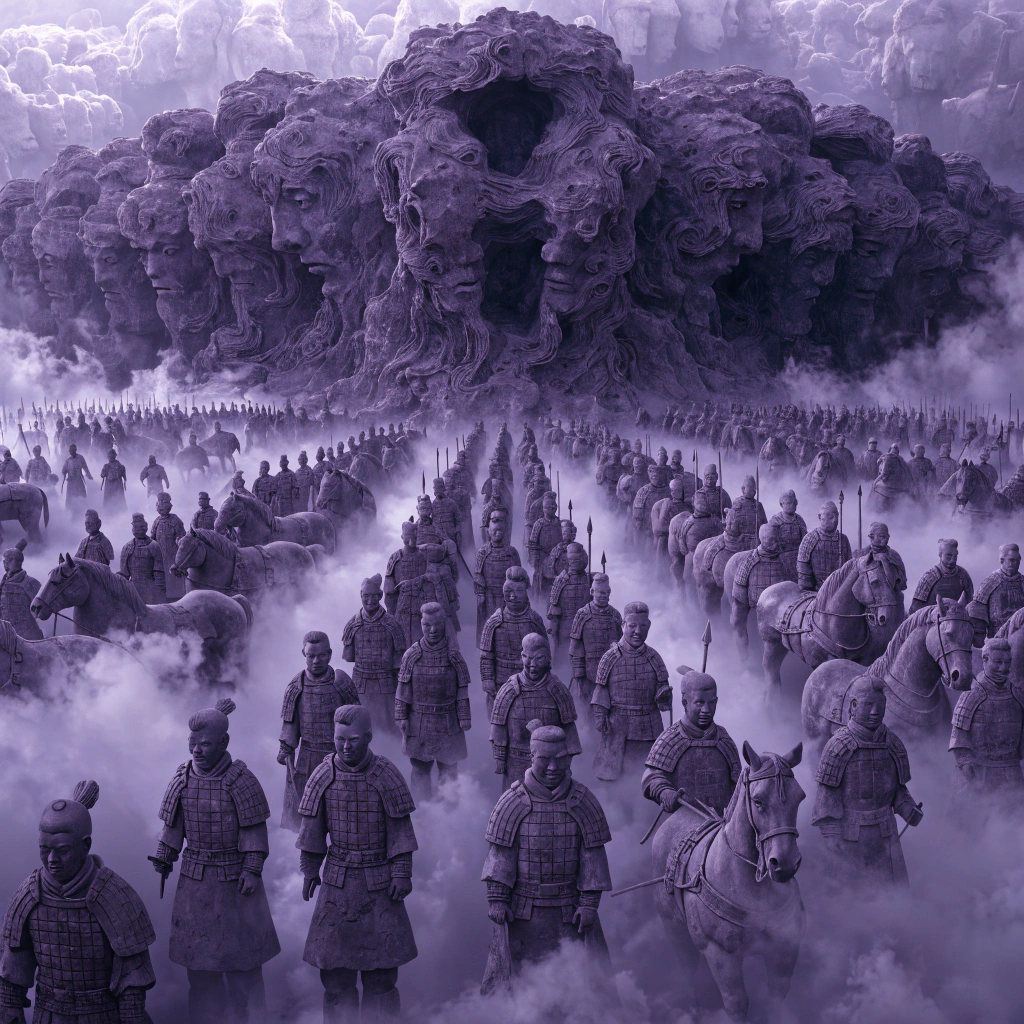
The Famous Army of China
In China, there is a very famous army. It is the Terracotta Army. It is more than 2,000 years old. Farmers find the first soldier in 1974. They are digging a well.
The army has 8,000 soldiers. They are made of clay. Each soldier is different. Some soldiers have horses. Some soldiers have chariots.
The army is for the first emperor of China. His name is Qin Shi Huang. He wants the soldiers to protect him after death. Now, the army is in a big museum near Xi'an. Many people visit it every year.
Gramática destacada
Patrón: There is / There are
"In China, there is a very famous army."
We use 'there is' for one person or thing and 'there are' for more than one. It tells us that something exists in a specific place.
Patrón: Present Simple with 'Has'
"The army has 8,000 soldiers."
We use 'has' for singular subjects like 'he', 'she', or 'it'. It shows possession or describes what something contains.
Pon a prueba tu comprensión
10 preguntas · A1 Principiante · 1 vista previa gratis
Pon a prueba lo que aprendiste en este artículo. ¡Responde todas las preguntas para ganar XP!
In which country is the Terracotta Army?
¿Quieres terminar el quiz?
9 preguntas más te esperan. ¡Regístrate gratis para desbloquear el quiz completo y ganar XP!
Regístrate gratis¿Ya tienes cuenta? Acceder
Desglose de preguntas
In which country is the Terracotta Army?
Tu respuesta:
Respuesta correcta: China
The soldiers are made of wood.
Tu respuesta:
Respuesta correcta: Falso
What does 'famous' mean?
Tu respuesta:
Respuesta correcta: Known by many people
Farmers find the first _____ in 1974.
Tu respuesta:
Respuesta correcta: soldier
The Amazing Clay Army of China
In 1974, some farmers in China found something amazing. They were digging a well near the city of Xi'an. Suddenly, they found a life-sized soldier made of clay. This was the first piece of the famous Terracotta Army.
Archaeologists found more than 8,000 soldiers, 130 chariots, and 520 horses. The army is very old because it is more than 2,200 years old. Every soldier is special. Some soldiers are taller than others, and they all have different faces. They even have different hair and clothes.
Emperor Qin Shi Huang was the first emperor of China. He ordered workers to build this army. He wanted the soldiers to protect him after he died. He believed in a life after death. Today, the Terracotta Army is a very popular place for tourists. People from all over the world visit China to see these beautiful statues because they are an important part of history.
Gramática destacada
Patrón: Past Simple
"In 1974, some farmers in China found something amazing."
We use the past simple to talk about finished actions in the past. To form it, we often add '-ed' to verbs, but 'found' is the irregular past of 'find'.
Patrón: Comparatives
"Some soldiers are taller than others."
We use comparatives to show the difference between two things. For short adjectives like 'tall', we add '-er' and use the word 'than'.
Pon a prueba tu comprensión
11 preguntas · A2 Básico · 1 vista previa gratis
Pon a prueba lo que aprendiste en este artículo. ¡Responde todas las preguntas para ganar XP!
Where did the farmers find the first clay soldier?
¿Quieres terminar el quiz?
10 preguntas más te esperan. ¡Regístrate gratis para desbloquear el quiz completo y ganar XP!
Regístrate gratis¿Ya tienes cuenta? Acceder
Desglose de preguntas
Where did the farmers find the first clay soldier?
Tu respuesta:
Respuesta correcta: Near the city of Xi'an
All the clay soldiers have the same face.
Tu respuesta:
Respuesta correcta: Falso
What does the word 'clay' mean?
Tu respuesta:
Respuesta correcta: Heavy earth used to make statues
Emperor Qin Shi Huang was the first _____ of China.
Tu respuesta:
Respuesta correcta: emperor
Why did the emperor build the army?
Tu respuesta:
Respuesta correcta: To protect him after death
El Ejército de Terracota: Guardianes Eternos de Qin Shi Huang
En el año 1974, un grupo de agricultores chinos hizo un descubrimiento asombroso cerca de la ciudad de Xi'an. Mientras excavaban un pozo, se toparon con una figura de arcilla de tamaño natural. Este hallazgo inicial fue solo el comienzo de lo que se ha convertido en uno de los descubrimientos arqueológicos más importantes del siglo XX. Lo que encontraron era parte del famoso Ejército de Terracota, una maravilla antigua que ha fascinado al mundo.
Este inmenso ejército fue construido hace más de 2.200 años para Qin Shi Huang, el primer emperador de una China unificada. El emperador deseaba tener protección en la vida después de la muerte, y por eso se ordenó la creación de miles de soldados, carros y caballos de terracota. Cada figura de soldado es única, con diferentes expresiones faciales, peinados y armaduras, lo que sugiere un gran nivel de detalle y habilidad artística. Se estima que hay más de 8.000 soldados, 130 carros y 520 caballos.
La construcción de este ejército funerario fue un proyecto gigantesco que involucró a miles de artesanos y trabajadores durante muchos años. El objetivo principal era asegurar que el emperador estuviera seguro y tuviera todo lo necesario en el más allá. Este complejo funerario es un testimonio impresionante del poder y la riqueza de Qin Shi Huang.
Hoy en día, el Ejército de Terracota es Patrimonio de la Humanidad por la UNESCO y atrae a millones de visitantes de todo el mundo. Los arqueólogos todavía están trabajando para desenterrar más figuras y aprender más sobre esta increíble civilización antigua. Es un recordatorio poderoso de la historia y la cultura china, y nos enseña mucho sobre las creencias de aquella época. Sin duda, es un tesoro que se ha conservado muy bien.
Gramática destacada
Patrón: La voz pasiva con "se"
"y por eso se ordenó la creación de miles de soldados..."
La voz pasiva con "se" se usa para hablar de acciones sin mencionar quién las realiza, o cuando el agente no es importante. Se forma con "se" más un verbo en tercera persona (singular o plural) que concuerda con el objeto de la acción.
Patrón: El Pretérito Perfecto Compuesto
"Este hallazgo inicial fue solo el comienzo de lo que se ha convertido en uno de los descubrimientos arqueológicos más importantes..."
Usamos el pretérito perfecto compuesto para hablar de acciones pasadas que tienen una conexión con el presente o que ocurrieron en un período de tiempo que aún no ha terminado. Se forma con el verbo "haber" en presente (he, has, ha, hemos, habéis, han) y un participio pasado (-ado, -ido).
Pon a prueba tu comprensión
11 preguntas · B1 Intermedio · 1 vista previa gratis
Pon a prueba lo que aprendiste en este artículo. ¡Responde todas las preguntas para ganar XP!
¿Cuándo se descubrió el Ejército de Terracota?
¿Quieres terminar el quiz?
10 preguntas más te esperan. ¡Regístrate gratis para desbloquear el quiz completo y ganar XP!
Regístrate gratis¿Ya tienes cuenta? Acceder
Desglose de preguntas
¿Cuándo se descubrió el Ejército de Terracota?
Tu respuesta:
Respuesta correcta: En 1974
El Ejército de Terracota fue creado para proteger al emperador Qin Shi Huang en la vida después de la muerte.
Tu respuesta:
Respuesta correcta: Verdadero
¿Qué significa la palabra "agricultores"?
Tu respuesta:
Respuesta correcta: Personas que trabajan la tierra
El Ejército de Terracota es un _________ impresionante del poder y la riqueza de Qin Shi Huang.
Tu respuesta:
Respuesta correcta: testimonio
¿Cuál de las siguientes afirmaciones sobre los soldados de terracota es correcta?
Tu respuesta:
Respuesta correcta: Cada soldado tiene detalles únicos como expresiones faciales.
Guardians of the First Emperor: The Legacy of the Terracotta Army
In 1974, a group of local farmers in Xi'an, China, stumbled upon what would become one of the most remarkable archaeological discoveries of the twentieth century. While digging a well, they unearthed a life-sized clay soldier, leading to the revelation of an entire underground army. This vast collection, now known as the Terracotta Army, was commissioned by Qin Shi Huang, the first emperor of a unified China, to accompany him into the afterlife. The discovery transformed our understanding of ancient Chinese history and the scale of imperial power.
The scale of the funerary complex is truly staggering. Estimates suggest that the site contains over 8,000 soldiers, 130 chariots, and 520 horses. What makes the discovery particularly fascinating is the level of detail found in each figure. Unlike mass-produced statues, every soldier possesses unique facial features, hairstyles, and expressions. It is widely believed that these figures were modeled after actual members of the emperor's guard, showcasing the intricate skill of the ancient artisans who crafted them. Furthermore, the figures were originally painted in bright colors, though most of this pigment has been lost over time.
Qin Shi Huang’s obsession with immortality drove him to construct this massive mausoleum. He sought to maintain his power even after death, ensuring that he would be protected by a formidable force in the spiritual realm and leaving a clear message for any future successor. Consequently, the project required an enormous workforce; historical records indicate that approximately 700,000 laborers were involved in its construction over several decades.
Despite the grandeur of the pits already excavated, much of the site remains a mystery. Archaeologists have been hesitant to open the emperor’s primary tomb due to concerns about preservation. When the first soldiers were unearthed, their vibrant paint began to flake and fade due to oxidation almost immediately upon exposure to the air. Had modern preservation techniques been available in the 1970s, more of the original color might have been saved. Therefore, experts are waiting for more advanced technology before they proceed further.
Today, the Terracotta Army stands as a testament to the administrative and artistic achievements of the Qin Dynasty. It continues to attract millions of visitors and researchers, all eager to catch a glimpse of the past. Although centuries have passed, the silent guardians of the emperor remain a powerful symbol of China’s enduring cultural heritage and a reminder of the lengths to which leaders go to preserve their legacy.
Gramática destacada
Patrón: Passive Voice (Past Simple)
"This vast collection, now known as the Terracotta Army, was commissioned by Qin Shi Huang."
The passive voice is used here to focus on the collection rather than the emperor. It is formed using 'was/were' + the past participle of the verb.
Patrón: Third Conditional (Inverted Form)
"Had modern preservation techniques been available in the 1970s, more of the original color might have been saved."
This is a formal way to express an unreal condition in the past. 'Had' is placed at the beginning of the sentence instead of using 'If', followed by the past participle.
Patrón: Relative Clauses with 'What'
"What makes the discovery particularly fascinating is the level of detail found in each figure."
This is a nominal relative clause where 'what' acts as the subject, used to emphasize a specific point or characteristic.
Pon a prueba tu comprensión
11 preguntas · B2 Intermedio alto · 1 vista previa gratis
Pon a prueba lo que aprendiste en este artículo. ¡Responde todas las preguntas para ganar XP!
Why did Emperor Qin Shi Huang commission the Terracotta Army?
¿Quieres terminar el quiz?
10 preguntas más te esperan. ¡Regístrate gratis para desbloquear el quiz completo y ganar XP!
Regístrate gratis¿Ya tienes cuenta? Acceder
Desglose de preguntas
Why did Emperor Qin Shi Huang commission the Terracotta Army?
Tu respuesta:
Respuesta correcta: To protect and serve him in the afterlife
Every soldier in the Terracotta Army was created using the same facial mold.
Tu respuesta:
Respuesta correcta: Falso
What does the word 'mausoleum' mean in the context of the article?
Tu respuesta:
Respuesta correcta: A grand building used as a tomb
The project required an enormous ______, with historical records indicating approximately 700,000 people were involved.
Tu respuesta:
Respuesta correcta: workforce
Why are archaeologists hesitant to open the main tomb of the emperor?
Tu respuesta:
Respuesta correcta: They are concerned about the preservation of the contents
Silent Sentinels of the First Emperor: A Testament to Megalomania or Manifestation of Order?
Rarely in the annals of human history has an archaeological discovery so profoundly reshaped our understanding of ancient power as did the unearthing of the Terracotta Army. In 1974, a group of unsuspecting farmers near Xi’an stumbled upon a clay fragment while digging a well, unknowingly initiating the revelation of a subterranean empire. What lay beneath was not merely a collection of statues, but a meticulously organized military force, standing guard over the mausoleum of Qin Shi Huang, the first emperor to achieve the unification of China. It was his obsession with immortality that precipitated the construction of this sprawling necropolis, a project that required the labor of hundreds of thousands of artisans over several decades.
The sheer scale of the army is staggering, yet it is the idiosyncratic nature of each figure that truly captivates the modern observer. Despite the mass production necessitated by such a grand undertaking, no two soldiers possess identical facial features. This level of detail suggests a rejection of artistic homogenization in favor of a hyper-realistic representation of the diverse ethnic groups that comprised the Qin military. Such craftsmanship speaks to a sophisticated understanding of human anatomy and a logistical mastery that allowed for the coordination of specialized workshops across the empire. The meticulousness of the craftsmanship is evidenced by the intricate details of the armor and the distinct hairstyles that denote various ranks and origins.
From a socio-political perspective, the Terracotta Army serves as a physical manifestation of Legalism, the rigid philosophical framework that underpinned the Qin dynasty. Under this system, the state was prioritized above all, and order was maintained through strict laws and centralized authority. The rigid formations and hierarchical structures of the clay soldiers mirror the emperor’s desire to extend his absolute control beyond the mortal realm. Scarcely had the emperor consolidated his power on earth when he turned his attention to the afterlife, ensuring that his celestial reign would be protected by the same disciplined force that had secured his terrestrial victories.
However, the preservation of this site presents a myriad of challenges. The original polychrome pigments, once vibrant and lifelike, began to flake and fade within seconds of being exposed to the dry air of the modern world. It is the fragility of these artifacts that has led archaeologists to exercise extreme caution, leaving large portions of the site unexcavated. The ongoing tension between the desire for scientific discovery and the necessity of conservation defines the current state of the Xi’an site. In conclusion, the Terracotta Army is more than an archaeological marvel; it is a window into the psyche of a leader whose megalomania was matched only by his organizational genius. By examining these silent sentinels, we gain insight into the transition of China from a collection of warring states to a unified empire, a legacy that continues to resonate in the modern era.
Gramática destacada
Patrón: Negative Inversion
"Rarely in the annals of human history has an archaeological discovery so profoundly reshaped our understanding of ancient power..."
When a sentence starts with a negative or restrictive adverb (like 'rarely' or 'scarcely'), the subject and auxiliary verb are inverted. This is used for emphasis and is common in formal C1 writing.
Patrón: It-Cleft Sentence
"It was his obsession with immortality that precipitated the construction of this sprawling necropolis..."
Cleft sentences use 'It + be + subject + relative clause' to focus on a specific piece of information. Here, it emphasizes that the 'obsession' was the primary cause.
Patrón: Nominalization
"The preservation of this site presents a myriad of challenges."
Nominalization involves turning verbs or adjectives into nouns (e.g., 'preserve' to 'preservation'). This makes writing more abstract, objective, and formal, which is a hallmark of advanced English.
Pon a prueba tu comprensión
12 preguntas · C1 Avanzado · 1 vista previa gratis
Pon a prueba lo que aprendiste en este artículo. ¡Responde todas las preguntas para ganar XP!
What was the primary motivation for the construction of the Terracotta Army?
¿Quieres terminar el quiz?
11 preguntas más te esperan. ¡Regístrate gratis para desbloquear el quiz completo y ganar XP!
Regístrate gratis¿Ya tienes cuenta? Acceder
Desglose de preguntas
What was the primary motivation for the construction of the Terracotta Army?
Tu respuesta:
Respuesta correcta: To protect the emperor in the afterlife
The statues were created using mass production techniques that resulted in identical facial features for every soldier.
Tu respuesta:
Respuesta correcta: Falso
Which word best describes the emperor's obsession with power and his own importance?
Tu respuesta:
Respuesta correcta: Megalomania
The original _____ pigments on the statues began to fade almost immediately upon exposure to air.
Tu respuesta:
Respuesta correcta: polychrome
Which philosophical framework influenced the rigid structure of the Terracotta Army?
Tu respuesta:
Respuesta correcta: Legalism
Archaeologists have purposefully left parts of the site unexcavated to ensure conservation.
Tu respuesta:
Respuesta correcta: Verdadero
Imperishable Sentinels: The Ontological and Political Significance of Qin Shi Huang’s Necropolis
The accidental discovery of a terracotta head by farmers in Shaanxi province in 1974 was not merely an archaeological windfall; it was the unearthing of a silent, subterranean empire that fundamentally altered our comprehension of the Qin dynasty. This vast necropolis, sprawling across an estimated 56 square kilometers, serves as a testament to the unprecedented hegemony of Qin Shi Huang, the first emperor of a unified China. Lest one misinterpret the Terracotta Army as a mere display of vanity, it is imperative to recognize it as a manifestation of a profound eschatological vision. The emperor sought not only to govern the terrestrial realm but also to project his administrative and military prowess into the afterlife, ensuring his sovereignty remained unchallenged even in death.
The sheer scale of the funerary complex is staggering, comprising over 8,000 soldiers, 130 chariots, and 520 horses. However, it is the idiosyncratic nature of the craftsmanship that truly captivates the scholarly imagination. Each figure possesses unique facial features, hairstyles, and vestments, suggesting a degree of verisimilitude that borders on the uncanny. Were one to scrutinize the individual soldiers, one would find a meticulous attention to detail that reflects the highly organized, bureaucratic nature of the Qin state. This was a society where standardization and mass production were harmonized with exquisite artistic skill, a duality that enabled the rapid assembly of such a monolithic force.
From an ontological perspective, the Terracotta Army represents an attempt to bridge the gap between the ephemeral nature of human life and the perceived permanence of the cosmos. The figures were originally brightly painted, though the pigments have largely succumbed to the ravages of time and oxidation upon exposure to the atmosphere. This loss of color serves as a poignant reminder of the fragility of even the most robust human endeavors. Furthermore, the strategic arrangement of the pits—aligned with the cardinal directions and situated to protect the emperor’s central tomb—underscores a sophisticated understanding of geomancy and the metaphysical requirements of royal interment.
Should the central tomb of Qin Shi Huang ever be fully excavated, it is speculated that even more profound revelations regarding the Qin’s scientific and cultural achievements would come to light. Contemporary accounts describe a subterranean palace with rivers of liquid mercury and a ceiling depicting the constellations, though such claims remain shrouded in mystery due to concerns over preservation and the potential toxicity of the site. The decision to delay excavation reflects a cautious, modern stratigraphy that prioritizes the integrity of the site over immediate curiosity. This academic hedging is necessary, as the risks of irreversible damage to the artifacts are substantial.
In conclusion, the Terracotta Army is far more than a collection of clay statues; it is a complex sociopolitical statement. It encapsulates the apotheosis of Qin Shi Huang’s power and his refusal to accept the limitations of mortality. As we continue to analyze this site, we are forced to confront the tension between the individual and the state, the fleeting and the eternal. The silent sentinels of Xi'an remain as a enduring legacy of an era that defined the trajectory of Chinese civilization for two millennia, proving that while empires may crumble, their ideological foundations can remain etched in clay and history alike.
Gramática destacada
Patrón: Lest + Subjunctive
"Lest one misinterpret the Terracotta Army as a mere display of vanity, it is imperative to recognize it as a manifestation of a profound eschatological vision."
The word 'lest' is used to express fear of a negative outcome. In C2 English, it is often followed by the base form of the verb (subjunctive mood) or 'should', creating a formal, cautionary tone.
Patrón: Inverted Conditional (Second Conditional)
"Were one to scrutinize the individual soldiers, one would find a meticulous attention to detail..."
This is a formal alternative to 'If one were to...'. By inverting the subject and 'were', the writer achieves a more academic and sophisticated rhetorical style common in analytical prose.
Patrón: Should + Inversion (Future/Potential Conditional)
"Should the central tomb of Qin Shi Huang ever be fully excavated, it is speculated that even more profound revelations... would come to light."
Using 'should' at the beginning of a conditional clause replaces 'if' to express a possibility that is considered unlikely or hypothetical. It is a hallmark of formal, speculative writing.
Pon a prueba tu comprensión
12 preguntas · C2 Dominio · 1 vista previa gratis
Pon a prueba lo que aprendiste en este artículo. ¡Responde todas las preguntas para ganar XP!
What does the author suggest about the craftsmanship of the Terracotta Army?
¿Quieres terminar el quiz?
11 preguntas más te esperan. ¡Regístrate gratis para desbloquear el quiz completo y ganar XP!
Regístrate gratis¿Ya tienes cuenta? Acceder
Desglose de preguntas
What does the author suggest about the craftsmanship of the Terracotta Army?
Tu respuesta:
Respuesta correcta: It successfully blended mass production with individual uniqueness.
The author argues that the Terracotta Army was solely a display of the emperor's vanity.
Tu respuesta:
Respuesta correcta: Falso
Which word best describes something that lasts for a very short time?
Tu respuesta:
Respuesta correcta: Ephemeral
The figures were originally brightly painted, though the _____ have largely succumbed to oxidation.
Tu respuesta:
Respuesta correcta: pigments
Why has the central tomb of Qin Shi Huang not yet been fully excavated?
Tu respuesta:
Respuesta correcta: Owing to concerns regarding preservation and potential environmental hazards.
The Terracotta Army is arranged according to specific geographical and metaphysical principles.
Tu respuesta:
Respuesta correcta: Verdadero

