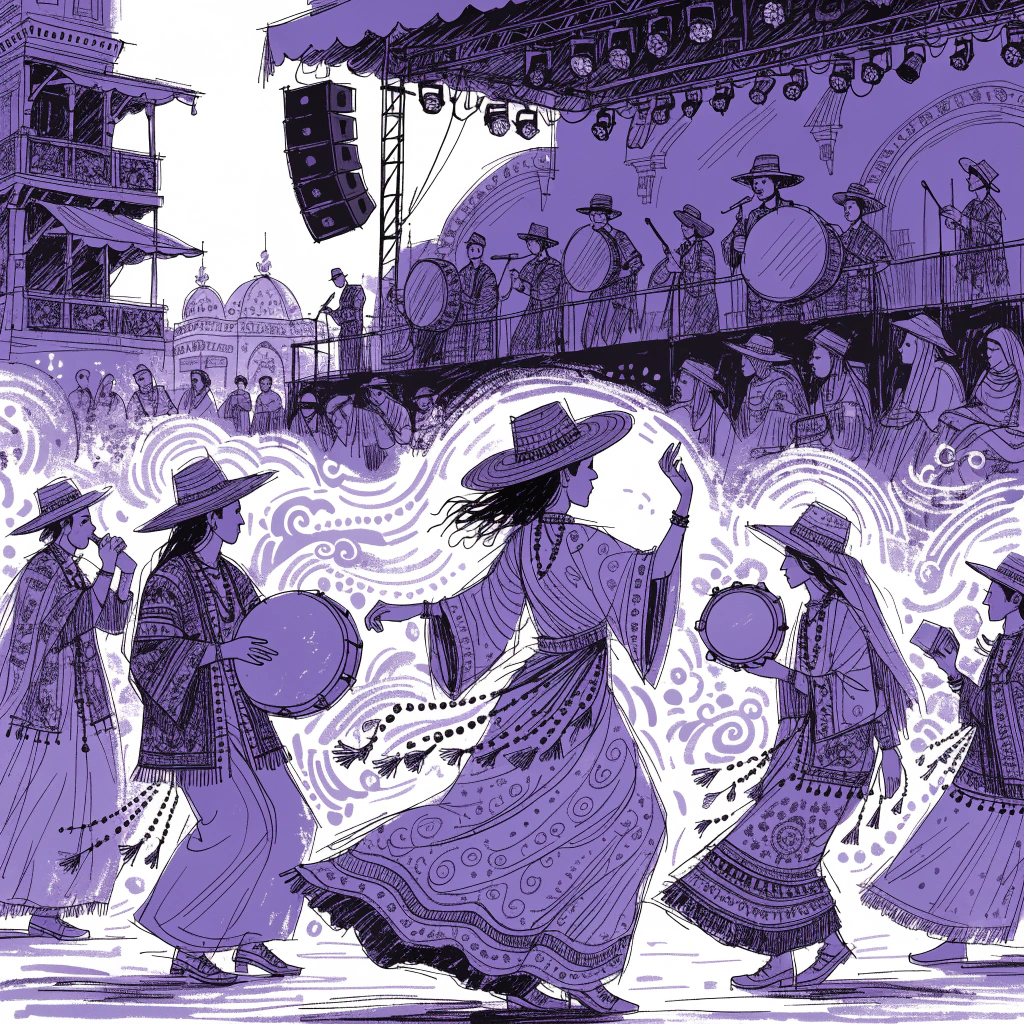
A Music Festival in Morocco
Essaouira is a city in Morocco. It is near the sea. Every year, there is a big music festival. It is the Gnaoua World Music Festival. Many people come to the city.
Musicians play special music. They use a guembri. It is a long instrument with three strings. They also use metal castanets. They are called qraqeb.
People dance and sing together. The music is very loud and happy. Visitors eat traditional food. They walk in the old streets. The festival is beautiful and fun.
Gramática destacada
Patrón: Present Simple 'to be'
"Essaouira is a city in Morocco."
We use 'is' for one person or place. It helps us describe facts or locations in the present.
Patrón: Present Simple (Plural)
"Many people come to the city."
We use the base form of the verb (like 'come' or 'play') for plural subjects. It describes regular actions.
Pon a prueba tu comprensión
10 preguntas · A1 Principiante · 1 vista previa gratis
Pon a prueba lo que aprendiste en este artículo. ¡Responde todas las preguntas para ganar XP!
Where is the music festival?
¿Quieres terminar el quiz?
9 preguntas más te esperan. ¡Regístrate gratis para desbloquear el quiz completo y ganar XP!
Regístrate gratis¿Ya tienes cuenta? Acceder
Desglose de preguntas
Where is the music festival?
Tu respuesta:
Respuesta correcta: Essaouira
The festival happens every year.
Tu respuesta:
Respuesta correcta: Verdadero
What is an 'instrument'?
Tu respuesta:
Respuesta correcta: An object to make music
The music is very _____ and happy.
Tu respuesta:
Respuesta correcta: loud
The Magic of the Gnaoua Festival
The Gnaoua World Music Festival is a famous event in Morocco. It happens every year in the beautiful city of Essaouira. The festival started in 1998, and now thousands of people visit it. It is one of the most important festivals in Africa because it celebrates a special history.
The music comes from the Gnaoua people. Their ancestors came from West Africa a long time ago. They play interesting instruments like the 'guembri'. This is a wooden guitar with three strings. They also use 'qraqeb', which are metal instruments that make a loud sound. The music is very rhythmic, and many people dance in the streets.
The atmosphere in Essaouira is better during the festival. It is louder and more colorful than usual. Visitors love the festival because the music is spiritual and deep. It is a great place to learn about Moroccan culture and meet new friends from around the world.
Gramática destacada
Patrón: Past Simple
"The festival started in 1998."
We use the past simple to talk about finished actions in the past. For regular verbs, we add '-ed' to the end of the base verb.
Patrón: Comparatives
"The atmosphere in Essaouira is better during the festival."
We use comparatives to show the difference between two things. 'Better' is the irregular comparative form of the adjective 'good'.
Pon a prueba tu comprensión
11 preguntas · A2 Básico · 1 vista previa gratis
Pon a prueba lo que aprendiste en este artículo. ¡Responde todas las preguntas para ganar XP!
Where does the Gnaoua World Music Festival take place?
¿Quieres terminar el quiz?
10 preguntas más te esperan. ¡Regístrate gratis para desbloquear el quiz completo y ganar XP!
Regístrate gratis¿Ya tienes cuenta? Acceder
Desglose de preguntas
Where does the Gnaoua World Music Festival take place?
Tu respuesta:
Respuesta correcta: Essaouira
The festival started in 2010.
Tu respuesta:
Respuesta correcta: Falso
What is a 'guembri'?
Tu respuesta:
Respuesta correcta: A wooden guitar with three strings
The music is very _____.
Tu respuesta:
Respuesta correcta: rhythmic
What are 'qraqeb'?
Tu respuesta:
Respuesta correcta: Metal instruments
The Magic of Essaouira: The Gnaoua World Music Festival
The Gnaoua World Music Festival is a famous event that takes place every year in the beautiful coastal city of Essaouira, Morocco. Since it started in 1998, the festival has become one of the most important musical celebrations in Africa. It attracts thousands of visitors who want to experience a unique mix of spiritual music and modern rhythms.
The festival celebrates the heritage of the Gnaoua people. These people are descendants of West Africans who moved to Morocco many centuries ago. Their music is special because it combines Islamic traditions with ancient African rituals. In the past, this music was mostly used for healing and prayer, but today it is enjoyed by people from all over the world.
During the festival, the streets of Essaouira are filled with the sounds of traditional instruments. The most important instrument is the guembri, which is a three-stringed lute that produces a deep sound. Musicians also use qraqeb, which are heavy metal castanets that create a loud beat. These instruments are played together to create a hypnotic atmosphere that often makes the audience dance for hours.
In recent years, the festival has grown into a major world music event. This means that Gnaoua masters, known as Maâlems, often perform with jazz, rock, and blues artists from other countries. These collaborations have helped to keep the tradition alive while making it popular with younger generations. Many international stars have visited Essaouira to learn from these local masters.
If you visit the festival, you will see how music can bring different cultures together. It is not just a concert; it is a spiritual journey that has been preserved for hundreds of years. The festival is a perfect example of how Morocco protects its history while welcoming the future.
Gramática destacada
Patrón: Present Perfect
"Since it started in 1998, the festival has become one of the most important musical celebrations in Africa."
The present perfect is used here to describe an action that started in the past and continues to be true in the present. It is formed using 'has/have' + the past participle.
Patrón: Passive Voice
"These instruments are played together to create a hypnotic atmosphere."
The passive voice is used to focus on the action or the object (the instruments) rather than the person performing the action. It is formed using 'to be' + the past participle.
Pon a prueba tu comprensión
11 preguntas · B1 Intermedio · 1 vista previa gratis
Pon a prueba lo que aprendiste en este artículo. ¡Responde todas las preguntas para ganar XP!
In which Moroccan city does the festival take place?
¿Quieres terminar el quiz?
10 preguntas más te esperan. ¡Regístrate gratis para desbloquear el quiz completo y ganar XP!
Regístrate gratis¿Ya tienes cuenta? Acceder
Desglose de preguntas
In which Moroccan city does the festival take place?
Tu respuesta:
Respuesta correcta: Essaouira
The Gnaoua World Music Festival first began in 1998.
Tu respuesta:
Respuesta correcta: Verdadero
What does 'heritage' mean?
Tu respuesta:
Respuesta correcta: Traditions and history from the past
The _____ is a three-stringed lute that produces a deep sound.
Tu respuesta:
Respuesta correcta: guembri
What are the Gnaoua musical masters called?
Tu respuesta:
Respuesta correcta: Maâlems
The Rhythmic Soul of Essaouira: A Deep Dive into the Gnaoua World Music Festival
Nestled along the Atlantic coast of Morocco, the city of Essaouira transforms every summer into a vibrant hub of cultural exchange. The Gnaoua World Music Festival, which was established in 1998, has since grown into one of Africa's most prestigious cultural events. It serves as a profound celebration of the Gnaoua people’s heritage, whose ancestors were enslaved West Africans. Over centuries, these communities successfully integrated Islamic Sufism with pre-Islamic African traditions, creating a unique spiritual synthesis that continues to captivate global audiences today.
At the heart of this musical tradition lies the guembri, a three-stringed lute known for its deep, resonant tones. This instrument is often accompanied by the rhythmic clatter of qraqeb, which are heavy metal castanets. Together, they create a hypnotic soundscape designed to induce a state of trance. Historically, these performances were part of 'Lila' ceremonies—all-night rituals intended for spiritual healing. However, in the context of the festival, this sacred music is brought to the public stage, where it undergoes a fascinating process of modernization.
Furthermore, the festival is renowned for its spirit of collaboration. While the core remains rooted in tradition, the event has become a laboratory for musical improvisation. International jazz, blues, and rock musicians frequently join Gnaoua 'Maâlems' (masters) on stage. This integration of diverse genres suggests that music serves as a universal language, capable of bridging cultural divides. Such collaborations have not only elevated the festival’s international profile but have also ensured that Gnaoua music remains a living, evolving art form rather than a static relic of the past.
Beyond its musical significance, the festival plays a crucial role in the preservation of intangible heritage. In a rapidly globalizing world, maintaining such distinct cultural identities can be challenging. By providing a global platform, the festival ensures that younger generations remain engaged with their roots. Concurrently, the event provides a substantial boost to the local economy, attracting hundreds of thousands of visitors annually. In conclusion, the Gnaoua World Music Festival is more than just a series of concerts; it is a testament to resilience, a celebration of diversity, and a powerful example of how tradition can thrive through innovation.
Gramática destacada
Patrón: Non-defining Relative Clauses
"The Gnaoua World Music Festival, which was established in 1998, has since grown into one of Africa's most prestigious cultural events."
These clauses provide extra information about a noun but are not essential for the sentence to make sense. They are separated by commas and often use 'which' or 'who'.
Patrón: Passive Voice
"This instrument is often accompanied by the rhythmic clatter of qraqeb..."
The passive voice is used to focus on the action or the object being acted upon rather than the subject performing the action. It is formed using 'be' + past participle.
Patrón: Present Perfect
"...the event has become a laboratory for musical improvisation."
The present perfect connects the past to the present. It is used here to describe a process that started in the past (the festival's growth) and continues to be true now.
Pon a prueba tu comprensión
11 preguntas · B2 Intermedio alto · 1 vista previa gratis
Pon a prueba lo que aprendiste en este artículo. ¡Responde todas las preguntas para ganar XP!
What is the primary purpose of the Gnaoua World Music Festival according to the article?
¿Quieres terminar el quiz?
10 preguntas más te esperan. ¡Regístrate gratis para desbloquear el quiz completo y ganar XP!
Regístrate gratis¿Ya tienes cuenta? Acceder
Desglose de preguntas
What is the primary purpose of the Gnaoua World Music Festival according to the article?
Tu respuesta:
Respuesta correcta: To celebrate Gnaoua heritage and cultural exchange
The 'guembri' is a type of heavy metal castanet used to create rhythmic clatter.
Tu respuesta:
Respuesta correcta: Falso
Which word describes the combination of different styles into a single whole?
Tu respuesta:
Respuesta correcta: Synthesis
The festival serves as a hub for cultural _____ between local and international artists.
Tu respuesta:
Respuesta correcta: exchange
What was the original purpose of 'Lila' ceremonies?
Tu respuesta:
Respuesta correcta: Spiritual healing
Resonance and Reconciliation: The Transcendental Allure of the Gnaoua World Music Festival
Nestled within the windswept ramparts of Essaouira, the Gnaoua World Music Festival stands as a testament to the enduring power of cultural synthesis. Since its inception in 1998, this sonic pilgrimage has evolved from a niche gathering into a global phenomenon, attracting hundreds of thousands of spectators annually. Central to its allure is the profound legacy of the Gnaoua people, descendants of enslaved West Africans whose history of displacement found expression in a unique fusion of Islamic Sufism and sub-Saharan ritualism. The festival acts as a vibrant laboratory where the ancestral and the avant-garde meet, creating a dialogue that resonates far beyond the borders of Morocco.
Seldom has a musical genre so effectively bridged the chasm between traumatic historical roots and contemporary spiritual liberation. The music functions not merely as entertainment but as a therapeutic vessel, traditionally utilized in 'lila' ceremonies to induce a state of trance and communal healing. These nocturnal rituals, characterized by incense and rhythmic repetition, aim to purge negative energies and reconnect the individual with the divine. Within the festival context, these sacred sounds are projected onto the grand stage, inviting a secular audience to partake in a collective moment of transcendence.
It is the deep, hypnotic thrum of the guembri that anchors the listener in a state of meditative focus. This three-stringed lute, carved from wood and covered in camel skin, produces a percussive resonance that serves as the heartbeat of every performance. Accompanied by the qraqeb, heavy iron castanets that provide a relentless, driving polyrhythm, the music creates a sonic texture that is both grounded and ethereal. The mastery of the maâlems—the master musicians who guard the oral traditions—is the bedrock upon which the entire festival is built.
However, the festival’s brilliance lies in its commitment to dialogue. By pairing these traditional maâlems with international jazz, blues, and rock virtuosos, the event facilitates a cross-cultural exchange that defies categorization. Critics often debate whether such commercial exposure dilutes the sanctity of the original ritual, yet the consensus remains that this juxtaposition fosters a revitalized appreciation for indigenous forms. This dialogue is not a one-way street; international artists often find their own creative horizons expanded by the intricate polyrhythms and spiritual depth of the Gnaoua tradition.
The festival’s success is a result of the meticulous curation of these diverse influences. The integration of global sounds does not overshadow the local tradition; rather, it serves as a contemporary precursor to a more inclusive musical future. This synthesis allows the Gnaoua heritage to remain dynamic, resisting the stagnation often associated with folkloric preservation. The preservation of this intangible heritage is achieved through its evolution, ensuring that the music remains relevant to younger generations.
Ultimately, the Gnaoua World Music Festival represents more than a mere sequence of concerts; it is a celebration of resilience and reconciliation. Through the sublimation of past suffering into transcendent art, the festival offers a blueprint for how historical trauma can be transformed into a source of collective strength. In an increasingly fragmented world, the rhythmic pulse of Essaouira serves as a reminder that music remains the most potent universal language, capable of bridging the widest of cultural divides.
Gramática destacada
Patrón: Inversion with Negative Adverbials
"Seldom has a musical genre so effectively bridged the chasm between traumatic historical roots and contemporary spiritual liberation."
When a negative or restrictive adverbial like 'seldom' starts a sentence for emphasis, the auxiliary verb is placed before the subject. This structure is common in formal C1 writing to highlight rarity or intensity.
Patrón: Cleft Sentences
"It is the deep, hypnotic thrum of the guembri that anchors the listener in a state of meditative focus."
Cleft sentences use the structure 'It + is/was + [emphasized part] + that/who' to focus the reader's attention on a specific element of the sentence. Here, it emphasizes the guembri as the primary source of the listener's focus.
Patrón: Nominalisation
"The preservation of this intangible heritage is achieved through its evolution, ensuring that the music remains relevant to younger generations."
Nominalisation involves turning verbs or adjectives into nouns (e.g., 'preserve' to 'preservation'). This technique makes the writing more abstract and formal, focusing on concepts and actions rather than people.
Pon a prueba tu comprensión
12 preguntas · C1 Avanzado · 1 vista previa gratis
Pon a prueba lo que aprendiste en este artículo. ¡Responde todas las preguntas para ganar XP!
What is the primary historical origin of the Gnaoua people according to the article?
¿Quieres terminar el quiz?
11 preguntas más te esperan. ¡Regístrate gratis para desbloquear el quiz completo y ganar XP!
Regístrate gratis¿Ya tienes cuenta? Acceder
Desglose de preguntas
What is the primary historical origin of the Gnaoua people according to the article?
Tu respuesta:
Respuesta correcta: Descendants of enslaved West Africans
The Gnaoua World Music Festival was established in the early 21st century.
Tu respuesta:
Respuesta correcta: Falso
What does 'juxtaposition' mean in the context of the article?
Tu respuesta:
Respuesta correcta: Placing contrasting elements together for effect
The _____ of the maâlems is the bedrock upon which the entire festival is built.
Tu respuesta:
Respuesta correcta: mastery
What is the main function of the traditional 'lila' ceremonies?
Tu respuesta:
Respuesta correcta: To induce healing and spiritual trance
How does the author view the integration of global sounds into the festival?
Tu respuesta:
Respuesta correcta: As a precursor to a more inclusive and dynamic musical future
The Sonic Palimpsest: Epistemological Reflections on the Gnaoua World Music Festival
The Gnaoua World Music Festival, staged annually within the fortified ramparts of Essaouira, represents far more than a mere congregation of global percussionists; it is a profound exercise in cultural archaeology and spiritual syncretism. Established in 1998, the festival serves as a contemporary repository for the intangible heritage of the Gnaoua people, whose ancestral lineage traces back to the historical subjugation and subsequent diaspora of West Africans across the Maghreb. To engage with this event is to witness a complex negotiation between the sacred and the profane, where the atavistic echoes of the sub-Saharan savannah coalesce with the mystical tenets of Islamic Sufism.
Central to this auditory landscape is the 'guembri', a three-stringed lute whose deep, percussive resonance provides the ontological foundation for the 'lila'—a night-long ritual of healing and transcendence. Should one venture beyond the superficiality of the main stages, the true essence of Gnaoua music reveals itself in the incantatory repetition of the 'qraqeb' (metal castanets). These instruments do not merely produce sound; they facilitate a rhythmic rupture through which the adept may achieve a state of 'hal', or ecstatic trance. It is imperative that the listener remain cognizant of the music’s vestigial connection to the trauma of slavery, as each rhythmic cycle serves as both a lamentation and a celebratory reclamation of identity.
From a musicological perspective, the festival’s brilliance lies in its radical intertextuality. By inviting jazz luminaries and blues practitioners to participate in 'fusion' sessions, the organizers challenge the Eurocentric hegemony that often dictates the parameters of 'world music'. These collaborations are not merely aesthetic experiments; they are epistemological inquiries into the shared roots of the African diaspora. Rarely has a cultural phenomenon so effectively bridged the chasm between traditionalist preservation and avant-garde evolution. One might argue that the festival operates as a living archive, where the oral traditions of the 'Maâlems' (master musicians) are perpetually renegotiated in the context of global modernity.
Furthermore, the socio-economic impact of the festival on Essaouira cannot be overstated. Once a quiescent fishing port, the city has undergone a metamorphosis, becoming a nexus for cultural tourism. However, this transformation invites scholarly scrutiny regarding the potential commodification of the sacred. Lest the spiritual gravity of the Gnaoua tradition be diluted by the demands of the global market, it is paramount that the sanctity of the ritual be preserved alongside its public exhibition. The festival thus stands as a testament to the resilience of the human spirit, demonstrating how the fragments of a fractured past can be woven into a vibrant, polyrhythmic future.
Gramática destacada
Patrón: Inverted Conditional
"Should one venture beyond the superficiality of the main stages, the true essence of Gnaoua music reveals itself..."
This formal structure replaces 'If one should venture' with an inversion. It is used in academic or literary contexts to express a hypothetical condition with a higher degree of formality.
Patrón: Subjunctive Mood
"It is imperative that the listener remain cognizant of the music’s vestigial connection to the trauma of slavery..."
The base form 'remain' is used after adjectives of urgency or importance (imperative, paramount). Note the absence of 's' even though the subject is singular.
Patrón: Negative Inversion
"Rarely has a cultural phenomenon so effectively bridged the chasm between traditionalist preservation and avant-garde evolution."
When a sentence begins with a negative or restrictive adverb like 'rarely', the auxiliary verb is placed before the subject for rhetorical emphasis.
Pon a prueba tu comprensión
12 preguntas · C2 Dominio · 1 vista previa gratis
Pon a prueba lo que aprendiste en este artículo. ¡Responde todas las preguntas para ganar XP!
What does the author suggest is the primary function of the festival beyond entertainment?
¿Quieres terminar el quiz?
11 preguntas más te esperan. ¡Regístrate gratis para desbloquear el quiz completo y ganar XP!
Regístrate gratis¿Ya tienes cuenta? Acceder
Desglose de preguntas
What does the author suggest is the primary function of the festival beyond entertainment?
Tu respuesta:
Respuesta correcta: A contemporary repository for intangible heritage and cultural archaeology.
The Gnaoua people are solely of North African Berber descent.
Tu respuesta:
Respuesta correcta: Falso
What does 'atavistic' mean in the context of the article?
Tu respuesta:
Respuesta correcta: Relating to ancient or ancestral characteristics.
The author argues that the festival operates as a living _____, where traditions are perpetually renegotiated.
Tu respuesta:
Respuesta correcta: archive
Which instrument is described as providing the 'ontological foundation' for the Gnaoua ritual?
Tu respuesta:
Respuesta correcta: Guembri
The author warns that the spiritual gravity of the tradition might be diluted by global market demands.
Tu respuesta:
Respuesta correcta: Verdadero

