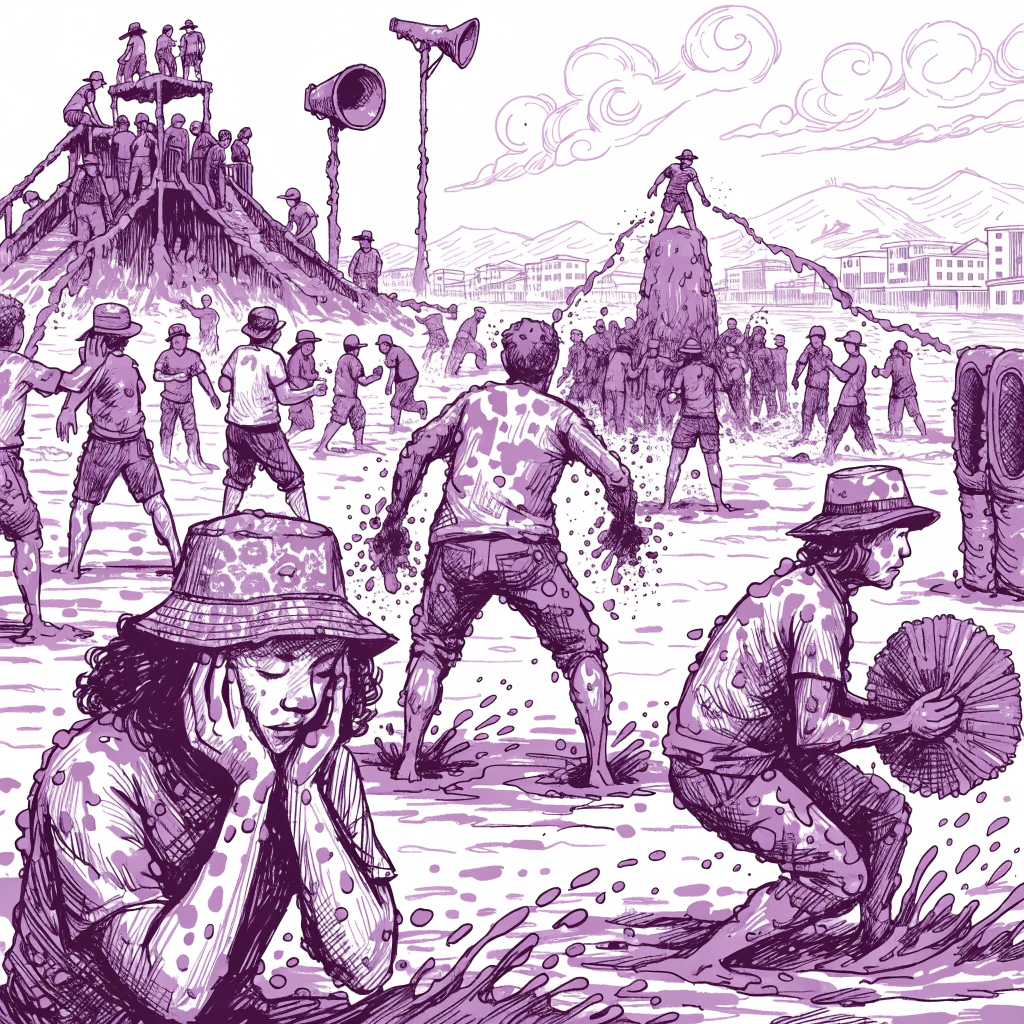
¡Un Festival de Barro en Corea!
¡Hola! Hoy hablamos de un festival muy divertido. Se llama Festival del Barro de Boryeong. Está en Corea del Sur, en la playa de Daecheon. Este festival es muy famoso y especial.
La gente va a la playa para jugar con barro. El barro de Boryeong es bueno para la piel. Tiene minerales importantes. Al principio, el festival promocionaba productos de belleza. Ahora, es una gran fiesta de verano para todos.
Muchas personas, jóvenes y turistas, visitan el festival. Bailan, ríen y se divierten mucho. Es una experiencia única. ¡Es un festival con mucho barro y mucha alegría!
Gramática destacada
Patrón: El verbo 'Ser' para describir
"Este festival es muy famoso."
Usamos el verbo 'ser' para decir qué o cómo es algo de forma permanente. Por ejemplo, 'El festival es famoso' describe una característica del festival. También se usa para identificar cosas, como 'Yo soy Juan'.
Patrón: Presente Simple (-ar verbos regulares)
"La gente juega con barro."
El presente simple se usa para acciones habituales o que ocurren ahora. Para verbos que terminan en '-ar', como 'jugar', quitamos '-ar' y añadimos '-a' para la tercera persona singular (él/ella/usted).
Pon a prueba tu comprensión
10 preguntas · A1 Principiante · 1 vista previa gratis
Pon a prueba lo que aprendiste en este artículo. ¡Responde todas las preguntas para ganar XP!
¿De qué trata el Festival del Barro de Boryeong?
¿Quieres terminar el quiz?
9 preguntas más te esperan. ¡Regístrate gratis para desbloquear el quiz completo y ganar XP!
Regístrate gratis¿Ya tienes cuenta? Acceder
Desglose de preguntas
¿De qué trata el Festival del Barro de Boryeong?
Tu respuesta:
Respuesta correcta: De barro
El Festival del Barro de Boryeong está en España.
Tu respuesta:
Respuesta correcta: Falso
¿Qué significa 'playa'?
Tu respuesta:
Respuesta correcta: Lugar con arena junto al mar
El barro de Boryeong es bueno para la _____.
Tu respuesta:
Respuesta correcta: piel
The Famous Mud Festival in South Korea
Every summer, thousands of people go to Daecheon Beach in South Korea. They go there for the famous Boryeong Mud Festival. This festival started in 1998 because a company wanted to sell mud products for the skin. Today, it is one of the most popular events in the country.
The mud in Boryeong is very special. It is better for your skin than regular mud because it has many healthy minerals. Visitors play in large mud pools and slide down big mud slides. Some people even join the mud wrestling competition! It is much noisier and more exciting than a quiet day at the beach.
People from many different countries visit the festival every July. They listen to loud music, watch fireworks, and take many funny photos. Everyone gets very dirty, but they are all very happy. The Boryeong Mud Festival is a great place to meet new friends and enjoy the summer sun.
Gramática destacada
Patrón: Past Simple
"This festival started in 1998 because a company wanted to sell mud products."
We use the past simple to talk about finished actions in the past. For regular verbs like 'start' and 'want', we add -ed to the end.
Patrón: Comparatives
"It is better for your skin than regular mud."
We use comparatives to compare two things. For the irregular adjective 'good', we use 'better than'.
Pon a prueba tu comprensión
11 preguntas · A2 Básico · 1 vista previa gratis
Pon a prueba lo que aprendiste en este artículo. ¡Responde todas las preguntas para ganar XP!
Why did the festival first start?
¿Quieres terminar el quiz?
10 preguntas más te esperan. ¡Regístrate gratis para desbloquear el quiz completo y ganar XP!
Regístrate gratis¿Ya tienes cuenta? Acceder
Desglose de preguntas
Why did the festival first start?
Tu respuesta:
Respuesta correcta: To sell mud cosmetics
The festival happens in the winter.
Tu respuesta:
Respuesta correcta: Falso
What does 'famous' mean?
Tu respuesta:
Respuesta correcta: Known by many people
Visitors slide down big mud _____.
Tu respuesta:
Respuesta correcta: slides
Where is the festival located?
Tu respuesta:
Respuesta correcta: At Daecheon Beach
Getting Dirty at the Boryeong Mud Festival
Every year in July, thousands of people travel to Daecheon Beach on the west coast of South Korea. They do not go there just for the sun and the ocean; they go to get covered in thick, grey mud. The Boryeong Mud Festival has become one of the most famous summer events in Asia. Since it first started in 1998, the festival has grown from a small marketing idea into a massive international celebration that attracts millions of visitors.
The festival was originally created to promote cosmetics that are made from local mud. This mud is exceptionally high in minerals like germanium and bentonite, which are beneficial for skin care. Although the event began as a commercial promotion, it quickly evolved into a world-famous party. Today, the festival grounds are designed to provide maximum excitement for everyone who attends.
Many fun activities have been organized for the participants. There are giant mud slides, mud pits for wrestling, and even a "mud prison" for those who are not muddy enough! These zones are supervised by staff who ensure that everyone stays safe while they are having fun. For people who prefer a more relaxing experience, there are also mud massages and skin treatments available in quieter areas.
At night, the atmosphere changes as the beach is transformed by spectacular fireworks and live K-pop concerts. Many tourists, who travel from all over the world to attend, say that it is the highlight of their summer. The festival is a place where social status does not matter because everyone is covered in the same grey mud. If you are looking for a unique holiday, this event is perfect. It has been recommended by many travel experts as a "must-visit" destination. Just remember to wear old clothes!
Gramática destacada
Patrón: Present Perfect
"The Boryeong Mud Festival has become one of the most famous summer events in Asia."
This tense is used to show that an action started in the past and is still true or relevant now. It is formed using 'have/has' and the past participle.
Patrón: Passive Voice
"The festival was originally created to promote cosmetics that are made from local mud."
The passive voice is used when the action is more important than the person who did it. It is formed using the verb 'to be' and the past participle.
Pon a prueba tu comprensión
11 preguntas · B1 Intermedio · 1 vista previa gratis
Pon a prueba lo que aprendiste en este artículo. ¡Responde todas las preguntas para ganar XP!
Where does the Boryeong Mud Festival take place?
¿Quieres terminar el quiz?
10 preguntas más te esperan. ¡Regístrate gratis para desbloquear el quiz completo y ganar XP!
Regístrate gratis¿Ya tienes cuenta? Acceder
Desglose de preguntas
Where does the Boryeong Mud Festival take place?
Tu respuesta:
Respuesta correcta: At Daecheon Beach
The festival was first held in 1998.
Tu respuesta:
Respuesta correcta: Verdadero
What does 'beneficial' mean?
Tu respuesta:
Respuesta correcta: Helpful
The mud is exceptionally high in _____, which are good for skin care.
Tu respuesta:
Respuesta correcta: minerals
What was the original reason for starting the festival?
Tu respuesta:
Respuesta correcta: To promote mud-based cosmetics
The Boryeong Mud Festival: A Global Celebration of Health and Hedonism
The Boryeong Mud Festival, held annually at Daecheon Beach on the west coast of South Korea, represents a fascinating intersection of commercial ingenuity and cultural celebration. Although it is now recognized as one of the most exuberant summer events globally, its origins were surprisingly pragmatic. Inaugurated in 1998, the festival was initially conceived as a strategic marketing maneuver to promote mud-based cosmetics. Local authorities sought to highlight the high mineral content of the mud found in the Boryeong flats, which is exceptionally rich in germanium and bentonite. These elements are renowned for their therapeutic properties, particularly in revitalizing skin and removing impurities.
Despite its humble beginnings as a promotional campaign, the festival has evolved into a massive spectacle that attracts millions of international tourists and locals alike. Participants are encouraged to cast aside their preconceived notions of cleanliness and immerse themselves in the grey, viscous mud. The festival grounds are meticulously designed to foster a sense of communal joy, featuring mud wrestling pits, gigantic mud slides, and even a 'mud prison' for those who attempt to remain clean. Such activities are not merely frivolous; they serve to break down social barriers, allowing people of all ages and nationalities to interact in a playful environment.
Furthermore, the economic impact of the event cannot be overstated. By successfully rebranding a natural resource into a tourist attraction, Boryeong has managed to revitalize its local economy significantly. Not only does the mud provide entertainment, but it also serves as a testament to how creative marketing can transform a region's identity. Furthermore, the event has gained such acclaim that it is often cited as a benchmark for successful destination branding in East Asia.
Had the festival organizers not embraced the messy nature of the event, it might have remained a niche trade fair. Instead, they leaned into the sensory experience, creating an atmosphere that is as much about wellness as it is about wild fun. As the sun sets over the Yellow Sea, the festival often transitions into a music-filled celebration, proving that the Boryeong Mud Festival is far more than just a marketing gimmick—it is a testament to the human desire for play and connection.
Gramática destacada
Patrón: Passive Voice
"The festival was initially conceived as a strategic marketing maneuver..."
The passive voice is used here to focus on the action (the conception of the festival) rather than the specific actors (the organizers). It is formed using the verb 'to be' plus the past participle.
Patrón: Negative Inversion
"Not only does the mud provide entertainment, but it also serves as a testament..."
When a sentence starts with 'Not only', the auxiliary verb comes before the subject. This structure is used for emphasis and is common in formal B2 writing.
Patrón: Third Conditional (Inverted)
"Had the festival organizers not embraced the messy nature of the event, it might have remained a niche trade fair."
This is a formal way of expressing a hypothetical situation in the past. 'Had' is placed before the subject instead of using 'If', expressing regret or alternative outcomes.
Pon a prueba tu comprensión
11 preguntas · B2 Intermedio alto · 1 vista previa gratis
Pon a prueba lo que aprendiste en este artículo. ¡Responde todas las preguntas para ganar XP!
What was the original purpose of the Boryeong Mud Festival?
¿Quieres terminar el quiz?
10 preguntas más te esperan. ¡Regístrate gratis para desbloquear el quiz completo y ganar XP!
Regístrate gratis¿Ya tienes cuenta? Acceder
Desglose de preguntas
What was the original purpose of the Boryeong Mud Festival?
Tu respuesta:
Respuesta correcta: To promote mud-based cosmetic products
The mud in Boryeong is naturally high in germanium and bentonite.
Tu respuesta:
Respuesta correcta: Verdadero
What does 'exuberant' mean in the context of the article?
Tu respuesta:
Respuesta correcta: Full of energy and excitement
The festival was _____ in 1998 as a marketing tool.
Tu respuesta:
Respuesta correcta: inaugurated
Where is the festival held?
Tu respuesta:
Respuesta correcta: At Daecheon Beach
The Alchemical Allure of Boryeong: Beyond the Surface of South Korea's Muddy Extravaganza
Seldom does one encounter a festival that so seamlessly blends primal human instinct with sophisticated economic strategy. The Boryeong Mud Festival, situated on the picturesque west coast of South Korea, represents a fascinating study in the commodification of natural resources. What began in 1998 as a relatively niche promotional campaign for mud-based cosmetics has burgeoned into an international phenomenon, drawing millions to the shores of Daecheon Beach. It was the strategic marketing of the region's mineral-rich sediment that catalyzed this transition, turning a utilitarian resource into a symbol of summer exuberance. The transformation of Daecheon Beach into a global hub for mud-based entertainment illustrates the power of creative regional branding in the modern era.
The ingenuity behind the festival lies in its multifaceted appeal. While many attendees are drawn by the ephemeral thrill of mud wrestling and massive slides, the underlying therapeutic benefits of the mud remain a central tenet of the event's identity. Rich in germanium and bentonite, the Boryeong mud is touted for its skin rejuvenation properties. This synergy between health and hedonism provides a unique narrative that distinguishes Boryeong from the ubiquitous music festivals that dominate the global summer calendar. The nominalization of 'fun' into a marketable health product has allowed the local government to bypass traditional tourism barriers and reach a diverse demographic.
Moreover, the festival’s evolution reflects broader shifts in South Korean societal dynamics. In a culture often characterized by rigorous work ethics and social hierarchies, the mud serves as a social equalizer. Once covered in the grey, viscous substance, distinctions of rank, age, and nationality become obscured. This temporary dissolution of social barriers is perhaps the festival's most profound achievement. Rarely has a commercial endeavor managed to foster such a genuine sense of global camaraderie while simultaneously promoting local industry.
However, the burgeoning number of international tourists has led to a critical analysis of the festival's long-term sustainability and authenticity. Critics suggest that the sheer scale of the extravaganza risks overshadowing the local cultural nuances that once defined the Boryeong region. The commodification of the mud has led to concerns regarding the environmental impact on the coastal ecosystem, necessitating a delicate balance between economic gain and ecological preservation. Furthermore, the infrastructure supporting the festival sustains a year-round industry of skincare research. The local government has invested heavily in laboratories that refine the sediment into high-end products, ensuring that the 'mud brand' extends far beyond the temporary duration of the festival itself.
In conclusion, the Boryeong Mud Festival stands as a testament to the power of creative marketing and the universal human desire for tactile, communal experiences. It is not merely the mud itself, but the collective experience of shedding one's inhibitions that ensures the festival's enduring popularity. Whether viewed through the lens of economic development, cosmetic science, or sociology, its impact on South Korea's tourism landscape is undeniable. As long as the tide continues to deposit its nutrient-rich sediment, the legacy of Boryeong will remain a vibrant, if messy, highlight of the global cultural calendar.
Gramática destacada
Patrón: Inversion
"Seldom does one encounter a festival that so seamlessly blends primal human instinct with sophisticated economic strategy."
Inversion is used here by placing 'Seldom' at the beginning of the sentence for emphasis. This requires the auxiliary verb 'does' to come before the subject 'one'.
Patrón: Cleft Sentence
"It was the strategic marketing of the region's mineral-rich sediment that catalyzed this transition."
A cleft sentence focuses on a specific part of the information. Here, 'It was... that' highlights the cause of the transition, making it more emphatic than a standard sentence.
Patrón: Nominalization
"The transformation of Daecheon Beach into a global hub for mud-based entertainment illustrates the power of creative regional branding."
Nominalization turns verbs (transform) into nouns (transformation). This is common in academic or formal C1 writing to pack more information into a sentence and sound more objective.
Pon a prueba tu comprensión
12 preguntas · C1 Avanzado · 1 vista previa gratis
Pon a prueba lo que aprendiste en este artículo. ¡Responde todas las preguntas para ganar XP!
What was the primary original purpose of the Boryeong Mud Festival?
¿Quieres terminar el quiz?
11 preguntas más te esperan. ¡Regístrate gratis para desbloquear el quiz completo y ganar XP!
Regístrate gratis¿Ya tienes cuenta? Acceder
Desglose de preguntas
What was the primary original purpose of the Boryeong Mud Festival?
Tu respuesta:
Respuesta correcta: To market mud-based cosmetic products
The mud used in the festival is scientifically proven to have no skin benefits.
Tu respuesta:
Respuesta correcta: Falso
What is the meaning of 'burgeoning' as used in the text?
Tu respuesta:
Respuesta correcta: Growing or increasing rapidly
The festival is located at _____ Beach on South Korea's west coast.
Tu respuesta:
Respuesta correcta: Daecheon
How does the author describe the mud's effect on social dynamics?
Tu respuesta:
Respuesta correcta: It acts as a social equalizer by obscuring status.
The festival began in the late 1990s.
Tu respuesta:
Respuesta correcta: Verdadero
The Carnivalesque Dissolution: An Analytical Inquiry into the Boryeong Mud Festival
Were one to survey the cultural topography of contemporary South Korea, the Boryeong Mud Festival would ostensibly appear as a curious outlier amidst the nation’s more traditional Confucian heritage. Yet, seldom has a regional marketing initiative achieved such a profound metamorphosis, evolving from a pragmatic commercial endeavor into a global phenomenon of liminality and social inversion. Established in 1998, the festival was initially conceived as a conduit for promoting the dermatological efficacy of Boryeong’s mineral-rich mud. The local deposits, purportedly replete with germanium, bentonite, and other bioactive minerals, were deemed a strategic asset for a burgeoning cosmetics industry. However, what began as a calculated attempt to commodify natural resources quickly burgeoned into an expansive, experiential rite of passage that attracts millions of international and domestic participants annually.
From a sociological perspective, the festival’s enduring appeal lies in its capacity for the 'carnivalesque'—a term popularized by Mikhail Bakhtin to describe the temporary suspension of societal hierarchies and norms. In the mud pits of Daecheon Beach, the ubiquitous markers of status, such as attire and professional demeanor, are rendered moot. Covered in a uniform layer of grey silt, the individual experiences a dissolution of the self, facilitating a communal spontaneity that is increasingly rare in highly stratified modern societies. It is imperative that the festival be understood not merely as a site of unstructured revelry, but as a sophisticated mechanism of social cohesion. The mud acts as a physical and metaphorical equalizer, allowing for a collective regression into play that transcends linguistic and cultural barriers.
Furthermore, the event serves as a quintessential case study in the 'experience economy.' Having transcended its initial commercial mandate, the festival now operates as a pivotal driver of regional development. The economic impact on Boryeong is undeniable, yet scholarly discourse often hedges regarding the environmental sustainability of such massive human gatherings. While the local government maintains rigorous standards for mud purification and beach maintenance, the ecological footprint of millions of tourists remains a subject of academic debate. There is a delicate equilibrium to be maintained between the proliferation of tourism and the preservation of the very natural resources that underpin the festival’s existence.
In conclusion, the Boryeong Mud Festival represents a fascinating intersection of commercial ingenuity and primal human instinct. It is a testament to the power of experiential marketing when aligned with the universal human proclivity for ritual and play. Lest the festival be perceived merely as a transient summer distraction, it should be recognized as a significant cultural artifact of the twenty-first century, reflecting the complexities of globalization, the commodification of nature, and the perennial search for communal connection in an atomized world. As participants emerge from the mud, cleansed both physically by the minerals and psychologically by the shared experience, they carry with them a fleeting glimpse of a world where barriers are, if only for a moment, entirely ephemeral.
Gramática destacada
Patrón: Negative Inversion
"Seldom has a regional marketing initiative achieved such a profound metamorphosis."
This structure places a negative or restrictive adverb at the beginning of the sentence for emphasis, requiring the auxiliary verb to precede the subject. It is used in formal, academic English to create a more dramatic or authoritative tone.
Patrón: Subjunctive Mood (Mandative)
"It is imperative that the festival be understood not merely as a site of unstructured revelry..."
The mandative subjunctive uses the base form of the verb ('be' instead of 'is') following adjectives of necessity or importance. It emphasizes a requirement or a crucial perspective in analytical writing.
Patrón: Perfect Participle Clause
"Having transcended its initial commercial mandate, the festival now operates as a pivotal driver of regional development."
The perfect participle ('Having' + past participle) indicates that one action was completed before the action in the main clause began. It allows for a concise way to show cause-and-effect or chronological progression.
Pon a prueba tu comprensión
12 preguntas · C2 Dominio · 1 vista previa gratis
Pon a prueba lo que aprendiste en este artículo. ¡Responde todas las preguntas para ganar XP!
What was the original primary objective of the Boryeong Mud Festival?
¿Quieres terminar el quiz?
11 preguntas más te esperan. ¡Regístrate gratis para desbloquear el quiz completo y ganar XP!
Regístrate gratis¿Ya tienes cuenta? Acceder
Desglose de preguntas
What was the original primary objective of the Boryeong Mud Festival?
Tu respuesta:
Respuesta correcta: To promote local mud-based cosmetics
The article suggests that the festival reinforces social hierarchies by making status markers more visible.
Tu respuesta:
Respuesta correcta: Falso
Which word is synonymous with 'the ability to produce a desired result'?
Tu respuesta:
Respuesta correcta: Efficacy
The article describes the festival as a world where barriers are entirely _____, lasting only a short time.
Tu respuesta:
Respuesta correcta: ephemeral
According to the text, what does the mud symbolize in the context of the festival?
Tu respuesta:
Respuesta correcta: A physical and metaphorical equalizer
Academic scholars are entirely in agreement regarding the environmental impact of the festival.
Tu respuesta:
Respuesta correcta: Falso
¡Hola! Festival del Barro en Corea
Hola. Mira. Esto es Corea. En Corea, hay un festival grande. Es el Festival del Barro.
¡Qué bien! Hay mucho barro. El barro es bueno para la piel. El festival es en la playa Daecheon.
La gente feliz juega con el barro. Es un festival divertido. Mucha gente va. ¡Mucha diversión!
Gramática destacada
Patrón: Hay (There is / There are)
"Hay mucho barro."
Usamos la palabra "hay" para decir que algo existe o está presente. Es como decir "there is" o "there are" en inglés. Por ejemplo: "Hay un festival".
Pon a prueba tu comprensión
10 preguntas · A0 Pre-principiante · 1 vista previa gratis
Pon a prueba lo que aprendiste en este artículo. ¡Responde todas las preguntas para ganar XP!
¿Dónde es el festival?
¿Quieres terminar el quiz?
9 preguntas más te esperan. ¡Regístrate gratis para desbloquear el quiz completo y ganar XP!
Regístrate gratis¿Ya tienes cuenta? Acceder
Desglose de preguntas
¿Dónde es el festival?
Tu respuesta:
Respuesta correcta: Corea
El barro es malo para la piel.
Tu respuesta:
Respuesta correcta: Falso
¿Qué significa "gente"?
Tu respuesta:
Respuesta correcta: people
El festival es en la ______ Daecheon.
Tu respuesta:
Respuesta correcta: playa

