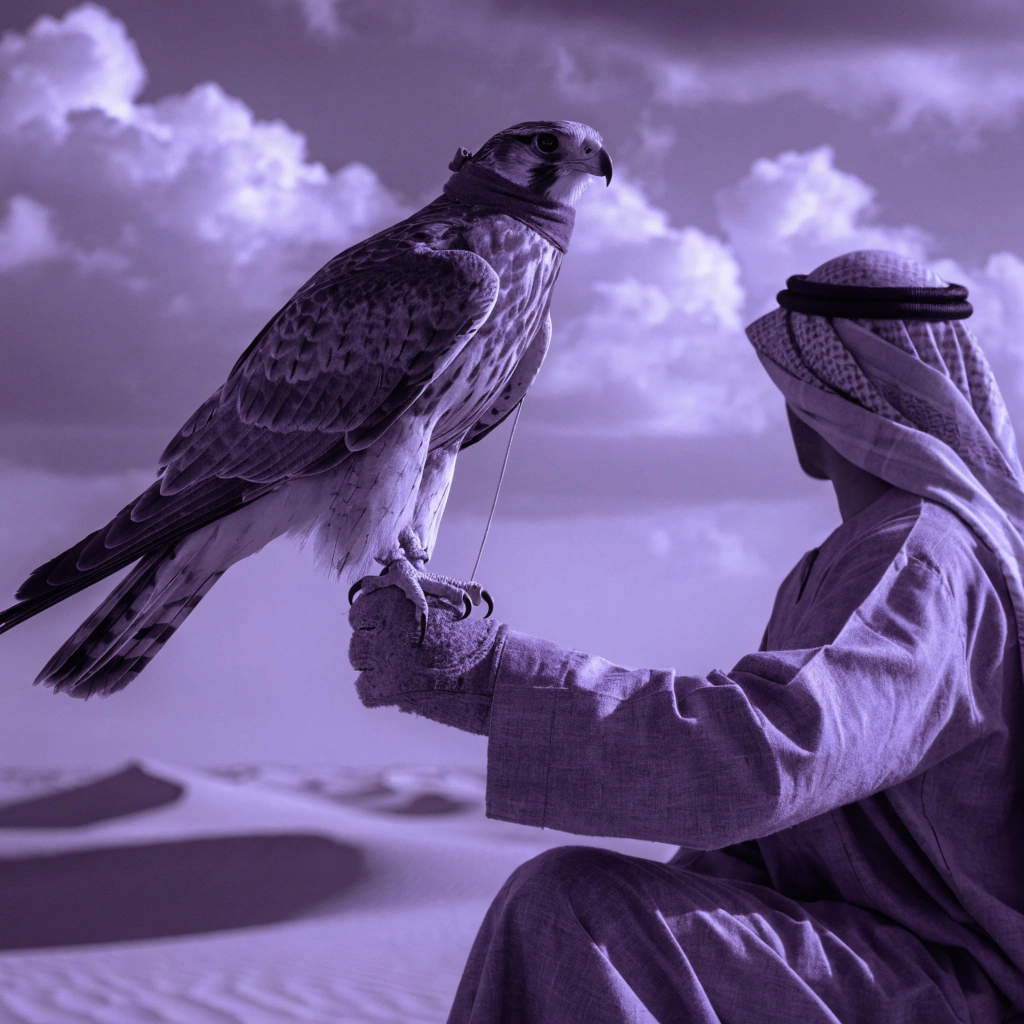
Falcons: The Special Birds of the UAE
Falcons are very important in the United Arab Emirates. People call falconry "Al-Bitar." In the past, Bedouin people lived in the desert. They used falcons to hunt for food. The desert is very hot and dry. The birds are very fast.
Today, falconry is a popular sport. Many people have a falcon. There is a special bond between the person and the bird. They are friends. People go to the desert to fly their birds. It is a beautiful tradition. The UAE protects these birds. They are symbols of the country.
Gramática destacada
Patrón: Present Simple with 'Be'
"Falcons are very important in the United Arab Emirates."
We use 'am', 'is', or 'are' to describe facts or states. In this sentence, 'are' links the subject (falcons) to a description (important).
Patrón: Present Simple for Habits
"People go to the desert to fly their birds."
We use the base form of the verb (go) for general truths or regular actions. With plural subjects like 'people', we do not add -s to the verb.
Pon a prueba tu comprensión
10 preguntas · A1 Principiante · 1 vista previa gratis
Pon a prueba lo que aprendiste en este artículo. ¡Responde todas las preguntas para ganar XP!
Where did Bedouin people live in the past?
¿Quieres terminar el quiz?
9 preguntas más te esperan. ¡Regístrate gratis para desbloquear el quiz completo y ganar XP!
Regístrate gratis¿Ya tienes cuenta? Acceder
Desglose de preguntas
Where did Bedouin people live in the past?
Tu respuesta:
Respuesta correcta: In the desert
Falcons are very slow birds.
Tu respuesta:
Respuesta correcta: Falso
What does 'hunt' mean?
Tu respuesta:
Respuesta correcta: To look for and kill animals for food
The birds are very _____.
Tu respuesta:
Respuesta correcta: fast
The Noble Sport: Falconry in Emirati Culture
Falconry is a very old and special sport in the United Arab Emirates. Long ago, the Bedouin people lived in the desert. Life was difficult because there was not much food. They used falcons to hunt animals like hares and birds. The falcon was faster than other animals, so it helped the people survive.
Today, falconry is more than just hunting. It is a symbol of Emirati culture and history. A falconer must be very patient. He spends many hours with his bird to build a strong bond. The bird learns to trust the human. This relationship is very important in the UAE.
Now, there are many falcon festivals and competitions. The government also built special hospitals for falcons. These birds are very expensive and beautiful. People in the UAE love their falcons because they represent the spirit of the desert. It is a noble sport that connects the past with the present.
Gramática destacada
Patrón: Past Simple
"Long ago, the Bedouin people lived in the desert."
We use the past simple to talk about things that happened and finished in the past. To form it for regular verbs, we usually add '-ed' to the end of the verb.
Patrón: Comparatives
"The falcon was faster than other animals."
We use comparatives to compare two things. For short adjectives, we add '-er' to the adjective and use the word 'than' after it.
Pon a prueba tu comprensión
11 preguntas · A2 Básico · 1 vista previa gratis
Pon a prueba lo que aprendiste en este artículo. ¡Responde todas las preguntas para ganar XP!
Why did the Bedouin people use falcons in the past?
¿Quieres terminar el quiz?
10 preguntas más te esperan. ¡Regístrate gratis para desbloquear el quiz completo y ganar XP!
Regístrate gratis¿Ya tienes cuenta? Acceder
Desglose de preguntas
Why did the Bedouin people use falcons in the past?
Tu respuesta:
Respuesta correcta: To hunt for food
Falconry is a modern sport that only started ten years ago.
Tu respuesta:
Respuesta correcta: Falso
What does the word 'patient' mean?
Tu respuesta:
Respuesta correcta: Being able to wait calmly
The falcon was _____ than other animals, so it helped people survive.
Tu respuesta:
Respuesta correcta: faster
Where did the Bedouin people live long ago?
Tu respuesta:
Respuesta correcta: In the desert
Falconry: The Ancient Heart of the Emirates
Falconry is a traditional sport that has been practiced in the United Arab Emirates for hundreds of years. In the past, it was not just a hobby; it was a way of survival for the Bedouin people who lived in the desert. Because food was difficult to find in the dry landscape, falcons were used to hunt animals like hares and birds. This helped families to supplement their diet with fresh meat.
The relationship between a falconer and his bird is very special. A deep bond is created during the training process, which requires a lot of patience and skill. The falconer must teach the bird to trust him, and this process can take many weeks. Today, although people no longer need to hunt for food, falconry has remained a symbol of Emirati identity and pride.
In the modern UAE, the government has introduced many programs to protect these magnificent birds. For example, special hospitals have been built to care for falcons that are sick or injured. Furthermore, international festivals are organized every year, where people from all over the world come to celebrate this ancient heritage.
Falconry has evolved from a necessity into a respected sport. It is a beautiful link to the past that is still cherished by young and old generations alike. Visitors who travel to the UAE can often see these birds during cultural events, showing that the spirit of the desert is still very much alive.
Gramática destacada
Patrón: Passive Voice
"Falcons were used to hunt animals like hares and birds."
The passive voice is used when the action is more important than the person doing it. It is formed using the verb 'to be' and the past participle of the main verb.
Patrón: Relative Clauses
"...Bedouin people who lived in the desert."
Relative clauses give more information about a noun. We use 'who' for people and 'which' or 'that' for things and animals.
Pon a prueba tu comprensión
11 preguntas · B1 Intermedio · 1 vista previa gratis
Pon a prueba lo que aprendiste en este artículo. ¡Responde todas las preguntas para ganar XP!
Why was falconry important to Bedouin people in the past?
¿Quieres terminar el quiz?
10 preguntas más te esperan. ¡Regístrate gratis para desbloquear el quiz completo y ganar XP!
Regístrate gratis¿Ya tienes cuenta? Acceder
Desglose de preguntas
Why was falconry important to Bedouin people in the past?
Tu respuesta:
Respuesta correcta: It was a necessary way to find food for survival.
Falconry is no longer considered an important part of Emirati culture.
Tu respuesta:
Respuesta correcta: Falso
What does the word 'supplement' mean in the text?
Tu respuesta:
Respuesta correcta: To add to something to make it better.
The UAE government has built special _____ to help sick or hurt falcons.
Tu respuesta:
Respuesta correcta: hospitals
What is required to create a bond between a falconer and his bird?
Tu respuesta:
Respuesta correcta: Patience and skill.
The Noble Sport: Falconry in Emirati Culture
In the heart of the United Arab Emirates, falconry—known locally as 'Al-Bitar'—represents far more than a mere recreational pursuit. It is a profound link to a bygone era, reflecting the resilience of the Bedouin people who once navigated the unforgiving Arabian deserts. Historically, these birds of prey were not kept for entertainment but were essential partners in the struggle for survival. For the tribes of the Arabian Peninsula, the falcon’s incredible speed and precision were vital tools used to secure food in a landscape where resources were incredibly scarce.
Centuries ago, the arid landscape offered limited resources, making it difficult for tribes to maintain a consistent diet. By training falcons to hunt hares and the elusive houbara bustard, Bedouins were able to supplement their meager food supplies. This relationship necessitated a deep, mutual trust; a falconer would spend weeks taming a wild bird, often treating it with the same care as a family member. Consequently, the bird became a symbol of patience, courage, and nobility. The bond formed between the handler and the falcon was so strong that it remains a cornerstone of Emirati identity today.
Despite the rapid modernization of the UAE, the tradition of falconry has not been abandoned. Instead, it has evolved into a sophisticated sport that attracts enthusiasts from across the globe. The government has played a pivotal role in ensuring its preservation, establishing institutions such as the Abu Dhabi Falcon Hospital. At this facility, cutting-edge medical technology is utilized to treat these majestic creatures, highlighting the nation's commitment to animal welfare and cultural heritage.
Furthermore, modern falconry incorporates advanced technology to enhance the experience and protect the species. GPS tracking devices are now frequently employed to monitor the birds during flight, while captive breeding programs have been implemented to reduce the pressure on wild populations. These initiatives demonstrate a balance between honoring ancestral customs and embracing contemporary scientific advancements.
Ultimately, falconry serves as a bridge between the past and the present. It allows younger generations to connect with their ancestors' values while fostering a sense of environmental stewardship. As the falcons soar above the golden dunes, they remain a living testament to the UAE’s enduring spirit and its respect for the natural world.
Gramática destacada
Patrón: Present Perfect Passive
"the tradition of falconry has not been abandoned."
This is used to show that an action was completed in the past but has relevance to the present, focusing on the tradition rather than who abandoned it. It is formed using 'has/have + been + past participle'.
Patrón: Non-defining Relative Clause
"falconry—known locally as 'Al-Bitar'—represents far more than a mere recreational pursuit."
This provides extra information about the subject (falconry) that is not essential to the sentence's basic meaning. It is usually separated by commas or dashes.
Patrón: Past Passive Voice
"these birds of prey were not kept for entertainment"
Used to describe historical facts where the focus is on the object (the birds) rather than the subject (the people). Formed with 'was/were + past participle'.
Pon a prueba tu comprensión
11 preguntas · B2 Intermedio alto · 1 vista previa gratis
Pon a prueba lo que aprendiste en este artículo. ¡Responde todas las preguntas para ganar XP!
What was the primary historical reason for falconry in the UAE?
¿Quieres terminar el quiz?
10 preguntas más te esperan. ¡Regístrate gratis para desbloquear el quiz completo y ganar XP!
Regístrate gratis¿Ya tienes cuenta? Acceder
Desglose de preguntas
What was the primary historical reason for falconry in the UAE?
Tu respuesta:
Respuesta correcta: As a method of survival to hunt for food
The Abu Dhabi Falcon Hospital uses modern technology to care for the birds.
Tu respuesta:
Respuesta correcta: Verdadero
What does 'pivotal' mean in the context of the article?
Tu respuesta:
Respuesta correcta: Extremely important or crucial
Modern falconers use GPS _____ devices to monitor their birds' flight.
Tu respuesta:
Respuesta correcta: tracking
According to the text, what does falconry symbolize for the Emirati people?
Tu respuesta:
Respuesta correcta: Patience, courage, and nobility
Beyond the Hunt: The Socio-Cultural Tapestry of Emirati Falconry
Seldom has a tradition remained so intrinsically linked to the identity of a nation as falconry has to the United Arab Emirates. Far from being a mere pastime, falconry—or Al-Bitar—represents a profound bridge to the ancestral Bedouin way of life, echoing a time when the desert’s arid expanse demanded exceptional survival skills. In the harsh reality of the Arabian Peninsula, the falcon was not a symbol of luxury, but a vital partner in the quest for sustenance. Bedouin tribes relied on these raptors to hunt hares and houbara bustards, supplementing a diet that would otherwise have been meager. The successful domestication of such an indomitable creature required more than just technical acumen; it necessitated a deep, spiritual bond between the falconer and his bird.
It is the symbiotic nature of this relationship that distinguishes Emirati falconry from its Western counterparts. Historically, the Bedouin would capture wild falcons during their autumn migration, train them with immense patience, and release them back into the wild at the end of the hunting season. This cycle of capture and release reflects a sophisticated understanding of ecological balance, ensuring that the wild population remained robust. The falconer’s mastery was not demonstrated through subjugation, but through a mutual trust that defied the bird's predatory instincts. Such was the importance of these birds that they were often treated as members of the family, sharing the warmth of the majlis and the protection of the nomad’s tent.
In the contemporary era, the transformation of the UAE into a global hub has not diminished the prestige of falconry. On the contrary, the sublimation of hunting into a heritage sport has allowed the practice to thrive under modern conservation frameworks. The implementation of the CITES passport system for falcons is a testament to the nation's commitment to ethical wildlife trade. Furthermore, the establishment of specialized hospitals, such as the Abu Dhabi Falcon Hospital, highlights the institutionalization of avian care. These facilities provide world-class medical attention, ensuring that the health of these prized birds is never compromised.
Critical analysis of modern falconry reveals a nuanced tension between tradition and globalization. While high-tech GPS trackers and air-conditioned transport have modernized the sport, the core values of patience, courage, and discipline remains steadfast. The preservation of falconry serves as a cultural anchor, preventing the total erosion of Bedouin heritage in the face of rapid urbanization. It is not merely the act of hunting that matters, but the transmission of values from one generation to the next. For an Emirati, a falcon is a living vestige of a proud past, a reminder that even in a world of skyscrapers, the spirit of the desert endures. Ultimately, the survival of falconry is indicative of a society that refuses to let its progress eclipse its origins.
Gramática destacada
Patrón: Negative Inversion
"Seldom has a tradition remained so intrinsically linked to the identity of a nation as falconry has to the United Arab Emirates."
Inversion is used here for emphasis by placing a negative or restrictive adverbial (Seldom) at the beginning of the sentence. This requires the auxiliary verb to come before the subject.
Patrón: Cleft Sentence
"It is the symbiotic nature of this relationship that distinguishes Emirati falconry from its Western counterparts."
A cleft sentence is used to focus on a specific part of the information (the symbiotic nature). It follows the structure 'It + is/was + [emphasized part] + that/who...'
Patrón: Nominalisation
"The implementation of the CITES passport system for falcons is a testament to the nation's commitment to ethical wildlife trade."
Nominalisation involves turning verbs (implement, commit) into nouns (implementation, commitment). This makes the writing sound more formal, objective, and academic, which is typical of C1 level prose.
Pon a prueba tu comprensión
12 preguntas · C1 Avanzado · 1 vista previa gratis
Pon a prueba lo que aprendiste en este artículo. ¡Responde todas las preguntas para ganar XP!
What was the primary historical function of falconry for the Bedouin tribes?
¿Quieres terminar el quiz?
11 preguntas más te esperan. ¡Regístrate gratis para desbloquear el quiz completo y ganar XP!
Regístrate gratis¿Ya tienes cuenta? Acceder
Desglose de preguntas
What was the primary historical function of falconry for the Bedouin tribes?
Tu respuesta:
Respuesta correcta: A practical method for securing food in the desert
Historically, Bedouin falconers kept their birds for their entire lives without ever releasing them.
Tu respuesta:
Respuesta correcta: Falso
Which word means 'the ability to make good judgments and quick decisions'?
Tu respuesta:
Respuesta correcta: Acumen
The falcon is described as an _____ creature, meaning it is impossible to defeat or subdue.
Tu respuesta:
Respuesta correcta: indomitable
According to the article, how does modern falconry interact with globalization?
Tu respuesta:
Respuesta correcta: It uses modern technology while maintaining traditional core values.
The Abu Dhabi Falcon Hospital is cited as an example of how avian care has become institutionalized.
Tu respuesta:
Respuesta correcta: Verdadero
La Cetrería en los Emiratos Árabes Unidos: Un Legado Ancestral y Símbolo de Identidad Cultural
En el vasto y a menudo inhóspito paisaje de los Emiratos Árabes Unidos, la cetrería, conocida localmente como "Al-Bitar", trasciende con creces la mera categoría de deporte para erigirse como un pilar fundamental de la identidad cultural emiratí. Lejos de ser una actividad lúdica contemporánea, su práctica se halla intrínsecamente imbricada en el tejido histórico y social de las tribus beduinas, constituyendo un testimonio elocuente de la ingeniosidad humana y la profunda conexión con el entorno desértico.
Durante siglos, la vida en la península arábiga exigió una adaptabilidad férrea y una sagaz explotación de los recursos disponibles. En este contexto de subsistencia precaria, los halcones no eran meros animales de compañía, sino aliados indispensables en la búsqueda de alimento. Su asombrosa velocidad y precisión, cualidades innatas magnificadas por un adiestramiento meticuloso, resultaban esenciales para la caza de presas como liebres y, sobre todo, la escurridiza hubara. La capacidad de estos depredadores alados para asegurar una fuente vital de proteínas en un ecosistema tan desafiante no solo complementaba la dieta, sino que a menudo marcaba la diferencia entre la supervivencia y la inanición. Es menester, por ende, comprender que la cetrería emergió como una necesidad imperiosa, forjando una simbiosis única entre el halconero y su ave, un vínculo de confianza mutua y dependencia recíproca que poco parangón tiene en la historia de la domesticación animal.
La destreza requerida para adiestrar a un halcón silvestre, transformándolo en un compañero de caza eficiente y leal, es un arte que se ha transmitido de generación en generación. Este proceso no solo implica paciencia y diligencia, sino también una profunda comprensión del comportamiento aviar y del entorno natural. Los halconeros beduinos, auténticos maestros de su oficio, desarrollaron técnicas sofisticadas para capturar, amansar y entrenar a estas aves rapaces, un conocimiento empírico que ha perdurado a través de los siglos. La relación que se establece es, pues, de una intimidad casi espiritual; el halcón llega a reconocer a su amo, y el halconero, a su vez, interpreta cada gesto, cada mirada de su ave, en una danza silenciosa de entendimiento mutuo.
Con la llegada de la modernidad y la transformación económica de los Emiratos Árabes Unidos, la cetrería podría haber quedado relegada a los anales de la historia. No obstante, lejos de desaparecer, ha experimentado una notable revitalización, transmutándose de una práctica de subsistencia a un deporte de prestigio y una manifestación cultural de primer orden. Los gobernantes de los Emiratos, conscientes del inestimable valor de este legado, han impulsado con ahínco su preservación y promoción, estableciendo centros de cría de halcones, organizando competiciones de alto nivel y fomentando su estudio científico. Esto no solo garantiza la continuidad de la tradición, sino que también refuerza el sentido de pertenencia y orgullo nacional.
La cetrería hoy día se practica con un renovado énfasis en la conservación de las especies y la sostenibilidad de la práctica. Los halconeros modernos, aunque equipados con tecnología avanzada, mantienen el respeto reverencial por la naturaleza que caracterizaba a sus ancestros. Es plausible afirmar que la cetrería encarna la esencia misma de la cultura emiratí: la fusión armónica de la tradición y la modernidad, la resiliencia ante la adversidad y la profunda veneración por el patrimonio natural. Así pues, al observar el majestuoso vuelo de un halcón sobre las dunas doradas, no solo somos testigos de un espectáculo de destreza, sino también de la viva pulsación de una historia milenaria que se niega a ser olvidada, un crisol de valores que continúan definiendo una nación. Es, sin duda, una manifestación cultural que, lejos de ser anacrónica, proyecta un futuro arraigado en la riqueza de su pasado.
Gramática destacada
Patrón: Subjuntivo en Cláusulas Adverbiales de Concesión
"Los halconeros modernos, aun cuando equipados con tecnología avanzada, mantienen el respeto reverencial por la naturaleza que caracterizaba a sus ancestros."
El subjuntivo se emplea en cláusulas adverbiales de concesión introducidas por "aun cuando" (o "aunque", "a pesar de que") para expresar una dificultad u objeción que no impide la acción principal. Se usa cuando la información de la cláusula concesiva se presenta como una hipótesis o una posibilidad, o cuando la acción principal no es un hecho que derive directamente de la subordinada.
Patrón: Perífrasis Verbal: "Es menester + infinitivo"
"Es menester, por ende, comprender que la cetrería emergió como una necesidad imperiosa..."
La perífrasis "es menester + infinitivo" se utiliza para expresar la necesidad, obligación o conveniencia de realizar una acción. Es una construcción formal y enfática que significa "es necesario" o "es preciso", elevando el tono del discurso y subrayando la importancia de lo que se afirma.
Patrón: Voz Pasiva Refleja (con "se")
"La destreza requerida para adiestrar a un halcón silvestre [...] es un arte que se ha transmitido de generación en generación."
La voz pasiva refleja se forma con la partícula "se" seguida de un verbo en tercera persona (singular o plural) y se utiliza cuando el agente de la acción no se menciona o no es relevante. En este caso, "se ha transmitido" indica que el arte fue transmitido, sin especificar quiénes fueron los transmisores, enfocándose en la acción y su resultado.
Pon a prueba tu comprensión
12 preguntas · C2 Dominio · 1 vista previa gratis
Pon a prueba lo que aprendiste en este artículo. ¡Responde todas las preguntas para ganar XP!
¿Cuál es la principal razón por la que la cetrería era crucial para las tribus beduinas?
¿Quieres terminar el quiz?
11 preguntas más te esperan. ¡Regístrate gratis para desbloquear el quiz completo y ganar XP!
Regístrate gratis¿Ya tienes cuenta? Acceder
Desglose de preguntas
¿Cuál es la principal razón por la que la cetrería era crucial para las tribus beduinas?
Tu respuesta:
Respuesta correcta: Proporcionaba una fuente vital de alimento en un entorno difícil.
El artículo sugiere que la cetrería ha desaparecido en los Emiratos Árabes Unidos debido a la modernidad.
Tu respuesta:
Respuesta correcta: Falso
¿Qué significa "imbricada" en el contexto del artículo?
Tu respuesta:
Respuesta correcta: Que está estrechamente entrelazada o conectada.
La cetrería, conocida localmente como "Al-Bitar", trasciende con creces la mera categoría de ______ para erigirse como un pilar fundamental de la identidad cultural emiratí.
Tu respuesta:
Respuesta correcta: deporte
¿Qué tipo de relación se forja entre el halconero y su ave según el texto?
Tu respuesta:
Respuesta correcta: Una simbiosis única de confianza mutua y dependencia recíproca.
Los halconeros beduinos desarrollaron técnicas sofisticadas para el adiestramiento de aves rapaces, conocimientos que se han mantenido por siglos.
Tu respuesta:
Respuesta correcta: Verdadero

