fries en 30 segundos
- Fries are deep-fried potato strips, a world-famous side dish.
- Commonly called 'French fries' in the US and 'chips' in the UK.
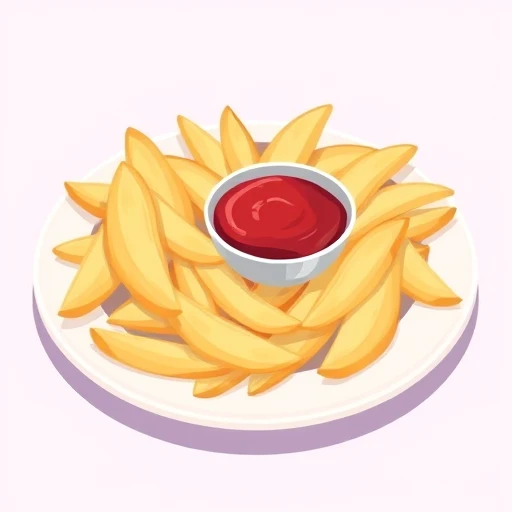
- Known for their crispy texture and salty flavor, often served with ketchup.
- A staple of fast food and casual dining across the globe.
The term 'fries' refers to a ubiquitous and beloved culinary staple consisting of potatoes that have been sliced into thin strips and subsequently deep-fried until they achieve a golden-brown, crispy exterior while maintaining a soft, fluffy interior. While the origin of the dish is often debated between Belgium and France, the word 'fries' has become the standard North American designation for this side dish. People use this word in almost every casual dining context, from fast-food drive-thrus to upscale bistros where 'truffle fries' might be featured on the menu. The word is almost always used in the plural form because it is rare to consume just one individual strip of potato. When you order 'fries,' you are requesting a portion or a serving of this snack. The versatility of fries is immense; they can be seasoned with simple salt, smothered in cheese and gravy to create poutine, or served with a variety of dipping sauces like ketchup, mayonnaise, or aioli. In social settings, fries are often seen as a communal food, frequently shared among friends at the center of a table. The term is essential for anyone navigating an English-speaking food environment, as it is one of the most frequently ordered items globally.
- Culinary Category
- Side dish / Snack / Fast Food
- Primary Ingredient
- Russet or Starchy Potatoes
I would like a large burger with a side of extra-crispy fries.
Beyond the physical food, 'fries' also appears in various cultural expressions. It represents the quintessential 'comfort food'—something high in carbohydrates and fats that provides immediate sensory satisfaction. In the United States, the term 'French fries' is the full name, but 'fries' is the standard shorthand used in 99% of daily conversations. It is important to note the regional variation: in the United Kingdom, Ireland, and Australia, what Americans call 'fries' (especially the thicker-cut variety) are known as 'chips,' whereas 'fries' usually specifically refers to the thin, fast-food style strips. Understanding this distinction is crucial for international travelers to avoid confusion when ordering at a pub versus a McDonald's.
Do you want to share some fries with the group?
- Texture Descriptors
- Crispy, crunchy, soggy, limp, greasy, fluffy.
These fries are too salty for my taste.
The word is also used in the context of 'steak fries' (thick wedges), 'curly fries' (spiraled), and 'waffle fries' (criss-cross pattern). Each variation carries the same basic linguistic root but describes a different physical form. In a broader sense, 'fries' can also be a verb (the third-person singular of 'to fry'), but as a noun, it is the king of side dishes. It is a word that transcends social classes; you can find fries at a local diner for two dollars or at a Michelin-starred restaurant served with shaved truffles and parmesan cheese for twenty dollars. Its usage is constant, informal, and universally understood across the English-speaking world.
The restaurant is famous for its hand-cut fries.
- Common Pairings
- Burgers, shakes, ketchup, fish (fish and chips), and steak (steak frites).
I prefer sweet potato fries over regular ones.
Using the word 'fries' correctly involves understanding its grammatical status as a plural count noun. Even though we often think of a 'serving' of fries as a single entity, we almost always use the plural form. You wouldn't say 'I want a fry' unless you were literally referring to a single piece of potato that fell on the floor. Instead, you say 'I want some fries' or 'an order of fries.' When acting as the subject of a sentence, 'fries' takes a plural verb: 'The fries are hot.' This is a common point of confusion for learners who might be tempted to treat it as an uncountable mass noun like 'rice' or 'pasta.' Furthermore, 'fries' is frequently modified by adjectives that describe their preparation or state. For example, 'bottomless fries' refers to an unlimited supply, while 'loaded fries' describes fries topped with various ingredients like bacon, chives, and sour cream.
- Verb Agreement
- Always plural: 'These fries taste amazing,' not 'This fries tastes amazing.'
Could we get another basket of fries for the table?
In a restaurant setting, the word 'fries' often appears in compound nouns or specific menu titles. You might see 'home fries,' which are typically cubed and pan-fried potatoes served for breakfast, or 'chili cheese fries.' When ordering, the word is often preceded by a size: 'small fries,' 'medium fries,' or 'large fries.' It can also be used in a comparative sense. If you are at a fast-food chain, you might ask, 'Whose fries are better, McDonald's or Wendy's?' Here, the possessive noun acts as an adjective for the implied 'fries.' Additionally, the word can be used metaphorically in slang, though this is less common. For instance, 'small fry' refers to something or someone insignificant, though this comes from the meaning of 'fry' as young fish, not the potato dish.
She always steals a few fries from my plate before I start eating.
- Quantifiers
- Use 'many,' 'few,' or 'some' with fries. Do not use 'much.'
How many fries come in a regular serving?
When describing the quality of fries, speakers often use specific sensory verbs. Fries can 'go cold,' 'get soggy,' or 'stay crunchy.' In a sentence like 'The fries went cold because we talked too long,' the word functions as the subject experiencing a change in state. In culinary writing, you might see more technical usage: 'The fries are double-fried to ensure a perfect crust.' Whether you are writing a Yelp review or just chatting with a friend about lunch, 'fries' is a versatile noun that fits into almost any sentence structure involving food. It is also common to use 'fries' as part of a choice: 'Would you like fries or a salad with that?' This is perhaps the most common question heard in American restaurants.
I'll take the fries, please; I'm not in the mood for a salad today.
The most common place to hear the word 'fries' is undoubtedly in the hospitality industry. From the moment you walk into a fast-food establishment, the air is filled with the sound of the word. Cashiers will ask, 'Do you want fries with that?'—a phrase so iconic it has become a cultural meme representing upselling or routine service work. In sit-down restaurants, servers will list fries as one of the 'sides' available with an entree. You will also hear it in domestic settings, particularly during meal planning or while watching television commercials for food products. Because fries are a staple of the 'Standard American Diet,' they are frequently mentioned in health and nutrition discussions, often as an example of a high-calorie food that should be eaten in moderation. In movies and TV shows, characters often bond over a shared plate of fries in a diner, making the word a part of the 'visual and auditory language' of casual American life.
- Common Locations
- Drive-thrus, diners, sports bars, school cafeterias, state fairs.
Welcome to Burger King, would you like to try our new chicken fries?
In pop culture, 'fries' appears in songs, memes, and even political discourse (such as the brief and controversial 'Freedom Fries' era in the early 2000s). You might hear it in a podcast about culinary history or a YouTube cooking tutorial where a chef explains the 'science of the perfect fry.' The word is also prevalent in advertising, where it is often paired with high-energy adjectives like 'sizzling,' 'golden,' or 'world-famous.' If you are listening to a sports broadcast, you might hear about a stadium's 'signature fries'—perhaps topped with local delicacies like crab meat in Baltimore or garlic in San Francisco. The word is so ingrained in the English language that it is one of the first food words children learn, and it remains a constant throughout adulthood in both high-stakes business lunches and late-night snacks.
The secret to their fries is the peanut oil they use for frying.
- Cultural Contexts
- American diners, Belgian 'friteries', French bistros.
I saw a commercial for those curly fries and now I'm starving.
One of the most frequent mistakes English learners make with the word 'fries' is treating it as a singular or uncountable noun. Because it represents a single 'dish,' learners often say 'I want a fry' or 'The fry is good.' In English, 'fries' is strictly plural when referring to the food item. If you want to refer to a single piece, you must say 'a french fry' or 'one of the fries.' Another common error involves the confusion between 'fries' and 'chips.' While both refer to fried potatoes, their usage depends entirely on geography. In the US, 'chips' are thin, crunchy slices of potato found in bags (potato chips), while 'fries' are the hot strips. In the UK, 'chips' are the hot strips (usually thicker), and 'crisps' are the thin slices in bags. Using 'chips' to mean 'fries' in an American McDonald's will likely result in the cashier being confused or offering you a bag of Lay's.
- Countability Error
- Incorrect: 'I ate much fries.' Correct: 'I ate many fries' or 'I ate a lot of fries.'
Wait, did you say you wanted fries or chips? It depends on which country we are in!
Spelling is another area where mistakes occur. The singular verb form 'fries' (as in 'he fries an egg') is spelled the same as the plural noun 'fries.' However, the plural of the noun 'fry' (meaning a small fish) is also 'fries.' Context is key here. Additionally, some learners forget that 'French' in 'French fries' should technically be capitalized, although in modern casual writing, it is often lowercase. Another nuance is the difference between 'fries' and 'fried potatoes.' While all fries are fried potatoes, not all fried potatoes (like hash browns or home fries) are 'fries.' Using the term too broadly can lead to culinary inaccuracy. Finally, avoid using 'fries' to describe roasted or baked potato wedges unless they have been prepared in a way that mimics the deep-fried texture, as 'fries' specifically implies the frying process.
You can't just call any potato fries; they have to be deep-fried strips!
- Spelling Note
- Singular noun: a fry. Plural noun: fries. Verb (he/she/it): fries.
I made a mistake and ordered 'chips' in London, expecting fries, and got thick potato wedges instead.
While 'fries' is the most common term, there are several alternatives depending on the shape, cooking method, and region. 'Chips' is the most significant alternative, used in the UK, Australia, and New Zealand. However, 'chips' are usually thicker than the standard American 'fry.' 'Steak fries' are even thicker, often wedge-shaped and served with hearty meals. 'Wedges' are potatoes cut into large triangular sections, often seasoned with paprika or herbs and sometimes baked rather than fried. 'Shoestring fries' are extremely thin and crispy, resembling pieces of string. 'Waffle fries' have a lattice-like appearance, created by a special corrugated blade. 'Curly fries' are cut into spirals and are almost always heavily seasoned with a spicy batter. Understanding these variations helps in navigating diverse menus.
- Fries vs. Chips
- Fries are usually thin (US style); Chips are usually thick (UK style).
- Fries vs. Wedges
- Fries are uniform strips; Wedges follow the natural curve of the potato.
I prefer thick-cut fries because they have more potato flavor.
Other related terms include 'tater tots,' which are grated potatoes formed into small cylinders and fried, and 'hash browns,' which are shredded or finely chopped potatoes fried into a patty or loose pile, typically for breakfast. In a more formal or French-influenced setting, you might see 'pommes frites,' which is the French term for fries. 'Home fries' are another breakfast staple, usually consisting of cubed potatoes sautéed with onions and peppers. If you are looking for a healthier alternative, 'sweet potato fries' have gained massive popularity in recent years, offering a sweeter taste and different nutrient profile. In slang, you might hear 'freedom fries,' though this term is largely dated and was a political statement rather than a culinary description. Knowing these synonyms and related words allows for more precise communication when ordering food.
The menu offers fries, but I think I'll upgrade to the sweet potato version.
- Regional Terms
- US: Fries; UK: Chips; France: Pommes Frites; Belgium: Frites.
These shoestring fries are so thin they're like potato needles!
How Formal Is It?
Dato curioso
Belgium has a museum dedicated entirely to fries, called the Frietmuseum, located in Bruges. They claim to have invented the dish in the 1680s.
Guía de pronunciación
- Pronouncing the 's' as an 's' instead of a 'z' sound.
- Confusing the pronunciation with 'freeze' (long 'e' sound).
- Adding an extra syllable like 'fry-es'.
- Not blending the 'f' and 'r' smoothly.
- Pronouncing the 'i' as a short 'i' like in 'fish'.
Nivel de dificultad
Very easy to recognize on menus and in text.
Easy, but remember the 'ies' plural spelling.
Simple one-syllable word.
Distinct sound, easy to hear.
Qué aprender después
Requisitos previos
Aprende después
Avanzado
Gramática que debes saber
Pluralization of words ending in 'y'
Fry becomes fries (change 'y' to 'i' and add 'es').
Count vs Uncount nouns
Fries is a count noun, so use 'many' or 'fewer'.
Adjective placement
The adjective comes before the noun: 'Crispy fries'.
Compound nouns
'French fries' acts as a single unit.
Verb agreement
'The fries are...' (plural verb).
Ejemplos por nivel
I like fries.
I enjoy eating fried potato strips.
Subject + Verb + Object (plural noun).
Can I have some fries?
A polite request for a portion of fries.
Interrogative sentence with 'some'.
The fries are hot.
Describing the temperature of the fries.
Plural subject with 'are'.
These fries are salty.
Describing the taste of the fries.
Demonstrative pronoun 'these' for plural.
Do you want fries?
Asking someone if they want the dish.
Simple present question.
I have a burger and fries.
Describing a meal.
Compound object.
The fries are yellow.
Describing the color.
Simple adjective use.
Give me the fries, please.
An imperative request.
Imperative with 'please' for politeness.
I ordered a large portion of fries.
Specifying the size of the order.
Past tense verb 'ordered'.
The fries are too greasy for me.
Expressing a negative opinion about the oiliness.
Adverb 'too' modifying an adjective.
She doesn't like cold fries.
Talking about preferences.
Negative third-person singular.
We shared a basket of fries at the diner.
Describing a social activity.
Past tense 'shared'.
Are the fries included with the meal?
Asking about the price or menu.
Passive voice 'included'.
I prefer fries over salad.
Expressing a preference.
Verb 'prefer' with 'over'.
He put ketchup on his fries.
Describing an action.
Prepositional phrase 'on his fries'.
There are many fries in this bag.
Using quantifiers.
'There are' with 'many' for count nouns.
The fries were crispy on the outside and soft inside.
Describing texture in detail.
Compound adjectives.
If you want better fries, you should double-fry them.
Giving advice on cooking.
First conditional structure.
Sweet potato fries are becoming very popular these days.
Discussing a food trend.
Present continuous for trends.
I'll have the steak with a side of fries, please.
Ordering a classic meal.
Future 'will' for decisions.
The waiter asked if I wanted my fries well-done.
Reporting a conversation.
Reported speech.
Homemade fries are much healthier than fast-food ones.
Making a comparison.
Comparative adjectives.
Don't forget to season the fries while they are still hot.
Giving instructions.
Negative imperative.
The fries at that restaurant are hand-cut every morning.
Describing quality.
Present passive.
Despite being high in calories, fries remain a global favorite.
Using a contrastive conjunction.
Concession clause with 'Despite'.
The chef specializes in Belgian-style fries served with aioli.
Describing a culinary specialty.
Present simple for habits/specialties.
You can't have a proper burger without a decent serving of fries.
Expressing a strong opinion.
Modal 'can't' for impossibility.
The fries had gone soggy by the time the delivery arrived.
Describing a past situation.
Past perfect 'had gone'.
Loaded fries, topped with cheese and bacon, are a meal in themselves.
Describing a specific dish.
Appositive phrase.
I was disappointed that the fries were undercooked.
Expressing dissatisfaction.
Adjective 'undercooked' with prefix.
The restaurant offers bottomless fries with every entree.
Describing a promotion.
Adjective 'bottomless'.
The aroma of fresh fries wafted through the air.
Describing a sensory experience.
Literary verb 'wafted'.
The ubiquity of fries in modern diets is a testament to their appeal.
Using formal vocabulary.
Abstract noun 'ubiquity'.
Achieving the perfect fry requires a precise balance of temperature and timing.
Describing a technical process.
Gerund phrase as subject.
The term 'French fries' is actually a misnomer, as they likely originated in Belgium.
Discussing etymology.
Noun 'misnomer'.
The fries were seasoned with a sophisticated blend of smoked paprika and sea salt.
Detailed culinary description.
Passive voice with detailed modifiers.
Critics argue that the excessive consumption of fries contributes to public health issues.
Discussing a social issue.
Noun clause as object.
The fries served at the bistro were a far cry from the greasy strips found in fast food.
Using an idiom for contrast.
Idiom 'a far cry from'.
The starch content of the potato is crucial for determining the final texture of the fries.
Technical explanation.
Noun phrase 'starch content'.
The restaurant's reputation was built on the back of its legendary truffle fries.
Using a metaphorical expression.
Idiom 'on the back of'.
The cultural hegemony of fries has marginalized traditional local side dishes in many regions.
High-level sociological analysis.
Complex noun phrase 'cultural hegemony'.
To describe these as mere 'fries' would be a gross understatement of their culinary artistry.
Using rhetorical devices.
Infinitive phrase as subject.
The fries possessed a transcendent crunch that defied linguistic description.
Hyperbolic literary style.
Relative clause 'that defied...'.
One might posit that the humble fry is the ultimate expression of egalitarian dining.
Philosophical speculation.
Formal 'one might posit'.
The Maillard reaction was perfectly executed, resulting in fries of an incomparable golden hue.
Scientific and aesthetic description.
Participial phrase 'resulting in...'.
The fries served as a nostalgic touchstone, evoking memories of childhood summers.
Evocative, emotional language.
Metaphor 'nostalgic touchstone'.
The chef's deconstructed take on fish and chips featured fries presented as delicate potato shards.
Avant-garde culinary context.
Compound modifiers.
The sheer versatility of the fry allows it to adapt to any flavor profile, from spicy to umami.
Comprehensive summary.
Prepositional phrase 'from... to...'.
Colocaciones comunes
Frases Comunes
— A standard question asked by fast-food workers to upsell.
The phrase 'Do you want fries with that?' is iconic in the US.
— Something or someone that is unimportant or insignificant.
Compared to the CEO, I'm just a small fry in this company.
— A portion of fries served alongside a main dish.
I'll take the burger with a side of fries.
— A large serving of fries usually intended for sharing.
We ordered a basket of fries for the whole table.
— Fries made from fresh potatoes sliced by hand, not frozen.
These hand-cut fries taste much better than the frozen ones.
— Fries that have spices or herbs added to them.
The seasoned fries have a bit of a kick to them.
— Fries topped with melted cheese.
I can't resist ordering cheese fries when I'm at the fair.
— Fries seasoned with truffle oil and often parmesan.
Truffle fries are a popular appetizer at upscale bars.
— Fries cut into a lattice or waffle shape.
Chick-fil-A is famous for its waffle fries.
— Very thin, matchstick-style fries.
I find shoestring fries hard to eat with a fork.
Se confunde a menudo con
In the US, these are cold snacks in a bag. In the UK, these are fries.
The UK term for what Americans call potato chips.
The action of cooking (e.g., 'He fries the fish').
Modismos y expresiones
— A person or thing of little importance.
In the world of international finance, this bank is small fry.
Informal— Moving from a bad situation to an even worse one (uses 'frying' root).
Quitting that job without a new one was like going out of the frying pan into the fire.
Neutral— To have more important things to do.
I can't worry about that minor detail; I have bigger fish to fry.
Informal— A political euphemism for French fries used in the US in 2003.
For a short time, the cafeteria renamed them freedom fries.
Historical/Political— Eyes that are wide open with surprise or exhaustion (related to 'fried').
He stared at the news with eyes like fried eggs.
Informal— To become mentally exhausted or damaged.
Studying for 12 hours straight will fry your brains.
Slang— To be insignificant (related to the ingredient).
That loss is small potatoes compared to what we could have lost.
Informal— A lazy person who watches a lot of TV (related to the ingredient).
Stop being a couch potato and go outside!
Informal— A controversial issue that no one wants to deal with.
The new tax law is a political hot potato.
NeutralFácil de confundir
Similar sound.
Freeze is to turn into ice; fries are potatoes.
Don't freeze the fries!
Similar sound.
Flies are insects; fries are food.
There are flies near my fries!
Starts with 'fr'.
Fresh means new/not old; fries are the dish.
I want fresh fries.
Past participle of fry.
Fried is an adjective; fries is the noun.
I like fried chicken and fries.
Rhymes with fries.
Rice is a grain; fries are potatoes.
I'll have rice instead of fries.
Patrones de oraciones
I like [noun].
I like fries.
Can I have [noun]?
Can I have fries?
The [noun] are [adjective].
The fries are crispy.
I prefer [noun] over [noun].
I prefer fries over salad.
Despite [gerund], [clause].
Despite being oily, the fries were delicious.
The [noun] had [past participle] by the time [clause].
The fries had gone cold by the time we ate.
The [noun] of [noun] is [adjective].
The texture of the fries is perfect.
To describe [noun] as [adjective] would be [noun phrase].
To describe these fries as good would be an understatement.
Familia de palabras
Sustantivos
Verbos
Adjetivos
Relacionado
Cómo usarlo
Extremely high in daily conversation and food-related contexts.
-
I want a fry.
→
I want some fries.
Unless you literally want only one single strip of potato, use the plural 'fries'.
-
The fries is cold.
→
The fries are cold.
'Fries' is a plural noun and requires a plural verb.
-
I ate much fries.
→
I ate many fries.
'Fries' is a countable noun, so use 'many' or 'a lot of' instead of 'much'.
-
Ordering 'chips' in the US expecting fries.
→
Ordering 'fries' in the US.
In the US, 'chips' refers to the crunchy snack in a bag, not hot potato strips.
-
Spelling it 'frys'.
→
Spelling it 'fries'.
The plural of 'fry' follows the rule of changing 'y' to 'i' and adding 'es'.
Consejos
Always Plural
Remember that 'fries' is a plural noun. Always use 'are' instead of 'is' when 'fries' is the subject.
Regional Differences
If you are in the UK, ask for 'chips' if you want thick fries. If you ask for 'chips' in the US, you will get a bag of potato chips.
The Famous Phrase
You will often hear 'Do you want fries with that?' in fast food. It's a standard way to offer a side dish.
Double Frying
The secret to the best fries is frying them twice: once at a lower temperature to cook the inside, and once at a higher temperature to crisp the outside.
Sweet Potato Fries
Don't forget about sweet potato fries! They are orange and have a different, sweeter flavor.
Not Necessarily French
The 'French' in French fries might refer to the way they are cut (frenched) rather than where they come from.
Healthier Options
If you want to be healthy, you can ask to substitute fries for a side salad or steamed vegetables.
The 'Z' Sound
The 's' at the end of 'fries' is pronounced like a 'z'. Make sure to vibrate your vocal cords!
Small Fry
You can use 'small fry' to describe something that isn't important. It's a common idiom.
Sharing is Caring
Fries are one of the most common foods to share. It's very normal to order a large portion for the whole table.
Memorízalo
Mnemotecnia
Fries are Fast, Fried, and Fun to eat with Friends.
Asociación visual
Imagine a bright red cardboard container with golden yellow strips sticking out of the top.
Word Web
Desafío
Try to order fries in three different ways: 'A side of fries,' 'Some fries,' and 'A large order of fries.'
Origen de la palabra
The term 'French fries' originated in the late 17th or early 18th century. The 'French' part likely refers to the style of cutting (to 'french' something means to cut it into strips) rather than the country of origin, though this is debated.
Significado original: Potatoes cut into strips and fried.
Germanic (English) / Romance (French influence).Contexto cultural
Be mindful of health contexts; fries are often used as an example of 'junk food' in nutritional discussions.
In the US, 'fries' is the standard. In the UK, use 'chips' for the thick ones and 'fries' for the thin ones.
Practica en la vida real
Contextos reales
At a Fast Food Restaurant
- Can I get a large fries?
- No salt on the fries, please.
- Do you have any dipping sauce?
- Are the fries fresh?
At a Diner
- I'll take the burger and fries.
- Can I substitute the fries for a salad?
- Do you have home fries?
- Another basket of fries, please.
At Home
- I'm going to bake some frozen fries.
- Do we have any ketchup for the fries?
- The fries are ready!
- Be careful, the fries are hot.
In a Health Discussion
- Fries are high in calories.
- I'm trying to eat fewer fries.
- Are these fries fried in vegetable oil?
- Baked fries are a healthier option.
In the UK
- I'd like some chips, please.
- Do you want salt and vinegar on your chips?
- Are these thin fries or thick chips?
- A portion of chips, please.
Inicios de conversación
"Who do you think has the best fries in town?"
"Do you prefer your fries crispy or a bit soft?"
"What is your favorite sauce to dip fries in?"
"Have you ever tried sweet potato fries?"
"Do you think fries are better with or without salt?"
Temas para diario
Describe the best plate of fries you have ever eaten. Where were you?
If you had to choose between fries and every other potato dish, which would you pick?
Write a short story about a character who discovers a secret recipe for the perfect fries.
Do you think fast food fries are a 'guilty pleasure'? Why or why not?
Compare the fries in your home country to the ones you've had elsewhere.
Preguntas frecuentes
10 preguntasYes, 'fries' is simply the common shorthand for 'French fries'. In almost all contexts, they refer to the same dish of deep-fried potato strips.
There are several theories. One is that American soldiers in WWI were introduced to them in Belgium, where the official language was French, so they called them 'French fries'. Another is that 'to french' is a culinary term for cutting into strips.
It is plural. You should say 'The fries are hot,' not 'The fries is hot.' If you want to talk about just one, say 'a fry' or 'a French fry'.
In England, thick-cut fries are called 'chips'. The very thin ones from fast-food places are still often called 'fries'.
Russet potatoes are generally considered the best because they have a high starch content, which makes the fries crispy on the outside and fluffy on the inside.
Generally, no. They are deep-fried in oil and usually high in salt and calories. However, they can be enjoyed in moderation as part of a balanced diet.
'Loaded' fries are fries that are topped with extra ingredients like melted cheese, bacon bits, sour cream, chives, or chili.
Yes, you can bake them. These are often called 'oven fries' and are a healthier alternative to deep-frying.
Poutine is a Canadian dish consisting of fries topped with fresh cheese curds and brown gravy.
Fries get soggy because they absorb moisture from the air or from being covered in a container. To keep them crispy, they should be eaten fresh or kept in a ventilated area.
Ponte a prueba 180 preguntas
Describe your favorite way to eat fries.
Well written! Good try! Check the sample answer below.
Write a short dialogue ordering fries at a restaurant.
Well written! Good try! Check the sample answer below.
Explain the difference between fries and chips.
Well written! Good try! Check the sample answer below.
Write a review of the best fries you've ever had.
Well written! Good try! Check the sample answer below.
Discuss the health implications of eating too many fries.
Well written! Good try! Check the sample answer below.
Write a recipe for making homemade fries.
Well written! Good try! Check the sample answer below.
Describe the texture of a perfect fry.
Well written! Good try! Check the sample answer below.
What are 'loaded fries'? Describe them.
Well written! Good try! Check the sample answer below.
Write a story about a 'small fry' character.
Well written! Good try! Check the sample answer below.
Compare sweet potato fries to regular fries.
Well written! Good try! Check the sample answer below.
Why do you think fries are so popular worldwide?
Well written! Good try! Check the sample answer below.
Write a complaint letter about cold fries.
Well written! Good try! Check the sample answer below.
Describe the smell of fresh fries.
Well written! Good try! Check the sample answer below.
Write an advertisement for a new type of fry.
Well written! Good try! Check the sample answer below.
Discuss the cultural importance of fries in Belgium.
Well written! Good try! Check the sample answer below.
What sauces do you like with fries? List three and why.
Well written! Good try! Check the sample answer below.
Write a sentence using 'fries' as a verb.
Well written! Good try! Check the sample answer below.
Describe the visual appearance of waffle fries.
Well written! Good try! Check the sample answer below.
Is it better to bake or fry potatoes? Explain.
Well written! Good try! Check the sample answer below.
Write a poem about fries.
Well written! Good try! Check the sample answer below.
Say 'I would like some fries' clearly.
Read this aloud:
Dijiste:
Speech recognition is not supported in your browser. Try Chrome or Edge.
Describe the taste of fries to a friend.
Read this aloud:
Dijiste:
Speech recognition is not supported in your browser. Try Chrome or Edge.
Order fries with two specific requests (e.g., no salt, extra crispy).
Read this aloud:
Dijiste:
Speech recognition is not supported in your browser. Try Chrome or Edge.
Explain how to make fries in your own words.
Read this aloud:
Dijiste:
Speech recognition is not supported in your browser. Try Chrome or Edge.
Debate whether fries are better with ketchup or mayonnaise.
Read this aloud:
Dijiste:
Speech recognition is not supported in your browser. Try Chrome or Edge.
Tell a story about a time you shared fries with someone.
Read this aloud:
Dijiste:
Speech recognition is not supported in your browser. Try Chrome or Edge.
Describe the difference between fries and wedges.
Read this aloud:
Dijiste:
Speech recognition is not supported in your browser. Try Chrome or Edge.
Use the idiom 'small fry' in a sentence.
Read this aloud:
Dijiste:
Speech recognition is not supported in your browser. Try Chrome or Edge.
Explain the concept of 'loaded fries' to someone who has never heard of them.
Read this aloud:
Dijiste:
Speech recognition is not supported in your browser. Try Chrome or Edge.
Discuss why fries are considered 'comfort food'.
Read this aloud:
Dijiste:
Speech recognition is not supported in your browser. Try Chrome or Edge.
Pronounce 'fries' and 'freeze' and explain the difference.
Read this aloud:
Dijiste:
Speech recognition is not supported in your browser. Try Chrome or Edge.
Describe your favorite fast-food place's fries.
Read this aloud:
Dijiste:
Speech recognition is not supported in your browser. Try Chrome or Edge.
What is the best thing to eat with fries?
Read this aloud:
Dijiste:
Speech recognition is not supported in your browser. Try Chrome or Edge.
How do you feel when your fries are soggy?
Read this aloud:
Dijiste:
Speech recognition is not supported in your browser. Try Chrome or Edge.
Talk about the regional names for fries (fries vs chips).
Read this aloud:
Dijiste:
Speech recognition is not supported in your browser. Try Chrome or Edge.
Is there a food in your country similar to fries?
Read this aloud:
Dijiste:
Speech recognition is not supported in your browser. Try Chrome or Edge.
Describe the process of deep-frying.
Read this aloud:
Dijiste:
Speech recognition is not supported in your browser. Try Chrome or Edge.
What is the most unusual topping you've seen on fries?
Read this aloud:
Dijiste:
Speech recognition is not supported in your browser. Try Chrome or Edge.
How many fries can you eat in one sitting?
Read this aloud:
Dijiste:
Speech recognition is not supported in your browser. Try Chrome or Edge.
Summarize the history of fries.
Read this aloud:
Dijiste:
Speech recognition is not supported in your browser. Try Chrome or Edge.
Listen to the sentence: 'I'll take the burger with fries.' What side dish did the person choose?
Listen to the sentence: 'These fries are way too salty.' What is the problem?
Listen to the sentence: 'Do you want to share a large fries?' What is the speaker suggesting?
Listen to the sentence: 'The fries were surprisingly crispy.' Were the fries crispy?
Listen to the sentence: 'I prefer chips over fries when I'm in London.' Where is the speaker?
Listen to the sentence: 'He's just a small fry in the corporate world.' Is he important?
Listen to the sentence: 'The fries had lost their crunch.' What happened to the texture?
Listen to the sentence: 'We ordered the truffle fries as an appetizer.' When did they eat the fries?
Listen to the sentence: 'The fries are hand-cut daily.' How often are they cut?
Listen to the sentence: 'Watch out, the oil for the fries is hot.' What should you be careful of?
Listen to the sentence: 'I'll have the steak frites.' What is the person ordering?
Listen to the sentence: 'The fries come with a side of aioli.' What sauce is provided?
Listen to the sentence: 'I'm craving some salty fries.' What does the person want?
Listen to the sentence: 'The fries were overcooked.' What was wrong with them?
Listen to the sentence: 'Can I substitute the fries for fruit?' What does the person want instead?
/ 180 correct
Perfect score!
Summary
Fries are the quintessential side dish made from deep-fried potato strips. Whether you call them fries, chips, or frites, they are defined by their crispy exterior and are almost always served in the plural form. Example: 'I'll have a burger and a large order of fries.'
- Fries are deep-fried potato strips, a world-famous side dish.
- Commonly called 'French fries' in the US and 'chips' in the UK.
- Known for their crispy texture and salty flavor, often served with ketchup.
- A staple of fast food and casual dining across the globe.
Always Plural
Remember that 'fries' is a plural noun. Always use 'are' instead of 'is' when 'fries' is the subject.
Regional Differences
If you are in the UK, ask for 'chips' if you want thick fries. If you ask for 'chips' in the US, you will get a bag of potato chips.
The Famous Phrase
You will often hear 'Do you want fries with that?' in fast food. It's a standard way to offer a side dish.
Double Frying
The secret to the best fries is frying them twice: once at a lower temperature to cook the inside, and once at a higher temperature to crisp the outside.