









helios en 30 segundos
- Helios is the ancient Greek Titan who personifies the sun and drives a golden chariot across the sky daily.
- The name is a vital linguistic root for English scientific words like heliocentric, helium, and heliotropism.
- In mythology, he is the son of Hyperion and is known as the all-seeing witness of earthly events.
- Culturally, he is famously associated with the Colossus of Rhodes, one of the Seven Wonders of the Ancient World.
The term Helios primarily refers to the ancient Greek personification of the sun. In the vast and intricate tapestry of Greek mythology, Helios was not merely a symbol but a living Titan, the son of Hyperion and Theia, who was tasked with the monumental duty of bringing light to the world. Every morning, he emerged from the ocean in the east, driving a magnificent golden chariot pulled by four fire-breathing horses. His journey across the celestial sphere concluded in the west, where he would descend into a golden cup that carried him back to his starting point during the night. This cyclical narrative provided the ancient Greeks with a poetic explanation for the day-night cycle, grounding astronomical phenomena in divine action. Beyond the mythological figure, the word serves as a foundational linguistic root in English. When you see the prefix 'helio-', it almost always denotes a connection to the sun, such as in 'heliocentric' (the model where the sun is the center of the solar system) or 'heliotherapy' (the use of sunlight for healing purposes). People use this word today in academic, scientific, and literary contexts to evoke the grandeur of the sun or to describe systems that revolve around it. It is a word that bridges the gap between ancient storytelling and modern empirical science, representing the enduring human fascination with the star that sustains life on Earth.
- Mythological Identity
- Helios is the Titan god of the sun, often confused with Apollo in later traditions, but distinct in his role as the literal orb of the sun.
- Scientific Root
- The name serves as the etymological base for words like 'helium' and 'heliotropism,' indicating solar influence.
The poet described the dawn as the moment Helios first touched the mountain peaks with his golden fingers.
In contemporary usage, Helios is frequently invoked in discussions regarding renewable energy, specifically solar power. Companies and projects often adopt the name to signify their reliance on solar energy, drawing a direct line from the ancient god's power to modern technology. Furthermore, in literature, Helios is used to personify an all-seeing gaze, as the sun god was believed to witness everything that happened on the surface of the earth during the day. This 'all-seeing' quality makes the name a powerful metaphor for truth, transparency, and inescapable observation. Whether you are studying the history of astronomy or reading Homeric hymns, Helios represents the intersection of light, heat, and divine order. The word carries a weight of antiquity, suggesting a power that is both ancient and eternal. It is also important to note the cultural impact of Helios on art; the Colossus of Rhodes, one of the Seven Wonders of the Ancient World, was a massive bronze statue of Helios, demonstrating the immense reverence the ancients held for this solar deity. Today, while we no longer worship the sun as a god in a chariot, the linguistic and cultural echoes of Helios remain vibrant in our language and our understanding of the cosmos.
The ancient sailors looked to Helios to guide their path across the Mediterranean.
- Astronomical Context
- Used to describe the sun as a physical and celestial body in historical scientific texts.
In the heliocentric model, Helios stands at the center of the planetary orbits.
The temple was dedicated to Helios, the bringer of light.
- Literary Usage
- Often used in epic poetry to describe the passage of time or the onset of day.
As Helios rose, the shadows of the valley retreated.
Using the word Helios effectively requires an understanding of its dual nature as both a proper noun and a linguistic root. When referring to the Greek god, it should always be capitalized. In this context, it functions like any other name. For example, 'Helios drove his chariot across the sky.' Here, Helios is the subject performing an action. You can also use it possessively: 'The chariot of Helios was made of pure gold.' This usage is common in mythology, historical fiction, and classical studies. It adds a layer of sophistication and specific cultural reference that the generic word 'sun' might lack. When you use Helios, you are not just talking about a star; you are talking about a character with a history, a family, and a specific set of attributes. This makes the word particularly useful in creative writing where personification is a key literary device.
- Subject Position
- Helios illuminates the world with his radiant crown.
- Object Position
- The ancient Greeks offered sacrifices to Helios to ensure a good harvest.
In the myth of Phaethon, the young boy tried to drive the chariot of Helios but lost control.
In scientific and technical writing, the word often appears as part of a compound or as a prefix. For instance, 'The heliocentric theory revolutionized our understanding of the universe.' In this sentence, 'heliocentric' is an adjective derived from Helios. Understanding the root allows you to decipher many complex terms. 'Heliotherapy' uses the sun's rays for medical treatment; 'heliotropism' describes how plants turn toward the sun. When using these derivatives, you are applying the concept of Helios to modern observation. It is also used in modern astronomy to name specific features or missions, such as the 'Helios' probes launched by NASA and West Germany in the 1970s to study solar processes. In these cases, the word is used to honor the ancient tradition while looking toward the future of exploration. Whether you are writing a poem about the dawn or a report on solar panels, Helios provides a rich, evocative vocabulary choice that connects the reader to thousands of years of human thought.
The architecture of the solar plant was designed to maximize the capture of Helios's energy.
- Metaphorical Use
- The CEO was the Helios of the company, around whom all departments revolved.
Scholars still debate the exact rituals performed in honor of Helios at Rhodes.
The sun's rays were often called the arrows of Helios in ancient verse.
- Scientific Adjective
- The heliosphere is the vast bubble of space dominated by the solar wind.
Many sunflowers exhibit heliotropism, following Helios across the sky.
You are most likely to encounter the word Helios in environments that value history, science, or high-level literature. In an academic setting, particularly in a Classics or Ancient History lecture, Helios is a central figure. Professors will discuss his role in the 'Odyssey,' where his sacred cattle are slaughtered by Odysseus's men, leading to their eventual doom. In this context, Helios is presented as a deity of justice and cosmic order. You might also hear the word in art history museums, especially when standing before Greek pottery or Roman mosaics that depict a figure with a radiant halo of sunbeams. The word is also a staple in the vocabulary of astronomers and astrophysicists. While they might use the term 'Sun' for general purposes, they use 'Helios' as a root for technical terms like 'helioseismology' (the study of the sun's interior through its surface oscillations). This scientific usage keeps the name alive in the most modern of fields.
- Classroom Setting
- Students of mythology learn about Helios as the predecessor to Apollo in solar duties.
- Scientific Documentaries
- Narrators often refer to the 'heliosphere' when describing the extent of the sun's influence in space.
The documentary explained how the helios-centered model changed our view of the world.
In the world of business and technology, Helios is a popular brand name. You might see it on the logo of a solar energy company, a high-tech optics manufacturer, or even a software firm that wants to project an image of enlightenment and power. In these cases, the word is used for its positive connotations of light, energy, and clarity. Furthermore, in literature and fantasy gaming, Helios often appears as a character or a legendary item. If you play role-playing games or read epic fantasy, you might encounter 'The Shield of Helios' or 'The Temple of Helios.' This pop-culture presence ensures that even people who have never studied Greek mythology are familiar with the name. Finally, you might hear it in news reports about space exploration. When NASA launches a solar probe, the press releases often make thematic references to Helios to connect the modern mission with the ancient human quest to understand the sun. Thus, Helios is a word that moves seamlessly from the dusty pages of ancient manuscripts to the cutting-edge reports of space agencies.
The architect named the central atrium Helios because it was flooded with natural light.
- Branding
- Many companies use 'Helios' to suggest innovation, energy, and a bright future.
The new 'Project Helios' aims to provide low-cost solar power to rural areas.
The museum's collection included a rare coin featuring the head of Helios.
- Astronomy Missions
- The Helios 1 and 2 probes were pioneering missions to study the sun's properties.
The guide pointed out the statue of Helios overlooking the ancient harbor.
One of the most frequent mistakes people make when using the word Helios is confusing him with Apollo. While both are associated with the sun in Greek mythology, they are distinct figures from different generations of gods. Helios is a Titan, an older deity who literally is the sun. Apollo is an Olympian god who, in later Greek and Roman periods, took on solar attributes but was primarily the god of music, prophecy, and healing. Using 'Helios' when you mean 'Apollo' (or vice versa) can be a significant error in classical studies or literature. Another common mistake is failing to capitalize the word when referring to the mythological figure. Because 'helios' is also a root for common nouns, people sometimes forget that as a name, it requires a capital letter. For example, writing 'the god helios' instead of 'the god Helios' is grammatically incorrect in English.
- Confusion with Apollo
- Incorrectly identifying Apollo as the one who drives the sun chariot in early Greek myths.
- Capitalization Errors
- Using a lowercase 'h' when referring to the personified deity.
Many people wrongly assume helios and Apollo are the same person in every story.
Another error involves the misuse of 'helios' as a standalone common noun for 'sun' in everyday conversation. While 'helios' means sun in Greek, in English, we use 'sun.' Saying 'The helios is very bright today' sounds unnatural and is technically incorrect in standard English. You should only use 'Helios' as a proper noun or as part of a scientific term. Additionally, some learners struggle with the pronunciation, often putting the stress on the wrong syllable. The correct pronunciation is 'HEE-lee-oss,' with the stress on the first syllable. Mispronouncing it can lead to confusion, especially in academic settings. Finally, there is the mistake of overusing the word in scientific contexts where 'solar' would be more appropriate. For example, 'helios energy' is less common and often less correct than 'solar energy' unless it is part of a specific brand name. Understanding these nuances helps in using the word with precision and authority.
The student lost points for writing helios without a capital letter in his essay on Titans.
- Unnatural Phrasing
- Using 'helios' instead of 'sun' in non-mythological, non-scientific everyday speech.
Don't say 'The helios is hot'; say 'The sun is hot.'
The lecturer corrected the student's pronunciation of Helios during the seminar.
- Over-Scientificizing
- Using 'helios' derivatives when simpler words like 'sunlight' would suffice for clarity.
The writer used 'heliotherapy' to sound smart, but 'sunbathing' was what they actually meant.
When looking for alternatives to Helios, the most direct synonym is 'Sun.' However, 'Sun' is a general term, whereas 'Helios' carries specific mythological and historical weight. If you are writing about Roman mythology, the equivalent term is 'Sol.' Sol was the Roman sun god, and while he shares many characteristics with Helios, he has his own distinct cultural context and iconography. In scientific contexts, you might use 'Solar' as an adjective or 'Star' as a general noun. For example, instead of 'heliocentric,' you might discuss the 'solar system.' Another related word is 'Apollo,' though as mentioned before, this is a different deity who eventually became associated with the sun. In poetry, you might use 'Phoebus,' which means 'bright' or 'radiant' and was an epithet used for both Helios and Apollo. This word captures the brilliance of the sun without necessarily naming the specific deity.
- Sol vs. Helios
- Sol is the Roman counterpart; Helios is the Greek original. Sol is the root for 'solar,' while Helios is the root for 'helium.'
- Apollo vs. Helios
- Apollo is the god of many things including light; Helios is the sun itself. Apollo is an Olympian; Helios is a Titan.
While the Greeks worshipped Helios, the Romans gave their devotion to Sol.
In a broader linguistic sense, you might consider words like 'Luminance' or 'Radiance' if you are trying to describe the quality of light associated with Helios. These words focus on the effect of the sun rather than the sun itself. In other mythologies, you have 'Ra' from Egyptian myth or 'Surya' from Hindu tradition. Comparing Helios to these figures can provide a rich cross-cultural perspective. For instance, while Helios drives a chariot, Ra travels in a solar barque (a boat). These comparisons highlight how different cultures personified the same celestial body. In modern English, 'Daystar' is a poetic synonym for the sun that evokes a similar sense of ancient wonder as Helios. Choosing the right word depends on the tone you want to set. Use 'Helios' for a classical, powerful, or scientific feel; use 'Sun' for everyday clarity; and use 'Sol' for Roman or specifically solar-system-related discussions. Each word carries its own history and set of associations that can enhance your writing.
The poet used the name Phoebus to describe the sun's blinding light.
- Ra vs. Helios
- Ra is the Egyptian sun god who travels by boat; Helios is the Greek god who travels by chariot.
The scientist explained that heliocentric means sun-centered, from the Greek word for sun.
The heliosphere protects our solar system from cosmic radiation.
- Surya vs. Helios
- Surya is the Hindu sun deity, often depicted with seven horses, whereas Helios has four.
The term heliotrope refers to plants that turn toward the sun.
How Formal Is It?
Dato curioso
The chemical element Helium was named after Helios because it was first discovered in the sun's atmosphere during a solar eclipse in 1868, before it was found on Earth.
Guía de pronunciación
- Pronouncing it as 'hel-EYE-os'.
- Putting the stress on the second syllable.
- Pronouncing the 'H' as silent.
- Using a short 'e' sound like in 'help' instead of a long 'e' like in 'he'.
- Confusing the pronunciation with 'He-li-um'.
Nivel de dificultad
The word itself is simple, but it often appears in complex academic or scientific texts.
Requires knowledge of capitalization and specific scientific prefixes.
Pronunciation is usually straightforward once the stress is learned.
Easily recognizable due to its distinct sound and frequent use in documentaries.
Qué aprender después
Requisitos previos
Aprende después
Avanzado
Gramática que debes saber
Proper Noun Capitalization
Always write 'Helios' with a capital H when referring to the god.
Prefix Usage
The prefix 'helio-' attaches to roots to form adjectives like 'heliocentric'.
Possessive Form
Use 'Helios's' or 'Helios'' to show possession, e.g., Helios's horses.
Article Omission
Do not use 'the' before Helios when it is used as a name.
Adjective Formation
Suffixes like '-ic' or '-al' turn Helios into 'heliocentric' or 'heliacal'.
Ejemplos por nivel
Helios is the name of the sun god.
Helios is de naam van de zonnegod.
Helios is a proper noun, so it starts with a capital letter.
Helios has a gold chariot.
Helios heeft een gouden strijdwagen.
Use 'has' for the third person singular.
The sun is Helios in Greek stories.
De zon is Helios in Griekse verhalen.
Proper nouns like 'Greek' and 'Helios' are always capitalized.
Helios brings light every day.
Helios brengt elke dag licht.
Add 's' to the verb 'bring' for Helios.
Helios is very bright.
Helios is erg helder.
Adjectives like 'bright' describe the noun Helios.
I like the story of Helios.
Ik hou van het verhaal van Helios.
'Story of Helios' uses 'of' to show a connection.
Helios lives in the sky.
Helios woont in de lucht.
Preposition 'in' is used for the sky.
Helios is a powerful god.
Helios is een machtige god.
'A' is the article for the singular noun 'god'.
Helios drives his horses across the sky.
Helios rijdt met zijn paarden door de lucht.
The possessive pronoun 'his' refers to Helios.
The word 'helium' comes from Helios.
Het woord 'helium' komt van Helios.
Use quotation marks for the word being discussed.
Ancient people prayed to Helios for sunshine.
Oude mensen baden tot Helios voor zonneschijn.
The past tense of 'pray' is 'prayed'.
Helios was the son of a Titan.
Helios was de zoon van een Titaan.
'Was' is the past tense of 'is'.
The chariot of Helios was made of gold.
De strijdwagen van Helios was van goud gemaakt.
'Made of' describes the material.
Helios had a sister named Selene.
Helios had een zus genaamd Selene.
Names of gods are always proper nouns.
Do you know the myth of Helios?
Ken je de mythe van Helios?
Use 'do' to start a question in the present tense.
Helios sees everything from above.
Helios ziet alles van bovenaf.
'Everything' is an indefinite pronoun.
The heliocentric model puts Helios at the center.
Het heliocentrische model plaatst Helios in het midden.
'Heliocentric' is an adjective derived from Helios.
In the Odyssey, Helios punishes the sailors.
In de Odyssee straft Helios de zeelieden.
Use the present tense when describing the plot of a book.
Many scientific terms use the root 'helio' from Helios.
Veel wetenschappelijke termen gebruiken de stam 'helio' van Helios.
'Root' refers to the base part of a word.
Helios was often depicted with a radiant crown.
Helios werd vaak afgebeeld met een stralende kroon.
'Depicted' means shown in art or stories.
The island of Rhodes was sacred to Helios.
Het eiland Rhodos was heilig voor Helios.
'Sacred to' means dedicated to a god.
Helios watched over the world during the day.
Helios waakte over de wereld gedurende de dag.
'Watched over' is a phrasal verb meaning to protect or observe.
Phaethon was the son of Helios who lost control of the chariot.
Phaethon was de zoon van Helios die de controle over de strijdwagen verloor.
'Who' is a relative pronoun referring to Phaethon.
The sun's rays are sometimes called the beams of Helios.
De zonnestralen worden soms de stralen van Helios genoemd.
'Beams' is a more poetic word for rays.
The heliosphere protects the planets from cosmic rays.
De heliosfeer beschermt de planeten tegen kosmische straling.
'Heliosphere' is a technical noun.
Ancient Greeks believed Helios was an all-seeing witness.
Oude Grieken geloofden dat Helios een alziende getuige was.
'All-seeing' is a compound adjective.
The Colossus of Rhodes was a massive tribute to Helios.
De Kolos van Rhodos was een enorm eerbetoon aan Helios.
'Tribute to' means something done to show respect.
Helios was eventually syncretized with the god Apollo.
Helios werd uiteindelijk gesyncretiseerd met de god Apollo.
'Syncretized' means merged or combined.
The movement of the sunflower is a form of heliotropism.
De beweging van de zonnebloem is een vorm van heliotropisme.
'Heliotropism' is a biological term.
Helios's daily journey symbolized the passage of time.
De dagelijkse reis van Helios symboliseerde het verstrijken van de tijd.
Use 's after Helios to show possession.
Scholars distinguish between the Titan Helios and the Olympian Apollo.
Geleerden maken onderscheid tussen de Titaan Helios en de Olympiër Apollo.
'Distinguish between' is a common academic phrase.
The myth of Helios highlights the dangers of hubris.
De mythe van Helios benadrukt de gevaren van overmoed.
'Hubris' is a Greek word for excessive pride.
The etymology of Helios traces back to Proto-Indo-European roots.
De etymologie van Helios gaat terug naar Proto-Indo-Europese wortels.
'Traces back to' means to find the origin of something.
Helios serves as a potent metaphor for enlightenment in classical texts.
Helios dient als een krachtige metafoor voor verlichting in klassieke teksten.
'Potent metaphor' is a sophisticated way to say strong symbol.
The transition from Helios to Sol Invictus reflects political shifts in Rome.
De overgang van Helios naar Sol Invictus weerspiegelt politieke verschuivingen in Rome.
'Reflects' means to show or represent.
Helioseismology allows scientists to 'see' inside the sun.
Helioseismologie stelt wetenschappers in staat om 'in' de zon te kijken.
Use single quotes for metaphorical use of 'see'.
The Homeric Hymn to Helios praises his unwearied rays.
De Homerische Hymne aan Helios prijst zijn onvermoeibare stralen.
'Unwearied' is a literary adjective meaning never getting tired.
The personification of Helios was central to the identity of Rhodes.
De personificatie van Helios stond centraal in de identiteit van Rhodos.
'Central to' means very important for.
Helios's role as an all-seeing deity made him a guardian of oaths.
De rol van Helios als alziende godheid maakte hem tot een bewaker van eden.
'Guardian of oaths' refers to someone who ensures promises are kept.
The heliacal rising of a star occurs just before sunrise.
De heliacale opkomst van een ster vindt plaats vlak voor zonsopgang.
'Heliacal' is a specialized astronomical adjective.
The ontological significance of Helios in Neoplatonism cannot be overstated.
De ontologische betekenis van Helios in het neoplatonisme kan niet worden overschat.
'Ontological' refers to the nature of being.
Helios's iconography evolved from a literal sun-disk to a radiant anthropomorphic figure.
De iconografie van Helios evolueerde van een letterlijke zonneschijf naar een stralende antropomorfe figuur.
'Anthropomorphic' means having human characteristics.
The syncretic fusion of Helios and Mithras exemplifies the religious fluidity of the era.
De syncretische versmelting van Helios en Mithras illustreert de religieuze vloeibaarheid van die tijd.
'Exemplifies' means to be a perfect example of.
The solar monotheism of Julian the Apostate centered on the figure of Helios.
Het zonnemonotheïsme van Julianus de Afvallige concentreerde zich op de figuur van Helios.
'Centered on' is a phrasal verb meaning focused on.
Helios's cattle in the Odyssey represent the sanctity of the natural order.
De runderen van Helios in de Odyssee vertegenwoordigen de heiligheid van de natuurlijke orde.
'Sanctity' means the state of being holy or sacred.
The linguistic divergence of 'helios' and 'sol' provides insight into Indo-European migration.
De taalkundige divergentie van 'helios' en 'sol' biedt inzicht in de Indo-Europese migratie.
'Divergence' means the process of separating or becoming different.
Helios is the celestial eye that pierces the veil of mortal deception.
Helios is het hemelse oog dat de sluier van menselijke misleiding doorboort.
'Pierces the veil' is a metaphorical expression for revealing the truth.
The architectural orientation of the temple was aligned with the solstice of Helios.
De architecturale oriëntatie van de tempel was afgestemd op de zonnewende van Helios.
'Aligned with' means positioned in relation to something else.
Colocaciones comunes
Frases Comunes
— To do something in broad daylight or where it can be seen by everyone. It implies transparency.
The treaty was signed under the gaze of Helios to ensure honesty.
— A reference to the power and speed of the sun's movement. Often used in poetic descriptions.
The horses of Helios galloped across the morning sky.
— A poetic way to refer to sunlight or the warmth of the sun. It suggests a divine blessing.
The farmers welcomed the gift of Helios after a long, cold winter.
— Refers to the vessel that carried Helios back to the east at night. Symbolizes hidden journeys.
In the myth, Helios's golden cup floated on the ocean waves.
— An epithet highlighting the sun god's ability to witness all human actions. Used in moral contexts.
Remember that the all-seeing Helios knows your secrets.
— Refers to mythological figures like Circe or Pasiphae. Used in genealogical discussions.
Circe, the famous enchantress, was a daughter of Helios.
— A reference to the sacred herd in the Odyssey. Often used to warn against forbidden actions.
Don't touch those files; they are like the cattle of Helios.
— Describes the sun at its brightest, usually at noon. Used for vivid imagery.
The desert was baked by Helios in his glory.
— A poetic term for sunset. It marks the end of the day's journey.
The birds grew quiet with the descent of Helios.
— Refers to the historical religious practices dedicated to the sun. Used in historical analysis.
The worship of Helios was particularly strong in the city of Rhodes.
Se confunde a menudo con
Apollo is the Olympian god of light, while Helios is the Titan who actually is the sun.
Sol is the Roman name for the sun god, whereas Helios is the Greek name.
Helium is a chemical element named after Helios, not the god himself.
Modismos y expresiones
— A variation of the Icarus myth, meaning to be overly ambitious or take too many risks. It suggests inevitable failure.
The young entrepreneur flew too close to Helios and lost his entire fortune.
Literary— Used to swear an oath or emphasize that something is true. It invokes the sun as a witness.
By the light of Helios, I promise to return what I borrowed.
Archaic— Refers to a predictable, daily routine that cannot be stopped. It implies inevitability.
The stock market's fluctuations are as certain as Helios's chariot-ride.
Metaphorical— Describes someone who is exceptionally bright, radiant, or charismatic. It is a high compliment.
The lead actor was truly a son of Helios on that stage.
Poetic— To pursue something impossible or to try to catch the day. It suggests a futile effort.
He spent his life chasing Helios, never satisfied with what he had.
Informal— Refers to the sun as a source of truth that reveals hidden things. Used in investigative contexts.
Nothing stays hidden forever from Helios's eye.
Formal— To be overlooked despite being near something very bright or famous. It is a paradox.
The smaller temple stood in the shadow of Helios's great monument.
Literary— A poetic way to describe a heatwave or very hot wind. It personifies the heat.
The crops withered under the scorching breath of Helios.
Poetic— To be incredibly brilliant or successful, even more so than the sun itself. Often used in hyperbole.
Her performance was so powerful it seemed to outshine Helios.
Informal— The natural course of events or the passage of time. It suggests following a set destiny.
We must all follow Helios's path toward the end of our days.
PhilosophicalFácil de confundir
It is an alternative spelling of Helios.
Helios is the standard English spelling; Helius is closer to the Latinized Greek.
Some older texts refer to the sun god as Helius.
Hyperion is the father of Helios.
Hyperion is an older Titan of light; Helios is his son and the specific god of the sun.
Helios is often called the son of Hyperion.
Phaethon is the son of Helios who famously drove the chariot.
Phaethon is a mortal/demigod; Helios is the immortal god.
Phaethon's ride was a disaster, unlike the steady path of Helios.
She is the sister of Helios and also travels the sky.
Selene is the moon; Helios is the sun.
When Helios sets, Selene begins her journey.
She is the sister of Helios and associated with the sky.
Eos is the dawn; Helios is the sun that follows the dawn.
Eos opens the gates for Helios every morning.
Patrones de oraciones
Helios is [adjective].
Helios is bright.
Helios has a [noun].
Helios has a chariot.
The [noun] of Helios is [adjective].
The crown of Helios is radiant.
Helios is known for [verb-ing].
Helios is known for driving across the sky.
The [noun] serves as a metaphor for Helios.
The golden cup serves as a metaphor for Helios's journey.
Helios's [noun] exemplifies the [abstract noun].
Helios's all-seeing gaze exemplifies the concept of divine justice.
Because of Helios, we have [noun].
Because of Helios, we have light during the day.
Scholars argue that Helios [verb].
Scholars argue that Helios represents the physical sun.
Familia de palabras
Sustantivos
Verbos
Adjetivos
Relacionado
Cómo usarlo
Common in academic, mythological, and scientific contexts; rare in daily casual speech.
-
Using 'helios' as a common noun.
→
The sun is hot.
In English, 'helios' is not a synonym for 'sun' in casual speech. Use 'sun' unless you are being poetic or scientific.
-
Confusing Helios with Apollo.
→
Helios drives the sun chariot in early myths.
While they both relate to light, Helios is the actual sun, and Apollo is the god of light/music. They are distinct characters.
-
Forgetting to capitalize the name.
→
I read about Helios today.
As a proper noun (a name), Helios must always start with a capital letter.
-
Mispronouncing the first syllable.
→
HEE-lee-os
The 'e' is long, like in 'he'. Avoid saying 'hel-ios' with a short 'e'.
-
Using 'the Helios' for the god.
→
Helios is a Titan.
Proper names of gods usually don't take the definite article 'the' in English.
Consejos
Learn the Root
If you learn that 'helio' means sun, you can easily understand words like 'heliotherapy' (sun healing) or 'heliograph' (sun writing/signaling).
Distinguish the Generations
Remember Helios is a Titan. This helps you understand his role as a more 'elemental' force compared to the more 'human-like' Olympian gods.
Capitalization Matters
Always capitalize Helios when referring to the person. This shows you understand it is a proper name and not just a common noun.
Use for Grandeur
Use 'Helios' instead of 'sun' when you want your writing to feel more epic, historical, or poetic. It changes the mood of the sentence.
Helium Connection
Remember the connection between Helios and Helium to help you remember both the god's name and the element's origin.
Iconography
Look for the 'radiant crown' in ancient art. If a figure has sunbeams coming from their head, it's almost certainly Helios.
Rhodes Connection
Associate Helios with the island of Rhodes. This specific geographical link makes the history of his worship easier to remember.
Watch for Epithets
In older books, Helios might be called 'Hyperion's son' or 'Phoebus.' Knowing these nicknames helps you follow the story.
No 'The' with Names
Treat 'Helios' like 'Peter' or 'Sarah.' You don't say 'The Peter,' so don't say 'The Helios' when talking about the god.
Stress the Start
Practice saying HEE-lee-os. Correct stress makes you sound more fluent and knowledgeable in academic settings.
Memorízalo
Mnemotecnia
Think of 'HE' (Helios) 'L' (Lights) 'I' (In) 'O' (Our) 'S' (Sky). Helios is the 'He' who lights our sky.
Asociación visual
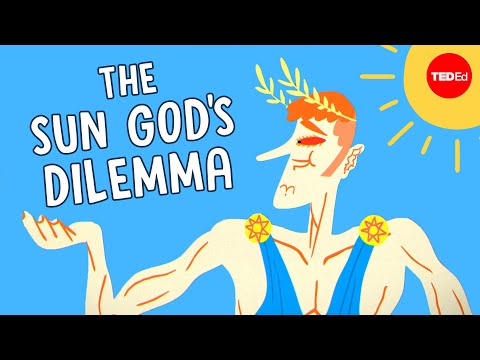
Imagine a man with a crown made of sunbeams driving a bright gold car through the clouds.
Word Web
Desafío
Try to use 'Helios' or a 'helio-' word in three different sentences today: one about history, one about science, and one poetic sentence.
Origen de la palabra
The word Helios originates from the Ancient Greek 'hēlios,' which means 'sun.' It is derived from the Proto-Indo-European root *sāwel-, which is the common ancestor for words meaning 'sun' across many Indo-European languages.
Significado original: The original meaning was simply the physical sun, which was later personified into a deity in Greek culture.
Indo-European > Hellenic > Greek.Contexto cultural
There are no major sensitivities, but when discussing religion, it is important to treat Helios as a historical deity of a past culture.
In English literature, Helios is often used to create a sense of 'epic' scale or to refer to the classical past.
Practica en la vida real
Contextos reales
Mythology Class
- The Titan Helios
- Chariot of the sun
- Son of Hyperion
- All-seeing deity
Astronomy
- Heliocentric model
- Solar wind in the heliosphere
- Helioseismic waves
- Solar spectrum
Literature
- The golden rays of Helios
- Under Helios's gaze
- The descent of the sun god
- Poetic personification
Renewable Energy
- Harnessing Helios
- Solar power innovation
- Project Helios
- Solar energy systems
History
- The Colossus of Rhodes
- Ancient sun worship
- Hellenic deities
- Sacred rituals
Inicios de conversación
"Did you know that the word 'helium' actually comes from the Greek god Helios?"
"If you could drive Helios's chariot for a day, where would you go?"
"Why do you think the ancient Greeks chose a chariot to represent the sun's movement?"
"Have you ever seen a statue or painting of Helios in a museum?"
"Do you prefer the mythological stories of Helios or the scientific facts about the sun?"
Temas para diario
Write a short story about what Helios sees as he drives his chariot over your city today.
Compare the idea of Helios as an 'all-seeing god' to modern technology like satellites.
How would our language be different if we didn't have the root 'helio-' from Helios?
Describe a sunrise as if you were an ancient Greek seeing Helios for the first time.
Reflect on why the sun is personified as a powerful man in so many different cultures.
Preguntas frecuentes
10 preguntasHelios is technically a Titan, belonging to the second generation of divine beings in Greek mythology. Titans are also gods, but they are older than the famous Olympian gods like Zeus and Hera. Helios is the son of the Titans Hyperion and Theia.
In early Greek mythology, they were completely separate. Helios was the sun itself, while Apollo was the god of music, healing, and prophecy. Over time, Apollo became associated with light and was eventually syncretized with Helios, but in the most famous myths like the 'Odyssey,' they are distinct.
Helium was first discovered by observing the sun's light during a solar eclipse. Because it was found in the sun (Helios) before it was found on Earth, scientists named it after the Greek sun god. This happened in 1868.
According to myth, Helios drives the chariot every single day. The most famous story involving the chariot is when his son Phaethon tried to drive it, lost control, and was struck down by Zeus to prevent the Earth from burning up.
His most famous center of worship was the island of Rhodes. The people of Rhodes considered him their patron deity and built the Colossus of Rhodes, a massive bronze statue, in his honor. It was one of the Seven Wonders of the Ancient World.
Helios has two sisters: Selene, who is the personification of the moon, and Eos, who is the personification of the dawn. Together, the three siblings represent the different stages of light in the sky.
Heliocentric comes from 'helio' (sun) and 'centric' (center). it refers to the astronomical model where the sun is at the center of the solar system and the planets revolve around it. This model replaced the geocentric (Earth-centered) model.
Yes, primarily as a root in scientific words like 'heliosphere' or 'heliotropism.' It is also a popular name for companies, space missions, and characters in fiction, keeping the ancient name alive in modern culture.
The Greeks believed that after Helios set in the West, he traveled back to the East by floating along the northern ocean in a giant golden cup or vessel. This allowed him to be ready to rise again the next morning.
The four horses that pull his chariot are often named Aethon (Blazing), Eous (Of the Dawn), Phlegon (Burning), and Pyrios (Fiery). These names all reflect the intense heat and light of the sun.
Ponte a prueba 180 preguntas
Describe the daily journey of Helios in your own words.
Well written! Good try! Check the sample answer below.
Explain the difference between the geocentric and heliocentric models.
Well written! Good try! Check the sample answer below.
Write a short poem about Helios rising over the mountains.
Well written! Good try! Check the sample answer below.
How does the myth of Phaethon serve as a warning?
Well written! Good try! Check the sample answer below.
Discuss the importance of Helios to the people of ancient Rhodes.
Well written! Good try! Check the sample answer below.
Analyze the etymological connection between Helios and Helium.
Well written! Good try! Check the sample answer below.
Compare Helios to another sun god from a different mythology.
Well written! Good try! Check the sample answer below.
Describe a modern use of the 'helio-' prefix in science.
Well written! Good try! Check the sample answer below.
Why was Helios called the 'all-seeing' god?
Well written! Good try! Check the sample answer below.
Write a dialogue between Helios and his sister Selene.
Well written! Good try! Check the sample answer below.
What role does Helios play in Homer's Odyssey?
Well written! Good try! Check the sample answer below.
Explain the concept of heliotropism in biology.
Well written! Good try! Check the sample answer below.
How did the iconography of Helios change over time?
Well written! Good try! Check the sample answer below.
Write a news report about the launch of a 'Helios' space probe.
Well written! Good try! Check the sample answer below.
Discuss the philosophical significance of the sun in Plato's works.
Well written! Good try! Check the sample answer below.
How would you explain Helios to a child?
Well written! Good try! Check the sample answer below.
What are the characteristics of Helios's horses?
Well written! Good try! Check the sample answer below.
Reflect on the power of solar metaphors in modern language.
Well written! Good try! Check the sample answer below.
Describe the appearance of Helios in ancient Greek art.
Well written! Good try! Check the sample answer below.
Why do we still use Greek roots like 'helio-' today?
Well written! Good try! Check the sample answer below.
Pronounce 'Helios' correctly three times.
Read this aloud:
Dijiste:
Speech recognition is not supported in your browser. Try Chrome or Edge.
Explain the myth of Helios to a partner.
Read this aloud:
Dijiste:
Speech recognition is not supported in your browser. Try Chrome or Edge.
Give a short presentation on the heliocentric model.
Read this aloud:
Dijiste:
Speech recognition is not supported in your browser. Try Chrome or Edge.
Discuss why Helios was important to ancient sailors.
Read this aloud:
Dijiste:
Speech recognition is not supported in your browser. Try Chrome or Edge.
Debate the merits of using mythological names for space missions.
Read this aloud:
Dijiste:
Speech recognition is not supported in your browser. Try Chrome or Edge.
Describe a sunrise using the name Helios.
Read this aloud:
Dijiste:
Speech recognition is not supported in your browser. Try Chrome or Edge.
Explain the meaning of 'heliotropism' without using notes.
Read this aloud:
Dijiste:
Speech recognition is not supported in your browser. Try Chrome or Edge.
Summarize the story of Phaethon in two minutes.
Read this aloud:
Dijiste:
Speech recognition is not supported in your browser. Try Chrome or Edge.
Discuss the influence of Helios on modern branding.
Read this aloud:
Dijiste:
Speech recognition is not supported in your browser. Try Chrome or Edge.
Analyze the symbolic meaning of Helios in a group discussion.
Read this aloud:
Dijiste:
Speech recognition is not supported in your browser. Try Chrome or Edge.
Practice using 'helio-' words in a sentence.
Read this aloud:
Dijiste:
Speech recognition is not supported in your browser. Try Chrome or Edge.
Talk about your favorite Greek god and mention Helios.
Read this aloud:
Dijiste:
Speech recognition is not supported in your browser. Try Chrome or Edge.
Explain how the sun was personified in ancient Greece.
Read this aloud:
Dijiste:
Speech recognition is not supported in your browser. Try Chrome or Edge.
Discuss the scientific discovery of Helium.
Read this aloud:
Dijiste:
Speech recognition is not supported in your browser. Try Chrome or Edge.
Role-play a tour guide at the Colossus of Rhodes.
Read this aloud:
Dijiste:
Speech recognition is not supported in your browser. Try Chrome or Edge.
Describe the horses of Helios with vivid adjectives.
Read this aloud:
Dijiste:
Speech recognition is not supported in your browser. Try Chrome or Edge.
Discuss the relationship between Helios, Selene, and Eos.
Read this aloud:
Dijiste:
Speech recognition is not supported in your browser. Try Chrome or Edge.
Explain the concept of the heliosphere to a non-scientist.
Read this aloud:
Dijiste:
Speech recognition is not supported in your browser. Try Chrome or Edge.
Give an impromptu speech on 'The All-Seeing Eye'.
Read this aloud:
Dijiste:
Speech recognition is not supported in your browser. Try Chrome or Edge.
Compare Helios and Apollo in a brief talk.
Read this aloud:
Dijiste:
Speech recognition is not supported in your browser. Try Chrome or Edge.
Listen to a podcast about Greek mythology and note every time Helios is mentioned.
Watch a video about the solar system and listen for 'heliocentric'.
Listen to a lecture on ancient art and identify descriptions of Helios.
Listen to a story about Phaethon and answer comprehension questions.
Identify the 'helio-' prefix in a list of spoken scientific terms.
Listen to a poem being read aloud and identify solar metaphors.
Watch a documentary clip on the Colossus of Rhodes.
Listen to a news report on solar energy and listen for brand names.
Listen to a discussion on the etymology of chemical elements.
Identify the stress pattern in 'Helios' from different speakers.
Listen to a summary of the Odyssey's 12th book.
Watch a short animation about the sun and the moon.
Listen for the word 'Titan' in a mythological context.
Listen to a talk on Neoplatonism and the sun.
Identify the names of the horses of Helios in a recording.
The helios is very bright today.
i read about helios in school.
/ 180 correct
Perfect score!
Summary
Helios represents the divine and physical power of the sun, serving as both a mythological figure and a scientific root. For example, the term 'heliocentric' directly uses his name to describe a sun-centered universe.
- Helios is the ancient Greek Titan who personifies the sun and drives a golden chariot across the sky daily.
- The name is a vital linguistic root for English scientific words like heliocentric, helium, and heliotropism.
- In mythology, he is the son of Hyperion and is known as the all-seeing witness of earthly events.
- Culturally, he is famously associated with the Colossus of Rhodes, one of the Seven Wonders of the Ancient World.
Learn the Root
If you learn that 'helio' means sun, you can easily understand words like 'heliotherapy' (sun healing) or 'heliograph' (sun writing/signaling).
Distinguish the Generations
Remember Helios is a Titan. This helps you understand his role as a more 'elemental' force compared to the more 'human-like' Olympian gods.
Capitalization Matters
Always capitalize Helios when referring to the person. This shows you understand it is a proper name and not just a common noun.
Use for Grandeur
Use 'Helios' instead of 'sun' when you want your writing to feel more epic, historical, or poetic. It changes the mood of the sentence.
Ejemplo
Helios rose from the ocean to begin his daily journey across the sky.
Contenido relacionado
Míralo en videos
Más palabras de Culture
creon
C2Creonte es el gobernante de Tebas en la mitología griega, un personaje central en las obras de Sófocles.
ethnic
B2Un miembro de un grupo étnico es una persona que pertenece a un grupo con tradiciones distintas.
wukong’s
B1La forma posesiva de Wukong, que se refiere a cosas que pertenecen al Rey Mono.
germanic
B2Relativo a la familia de lenguas que incluye el inglés y el alemán. Las tribus germánicas migraron por Europa.
hercules
C1Hércules es un héroe de la mitología romana célebre por su fuerza sobrehumana.
moroccan
A2Relativo a Marruecos, a su gente o a su cultura. Un marroquí es un ciudadano de Marruecos.
daedalus
B2Dédalo fue un legendario arquitecto e inventor griego que diseñó el Laberinto de Creta para el rey Minos.
oedipus’
C1Oedipus' es la forma posesiva del nombre Edipo, que se refiere a algo que le pertenece o está relacionado con él.
turkish
A1Relacionado con Turquía, su gente o su idioma.
imp
B2Un imp es un pequeño demonio o duende travieso en el folclore.

