greenland en 30 secondes
- Greenland is the world's largest island, located in the Arctic region and known for its massive ice sheet covering 80% of its landmass.
- Politically, it is an autonomous territory of Denmark, meaning it has its own government but remains part of the Danish Kingdom.
- The population is small and mostly Inuit, with a culture deeply tied to the sea, hunting, and the unique Arctic environment.
- It is a critical site for climate change research because its melting ice significantly impacts global sea levels and ocean currents.
Greenland, or Kalaallit Nunaat in the native Greenlandic language, is a massive island territory that serves as a focal point for geographical, environmental, and geopolitical discussions. When people use the word 'Greenland,' they are typically referring to the world's largest island that is not classified as a continent. Situated between the North Atlantic and Arctic Oceans, it is a land defined by its extremes. Geographically, it is part of the North American continent, but politically and historically, it has been deeply tied to Europe, specifically the Kingdom of Denmark. People use this term most frequently when discussing the Arctic environment, climate change, and the unique lifestyle of the Inuit people who have inhabited the land for centuries.
- Geographical Context
- In a geographical sense, Greenland is synonymous with the vast Greenland Ice Sheet, which covers approximately 80% of its surface. This ice sheet is the second largest in the world after Antarctica. When scientists or researchers mention Greenland, they are often highlighting its role as a 'canary in the coal mine' for global warming, as the melting of its glaciers has a direct and significant impact on global sea levels.
The expedition team spent three months traversing the rugged terrain of Greenland to study the movement of the Jakobshavn Glacier.
- Political Context
- Politically, Greenland is an autonomous territory. While it is part of the Kingdom of Denmark, it has its own domestic government and parliament. In international news, you might hear 'Greenland' mentioned in relation to sovereignty, mineral rights, or strategic military locations, such as Thule Air Base. The term is used to describe a nation in transition, moving toward greater independence while maintaining strong ties to the Danish Crown.
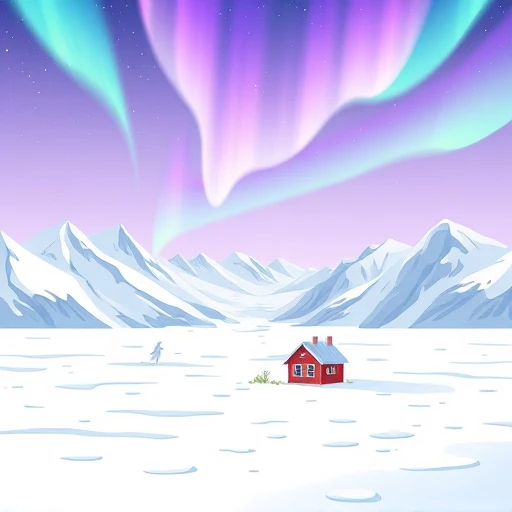
Culturally, the word Greenland evokes images of the Midnight Sun, the Northern Lights (Aurora Borealis), and traditional Inuit practices like dog sledding and kayaking. It is used by travelers to describe a destination of 'untouched' beauty and by anthropologists to discuss the resilience of Arctic cultures. The name itself, given by the Norse explorer Erik the Red, was arguably an early form of marketing, intended to lure settlers to a land that was mostly covered in ice by calling it 'Green' land.
Many tourists visit Greenland during the summer months to witness the spectacular icebergs in Disko Bay.
- Environmental Context
- In the context of ecology, Greenland represents a unique biome. It is home to polar bears, muskoxen, and various species of whales. When environmentalists use the word, they are often referring to the fragile balance of the Arctic ecosystem and the threat posed by industrial expansion and resource extraction in the region.
Scientists are monitoring the Greenland ice sheet closely to predict future sea-level rise.
The indigenous culture of Greenland is deeply connected to the sea and the ice.
Nuuk, the capital of Greenland, is one of the smallest capital cities in the world by population.
Using the word 'Greenland' correctly involves understanding its role as a proper noun and its specific grammatical nuances. Because it is the name of a specific place, it is always capitalized. Unlike some other geographical names (like 'the Netherlands' or 'the United Kingdom'), Greenland is typically used without a definite article ('the') when referring to the island or the territory as a whole. However, when referring to specific features of the island, the article is often necessary.
- General Reference
- When you are talking about the location in general, you simply use the name. For example: 'I am planning a trip to Greenland.' or 'Greenland has a very small population density.' You do not say 'the Greenland' unless you are using it as an adjective to modify another noun.
The political status of Greenland has evolved significantly over the last century.
- Adjectival Use
- Greenland can function as an adjective to describe things originating from or related to the island. In this case, you might use an article depending on the noun it modifies. For example: 'The Greenland shark is known for its incredible longevity.' or 'We studied the Greenland economy.' Note that 'Greenlandic' is the specific adjective for the people and the language.
In more complex sentences, Greenland often appears in prepositional phrases. You might say something is 'in Greenland,' 'across Greenland,' or 'off the coast of Greenland.' Because it is an island, 'in' is used for locations on the land, while 'on' is sometimes used when emphasizing the island status, though 'in' is much more common for the territory. For example: 'The largest national park in the world is located in Greenland.'
Researchers found ancient DNA preserved in the Greenland permafrost.
- Possessive Form
- The possessive form is 'Greenland's'. This is used to indicate ownership or association. For example: 'Greenland's capital, Nuuk, is home to about a third of the population.' or 'Greenland's history is marked by Norse and Inuit interactions.'
During the Cold War, Greenland held immense strategic value for the United States.
The flora of Greenland is limited to hardy species that can survive the tundra climate.
Few people realize that Greenland is technically part of the North American tectonic plate.
The word 'Greenland' is a staple in several specific domains of public and academic discourse. If you follow international news, scientific reports, or travel media, you will encounter this word frequently. Understanding these contexts helps in grasping the weight and implications the word carries in modern English.
- Climate Science and Environmental News
- This is perhaps the most common place to hear the word today. Headlines like 'Greenland's ice sheet is melting faster than expected' or 'New data from Greenland shows record temperatures' are frequent. In this context, Greenland is used as a primary indicator of the health of the global climate system. Scientists use it to discuss 'tipping points' and the 'albedo effect' (how the white ice reflects sunlight).
BBC News reported today on the unprecedented rate of glacial retreat in Greenland.
- Geopolitics and International Relations
- You will hear 'Greenland' in discussions about Arctic sovereignty. As the ice melts, new shipping lanes open up, and access to underwater minerals becomes easier. This makes Greenland a subject of interest for major powers like the US, China, and Russia. You might remember the 2019 news cycle when there was a high-profile (and controversial) suggestion that the United States might purchase Greenland from Denmark.
In the world of Travel and Adventure, Greenland is often described as the 'final frontier.' Travel vloggers and writers use the word to describe high-end expedition cruises, heli-skiing, and photography tours. Here, the word is associated with luxury, isolation, and the 'sublime'—a feeling of awe mixed with a touch of fear at the scale of nature. You'll hear it in phrases like 'the Greenlandic wilderness' or 'the fjords of Greenland.'
The documentary 'Chasing Ice' features stunning time-lapse footage of glaciers in Greenland.
- History and Archaeology
- In academic circles, Greenland is a major topic for historians studying the Norse expansion. You'll hear about the 'Greenland Vikings' and why their settlements eventually vanished in the 15th century. It is also a key site for paleo-climatologists who drill ice cores in Greenland to see what the Earth's atmosphere was like 100,000 years ago.
Archaeologists recently discovered a new Norse farmstead in Southern Greenland.
The Greenland summit was attended by representatives from all Arctic Council nations.
Listening to the radio, I heard a fascinating interview with a hunter from Northern Greenland.
Despite being a well-known geographical entity, Greenland is often the subject of several common misconceptions and linguistic errors. Addressing these can help you use the word more accurately and demonstrate a deeper understanding of the world.
- Confusing Greenland with Iceland
- This is the most frequent mistake. There is a common saying that 'Greenland is full of ice, and Iceland is very green.' While this is a simplification, it highlights the irony of their names. Many people mistakenly think Greenland is the smaller, greener island, when in fact it is the massive, ice-covered one. When writing or speaking, ensure you are attributing the correct characteristics to the correct island.
Incorrect: I want to see the volcanoes in Greenland. (Volcanoes are more characteristic of Iceland; Greenland is known for its ice sheet.)
- Misunderstanding Political Status
- Another common error is referring to Greenland as an independent country. While it has a high degree of self-rule, it is technically an autonomous territory within the Kingdom of Denmark. Using the term 'country' is often accepted in casual conversation, but in formal writing or political science, it is more accurate to call it a 'territory' or 'autonomous constituent country.'
Geographical misplacement is also common. Many people assume Greenland is near Europe because of its ties to Denmark. However, it is physically part of North America. When discussing 'North American geography,' many students forget to include Greenland, which is a significant omission given its size.
Correct: Greenland is the largest island in North America.
- Article Usage Errors
- As mentioned before, saying 'the Greenland' is a common mistake for non-native speakers. Unlike 'the UK' or 'the US,' Greenland does not take a definite article. You go to Greenland, you live in Greenland, and you study Greenland. The only time 'the' precedes it is when 'Greenland' is an adjective modifying a noun (e.g., 'the Greenland government').
Incorrect: He is a Greenlandic. Correct: He is a Greenlander. / He is Greenlandic.
Incorrect: I am going to the Greenland next week. Correct: I am going to Greenland next week.
Mistake: Thinking Greenland is a continent. It is an island.
While 'Greenland' is a specific proper noun, there are several words and phrases used in similar contexts or as alternatives when discussing Arctic geography, climate, and politics. Understanding these comparisons helps in building a more nuanced vocabulary for describing the polar regions.
- Greenland vs. Antarctica
- These two are often discussed together as the world's two major ice sheets. The key difference is that Antarctica is a continent at the South Pole, while Greenland is an island in the North Atlantic. Antarctica is much larger and colder, and unlike Greenland, it has no permanent human residents or indigenous population.
While Greenland has a population of over 50,000, Antarctica is inhabited only by rotating teams of scientists.
- Greenland vs. The Arctic
- 'The Arctic' is a broad regional term that includes the Arctic Ocean and parts of Canada, Russia, Alaska, Scandinavia, and Greenland. Greenland is a specific landmass *within* the Arctic. You might hear people use 'The Arctic' when they want to speak generally about the northern polar region, whereas 'Greenland' is used for specific territorial or geographical details.
Other related terms include Archipelago (though Greenland is one large island, it is surrounded by many smaller ones), Tundra (the biome found in Greenland's ice-free areas), and Cryosphere (the collective term for the Earth's frozen water, of which Greenland is a major part). When discussing the people, you might use 'Inuit' or 'Greenlanders' depending on whether you are referring to ethnicity or residency.
The Greenland ecosystem is remarkably different from the Siberian tundra despite both being Arctic environments.
- Greenland vs. Iceland
- As mentioned in common mistakes, these are frequently compared. Iceland is a sovereign nation with a much larger population, a milder climate due to the Gulf Stream, and a landscape dominated by volcanic activity rather than a continental ice sheet. Greenland is much larger, more isolated, and politically tied to Denmark.
Comparing the ice-core data from Greenland and the Vostok station in Antarctica reveals global climate patterns.
The word 'Kalaallit Nunaat' is used in the Greenland national anthem.
The Greenland Sea lies to the east of the island, separating it from Svalbard.
How Formal Is It?
Le savais-tu ?
Erik the Red allegedly gave the island this appealing name to encourage fellow Icelanders to settle there, despite the island being mostly ice. It is often cited as one of the first examples of 'false advertising' or marketing in history.
Guide de prononciation
- Pronouncing it as 'Green-LAND' with stress on the second syllable.
- Adding an extra 'e' sound in the middle.
- Pronouncing the 'a' in 'land' too clearly (it should be a reduced sound).
Niveau de difficulté
The word itself is easy to read, but texts about it often use complex scientific or political terms.
Simple to spell, but requires remembering not to use 'the'.
Pronunciation is straightforward for English learners.
Easily recognizable in speech.
Quoi apprendre ensuite
Prérequis
Apprends ensuite
Avancé
Grammaire à connaître
Proper Nouns for Countries and Islands
Greenland, Japan, and Madagascar do not take 'the'.
Possessive 's with Place Names
Greenland's ice sheet is famous.
Adjectives from Place Names
The Greenlandic language is beautiful.
Prepositions of Place (In vs. On)
We live in Greenland (territory) vs. We are on the island of Greenland.
Capitalization of Proper Nouns
Always capitalize Greenland.
Exemples par niveau
Greenland is a very big island.
Greenland est une très grande île.
Proper noun, no article.
It is cold in Greenland.
Il fait froid au Groenland.
Preposition 'in' used for location.
I see ice in Greenland.
Je vois de la glace au Groenland.
Simple subject-verb-object.
Greenland has many icebergs.
Le Groenland a beaucoup d'icebergs.
Third person singular verb 'has'.
People live in Greenland.
Des gens vivent au Groenland.
Plural subject 'people'.
Is Greenland near the North Pole?
Le Groenland est-il près du pôle Nord ?
Question form with 'is'.
Greenland is white and blue.
Le Groenland est blanc et bleu.
Adjectives describing the noun.
The dog lives in Greenland.
Le chien vit au Groenland.
Definite article for the dog, none for Greenland.
Greenland is the largest island in the world.
Le Groenland est la plus grande île du monde.
Superlative 'the largest'.
Most of Greenland is covered in ice.
La majeure partie du Groenland est couverte de glace.
Passive voice 'is covered'.
The capital of Greenland is Nuuk.
La capitale du Groenland est Nuuk.
Genitive 'of' construction.
Greenland is part of the Kingdom of Denmark.
Le Groenland fait partie du Royaume du Danemark.
Proper noun phrase.
You can see the Northern Lights in Greenland.
On peut voir les aurores boréales au Groenland.
Modal verb 'can'.
Greenland has a very small population.
Le Groenland a une population très faible.
Adjective 'small' modifying 'population'.
Inuit people have lived in Greenland for a long time.
Les Inuits vivent au Groenland depuis longtemps.
Present perfect tense.
Greenland is a great place for adventure.
Le Groenland est un endroit idéal pour l'aventure.
Noun phrase 'place for adventure'.
Greenland is an autonomous territory with its own government.
Le Groenland est un territoire autonome avec son propre gouvernement.
Adjective 'autonomous' modifying 'territory'.
The melting ice in Greenland affects the whole world.
La fonte des glaces au Groenland affecte le monde entier.
Present simple for a general fact.
Greenland's economy depends mostly on fishing.
L'économie du Groenland dépend principalement de la pêche.
Possessive 's.
Many scientists travel to Greenland to study the climate.
De nombreux scientifiques se rendent au Groenland pour étudier le climat.
Infinitive of purpose 'to study'.
Greenland was first settled by the Norse over a thousand years ago.
Le Groenland a été colonisé pour la première fois par les Scandinaves il y a plus de mille ans.
Past passive voice.
The official language of Greenland is Greenlandic.
La langue officielle du Groenland est le groenlandais.
Adjective 'official' and proper noun 'Greenlandic'.
Tourism in Greenland is growing every year.
Le tourisme au Groenland se développe chaque année.
Present continuous for a trend.
Greenland is located between the Arctic and Atlantic Oceans.
Le Groenland est situé entre les océans Arctique et Atlantique.
Prepositional phrase 'between... and'.
Greenland's strategic location makes it important for international security.
La situation stratégique du Groenland le rend important pour la sécurité internationale.
Complex subject with possessive.
The Greenland Ice Sheet contains enough water to raise sea levels significantly.
L'inlandsis du Groenland contient assez d'eau pour faire monter le niveau de la mer de manière significative.
Adverb 'significantly' modifying 'raise'.
Despite its name, Greenland is mostly covered by a thick layer of ice.
Malgré son nom, le Groenland est principalement recouvert d'une épaisse couche de glace.
Concession clause starting with 'Despite'.
Greenland has been moving toward greater independence from Denmark.
Le Groenland s'oriente vers une plus grande indépendance vis-à-vis du Danemark.
Present perfect continuous.
The unique flora and fauna of Greenland are adapted to extreme cold.
La flore et la faune uniques du Groenland sont adaptées au froid extrême.
Compound subject with plural verb 'are'.
Climate change is causing the Greenland glaciers to retreat rapidly.
Le changement climatique provoque le recul rapide des glaciers du Groenland.
Causative structure 'causing... to retreat'.
Greenland's history is a fascinating mix of Inuit and European cultures.
L'histoire du Groenland est un mélange fascinant de cultures inuite et européenne.
Noun phrase as a complement.
Mineral exploration in Greenland could change its economic future.
L'exploration minière au Groenland pourrait changer son avenir économique.
Modal 'could' for possibility.
The geopolitical significance of Greenland has increased due to melting Arctic ice.
L'importance géopolitique du Groenland a augmenté en raison de la fonte des glaces de l'Arctique.
Abstract noun phrase as subject.
Greenland's self-government act of 2009 granted it more control over its resources.
La loi sur l'autonomie du Groenland de 2009 lui a accordé plus de contrôle sur ses ressources.
Specific historical reference.
The cultural identity of Greenland is deeply rooted in the relationship with the sea.
L'identité culturelle du Groenland est profondément enracinée dans la relation avec la mer.
Metaphorical language 'deeply rooted'.
Greenland serves as a critical laboratory for understanding global warming.
Le Groenland sert de laboratoire critique pour comprendre le réchauffement climatique.
Metaphorical use of 'laboratory'.
The withdrawal of Greenland from the EEC in 1985 was a landmark political event.
Le retrait du Groenland de la CEE en 1985 a été un événement politique marquant.
Nominalization 'The withdrawal'.
Greenlandic society faces the challenge of balancing tradition with modernization.
La société groenlandaise est confrontée au défi de concilier tradition et modernisation.
Gerund phrase 'balancing... with'.
The vastness of Greenland is difficult to comprehend without seeing it firsthand.
L'immensité du Groenland est difficile à comprendre sans le voir de ses propres yeux.
Infinitive as adjective complement.
Greenland's ice cores provide a historical record of the Earth's atmosphere.
Les carottes de glace du Groenland fournissent un enregistrement historique de l'atmosphère terrestre.
Technical scientific terminology.
The potential for full sovereignty remains a central theme in Greenlandic political discourse.
Le potentiel d'une pleine souveraineté reste un thème central du discours politique groenlandais.
Advanced political vocabulary.
Greenland's cryosphere is integral to the regulation of the global climate system.
La cryosphère du Groenland fait partie intégrante de la régulation du système climatique mondial.
Scientific precision 'cryosphere'.
The narrative of Greenland as a 'pristine wilderness' often overlooks its complex colonial history.
Le récit du Groenland comme une « nature vierge » ignore souvent son histoire coloniale complexe.
Critical analysis of a 'narrative'.
Greenland's fiscal autonomy is constrained by its continued reliance on Danish block grants.
L'autonomie fiscale du Groenland est limitée par sa dépendance continue aux subventions globales danoises.
Passive voice with 'constrained by'.
The linguistic revitalization of Greenlandic is a cornerstone of the nation-building process.
La revitalisation linguistique du groenlandais est une pierre angulaire du processus de construction nationale.
Metaphor 'cornerstone'.
Greenland's subglacial topography was recently mapped using advanced radar technology.
La topographie sous-glaciaire du Groenland a été récemment cartographiée à l'aide d'une technologie radar avancée.
Technical compound 'subglacial'.
The socio-economic disparities in Greenland are often exacerbated by its extreme geography.
Les disparités socio-économiques au Groenland sont souvent exacerbées par sa géographie extrême.
Advanced verb 'exacerbated'.
Greenland's role in the Arctic Council is pivotal for addressing regional environmental concerns.
Le rôle du Groenland au sein du Conseil de l'Arctique est essentiel pour aborder les préoccupations environnementales régionales.
Adjective 'pivotal' for importance.
Collocations courantes
Phrases Courantes
— In the waters near the island. Used in maritime and scientific contexts.
A new species of fish was found off the coast of Greenland.
— Far into the interior of the island, usually on the ice sheet.
Scientists are drilling deep in Greenland to find ancient ice.
— Moving from one side of the island to the other.
The explorers traveled across Greenland on skis.
— The central or most important part of the island.
Nuuk is considered the heart of Greenland's political life.
— The large, uninhabited areas of the island.
Greenland's vast wilderness is home to the muskox.
— The traditional and modern lifestyle of the people living there.
Hunting is still central to the Greenlandic way of life.
— A common phrase in climate change discussions.
Greenland's melting glaciers are a sign of a warming planet.
— Traveling to the island for tourism or work.
A trip to Greenland requires careful planning and warm clothes.
— The legislative body of the territory.
The Greenlandic parliament is called the Inatsisartut.
— The value of the island's location for military or trade reasons.
The US has long recognized Greenland's strategic importance.
Souvent confondu avec
Iceland is a separate country, smaller, and has more volcanic activity and less ice.
Antarctica is a continent at the South Pole, while Greenland is an island in the North.
The Arctic is a whole region; Greenland is just one part of it.
Expressions idiomatiques
— Extremely cold. Used to describe weather or a person's demeanor.
The reception I got at the office was as cold as Greenland.
Informal— Sometimes used metaphorically for something very old and preserved.
That old car is preserved like Greenland ice.
Informal— A very short or non-existent summer.
We had a Greenland summer this year; it rained every day.
Informal— Metaphorically, to be in a very remote or isolated place.
Living in that small village felt like being in Greenland.
Informal— Often refers to the fish or minerals that provide wealth to the island.
Halibut is often called Greenland's gold.
Journalistic— In climate science, the specific impact of Greenland's melting on the world.
The Greenland effect is a major concern for coastal cities.
Scientific— To be very tough, resilient, and hardworking.
He worked through the storm like a Greenland husky.
Informal— The influence or presence of the island in Arctic politics.
The meeting was held under Greenland's shadow.
Literary— A reference to a highly unlikely or audacious geopolitical purchase.
You can't just buy Greenland; it's not for sale.
Political/Sarcastic— A specific shade of pure, blinding white.
The new museum was painted a brilliant Greenland white.
DescriptiveFacile à confondre
People use it for both the person and the language.
Greenlandic is the adjective and language; Greenlander is the noun for the person.
He speaks Greenlandic and is a Greenlander.
Often used interchangeably with 'ice sheet'.
A glacier is a river of ice; an ice sheet is a massive continental-scale cover of ice.
The Greenland Ice Sheet contains many individual glaciers.
Confused with glaciers.
Icebergs are chunks of ice that have broken off and are floating in the sea.
We saw a massive iceberg floating off the Greenland coast.
Used to describe the whole island.
Tundra is the specific treeless biome found in the ice-free parts of Greenland.
The Greenland tundra is beautiful in the summer.
Confused with 'Independent'.
Autonomous means having self-rule within a larger state; independent means being a separate state.
Greenland is autonomous but not yet fully independent.
Structures de phrases
[Subject] is [Adjective] in Greenland.
It is cold in Greenland.
Greenland is the [Superlative] [Noun].
Greenland is the largest island.
Greenland is known for [Noun/Gerund].
Greenland is known for its vast ice sheet.
The [Noun] of Greenland is [Adjective].
The political status of Greenland is complex.
Greenland serves as a [Noun] for [Gerund/Noun].
Greenland serves as a laboratory for studying climate change.
Greenland's [Abstract Noun] is [Verb] by [Noun].
Greenland's sovereignty is constrained by economic factors.
If you go to Greenland, you will [Verb].
If you go to Greenland, you will see amazing icebergs.
Despite [Noun], Greenland remains [Adjective].
Despite the cold, Greenland remains a popular destination for adventurers.
Famille de mots
Noms
Adjectifs
Apparenté
Comment l'utiliser
High in scientific and geographical contexts; moderate in general conversation.
-
The Greenland is very cold.
→
Greenland is very cold.
Proper nouns for islands and countries usually don't take the definite article.
-
He is a Greenlandic.
→
He is a Greenlander.
Greenlandic is an adjective or a language name, not a noun for a person.
-
Greenland is an independent country.
→
Greenland is an autonomous territory of Denmark.
It's important to be accurate about its political status in formal contexts.
-
I want to see the volcanoes in Greenland.
→
I want to see the glaciers in Greenland.
Greenland is famous for ice; Iceland is famous for volcanoes.
-
Greenland is in Europe.
→
Greenland is in North America.
Geographically, it belongs to the North American continent.
Astuces
No 'The'
Remember that Greenland is a proper noun like France or Italy. You don't say 'the Greenland' unless you are using it as an adjective.
Greenlandic vs. Greenlander
Use 'Greenlandic' for the language or as an adjective (Greenlandic food). Use 'Greenlander' for the person.
Continent vs. Island
Greenland is the largest island, but Australia is the smallest continent. This is a common point of confusion in geography.
Double 'e'
Always spell it with a double 'e' like the color green. It's 'Green' + 'land'.
Native Name
Knowing the name 'Kalaallit Nunaat' shows you have a deeper respect for the local culture.
Ice Sheet vs. Glacier
When talking about Greenland's ice, 'Ice Sheet' refers to the whole mass, while 'Glacier' refers to specific 'rivers' of ice.
Stress the Green
Put the emphasis on the first part of the word: GREEN-land.
News Keyword
If you see 'Greenland' in a headline, it's almost certainly about climate change or Arctic politics.
Nuuk
Remember that Nuuk is the capital. It's a useful word to know when discussing the territory.
Erik the Red
Associating the name with Erik the Red helps you remember the 'Green' part of the name.
Mémorise-le
Moyen mnémotechnique
Remember: Greenland is ICE, and Iceland is GREEN. To remember the name, think of the 'Green' lie Erik the Red told to get people to move there.
Association visuelle
Imagine a giant white triangle (the island) floating in a blue ocean, with a tiny green dot on the edge representing the name.
Word Web
Défi
Try to write three sentences about Greenland without using the word 'cold' or 'ice'. Focus on its politics, people, or size.
Origine du mot
The name 'Greenland' comes from the Old Norse 'Grœnland'. It was named by the Norse explorer Erik the Red in the late 10th century.
Sens originel : Literally 'Green Land'.
Germanic (Old Norse).Contexte culturel
When discussing Greenland, it is respectful to acknowledge its Inuit heritage and the preference for the native name 'Kalaallit Nunaat' in formal contexts. Avoid colonial stereotypes about 'Eskimos'.
In the English-speaking world, Greenland is often viewed through the lens of environmentalism and adventure travel.
Pratique dans la vie réelle
Contextes réels
Geography Class
- Where is Greenland located?
- Is Greenland a continent?
- The size of Greenland
- Greenland's borders
Climate Change Discussion
- Greenland's melting ice
- Sea level rise from Greenland
- Arctic warming in Greenland
- Glacial retreat in Greenland
Travel Planning
- Flights to Greenland
- Best time to visit Greenland
- Hiking in Greenland
- Nuuk, Greenland
History Lesson
- Viking settlements in Greenland
- Erik the Red and Greenland
- Inuit history in Greenland
- Danish colonization of Greenland
Political News
- Greenland's autonomy
- The Greenlandic government
- Greenland and Denmark
- Strategic value of Greenland
Amorces de conversation
"Have you ever seen photos of the massive icebergs in Greenland?"
"Did you know that Greenland is actually part of North America geographically?"
"Would you ever consider going on an expedition to Greenland?"
"What do you think about the impact of Greenland's melting ice on the world?"
"How do you think the name 'Greenland' affected people's perception of the island?"
Sujets d'écriture
Imagine you are an explorer arriving in Greenland for the first time. Describe what you see and feel.
Write about the irony of the names Greenland and Iceland. Why do you think names are so powerful?
If you lived in Nuuk, Greenland, how would your daily life be different from your life now?
Discuss the importance of protecting Greenland's environment in the face of global warming.
Research a piece of Greenlandic culture and write about why it is unique and important.
Questions fréquentes
10 questionsGreenland is an autonomous territory within the Kingdom of Denmark. It has its own government and parliament but is not a fully independent sovereign state. It is often called a 'constituent country' within the Danish Realm.
The name was given by Erik the Red, a Norse explorer. He wanted to attract settlers from Iceland, so he chose an appealing name. While some coastal areas are green in summer, the name was largely a marketing tactic.
Yes, over 56,000 people live in Greenland throughout the year. Most live in towns and villages along the ice-free coastline, with the largest population in the capital, Nuuk.
The official language is Greenlandic (Kalaallisut). Many people also speak Danish, and English is increasingly common, especially among younger generations and in the tourism industry.
Geographically, Greenland is part of the North American continent. However, politically and culturally, it has been associated with Europe (specifically Scandinavia) for over a thousand years.
No, there are no roads connecting the towns in Greenland. People travel between locations by boat, helicopter, plane, or dog sled in the winter.
Fishing is the most important industry, accounting for the vast majority of Greenland's exports. Shrimp and halibut are the primary catches. Tourism and mining are also growing sectors.
Greenland is about 2.16 million square kilometers. It is about three times the size of Texas or slightly smaller than the country of Algeria. It is the largest island in the world.
Greenland does not have its own military. Its defense is the responsibility of the Danish Armed Forces, specifically the Joint Arctic Command.
No, Greenland experiences the 'Midnight Sun' in the summer, where the sun doesn't set for weeks, and the 'Polar Night' in the winter, where the sun doesn't rise. The duration depends on how far north you are.
Teste-toi 200 questions
Write a short paragraph describing the geography of Greenland.
Well written! Good try! Check the sample answer below.
Explain why Erik the Red named the island 'Greenland'.
Well written! Good try! Check the sample answer below.
Compare Greenland and Iceland in three sentences.
Well written! Good try! Check the sample answer below.
Discuss the impact of melting ice in Greenland on global sea levels.
Well written! Good try! Check the sample answer below.
Describe the relationship between Greenland and Denmark.
Well written! Good try! Check the sample answer below.
Write a postcard from Nuuk to a friend.
Well written! Good try! Check the sample answer below.
What are the challenges of living in a place like Greenland?
Well written! Good try! Check the sample answer below.
Describe the traditional Inuit culture of Greenland.
Well written! Good try! Check the sample answer below.
How has tourism changed Greenland in recent years?
Well written! Good try! Check the sample answer below.
Explain the importance of the Greenland shark in Arctic biology.
Well written! Good try! Check the sample answer below.
Write a formal letter requesting information about mineral rights in Greenland.
Well written! Good try! Check the sample answer below.
Discuss the pros and cons of Greenland becoming a fully independent nation.
Well written! Good try! Check the sample answer below.
Describe the experience of seeing the Northern Lights in Greenland.
Well written! Good try! Check the sample answer below.
How does the 'Midnight Sun' affect daily life in Greenland?
Well written! Good try! Check the sample answer below.
Write a summary of Greenland's history from the Vikings to today.
Well written! Good try! Check the sample answer below.
What role does Greenland play in the Arctic Council?
Well written! Good try! Check the sample answer below.
Describe the flora and fauna of the Greenlandic tundra.
Well written! Good try! Check the sample answer below.
Explain the significance of the native name 'Kalaallit Nunaat'.
Well written! Good try! Check the sample answer below.
Write a creative story about a sled dog in Greenland.
Well written! Good try! Check the sample answer below.
Discuss the ethical considerations of mining in Greenland's pristine environment.
Well written! Good try! Check the sample answer below.
Describe Greenland to someone who has never heard of it.
Read this aloud:
Tu as dit :
Speech recognition is not supported in your browser. Try Chrome or Edge.
Discuss whether you would like to visit Greenland and why.
Read this aloud:
Tu as dit :
Speech recognition is not supported in your browser. Try Chrome or Edge.
Explain the difference between Greenland and Iceland.
Read this aloud:
Tu as dit :
Speech recognition is not supported in your browser. Try Chrome or Edge.
Give a short presentation on the impact of climate change on Greenland.
Read this aloud:
Tu as dit :
Speech recognition is not supported in your browser. Try Chrome or Edge.
Debate the pros and cons of increased mining in Greenland.
Read this aloud:
Tu as dit :
Speech recognition is not supported in your browser. Try Chrome or Edge.
Role-play a conversation between a tourist and a Greenlandic guide.
Read this aloud:
Tu as dit :
Speech recognition is not supported in your browser. Try Chrome or Edge.
Talk about the strategic importance of Greenland in the 21st century.
Read this aloud:
Tu as dit :
Speech recognition is not supported in your browser. Try Chrome or Edge.
Describe the traditional Inuit way of life in Greenland.
Read this aloud:
Tu as dit :
Speech recognition is not supported in your browser. Try Chrome or Edge.
Discuss the challenges of modernizing a remote society like Greenland.
Read this aloud:
Tu as dit :
Speech recognition is not supported in your browser. Try Chrome or Edge.
Explain the concept of 'Home Rule' in the context of Greenland.
Read this aloud:
Tu as dit :
Speech recognition is not supported in your browser. Try Chrome or Edge.
Tell a story about an imaginary expedition across the Greenland Ice Sheet.
Read this aloud:
Tu as dit :
Speech recognition is not supported in your browser. Try Chrome or Edge.
Discuss the importance of preserving the Greenlandic language.
Read this aloud:
Tu as dit :
Speech recognition is not supported in your browser. Try Chrome or Edge.
Talk about the wildlife of Greenland and why it is under threat.
Read this aloud:
Tu as dit :
Speech recognition is not supported in your browser. Try Chrome or Edge.
Describe the appearance of an iceberg and how it forms.
Read this aloud:
Tu as dit :
Speech recognition is not supported in your browser. Try Chrome or Edge.
Discuss the cultural significance of dog sledding in Greenland.
Read this aloud:
Tu as dit :
Speech recognition is not supported in your browser. Try Chrome or Edge.
Explain why Greenland is geographically part of North America but politically European.
Read this aloud:
Tu as dit :
Speech recognition is not supported in your browser. Try Chrome or Edge.
Talk about the capital city, Nuuk, and its features.
Read this aloud:
Tu as dit :
Speech recognition is not supported in your browser. Try Chrome or Edge.
Discuss the potential for renewable energy in Greenland.
Read this aloud:
Tu as dit :
Speech recognition is not supported in your browser. Try Chrome or Edge.
Explain the 'Midnight Sun' phenomenon to a child.
Read this aloud:
Tu as dit :
Speech recognition is not supported in your browser. Try Chrome or Edge.
Summarize the main points of the Greenland-Denmark relationship.
Read this aloud:
Tu as dit :
Speech recognition is not supported in your browser. Try Chrome or Edge.
Listen to a description of Greenland and identify the three main colors mentioned.
Listen to a weather report for Nuuk and note the high and low temperatures.
Listen to a short history of Erik the Red and identify the year he arrived in Greenland.
Listen to an interview with a scientist and explain what 'ice calving' is.
Listen to a news clip about Greenlandic independence and identify the speaker's main concern.
Listen to a traditional Greenlandic drum song and describe the rhythm.
Listen to a travel guide describing Ilulissat and list two landmarks.
Listen to a discussion on Arctic geopolitics and note Greenland's strategic value.
Listen to a story about a husky and identify the dog's name.
Listen to a lecture on the Greenland shark and note its maximum age.
Listen to a podcast about Inuit mythology and identify the 'Mother of the Sea'.
Listen to a report on Greenland's economy and identify the main export.
Listen to a description of the Northern Lights and identify the colors mentioned.
Listen to a debate about mining in Greenland and summarize both sides.
Listen to a guide on how to pronounce 'Kalaallit Nunaat' and repeat it.
/ 200 correct
Perfect score!
Summary
Greenland is a massive, ice-covered autonomous territory of Denmark in the Arctic, serving as a vital indicator for global climate change and a home to a resilient Inuit culture. Example: 'Greenland's ice sheet is a major focus for environmental scientists.'
- Greenland is the world's largest island, located in the Arctic region and known for its massive ice sheet covering 80% of its landmass.
- Politically, it is an autonomous territory of Denmark, meaning it has its own government but remains part of the Danish Kingdom.
- The population is small and mostly Inuit, with a culture deeply tied to the sea, hunting, and the unique Arctic environment.
- It is a critical site for climate change research because its melting ice significantly impacts global sea levels and ocean currents.
No 'The'
Remember that Greenland is a proper noun like France or Italy. You don't say 'the Greenland' unless you are using it as an adjective.
Greenlandic vs. Greenlander
Use 'Greenlandic' for the language or as an adjective (Greenlandic food). Use 'Greenlander' for the person.
Continent vs. Island
Greenland is the largest island, but Australia is the smallest continent. This is a common point of confusion in geography.
Double 'e'
Always spell it with a double 'e' like the color green. It's 'Green' + 'land'.