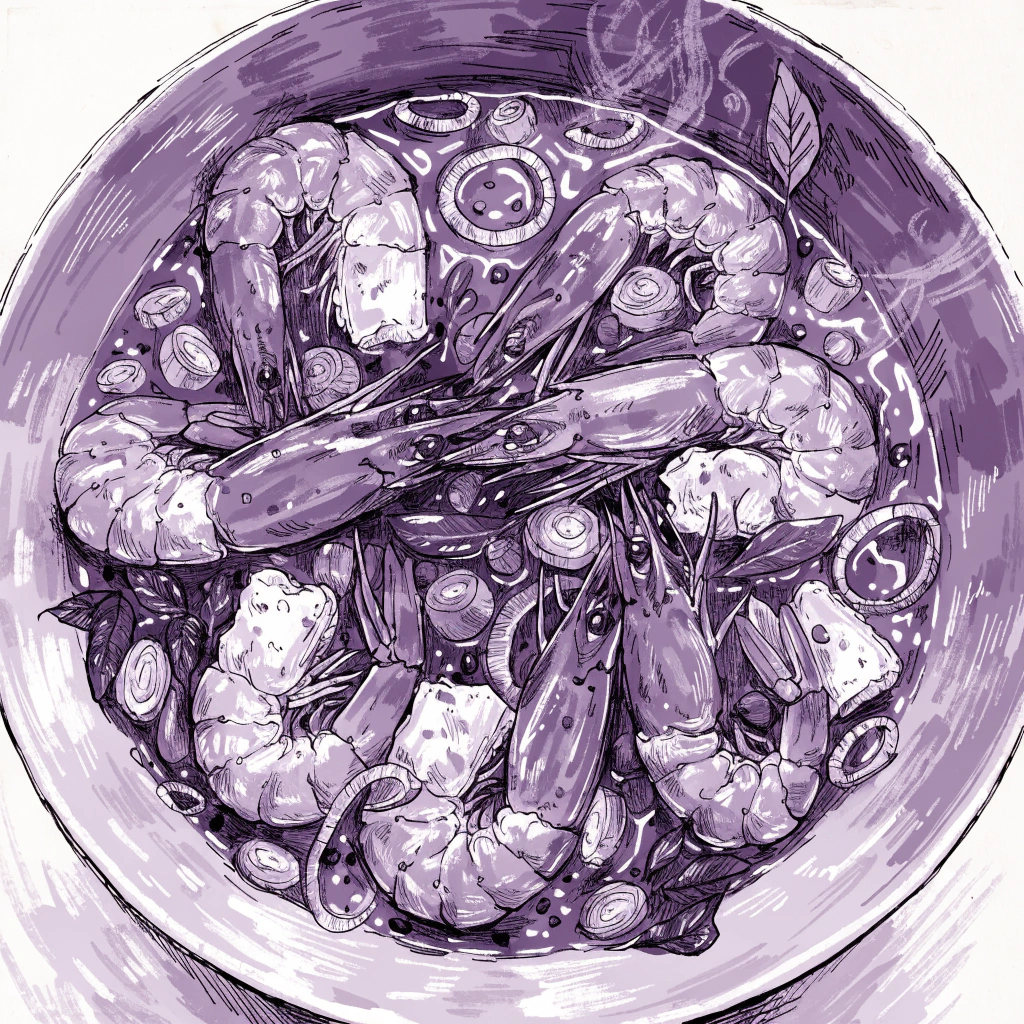
A Famous Thai Soup
Thailand is a beautiful country. It has many delicious foods. One famous food is Tom Yum Goong. This is a special soup. People in Thailand love it very much.
The soup has many fresh things. It has big shrimp. It also has many herbs. These herbs make the soup smell good. The soup is spicy and sour. It is very healthy.
You can eat this soup with white rice. Many people eat it for lunch or dinner. It is a very popular dish. It is the king of Thai food.
व्याकरण स्पॉटलाइट
पैटर्न: Present Simple 'To Be'
"Thailand is a beautiful country."
We use 'is' for singular subjects like 'Thailand'. It is used to describe facts and states.
पैटर्न: Present Simple (Plural Subjects)
"Many people eat it for lunch."
With plural subjects like 'people', we use the base form of the verb 'eat'. We use this for habits or regular actions.
अपनी समझ जाँचें
10 सवाल · A1 शुरुआती · 1 मुफ्त प्रीव्यू
इस लेख से आपने जो सीखा उसकी जाँच करें। सभी सवालों के जवाब दें और XP कमाएँ!
What is Tom Yum Goong?
क्या आप क्विज़ समाप्त करना चाहते हैं?
9 और सवाल आपका इंतज़ार कर रहे हैं। पूरा क्विज़ अनलॉक करने और XP कमाने के लिए मुफ्त साइन अप करें!
मुफ़्त साइन अप करोपहले से अकाउंट है? साइन इन करो
बहुत बढ़िया!
अभ्यास जारी रखें!
पहले से पूर्ण — कोई अतिरिक्त XP नहीं
XP कमाने के लिए साइन अप करोसवालों का विवरण
What is Tom Yum Goong?
आपका जवाब:
सही जवाब: A famous soup
Tom Yum Goong is from Thailand.
आपका जवाब:
सही जवाब: सही
What does 'spicy' mean?
आपका जवाब:
सही जवाब: A hot taste
The soup has big _____.
आपका जवाब:
सही जवाब: shrimp
Tom Yum Goong: The Famous Soup of Thailand
Tom Yum Goong is the most famous soup in Thailand. It is a special dish because it has a strong spicy and sour taste. Thai people love this soup because the ingredients are very fresh and healthy.
Many years ago, people lived near the big rivers in Central Thailand. There were many large prawns in the water. People caught the prawns and boiled them with local herbs. They used lemongrass and lime to make the soup smell good. It was a simple meal, but it became a very important part of Thai culture.
The name "Tom Yum" means "boiled and mixed," and "Goong" means "shrimp." Today, Tom Yum Goong is more famous than other Thai dishes. You can find it in small street markets or expensive restaurants. Many tourists visit Thailand because they want to taste this delicious soup. It is a great meal to share with friends and family.
व्याकरण स्पॉटलाइट
पैटर्न: Comparatives (more + adjective + than)
"Today, Tom Yum Goong is more famous than other Thai dishes."
We use 'more' with long adjectives like 'famous' to compare two things. This pattern shows that one thing has a higher quality than the other.
पैटर्न: Conjunction 'because'
"Many tourists visit Thailand because they want to taste this delicious soup."
We use 'because' to give a reason for something. It connects an action with the reason why it happens.
अपनी समझ जाँचें
11 सवाल · A2 बिगिनर · 1 मुफ्त प्रीव्यू
इस लेख से आपने जो सीखा उसकी जाँच करें। सभी सवालों के जवाब दें और XP कमाएँ!
Where did people find the prawns for the soup in the past?
क्या आप क्विज़ समाप्त करना चाहते हैं?
10 और सवाल आपका इंतज़ार कर रहे हैं। पूरा क्विज़ अनलॉक करने और XP कमाने के लिए मुफ्त साइन अप करें!
मुफ़्त साइन अप करोपहले से अकाउंट है? साइन इन करो
बहुत बढ़िया!
अभ्यास जारी रखें!
पहले से पूर्ण — कोई अतिरिक्त XP नहीं
XP कमाने के लिए साइन अप करोसवालों का विवरण
Where did people find the prawns for the soup in the past?
आपका जवाब:
सही जवाब: In the big rivers
Tom Yum Goong is a sweet and salty soup.
आपका जवाब:
सही जवाब: गलत
What does the word 'Goong' mean?
आपका जवाब:
सही जवाब: Shrimp
Tom Yum Goong is the most _____ soup in Thailand.
आपका जवाब:
सही जवाब: famous
Why do people like this soup according to the text?
आपका जवाब:
सही जवाब: The ingredients are fresh and healthy
Tom Yum Goong: The Heart of Thai Cuisine
Tom Yum Goong is a famous soup from Thailand that has become popular all over the world. It is a dish which perfectly represents the 'spicy and sour' flavors of Thai cuisine. The name is quite simple: 'Tom Yum' refers to the boiling and mixing process, while 'Goong' means shrimp. For many people, it is the first dish they try when they visit the country.
Historically, this delicious soup was developed in the river basins of Central Thailand. In these areas, freshwater prawns have been caught by local people for centuries because they are so abundant in the water. The soup was originally created as a clear broth that uses many healthy herbs. These ingredients, such as lemongrass, lime leaves, and galangal, are used to create a strong and aromatic smell that stimulates the appetite.
The soup is prepared by boiling these aromatic herbs in water before adding the fresh shrimp and fish sauce. In many modern restaurants, a small amount of coconut milk or evaporated milk is added to make a creamy variation. This version is often preferred by international tourists who might find the spice level a bit high. On the other hand, the clear version is known for being very spicy, sharp, and healthy.
Tom Yum Goong has been recognized as a national symbol of Thailand. It is served in almost every Thai restaurant, from simple street stalls to prestigious hotels. Because it is both delicious and medicinal, it has been enjoyed by millions of people who want to experience the true taste of Thailand. It has even been nominated for UNESCO heritage status because it is so important to Thai culture.
व्याकरण स्पॉटलाइट
पैटर्न: Relative Clauses
"It is a dish which perfectly represents the 'spicy and sour' flavors of Thai cuisine."
A relative clause uses 'which' or 'that' to provide more information about a noun. It helps combine two simple sentences into one complex sentence.
पैटर्न: Passive Voice
"The soup is prepared by boiling these aromatic herbs in water before adding the fresh shrimp."
The passive voice is used when the action is more important than the person doing it. It is formed using the verb 'to be' followed by the past participle.
अपनी समझ जाँचें
11 सवाल · B1 मध्यम · 1 मुफ्त प्रीव्यू
इस लेख से आपने जो सीखा उसकी जाँच करें। सभी सवालों के जवाब दें और XP कमाएँ!
What does the word 'Goong' mean in the name of the dish?
क्या आप क्विज़ समाप्त करना चाहते हैं?
10 और सवाल आपका इंतज़ार कर रहे हैं। पूरा क्विज़ अनलॉक करने और XP कमाने के लिए मुफ्त साइन अप करें!
मुफ़्त साइन अप करोपहले से अकाउंट है? साइन इन करो
बहुत बढ़िया!
अभ्यास जारी रखें!
पहले से पूर्ण — कोई अतिरिक्त XP नहीं
XP कमाने के लिए साइन अप करोसवालों का विवरण
What does the word 'Goong' mean in the name of the dish?
आपका जवाब:
सही जवाब: Shrimp
The soup was originally created as a creamy broth with coconut milk.
आपका जवाब:
सही जवाब: गलत
What does 'aromatic' mean?
आपका जवाब:
सही जवाब: Having a pleasant smell
Tom Yum Goong has been recognized as a national _____ of Thailand.
आपका जवाब:
सही जवाब: symbol
Where did this soup historically develop?
आपका जवाब:
सही जवाब: In the river basins of Central Thailand
The Culinary Alchemy of Tom Yum Goong: A Symbol of Thai Identity
Tom Yum Goong is widely regarded as the quintessential Thai dish, embodying the sophisticated 'spicy and sour' flavor profile that defines the nation's culinary palate. While there are numerous variations of 'Tom Yum'—a term that literally translates to 'boiled' and 'mixed'—the version featuring 'Goong', or shrimp, is considered the most prestigious. This iconic soup represents a delicate balance of five distinct tastes: spicy, sour, salty, sweet, and bitter, creating a harmonious experience that has been captivating food enthusiasts globally for decades.
Historically, the dish evolved along the lush river basins of Central Thailand, where freshwater prawns were found in great abundance. It was originally conceived as a clear, aromatic broth designed to stimulate the appetite and provide nourishment. Over time, the recipe has been refined by local communities, who integrated indigenous herbs and spices to enhance both the flavor and the preservation of the seafood. Consequently, what began as a humble fisherman's meal has transformed into a culinary masterpiece served in the finest establishments worldwide.
The complexity of Tom Yum Goong lies in its specific combination of medicinal ingredients. Lemongrass, galangal, and kaffir lime leaves form the aromatic backbone of the soup, each contributing unique health benefits ranging from improved digestion to immune system support. Furthermore, the addition of bird's eye chilies provides the characteristic heat, while lime juice offers a refreshing acidity. In recent years, a 'creamy' version has gained popularity, achieved by adding evaporated milk or coconut milk, which offers a modern twist on the traditional clear broth.
Beyond its nutritional value, Tom Yum Goong serves as a significant cultural ambassador for Thailand. It reflects the Thai philosophy of promoting the country's rich agricultural heritage and culinary expertise. Despite the introduction of modern cooking techniques, the fundamental essence of the dish remains unchanged, emphasizing the importance of fresh, high-quality ingredients. In conclusion, Tom Yum Goong is far more than a mere culinary delight; it is an analytical study of balance and tradition. Its evolution from a regional staple to a global phenomenon illustrates the versatility of Thai cuisine.
व्याकरण स्पॉटलाइट
पैटर्न: Passive Voice
"Tom Yum Goong is widely regarded as the quintessential Thai dish..."
The passive voice is used here to focus on the dish itself rather than the people who regard it. It is formed using 'to be' + past participle, creating a more formal and objective tone.
पैटर्न: Present Perfect Continuous
"...creating a harmonious experience that has been captivating food enthusiasts globally for decades."
This tense is used to describe an action that started in the past and continues to the present. It emphasizes the duration and ongoing nature of the soup's popularity.
पैटर्न: Non-defining Relative Clauses
"...the version featuring 'Goong', or shrimp, which is considered the most prestigious."
A non-defining relative clause provides extra information about a noun. It is separated by commas and uses 'which' to add descriptive detail without limiting the noun's identity.
अपनी समझ जाँचें
11 सवाल · B2 अपर इंटरमीडिएट · 1 मुफ्त प्रीव्यू
इस लेख से आपने जो सीखा उसकी जाँच करें। सभी सवालों के जवाब दें और XP कमाएँ!
What does the word 'Goong' specifically refer to in the context of this soup?
क्या आप क्विज़ समाप्त करना चाहते हैं?
10 और सवाल आपका इंतज़ार कर रहे हैं। पूरा क्विज़ अनलॉक करने और XP कमाने के लिए मुफ्त साइन अप करें!
मुफ़्त साइन अप करोपहले से अकाउंट है? साइन इन करो
बहुत बढ़िया!
अभ्यास जारी रखें!
पहले से पूर्ण — कोई अतिरिक्त XP नहीं
XP कमाने के लिए साइन अप करोसवालों का विवरण
What does the word 'Goong' specifically refer to in the context of this soup?
आपका जवाब:
सही जवाब: Shrimp
Tom Yum Goong originally evolved in the mountain regions of Northern Thailand.
आपका जवाब:
सही जवाब: गलत
What does 'abundance' mean?
आपका जवाब:
सही जवाब: A large quantity
The soup was originally conceived as a clear, _____ broth designed to stimulate the appetite.
आपका जवाब:
सही जवाब: aromatic
According to the article, how is the 'creamy' version of the soup achieved?
आपका जवाब:
सही जवाब: By adding evaporated or coconut milk
The Gastronomic Alchemy of Tom Yum Goong: A Cultural Synthesis
Rarely has a single dish so effectively encapsulated a nation’s sensory identity as Tom Yum Goong has for Thailand. Often lauded as the quintessential Thai soup, it represents far more than a mere culinary assembly; it is a profound manifestation of the Thai palate's complexity. Historically, the dish’s genesis is inextricably linked to the fertile river basins of Central Thailand, where the abundance of freshwater prawns—the 'Goong' in its title—first inspired this aromatic creation. What began as a humble, clear broth intended to stimulate the appetite has undergone a remarkable metamorphosis, evolving into a globally recognized symbol of Thai heritage.
The proliferation of Tom Yum Goong across international borders has sparked a nuanced debate regarding authenticity versus adaptation. It is the delicate balance of the 'four pillars'—spicy, sour, salty, and sweet—that distinguishes an authentic rendition from its diluted counterparts. While the inclusion of coconut milk or evaporated milk creates the 'Nam Khon' (creamy) variation, purists often argue that the 'Nam Sai' (clear) version better showcases the piquant interplay of lemongrass, galangal, and kaffir lime leaves. This duality reflects the broader ambivalence within modern Thai gastronomy: the desire to preserve traditional techniques while embracing the inevitable evolution brought about by global exposure.
The meticulous preparation of Tom Yum Goong is a ritual in itself. The bruising of the lemongrass and the precise slicing of the galangal are not merely aesthetic choices but essential steps to release the essential oils that form the soup's aromatic backbone. It is this attention to detail that ensures the broth achieves its signature depth. Moreover, the choice of prawns is critical; the inclusion of the head fat provides a richness that no substitute can replicate. This technical rigor suggests that the dish is less a recipe and more a disciplined art form, requiring years of experience to master the subtle shifts in flavor profile caused by seasonal variations in produce.
Furthermore, the medicinal properties attributed to the soup's ingredients underscore its holistic nature. The nominalization of health benefits—such as the anti-inflammatory properties of galangal or the digestive aid provided by lemongrass—elevates Tom Yum Goong from a simple meal to a functional elixir. However, the commercialization of the dish has led to the emergence of 'instant' versions, which some critics suggest epitomize the erosion of culinary craftsmanship. Despite this, the core essence of the dish remains steadfast.
Never before has the world been so enamored with a soup that demands such precision. The alchemy of transforming raw, pungent herbs into a harmonious liquid is a testament to the skill of Thai cooks. Ultimately, Tom Yum Goong serves as a bridge between the past and the present, a liquid narrative of Thailand's geographical bounty and its people's enduring ingenuity. Whether consumed in a bustling Bangkok street market or an upscale London eatery, it remains an indispensable cornerstone of the global culinary landscape.
व्याकरण स्पॉटलाइट
पैटर्न: Inversion with negative/restrictive adverbs
"Rarely has a single dish so effectively encapsulated a nation’s sensory identity as Tom Yum Goong has for Thailand."
This pattern places the auxiliary verb before the subject to emphasize the rarity of the occurrence. It is commonly used in formal C1-level writing to create a more dramatic or sophisticated tone.
पैटर्न: Cleft Sentences
"It is the delicate balance of the 'four pillars'—spicy, sour, salty, and sweet—that distinguishes an authentic rendition from its diluted counterparts."
Cleft sentences use 'It is/was... that' to focus on a specific piece of information. This structure highlights the 'four pillars' as the most important factor in authenticity.
पैटर्न: Nominalisation
"The proliferation of Tom Yum Goong across international borders has sparked a nuanced debate regarding authenticity versus adaptation."
Nominalisation involves turning verbs (proliferate) into nouns (proliferation). This allows the writer to discuss complex concepts as objects, making the text more academic and concise.
अपनी समझ जाँचें
12 सवाल · C1 उन्नत · 1 मुफ्त प्रीव्यू
इस लेख से आपने जो सीखा उसकी जाँच करें। सभी सवालों के जवाब दें और XP कमाएँ!
What was the original purpose of the clear broth version of Tom Yum Goong?
क्या आप क्विज़ समाप्त करना चाहते हैं?
11 और सवाल आपका इंतज़ार कर रहे हैं। पूरा क्विज़ अनलॉक करने और XP कमाने के लिए मुफ्त साइन अप करें!
मुफ़्त साइन अप करोपहले से अकाउंट है? साइन इन करो
बहुत बढ़िया!
अभ्यास जारी रखें!
पहले से पूर्ण — कोई अतिरिक्त XP नहीं
XP कमाने के लिए साइन अप करोसवालों का विवरण
What was the original purpose of the clear broth version of Tom Yum Goong?
आपका जवाब:
सही जवाब: To stimulate the appetite
The 'Nam Khon' version of the soup is the traditional clear variety preferred by purists.
आपका जवाब:
सही जवाब: गलत
What does 'piquant' mean in the context of the article?
आपका जवाब:
सही जवाब: Pleasantly sharp or spicy
The abundance of _____ prawns in Central Thailand was the catalyst for the dish's creation.
आपका जवाब:
सही जवाब: freshwater
According to the text, what does the 'alchemy' of the soup refer to?
आपका जवाब:
सही जवाब: The transformation of raw herbs into a balanced liquid
The article suggests that commercialized instant versions of the soup represent a loss of traditional skill.
आपका जवाब:
सही जवाब: सही
The Gastronomic Quintessence of the Chao Phraya: An Analytical Deconstruction of Tom Yum Goong
To characterize Tom Yum Goong merely as a culinary staple would be to overlook its profound status as a sensory manifestation of Thai cultural identity. Often heralded as the gastronomic quintessence of the nation, this vibrant broth serves as a palimpsest of historical migration, riparian adaptation, and a sophisticated understanding of botanical synergies. It is not simply a dish; it is an ontological statement regarding the Thai palate’s preference for equilibrium amidst intensity. To understand the dish, one must look beyond the steam and examine the intricate interplay of its constituent elements.
Historically, the genesis of Tom Yum Goong is inextricably linked to the freshwater ecosystems of the Chao Phraya River basin. Here, the abundance of giant river prawns—Goong—necessitated a culinary framework that could both preserve and accentuate their delicate sweetness. The primordial iteration, Tom Yum Nam Sai, was a transparent infusion, a medicinal elixir designed to stimulate the palate and fortify the constitution against the humidity of the tropics. It was a clear, herbaceous broth that prioritized the volatile oils of indigenous flora over the richness of added fats.
The efficacy of the dish lies in its precarious equilibrium between four cardinal flavor axes: the piquancy of bird’s eye chilies, the acidity of lime juice, the salinity of fish sauce, and the subtle saccharine undertones of the prawns. Were one to deconstruct this flavor profile, one would find that the volatile oils of the tripartite aromatic foundation—lemongrass, galangal, and kaffir lime leaves—do not merely season the broth but fundamentally alter its chemical structure. This interaction is less a simple mixture and more a synergistic fusion, where the citric notes of the lime juice serve to attenuate the aggressive heat of the capsaicin, resulting in a sensation that is simultaneously abrasive and restorative.
In the mid-20th century, a significant evolution occurred with the introduction of Tom Yum Nam Khon, the creamy variant. This iteration, often enriched with evaporated milk or chili jam, represents a departure from the austere purity of its predecessor. Critics have debated whether this modification dilutes the ontological essence of the dish, yet its ubiquitous popularity suggests a successful adaptation to a globalized palate that favors richness and texture. Not only does the capsaicin provoke a physiological response, but the addition of fat in the creamy version also serves to coat the tongue, extending the duration of the sensory experience.
Beyond its chemical complexity, Tom Yum Goong functions as a vessel for Thai soft power. It is an ambassador of national identity, a symbol of hospitality that has been subsumed into the international culinary canon. Yet, despite its global proliferation, the dish remains a capricious entity; its quality is entirely contingent upon the freshness of its ingredients. A stale kaffir lime leaf or an overcooked prawn can render the most elaborate recipe an exercise in mediocrity. It is widely posited that the evolution of the creamy variant was a response to Western culinary influences, yet the dish remains fiercely Thai at its core.
Ultimately, the enduring allure of Tom Yum Goong resides in its ability to transcend its humble origins. It is not merely a soup but a testament to the sophistication of Thai culinary philosophy—a philosophy that embraces complexity, celebrates the riparian landscape, and recognizes that the most profound sensory experiences are often those that balance on the knife-edge of contradiction. Seldom has a dish managed to maintain such local authenticity while achieving such universal acclaim.
व्याकरण स्पॉटलाइट
पैटर्न: Second Conditional with Inversion (Subjunctive)
"Were one to deconstruct this flavor profile, one would find that the volatile oils..."
This formal construction replaces 'If one were to' by inverting the verb and subject. It is used in C2 level writing to express hypothetical scenarios with a scholarly tone.
पैटर्न: Negative Inversion
"Not only does the capsaicin provoke a physiological response, but the addition of fat..."
When a sentence starts with a negative or restrictive phrase like 'Not only', the auxiliary verb comes before the subject. This adds rhetorical emphasis to the point being made.
पैटर्न: Academic Hedging (Passive Voice with It-clause)
"It is widely posited that the evolution of the creamy variant was a response to Western culinary influences..."
This structure allows the writer to present a theory or common belief without attributing it to a specific person, maintaining an objective and analytical distance.
अपनी समझ जाँचें
12 सवाल · C2 महारत · 1 मुफ्त प्रीव्यू
इस लेख से आपने जो सीखा उसकी जाँच करें। सभी सवालों के जवाब दें और XP कमाएँ!
What does the author suggest by calling the dish a 'palimpsest'?
क्या आप क्विज़ समाप्त करना चाहते हैं?
11 और सवाल आपका इंतज़ार कर रहे हैं। पूरा क्विज़ अनलॉक करने और XP कमाने के लिए मुफ्त साइन अप करें!
मुफ़्त साइन अप करोपहले से अकाउंट है? साइन इन करो
बहुत बढ़िया!
अभ्यास जारी रखें!
पहले से पूर्ण — कोई अतिरिक्त XP नहीं
XP कमाने के लिए साइन अप करोसवालों का विवरण
What does the author suggest by calling the dish a 'palimpsest'?
आपका जवाब:
सही जवाब: It contains layers of history and cultural adaptation.
The original version of the soup (Nam Sai) was primarily intended to be a heavy, filling meal.
आपका जवाब:
सही जवाब: गलत
What does 'attenuate' mean in the context of the article?
आपका जवाब:
सही जवाब: To reduce or weaken the intensity
The quality of the dish is described as _____, meaning it is highly dependent on the freshness of the ingredients.
आपका जवाब:
सही जवाब: capricious
What is the primary function of the 'tripartite aromatic foundation' mentioned in the text?
आपका जवाब:
सही जवाब: To fundamentally alter the chemical structure of the broth
The author argues that the creamy version of the soup has completely lost its Thai essence.
आपका जवाब:
सही जवाब: गलत

