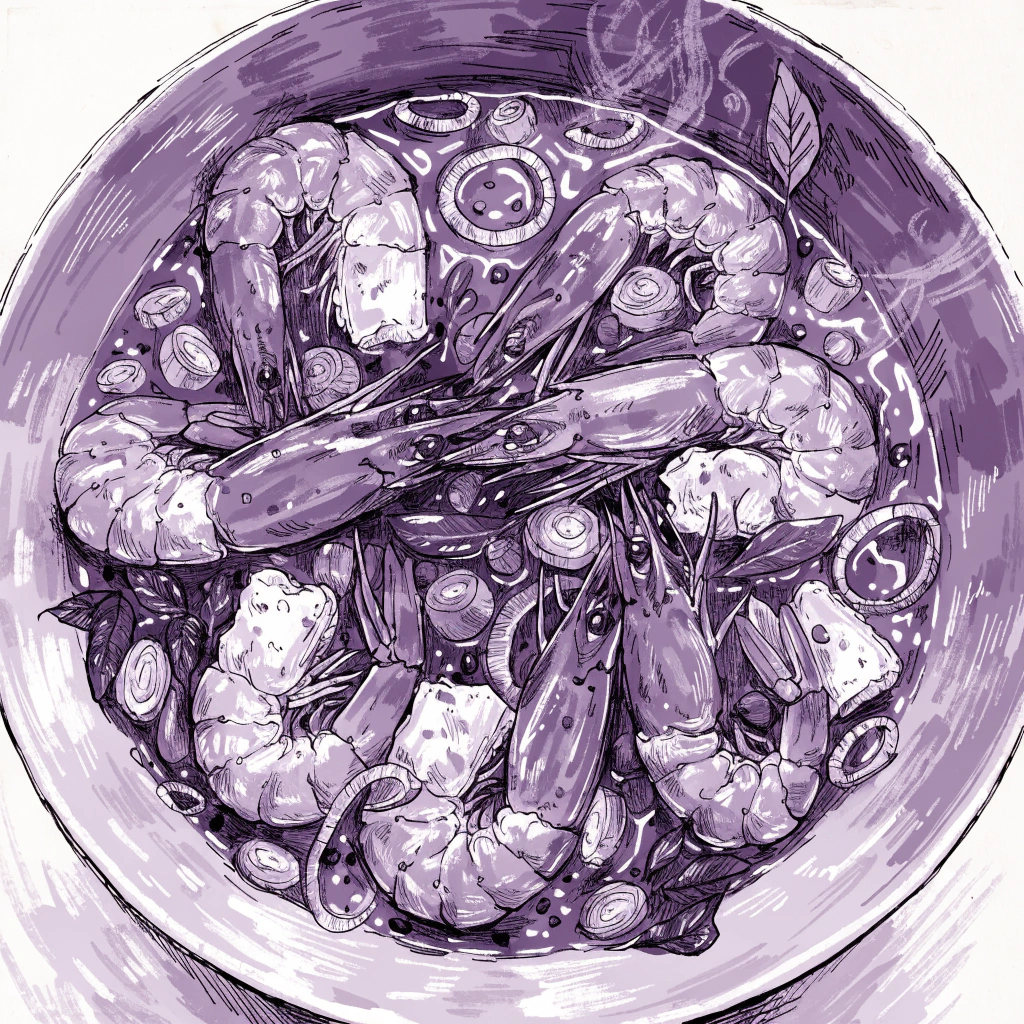
美味的冬阴功汤
冬阴功汤是泰国的有名汤。它很辣,也很酸。这个汤的味道非常好。汤里有大虾和一些菜。大虾是红色的。菜是绿色的。很多人喜欢喝冬阴功汤。它在泰国很受欢迎。你可以在泰国的饭店吃到它。冬阴功汤是泰国的特色食物。这个汤很特别,很多人第一次吃就爱上它。如果你去泰国,一定要尝尝冬阴功汤。
语法聚焦
句型: 是 (shì) - 是...
"冬阴功汤是泰国的有名汤。"
“是”是一个动词,意思是“to be”。我们用“是”来介绍或说明一个东西是什么,或者它的身份。例如,“我是学生” (I am a student)。
句型: 很 + 形容词 (hěn + xíngróngcí) - 很...
"它很辣,也很酸。"
“很”是一个副词,意思是“very”。我们用“很”来加强形容词的语气,让形容词表达的程度更高。例如,“他很高兴” (He is very happy)。
Tom Yum Goong: The Famous Soup of Thailand
Tom Yum Goong is the most famous soup in Thailand. It is a special dish because it has a strong spicy and sour taste. Thai people love this soup because the ingredients are very fresh and healthy.
Many years ago, people lived near the big rivers in Central Thailand. There were many large prawns in the water. People caught the prawns and boiled them with local herbs. They used lemongrass and lime to make the soup smell good. It was a simple meal, but it became a very important part of Thai culture.
The name "Tom Yum" means "boiled and mixed," and "Goong" means "shrimp." Today, Tom Yum Goong is more famous than other Thai dishes. You can find it in small street markets or expensive restaurants. Many tourists visit Thailand because they want to taste this delicious soup. It is a great meal to share with friends and family.
语法聚焦
句型: Comparatives (more + adjective + than)
"Today, Tom Yum Goong is more famous than other Thai dishes."
We use 'more' with long adjectives like 'famous' to compare two things. This pattern shows that one thing has a higher quality than the other.
句型: Conjunction 'because'
"Many tourists visit Thailand because they want to taste this delicious soup."
We use 'because' to give a reason for something. It connects an action with the reason why it happens.
测试你的理解
11 个问题 · A2 基础 · 1 次免费预览
测试你从这篇文章中学到的知识。回答所有问题即可获得经验值!
Where did people find the prawns for the soup in the past?
题目详情
Where did people find the prawns for the soup in the past?
你的回答:
正确答案: In the big rivers
Tom Yum Goong is a sweet and salty soup.
你的回答:
正确答案: 错误
What does the word 'Goong' mean?
你的回答:
正确答案: Shrimp
Tom Yum Goong is the most _____ soup in Thailand.
你的回答:
正确答案: famous
Why do people like this soup according to the text?
你的回答:
正确答案: The ingredients are fresh and healthy
Tom Yum Goong: The Heart of Thai Cuisine
Tom Yum Goong is a famous soup from Thailand that has become popular all over the world. It is a dish which perfectly represents the 'spicy and sour' flavors of Thai cuisine. The name is quite simple: 'Tom Yum' refers to the boiling and mixing process, while 'Goong' means shrimp. For many people, it is the first dish they try when they visit the country.
Historically, this delicious soup was developed in the river basins of Central Thailand. In these areas, freshwater prawns have been caught by local people for centuries because they are so abundant in the water. The soup was originally created as a clear broth that uses many healthy herbs. These ingredients, such as lemongrass, lime leaves, and galangal, are used to create a strong and aromatic smell that stimulates the appetite.
The soup is prepared by boiling these aromatic herbs in water before adding the fresh shrimp and fish sauce. In many modern restaurants, a small amount of coconut milk or evaporated milk is added to make a creamy variation. This version is often preferred by international tourists who might find the spice level a bit high. On the other hand, the clear version is known for being very spicy, sharp, and healthy.
Tom Yum Goong has been recognized as a national symbol of Thailand. It is served in almost every Thai restaurant, from simple street stalls to prestigious hotels. Because it is both delicious and medicinal, it has been enjoyed by millions of people who want to experience the true taste of Thailand. It has even been nominated for UNESCO heritage status because it is so important to Thai culture.
语法聚焦
句型: Relative Clauses
"It is a dish which perfectly represents the 'spicy and sour' flavors of Thai cuisine."
A relative clause uses 'which' or 'that' to provide more information about a noun. It helps combine two simple sentences into one complex sentence.
句型: Passive Voice
"The soup is prepared by boiling these aromatic herbs in water before adding the fresh shrimp."
The passive voice is used when the action is more important than the person doing it. It is formed using the verb 'to be' followed by the past participle.
测试你的理解
11 个问题 · B1 中级 · 1 次免费预览
测试你从这篇文章中学到的知识。回答所有问题即可获得经验值!
What does the word 'Goong' mean in the name of the dish?
题目详情
What does the word 'Goong' mean in the name of the dish?
你的回答:
正确答案: Shrimp
The soup was originally created as a creamy broth with coconut milk.
你的回答:
正确答案: 错误
What does 'aromatic' mean?
你的回答:
正确答案: Having a pleasant smell
Tom Yum Goong has been recognized as a national _____ of Thailand.
你的回答:
正确答案: symbol
Where did this soup historically develop?
你的回答:
正确答案: In the river basins of Central Thailand
The Culinary Alchemy of Tom Yum Goong: A Symbol of Thai Identity
Tom Yum Goong is widely regarded as the quintessential Thai dish, embodying the sophisticated 'spicy and sour' flavor profile that defines the nation's culinary palate. While there are numerous variations of 'Tom Yum'—a term that literally translates to 'boiled' and 'mixed'—the version featuring 'Goong', or shrimp, is considered the most prestigious. This iconic soup represents a delicate balance of five distinct tastes: spicy, sour, salty, sweet, and bitter, creating a harmonious experience that has been captivating food enthusiasts globally for decades.
Historically, the dish evolved along the lush river basins of Central Thailand, where freshwater prawns were found in great abundance. It was originally conceived as a clear, aromatic broth designed to stimulate the appetite and provide nourishment. Over time, the recipe has been refined by local communities, who integrated indigenous herbs and spices to enhance both the flavor and the preservation of the seafood. Consequently, what began as a humble fisherman's meal has transformed into a culinary masterpiece served in the finest establishments worldwide.
The complexity of Tom Yum Goong lies in its specific combination of medicinal ingredients. Lemongrass, galangal, and kaffir lime leaves form the aromatic backbone of the soup, each contributing unique health benefits ranging from improved digestion to immune system support. Furthermore, the addition of bird's eye chilies provides the characteristic heat, while lime juice offers a refreshing acidity. In recent years, a 'creamy' version has gained popularity, achieved by adding evaporated milk or coconut milk, which offers a modern twist on the traditional clear broth.
Beyond its nutritional value, Tom Yum Goong serves as a significant cultural ambassador for Thailand. It reflects the Thai philosophy of promoting the country's rich agricultural heritage and culinary expertise. Despite the introduction of modern cooking techniques, the fundamental essence of the dish remains unchanged, emphasizing the importance of fresh, high-quality ingredients. In conclusion, Tom Yum Goong is far more than a mere culinary delight; it is an analytical study of balance and tradition. Its evolution from a regional staple to a global phenomenon illustrates the versatility of Thai cuisine.
语法聚焦
句型: Passive Voice
"Tom Yum Goong is widely regarded as the quintessential Thai dish..."
The passive voice is used here to focus on the dish itself rather than the people who regard it. It is formed using 'to be' + past participle, creating a more formal and objective tone.
句型: Present Perfect Continuous
"...creating a harmonious experience that has been captivating food enthusiasts globally for decades."
This tense is used to describe an action that started in the past and continues to the present. It emphasizes the duration and ongoing nature of the soup's popularity.
句型: Non-defining Relative Clauses
"...the version featuring 'Goong', or shrimp, which is considered the most prestigious."
A non-defining relative clause provides extra information about a noun. It is separated by commas and uses 'which' to add descriptive detail without limiting the noun's identity.
测试你的理解
11 个问题 · B2 中高级 · 1 次免费预览
测试你从这篇文章中学到的知识。回答所有问题即可获得经验值!
What does the word 'Goong' specifically refer to in the context of this soup?
题目详情
What does the word 'Goong' specifically refer to in the context of this soup?
你的回答:
正确答案: Shrimp
Tom Yum Goong originally evolved in the mountain regions of Northern Thailand.
你的回答:
正确答案: 错误
What does 'abundance' mean?
你的回答:
正确答案: A large quantity
The soup was originally conceived as a clear, _____ broth designed to stimulate the appetite.
你的回答:
正确答案: aromatic
According to the article, how is the 'creamy' version of the soup achieved?
你的回答:
正确答案: By adding evaporated or coconut milk
The Gastronomic Alchemy of Tom Yum Goong: A Cultural Synthesis
Rarely has a single dish so effectively encapsulated a nation’s sensory identity as Tom Yum Goong has for Thailand. Often lauded as the quintessential Thai soup, it represents far more than a mere culinary assembly; it is a profound manifestation of the Thai palate's complexity. Historically, the dish’s genesis is inextricably linked to the fertile river basins of Central Thailand, where the abundance of freshwater prawns—the 'Goong' in its title—first inspired this aromatic creation. What began as a humble, clear broth intended to stimulate the appetite has undergone a remarkable metamorphosis, evolving into a globally recognized symbol of Thai heritage.
The proliferation of Tom Yum Goong across international borders has sparked a nuanced debate regarding authenticity versus adaptation. It is the delicate balance of the 'four pillars'—spicy, sour, salty, and sweet—that distinguishes an authentic rendition from its diluted counterparts. While the inclusion of coconut milk or evaporated milk creates the 'Nam Khon' (creamy) variation, purists often argue that the 'Nam Sai' (clear) version better showcases the piquant interplay of lemongrass, galangal, and kaffir lime leaves. This duality reflects the broader ambivalence within modern Thai gastronomy: the desire to preserve traditional techniques while embracing the inevitable evolution brought about by global exposure.
The meticulous preparation of Tom Yum Goong is a ritual in itself. The bruising of the lemongrass and the precise slicing of the galangal are not merely aesthetic choices but essential steps to release the essential oils that form the soup's aromatic backbone. It is this attention to detail that ensures the broth achieves its signature depth. Moreover, the choice of prawns is critical; the inclusion of the head fat provides a richness that no substitute can replicate. This technical rigor suggests that the dish is less a recipe and more a disciplined art form, requiring years of experience to master the subtle shifts in flavor profile caused by seasonal variations in produce.
Furthermore, the medicinal properties attributed to the soup's ingredients underscore its holistic nature. The nominalization of health benefits—such as the anti-inflammatory properties of galangal or the digestive aid provided by lemongrass—elevates Tom Yum Goong from a simple meal to a functional elixir. However, the commercialization of the dish has led to the emergence of 'instant' versions, which some critics suggest epitomize the erosion of culinary craftsmanship. Despite this, the core essence of the dish remains steadfast.
Never before has the world been so enamored with a soup that demands such precision. The alchemy of transforming raw, pungent herbs into a harmonious liquid is a testament to the skill of Thai cooks. Ultimately, Tom Yum Goong serves as a bridge between the past and the present, a liquid narrative of Thailand's geographical bounty and its people's enduring ingenuity. Whether consumed in a bustling Bangkok street market or an upscale London eatery, it remains an indispensable cornerstone of the global culinary landscape.
语法聚焦
句型: Inversion with negative/restrictive adverbs
"Rarely has a single dish so effectively encapsulated a nation’s sensory identity as Tom Yum Goong has for Thailand."
This pattern places the auxiliary verb before the subject to emphasize the rarity of the occurrence. It is commonly used in formal C1-level writing to create a more dramatic or sophisticated tone.
句型: Cleft Sentences
"It is the delicate balance of the 'four pillars'—spicy, sour, salty, and sweet—that distinguishes an authentic rendition from its diluted counterparts."
Cleft sentences use 'It is/was... that' to focus on a specific piece of information. This structure highlights the 'four pillars' as the most important factor in authenticity.
句型: Nominalisation
"The proliferation of Tom Yum Goong across international borders has sparked a nuanced debate regarding authenticity versus adaptation."
Nominalisation involves turning verbs (proliferate) into nouns (proliferation). This allows the writer to discuss complex concepts as objects, making the text more academic and concise.
测试你的理解
12 个问题 · C1 高级 · 1 次免费预览
测试你从这篇文章中学到的知识。回答所有问题即可获得经验值!
What was the original purpose of the clear broth version of Tom Yum Goong?
题目详情
What was the original purpose of the clear broth version of Tom Yum Goong?
你的回答:
正确答案: To stimulate the appetite
The 'Nam Khon' version of the soup is the traditional clear variety preferred by purists.
你的回答:
正确答案: 错误
What does 'piquant' mean in the context of the article?
你的回答:
正确答案: Pleasantly sharp or spicy
The abundance of _____ prawns in Central Thailand was the catalyst for the dish's creation.
你的回答:
正确答案: freshwater
According to the text, what does the 'alchemy' of the soup refer to?
你的回答:
正确答案: The transformation of raw herbs into a balanced liquid
The article suggests that commercialized instant versions of the soup represent a loss of traditional skill.
你的回答:
正确答案: 正确
冬荫功:泰式烹饪哲学与文化表征的深度剖析
冬荫功(Tom Yum Goong),这道蜚声国际的泰式酸辣虾汤,毋庸置疑已超越了单纯的佳肴范畴,升华为泰国美食文化的精髓与民族精神的鲜活表征。它不仅仅是味蕾上的一场饕餮盛宴,更是对泰国烹饪哲学——即对酸、辣、咸、甜、鲜五味和谐共存的极致追求——的完美诠释。其名“Tom Yum”在泰语中意为“煮”与“混合”,而“Goong”则特指虾,故“冬荫功”直译为“酸辣虾汤”,这简洁的命名背后,实则蕴含着深邃的烹饪智慧与历史沉淀。
追溯冬荫功的滥觞,我们不难发现其根植于泰国中部河域的庶民生活。彼时,淡水虾资源丰沛,当地居民便以其为主要食材,辅以香茅、南姜、柠檬叶、辣椒等当地特有的香料,熬制出一种既能开胃又具药用价值的清汤。这最初的形态,或许尚显质朴,却已奠定了冬荫功酸辣鲜香的基调。随着时间的推移,以及社会阶层的分化,冬荫功的制作技艺日臻完善,从民间走向宫廷,逐渐演变出清汤(Tom Yum Nam Sai)与浓汤(Tom Yum Nam Khon)两种主要流派。前者更注重食材的本味与香料的清新,后者则通过加入椰奶或淡奶,赋予汤品更为醇厚、圆润的口感,使之在辛辣之余,更添一份柔和与绵长,此二者虽风味迥异,却殊途同归地展现了泰国人对味觉层次感的精妙把握。
冬荫功之所以能风靡全球,并成为泰国饮食文化最具代表性的符码之一,其核心在于那令人难以抗拒的、近乎完美的风味协同。香茅的柠檬清香、南姜的辛辣芳醇、柠檬叶的独特柑橘气息、小辣椒的炽热与鱼露的咸鲜,以及少许糖分的提味,这些看似独立的元素,在沸腾的汤锅中奇妙地交织融合,共同谱写出一曲和谐的味觉交响乐。这种复杂的平衡,绝非偶然,而是泰国厨师们在长期的实践中,通过经验的累积与味觉的敏感,臻于化境的成果。它不仅刺激着食客的味蕾,更在无形中传递着泰国人热情、奔放而又细腻的生活哲学。
然而,冬荫功的魅力并不仅限于其独特的风味。它更承载着丰富的文化内涵。在泰国人眼中,冬荫功不仅仅是一道菜,它象征着家庭的团聚、友谊的维系,甚至是对病患的慰藉。其丰富的香料被认为具有驱寒、提神、促进消化的功效,使得这道汤品在日常饮食中扮演着不可或缺的角色。在全球化浪潮的冲击下,冬荫功以其强大的适应性和普世的吸引力,成功地跨越了地域与文化的界限。尽管在不同国家和地区的本土化过程中,其配方可能有所调整,例如为适应西方口味而降低辣度,或加入当地特色食材,但其标志性的酸辣风味始终是其不可磨灭的印记,亦是其文化生命力经久不衰的明证。
综上所述,冬荫功不仅是泰国烹饪艺术的巅峰之作,更是其深厚文化底蕴的直观体现。它以其独特而复杂的风味,向世界展示了泰国人民对生活的热爱、对自然的敬畏以及对和谐的追求。品尝一碗地道的冬荫功,便如同进行一场微型的文化之旅,从中我们得以管窥泰国的历史变迁、风土人情以及那份融于骨血的烹饪智慧。它无疑已成为一种超越国界的文化符号,持续激发着全球食客的无限遐想与探索欲望。
语法聚焦
句型: 毋庸置疑……,(更)升华为……
"冬荫功(Tom Yum Goong),这道蜚声国际的泰式酸辣虾汤,毋庸置疑已超越了单纯的佳肴范畴,升华为泰国美食文化的精髓与民族精神的鲜活表征。"
此句式用于强调某事物的重要性或其地位的提升。 “毋庸置疑”表示确定无疑,引出主语,接着通过“超越了……范畴,(更)升华为……”来阐明该事物不仅限于其表象,而是达到了更高的境界或拥有了更深远的意义,具有较强的论证和修辞色彩。
句型: A与B虽风味迥异,却殊途同归地展现了……
"此二者虽风味迥异,却殊途同归地展现了泰国人对味觉层次感的精妙把握。"
这个句式用于比较两种或多种事物,指出它们尽管表面上存在差异(“风味迥异”),但最终却殊途同归,达到了相同的目的或呈现出共同的本质。它强调了在多样性中寻找共性或统一性,常用于分析和总结。
句型: 绝非偶然,而是……的成果。
"这种复杂的平衡,绝非偶然,而是泰国厨师们在长期的实践中,通过经验的累积与味觉的敏感,臻于化境的成果。"
此句式常用于驳斥偶然性,强调事物是特定条件或努力的必然结果。 “绝非偶然”否定了随机性,后半部分“而是……的成果”则具体阐明了达成此结果的深层原因或过程,体现了严谨的分析和归因。
测试你的理解
12 个问题 · C2 精通 · 1 次免费预览
测试你从这篇文章中学到的知识。回答所有问题即可获得经验值!
根据文章,冬荫功的命名“Tom Yum Goong”中的“Goong”特指什么?
题目详情
根据文章,冬荫功的命名“Tom Yum Goong”中的“Goong”特指什么?
你的回答:
正确答案: 虾
文章指出,冬荫功最初起源于泰国宫廷,而非民间。
你的回答:
正确答案: 错误
“滥觞”在文中指的是什么?
你的回答:
正确答案: 事物的发端、起源
冬荫功的制作技艺从民间走向宫廷,逐渐_____出清汤与浓汤两种主要流派。
你的回答:
正确答案: 演变
文章中提到,冬荫功的风味协同融合了哪些元素?
你的回答:
正确答案: 香茅、南姜、柠檬叶、辣椒、鱼露等多种元素
文章认为,冬荫功在全球化浪潮中,其配方在不同国家和地区从未有过调整。
你的回答:
正确答案: 错误

