









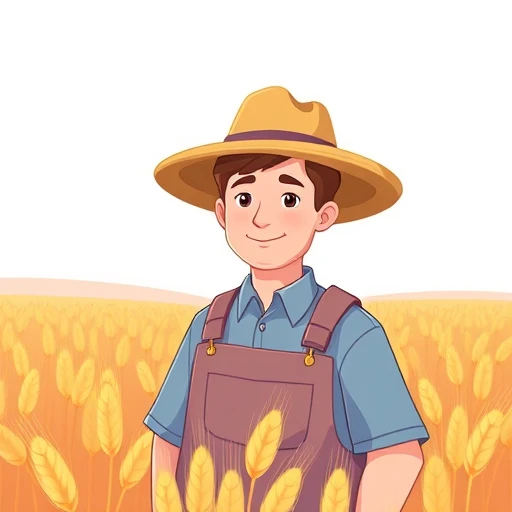
farmer in 30 Seconds
- A farmer is a person who manages a farm, focusing on crop cultivation and livestock raising to produce food and raw materials for society.
- The role of a farmer is essential for food security and involves a wide range of skills, from manual labor to complex economic management.
- Farmers can work on various scales, from small subsistence plots to large industrial operations, and their work is heavily influenced by weather and markets.
- The term 'farmer' is a respected professional title that carries deep cultural and historical significance as the foundation of human civilization.
The term farmer refers to an individual who is primarily engaged in the practice of agriculture, which involves the cultivation of crops, the raising of livestock, or a combination of both. This role is fundamental to human civilization, as farmers are the primary producers of the food, fiber, and raw materials that sustain global populations. The scope of a farmer's work can vary significantly depending on the scale of the operation, the geographical location, and the specific commodities being produced. In a modern context, being a farmer requires a diverse skill set that extends far beyond manual labor; it involves understanding soil chemistry, meteorology, mechanical engineering for equipment maintenance, and complex economic principles for market navigation. People use this word to describe anyone from a small-scale organic gardener who sells produce at a local market to a manager of a massive industrial farm spanning thousands of acres. The word carries connotations of hard work, resilience, and a profound connection to the natural world, often serving as a symbol of the rural lifestyle and the foundational strength of a nation's economy.
- Professional Identity
- A farmer identifies as a professional steward of the land, responsible for the lifecycle of biological products from seed or birth to harvest or sale.
The farmer inspected the wheat fields carefully, looking for signs of pests before the upcoming harvest season began in earnest.
Historically, the farmer was the central figure in the transition from nomadic hunter-gatherer societies to settled agrarian communities. This shift allowed for the creation of food surpluses, which in turn facilitated the growth of cities and the specialization of labor. Today, the word is used in various specialized forms, such as 'dairy farmer,' 'poultry farmer,' or 'crop farmer,' to specify the type of agriculture being practiced. In many cultures, the farmer is celebrated through festivals and folklore, representing the cycle of life and the rewards of patient, diligent effort. However, the term also encompasses the challenges of the profession, including the unpredictability of weather, the threat of disease in plants and animals, and the fluctuating prices of global commodities. When discussing environmental sustainability, the farmer is often at the center of the conversation, as their methods of land management directly impact biodiversity, water quality, and carbon sequestration. Thus, the word 'farmer' is not just a job title but a multifaceted descriptor of a person whose life is intricately woven into the biological and economic fabric of society.
- Economic Impact
- Farmers contribute significantly to the Gross Domestic Product (GDP) of many nations and are essential for maintaining food security at both local and international levels.
Many young people are returning to the countryside to become small-scale farmers, focusing on organic and sustainable methods.
In contemporary discourse, the term 'farmer' is increasingly associated with technology and innovation. Precision agriculture, which uses data from satellites and sensors to optimize crop production, has transformed the image of the farmer from a manual laborer to a tech-savvy operator. Despite these advancements, the core essence of the word remains the same: a person who works with the earth to provide for others. The farmer's role is often described as a 'calling' rather than just a career, reflecting the deep commitment required to manage the land through all seasons and conditions. Whether they are tending to vineyards in France, rice paddies in Vietnam, or cornfields in Iowa, farmers share a common goal of harvesting the bounty of the earth. This universal relevance makes the word 'farmer' one of the most recognized and respected terms across different languages and cultures, signifying a profession that is as old as civilization itself yet constantly evolving to meet the needs of a changing world.
Without the dedication of the local farmer, our community would lack access to fresh, seasonal vegetables and fruits.
- Social Context
- In social settings, the term often evokes a sense of community and tradition, highlighting the importance of supporting local agriculture.
The farmer's market is a popular destination for city dwellers looking for high-quality, farm-to-table ingredients.
Every farmer knows that the success of the crop depends as much on the quality of the soil as it does on the timing of the rain.
Using the word farmer in a sentence requires an understanding of its role as a common noun that can function as the subject, object, or part of a prepositional phrase. Because farming is an active profession, the word is frequently paired with dynamic verbs that describe agricultural processes, such as 'plant,' 'harvest,' 'plow,' 'sow,' 'breed,' and 'cultivate.' For instance, one might say, 'The farmer plows the field in early spring,' where the farmer is the agent performing the action. The word can also be modified by various adjectives to provide more specific information about the individual's specialty or the nature of their work. Common modifiers include 'dairy,' 'organic,' 'tenant,' 'subsistence,' 'commercial,' and 'veteran.' These adjectives help to distinguish between different types of agricultural practices and the socio-economic status of the person involved. For example, 'A subsistence farmer grows only enough food to feed their own family,' provides a clear picture of the scale and purpose of the farming activity.
- Subject-Verb Agreement
- When 'farmer' is the subject, ensure the verb matches in number. 'The farmer works' (singular) versus 'The farmers work' (plural).
The farmer used a modern tractor to speed up the process of tilling the large acreage.
In more complex sentence structures, 'farmer' can be part of a compound subject or object, or it can be used in possessive form to indicate ownership of land, equipment, or produce. 'The farmer's expertise in crop rotation saved the soil from depletion' uses the possessive 'farmer's' to attribute the expertise to the individual. Additionally, the word often appears in collective contexts, such as 'a community of farmers' or 'the local farmers' union,' which emphasizes the social and organized aspects of the profession. When writing about the challenges faced by those in agriculture, the word is often linked with environmental or economic factors. Sentences like 'The farmer struggled against the prolonged drought' or 'The farmer negotiated a better price for his grain' illustrate the external pressures that define the agricultural experience. Furthermore, the word can be used metaphorically, though this is less common than its literal usage. For example, 'He is a farmer of ideas,' suggests someone who nurtures and grows concepts, though this usage is quite poetic and specific.
- Prepositional Phrases
- 'Farmer' often follows prepositions like 'by,' 'for,' or 'with.' Example: 'The land was cultivated by a local farmer.'
After years of working in the city, she decided to become an organic farmer in the countryside.
The word 'farmer' also appears frequently in the context of policy and global issues. In academic or journalistic writing, you might see sentences such as, 'Government subsidies are designed to support the small-scale farmer during market volatility.' Here, 'farmer' represents a demographic or a socio-economic class. In instructional or descriptive texts, the word is used to explain the steps of a process: 'First, the farmer prepares the seedbed; then, the farmer sows the seeds at the correct depth.' This repetitive use reinforces the role of the individual as the central actor in the agricultural narrative. Whether used in a simple declarative sentence or a complex analytical paragraph, 'farmer' remains a versatile and essential noun for describing the people who provide the world's most basic needs. Its usage is consistent across various registers of English, from casual conversation to formal scientific reports, making it a key vocabulary word for learners at all levels.
The farmer's hands were calloused and worn from decades of manual labor in the fields.
- Colloquial Usage
- In some regions, 'farmer' might be used affectionately or even pejoratively to describe someone with a rural or unrefined manner, though this is less common in professional settings.
A group of farmers gathered at the town hall to discuss the new irrigation project.
The farmer's almanac is a traditional book used to predict weather and planting times.
The word farmer is ubiquitous in various settings, ranging from the most rural environments to the heart of urban centers. One of the most common places to hear this word is at a 'farmer's market,' a popular community event where producers sell their goods directly to consumers. In this context, the word signifies freshness, local origin, and a personal connection between the grower and the buyer. You will also hear the word frequently in news broadcasts, particularly when the discussion turns to the economy, climate change, or international trade. Journalists often report on how 'farmers' are being affected by new tariffs, extreme weather events like droughts or floods, or shifts in consumer demand for organic products. In these reports, the word is used to represent a vital sector of the workforce whose stability is crucial for the overall health of the nation.
- In the Media
- Documentaries and news segments often feature interviews with farmers to provide a first-hand perspective on agricultural issues.
The evening news featured a story about how local farmers are adapting to the changing climate.
In educational settings, the word 'farmer' is introduced early on, often in the context of learning about food sources and community helpers. Children's books and songs, such as 'The Farmer in the Dell,' make the word a familiar part of early vocabulary. In higher education, particularly in fields like agronomy, environmental science, and economics, the word is used more technically to discuss the 'primary producer' in the supply chain. Furthermore, the word is prevalent in political discourse. Politicians often speak of 'supporting our farmers' to appeal to rural voters, framing the farmer as a hardworking, patriotic figure who embodies traditional values. This rhetorical use of the word highlights its cultural significance beyond its literal definition. You might also encounter the word in the names of various organizations, such as the 'National Farmers Union' or 'Farmers Insurance,' where it serves as a brand identifier associated with reliability and protection.
- In Literature
- Classic novels often use the character of the farmer to explore themes of man's relationship with nature and the struggle for survival.
The protagonist of the novel was a humble farmer who dreamed of owning his own land one day.
In casual conversation, people use the word when discussing their weekend plans ('We're going to the farmer's market') or when talking about where their food comes from ('I bought these eggs directly from a farmer'). In rural areas, the word is a common job title and a point of pride. You might hear someone say, 'My father was a farmer, and his father before him,' indicating a generational commitment to the land. In the business world, the term 'farming' is sometimes used metaphorically to describe the process of nurturing existing clients to generate more business, as opposed to 'hunting' for new ones. However, the literal meaning remains the most dominant. Whether you are in a grocery store, a classroom, a political rally, or a rural village, the word 'farmer' is a constant presence, reminding us of the essential labor that feeds the world and the deep-rooted traditions that continue to shape our society.
The farmer explained the benefits of crop rotation to the group of visiting students.
- In Cinema
- Movies like 'Interstellar' or 'The Grapes of Wrath' portray farmers as central figures facing existential or economic crises.
The farmer stood at the edge of his property, watching the sunset over the rolling hills.
During the harvest festival, the community honors the farmers for their hard work throughout the year.
One of the most common mistakes learners make with the word farmer is confusing it with related but distinct terms like 'gardener,' 'peasant,' or 'rancher.' While a gardener also grows plants, the term usually implies a smaller, non-commercial scale, often for personal enjoyment or aesthetic purposes. A farmer, by contrast, operates on a commercial or subsistence scale with the primary goal of producing food or materials for consumption or sale. Confusing these two can lead to a misunderstanding of the person's professional status. Another frequent error is the use of the word 'peasant.' In modern English, 'peasant' is often considered derogatory or archaic, referring to a poor, low-status agricultural worker in a feudal or traditional society. Using 'peasant' to describe a modern farmer can be offensive; 'farmer' is the correct and respectful term. Additionally, 'rancher' is a specific type of farmer who focuses on raising livestock on large tracts of land, particularly in North America. Using 'farmer' for a rancher is technically correct but less precise.
- Scale and Purpose
- Avoid calling a professional agriculturalist a 'gardener' unless they are specifically tending to a garden for pleasure.
Incorrect: The peasant sold his crops at the market. Correct: The farmer sold his crops at the market.
Grammatically, learners sometimes struggle with the possessive form 'farmer's.' It is common to see 'farmers market' written without the apostrophe, but the standard form is 'farmer's market' (market of a farmer) or 'farmers' market' (market of many farmers). Omitting the apostrophe is a frequent error in signage and casual writing. Another grammatical pitfall is the countability of the noun. 'Farmer' is a countable noun, meaning it must be used with an article or in the plural form. Saying 'He is farmer' is incorrect; it should be 'He is a farmer.' Furthermore, learners may confuse the noun 'farmer' with the verb 'to farm.' While 'He farms the land' is correct, using 'farmer' as a verb ('He farmers the land') is a common morphological mistake. The agent noun 'farmer' is derived from the verb 'farm' by adding the suffix '-er,' and this distinction must be maintained.
- Apostrophe Usage
- Remember to use 'farmer's' for singular possession and 'farmers'' for plural possession.
Incorrect: I am going to the farmers market. Correct: I am going to the farmer's market.
Lastly, there is the issue of register and connotation. In some urban contexts, 'farmer' might be used as a slang term to imply that someone is unsophisticated or 'country.' However, this is highly informal and can be perceived as elitist or rude. In a professional or educational setting, 'farmer' should always be used with the respect due to an essential profession. Misusing the word in a derogatory way can cause social friction. Another subtle mistake is failing to specify the type of farmer when the context requires it. For example, in a discussion about the dairy industry, simply saying 'the farmer' might be too vague if there are also crop farmers involved. Using 'the dairy farmer' provides necessary clarity. By being mindful of these distinctions—scale, historical context, grammar, and register—learners can use the word 'farmer' accurately and appropriately in any situation.
The farmer is not just a worker; he is a business owner who manages complex operations.
- Countability
- Always use 'a' or 'the' before 'farmer' in the singular form unless it's a title like 'Farmer Brown.'
The farmer's role in the community is often undervalued despite its essential nature.
Many farmers are now using drones to monitor the health of their crops from the air.
While farmer is the most common and versatile term for someone in agriculture, there are several synonyms and related words that can be used depending on the specific context, register, or type of farming. One such alternative is 'agriculturist' (or 'agriculturalist'), which is a more formal and academic term. It often refers to someone who studies the science of farming or manages agricultural operations on a professional or scientific level. Another term is 'grower,' which is frequently used in the context of specific crops, such as a 'fruit grower' or a 'wheat grower.' This term emphasizes the act of cultivation rather than the management of a whole farm. In the livestock industry, 'rancher' is the preferred term in North America for someone who raises cattle, sheep, or horses on large areas of land. In contrast, 'breeder' refers specifically to someone who raises animals for the purpose of producing offspring with particular traits.
- Agriculturist vs. Farmer
- An agriculturist often has a scientific or management focus, while a farmer is the general term for the practitioner.
The agriculturist advised the community on how to improve soil fertility using natural fertilizers.
For those who work on a farm but do not own or manage it, the term 'farmhand' or 'agricultural worker' is used. These terms distinguish the employee from the owner or manager. In historical or literary contexts, you might encounter 'husbandman,' an archaic term for a farmer, or 'yeoman,' which referred to a man who owned and cultivated a small farm. In a more modern, business-oriented context, the term 'producer' is often used by government agencies and industry groups. For example, 'The nation's corn producers are expecting a record harvest.' This term frames the farmer as a key player in the economic supply chain. Additionally, 'planter' is a term historically used in the Southern United States and other colonial regions to describe the owner of a large plantation, though it is less common today and carries significant historical weight. Understanding these nuances allows for more precise communication when discussing the diverse world of agriculture.
- Rancher vs. Farmer
- A rancher focuses on livestock and large grazing lands, whereas a farmer may focus on crops or a mix of both.
The local growers association organized a meeting to discuss the impact of the new water regulations.
Another interesting alternative is 'crofter,' a term used specifically in Scotland to describe someone who farms a small piece of land known as a croft. In a global context, 'subsistence farmer' and 'smallholder' are terms used to describe individuals who farm on a small scale, primarily for their own consumption. These terms are common in development and humanitarian work. In contrast, 'agribusinessman' refers to someone involved in large-scale, corporate farming operations. By choosing the right word, you can convey a wealth of information about the scale, location, and nature of the agricultural work being discussed. Whether you use the simple and direct 'farmer' or a more specialized term like 'vigneron' (a person who grows grapes for wine), each word offers a unique perspective on the ancient and essential practice of working the land. This variety of terms reflects the complexity and diversity of the agricultural sector across the globe.
As a smallholder, she faced many challenges in accessing the global market for her organic coffee.
- Producer
- This term is often used in economic and policy contexts to describe farmers as part of the industrial system.
The farmhand worked tirelessly to ensure the animals were fed before the storm arrived.
The yeoman farmers of the past were often seen as the backbone of the independent middle class.
How Formal Is It?
Fun Fact
The word 'farm' itself comes from the Medieval Latin 'firma,' meaning a fixed payment or contract. It wasn't until the 16th century that it primarily meant a piece of agricultural land.
Pronunciation Guide
- Pronouncing the 'a' like the 'a' in 'cat'. It should be a deeper 'ah' sound.
- Over-emphasizing the second syllable.
- In non-rhotic accents, pronouncing the final 'r' too strongly.
- Confusing the pronunciation with 'former'.
- Dropping the 'f' sound at the beginning.
Difficulty Rating
The word is very common and easily recognized in most texts.
Simple to spell and use in basic sentences.
Easy to pronounce, though the 'r' sounds can vary by accent.
Very distinct sound, rarely confused with other words.
What to Learn Next
Prerequisites
Learn Next
Advanced
Grammar to Know
Agent Nouns (-er suffix)
The word 'farmer' is formed by adding '-er' to the verb 'farm', meaning 'one who farms'.
Possessive Apostrophe
Use 'the farmer's tractor' for one farmer and 'the farmers' tractors' for many farmers.
Countable Noun Usage
Always use an article like 'a' or 'the' with the singular 'farmer'.
Compound Noun Formation
Combining 'farmer' with other nouns like 'dairy' or 'poultry' to create specific job titles.
Present Simple for Habitual Actions
Farmers often wake up before sunrise to begin their work.
Examples by Level
The farmer lives in a big house on the farm.
Le fermier vit dans une grande maison à la ferme.
Simple present tense with a singular subject.
A farmer grows food for us.
Un fermier cultive de la nourriture pour nous.
Use of 'a' before a singular countable noun.
The farmer has five cows and many chickens.
Le fermier a cinq vaches et beaucoup de poulets.
Using 'has' for possession with a singular subject.
I see a farmer on a red tractor.
Je vois un fermier sur un tracteur rouge.
Direct object 'farmer' after the verb 'see'.
The farmer works every day.
Le fermier travaille tous les jours.
Third-person singular 's' on the verb 'works'.
Is your father a farmer?
Est-ce que ton père est fermier ?
Question form with 'is'.
The farmer is very busy in the morning.
Le fermier est très occupé le matin.
Adjective 'busy' describing the farmer.
Farmers wear boots and hats.
Les fermiers portent des bottes et des chapeaux.
Plural form 'farmers' with a plural verb.
The farmer is planting seeds in the field today.
Le fermier plante des graines dans le champ aujourd'hui.
Present continuous tense for an action happening now.
We bought fresh eggs from the local farmer.
Nous avons acheté des œufs frais au fermier local.
Simple past tense 'bought'.
The farmer's dog helps him with the sheep.
Le chien du fermier l'aide avec les moutons.
Possessive form 'farmer's'.
Being a farmer is a very hard job.
Être fermier est un travail très difficile.
Gerund 'being' as the subject of the sentence.
The farmer will harvest the wheat next month.
Le fermier récoltera le blé le mois prochain.
Future tense with 'will'.
The farmer needs rain for his crops to grow.
Le fermier a besoin de pluie pour que ses cultures poussent.
Infinitive 'to grow' expressing purpose.
She wants to be an organic farmer when she grows up.
Elle veut être fermière biologique quand elle sera grande.
Infinitive 'to be' after the verb 'wants'.
The farmer showed us how to milk a cow.
Le fermier nous a montré comment traire une vache.
Indirect object 'us' and direct object 'how to milk a cow'.
The farmer decided to switch to organic methods to protect the environment.
Le fermier a décidé de passer aux méthodes biologiques pour protéger l'environnement.
Infinitive phrase 'to protect the environment' as a purpose clause.
If the farmer doesn't receive the subsidy, he might lose his land.
Si le fermier ne reçoit pas la subvention, il pourrait perdre sa terre.
First conditional sentence structure.
Many farmers are now using solar panels to power their equipment.
De nombreux fermiers utilisent désormais des panneaux solaires pour alimenter leur équipement.
Present continuous for a current trend.
The farmer, who has lived here for fifty years, knows the land perfectly.
Le fermier, qui vit ici depuis cinquante ans, connaît parfaitement la terre.
Non-defining relative clause with 'who'.
It is important to support local farmers by buying from their markets.
Il est important de soutenir les fermiers locaux en achetant sur leurs marchés.
Gerund 'buying' after the preposition 'by'.
The farmer struggled to make a profit because of the low price of milk.
Le fermier a eu du mal à faire des bénéfices à cause du prix bas du lait.
Prepositional phrase 'because of' followed by a noun phrase.
We should ask the farmer if we can walk across his field.
Nous devrions demander au fermier si nous pouvons traverser son champ.
Modal verb 'should' for advice.
The farmer's association is protesting against the new regulations.
L'association des fermiers proteste contre les nouvelles réglementations.
Collective noun 'association' with a singular verb.
The farmer implemented precision agriculture techniques to optimize his yield.
Le fermier a mis en œuvre des techniques d'agriculture de précision pour optimiser son rendement.
Use of specific vocabulary like 'implemented' and 'yield'.
Despite the challenges, the farmer remains committed to sustainable land management.
Malgré les défis, le fermier reste engagé dans une gestion durable des terres.
Concessive clause starting with 'Despite'.
The farmer's livelihood is inextricably linked to the global market prices.
Le gagne-pain du fermier est inextricablement lié aux prix du marché mondial.
Passive voice 'is linked' with an adverbial modifier.
Having worked as a farmer all his life, he was well-prepared for the drought.
Ayant travaillé comme fermier toute sa vie, il était bien préparé à la sécheresse.
Perfect participle 'Having worked' as an adverbial clause.
The government is being urged to provide more assistance to small-scale farmers.
Le gouvernement est pressé de fournir plus d'aide aux petits fermiers.
Passive continuous 'is being urged'.
The farmer diversified his income by opening a small bed and breakfast on the farm.
Le fermier a diversifié ses revenus en ouvrant un petit gîte à la ferme.
Verb 'diversified' followed by a prepositional phrase.
No sooner had the farmer finished planting than the heavy rains began.
À peine le fermier avait-il fini de planter que les fortes pluies ont commencé.
Inversion after 'No sooner' for emphasis.
The farmer argued that the new policy would unfairly benefit large corporations.
Le fermier a soutenu que la nouvelle politique profiterait injustement aux grandes entreprises.
Reported speech with 'argued that'.
The modern farmer must navigate a complex landscape of environmental regulations and market volatility.
Le fermier moderne doit naviguer dans un paysage complexe de réglementations environnementales et de volatilité des marchés.
Modal 'must' expressing necessity in a formal context.
Agrarian societies often place the farmer at the heart of their cultural identity.
Les sociétés agraires placent souvent le fermier au cœur de leur identité culturelle.
Use of the adjective 'agrarian' to modify 'societies'.
The farmer's role as a steward of biodiversity is increasingly recognized by policymakers.
Le rôle du fermier en tant que gardien de la biodiversité est de plus en plus reconnu par les décideurs politiques.
Noun phrase 'steward of biodiversity' as a complement.
By adopting regenerative practices, the farmer aims to restore the health of the soil.
En adoptant des pratiques régénératrices, le fermier vise à restaurer la santé du sol.
Gerund phrase 'By adopting' indicating method.
The plight of the debt-ridden farmer has become a central theme in contemporary literature.
Le sort du fermier criblé de dettes est devenu un thème central de la littérature contemporaine.
Compound adjective 'debt-ridden'.
Such was the farmer's dedication that he worked through the night to save his livestock.
Telle était la dévotion du fermier qu'il a travaillé toute la nuit pour sauver son bétail.
Inversion with 'Such' for rhetorical effect.
The farmer contended that the subsidies were insufficient to cover the rising costs of production.
Le fermier a soutenu que les subventions étaient insuffisantes pour couvrir les coûts de production croissants.
Formal verb 'contended' for expressing an opinion.
Far from being a simple laborer, the farmer is a sophisticated manager of biological systems.
Loin d'être un simple ouvrier, le fermier est un gestionnaire sophistiqué de systèmes biologiques.
Prepositional phrase 'Far from being' used for contrast.
The ontological connection between the farmer and the land is a recurring motif in agrarian philosophy.
Le lien ontologique entre le fermier et la terre est un motif récurrent dans la philosophie agraire.
Use of high-level academic vocabulary like 'ontological' and 'motif'.
In the face of rampant urbanization, the farmer stands as a bulwark against the loss of traditional rural life.
Face à l'urbanisation rampante, le fermier se dresse comme un rempart contre la perte de la vie rurale traditionnelle.
Metaphorical use of 'bulwark'.
The farmer's agency is often constrained by the overarching structures of global neoliberalism.
L'agence du fermier est souvent contrainte par les structures globales du néolibéralisme.
Passive voice with a complex agent 'overarching structures...'.
Were the farmer to abandon his post, the delicate equilibrium of the local ecosystem might collapse.
Si le fermier devait abandonner son poste, l'équilibre délicat de l'écosystème local pourrait s'effondrer.
Second conditional with 'Were... to' for a hypothetical situation.
The farmer's narrative is one of perpetual struggle against the caprices of nature and the vagaries of the market.
Le récit du fermier est celui d'une lutte perpétuelle contre les caprices de la nature et les aléas du marché.
Use of sophisticated nouns like 'caprices' and 'vagaries'.
The displacement of the small-scale farmer by corporate interests has profound implications for food sovereignty.
Le déplacement du petit fermier par les intérêts des entreprises a des implications profondes pour la souveraineté alimentaire.
Complex subject 'The displacement... by corporate interests'.
To the casual observer, the farmer's work may seem monotonous, yet it requires a profound and intuitive knowledge of the earth.
Pour l'observateur occasionnel, le travail du fermier peut sembler monotone, pourtant il nécessite une connaissance profonde et intuitive de la terre.
Contrastive structure with 'yet'.
The farmer, in his quiet persistence, embodies the enduring spirit of human labor and its essential tie to the soil.
Le fermier, dans sa persistance tranquille, incarne l'esprit durable du travail humain et son lien essentiel au sol.
Appositive phrase 'in his quiet persistence' adding detail.
Synonyms
Antonyms
Common Collocations
Common Phrases
— A person who farms for pleasure rather than for profit, often someone wealthy.
After retiring from banking, he became a gentleman farmer in Vermont.
— A farmer who works very hard on poor land, often struggling to make a living.
He grew up as the son of a dirt farmer during the Great Depression.
— A movement or style of cooking that emphasizes using fresh, local ingredients directly from farmers.
The restaurant is famous for its farm-to-table menu.
— An encouragement to purchase goods from nearby farmers and businesses to support the local economy.
The 'buy local' campaign has helped many small farmers stay in business.
— Literally, what a farmer does; metaphorically, to do something that will have a big effect in the future.
The farmer sowed the seeds in early spring; his hard work sowed the seeds of his future success.
— A proverb meaning you will eventually face the consequences of your actions, just as a farmer harvests what they planted.
The farmer knows that if he works hard, he will reap what he sows at harvest time.
— To distinguish between what is valuable and what is worthless, a process originally done by farmers.
The manager had to separate the wheat from the chaff when reviewing the job applications.
— To take advantage of a good situation while it lasts, as farmers must harvest hay during dry weather.
The farmer worked late to make hay while the sun shone, knowing rain was coming.
— A movement where people leave cities to live a simpler life as farmers in the countryside.
In the 1970s, many people joined the back-to-the-land movement to become farmers.
— The portion of the final price of a food product that actually goes to the farmer.
The farmer's share of a loaf of bread is surprisingly small.
Often Confused With
Sounds similar but means 'the first of two' or 'previous'.
A gardener usually works on a small, non-commercial scale for pleasure.
A rancher specifically raises livestock on large areas of land.
Idioms & Expressions
— A slang idiom meaning to die, originally used by military pilots.
He almost bought the farm in that car accident.
informal/slang— To risk everything you have on a single venture or outcome.
He decided to bet the farm on his new business idea.
informal— To give work to other people to do instead of doing it yourself.
The company decided to farm out its accounting to a specialized firm.
neutral— For a very long time; indefinitely.
You can argue with him till the cows come home, but he won't change his mind.
informal— Don't assume you will be successful until it actually happens.
The farmer didn't count his chickens before they hatched, even though the crop looked good.
neutral— To take precautions after the damage has already been done.
Installing a security system now is like locking the barn door after the horse has bolted.
informal— A difficult task or situation to deal with.
Starting a new farm from scratch is a tough row to hoe.
informal— To force someone to retire because they are considered too old to be useful.
After forty years at the company, he was finally put out to pasture.
informal— The very best of a group.
These students are the cream of the crop in the agricultural science department.
neutral— To go to bed or go to sleep.
The farmer was exhausted and decided to hit the hay early.
informalEasily Confused
Both work in agriculture.
Peasant is a historical or derogatory term for a poor farmer. Farmer is the modern, respectful term.
The farmer (not peasant) used a modern tractor.
Both work on a farm.
A farmer usually owns or manages the farm. A farmhand is an employee who does manual labor.
The farmer hired a farmhand to help with the harvest.
Both are related to farming.
An agriculturist is often a scientist or expert in the field of agriculture. A farmer is the person who actually does the farming.
The agriculturist gave advice to the local farmer.
Both raise animals.
A rancher specifically manages large herds of animals on vast land. A farmer might have a smaller farm with crops and animals.
The cattle rancher (not farmer) lives in Texas.
Both grow plants.
Grower is often used for someone who specializes in one specific crop, like grapes or flowers.
The rose grower (not farmer) won a prize for her flowers.
Sentence Patterns
The farmer is [adjective].
The farmer is happy.
The farmer [verb] the [noun].
The farmer feeds the pigs.
The farmer decided to [verb].
The farmer decided to grow organic corn.
Despite the [noun], the farmer [verb].
Despite the storm, the farmer checked on the sheep.
The farmer's role as [noun] is [adjective].
The farmer's role as a land manager is essential.
Were the farmer to [verb], the [noun] would [verb].
Were the farmer to stop working, the food supply would suffer.
A farmer needs [noun] to [verb].
A farmer needs a tractor to plow the field.
Many farmers believe that [clause].
Many farmers believe that the weather is changing.
Word Family
Nouns
Verbs
Adjectives
Related
How to Use It
The word 'farmer' is among the top 3,000 most common words in English.
-
He is farmer.
→
He is a farmer.
'Farmer' is a countable noun and needs an article in the singular form.
-
The peasant is planting corn.
→
The farmer is planting corn.
'Peasant' is often offensive or archaic. 'Farmer' is the correct modern term.
-
I went to the farmers market.
→
I went to the farmer's market.
The possessive apostrophe is needed to show the market belongs to the farmers.
-
The farmer is former.
→
The farmer is a former soldier.
Don't confuse 'farmer' with 'former' (previous). They sound similar but have different meanings.
-
He farmers the land.
→
He farms the land.
'Farmer' is the noun (person). 'Farm' is the verb (action).
Tips
Use the correct article
Remember that 'farmer' is a countable noun. Always use 'a' or 'the' when referring to a single farmer in a general or specific sense.
Be specific
If you know what the farmer grows, use a modifier like 'dairy farmer' or 'wheat farmer' to make your English sound more natural and precise.
Respect the profession
Farming is a highly skilled and essential job. Avoid using terms like 'peasant' or 'country bumpkin,' which can be offensive.
Apostrophe placement
In 'farmer's market,' the apostrophe usually goes before the 's'. This is a very common mistake even for native speakers.
Pronunciation of 'r'
In American English, pronounce the 'r' clearly. In British English, the 'r' at the end of 'farmer' is usually silent unless followed by a vowel.
Connect to food
To remember the word, think of your favorite food and then think of the farmer who worked hard to grow the ingredients for it.
Global perspective
Remember that farmers look different all over the world, from rice farmers in Asia to cattle ranchers in South America.
Use idioms carefully
Idioms like 'buy the farm' are very informal. Make sure you use them in the right context so you don't sound out of place.
Plural agreement
When using 'farmers' in the plural, make sure your verbs agree: 'The farmers are working,' not 'The farmers is working.'
Learn related verbs
To talk about farmers effectively, learn verbs like 'plow,' 'sow,' 'harvest,' and 'irrigate' to describe their daily work.
Memorize It
Mnemonic
Think of the 'F' in Farmer for 'Food' and 'Fields'. A Farmer Finds Food in the Fields.
Visual Association
Visualize a person in a straw hat and overalls, standing in a field of golden wheat with a big red tractor behind them.
Word Web
Challenge
Try to use the word 'farmer' in three different sentences today: one about a person, one about a place (farmer's market), and one about a type of food.
Word Origin
The word 'farmer' comes from the Middle English word 'fermer,' which was borrowed from the Old French word 'fermier.'
Original meaning: Originally, a 'farmer' was someone who collected taxes or rents for a fixed fee (a 'farm'). The meaning shifted to someone who cultivated land for a fixed rent, and eventually to anyone who cultivated land.
Germanic (via Old French and Latin).Cultural Context
Avoid using 'peasant' as a synonym, as it can be offensive. 'Farmer' is the appropriate term.
In the US and UK, 'farmer' is a very common and respected term. 'Farmer's markets' are a huge cultural trend in urban areas.
Practice in Real Life
Real-World Contexts
At the Market
- Is this from a local farmer?
- Which farmer grew these apples?
- I love the farmer's market.
- The farmer is selling fresh eggs.
On the Farm
- The farmer is driving the tractor.
- The farmer is milking the cows.
- Can we help the farmer?
- The farmer lives in that house.
In the News
- Farmers are worried about the drought.
- New laws for farmers.
- The farmer's union is meeting.
- Supporting our local farmers.
In School
- What does a farmer do?
- Draw a picture of a farmer.
- Farmers provide our food.
- The life of a farmer.
In History
- The first farmers in this area.
- How farmers lived long ago.
- The role of the farmer in society.
- Traditional farming methods.
Conversation Starters
"Have you ever visited a real farm and talked to a farmer?"
"What do you think is the hardest part of being a farmer?"
"Do you prefer buying food directly from a farmer or from a supermarket?"
"If you were a farmer, what kind of crops or animals would you want to raise?"
"How do you think technology is changing the way a farmer works today?"
Journal Prompts
Imagine you are a farmer for one day. Describe your morning routine from the moment you wake up.
Write about why you think the role of a farmer is important for the future of our planet.
Describe a visit to a farmer's market. What did you see, smell, and buy?
If you had to choose between being a dairy farmer or a crop farmer, which would you pick and why?
How has the image of the farmer changed in movies or books that you have seen or read?
Frequently Asked Questions
10 questionsA farmer is a general term for someone who cultivates land or raises livestock. A rancher is a specific type of farmer who focuses on raising large herds of animals like cattle or sheep on expansive tracts of land, common in North America. For example, a person growing corn is a farmer, but someone raising thousands of cattle is often called a rancher.
Yes, 'farmer' is used for both men and women. While terms like 'farmwoman' existed in the past, 'farmer' is the standard and most respectful term for anyone in the profession today. For instance, you would say, 'She is a successful organic farmer.'
Absolutely. Modern farming often requires a deep understanding of soil science, biology, and technology. Many farmers have degrees in agricultural science and use scientific methods to improve their crop yields and soil health. They are sometimes called agriculturists in a professional context.
It is called a farmer's market because it is a place where farmers sell their products directly to the public. The apostrophe indicates that the market belongs to or is characterized by the farmers. It can be written as 'farmer's market' (singular possessive) or 'farmers' market' (plural possessive).
A subsistence farmer grows only enough food to feed themselves and their family, with little or no surplus for sale. This type of farming is common in many developing parts of the world and focuses on survival rather than profit. For example, a subsistence farmer might grow rice and vegetables for their daily meals.
Yes, farming is considered one of the more dangerous professions. Farmers work with heavy machinery, large animals, and sometimes hazardous chemicals. They are also exposed to extreme weather conditions. Safety training and modern equipment have helped, but it remains a physically demanding and risky occupation.
An organic farmer is someone who grows crops or raises livestock without using synthetic pesticides, herbicides, or fertilizers. They focus on natural methods to maintain soil fertility and control pests. Organic farmers often receive a special certification to sell their products as 'organic'.
Many farmers help the environment by using sustainable practices like crop rotation, planting cover crops, and managing water carefully. These methods help prevent soil erosion, protect water quality, and promote biodiversity. Some farmers also participate in carbon sequestration programs to help fight climate change.
A tenant farmer is someone who does not own the land they work on. Instead, they rent the land from a landowner, often paying with a portion of the crops they produce or with money. This was a very common system in history and still exists in some forms today.
Yes, farmers work throughout the year, although their tasks change with the seasons. In the spring, they plant; in the summer, they tend to the crops; in the autumn, they harvest; and in the winter, they maintain equipment, plan for the next year, and care for livestock. There is rarely a 'day off' on a farm.
Test Yourself 200 questions
Write a short paragraph (3-4 sentences) about what a farmer does every day.
Well written! Good try! Check the sample answer below.
Describe a visit to a farmer's market. What did you see and buy?
Well written! Good try! Check the sample answer below.
Explain why farmers are important for our society.
Well written! Good try! Check the sample answer below.
Write a story about a farmer who faces a difficult challenge, like a drought.
Well written! Good try! Check the sample answer below.
Compare and contrast a small-scale organic farmer with a large industrial farmer.
Well written! Good try! Check the sample answer below.
Discuss the impact of technology on the modern farmer's life.
Well written! Good try! Check the sample answer below.
Write a letter to a farmer thanking them for the food they produce.
Well written! Good try! Check the sample answer below.
Imagine you are a farmer. Write a journal entry for a busy day during the harvest.
Well written! Good try! Check the sample answer below.
Explain the meaning of the idiom 'reap what you sow' using a farming example.
Well written! Good try! Check the sample answer below.
Describe the different types of farmers you might find in your country.
Well written! Good try! Check the sample answer below.
Write a persuasive essay on why the government should support local farmers.
Well written! Good try! Check the sample answer below.
How would you describe a farmer to someone who has never seen one?
Well written! Good try! Check the sample answer below.
Write a dialogue between a farmer and a customer at a market.
Well written! Good try! Check the sample answer below.
Discuss the ethical considerations of modern industrial farming.
Well written! Good try! Check the sample answer below.
Write a poem about the changing seasons on a farm.
Well written! Good try! Check the sample answer below.
Explain the role of a farmer in maintaining the local ecosystem.
Well written! Good try! Check the sample answer below.
Write a short biography of a famous farmer or agriculturist.
Well written! Good try! Check the sample answer below.
Describe the tools and machinery that a modern farmer uses.
Well written! Good try! Check the sample answer below.
What are the pros and cons of being a farmer? Write a list and explain.
Well written! Good try! Check the sample answer below.
Write a description of a beautiful farm landscape.
Well written! Good try! Check the sample answer below.
Talk about what you think a farmer's daily life is like.
Read this aloud:
You said:
Speech recognition is not supported in your browser. Try Chrome or Edge.
Describe your favorite fruit or vegetable and where it comes from.
Read this aloud:
You said:
Speech recognition is not supported in your browser. Try Chrome or Edge.
Discuss the importance of supporting local farmers.
Read this aloud:
You said:
Speech recognition is not supported in your browser. Try Chrome or Edge.
Would you like to be a farmer? Why or why not?
Read this aloud:
You said:
Speech recognition is not supported in your browser. Try Chrome or Edge.
Explain the challenges that farmers face in your country.
Read this aloud:
You said:
Speech recognition is not supported in your browser. Try Chrome or Edge.
Read this aloud:
You said:
Speech recognition is not supported in your browser. Try Chrome or Edge.
Talk about a time you visited a farm or a farmer's market.
Read this aloud:
You said:
Speech recognition is not supported in your browser. Try Chrome or Edge.
How do you think technology is changing the role of the farmer?
Read this aloud:
You said:
Speech recognition is not supported in your browser. Try Chrome or Edge.
Discuss the pros and cons of organic versus industrial farming.
Read this aloud:
You said:
Speech recognition is not supported in your browser. Try Chrome or Edge.
What is the most important quality a farmer should have?
Read this aloud:
You said:
Speech recognition is not supported in your browser. Try Chrome or Edge.
How does the weather affect a farmer's work?
Read this aloud:
You said:
Speech recognition is not supported in your browser. Try Chrome or Edge.
Describe a famous farmer from history or literature.
Read this aloud:
You said:
Speech recognition is not supported in your browser. Try Chrome or Edge.
Discuss the concept of 'farm-to-table' dining.
Read this aloud:
You said:
Speech recognition is not supported in your browser. Try Chrome or Edge.
How can we encourage more young people to become farmers?
Read this aloud:
You said:
Speech recognition is not supported in your browser. Try Chrome or Edge.
Talk about the role of farmers in your culture's traditions or festivals.
Read this aloud:
You said:
Speech recognition is not supported in your browser. Try Chrome or Edge.
What would happen if there were no more farmers?
Read this aloud:
You said:
Speech recognition is not supported in your browser. Try Chrome or Edge.
Discuss the ethical issues surrounding animal husbandry.
Read this aloud:
You said:
Speech recognition is not supported in your browser. Try Chrome or Edge.
How do farmers contribute to the economy of a country?
Read this aloud:
You said:
Speech recognition is not supported in your browser. Try Chrome or Edge.
Explain the meaning of the idiom 'don't count your chickens before they hatch'.
Read this aloud:
You said:
Speech recognition is not supported in your browser. Try Chrome or Edge.
Talk about the impact of global trade on local farmers.
Read this aloud:
You said:
Speech recognition is not supported in your browser. Try Chrome or Edge.
Listen to the description of a farmer's morning and list the tasks mentioned.
Identify the type of farmer being interviewed in the audio clip.
What is the main concern of the farmer in this news report?
Listen to the song 'The Farmer in the Dell' and identify the characters.
What advice does the old farmer give to the young one in the story?
Listen to the weather forecast and explain how it will affect the farmers.
Identify the technical terms used in the presentation on precision agriculture.
What are the three benefits of organic farming mentioned in the podcast?
Listen to the dialogue at the farmer's market and note the prices.
What is the historical context of the farming methods described in the audio?
Listen to the description of a farm and draw a simple map.
What is the tone of the farmer's voice in the interview? (Happy, worried, etc.)
Summarize the main argument of the speaker regarding agricultural subsidies.
Identify the sounds of the different farm animals in the recording.
What is the farmer's plan for the upcoming season according to the audio?
/ 200 correct
Perfect score!
Summary
A farmer is the primary agent in the agricultural process, bridging the gap between natural resources and human consumption. For example, a dairy farmer manages a herd of cows to produce milk, which is then processed and sold to provide essential nutrition to the public.
- A farmer is a person who manages a farm, focusing on crop cultivation and livestock raising to produce food and raw materials for society.
- The role of a farmer is essential for food security and involves a wide range of skills, from manual labor to complex economic management.
- Farmers can work on various scales, from small subsistence plots to large industrial operations, and their work is heavily influenced by weather and markets.
- The term 'farmer' is a respected professional title that carries deep cultural and historical significance as the foundation of human civilization.
Use the correct article
Remember that 'farmer' is a countable noun. Always use 'a' or 'the' when referring to a single farmer in a general or specific sense.
Be specific
If you know what the farmer grows, use a modifier like 'dairy farmer' or 'wheat farmer' to make your English sound more natural and precise.
Respect the profession
Farming is a highly skilled and essential job. Avoid using terms like 'peasant' or 'country bumpkin,' which can be offensive.
Apostrophe placement
In 'farmer's market,' the apostrophe usually goes before the 's'. This is a very common mistake even for native speakers.
Example
The farmer wakes up early to tend to his crops.
Related Content

Learn it in Context
This Word in Other Languages
More work words
meeting
A2A meeting is an event where a group of people come together to talk about specific topics or make important decisions. It can happen in person or online, and is common in work, school, and social life.
officer
A2A person with an important position in an organization.
shopkeeper
A2A person who owns or manages a shop.
occupation
A2A job or profession.
salary
B1A fixed amount of money that an employee receives at regular intervals, such as monthly or annually, for professional or office work. It is usually agreed upon in a contract and does not change based on the specific number of hours worked each week.
deadline
B1A deadline is a specific point in time or a date by which a particular task, project, or assignment must be finished. It is used to manage schedules and ensure that work is completed within a required timeframe.
burn the midnight oil
B2To work or study late into the night, typically to complete a specific task or meet a deadline. It implies a high level of effort or necessity during hours when most people are asleep.
Firefighter
A2A person whose job is to put out fires.
factory
A2A building where goods are manufactured.
colleague
B1A colleague is a person with whom you work, typically in a professional or office-based environment. The term usually refers to someone of a similar status or rank within the same organization or profession.

