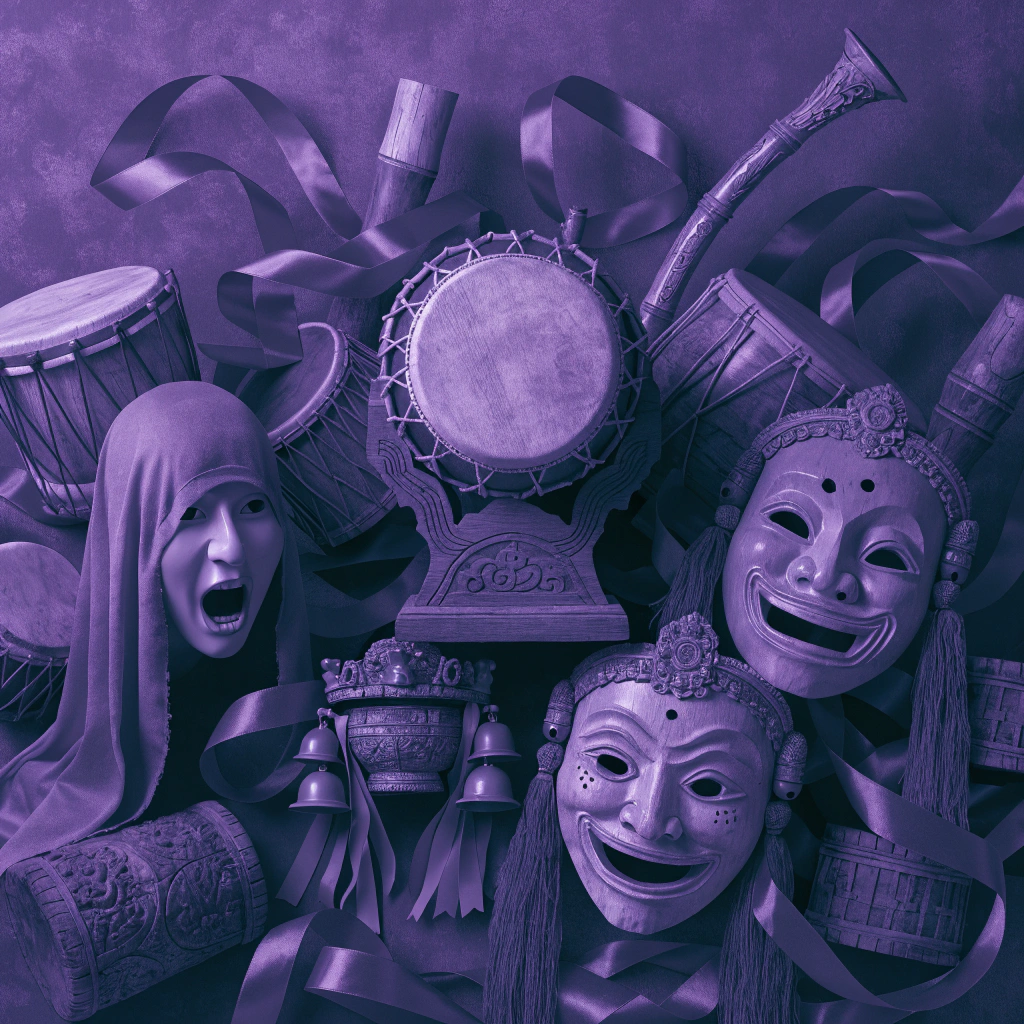
Nongak: Happy Music from Korea
Nongak is a special music from South Korea. It is very old. Long ago, farmers played this music to have a good harvest. Today, many people still love it.
The performers wear bright clothes. They wear hats with long ribbons. They dance and jump. It is very exciting. There are four main instruments. They are all drums and gongs.
People play Nongak at festivals. It brings people together. It is a happy part of Korean culture. You can see it in many villages. It is loud and beautiful.
Grammar Spotlight
Pattern: Present Simple (to be)
"Nongak is a special music from South Korea."
We use 'is' with singular subjects to state facts. It connects the subject to a description.
Pattern: Present Simple (Action Verbs)
"The performers wear bright clothes."
We use the base form of the verb for plural subjects. It describes habits or general truths.
Test Your Understanding
10 questions · A1 Beginner · 1 free preview
Test what you learned from this article. Answer all questions to earn XP!
Where is Nongak from?
Want to finish the quiz?
9 more questions are waiting for you. Sign up free to unlock the full quiz and earn XP!
Sign Up FreeAlready have an account? Sign In
Question Breakdown
Where is Nongak from?
Your answer:
Correct answer: South Korea
Nongak is very quiet music.
Your answer:
Correct answer: False
What does 'bright' mean?
Your answer:
Correct answer: A strong color
People play Nongak at _____.
Your answer:
Correct answer: festivals
Nongak: The Happy Music of Korean Farmers
Nongak is a very old and famous tradition in South Korea. People call it 'farmers’ music' because it started in small villages. Long ago, farmers played this music because they wanted a good harvest. They also played it to thank the local gods.
There are four main instruments in Nongak. These instruments are made of metal and wood. The music is very loud and high-energy. The performers wear colorful clothes and special hats. Some hats have long, white ribbons on top. The dancers move their heads quickly, and the ribbons make beautiful circles in the air.
Today, Nongak is more popular than before. People perform it at big festivals and in modern theaters. It is special because it brings people together. It is also louder and more exciting than many other traditional dances. People of all ages love to watch the acrobats and listen to the drums. It is a very important part of Korean culture.
Grammar Spotlight
Pattern: Past Simple
"Long ago, farmers played this music because they wanted a good harvest."
We use the Past Simple to talk about finished actions in the past. For regular verbs like 'play' and 'want', we add -ed to the end.
Pattern: Comparatives
"Today, Nongak is more popular than before."
We use 'more' + adjective + 'than' to compare two things. We use 'more' for long adjectives like 'popular' or 'exciting'.
Test Your Understanding
11 questions · A2 Elementary · 1 free preview
Test what you learned from this article. Answer all questions to earn XP!
Why did farmers play Nongak in the past?
Want to finish the quiz?
10 more questions are waiting for you. Sign up free to unlock the full quiz and earn XP!
Sign Up FreeAlready have an account? Sign In
Question Breakdown
Why did farmers play Nongak in the past?
Your answer:
Correct answer: To have a good harvest
Nongak uses four main instruments.
Your answer:
Correct answer: True
What does 'harvest' mean?
Your answer:
Correct answer: Collecting food from the fields
The performers wear _____ clothes and special hats.
Your answer:
Correct answer: colorful
What is on top of some of the performers' hats?
Your answer:
Correct answer: Ribbons
Nongak: The Energetic Heart of Korean Culture
Nongak is a vibrant and energetic performing art that has been part of Korean rural life for hundreds of years. Often called 'farmers' music,' it was originally created by villagers who wanted to celebrate a successful harvest. This tradition has evolved into a complex performance that combines music, dance, and theater.
The music is played using four traditional percussion instruments, which are collectively known as the 'Samul.' These instruments represent different elements of nature, such as lightning, wind, clouds, and rain. The loud, rhythmic sounds are designed to bring people together and create a sense of community. In the past, these performances were held to please local spirits, but today they are enjoyed by audiences all over the world.
During a Nongak show, the performers wear bright, traditional costumes. Many dancers wear special hats with long ribbons that they spin in the air while they jump. These breathtaking acrobatics have become a famous part of the tradition. Because the movements are so fast, the performers must train for many years to master the skills.
In recent years, Nongak has been protected by UNESCO as an Intangible Cultural Heritage. This means that the government and local communities have worked hard to ensure that the art form is not forgotten. Although Korea has changed into a modern society, Nongak remains a powerful symbol of the country’s history. It is a beautiful example of how ancient traditions can survive in the modern world.
Grammar Spotlight
Pattern: Present Perfect
"This tradition has evolved into a complex performance that combines music, dance, and theater."
The present perfect (have/has + past participle) is used here to describe an action that started in the past and has continued until now.
Pattern: Passive Voice
"In recent years, Nongak has been protected by UNESCO as an Intangible Cultural Heritage."
The passive voice is used to focus on the person or thing receiving the action (Nongak) rather than who is performing the action.
Test Your Understanding
11 questions · B1 Intermediate · 1 free preview
Test what you learned from this article. Answer all questions to earn XP!
What was the original reason for performing Nongak?
Want to finish the quiz?
10 more questions are waiting for you. Sign up free to unlock the full quiz and earn XP!
Sign Up FreeAlready have an account? Sign In
Question Breakdown
What was the original reason for performing Nongak?
Your answer:
Correct answer: To celebrate a successful harvest
Nongak only involves playing musical instruments.
Your answer:
Correct answer: False
Which word means 'traditions and qualities passed down through generations'?
Your answer:
Correct answer: Heritage
The performers wear bright, traditional _____.
Your answer:
Correct answer: costumes
What do the four instruments in the Samul represent?
Your answer:
Correct answer: Elements of nature
Nongak: The Rhythmic Heartbeat of Korean Heritage
Nongak, a vibrant and high-energy performing art, has served as the heartbeat of Korean rural life for centuries. Historically rooted in agricultural rites, this tradition was initially intended to appease local deities and ensure a bountiful harvest. However, over time, it has evolved into a comprehensive artistic expression that encompasses music, dance, theater, and breathtaking acrobatics. This multi-faceted manifestation of culture reflects the resilience and communal spirit of the Korean people.
At the core of any Nongak performance is the 'Samul'—the four traditional percussion instruments. These include the small gong (Kkwaenggwari), the large gong (Jing), the hourglass-shaped drum (Janggu), and the barrel drum (Buk). Each instrument is thought to represent a different weather phenomenon: thunder, wind, rain, and clouds, respectively. When played together, they create a complex, layered soundscape that symbolizes the harmony between humanity and nature. The small gong leads the ensemble with its piercing tones, while the deep resonance of the Jing provides a grounding foundation. The Janggu produces a variety of pitches that mimic the sound of falling rain, and the Buk adds a steady, heartbeat-like rhythm.
The performance is characterized by its immense vitality. Performers, often dressed in colorful traditional attire, execute synchronized movements while playing their instruments. The spectacle frequently includes 'Sangmo' spinning, where dancers rotate long ribbons attached to their hats in intricate patterns. Furthermore, Nongak often integrates theatrical sketches and spontaneous interaction with the audience, breaking the barrier between the performers and the observers. This inclusivity ensures that the performance transcends simple entertainment, becoming a shared experience for the entire community.
Despite the rapid urbanization of South Korea, Nongak remains a vital symbol of national identity. It is no longer restricted to rural fields; instead, it is celebrated in urban festivals and on international stages. Having been inscribed on the UNESCO Representative List of the Intangible Cultural Heritage of Humanity in 2014, its global significance is firmly established. By preserving these traditions, modern Koreans continue to honor their ancestors' deep-rooted connection to the land. In conclusion, Nongak is far more than just 'farmers' music.' It is a dynamic manifestation of history and a testament to the enduring power of community. As it continues to adapt, it serves as a living, breathing entity that inspires future generations.
Grammar Spotlight
Pattern: Present Perfect Passive
"Having been inscribed on the UNESCO Representative List of the Intangible Cultural Heritage of Humanity in 2014, its global significance is firmly established."
This structure uses 'having been' + past participle to show that an action was completed before the main action of the sentence. It emphasizes the status or result of the previous action.
Pattern: Reduced Relative Clauses
"Performers, often dressed in colorful traditional attire, execute synchronized movements while playing their instruments."
The phrase 'often dressed in' is a reduced relative clause, standing in for 'who are often dressed in'. This is a common B2 technique to make writing more concise and formal.
Pattern: Concessive Clauses with 'Despite'
"Despite the rapid urbanization of South Korea, Nongak remains a vital symbol of national identity."
'Despite' is a preposition used to introduce a contrast. It is followed by a noun phrase or a gerund, showing that something is true even though there is an obstacle.
Test Your Understanding
11 questions · B2 Upper Intermediate · 1 free preview
Test what you learned from this article. Answer all questions to earn XP!
What was the original historical purpose of Nongak?
Want to finish the quiz?
10 more questions are waiting for you. Sign up free to unlock the full quiz and earn XP!
Sign Up FreeAlready have an account? Sign In
Question Breakdown
What was the original historical purpose of Nongak?
Your answer:
Correct answer: To appease deities and ensure a successful harvest
Nongak is currently only performed in rural farming communities.
Your answer:
Correct answer: False
What does the word 'Manifestation' mean in the context of the article?
Your answer:
Correct answer: A clear sign or expression of something
The hourglass-shaped drum, known as the Janggu, is said to represent the weather phenomenon of _____.
Your answer:
Correct answer: rain
What does 'Sangmo' spinning involve?
Your answer:
Correct answer: Rotating long ribbons attached to hats
The Rhythmic Pulse of the Peninsula: Deciphering the Cultural Sophistication of Nongak
Seldom has a performance art form captured the visceral spirit of a nation as poignantly as Nongak. Originating in the fertile valleys of the Korean Peninsula, this "farmers’ music" transcends the mere categorization of folk entertainment. It represents a sophisticated syncretism of agricultural necessity, spiritual supplication, and artistic bravado. While modern audiences may view the high-energy percussion and breathtaking acrobatics as purely spectacle, the underlying structure of Nongak reveals a profound communal fluidity that has sustained rural Korean life for centuries.
Historically, the practice was deeply embedded in the rhythmic cycles of the agrarian calendar. Farmers sought to appease local deities through vibrant soundscapes, believing that the resonant vibrations of the drums could ensure a bountiful harvest and protect the village from malevolent spirits. The transformation of these agricultural rites into a comprehensive performing art involved the integration of intricate dance, satirical theater, and martial-arts-inspired acrobatics. It is the intricate interplay between the four percussion instruments—the Samul—that forms the acoustic backbone of the performance. The kkwaenggwari (small gong), jing (large gong), janggu (hourglass drum), and buk (barrel drum) do not merely provide a beat; they are symbolic representations of meteorological phenomena. The small gong mimics lightning, while the barrel drum represents the rolling clouds, creating a sonic landscape that bridges the gap between the terrestrial and the divine.
However, the transition of Nongak from the village square to the global stage has not been without its intellectual challenges. The preservation of Nongak’s historical authenticity often stands in direct opposition to its modern commodification. As South Korea underwent rapid industrialization and urbanization in the late 20th century, the traditional rural structures that birthed Nongak began to dissolve. What was once a spontaneous, participatory event has, in many contexts, become a rehearsed exhibition tailored for international consumption. This shift prompts a critical analysis: can a tradition rooted in soil and sweat retain its soul when transposed to the sterile environment of a professional theater? Scholars argue that the removal of the performance from its original communal context risks diluting its spiritual potency.
Despite these concerns, the resilience of Nongak lies in its inherent adaptability. Modern practitioners have embraced the ephemeral nature of the performance, allowing it to evolve alongside contemporary tastes while maintaining the core "gut" (ritualistic) elements. The nominalisation of its cultural significance as a UNESCO Intangible Cultural Heritage of Humanity has provided a vital safeguard against total erasure. Nevertheless, a persistent tension remains between honoring the ancestral past and fostering a living, breathing art form that resonates with the youth. Ultimately, Nongak serves as a mirror to the Korean psyche—tenacious, rhythmic, and deeply connected to the collective. It is not just music; it is a visceral testament to the endurance of community in an increasingly atomized world.
Grammar Spotlight
Pattern: Inversion with negative adverbials
"Seldom has a performance art form captured the visceral spirit of a nation as poignantly as Nongak."
When using negative or restrictive adverbials like 'seldom' or 'never' at the start of a sentence for emphasis, the auxiliary verb is placed before the subject.
Pattern: Cleft sentences
"It is the intricate interplay between the four percussion instruments—the Samul—that forms the acoustic backbone of the performance."
Cleft sentences use the structure 'It is/was + [emphasized part] + that/who' to focus the reader's attention on a specific element of the sentence.
Pattern: Nominalisation
"The nominalisation of its cultural significance as a UNESCO Intangible Cultural Heritage of Humanity has provided a vital safeguard against total erasure."
Nominalisation involves turning verbs or adjectives into nouns. This is a hallmark of C1/C2 writing, making the text sound more academic and abstract.
Test Your Understanding
12 questions · C1 Advanced · 1 free preview
Test what you learned from this article. Answer all questions to earn XP!
What was the primary historical purpose of the rhythmic sounds in Nongak?
Want to finish the quiz?
11 more questions are waiting for you. Sign up free to unlock the full quiz and earn XP!
Sign Up FreeAlready have an account? Sign In
Question Breakdown
What was the primary historical purpose of the rhythmic sounds in Nongak?
Your answer:
Correct answer: To appease deities and ensure a successful harvest
The four instruments of the Samul are intended to represent different types of weather.
Your answer:
Correct answer: True
What does 'commodification' refer to in the context of the article?
Your answer:
Correct answer: The process of turning a cultural tradition into a commercial product
Nongak represents a sophisticated _____ of agricultural necessity and artistic bravado.
Your answer:
Correct answer: syncretism
What is a major concern regarding the modern performance of Nongak in theaters?
Your answer:
Correct answer: The loss of its original communal and spiritual context
The author suggests that Nongak is a dead relic that cannot adapt to the modern world.
Your answer:
Correct answer: False
The Rhythmic Pulse of the Agrarian Soul: A Socio-Analytical Inquiry into Nongak
The rhythmic pulse of Nongak, often characterized as the heartbeat of the Korean countryside, represents a profound synthesis of the mundane and the metaphysical. To view Nongak merely as a percussive performance would be to overlook its intrinsic role as a communal mechanism for social cohesion and spiritual propitiation. Originating in the agrarian rites of antiquity, Nongak has undergone a remarkable metamorphosis, evolving from a localized ritual intended to ensure a bountiful harvest into a quintessence of Korean national identity. Central to this performance is the Samul, a quartet of instruments whose sounds are purported to mirror natural phenomena: the lightning, the wind, the clouds, and the rain. Each strike of the drum is not merely a musical note but a symbolic invocation of the elements, seeking harmony between human labor and the unpredictable whims of nature.
Should one observe a full-scale Nongak performance, the sheer kinetic energy is palpable. The dancers, adorned in vibrant vestments and rotating long ribbons attached to their headgear, execute intricate maneuvers that blur the line between the physical and the spiritual. It is imperative that the lead performer, or Sangsoe, maintain a delicate balance between rhythmic precision and improvisational flair. Seldom does an art form encapsulate such a broad spectrum of human experience, ranging from the somber supplication for divine favor to the exuberant celebration of communal triumph. This versatility is what allowed Nongak to survive the tumultuous shifts of Korean history, adapting its form while preserving its core spiritual resonance.
The liminal space occupied by Nongak—existing somewhere between the sacred and the profane—allows for a unique form of social expression. In historical contexts, it served as a vehicle for subverting rigid social hierarchies, albeit temporarily. Through the use of masks and theatrical satire, performers could critique the ruling elite under the guise of festive revelry. This idiosyncratic blend of entertainment and social commentary underscores the sophistication of rural Korean culture, which utilized the 'carnivalesque' to vent social frustrations and reinforce village solidarity. The performance was never a passive experience; it demanded the active participation of the audience, creating a collective euphoria that transcended individual identity.
However, the transition into the modern era has not been without its challenges. As urbanization accelerated during the 20th century, the traditional agrarian structures that sustained Nongak began to erode. One might posit that the relocation of Nongak from the village square to the proscenium arch has altered its fundamental character, turning a participatory rite into a spectator sport. While institutionalization has ensured its preservation as a UNESCO Intangible Cultural Heritage, there remains a vestigial longing for the raw, ephemeral spontaneity of its original context. The challenge for contemporary practitioners lies in maintaining the 'heung'—an irrepressible surge of internal joy—within the confines of a modern stage.
Furthermore, the technical virtuosity required for contemporary Nongak is staggering. The Sangmo spinning, where performers rotate ribbons in complex geometric patterns while dancing, requires years of disciplined training. Lest the performance become a mere gymnastic display, practitioners emphasize that the physical movements must be an extension of the internal rhythm. It is this symbiosis of technical mastery and emotional depth that continues to captivate audiences globally. Whether performed in a rural field during the lunar New Year or in a metropolitan concert hall, Nongak’s percussive resonance serves as a bridge across time, connecting contemporary Koreans with the ancestral rhythms of their land. It remains a living, breathing entity that continues to adapt to the exigencies of the present while honoring its ancient roots.
Grammar Spotlight
Pattern: Inversion with 'Should' (Conditional)
"Should one observe a full-scale Nongak performance, the sheer kinetic energy is palpable."
This is a formal way of expressing a first conditional. By inverting the subject and 'should', the sentence gains a more scholarly and hypothetical tone.
Pattern: Subjunctive Mood
"It is imperative that the lead performer, or Sangsoe, maintain a delicate balance between rhythmic precision and improvisational flair."
The subjunctive 'maintain' (instead of 'maintains') is used after adjectives indicating importance or necessity, such as 'imperative', 'essential', or 'crucial'.
Pattern: Negative Inversion
"Seldom does an art form encapsulate such a broad spectrum of human experience..."
When a sentence begins with a negative or restrictive adverb like 'seldom', 'never', or 'rarely', the auxiliary verb and subject are inverted for rhetorical emphasis.
Test Your Understanding
12 questions · C2 Mastery · 1 free preview
Test what you learned from this article. Answer all questions to earn XP!
What is the primary symbolic function of the instruments in the Samul quartet?
Want to finish the quiz?
11 more questions are waiting for you. Sign up free to unlock the full quiz and earn XP!
Sign Up FreeAlready have an account? Sign In
Question Breakdown
What is the primary symbolic function of the instruments in the Samul quartet?
Your answer:
Correct answer: To mirror natural weather phenomena
Historically, Nongak was used as a tool to support and reinforce the rigid social hierarchies of the ruling elite.
Your answer:
Correct answer: False
Which word describes the 'perfect or typical example' of something?
Your answer:
Correct answer: Quintessence
The transition from village squares to modern stages has led to a _____ longing for the original spontaneity of Nongak.
Your answer:
Correct answer: vestigial
What does the term 'heung' refer to in the context of the article?
Your answer:
Correct answer: An irrepressible surge of internal joy
The article suggests that the institutionalization of Nongak has come at the cost of its original participatory nature.
Your answer:
Correct answer: True
