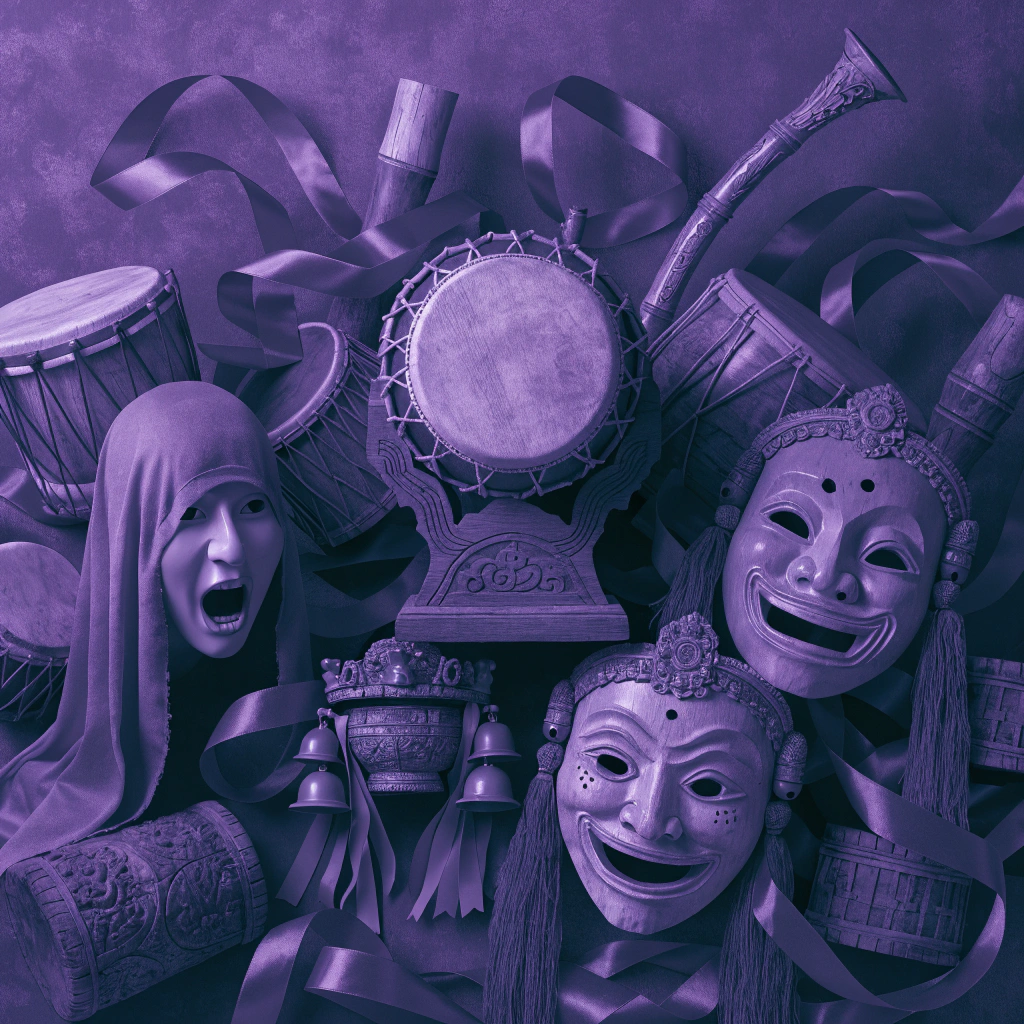
The Famous Mask Dance of Korea
Talchum is a traditional dance from South Korea. It is a very famous mask dance. Dancers wear colorful masks on their faces. These masks are made of wood or paper.
In the dance, people tell funny stories. They use traditional music and big movements. They often dance in the village or at big markets.
Talchum is very old. It shows the life of normal people in Korea. Many people like to watch the dance today because it is fun. It is a special part of Korean culture. Visitors love this beautiful art.
Grammar Spotlight
Pattern: Present Simple (to be)
"It is a very famous mask dance."
We use 'is' with singular subjects like 'it' or 'Talchum'. This pattern is used to describe facts or give information about a thing.
Pattern: Present Simple (Plural Verbs)
"Dancers wear colorful masks on their faces."
When the subject is plural (like 'dancers'), the verb stays in its base form. We do not add '-s' to the verb 'wear' in this case.
Test Your Understanding
10 questions · A1 Beginner · 1 free preview
Test what you learned from this article. Answer all questions to earn XP!
Where is the dance Talchum from?
Want to finish the quiz?
9 more questions are waiting for you. Sign up free to unlock the full quiz and earn XP!
Sign Up FreeAlready have an account? Sign In
Question Breakdown
Where is the dance Talchum from?
Your answer:
Correct answer: South Korea
The masks are made of plastic.
Your answer:
Correct answer: False
What is a 'market'?
Your answer:
Correct answer: A place to buy and sell things
Dancers wear colorful _____ on their faces.
Your answer:
Correct answer: masks
Talchum: The Funny Mask Dance of Korea
Talchum is a famous traditional dance from South Korea. In this dance, the performers wear colorful masks and beautiful costumes. They dance, play music, and tell funny stories to the audience.
In the past, people performed Talchum at village festivals and markets. It was more than just a dance. It was a way for the common people to talk about their problems. They used humor to show that some rich people were not always good. They also showed that some monks were not honest. Because the dancers wore masks, they could say things that were usually difficult to say.
The masks are very important in Talchum. Artists made them from wood or paper. Some masks look happy, and others look angry or strange. Today, Talchum is a special part of Korean culture. It is more popular than many other old dances because it is funny and exciting. Many tourists go to Korea to see these amazing performances.
Grammar Spotlight
Pattern: Past Simple
"In the past, people performed Talchum at village festivals and markets."
We use the past simple to talk about completed actions in the past. For regular verbs, we usually add '-ed' to the end of the word.
Pattern: Comparatives
"It is more popular than many other old dances because it is funny and exciting."
We use 'more' plus an adjective and 'than' to compare two things. This is used for longer adjectives like 'popular' or 'exciting'.
Test Your Understanding
11 questions · A2 Elementary · 1 free preview
Test what you learned from this article. Answer all questions to earn XP!
Where did people usually perform Talchum in the past?
Want to finish the quiz?
10 more questions are waiting for you. Sign up free to unlock the full quiz and earn XP!
Sign Up FreeAlready have an account? Sign In
Question Breakdown
Where did people usually perform Talchum in the past?
Your answer:
Correct answer: At village festivals and markets
Dancers wore masks so they could say things that were usually difficult to say.
Your answer:
Correct answer: True
What is the meaning of 'performer'?
Your answer:
Correct answer: A person who acts, sings, or dances
Artists made the masks from _____ or paper.
Your answer:
Correct answer: wood
Why is Talchum popular today?
Your answer:
Correct answer: Because it is funny and exciting
Talchum: The Art of the Korean Mask Dance
Talchum is a traditional art form from South Korea that combines dance, music, and theater into one exciting show. It has been performed for centuries at outdoor village festivals and busy marketplaces across the country. While it looks like a simple celebration, Talchum actually carries a deep meaning and tells important stories about the past.
Historically, this dance was a vital way for common people to express their frustration with society. In the past, Korean society was very strict and divided into different classes. Through these performances, the actors could critique the aristocracy and powerful monks who were not acting fairly. They used humor and satire to show the hypocrisy of the ruling class. Because the actors were wearing masks, they could speak freely about social problems without being punished by the leaders.
The masks are the most important part of the performance. They are usually made from wood or paper and are painted with bright, bold colors. Many of the faces have exaggerated features, such as very large noses, strange smiles, or uneven eyes. These details help to symbolize different characters and their personalities. For example, a mask with a red face might represent a character who is angry, while a white mask might show a young woman.
Today, Talchum is not just a historical memory; it is a living tradition that people still love. It has been preserved carefully as an important part of Korea's cultural heritage. Modern audiences, including many international tourists, still enjoy watching these energetic shows in Seoul and other cities. By watching Talchum, people can learn about Korean history while enjoying a funny and colorful story. It remains a powerful symbol of the people's voice and their creative spirit.
Grammar Spotlight
Pattern: Present Perfect Passive
"It has been performed for centuries at outdoor village festivals..."
This pattern is used to talk about an action that started in the past and is still relevant today, where the focus is on the action rather than the person doing it. It is formed using 'has/have + been + past participle'.
Pattern: Relative Clauses with 'Who'
"...monks who were not acting fairly."
Relative clauses give us more information about a person. We use the relative pronoun 'who' to connect a description directly to the noun it describes.
Test Your Understanding
11 questions · B1 Intermediate · 1 free preview
Test what you learned from this article. Answer all questions to earn XP!
What three elements does Talchum combine into one show?
Want to finish the quiz?
10 more questions are waiting for you. Sign up free to unlock the full quiz and earn XP!
Sign Up FreeAlready have an account? Sign In
Question Breakdown
What three elements does Talchum combine into one show?
Your answer:
Correct answer: Dance, music, and theater
Wearing masks allowed the actors to speak freely without being punished.
Your answer:
Correct answer: True
What does the word 'exaggerated' mean in the context of the masks?
Your answer:
Correct answer: Made to look bigger or more intense than normal
Talchum is a _____ art form from South Korea.
Your answer:
Correct answer: traditional
What might a red-faced mask symbolize in a performance?
Your answer:
Correct answer: An angry or drunk character
Talchum: The Satirical Soul of Korean Mask Dance
Talchum, the traditional Korean mask dance drama, is a multifaceted art form that has captivated audiences for centuries. Originating as a ritualistic practice to pray for a good harvest and communal peace, it subsequently evolved into a powerful medium for social commentary and artistic expression. Historically performed at vibrant outdoor village festivals or bustling marketplaces, Talchum served as a vital outlet for the common people to vent their frustrations against the rigid social structures of the Joseon Dynasty. It was a unique cultural space where the marginalized could reclaim their voices through performance.
Central to the performance is its satirical nature. Through a clever blend of rhythmic dance, traditional music, and spoken theater, performers would mock the hypocrisy of the yangban—the ruling aristocracy—and corrupt religious figures who failed to live up to their moral obligations. By wearing masks, the performers were granted the freedom to safely criticize those in power, as the disguise provided a necessary layer of anonymity. Crafted from materials such as wood, paper, or even dried gourds, these masks are highly symbolic. Their exaggerated features, such as lopsided grins or bulging eyes, represent specific character archetypes and social status, allowing the audience to immediately identify the subject of the satire.
Furthermore, Talchum is notable for its improvisational elements and the unique relationship it shares with its viewers. Unlike the formal and restrained court dances of the era, Talchum encourages active interaction between the performers and the audience. The spectators are not merely passive observers; they often shout words of encouragement, laugh loudly at the jokes, or even join in the dancing during the finale. This breakdown of the 'fourth wall' fostered a deep sense of community and collective resilience among the commoners, turning a simple performance into a shared experience of catharsis.
Despite the rapid modernization of South Korea, Talchum remains a significant cultural treasure that bridges the past and the present. In 2022, its global importance was recognized when it was officially inscribed on the UNESCO Representative List of the Intangible Cultural Heritage of Humanity. Today, while it may no longer serve as a primary tool for political protest, it continues to be celebrated for its immense artistic value and historical depth. Modern troupes across the country strive to preserve the authentic movements and complex rhythms of the drums and flutes, ensuring that this dynamic expression of Korean identity is passed down to future generations. By studying Talchum, one gains profound insight into the enduring spirit of a people who used humor and art to navigate the complexities of their society.
Grammar Spotlight
Pattern: Passive Voice
"Talchum was historically performed at vibrant outdoor village festivals or bustling marketplaces."
The passive voice is used here to focus on the action (the performance) rather than the specific actors, which is common in historical descriptions.
Pattern: Non-defining Relative Clauses
"...the yangban—the ruling aristocracy—and corrupt religious figures who failed to live up to their moral obligations."
This clause adds extra information about the 'religious figures'. It is used to provide context without being essential to the sentence structure.
Pattern: Past Participle Phrases
"Crafted from materials such as wood, paper, or even dried gourds, these masks are highly symbolic."
Starting a sentence with a past participle phrase provides a concise way to give background information about the subject (the masks).
Test Your Understanding
11 questions · B2 Upper Intermediate · 1 free preview
Test what you learned from this article. Answer all questions to earn XP!
What was the primary social function of Talchum during the Joseon Dynasty?
Want to finish the quiz?
10 more questions are waiting for you. Sign up free to unlock the full quiz and earn XP!
Sign Up FreeAlready have an account? Sign In
Question Breakdown
What was the primary social function of Talchum during the Joseon Dynasty?
Your answer:
Correct answer: To serve as an outlet for criticizing the ruling class
Talchum masks were strictly realistic and avoided exaggeration.
Your answer:
Correct answer: False
Which word describes the ability to recover from social hardship or difficulties?
Your answer:
Correct answer: Resilience
Talchum served as a vital _____ for the common people to express their frustrations.
Your answer:
Correct answer: outlet
When was Talchum inscribed on the UNESCO Intangible Cultural Heritage list?
Your answer:
Correct answer: 2022
The Subversive Elegance of Talchum: Satire Behind the Shimmering Masks
Seldom has a theatrical form managed to encapsulate the collective grievances of a populace as poignantly as Talchum, Korea’s traditional mask dance drama. While many perceive it as a mere vestige of agrarian folk life, its essence lies in a sophisticated socio-political subversion that once rattled the foundations of the Joseon dynasty. Historically, these performances were not confined to the sterile stages of the elite; rather, they flourished in the bustling marketplaces and open village squares, serving as a vital conduit for the frustrations of the common people. Through a combination of dance, music, and spoken dialogue, Talchum provided a platform for those silenced by the rigid structures of the past.
It is the deliberate anonymity afforded by the grotesque masks that empowers the performers to challenge the status quo. By donning these exaggerated wooden or papier-mâché faces, actors could bypass the draconian censorship of the era, launching scathing critiques against the hypocrisy of the 'yangban' aristocracy and the moral decay of apostate monks. The masks function as a psychological veneer, allowing the marginalized to satirize their oppressors without immediate fear of retribution. This theatrical artifice creates a liminal space where the rigid boundaries of social class are momentarily suspended, replaced by a carnivalesque atmosphere of egalitarian defiance.
The choreography of Talchum is characterized by a fluid, almost ethereal grace, juxtaposed with moments of jarring, earthbound humor. The movements are not merely aesthetic; they are symbolic representations of the struggle against subjugation. The wide, sweeping motions of the arms suggest a longing for freedom, while the rhythmic stomping reflects an unbreakable connection to the land. Through this physical vocabulary, the performers articulate a narrative of resilience that transcends the parochial concerns of their specific time and place. It is this duality of elegance and earthiness that makes the performance so captivating to the modern observer.
Furthermore, the systematic dismantling of the rigid Confucian hierarchy occurs through the medium of biting wit and caricature. The 'yangban' characters are often depicted as bumbling, incompetent, or physically deformed, stripped of their undeserved dignity through ridicule. This collective catharsis was essential for maintaining social cohesion in a society defined by extreme inequality. By laughing at their masters, the audience engaged in a symbolic reclamation of power, finding solace in the shared recognition of their common humanity. This ritualistic mocking served as a safety valve for societal pressure.
In the contemporary era, the preservation of these rituals has taken on a new significance. No longer just a tool for class struggle, Talchum has evolved into a symbol of national identity and cultural continuity. However, the commodification of traditional arts in the global tourism market poses a risk of diluting its original subversive spirit. To truly appreciate Talchum is to look beyond the vibrant colors and rhythmic drums, recognizing it as a testament to the enduring human desire for justice and the transformative power of art. It remains a poignant reminder that even under the most oppressive structures, the voice of the people will find a way to resonate, masked yet unyielding.
Grammar Spotlight
Pattern: Negative Inversion
"Seldom has a theatrical form managed to encapsulate the collective grievances of a populace as poignantly as Talchum."
When a negative or restrictive adverb (like 'seldom') starts a sentence, the subject and auxiliary verb are inverted. This is used for emphasis and is common in formal C1-level writing.
Pattern: Cleft Sentences
"It is the deliberate anonymity afforded by the grotesque masks that empowers the performers to challenge the status quo."
A cleft sentence focuses on a specific part of the information by using the structure 'It is/was [focus] that...'. It highlights the cause or agent in a complex sentence.
Pattern: Nominalization
"Furthermore, the systematic dismantling of the rigid Confucian hierarchy occurs through the medium of biting wit and caricature."
Nominalization involves turning verbs or adjectives into nouns (e.g., 'dismantling'). This creates a more abstract, academic, and formal tone suitable for advanced analysis.
Test Your Understanding
12 questions · C1 Advanced · 1 free preview
Test what you learned from this article. Answer all questions to earn XP!
What was the primary function of Talchum in historical Korean society?
Want to finish the quiz?
11 more questions are waiting for you. Sign up free to unlock the full quiz and earn XP!
Sign Up FreeAlready have an account? Sign In
Question Breakdown
What was the primary function of Talchum in historical Korean society?
Your answer:
Correct answer: To serve as a vehicle for social criticism and emotional release
The masks used in Talchum were designed to make the performers easily identifiable to the authorities.
Your answer:
Correct answer: False
Which word describes the process of turning a cultural art form into a commercial product?
Your answer:
Correct answer: Commodification
The masks functioned as a psychological _____ that allowed actors to mock their superiors safely.
Your answer:
Correct answer: veneer
How are 'yangban' characters typically portrayed in Talchum?
Your answer:
Correct answer: As incompetent and ridiculous figures
According to the article, modern tourism poses no risk to the original spirit of Talchum.
Your answer:
Correct answer: False
The Mask of Subversion: An Ontological Analysis of Talchum
Were one to scrutinize the historical trajectory of Korean performing arts, the mask dance drama known as Talchum would undoubtedly emerge as a preeminent site of cultural resistance. Far from being a mere vestige of a bygone epoch, Talchum represents a sophisticated synthesis of theatricality and social critique that continues to resonate in the contemporary era. Historically performed at outdoor village festivals or bustling marketplaces, this multifaceted art form served as a vital outlet for the commonality to vent their frustrations against the systemic injustices of the Joseon period. It functioned as a pedagogical tool, educating the masses on the inherent hypocrisies of the ruling 'yangban' aristocracy and the moral decay of corrupted monks, all while maintaining a veneer of festive entertainment.
The masks themselves are central to this ontological shift, providing the performers with a shield of anonymity that was requisite for such bold subversion. In a society governed by rigid Neo-Confucian hierarchies, the act of mocking a superior was a perilous endeavor. However, once the mask was donned, the performer ceased to be an individual subject to the law and became a vessel for collective satire. Not only does the mask conceal the wearer’s identity, but it also amplifies the archetypal characteristics of the persona being lampooned. The exaggerated features—distorted mouths, bulbous noses, and asymmetrical eyes—serve to dehumanize the elite, stripping them of their perceived hegemony and rendering them objects of ridicule.
Central to the aesthetic experience of Talchum is the interplay between 'han' (a deep-seated sense of sorrow or unresolved resentment) and 'heung' (a state of exuberant joy or exhilaration). This juxtaposition facilitates a profound psychological catharsis for both the performers and the audience. As the rhythmic cadence of the 'janggu' drum intensifies, the narrative transitions from a depiction of suffering to an ecstatic celebration of resilience. It is through this deliberate use of caricature and dance that the audience is invited to transcend their mundane hardships. The ephemeral nature of the performance, occurring in the 'madang' or open field, further emphasizes the breakdown of the fourth wall, as spectators are often drawn into the dialogue, blurring the boundary between observer and participant.
Moreover, Talchum is not merely a relic of historical grievances; it is a living tradition that undergoes constant reinterpretation. While the specific socio-political targets may have shifted from feudal lords to modern corporate or political figures, the underlying mechanism of challenging authority remains intact. The regional variations, such as the Bongsan and Hahoe styles, underscore the fact that Talchum was never a monolithic entity but rather a localized response to universal themes of inequality and human frailty. Notwithstanding the modernization of South Korea, the vestige of these traditional performances remains a cornerstone of national identity.
In recent years, the global recognition of Talchum, culminating in its inscription on the UNESCO Representative List of the Intangible Cultural Heritage of Humanity, has prompted a renewed academic interest in its structural complexities. Scholars now analyze the dance movements not merely as rhythmic exercises but as encoded semiotic systems that communicate complex emotional states. The pedagogical value of Talchum in contemporary education cannot be overstated, as it fosters a critical understanding of how art can serve as a catalyst for social change. In conclusion, Talchum remains a testament to the enduring power of the human spirit to seek justice through the medium of creative expression, proving that the mask, rather than hiding the truth, often serves to reveal it more clearly.
Grammar Spotlight
Pattern: Second Conditional with Subjunctive 'Were'
"Were one to scrutinize the historical trajectory of Korean performing arts, the mask dance drama known as Talchum would undoubtedly emerge as a preeminent site of cultural resistance."
This formal structure uses 'were' instead of 'if... was/were' to express a hypothetical or unlikely condition. It is common in academic writing to introduce an analytical perspective.
Pattern: Negative Inversion
"Not only does the mask conceal the wearer’s identity, but it also amplifies the archetypal characteristics of the persona being lampooned."
Inversion occurs when a negative or restrictive adverbial starts a sentence, requiring the auxiliary verb to come before the subject. This adds emphasis and formal variety to the prose.
Pattern: Cleft Sentence (It is... that...)
"It is through this deliberate use of caricature and dance that the audience is invited to transcend their mundane hardships."
Cleft sentences are used to focus on a specific part of the sentence (the instrument or method in this case). It highlights 'through this deliberate use' as the primary cause of the audience's experience.
Test Your Understanding
12 questions · C2 Mastery · 1 free preview
Test what you learned from this article. Answer all questions to earn XP!
According to the text, what was the primary social function of Talchum during the Joseon period?
Want to finish the quiz?
11 more questions are waiting for you. Sign up free to unlock the full quiz and earn XP!
Sign Up FreeAlready have an account? Sign In
Question Breakdown
According to the text, what was the primary social function of Talchum during the Joseon period?
Your answer:
Correct answer: To serve as a medium for criticizing social injustices and hypocrisy
The author suggests that Talchum is a monolithic art form with no regional variations.
Your answer:
Correct answer: False
What does 'catharsis' mean in the context of the article?
Your answer:
Correct answer: The emotional relief experienced through art
The mask provided performers with a shield of _____ which allowed them to mock their superiors safely.
Your answer:
Correct answer: anonymity
What does the term 'heung' represent in the aesthetic of Talchum?
Your answer:
Correct answer: A state of exuberant joy
Talchum has been recognized by UNESCO as part of the Intangible Cultural Heritage of Humanity.
Your answer:
Correct answer: True
