forrest in 30 Seconds
- A large area dominated by trees and undergrowth.
- A vital ecosystem providing oxygen and habitat for wildlife.
- Commonly used in environmental, recreational, and mythological contexts.
- Distinguished from woods by its larger size and greater density.
The term forest refers to a complex ecological system dominated by trees, yet it encompasses far more than just a collection of timber. In a biological sense, a forest is a dense growth of trees and underbrush covering a large tract of land. It serves as a vital organ for the planet, often described as the 'lungs of the Earth' due to its role in carbon sequestration and oxygen production. When people use this word, they are often referring to a place of mystery, natural beauty, or significant environmental importance. It is distinguished from a 'wood' by its size and the density of its canopy, which often creates a unique microclimate beneath the leaves. In modern discourse, the word is frequently used in the context of conservation, climate change, and biodiversity. For instance, scientists discuss the 'Amazon Rainforest' not just as a location, but as a critical component of global weather patterns. On a more personal level, people use the word when describing recreational activities like hiking, camping, or 'forest bathing'—a practice known as shinrin-yoku in Japan, which emphasizes the healing power of being among trees.
- Biological Context
- A forest is a climax community, meaning it is a stable, mature ecosystem that has reached a steady state through the process of ecological succession.
- Economic Context
- Forests are sources of timber, medicinal plants, and non-timber forest products, supporting millions of livelihoods globally.
The word also carries deep cultural and mythological weight. In folklore, the forest is often a place of transformation or danger, where characters like Little Red Riding Hood or Hansel and Gretel encounter the unknown. This duality—the forest as both a provider of life and a place of hidden depths—makes it a powerful word in literature and daily conversation. Whether you are talking about a 'temperate forest' in Europe or a 'boreal forest' in Canada, the word evokes a sense of vastness and complexity. It is also used metaphorically; one might say they 'cannot see the forest for the trees,' meaning they are so focused on small details that they miss the overall situation. This versatility ensures that the word remains central to both scientific terminology and everyday English.
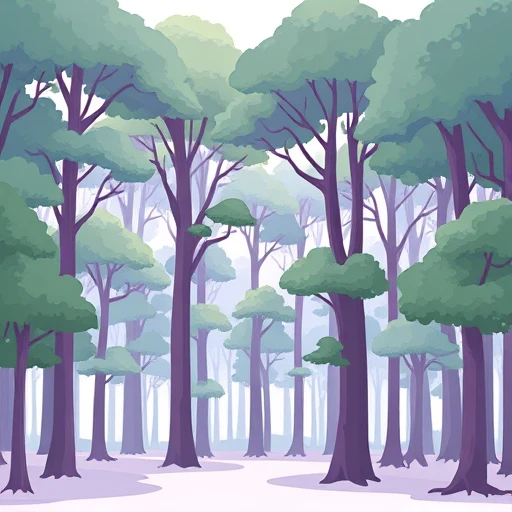
The ancient forest stood silent, its towering pines whispering secrets to the wind as the first light of dawn filtered through the thick canopy.
Furthermore, the word is essential in discussing global issues. Deforestation—the clearing of forests—is a major contributor to global warming. Conversely, reforestation and afforestation are key strategies for environmental restoration. When using the word, consider the specific type of forest you are referring to: deciduous (trees that lose leaves), coniferous (evergreen trees with needles), or tropical. Each type has its own characteristics, but they all share the fundamental definition of being a tree-dominated landscape. In urban planning, we even hear about 'urban forests,' which are the collections of trees within a city that help manage heat and improve air quality. This expansion of the word's use shows how integral trees are to human survival and well-being, regardless of the setting.
Conservationists are working tirelessly to protect the tropical forest from illegal logging and land conversion.
- Environmental Impact
- Forests act as carbon sinks, absorbing billions of tonnes of CO2 annually, which helps mitigate the effects of climate change.
In summary, 'forest' is a word that bridges the gap between the physical world and the human imagination. It describes a physical place of immense biological variety and a symbolic space of mystery and growth. Its usage spans from the simplest A1 descriptions of 'green trees' to complex C2 discussions on 'climax ecosystems' and 'silviculture.' Understanding this word requires an appreciation for its ecological, economic, and cultural dimensions.
Using the word forest correctly involves understanding its role as a countable noun and the common adjectives and verbs that accompany it. Because a forest is a physical location, it is often used with prepositions of place such as 'in,' 'through,' 'into,' and 'across.' For example, you might 'walk through the forest' or 'live near the forest.' When describing the density or state of the forest, adjectives like 'dense,' 'lush,' 'thick,' 'ancient,' 'primeval,' and 'vast' are frequently employed. These modifiers help the listener or reader visualize the specific type of environment being discussed. A 'dense forest' implies that the trees are very close together, making it difficult to pass through, while an 'ancient forest' suggests a place that has remained undisturbed for centuries, often containing high levels of biodiversity.
- Verb Pairings
- Common verbs include: preserve, protect, clear, explore, venture into, and manage.
- Adjective Modifiers
- Common adjectives include: tropical, temperate, boreal, deciduous, coniferous, and evergreen.
In more technical or academic writing, 'forest' often appears in compound nouns or as part of a larger phrase. Phrases like 'forest management,' 'forest fire,' 'forest floor,' and 'forest canopy' are standard in environmental science. For instance, 'The forest floor is rich in nutrients due to the decomposition of organic matter.' Here, 'forest floor' specifically refers to the ground layer of the ecosystem. Similarly, 'forest canopy' refers to the upper layer formed by the crowns of the trees. When writing about environmental issues, you might use the word in the context of 'forest degradation' or 'forest conservation.' These terms are more precise than simply saying the forest is 'getting worse' or 'being saved.'
The hikers were warned not to enter the forest without a map, as the trails were poorly marked and the terrain was treacherous.
Metaphorical usage is also common in English. The most famous idiom is 'to not see the forest for the trees.' This is used when someone is so involved in the details of a problem that they do not look at the situation as a whole. For example, 'The manager was so worried about the daily reports that he didn't see the forest for the trees and missed the overall decline in sales.' Another metaphorical use is 'a forest of [something],' which describes a large, confusing, or dense collection of objects. One might speak of 'a forest of microphones' at a press conference or 'a forest of skyscrapers' in a major city like New York. This usage emphasizes the overwhelming number and density of the objects, drawing a parallel to the physical density of a natural forest.
After the storm, the yard was a forest of fallen branches and debris, making it impossible to drive the car out.
- Prepositional Phrases
- 'Deep in the forest,' 'On the edge of the forest,' 'Across the forest,' 'Through the forest.'
When constructing sentences, pay attention to the level of formality. In a casual conversation, you might say, 'We went for a walk in the forest.' In a scientific report, you would likely be more specific: 'The study was conducted within a temperate deciduous forest to observe the migratory patterns of local bird species.' The word 'forest' remains the same, but the surrounding vocabulary changes to suit the audience. By mastering these different ways to use the word, you can communicate more effectively in both everyday and professional contexts.
The word forest is ubiquitous in various media, from news reports to children's literature. In the realm of news and current events, you will hear it most often in stories related to the environment. Headlines frequently mention 'forest fires' (or 'wildfires') during the summer months, especially in regions like California, Australia, and the Mediterranean. News anchors might report on 'deforestation in the Amazon' or 'new forest conservation laws' passed by a government. In these contexts, the word is often associated with urgency, crisis, or political debate. Listening to podcasts or watching documentaries about nature—such as those narrated by David Attenborough—will expose you to the word used with scientific precision, describing various biomes and the wildlife that inhabits them.
- In the News
- 'The raging forest fire has already consumed ten thousand acres of land, forcing residents to evacuate.'
- In Documentaries
- 'Deep within the tropical rainforest, species have evolved unique survival strategies found nowhere else on Earth.'
In literature and film, the forest is a staple setting. You hear it in fairy tales like 'The Brothers Grimm,' where the forest is a place of magic and peril. In fantasy epics like J.R.R. Tolkien's 'The Lord of the Rings,' forests like Fangorn or Mirkwood are characters in their own right, possessing ancient wisdom and dangerous secrets. Movie trailers often use the word to set a mood: 'In a world where the forest holds the key to the past...' This cinematic use of the word leans into the mysterious and atmospheric qualities of large wooded areas. Even in pop music, the forest appears as a metaphor for being lost or finding oneself, as seen in songs by artists like Taylor Swift (in her 'folklore' and 'evermore' albums) or indie bands who use 'forest' imagery to evoke a sense of naturalism and introspection.
'The forest is the shadow of civilization, a place where the rules of the city no longer apply,' the narrator intoned in the documentary's opening.
You will also encounter the word in educational settings. From primary school geography lessons to university-level ecology lectures, 'forest' is a fundamental term. Teachers explain the water cycle by describing how forests release moisture into the atmosphere through transpiration. In business and economics, you might hear about the 'forestry industry,' which deals with the management and harvesting of trees for paper and lumber. Even in the tech world, the word 'forest' has a specific meaning in Active Directory (a Microsoft technology), where it refers to a collection of one or more domain trees. This shows how a word rooted in nature can be adapted into highly technical, non-natural fields.
During the lecture, the professor explained how the forest ecosystem relies on a delicate balance between predators and prey.
- In Daily Life
- 'Let's go for a hike in the national forest this weekend; the air is so much cleaner there.'
Finally, the word is common in travel and tourism. Brochures for national parks, travel blogs, and Instagram captions often feature the word to attract visitors. Phrases like 'explore the enchanted forest' or 'hidden gems in the Black Forest' are used to market destinations. Whether you are reading a scientific paper, a fantasy novel, or a travel guide, the word 'forest' is a constant presence, signifying a place of depth, life, and significance. Its widespread use across different domains highlights its importance in the English language.
One of the most frequent mistakes learners make with the word forest is confusing it with similar terms like 'wood,' 'woods,' or 'jungle.' While they all involve trees, they are not interchangeable. A 'wood' (or 'the woods') is generally smaller and less dense than a forest. If you are walking in a small area of trees behind your house, you are likely in the woods, not a forest. A 'jungle' specifically refers to a tropical forest with very dense, tangled vegetation at ground level, often making it nearly impenetrable. Calling a pine forest in Norway a 'jungle' would be incorrect. Understanding these nuances helps in providing accurate descriptions and avoiding confusion.
- Forest vs. Wood
- A forest is a large, complex ecosystem; a wood is a smaller area of trees, often managed or near human habitation.
- Forest vs. Jungle
- A jungle is a type of tropical forest characterized by thick ground-level vegetation; not all forests are jungles.
Spelling is another area where errors occur. As noted in the prompt, some might spell it 'forrest' with two 'r's. While 'Forrest' is a common English surname (like Forrest Gump), the noun referring to the trees is always spelled with a single 'r': forest. Mixing these up can make writing appear unprofessional or lead to confusion with proper names. Additionally, learners sometimes struggle with the countability of the word. 'Forest' is a countable noun, so you should use 'a forest' or 'forests.' You wouldn't say 'much forest' unless you are using it as an uncountable mass noun in a very specific technical context (e.g., 'there is not much forest left in this region'), but 'not many forests' is generally safer and more common.
Incorrect: We went for a walk in the forrest.
Correct: We went for a walk in the forest.
Another common mistake involves the use of articles. Because 'forest' is a specific place, it often requires the definite article 'the' when referring to a specific one known to the speaker and listener. For example, 'I'm going to the forest' implies a specific forest nearby. However, if you are speaking generally, you might say 'Forests are important for the environment.' Forgetting the article or using the wrong one can change the meaning of the sentence. Furthermore, avoid using 'forest' when you mean 'park.' A park is a landscaped area for recreation, often with grass and some trees, whereas a forest is a natural, wild area dominated by trees.
Incorrect: The city built a new forest with a playground.
Correct: The city built a new park with a playground.
- Preposition Pitfalls
- Use 'in the forest' for location, but 'into the forest' for movement from outside to inside.
Finally, be careful with the idiom 'can't see the forest for the trees.' Learners sometimes misquote it as 'can't see the trees for the forest' or 'can't see the woods for the trees.' While 'woods' is acceptable in British English, the standard American version uses 'forest.' Reversing the nouns ('can't see the trees for the forest') would mean you are missing the details because of the big picture, which is the opposite of the idiom's intended meaning. By paying attention to these common pitfalls, you can use the word 'forest' with greater precision and confidence.
While forest is the most common and general term, several alternatives can provide more specific meaning depending on the context. 'Woodland' is a frequent synonym, often used to describe land covered with trees, but it typically implies a lower density of trees than a forest, often with more open space and sunlight reaching the ground. 'Timberland' is used specifically in the context of the logging industry, referring to forests that are maintained for the production of wood. If you want to evoke a more poetic or archaic feeling, you might use 'wildwood' or 'greenwood,' which are common in folk songs and older literature. These words suggest an untamed, natural state that 'forest' might not always convey.
- Woodland
- Land covered with trees; often implies a less dense or smaller area than a full forest.
- Grove
- A small group of trees, often of a specific type, like an 'orange grove' or an 'olive grove.'
For very specific types of forests, more technical terms are used. 'Rainforest' describes a forest with high rainfall, usually in tropical or temperate zones. 'Taiga' or 'boreal forest' refers to the vast coniferous forests of the high northern latitudes (like Siberia or Canada). 'Copse' or 'spinney' are British English terms for very small groups of trees or thickets. 'Thicket' itself refers to a dense growth of small trees or bushes, often difficult to walk through. Using these specific terms instead of the general 'forest' can make your writing much more descriptive and professional, especially in scientific or geographical contexts.
The hikers passed through a small grove of birch trees before entering the much larger pine forest.
In terms of register, 'forest' is neutral and can be used in almost any situation. However, in formal environmental reports, you might see 'silvicultural system' or 'arboreal ecosystem.' These terms focus on the management and biological aspects of the forest. In informal settings, people often just say 'the woods.' For example, 'We're going camping in the woods this weekend.' This sounds more natural and less formal than saying 'We are going camping in the forest.' Conversely, when discussing global policy, 'forest' is the standard: 'The UN's goal is to halt global forest loss by 2030.' Choosing the right synonym depends entirely on your audience and the specific image you want to create.
The rainforest is home to more than half of the world's plant and animal species, despite covering only 6% of Earth's land surface.
- Comparison Table
-
- Forest: Large, dense, wild.
- Wood: Smaller, less dense, often near people.
- Jungle: Tropical, thick ground vegetation.
- Grove: Small group of trees, often one species.
By expanding your vocabulary to include these alternatives, you can avoid repetition and provide more precise information. Whether you are describing a 'copse' of trees in a meadow or the 'boreal forest' stretching across a continent, having these words at your disposal allows for more nuanced and engaging communication. Remember to consider the size, density, and location of the trees when choosing which word to use.
How Formal Is It?
Fun Fact
In medieval England, a 'forest' wasn't necessarily full of trees; it was a legal term for land reserved for royal hunting, which could include open fields and villages.
Pronunciation Guide
- Pronouncing it with two 'r' sounds (like 'for-rest').
- Confusing the 'o' sound with 'u' (like 'fur-est').
- Stress on the second syllable.
- Pronouncing the 'e' as a long 'ee' sound.
- Silent 't' at the end.
Difficulty Rating
A common word found in many basic texts, but technical descriptions can be harder.
Easy to use, but watch out for the single 'r' spelling.
A fundamental word for describing nature and travel.
Very common in media and daily conversation.
What to Learn Next
Prerequisites
Learn Next
Advanced
Grammar to Know
Countable Nouns
There are many forests in Canada.
Prepositions of Place
We are walking *in* the forest.
Compound Nouns
The *forest fire* was very dangerous.
Definite vs Indefinite Articles
I saw *a* forest from the plane. *The* forest looked vast.
Adjective Order
A *beautiful, dense, tropical* forest.
Examples by Level
The forest is very green.
Le forêt est très verte.
Simple subject-verb-adjective structure.
I see a bird in the forest.
Je vois un oiseau dans la forêt.
Use of the preposition 'in'.
The trees in the forest are tall.
Les arbres de la forêt sont grands.
Plural noun 'trees' with 'are'.
We walk in the forest.
Nous marchons dans la forêt.
Present simple tense for a regular activity.
The forest has many animals.
La forêt a beaucoup d'animaux.
Use of 'has' for possession/containing.
Is the forest big?
Est-ce que la forêt est grande ?
Basic question form.
I like the forest.
J'aime la forêt.
Subject-verb-object.
The forest is quiet.
La forêt est calme.
Adjective describing a place.
There are many beautiful flowers in the forest.
Il y a beaucoup de belles fleurs dans la forêt.
Use of 'There are' for existence.
We saw a small deer in the forest yesterday.
Nous avons vu un petit cerf dans la forêt hier.
Past simple tense 'saw'.
Don't go into the forest at night.
N'allez pas dans la forêt la nuit.
Imperative mood (command).
The forest is near my house.
La forêt est près de chez moi.
Prepositional phrase 'near my house'.
He likes to run through the forest.
Il aime courir à travers la forêt.
Preposition 'through' for movement.
The forest is a great place for a picnic.
La forêt est un endroit idéal pour un pique-nique.
Noun phrase 'a great place for'.
Are there any bears in this forest?
Y a-t-il des ours dans cette forêt ?
Question with 'Are there any'.
The forest leaves turn red in autumn.
Les feuilles de la forêt deviennent rouges en automne.
Present simple for a general truth.
The dense forest made it difficult to see the path.
La forêt dense rendait difficile la vision du sentier.
Adjective 'dense' modifying 'forest'.
Many species of birds live in the tropical forest.
De nombreuses espèces d'oiseaux vivent dans la forêt tropicale.
Subject-verb agreement with 'Many species'.
We need to protect the forest from being destroyed.
Nous devons protéger la forêt de la destruction.
Passive gerund 'being destroyed'.
The forest fire was finally put out by the rain.
L'incendie de forêt a finalement été éteint par la pluie.
Passive voice 'was put out'.
Hiking in the forest is a popular weekend activity.
La randonnée en forêt est une activité de week-end populaire.
Gerund 'Hiking' as the subject.
The forest floor was covered in soft moss.
Le sol de la forêt était couvert de mousse douce.
Compound noun 'forest floor'.
They decided to camp on the edge of the forest.
Ils ont décidé de camper à la lisière de la forêt.
Prepositional phrase 'on the edge of'.
The forest provides a habitat for many endangered animals.
La forêt offre un habitat à de nombreux animaux en voie de disparition.
Present simple for a factual statement.
Deforestation is a major threat to the world's forests.
La déforestation est une menace majeure pour les forêts du monde.
Abstract noun 'Deforestation' as subject.
The government has introduced new laws for forest conservation.
Le gouvernement a introduit de nouvelles lois pour la conservation des forêts.
Present perfect 'has introduced'.
He's so focused on the details that he can't see the forest for the trees.
Il est tellement concentré sur les détails qu'il ne voit pas la forêt derrière l'arbre.
Idiomatic expression.
The temperate forest experiences four distinct seasons.
La forêt tempérée connaît quatre saisons distinctes.
Specific adjective 'temperate'.
The forest canopy blocks most of the sunlight from reaching the ground.
La canopée de la forêt empêche la majeure partie de la lumière du soleil d'atteindre le sol.
Technical term 'canopy'.
Illegal logging has significantly reduced the size of the forest.
L'exploitation forestière illégale a considérablement réduit la taille de la forêt.
Adverb 'significantly' modifying the verb.
The forest ecosystem is incredibly resilient but also fragile.
L'écosystème forestier est incroyablement résilient mais aussi fragile.
Contrast using 'but also'.
Scientists are studying the impact of climate change on forest health.
Les scientifiques étudient l'impact du changement climatique sur la santé des forêts.
Present continuous for ongoing research.
The primeval forest remains largely untouched by human intervention.
La forêt primaire reste largement épargnée par l'intervention humaine.
Adjective 'primeval' for ancient, original state.
Sustainable forestry practices are essential for long-term ecological balance.
Des pratiques forestières durables sont essentielles à l'équilibre écologique à long terme.
Adjective 'Sustainable' and noun 'forestry'.
The forest acts as a massive carbon sink, mitigating the effects of global warming.
La forêt agit comme un immense puits de carbone, atténuant les effets du réchauffement climatique.
Participle phrase 'mitigating the effects'.
The biodiversity within the tropical rainforest is unparalleled.
La biodiversité au sein de la forêt tropicale est inégalée.
Preposition 'within' for internal complexity.
The expansion of urban areas often leads to forest fragmentation.
L'expansion des zones urbaines conduit souvent à la fragmentation des forêts.
Technical term 'fragmentation'.
The forest was a labyrinth of ancient oaks and tangled briars.
La forêt était un labyrinthe de chênes centenaires et de ronces emmêlées.
Metaphorical use of 'labyrinth'.
Indigenous communities have lived in harmony with the forest for millennia.
Les communautés autochtones vivent en harmonie avec la forêt depuis des millénaires.
Present perfect for a long-standing state.
The report highlights the catastrophic consequences of forest degradation.
Le rapport souligne les conséquences catastrophiques de la dégradation des forêts.
Formal verb 'highlights'.
The forest's ethereal beauty was heightened by the morning mist.
La beauté éthérée de la forêt était rehaussée par la brume matinale.
Sophisticated adjective 'ethereal'.
The intricate web of life within the forest is a testament to millions of years of evolution.
Le réseau complexe de la vie au sein de la forêt témoigne de millions d'années d'évolution.
Noun phrase 'testament to'.
The encroachment of industrial agriculture poses an existential threat to the forest.
L'empiètement de l'agriculture industrielle constitue une menace existentielle pour la forêt.
Advanced vocabulary 'encroachment' and 'existential'.
Silviculture involves the complex art and science of controlling forest growth and quality.
La sylviculture implique l'art et la science complexes du contrôle de la croissance et de la qualité des forêts.
Specialized term 'Silviculture'.
The forest's capacity for regeneration is being severely compromised by over-exploitation.
La capacité de régénération de la forêt est gravement compromise par la surexploitation.
Passive continuous 'is being... compromised'.
In his prose, the forest serves as a liminal space between the mundane and the supernatural.
Dans sa prose, la forêt sert d'espace liminal entre le banal et le surnaturel.
Literary analysis terminology 'liminal space'.
The sheer scale of the boreal forest is difficult for the human mind to grasp.
L'ampleur même de la forêt boréale est difficile à saisir pour l'esprit humain.
Emphatic use of 'sheer scale'.
Policy-makers must balance economic interests with the imperative of forest preservation.
Les décideurs politiques doivent équilibrer les intérêts économiques avec l'impératif de préservation des forêts.
Formal noun 'imperative'.
Common Collocations
Common Phrases
— Far inside the forest, away from the edges.
The hermit lived in a small cabin deep in the forest.
— The boundary where the forest ends and another type of land begins.
We stopped at the edge of the forest to look at the view.
— A person whose job is to look after a forest.
The forest ranger warned us about the danger of fires.
— A forest in stories that has magical powers.
The princess had to travel through the enchanted forest.
— A forest that has never been cut down or disturbed by humans.
There are very few areas of virgin forest left in Europe.
— Trees and vegetation within a city environment.
The city is investing in its urban forest to reduce heat.
— An open space in the middle of a forest.
They found a beautiful forest clearing to set up their tent.
— The amount of land covered by forests.
Satellite images show a decrease in forest cover over the last decade.
Often Confused With
This is a common misspelling of the noun 'forest'. 'Forrest' is usually a proper name.
A 'wood' is generally smaller and less dense than a 'forest'.
A 'jungle' is specifically a tropical forest with very thick ground-level vegetation.
Idioms & Expressions
— To be so involved in the details of a situation that you do not notice the situation as a whole.
He's so worried about the font size that he can't see the forest for the trees; the whole report is poorly written.
neutral— Not yet free from difficulties or danger (uses 'woods' but related to forest).
The patient is doing better, but she's not out of the woods yet.
informal— A large and often confusing number or amount of something.
I had to push through a forest of microphones to reach the podium.
neutral— Money is not easy to get and must be worked for (related to trees/forest).
You can't just buy everything you want; money doesn't grow on trees!
informal— To have a wrong idea about how to get or achieve something.
If you think I'm the one who stole your lunch, you're barking up the wrong tree.
informal— To do something to make things happen or to find out information.
We need to shake the tree and see if any new investors come forward.
informal— Said to avoid bad luck after saying something positive (wood comes from the forest).
I haven't been sick all year, knock on wood.
informal— A child usually has a similar character or similar qualities to their parents.
He's just as talented as his father; the apple doesn't fall far from the tree.
informal— In a difficult situation from which you cannot easily escape.
Without that contract, the company is really up a tree.
informal— To turn the pages of a book or magazine quickly.
I was just leafing through the magazine while I waited.
neutralEasily Confused
Both refer to areas with trees.
A forest is larger and more complex; a wood is smaller and often closer to human activity.
The national forest covers three states, but the local wood is just a few acres.
Both are tree-filled areas.
A jungle is a specific type of tropical forest with dense, tangled undergrowth.
You can find a pine forest in Canada, but not a jungle.
Both have trees and are used for recreation.
A park is usually man-made and landscaped; a forest is a natural, wild area.
We played soccer in the park, then went for a hike in the forest.
Both are groups of trees.
A grove is a very small group of trees, often of one kind.
The house was surrounded by a small grove of apple trees.
Both have many trees.
An orchard is a group of trees planted specifically to grow fruit or nuts.
The farmers were picking cherries in the orchard.
Sentence Patterns
The [noun] is [adjective].
The forest is green.
There are [noun] in the forest.
There are many trees in the forest.
We [verb] through the [adjective] forest.
We hiked through the dense forest.
[Gerund] is important for [noun].
Protecting the forest is important for the planet.
The [noun] acts as a [noun], [participle phrase].
The forest acts as a carbon sink, mitigating climate change.
The [adjective] [noun] of the forest [verb] [noun].
The sheer scale of the forest defies imagination.
It is [adjective] to [verb] in the forest.
It is easy to get lost in the forest.
Despite [noun], the forest [verb].
Despite the fire, the forest began to recover.
Word Family
Nouns
Verbs
Adjectives
Related
How to Use It
Very common in both spoken and written English.
-
Spelling it as 'forrest'.
→
forest
The noun for the tree-covered area is always 'forest'. 'Forrest' is a name.
-
Calling a small park a 'forest'.
→
park
A forest is a large, wild area. A small area with trees in a city is a park.
-
Using 'jungle' for a temperate forest.
→
forest
A jungle is only for tropical areas with very thick ground plants.
-
Saying 'much forest' instead of 'many forests'.
→
many forests
Forest is a countable noun, so use 'many' for the plural form.
-
Misquoting the idiom as 'can't see the trees for the forest'.
→
can't see the forest for the trees
The idiom means you miss the big picture (forest) because of the details (trees).
Tips
One 'R' Only
Always remember that 'forest' has only one 'r'. If you add a second 'r', you are writing a name, not a place. Think of 'one forest, one R'.
Use Specific Adjectives
Instead of just saying 'a forest', try using words like 'dense', 'lush', 'ancient', or 'sparse'. This helps your reader imagine the place much better.
Master the Idiom
Use 'can't see the forest for the trees' when someone is over-analyzing a small part of a problem. It's a very common and useful expression in business and education.
Articles Matter
Use 'the forest' when you are talking about a specific one, and 'forests' when you are talking about them in general. For example: 'Forests are green' vs 'I am going to the forest'.
Forest vs Jungle
Don't call every group of trees a jungle. Use 'jungle' only for tropical, messy, and thick areas. For most other places, 'forest' is the correct word.
Stress the First Part
The stress is on 'FOR'. Say it loudly and clearly, then let the 'est' part be softer. FOR-est. This will make you sound much more natural.
Avoid Repetition
If you are writing a long story, switch between 'forest', 'woodland', and 'the woods' so you don't repeat the same word too many times.
Listen for Compounds
Words like 'forest fire' or 'rainforest' are very common. When you hear 'forest', listen for the next word to see if it's a compound noun.
Literary Symbolism
In books, a forest often represents a place where a character changes or faces a challenge. Keep this in mind when reading novels or watching movies.
Learn Related Verbs
Learn verbs like 'preserve', 'conserve', and 'restore' to talk about forests in an environmental context. This will improve your B2 and C1 level speaking.
Memorize It
Mnemonic
Think of 'FOR ESTher'. You are planting a 'forest' FOR ESTher. (One 'r' because Esther is one person).
Visual Association
Imagine a giant green letter 'F' made of tall pine trees.
Word Web
Challenge
Write three sentences about a forest using the words 'dense', 'habitat', and 'protect'.
Word Origin
The word 'forest' comes from the Old French 'forest', which referred to a large wood or woodland. This, in turn, derived from the Late Latin 'forestis silva', meaning 'the outside wood'.
Original meaning: In Medieval Latin, 'forestis' referred to land that was outside the common laws and reserved for the king's hunting.
Indo-European -> Latin -> Romance -> Old French -> English.Cultural Context
When discussing forests and indigenous peoples, be mindful of the history of land rights and displacement.
In the US and Canada, 'National Forests' are public lands managed for multiple uses, including recreation and timber.
Practice in Real Life
Real-World Contexts
Nature and Environment
- protect the forest
- forest ecosystem
- deforestation
- carbon sink
Recreation and Travel
- hiking trail
- camping in the forest
- national forest
- explore the woods
Literature and Stories
- enchanted forest
- dark forest
- deep in the woods
- forest creature
Science and Geography
- tropical rainforest
- temperate forest
- forest canopy
- boreal forest
Industry and Economy
- forestry industry
- timber production
- forest management
- sustainable logging
Conversation Starters
"Do you enjoy hiking in the forest or do you prefer the beach?"
"What is the most beautiful forest you have ever visited?"
"How important do you think forest conservation is for our future?"
"Have you ever seen any wild animals in a forest?"
"What do you think about the practice of 'forest bathing' for health?"
Journal Prompts
Describe a time you felt peaceful while being in a forest. What did you see and hear?
Write about the importance of forests in your country. Are they well-protected?
Imagine you are lost in an enchanted forest. Describe your surroundings and how you find your way out.
Discuss the impact of deforestation on global climate change. What can individuals do to help?
If you could live in a forest cabin for a month, what would your daily life look like?
Frequently Asked Questions
10 questionsThe noun for a large area of trees is spelled 'forest' with one 'r'. 'Forrest' with two 'r's is typically used as a name, such as Forrest Gump. In standard English, always use 'forest' when referring to the environment.
The main difference is size and density. A forest is much larger and has a denser canopy of trees. A wood (or the woods) is smaller and often has more light reaching the ground. For example, a national forest can cover thousands of miles, while a wood might only cover a few acres.
Only if you are talking about a tropical forest with very thick, tangled vegetation at ground level. You wouldn't call a forest of pine or oak trees a jungle. 'Forest' is a more general and safer term to use in most cases.
Yes, 'forest' is countable. You can say 'a forest,' 'the forest,' or 'many forests.' For example, 'There are several large forests in this region.' You would not say 'much forest' unless you are using it in a very specific, technical way.
This idiom means that someone is so focused on small details that they fail to understand the overall situation. For example, if a student worries about one difficult word but doesn't understand the main idea of the story, they are not seeing the forest for the trees.
A rainforest is a specific type of forest that receives a very high amount of rainfall each year. They are known for being very green and having a huge variety of plants and animals. The Amazon is the most famous example.
Deforestation is the process of clearing or cutting down forests, usually to make room for farms, buildings, or to get wood. It is a major environmental problem because it destroys habitats and contributes to climate change.
In British English, it's pronounced /ˈfɒr.ɪst/ (FOR-ist). In American English, it's often /ˈfɔːr.ɪst/ (FAWR-ist). The stress is always on the first syllable. Make sure not to emphasize the 'est' at the end.
A forest ranger is a person whose job is to protect and manage a forest. they look out for fires, help visitors, and make sure the animals and plants are safe. It is a common job in national parks.
In casual conversation, they are often used to mean the same thing. However, 'the woods' sounds more informal and usually refers to a smaller area. If you are talking about a massive, wild area, 'forest' is the better word.
Test Yourself 190 questions
Write a simple sentence about a forest.
Well written! Good try! Check the sample answer below.
What do you see in a forest?
Well written! Good try! Check the sample answer below.
Describe a forest using two adjectives.
Well written! Good try! Check the sample answer below.
What did you do in the forest yesterday?
Well written! Good try! Check the sample answer below.
Why are forests important for animals?
Well written! Good try! Check the sample answer below.
Write a sentence using the word 'rainforest'.
Well written! Good try! Check the sample answer below.
Explain the idiom 'can't see the forest for the trees'.
Well written! Good try! Check the sample answer below.
What is deforestation and why is it a problem?
Well written! Good try! Check the sample answer below.
Describe the different layers of a forest.
Well written! Good try! Check the sample answer below.
Discuss the role of forests in carbon sequestration.
Well written! Good try! Check the sample answer below.
Compare a temperate forest with a boreal forest.
Well written! Good try! Check the sample answer below.
Analyze the impact of forest fragmentation on biodiversity.
Well written! Good try! Check the sample answer below.
Write a short story set in an ancient forest.
Well written! Good try! Check the sample answer below.
How can we promote sustainable forestry?
Well written! Good try! Check the sample answer below.
Describe the feeling of 'forest bathing'.
Well written! Good try! Check the sample answer below.
What are the economic benefits of forests?
Well written! Good try! Check the sample answer below.
Write a formal sentence about forest conservation.
Well written! Good try! Check the sample answer below.
Discuss the symbolic meaning of the forest in literature.
Well written! Good try! Check the sample answer below.
What is the relationship between forests and the water cycle?
Well written! Good try! Check the sample answer below.
Argue for the protection of old-growth forests.
Well written! Good try! Check the sample answer below.
Say: 'The forest is big.'
Read this aloud:
You said:
Speech recognition is not supported in your browser. Try Chrome or Edge.
Say: 'I like the green forest.'
Read this aloud:
You said:
Speech recognition is not supported in your browser. Try Chrome or Edge.
Say: 'We saw a deer in the forest.'
Read this aloud:
You said:
Speech recognition is not supported in your browser. Try Chrome or Edge.
Say: 'Don't get lost in the dark forest.'
Read this aloud:
You said:
Speech recognition is not supported in your browser. Try Chrome or Edge.
Say: 'The forest fire was very dangerous.'
Read this aloud:
You said:
Speech recognition is not supported in your browser. Try Chrome or Edge.
Say: 'We need to protect the rainforest.'
Read this aloud:
You said:
Speech recognition is not supported in your browser. Try Chrome or Edge.
Say: 'He can't see the forest for the trees.'
Read this aloud:
You said:
Speech recognition is not supported in your browser. Try Chrome or Edge.
Say: 'Deforestation is a major global issue.'
Read this aloud:
You said:
Speech recognition is not supported in your browser. Try Chrome or Edge.
Say: 'Sustainable forest management is essential.'
Read this aloud:
You said:
Speech recognition is not supported in your browser. Try Chrome or Edge.
Say: 'The forest acts as a massive carbon sink.'
Read this aloud:
You said:
Speech recognition is not supported in your browser. Try Chrome or Edge.
Say: 'Silviculture involves complex ecological principles.'
Read this aloud:
You said:
Speech recognition is not supported in your browser. Try Chrome or Edge.
Say: 'The sheer scale of the boreal forest is staggering.'
Read this aloud:
You said:
Speech recognition is not supported in your browser. Try Chrome or Edge.
Say: 'Hiking in the forest is very peaceful.'
Read this aloud:
You said:
Speech recognition is not supported in your browser. Try Chrome or Edge.
Say: 'The forest canopy blocks the sunlight.'
Read this aloud:
You said:
Speech recognition is not supported in your browser. Try Chrome or Edge.
Say: 'We must preserve our ancient forests.'
Read this aloud:
You said:
Speech recognition is not supported in your browser. Try Chrome or Edge.
Say: 'Forest fragmentation leads to habitat loss.'
Read this aloud:
You said:
Speech recognition is not supported in your browser. Try Chrome or Edge.
Say: 'The primeval forest remains largely untouched.'
Read this aloud:
You said:
Speech recognition is not supported in your browser. Try Chrome or Edge.
Say: 'Ecosystem services are vital for humanity.'
Read this aloud:
You said:
Speech recognition is not supported in your browser. Try Chrome or Edge.
Say: 'Afforestation projects are gaining momentum.'
Read this aloud:
You said:
Speech recognition is not supported in your browser. Try Chrome or Edge.
Say: 'The forest's ethereal beauty is breathtaking.'
Read this aloud:
You said:
Speech recognition is not supported in your browser. Try Chrome or Edge.
Listen and identify the word: 'The forest is green.'
Listen and identify the word: 'We saw a deer in the forest.'
Listen and identify the word: 'The forest fire was big.'
Listen and identify the word: 'Protect the rainforest.'
Listen and identify the word: 'Deforestation is bad.'
Listen and identify the word: 'Forest management is key.'
Listen and identify the word: 'The canopy is thick.'
Listen and identify the word: 'Carbon sequestration.'
Listen and identify the word: 'Silviculture practices.'
Listen and identify the word: 'Arboreal species.'
Listen and identify the word: 'Forest floor.'
Listen and identify the word: 'Boreal forest.'
Listen and identify the word: 'Ancient forest.'
Listen and identify the word: 'Forest conservation.'
Listen and identify the word: 'Ecosystem services.'
/ 190 correct
Perfect score!
Summary
The word 'forest' describes a vast, tree-filled ecosystem essential for life on Earth. It is used both literally to describe nature and metaphorically to discuss complex situations, such as in the idiom 'not seeing the forest for the trees.'
- A large area dominated by trees and undergrowth.
- A vital ecosystem providing oxygen and habitat for wildlife.
- Commonly used in environmental, recreational, and mythological contexts.
- Distinguished from woods by its larger size and greater density.
One 'R' Only
Always remember that 'forest' has only one 'r'. If you add a second 'r', you are writing a name, not a place. Think of 'one forest, one R'.
Use Specific Adjectives
Instead of just saying 'a forest', try using words like 'dense', 'lush', 'ancient', or 'sparse'. This helps your reader imagine the place much better.
Master the Idiom
Use 'can't see the forest for the trees' when someone is over-analyzing a small part of a problem. It's a very common and useful expression in business and education.
Articles Matter
Use 'the forest' when you are talking about a specific one, and 'forests' when you are talking about them in general. For example: 'Forests are green' vs 'I am going to the forest'.