









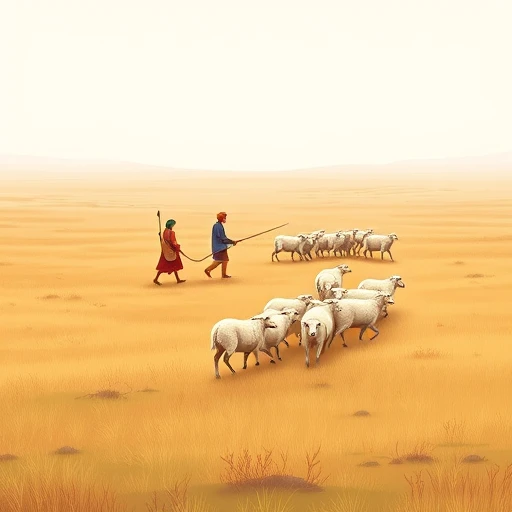
pastoralists in 30 Seconds
- Pastoralists are people who raise livestock and often move their herds to find fresh grazing land and water sources in different seasons.
- Their lifestyle, known as pastoralism, is a traditional socio-economic system common in arid or mountainous regions where crop farming is difficult.
- Livestock like cattle, sheep, and goats provide pastoralists with food, materials, and wealth, forming the core of their cultural and social identity.
- Modern pastoralists face challenges from climate change, land loss, and political borders, which threaten their mobile and resilient way of life.
The term pastoralists refers to a specific group of people whose entire way of life, economy, and social structure are centered around the care and management of livestock. Unlike sedentary farmers who stay in one place to grow crops, pastoralists are often mobile, moving their herds of cattle, sheep, goats, camels, or reindeer across vast landscapes to find the best grazing lands and water sources. This lifestyle is not merely a job; it is a complex cultural identity that has existed for thousands of years, particularly in environments where the soil is too poor or the climate too dry for traditional agriculture. When we talk about pastoralists, we are discussing a group that balances the needs of their animals with the rhythms of nature, often acting as stewards of some of the world's most fragile ecosystems.
- Core Identity
- Pastoralists define themselves through their relationship with their animals, which serve as their primary source of wealth, food, and social status.
In the arid regions of East Africa, the Maasai pastoralists have developed a deep understanding of seasonal weather patterns to ensure their cattle survive the dry months.
The use of this word is common in anthropology, geography, and environmental science. It is used to distinguish those who rely on animal husbandry from those who rely on hunting and gathering or crop cultivation. In modern discourse, you will often hear about pastoralists in the context of climate change and land rights. Because they move across borders and through different territories, they frequently face challenges regarding land ownership and access to traditional grazing routes. Their mobility, which was once their greatest strength, is now often at odds with the fixed borders of modern nation-states. Understanding pastoralists requires looking beyond the simple act of herding and seeing the intricate social networks and ecological knowledge they possess.
- Economic System
- Their economy is based on the products of their animals, such as milk, meat, wool, and hides, which they use for themselves or trade for grain and other goods.
Many Arctic pastoralists, such as the Sami, rely on reindeer to provide everything from transportation to clothing.
Furthermore, the term is frequently used when discussing historical migrations. Many of the great movements of people in history were driven by pastoralists seeking new lands for their herds. Their ability to move quickly and adapt to different environments made them formidable forces in history. Today, however, the word is often associated with vulnerability. As droughts become more frequent and severe due to global warming, pastoralists are among the first to suffer, as their entire livelihood depends on the availability of green grass and clean water. This has led to increased migration to cities and a shift in their traditional ways of life.
- Social Structure
- Pastoralist societies are often organized into clans or tribes, with social standing determined by the size and health of one's herd.
The conflict between settled farmers and nomadic pastoralists over water rights has intensified in recent years.
In academic writing, you might encounter the term 'transhumant pastoralists,' which refers to those who move between fixed summer and winter pastures. This is a very organized form of movement that follows the same routes year after year. In contrast, 'nomadic pastoralists' may have less predictable routes, moving wherever the rain has fallen. Both groups fall under the broad umbrella of pastoralists. The word carries a sense of resilience and ancient wisdom, but also a sense of being at a crossroads in the modern world. When you use this word, you are acknowledging a way of life that is fundamentally different from the urban, sedentary existence most people lead today.
Researchers are studying how pastoralists manage communal land without depleting resources.
The government implemented new policies to support pastoralists during the prolonged dry season.
Using the word pastoralists correctly involves understanding its role as a plural noun that describes a collective group of people. It is rarely used in the singular ('pastoralist') unless you are describing an individual's specific role or using it as an adjective (e.g., 'a pastoralist community'). In most sentences, it functions as the subject or the object of an action related to movement, animal care, or environmental interaction. Because the word is quite formal and specific, it is most at home in academic, journalistic, or historical contexts. However, it can also be used in general conversation when discussing travel, different cultures, or global issues like climate change.
- Subject Position
- When pastoralists is the subject, it often performs actions like migrating, herding, grazing, or adapting.
During the spring, the pastoralists drive their flocks toward the higher mountain meadows.
To use the word effectively, you should pair it with verbs that reflect their mobile and livestock-dependent nature. Common verbs include 'migrate,' 'herd,' 'graze,' 'rely on,' 'traverse,' and 'sustain.' You can also use it to describe the challenges they face, such as 'struggle,' 'endure,' or 'confront.' For example, 'Pastoralists confront many obstacles as they cross international borders.' This highlights the active and often difficult nature of their existence. It is also useful to use adjectives that provide more detail about the specific type of pastoralists you are referring to, such as 'nomadic,' 'semi-nomadic,' 'traditional,' or 'indigenous.'
- Object Position
- As an object, it often follows verbs like 'support,' 'displace,' 'study,' or 'protect.'
The new irrigation project unfortunately displaced thousands of local pastoralists.
In more complex sentences, you can use 'pastoralists' to contrast with other groups. This is a common rhetorical device in sociology and history. For instance, 'While the farmers sought to fence off the land, the pastoralists required open access to the plains.' This creates a clear picture of the conflicting needs of different groups. You can also use the word in the possessive form ('pastoralists' rights' or 'pastoralists' herds') to discuss ownership or legal issues. Remember that the apostrophe goes after the 's' because the word is plural. 'The pastoralists' knowledge of the terrain is unparalleled' is a strong way to emphasize their expertise.
- Adjectival Use
- Though usually a noun, the singular form 'pastoralist' often acts as an adjective to describe systems or societies.
The pastoralist lifestyle is increasingly threatened by the expansion of urban centers.
Finally, consider the tone of your sentence. Because 'pastoralists' is a technical and respectful term, it helps maintain an objective and professional tone. If you were to use a word like 'herders,' it might feel more informal or less precise in a scientific paper. 'Pastoralists' encompasses the entire socio-economic system, not just the act of watching animals. By using this word, you signal that you are looking at the bigger picture of how these people live and interact with their environment. Whether you are writing an essay on human geography or a news report on international development, 'pastoralists' is the most accurate and sophisticated choice.
Education programs are being tailored to the mobile schedules of pastoralists in remote areas.
Historical records suggest that these pastoralists traded milk for grain with nearby villages.
While pastoralists might not be a word you use every day at the grocery store, it is a staple in several specific environments. If you are a student of the social sciences, you will encounter it constantly. It is the standard term used in textbooks to describe one of the primary ways human societies have organized themselves. In university lectures on anthropology, sociology, or world history, professors use 'pastoralists' to discuss the evolution of human culture and the different ways people have adapted to their environments. It is a word that carries academic weight and precision, distinguishing these groups from hunter-gatherers and settled farmers.
- In News and Media
- You will often hear this word in international news reports, especially those focusing on Africa, Central Asia, or the Middle East.
The BBC report highlighted the impact of the drought on Somali pastoralists.
Another common place to hear the word is in documentaries. Programs like those on National Geographic, the Discovery Channel, or the BBC's 'Planet Earth' series often feature pastoralist communities. The narrators use the word to explain the incredible journeys these people take with their animals. It is often framed in a way that highlights their traditional knowledge and their deep connection to the land. In these contexts, 'pastoralists' is used to evoke a sense of wonder and respect for a way of life that seems very different from the modern, urban experience. It helps the audience understand that these are not just people with animals, but people with a rich and complex heritage.
- In International Development
- Organizations like the United Nations or the World Bank use the term when discussing aid and policy for rural populations.
The UN report called for better veterinary services for migratory pastoralists.
You might also encounter the word in political discussions regarding land use. In many parts of the world, there are ongoing debates about how to share land between pastoralists and farmers. When politicians or activists speak about these issues, they use 'pastoralists' to refer to the group whose rights they are either defending or challenging. This makes the word part of a very modern and often heated conversation about resources and justice. It is not just a historical term; it is a very active one in the world of global politics and human rights. If you follow international affairs, you will see it appearing in articles about the Sahel region of Africa or the steppes of Mongolia.
- In Environmental Science
- Scientists use the term to discuss sustainable grazing practices and the management of dryland ecosystems.
Ecologists argue that pastoralists play a crucial role in maintaining the biodiversity of the grasslands.
Finally, you might hear the word in the context of cultural tourism. Travel guides and cultural tours often highlight the unique lifestyles of pastoralists to attract visitors who are interested in traditional cultures. In this setting, the word is used to describe an 'authentic' and 'timeless' way of life. While this can sometimes be a bit romanticized, it still relies on the word 'pastoralists' to accurately categorize the people being visited. Whether in a high-level academic paper, a gripping news story, or a glossy travel brochure, the word 'pastoralists' is the essential term for describing those who live by the herd.
The museum exhibit focused on the intricate jewelry made by Turkana pastoralists.
Local radio stations often broadcast weather warnings specifically for pastoralists in the outback.
One of the most frequent mistakes people make with the word pastoralists is confusing it with 'farmers.' While both groups work with the land and animals, the distinction is vital. Farmers are typically sedentary, meaning they live in one place and focus on growing crops (agriculture). Pastoralists, on the other hand, focus on livestock and are often mobile. Using 'farmers' when you mean 'pastoralists' can lead to significant misunderstandings, especially in discussions about land use and economy. If you say 'the farmers moved their cattle to the mountains,' it sounds slightly odd; 'pastoralists' is the much more accurate term for that specific action.
- Pastoralists vs. Nomads
- Another common error is using 'nomads' and 'pastoralists' interchangeably. While many pastoralists are nomadic, not all nomads are pastoralists.
Correct: These pastoralists are nomadic, moving their herds every few weeks.
A 'nomad' is simply someone who moves from place to place without a permanent home. This could include hunter-gatherers, traveling merchants, or even modern 'digital nomads' who work from their laptops while traveling. 'Pastoralists' is a much more specific term that defines *why* they move and *how* they survive—specifically through animal husbandry. If you use 'nomads' when you specifically mean people who herd animals, you are losing a lot of important detail. It is better to use 'nomadic pastoralists' if you want to be precise. This mistake is common in casual conversation but should be avoided in academic or professional writing.
- Spelling and Form
- The word is often misspelled or used in the wrong grammatical form. Ensure you include the 'al' in the middle and the 'ists' at the end.
Incorrect: The pastorals moved their sheep. Correct: The pastoralists moved their sheep.
People also sometimes confuse 'pastoralists' with 'pastors.' A 'pastor' is a leader in a church. While both words share a Latin root (*pastor* means 'shepherd'), their modern meanings are completely different. Calling a group of animal herders 'pastors' would be a very confusing mistake! Additionally, be careful with the word 'pastoral.' As an adjective, 'pastoral' can mean related to herding, but it is also used in literature and art to describe a romanticized, peaceful view of country life. 'Pastoralists' is a neutral, descriptive noun, whereas 'pastoral' can have a more poetic or artistic connotation. Don't use 'pastoralists' if you just mean 'people who live in the country.'
- Singular vs. Plural
- Because pastoralism is a communal activity, the word is almost always plural. Using the singular 'pastoralist' can sometimes feel incomplete.
Weak: A pastoralist needs a lot of land. Stronger: Pastoralists require vast territories to sustain their herds.
Finally, avoid the mistake of thinking all pastoralists are the same. There is a huge difference between a reindeer pastoralist in Siberia and a camel pastoralist in the Sahara. When using the word, it is often helpful to provide geographical or cultural context to avoid overgeneralization. Using the word as a blanket term for all 'primitive' people is also a mistake; many pastoralist societies are highly sophisticated and have successfully adapted to some of the harshest environments on Earth for millennia. Treat the word with the technical respect it deserves, and you will avoid these common pitfalls.
The study compared the dietary habits of sedentary farmers and migratory pastoralists.
Many pastoralists now use mobile phones to track market prices for their livestock.
When you want to describe people who raise animals, pastoralists is the most comprehensive and academic term. However, depending on the context, there are several other words you might use. The most common alternative is 'herders.' This is a simpler, more everyday word. While 'pastoralists' implies an entire socio-economic system, 'herders' focuses more on the physical act of watching and moving the animals. You might use 'herders' in a children's book or a casual conversation, but 'pastoralists' would be better for a research paper or a serious news article.
- Herders vs. Pastoralists
- 'Herders' is more informal and focuses on the job; 'pastoralists' is more formal and focuses on the culture and economy.
The young herders spent all day with the goats, while the elders discussed the pastoralists' future.
Another related term is 'nomads.' As discussed earlier, many pastoralists are nomadic, but the two words are not identical. If you want to emphasize the fact that they move around, 'nomads' is a good choice. If you want to emphasize that they live off animals, 'pastoralists' is better. In many cases, the two are combined into the phrase 'nomadic pastoralists' to provide the most complete description. Another term you might encounter is 'ranchers.' This is mostly used in North and South America and Australia. Ranchers are usually sedentary and run their operations as a commercial business rather than a subsistence lifestyle. You wouldn't usually call a Maasai person a 'rancher,' nor would you call a Texas cattleman a 'pastoralist.'
- Transhumants
- This is a very specific technical term for pastoralists who move their animals between the same two locations every year.
The transhumants of the Alps move their cows to high pastures in the summer and back to the valleys in winter.
In some regions, there are very specific names for pastoralists. For example, 'Bedouins' refers to Arabic-speaking pastoralists in the Middle East and North Africa. 'Gauchos' refers to the skilled horsemen and cattle herders of the South American pampas. 'Sami' refers to the indigenous reindeer herders of northern Europe. Using these specific names is often better than using the general term 'pastoralists' if you are talking about a specific group. It shows a deeper knowledge of the culture you are discussing. However, 'pastoralists' remains the best general term when you are talking about the group as a whole or comparing different groups across the world.
- Stockmen and Drovers
- In Australia and parts of the UK, these terms are used for people who move large numbers of livestock over long distances.
The drovers of old would walk cattle hundreds of miles to reach the city markets.
Finally, you might hear the term 'agro-pastoralists.' This refers to people who combine animal herding with some crop farming. This is a very common lifestyle in many parts of the world today, as it provides more security than relying on animals alone. If a group grows some corn but also has a large herd of goats that they move around, 'agro-pastoralists' is the most accurate term. Choosing the right word depends on how much detail you want to provide. 'Pastoralists' is your safe, high-level academic choice, while 'herders,' 'nomads,' or specific cultural names can provide more color or focus depending on your needs.
The government is encouraging agro-pastoralists to adopt more modern farming techniques.
Unlike the pastoralists, the local villagers relied almost entirely on their vegetable gardens.
How Formal Is It?
Fun Fact
The word 'pastor' in a religious sense and 'pastoralist' in a farming sense both come from the same image of a shepherd caring for a flock. In many ancient cultures, kings were also referred to as 'shepherds of the people'.
Pronunciation Guide
- Pronouncing it like 'pastors' (church leaders).
- Missing the 'al' in the middle, saying 'pastorists'.
- Putting the stress on the second or third syllable.
- Confusing the 'a' sound in 'pas' between UK and US versions.
- Forgetting the final 's' when referring to the group.
Difficulty Rating
The word is common in academic and news texts but rare in everyday fiction.
Requires correct spelling and understanding of its specific socio-economic meaning.
Pronunciation can be tricky due to the multiple syllables and 'st' clusters.
Usually clear in context, but can be confused with 'pastors' if not careful.
What to Learn Next
Prerequisites
Learn Next
Advanced
Grammar to Know
Plural Noun Agreement
Pastoralists *are* (not is) moving their herds.
Possessive Plural
The pastoralists' (not pastoralist's) rights are being debated.
Adjective Placement
The *nomadic* pastoralists (adjective before the noun).
Zero Article for General Groups
Pastoralists often face drought (no 'the' when speaking generally).
Compound Nouns
The pastoralist community (using the singular form as an adjective).
Examples by Level
The pastoralists have many sheep.
Los pastores tienen muchas ovejas.
Pastoralists is the plural subject.
Pastoralists move to find water.
Los pastores se mueven para encontrar agua.
Present simple for a general fact.
These pastoralists live in tents.
Estos pastores viven en tiendas.
Demonstrative 'these' used with plural noun.
The pastoralists drink milk from their cows.
Los pastores beben leche de sus vacas.
Possessive 'their' refers to the pastoralists.
Pastoralists love their animals.
Los pastores aman a sus animales.
Simple subject-verb-object structure.
Are they pastoralists?
¿Son ellos pastores?
Question form with 'to be'.
The pastoralists are very strong.
Los pastores son muy fuertes.
Adjective 'strong' describing the noun.
Pastoralists walk a lot every day.
Los pastores caminan mucho todos los días.
Adverbial phrase 'every day'.
Many pastoralists in Africa keep cattle for wealth.
Muchos pastores en África crían ganado por riqueza.
Prepositional phrase 'in Africa' provides context.
Pastoralists often travel during the dry season.
Los pastores suelen viajar durante la estación seca.
Frequency adverb 'often' used before the verb.
The pastoralists' life is very traditional.
La vida de los pastores es muy tradicional.
Possessive plural 'pastoralists' with apostrophe after 's'.
Pastoralists use goats for meat and milk.
Los pastores usan cabras para carne y leche.
Use of 'for' to indicate purpose.
It is difficult for pastoralists when it does not rain.
Es difícil para los pastores cuando no llueve.
Introductory 'it is' structure.
Pastoralists know how to find grass in the desert.
Los pastores saben cómo encontrar hierba en el desierto.
'Know how to' + infinitive.
The pastoralists trade their wool for grain.
Los pastores intercambian su lana por grano.
Verb 'trade' with 'for'.
Some pastoralists use camels to carry their things.
Algunos pastores usan camellos para cargar sus cosas.
Infinitive of purpose 'to carry'.
Nomadic pastoralists move their herds to follow the rainfall.
Los pastores nómadas mueven sus rebaños para seguir las lluvias.
Adjective 'nomadic' modifying 'pastoralists'.
Pastoralists play an important role in the local economy.
Los pastores juegan un papel importante en la economía local.
Idiomatic expression 'play a role in'.
The government is trying to help pastoralists find new land.
El gobierno está tratando de ayudar a los pastores a encontrar nuevas tierras.
Present continuous 'is trying'.
Pastoralists must protect their animals from wild predators.
Los pastores deben proteger a sus animales de los depredadores salvajes.
Modal verb 'must' for obligation.
Many pastoralists are losing their traditional grazing lands.
Muchos pastores están perdiendo sus tierras de pastoreo tradicionales.
Present continuous for a current trend.
Pastoralists have a deep understanding of the environment.
Los pastores tienen un profundo conocimiento del medio ambiente.
Collocation 'deep understanding'.
The pastoralists' culture is famous for its beautiful music.
La cultura de los pastores es famosa por su bella música.
Adjective 'famous for'.
Pastoralists often live in communities based on family ties.
Los pastores suelen vivir en comunidades basadas en lazos familiares.
Past participle 'based on' used as an adjective.
Pastoralists manage communal lands to ensure they are not overgrazed.
Los pastores gestionan las tierras comunales para asegurar que no se sobrepastoreen.
Infinitive of purpose 'to ensure'.
The conflict between pastoralists and farmers is often about water rights.
El conflicto entre pastores y agricultores suele ser por los derechos de agua.
Noun phrase 'water rights' as the object of the preposition.
Pastoralists are highly adaptable to extreme weather conditions.
Los pastores son muy adaptables a las condiciones climáticas extremas.
Adverb 'highly' modifying the adjective 'adaptable'.
Climate change poses a significant threat to the livelihoods of pastoralists.
El cambio climático representa una amenaza significativa para el sustento de los pastores.
Verb 'poses' used with 'threat'.
Pastoralists rely on their social networks to survive during droughts.
Los pastores dependen de sus redes sociales para sobrevivir durante las sequías.
Phrasal verb 'rely on'.
The study focuses on how pastoralists interact with the local ecosystem.
El estudio se centra en cómo los pastores interactúan con el ecosistema local.
Verb 'interact' with the preposition 'with'.
Pastoralists' traditional knowledge is being recognized by scientists.
El conocimiento tradicional de los pastores está siendo reconocido por los científicos.
Passive voice 'is being recognized'.
Many pastoralists are now using technology to track their herds.
Muchos pastores ahora están usando tecnología para rastrear sus rebaños.
Present continuous for a modern change.
The resilience of pastoralists is evident in their ability to thrive in arid environments.
La resiliencia de los pastores es evidente en su capacidad para prosperar en entornos áridos.
Abstract noun 'resilience' as the subject.
Pastoralists often employ sophisticated risk-management strategies.
Los pastores a menudo emplean estrategias sofisticadas de gestión de riesgos.
Academic vocabulary 'employ' and 'sophisticated'.
The marginalization of pastoralists by the state has led to social unrest.
La marginación de los pastores por parte del estado ha provocado disturbios sociales.
Noun 'marginalization' followed by a prepositional phrase.
Pastoralists' mobility is a rational response to ecological variability.
La movilidad de los pastores es una respuesta racional a la variabilidad ecológica.
Adjective 'rational' modifying 'response'.
The socio-economic status of pastoralists is often tied to the size of their herds.
El estatus socioeconómico de los pastores a menudo está ligado al tamaño de sus rebaños.
Compound adjective 'socio-economic'.
Pastoralists facilitate the dispersal of seeds across vast grasslands.
Los pastores facilitan la dispersión de semillas a través de vastas praderas.
Scientific verb 'facilitate'.
The hardening of international borders has severely restricted the movement of pastoralists.
El endurecimiento de las fronteras internacionales ha restringido severamente el movimiento de los pastores.
Present perfect 'has restricted' with an adverb.
Pastoralists' contribution to global biodiversity is frequently underestimated.
La contribución de los pastores a la biodiversidad global es frecuentemente subestimada.
Passive voice 'is underestimated'.
Pastoralists navigate a complex landscape of shifting ecological and political boundaries.
Los pastores navegan por un paisaje complejo de fronteras ecológicas y políticas cambiantes.
Metaphorical use of 'navigate' and 'landscape'.
The ontological relationship between pastoralists and their livestock transcends mere economic utility.
La relación ontológica entre los pastores y su ganado trasciende la mera utilidad económica.
Advanced philosophical term 'ontological'.
Sedentarization policies often fail to account for the inherent flexibility of pastoralists.
Las políticas de sedentarización a menudo no tienen en cuenta la flexibilidad inherente de los pastores.
Noun 'sedentarization' and the phrase 'fail to account for'.
Pastoralists act as custodians of traditional knowledge in an increasingly homogenized world.
Los pastores actúan como custodios del conocimiento tradicional en un mundo cada vez más homogeneizado.
Metaphorical noun 'custodians'.
The precarity of pastoralists' existence is exacerbated by neoliberal land reforms.
La precariedad de la existencia de los pastores se ve exacerbada por las reformas agrarias neoliberales.
Advanced vocabulary 'precarity' and 'exacerbated'.
Pastoralists' intricate social structures are designed to mitigate environmental risk.
Las intrincadas estructuras sociales de los pastores están diseñadas para mitigar el riesgo ambiental.
Infinitive of purpose 'to mitigate'.
The displacement of pastoralists often results in the irreversible loss of cultural heritage.
El desplazamiento de los pastores a menudo resulta en la pérdida irreversible del patrimonio cultural.
Adjective 'irreversible' modifying 'loss'.
Pastoralists embody a form of sustainable living that challenges modern industrial paradigms.
Los pastores encarnan una forma de vida sostenible que desafía los paradigmas industriales modernos.
Verb 'embody' and noun 'paradigms'.
Common Collocations
Common Phrases
— The typical pattern of behavior and beliefs of a group. It describes the holistic nature of pastoralism.
For these pastoralists, herding is more than a job; it is a way of life.
— The regular movement of people and animals between different areas at specific times of the year.
Pastoralists rely on seasonal migration to find the best grazing land.
— The science of breeding and caring for farm animals. It is the core skill of pastoralists.
Pastoralists are experts in animal husbandry, knowing every detail of their livestock.
— The legal or traditional permission to allow animals to eat grass on a specific piece of land.
The pastoralists fought to maintain their ancient grazing rights.
— Land that is owned or used by all members of a community rather than by individuals.
Pastoralists often share communal land to ensure everyone has access to water.
— Land that is of little agricultural value because of poor soil or lack of water.
Pastoralists are often the only ones who can make use of marginal land.
— An economy where people produce only enough for their own needs, without much surplus for trade.
Many pastoralists live in a subsistence economy, relying on their animals for everything.
— The legal regime in which land is owned or used. This is a major issue for pastoralists.
Changes in land tenure have made it harder for pastoralists to move their herds.
— The state of having reliable access to a sufficient quantity of affordable, nutritious food.
Pastoralists contribute significantly to food security in dry regions.
— Knowledge, know-how, skills and practices that are developed, sustained and passed on from generation to generation.
Scientists are studying the traditional knowledge of pastoralists to combat desertification.
Often Confused With
Pastors are religious leaders; pastoralists are animal herders. They share a root but have very different meanings.
Peasants are usually poor farmers who stay in one place; pastoralists are often mobile and focused on animals.
Nomads move around, but not all nomads have animals. Pastoralists specifically live off their herds.
Idioms & Expressions
— To do what everyone else is doing without thinking for oneself. While related to animals, it's rarely used to describe actual pastoralists.
Don't just follow the herd; think for yourself!
informal— The idea that other people's situations always seem better than one's own. This is literally true for pastoralists seeking better pasture.
For pastoralists, the grass is always greener on the other side of the mountain.
neutral— To distinguish between people or things of good quality and those of poor quality.
The difficult journey across the desert separated the sheep from the goats among the pastoralists.
neutral— Someone who appears friendly but is actually dangerous. A metaphor a pastoralist would understand well.
The merchant turned out to be a wolf in sheep's clothing, cheating the pastoralists.
neutral— To deal with a difficult situation in a very direct and confident way.
The pastoralists took the bull by the horns and negotiated directly with the government.
neutral— To be forced to retire because of old age. This comes from the practice of letting old animals graze until they die.
After forty years of herding, the old man was finally put out to pasture.
informal— A business or product that consistently makes a lot of money. For pastoralists, a healthy cow is a literal cash cow.
For the pastoralists, their camels were their main cash cow.
informal— To assume success before it actually happens. Pastoralists know that many things can happen to a herd.
Don't count your cattle before the dry season is over.
neutral— Going into a dangerous situation without realizing it or without resisting.
The pastoralists walked into the trap like a lamb to the slaughter.
neutral— To have a reason to argue or complain about something. Often used in conflicts over land.
The pastoralists had a bone to pick with the farmers over the blocked river.
informalEasily Confused
It is the adjective form of the same root.
'Pastoral' can describe a peaceful country scene or a type of literature, while 'pastoralists' are the actual people who herd animals.
The painting showed a pastoral scene with several pastoralists.
Both raise livestock.
Ranchers are usually commercial and stay on one piece of land; pastoralists are often subsistence-based and mobile.
Unlike the pastoralists of Kenya, the ranchers of Texas own their land.
Both work with the land and animals.
Farmers primarily grow crops and are sedentary; pastoralists primarily raise animals and are often mobile.
The farmers and pastoralists often fight over who gets to use the river.
They are synonyms.
'Herders' is a simpler word for the job; 'pastoralists' is a more formal word for the whole culture.
The young herders will grow up to be respected pastoralists.
Many pastoralists move around.
'Nomad' describes the movement; 'pastoralist' describes the economy. You can be a nomad without having animals.
The group of nomads were actually pastoralists looking for grass.
Sentence Patterns
Pastoralists have [animals].
Pastoralists have sheep.
Pastoralists move to find [resource].
Pastoralists move to find water.
Pastoralists rely on [animals] for [purpose].
Pastoralists rely on cattle for milk.
The lifestyle of pastoralists is threatened by [threat].
The lifestyle of pastoralists is threatened by climate change.
Pastoralists employ [strategy] to manage [risk].
Pastoralists employ mobility to manage environmental risk.
The [abstract noun] of pastoralists is [adjective] by [factor].
The resilience of pastoralists is challenged by modern borders.
Pastoralists act as [role] in [environment].
Pastoralists act as stewards in the savanna.
Pastoralists navigate the complexities of [complex system].
Pastoralists navigate the complexities of land tenure.
Word Family
Nouns
Verbs
Adjectives
Related
How to Use It
Common in academic, scientific, and journalistic writing; rare in casual speech.
-
Using 'pastors' instead of 'pastoralists'.
→
The pastoralists moved their sheep.
A pastor is a church leader. A pastoralist is an animal herder. They are not the same thing!
-
Saying 'the pastoralists is moving'.
→
The pastoralists are moving.
'Pastoralists' is a plural noun, so it needs a plural verb like 'are'.
-
Spelling it 'pastorists'.
→
Pastoralists
You must include the 'al' in the middle. It comes from the adjective 'pastoral'.
-
Confusing them with 'farmers'.
→
The pastoralists rely on livestock, while the farmers grow crops.
Farmers stay in one place to grow plants; pastoralists move to raise animals.
-
Writing 'pastoralist's herds' for the group.
→
Pastoralists' herds.
When referring to the herds of the whole group, the apostrophe goes after the 's'.
Tips
Use in Academic Writing
When writing an essay about geography or history, use 'pastoralists' instead of 'herders' to sound more professional. It shows you understand the socio-economic system, not just the job.
The 'AL' is Key
Don't forget the 'al' in the middle. It's 'pastor-AL-ists.' Without the 'al,' it's not a word. Think of the word 'pastoral' first, then add 'ists.'
Specify the Group
If you can, specify what kind of pastoralists you are talking about, like 'Maasai pastoralists' or 'reindeer pastoralists.' This makes your writing much more descriptive and accurate.
Plural Agreement
Always remember that 'pastoralists' is plural. Use 'they,' 'their,' and 'are' when talking about them. For example: 'The pastoralists are moving their herds.'
Related Terms
Learn the word 'transhumance' along with 'pastoralists.' It's a very common term used to describe their specific type of seasonal movement.
Stress the First Syllable
The stress is on the 'PAS.' Say it like 'PAS-tor-a-lists.' This will help you sound more natural and clear when speaking.
Listen for the 'S'
In fast speech, the 'sts' at the end can be hard to hear. Listen for the context of animals and movement to be sure of the word.
Avoid Stereotypes
Remember that many modern pastoralists use technology like GPS and mobile phones. Don't assume they are 'stuck in the past' just because they have a traditional lifestyle.
Possessive Form
When writing about something they own, put the apostrophe after the 's': 'pastoralists' herds.' This is a very common mistake to avoid.
The 'Pasture' Connection
Always link 'pastoralists' to 'pasture' in your mind. They are the people of the pasture. This makes the meaning easy to remember.
Memorize It
Mnemonic
Think of 'PASTure' + 'AL' + 'ISTS'. Pastoralists are the 'specialists' (ists) who use the 'pasture' (pastor-al).
Visual Association
Imagine a vast, open green field with a long line of people walking with hundreds of sheep and cows. They are carrying their homes (tents) on their backs or on camels.
Word Web
Challenge
Try to explain the difference between a pastoralist and a farmer to a friend using only three sentences. Use the word 'pastoralists' at least twice.
Word Origin
The word comes from the Latin 'pastor', which means 'shepherd'. This root is also where we get the word 'pasture' (land for grazing) and 'pastor' (a spiritual leader who 'shepherds' a congregation). The suffix '-alist' was added to denote a person who follows a specific system or way of life.
Original meaning: Originally, it referred simply to anyone who looked after sheep or cattle. Over time, it became a more technical term in anthropology and sociology to describe a specific type of economic system.
Indo-European (Latin root).Cultural Context
Be careful not to label pastoralists as 'primitive' or 'backward.' Their lifestyle is a highly sophisticated adaptation to specific environments.
In Australia, the term 'pastoralist' is often used for owners of large sheep or cattle stations, which is slightly different from the nomadic sense used in Africa or Asia.
Practice in Real Life
Real-World Contexts
Environmental Science
- sustainable grazing
- rangeland management
- ecological impact
- resource depletion
International News
- humanitarian aid
- conflict over resources
- climate change impact
- displaced populations
History/Anthropology
- traditional way of life
- social structure
- migratory patterns
- cultural heritage
Economics
- subsistence economy
- livestock trade
- wealth in animals
- market access
Geography
- arid regions
- seasonal movement
- land use
- territorial boundaries
Conversation Starters
"How do you think the lives of pastoralists have changed with the invention of smartphones?"
"Do you think pastoralists have a better understanding of nature than people who live in cities?"
"What are some of the biggest challenges pastoralists face in your part of the world?"
"If you had to live as a pastoralist for a year, which animal would you want to herd?"
"How can governments better support pastoralists while also protecting the environment?"
Journal Prompts
Imagine you are a pastoralist moving your herd across a vast desert. Describe a typical day and the challenges you face.
Write an essay discussing whether the traditional lifestyle of pastoralists can survive in a world of fixed borders.
Compare and contrast the lives of pastoralists with the lives of sedentary farmers. Which lifestyle seems more resilient?
Research a specific group of pastoralists, like the Sami or the Maasai, and write about their unique cultural traditions.
Reflect on how climate change might be forcing pastoralists to change their ancient ways of living.
Frequently Asked Questions
10 questionsNo, not all pastoralists are nomadic. Some are 'semi-nomadic,' meaning they have a permanent home but move their animals for part of the year. Others practice 'transhumance,' which is a very regular movement between two specific places. Some may even be sedentary if they have enough land and water in one spot.
It depends on where they live. In Africa and Asia, they often keep cattle, sheep, goats, and camels. In the Arctic, they keep reindeer. In the Andes mountains of South America, they keep llamas and alpacas. In Tibet and Mongolia, they keep yaks and horses.
They move to find food and water for their animals. In many parts of the world, rain only falls in certain places at certain times. By moving, pastoralists can ensure their animals always have fresh grass to eat, which keeps the herd healthy and productive.
When managed well, pastoralism can be very good for the environment. The animals help spread seeds and their waste fertilizes the soil. However, if there are too many animals in one small area for too long, it can lead to 'overgrazing,' which damages the land.
A rancher usually owns a fixed piece of land and raises animals to sell for profit in a modern market. A pastoralist often uses communal land, moves their animals seasonally, and relies on the animals for their own food and traditional way of life.
They survive by using their deep knowledge of the land. They know where hidden water sources are and can predict the weather by looking at the clouds and stars. They also keep animals like camels that are specially adapted to live without much water.
It can be difficult for pastoralist children to go to traditional schools because they are always moving. However, many governments now provide 'mobile schools' that travel with the communities, or boarding schools where the children stay while their parents move with the herds.
Their diet is mostly based on their animals. They drink a lot of milk and eat meat on special occasions. They also trade animal products like wool or hides for grains like rice, corn, or wheat. In some cultures, they also collect wild fruits and honey.
While the term isn't used much, some Navajo and other Indigenous groups practice a form of pastoralism with sheep and goats. However, most animal raising in the US is done by 'ranchers' on fixed properties.
The word is usually plural because pastoralism is a community-based way of life. It's rare to find a single person doing it all alone; it requires a whole group of people working together to manage the herds and move the camp.
Test Yourself 200 questions
Describe the typical lifestyle of pastoralists in three sentences.
Well written! Good try! Check the sample answer below.
Explain why climate change is a threat to pastoralists.
Well written! Good try! Check the sample answer below.
Compare pastoralists and sedentary farmers.
Well written! Good try! Check the sample answer below.
What is the importance of livestock to pastoralists?
Well written! Good try! Check the sample answer below.
Write a short paragraph about reindeer pastoralists in the Arctic.
Well written! Good try! Check the sample answer below.
Discuss the role of traditional knowledge in pastoralist societies.
Well written! Good try! Check the sample answer below.
Why do pastoralists often use communal land rather than private property?
Well written! Good try! Check the sample answer below.
Imagine you are a journalist reporting on a conflict between pastoralists and farmers. Write a headline and a lead sentence.
Well written! Good try! Check the sample answer below.
How has modern technology changed the lives of pastoralists?
Well written! Good try! Check the sample answer below.
Explain the term 'transhumance' in your own words.
Well written! Good try! Check the sample answer below.
What are some of the cultural traditions of pastoralists?
Well written! Good try! Check the sample answer below.
Discuss the economic contribution of pastoralists to their countries.
Well written! Good try! Check the sample answer below.
Why is the term 'pastoralists' preferred over 'herders' in academic contexts?
Well written! Good try! Check the sample answer below.
What are the social consequences of forcing pastoralists to settle in one place?
Well written! Good try! Check the sample answer below.
Describe the relationship between pastoralists and their animals.
Well written! Good try! Check the sample answer below.
How do pastoralists manage to survive in extremely cold environments?
Well written! Good try! Check the sample answer below.
Write a short dialogue between a pastoralist and a city-dweller.
Well written! Good try! Check the sample answer below.
What is the role of women in pastoralist societies?
Well written! Good try! Check the sample answer below.
Discuss the impact of international borders on pastoralist migrations.
Well written! Good try! Check the sample answer below.
Why is pastoralism considered a form of 'risk management'?
Well written! Good try! Check the sample answer below.
Describe a day in the life of a pastoralist.
Read this aloud:
You said:
Speech recognition is not supported in your browser. Try Chrome or Edge.
Discuss the pros and cons of being a pastoralist.
Read this aloud:
You said:
Speech recognition is not supported in your browser. Try Chrome or Edge.
How can technology help modern pastoralists?
Read this aloud:
You said:
Speech recognition is not supported in your browser. Try Chrome or Edge.
Why is it important to protect the rights of pastoralists?
Read this aloud:
You said:
Speech recognition is not supported in your browser. Try Chrome or Edge.
What would you ask a pastoralist if you met one?
Read this aloud:
You said:
Speech recognition is not supported in your browser. Try Chrome or Edge.
Explain the difference between a pastoralist and a rancher to a child.
Read this aloud:
You said:
Speech recognition is not supported in your browser. Try Chrome or Edge.
How does climate change affect the migration of pastoralists?
Read this aloud:
You said:
Speech recognition is not supported in your browser. Try Chrome or Edge.
Do you think pastoralism is a sustainable lifestyle in the 21st century?
Read this aloud:
You said:
Speech recognition is not supported in your browser. Try Chrome or Edge.
Describe the relationship between pastoralists and farmers in your country or region.
Read this aloud:
You said:
Speech recognition is not supported in your browser. Try Chrome or Edge.
What is the role of animals in pastoralist cultures beyond just food?
Read this aloud:
You said:
Speech recognition is not supported in your browser. Try Chrome or Edge.
How do pastoralists handle education for their children?
Read this aloud:
You said:
Speech recognition is not supported in your browser. Try Chrome or Edge.
Why do pastoralists often live in communal societies?
Read this aloud:
You said:
Speech recognition is not supported in your browser. Try Chrome or Edge.
Discuss the impact of urbanization on pastoralist communities.
Read this aloud:
You said:
Speech recognition is not supported in your browser. Try Chrome or Edge.
What are the environmental benefits of pastoralism?
Read this aloud:
You said:
Speech recognition is not supported in your browser. Try Chrome or Edge.
Imagine you are a pastoralist elder. What advice would you give to the younger generation?
Read this aloud:
You said:
Speech recognition is not supported in your browser. Try Chrome or Edge.
How do pastoralists contribute to the global economy?
Read this aloud:
You said:
Speech recognition is not supported in your browser. Try Chrome or Edge.
What is the significance of 'transhumance' in European history?
Read this aloud:
You said:
Speech recognition is not supported in your browser. Try Chrome or Edge.
How do pastoralists manage to find water in the desert?
Read this aloud:
You said:
Speech recognition is not supported in your browser. Try Chrome or Edge.
Discuss the role of livestock as 'living savings accounts' for pastoralists.
Read this aloud:
You said:
Speech recognition is not supported in your browser. Try Chrome or Edge.
What is the future of pastoralism in a world of fixed borders and climate change?
Read this aloud:
You said:
Speech recognition is not supported in your browser. Try Chrome or Edge.
Listen to the description of the Maasai and identify their main animal.
According to the speaker, why do pastoralists move?
What is the term used for seasonal movement between summer and winter pastures?
What does the speaker say is the biggest threat to pastoralists today?
How do pastoralists use their animals besides for food?
What is the relationship between pastoralists and farmers described as?
What technology are modern pastoralists using, according to the report?
Why is 'communal land' important for pastoralists?
What is the ecological benefit of pastoralism mentioned by the scientist?
What does the term 'agro-pastoralists' refer to?
According to the elder, how do they find water in the desert?
What is the impact of international borders on their migration?
How is a pastoralist's wealth measured?
What is the 'Neolithic Revolution's' role in pastoralism?
What is the speaker's conclusion about the future of pastoralism?
/ 200 correct
Perfect score!
Summary
Pastoralists are more than just animal herders; they represent a complex, mobile way of life that turns marginal lands into productive resources through deep ecological knowledge. For example, the Maasai pastoralists of East Africa use seasonal migration to sustain large cattle herds in semi-arid savannas.
- Pastoralists are people who raise livestock and often move their herds to find fresh grazing land and water sources in different seasons.
- Their lifestyle, known as pastoralism, is a traditional socio-economic system common in arid or mountainous regions where crop farming is difficult.
- Livestock like cattle, sheep, and goats provide pastoralists with food, materials, and wealth, forming the core of their cultural and social identity.
- Modern pastoralists face challenges from climate change, land loss, and political borders, which threaten their mobile and resilient way of life.
Use in Academic Writing
When writing an essay about geography or history, use 'pastoralists' instead of 'herders' to sound more professional. It shows you understand the socio-economic system, not just the job.
The 'AL' is Key
Don't forget the 'al' in the middle. It's 'pastor-AL-ists.' Without the 'al,' it's not a word. Think of the word 'pastoral' first, then add 'ists.'
Specify the Group
If you can, specify what kind of pastoralists you are talking about, like 'Maasai pastoralists' or 'reindeer pastoralists.' This makes your writing much more descriptive and accurate.
Plural Agreement
Always remember that 'pastoralists' is plural. Use 'they,' 'their,' and 'are' when talking about them. For example: 'The pastoralists are moving their herds.'
Example
Nomadic pastoralists play a crucial role in the economy of the Sahel region.
Related Content
See it in Videos
More People words
annyce
B1Annyce is a feminine given name of English origin, typically considered a variant of the names Agnes or Annice. It is used as a proper noun to refer to a specific individual in both spoken and written communication.
representation
B2The action of speaking or acting on behalf of someone or the state of being so represented. It also refers to the description or portrayal of someone or something in a particular way or through a specific medium like art or media.
davis
B1Davis is a common English surname of Welsh origin, derived from 'son of David.' It is also frequently used as a place name for various cities, towns, and geographical features across the English-speaking world.
catherine’s
B1The possessive form of the proper name Catherine, used to indicate that something belongs to or is associated with a person of that name.
derek
B1Derek is a common masculine given name of English origin. It is primarily used as a proper noun to refer to a specific individual.
zaina
A1A female given name of Arabic origin, meaning 'beauty', 'grace', or 'beautiful'. It is used as a personal name in English-speaking communities and worldwide.
stranger
B1A person whom one does not know or with whom one is not familiar. It can also refer to someone who is in a place or situation that is new to them.
louis
A1A common male given name of French and Germanic origin, meaning 'renowned warrior'. Occasionally refers to a French gold coin (Louis d'or) issued in the 17th and 18th centuries.
experts
B1People who have acquired a high level of knowledge, skill, or proficiency in a particular field through extensive study or experience. They are often recognized as authorities and consulted for their specialized opinions or advice.
resident
C2A person who lives in a particular place on a long-term or permanent basis, as opposed to a visitor. In a specialized academic or professional context, it refers to a physician or specialist who is receiving advanced clinical training in a hospital.

