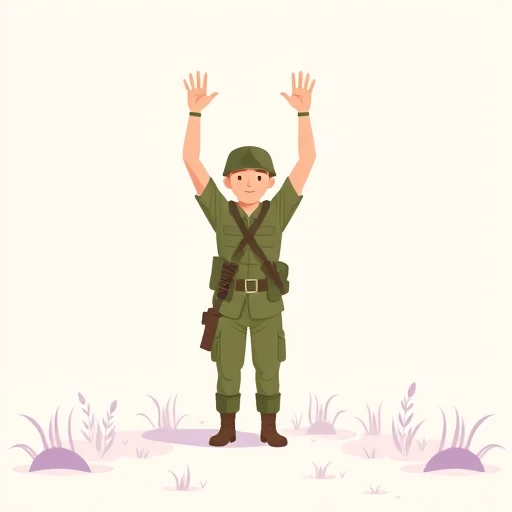
surrender in 30 Seconds
- Surrender means to stop fighting and admit defeat, often in a formal or military context.
- It can also mean to give up a right, property, or document to an authority.
- Figuratively, it means to let go of resistance to an emotion, influence, or situation.
- The word is commonly followed by the preposition 'to' and can be used as both a verb and a noun.
The word surrender is a multifaceted verb that primarily describes the act of ceasing resistance against an opponent, authority, or overwhelming force. While its origins are deeply rooted in military history—where a defeated army would lay down their weapons—its modern usage has expanded significantly into legal, emotional, and spiritual contexts. When you surrender, you are essentially making a conscious decision to stop fighting, whether that fight is physical, legal, or internal. It implies a transfer of control from yourself to another entity or power. In a B1 level context, you might encounter it in news reports about conflicts or in stories where a character finally gives up a long-held secret or a struggle. However, as you move toward higher levels of English proficiency, you will see it used to describe the act of yielding to one's emotions, such as surrendering to grief or surrendering to the beauty of a piece of music.
- Military Context
- This is the most literal use, where a soldier or army stops fighting and allows themselves to be captured. It often involves a formal declaration or a symbolic gesture like raising a white flag.
- Legal and Official Context
- In law, to surrender can mean to give up a right, a piece of property, or a document. For example, a person might be required to surrender their passport to the court to prevent them from leaving the country during a trial.
- Emotional and Psychological Context
- This refers to letting go of resistance to a feeling or a situation. It is often seen as a positive step in therapy or mindfulness, where one surrenders to the present moment rather than fighting against reality.
After weeks of being surrounded by the enemy, the general finally decided to surrender to save the lives of his remaining troops.
The suspect was forced to surrender his driver's license after the third traffic violation.
Sometimes, the only way to find peace is to surrender to the flow of life rather than trying to control every outcome.
The rebel forces refused to surrender, choosing instead to retreat into the mountains.
He felt a sense of relief when he finally decided to surrender his pride and apologize for his mistakes.
Furthermore, the term is frequently used in financial and insurance sectors. For instance, a 'surrender value' is the amount of money an insurance policyholder receives if they cancel their policy before it matures. This highlights the concept of giving up a future benefit for a present, albeit smaller, gain. In literature, surrender is a powerful theme, often representing a turning point in a character's journey—a moment of total vulnerability that leads to transformation. Whether it is a kingdom surrendering to an invader or a lover surrendering to their passion, the word carries a weight of finality and transition. Understanding 'surrender' requires recognizing that it is not always a sign of weakness; in many philosophical traditions, surrendering is seen as the ultimate form of strength and wisdom, allowing one to align with a higher truth or a natural order.
Using the word surrender correctly involves understanding its grammatical patterns and the prepositions that typically follow it. Most commonly, 'surrender' is used as an intransitive verb (without a direct object) or a transitive verb (with a direct object). When used intransitively, it often stands alone to describe the act of giving up. When used transitively, it specifies what is being given up, such as a weapon, a right, or a person. The preposition 'to' is almost always used to indicate the recipient of the surrender, whether that recipient is a person, an organization, or an abstract concept like 'temptation' or 'despair'.
- Surrender + To + Someone/Something
- This pattern is used when you give yourself up to an authority or an influence. Example: 'The criminal surrendered to the police after a long chase.'
- Surrender + Something
- This pattern is used when you give up an object or a right. Example: 'The soldiers were ordered to surrender their arms.'
- Surrender + Yourself + To
- This is often used in a more figurative or emotional sense. Example: 'She surrendered herself to the music, dancing until dawn.'
The fortress was forced to surrender when their food supplies ran out.
You must surrender your old passport before the new one can be issued.
He refused to surrender his principles, even when faced with intense pressure.
In more advanced writing, 'surrender' can be used to describe the yielding of a position in an argument or a negotiation. For instance, 'The company surrendered its market share to its competitors by failing to innovate.' Here, the surrender is not a physical act but a strategic consequence. It is also worth noting the difference between 'surrender' and 'give up'. While they are often synonyms, 'surrender' carries a more formal and often more total connotation. You might 'give up' on a difficult crossword puzzle, but you 'surrender' to an invading army. The word implies a certain level of gravity and often a formal acknowledgement of the end of a struggle. When using it in a sentence, consider the level of formality and the stakes involved in the act of yielding.
You will encounter the word surrender in a variety of real-world settings, ranging from historical documentaries to modern-day legal proceedings and even in popular culture. Its usage is widespread because it captures a universal human experience: the moment of letting go. In news broadcasts, you might hear about a fugitive who decided to 'surrender to authorities' after a standoff. In history books, the 'unconditional surrender' of Nazi Germany in 1945 is a pivotal moment that every student learns about. These contexts emphasize the gravity and the official nature of the word.
- In News and Media
- Journalists use 'surrender' to describe the end of police standoffs, the conclusion of battles, or when a politician gives up their seat. It provides a clear, decisive image of the end of a conflict.
- In Legal Proceedings
- Lawyers and judges use 'surrender' when discussing the handing over of evidence, the relinquishing of parental rights, or the act of a defendant turning themselves in to the court.
- In Music and Literature
- Songwriters often use 'surrender' to describe the feeling of falling in love or giving in to an emotion. Think of Cheap Trick's famous song 'Surrender' or Elvis Presley's 'Surrender'. In these cases, it's about vulnerability and passion.
'The suspect chose to surrender peacefully, ending the twelve-hour standoff without further violence,' the news anchor reported.
In the movie, the hero had to surrender his magical sword to save his friends from the villain.
In daily conversation, 'surrender' is less common than 'give up', but it is used when someone wants to sound more dramatic or precise. For example, a parent might jokingly say to a stubborn child, 'I surrender! You can have the extra cookie.' This uses the word's heavy historical weight for a lighthearted, hyperbolic effect. In spiritual and self-help communities, 'surrender' is a key concept, often meaning to stop resisting the reality of the present moment. Books like 'The Surrender Experiment' by Michael Singer explore this idea in depth, teaching readers how to stop fighting against life's circumstances and instead 'surrender' to the flow of events. This diversity of usage—from the battlefield to the yoga mat—makes 'surrender' a vital word for any English learner to master.
While 'surrender' is a straightforward word, learners often make mistakes regarding its prepositional use and its distinction from similar verbs like 'give up', 'abandon', or 'yield'. One of the most frequent errors is using the wrong preposition. 'Surrender' is almost always followed by 'to' when indicating the recipient of the surrender. Using 'at' or 'for' in this context is incorrect. Another common mistake is using 'surrender' when 'give up' would be more appropriate for a casual situation. 'Surrender' implies a formal or high-stakes situation, whereas 'give up' is much more versatile and informal.
- Incorrect Preposition
- Mistake: 'He surrendered at the police.' Correct: 'He surrendered to the police.'
- Confusing with 'Abandon'
- 'Abandon' means to leave something behind, while 'surrender' means to give something up to someone else. You abandon a car in the woods, but you surrender your car to the bank if you can't pay the loan.
- Overusing in Casual Contexts
- Saying 'I surrender my attempt to cook dinner' sounds overly formal and slightly strange. 'I'm giving up on cooking dinner' is much more natural.
Incorrect: They surrendered their weapons for the enemy. Correct: They surrendered their weapons to the enemy.
Furthermore, learners sometimes confuse 'surrender' with 'yield'. While they are synonyms in the sense of 'giving way', 'yield' is more common in traffic (yielding the right of way) or in agriculture/finance (the yield of a crop or an investment). 'Surrender' specifically carries the connotation of defeat or a formal hand-over. Another nuance is the reflexive use: 'surrender oneself'. This is often used when someone turns themselves in to the police. Saying 'He surrendered him to the police' means he handed someone else over, while 'He surrendered himself to the police' means he turned himself in. Paying attention to these small details will help you use the word with the precision of a native speaker.
The English language offers several synonyms for surrender, each with its own specific nuance and register. Understanding these alternatives allows you to choose the most precise word for your context. While 'give up' is the most common informal alternative, words like 'cede', 'relinquish', and 'succumb' provide more formal or specific meanings that can elevate your writing and speaking.
- Give up
- The most common and versatile synonym. It can be used for everything from quitting a habit to admitting defeat in a game. It is much less formal than 'surrender'.
- Cede
- A very formal word, usually used in political or territorial contexts. For example, 'The country was forced to cede territory after the war.' It implies a formal transfer of ownership.
- Relinquish
- This word means to voluntarily give up a claim, office, or possession. It often implies a sense of duty or necessity. Example: 'He relinquished his role as CEO to spend more time with family.'
- Succumb
- This is used when someone gives in to an overwhelming force, often a negative one like an illness or a temptation. Example: 'He finally succumbed to his injuries' or 'She succumbed to the temptation of the chocolate cake.'
While the general had to surrender the city, he refused to relinquish his hope for future victory.
Another interesting comparison is with the word 'capitulate'. To capitulate is to surrender under specific conditions or terms. It is a very formal, often academic or historical term. If an army capitulates, they have negotiated the terms of their surrender. In contrast, 'unconditional surrender' means giving up without any terms or promises. Understanding these distinctions helps you navigate complex texts. For example, in a business negotiation, you might 'concede' a point (admit the other side is right about one thing) without 'surrendering' your entire position. Choosing the right word—whether it's the common 'give up', the formal 'cede', or the dramatic 'surrender'—will make your English sound more nuanced and professional.
How Formal Is It?
Fun Fact
The 'sur-' in surrender is the same prefix found in 'surface' and 'surplus', meaning 'above' or 'over'. So, to surrender is literally to 'give over'.
Pronunciation Guide
- Pronouncing the first 'u' like 'oo' (soorender).
- Stressing the first syllable (SUR-render).
- Confusing the 'e' sound with 'a' (surrandar).
- Making the 's' sound like a 'z'.
- Omitting the 'n' sound (surreder).
Difficulty Rating
Common in news and history books, but sometimes used in complex legal or philosophical ways.
Requires knowledge of the correct prepositions (surrender to).
Easy to pronounce but sounds formal in casual conversation.
Clear pronunciation, but can be confused with 'render' in fast speech.
What to Learn Next
Prerequisites
Learn Next
Advanced
Grammar to Know
Transitive vs. Intransitive
He surrendered (intransitive). He surrendered his gun (transitive).
Prepositional Verb
You must surrender to the authorities.
Passive Voice
The city was surrendered by the governor.
Gerund as Subject
Surrendering is not an option for us.
Infinitive after Verbs
They decided to surrender.
Examples by Level
The king had to surrender.
The king had to stop fighting.
Simple subject + verb.
I surrender! You win the game.
I stop playing because you are better.
Exclamatory use.
The soldiers surrender their guns.
They give their guns to the other side.
Transitive verb (surrender + object).
Do not surrender yet!
Keep fighting!
Imperative with 'do not'.
She will surrender tomorrow.
She will give up in the future.
Future tense with 'will'.
He surrendered his toy to his brother.
He gave the toy to his brother.
Past tense with -ed.
They surrender to the teacher.
They follow the teacher's rules.
Surrender + to + person.
We never surrender.
We always keep trying.
Adverb 'never' before the verb.
The army decided to surrender after the battle.
They chose to stop fighting.
Infinitive 'to surrender' after 'decided'.
The police told the man to surrender.
The police told him to give himself up.
Verb + object + infinitive.
He had to surrender his passport at the airport.
He had to give his passport to the officials.
Modal 'had to' + verb.
The castle surrendered after three days.
The people in the castle gave up.
Intransitive use in past tense.
I will never surrender my dreams.
I will never give up on my dreams.
Figurative use.
They are surrendering their weapons now.
They are giving up their guns at this moment.
Present continuous tense.
The enemy refused to surrender.
The other side did not want to give up.
Negative infinitive.
Surrender is the only way to stay safe.
Giving up is the only way.
Used as a noun here.
The criminal finally surrendered to the authorities.
He turned himself in to the police.
Surrender + to + authorities.
She surrendered to her emotions and started to cry.
She let her feelings take over.
Figurative use with 'to'.
The company was forced to surrender its market share.
The company lost its position to competitors.
Passive voice 'was forced to'.
You must surrender your old license to get a new one.
You have to give back the old card.
Transitive use with 'must'.
He surrendered himself to the beauty of the landscape.
He let himself be fully absorbed by the view.
Reflexive use: surrender oneself to.
The town surrendered without a single shot being fired.
They gave up peacefully.
Adverbial phrase 'without a single shot'.
It is hard to surrender control when you are a leader.
It is difficult to let others take charge.
Infinitive as subject complement.
The treaty required the nation to surrender its colonies.
The agreement said they must give up their lands.
Verb + object + infinitive.
The defendant was ordered to surrender his travel documents.
The judge told him to hand over his passport.
Passive voice 'was ordered to'.
If you cancel the policy now, the surrender value will be low.
The money you get back will not be much.
Surrender used as an attributive noun (surrender value).
He finally surrendered to the realization that he was wrong.
He accepted the fact that he made a mistake.
Surrender to + abstract noun.
The rebels were given 24 hours to surrender unconditionally.
They had to give up without any terms.
Adverb 'unconditionally' modifying surrender.
She refused to surrender her principles for a promotion.
She wouldn't give up her beliefs to get a better job.
Transitive use with 'principles'.
The fortress surrendered after a prolonged siege.
They gave up after being surrounded for a long time.
Past tense with 'after'.
Surrendering to despair is never the answer.
Giving in to sadness is not helpful.
Gerund 'surrendering' as subject.
The general signed the surrender documents at noon.
He signed the papers to stop the war.
Surrender as an attributive noun.
The government refused to surrender its sovereignty to the international body.
They wouldn't give up their power to rule themselves.
Surrender + sovereignty + to.
In a moment of weakness, he surrendered to the temptation of the bribe.
He couldn't resist taking the illegal money.
Surrender to + temptation.
The poet describes the day surrendering to the embrace of night.
The day is turning into night in a poetic way.
Metaphorical/literary use.
The surrender of the city led to a period of great uncertainty.
When the city gave up, things became very unstable.
Surrender used as a noun.
He had to surrender his seat on the board after the scandal.
He had to leave his high-level position.
Transitive use in a professional context.
The philosophy teaches that one must surrender the ego to find truth.
You must let go of your pride to see the truth.
Abstract transitive use.
The terms of the surrender were negotiated over several weeks.
They spent weeks deciding how they would give up.
Noun with 'terms of'.
She felt a profound sense of peace after surrendering her worries to the universe.
She felt better after letting go of her stress.
Gerund after a preposition.
The treaty forced the empire to surrender its far-flung territories.
The agreement made them give up distant lands.
Transitive use with 'far-flung'.
There is a certain sublime beauty in surrendering to the inevitable.
Accepting what must happen can be beautiful.
Gerund as object of preposition 'in'.
The suspect's surrender was a calculated move to avoid a harsher sentence.
He gave himself up on purpose to get less punishment.
Noun with 'calculated move'.
The music demands that the listener surrender all preconceived notions.
The music wants you to forget what you think you know.
Surrender + preconceived notions.
The surrender of individual rights for collective security is a classic political dilemma.
Giving up personal freedom for safety is a big problem.
Noun with 'for'.
He refused to surrender his dignity, even in the face of total defeat.
He kept his self-respect even though he lost.
Transitive use with 'dignity'.
The city's capitulation was more of a strategic surrender than a moral defeat.
They gave up for smart reasons, not because they were wrong.
Comparison between capitulation and surrender.
To surrender to the flow of the Tao is the essence of Wu Wei.
Going with the natural way is the core of this philosophy.
Infinitive as subject.
Synonyms
Antonyms
Common Collocations
Common Phrases
— A phrase used to admit defeat in a game or argument.
I surrender! You're right about the movie.
— An old-fashioned idiom meaning to die.
The old machine finally surrendered the ghost.
— To stop resisting life's events and go with them.
Just surrender to the flow and see what happens.
— To officially give up your legal protections.
By signing this, you surrender your rights to sue.
— To give up a physical or strategic location.
The troops had to surrender their position on the hill.
— To let oneself be fully moved by music.
She closed her eyes and surrendered to the music.
— To finally fall asleep after trying to stay awake.
He finally surrendered to sleep after the long flight.
— To give in to the urge to find something out.
I surrendered to curiosity and opened the box.
— To accept something that you cannot change.
He surrendered to the inevitable and retired.
— To obey or give in to someone in power.
The citizens were forced to surrender to authority.
Often Confused With
Render means to provide or give (like a service), while surrender means to give up control.
Abandon means to leave something behind; surrender means to give it to someone else.
Relinquish is more about giving up a claim or right voluntarily, while surrender is often forced.
Idioms & Expressions
— To give up or surrender in a difficult situation, originally from boxing.
After three failed attempts, he decided to throw in the towel.
informal— To signal that you want to surrender or stop fighting.
I'm waving the white flag; I can't argue with you anymore.
neutral— To finally agree to what someone wants after refusing.
The parents finally gave in and bought the toy.
informal— To submit to someone's authority or pressure.
He refused to knuckle under to the boss's demands.
informal— To admit you were wrong and surrender your pride.
He had to eat humble pie after his prediction failed.
informal— To accept something that is going to happen anyway.
They had to bow to the inevitable and close the shop.
formal— To stop fighting and surrender, literally or figuratively.
The rebels were asked to lay down their arms.
formal— To surrender to pressure or demands.
The company caved in to the union's requests.
informal— To admit defeat or surrender in a fight or contest.
I'll keep tickling you until you cry uncle!
informal— To stop speaking and let someone else speak in a meeting.
I will now yield the floor to my colleague.
formalEasily Confused
Both mean to give way.
Yield is used in traffic and agriculture; surrender is used in war and law.
You must yield to oncoming traffic, but you surrender to an army.
Both mean to surrender.
Capitulate implies surrendering under specific negotiated terms.
The city capitulated after its demands for safety were met.
Both involve giving something up.
Cede is specifically for territory or formal rights in treaties.
Spain ceded Florida to the United States.
Both involve giving in to authority.
Submit is more about obedience; surrender is more about ending a fight.
Students must submit their essays, but soldiers surrender their weapons.
Both mean giving in to a force.
Succumb is usually used for illness, death, or temptation.
He succumbed to his injuries after the accident.
Sentence Patterns
Subject + surrender.
The boy surrendered.
Subject + surrender + object.
The army surrendered the fort.
Subject + surrender + to + someone.
He surrendered to the police.
Subject + be + forced to surrender.
They were forced to surrender.
Noun + of + surrender.
The surrender of the city was a shock.
Gerund + to + abstract noun.
Surrendering to the inevitable is difficult.
Subject + surrender + oneself + to.
She surrendered herself to the music.
Surrender + value.
The surrender value is quite high.
Word Family
Nouns
Verbs
Adjectives
Related
How to Use It
Common in news, history, and law; less common in daily casual speech.
-
He surrendered his passport at the police.
→
He surrendered his passport to the police.
We use 'to' to indicate the person or authority receiving the item.
-
I surrender on this math problem.
→
I give up on this math problem.
'Surrender' is too formal for a simple math problem. 'Give up' is more natural.
-
The army made a surrender.
→
The army surrendered.
While 'surrender' can be a noun, it's more common and direct to use it as a verb in this context.
-
They surrendered for the enemy.
→
They surrendered to the enemy.
The preposition 'for' is incorrect here; 'to' is the standard preposition.
-
He surrendered himself from the police.
→
He surrendered himself to the police.
You surrender 'to' an authority, not 'from' them.
Tips
Use 'to'
Always remember that you surrender TO someone or something. 'He surrendered the police' is wrong; it must be 'He surrendered TO the police'.
Formal vs Informal
Use 'surrender' for serious situations like war, law, or deep emotions. Use 'give up' for daily tasks like homework or puzzles.
Stress the Second Syllable
The word is su-RREN-der. Putting the stress on the first syllable makes it sound like a different word.
Noun Use
You can use 'surrender' as a noun to describe the event. 'The surrender of the army' sounds very professional in history essays.
Police Context
In movies and books, you'll often hear 'Surrender!' as a command. It's a very strong and clear word.
Cultural Symbol
Remember the white flag. It's the most common visual associated with this word globally.
Document Handover
In legal English, 'surrender' is the standard word for giving back a passport or license.
Positive Surrender
Don't forget that surrendering can be positive, like surrendering to a beautiful song or a peaceful moment.
Insurance Term
If you see 'surrender value' on a document, it's about the money you get for ending a policy early.
Unconditional
The most famous adjective used with surrender is 'unconditional'. It means 'no strings attached'.
Memorize It
Mnemonic
Think of 'SURrender' as 'Sending Under Resistance'. You are sending your weapons or yourself over because you can no longer resist.
Visual Association
Imagine a soldier holding a white flag (the universal symbol of surrender) standing on a hill.
Word Web
Challenge
Try to use 'surrender' in three different ways today: once about a game, once about an emotion, and once about a document.
Word Origin
The word comes from the Old French word 'surrendre', which was formed by combining 'sur-' (meaning 'over') and 'rendre' (meaning 'to give back' or 'to render'). It entered the English language in the late 15th century.
Original meaning: To give up or deliver something over to another.
Indo-European > Latin > Romance > French > English.Cultural Context
Be careful when using 'surrender' in a military context, as it can imply weakness or failure, which can be a sensitive topic for veterans.
In English-speaking countries, 'surrender' is often used in police dramas ('Surrender with your hands up!').
Practice in Real Life
Real-World Contexts
War and Conflict
- unconditional surrender
- sign the surrender
- order to surrender
- refusal to surrender
Law and Justice
- surrender a passport
- surrender to police
- surrender a license
- surrender of rights
Finance and Insurance
- surrender value
- surrender a policy
- surrender charges
- cash surrender
Emotions and Psychology
- surrender to fear
- surrender to love
- surrender to the moment
- total surrender
Games and Sports
- I surrender!
- surrender the lead
- surrender the match
- forced to surrender
Conversation Starters
"Have you ever had to surrender in a game because your opponent was too good?"
"Do you think surrendering is a sign of weakness or a sign of wisdom?"
"If you were a general, under what conditions would you surrender?"
"What does it mean to you to 'surrender to the moment'?"
"Have you ever seen a movie where a character's surrender was a surprise?"
Journal Prompts
Write about a time you had to surrender your pride and apologize to someone.
Describe a historical event where a surrender changed the course of history.
How do you feel about the idea of surrendering to things you cannot control?
Write a story about a person who refuses to surrender even when everything is lost.
Reflect on the difference between 'giving up' and 'surrendering' in your own life.
Frequently Asked Questions
10 questionsNo, not always. In spiritual contexts, surrendering is seen as a way to find peace. In a game, surrendering can be a polite way to admit your opponent played better. It is about the context of the situation.
'Surrender' is more formal and often involves a transfer of control to an authority. 'Give up' is informal and can be used for quitting a task or a habit. You surrender to the police, but you give up smoking.
Yes, in a legal sense, you can surrender a suspect to the authorities. However, it is more common to 'surrender oneself' (turn yourself in).
It means surrendering without any conditions or promises from the winner. The loser must accept whatever the winner decides. This was famous at the end of World War II.
In insurance, 'surrender' means to cancel your policy before it ends. The 'surrender value' is the amount of money you get back when you do this.
It is both! As a verb: 'I surrender.' As a noun: 'The surrender was signed yesterday.' Both are very common.
The most direct opposites are 'resist', 'fight', or 'withstand'. If you don't surrender, you keep fighting or resisting.
The white flag is an international symbol that is easy to see and shows that the person is not carrying a weapon and wants to talk or stop fighting.
Yes, you can 'surrender to your feelings'. This means you stop trying to hide or fight your emotions and just let yourself feel them.
Yes, a team might 'surrender a lead' (lose the advantage) or 'surrender a goal' in soccer.
Test Yourself 190 questions
Write a sentence using 'surrender' about a game.
Well written! Good try! Check the sample answer below.
Write a sentence using 'surrender' about a passport.
Well written! Good try! Check the sample answer below.
Write a sentence using 'surrender to the police'.
Well written! Good try! Check the sample answer below.
Write a sentence using 'unconditional surrender'.
Well written! Good try! Check the sample answer below.
Write a sentence using 'surrender' in a poetic way.
Well written! Good try! Check the sample answer below.
Write a sentence using 'never surrender'.
Well written! Good try! Check the sample answer below.
Write a sentence using 'surrendered' in the past tense.
Well written! Good try! Check the sample answer below.
Write a sentence using 'surrender to emotions'.
Well written! Good try! Check the sample answer below.
Write a sentence using 'surrender value'.
Well written! Good try! Check the sample answer below.
Write a sentence using 'surrender sovereignty'.
Well written! Good try! Check the sample answer below.
Write a sentence using 'surrender' and 'king'.
Well written! Good try! Check the sample answer below.
Write a sentence using 'surrender' and 'police'.
Well written! Good try! Check the sample answer below.
Write a sentence using 'surrender' and 'control'.
Well written! Good try! Check the sample answer below.
Write a sentence using 'surrender' and 'principles'.
Well written! Good try! Check the sample answer below.
Write a sentence using 'surrender' and 'inevitable'.
Well written! Good try! Check the sample answer below.
Write a sentence using 'surrender' and 'white flag'.
Well written! Good try! Check the sample answer below.
Write a sentence using 'surrender' and 'weapon'.
Well written! Good try! Check the sample answer below.
Write a sentence using 'surrender' and 'temptation'.
Well written! Good try! Check the sample answer below.
Write a sentence using 'surrender' and 'negotiation'.
Well written! Good try! Check the sample answer below.
Write a sentence using 'surrender' and 'dignity'.
Well written! Good try! Check the sample answer below.
Say 'I surrender' with a loud and clear voice.
Read this aloud:
You said:
Speech recognition is not supported in your browser. Try Chrome or Edge.
Say 'The army surrendered yesterday' with correct past tense.
Read this aloud:
You said:
Speech recognition is not supported in your browser. Try Chrome or Edge.
Say 'He surrendered to the police' focusing on the 'to'.
Read this aloud:
You said:
Speech recognition is not supported in your browser. Try Chrome or Edge.
Say 'unconditional surrender' with clear pronunciation.
Read this aloud:
You said:
Speech recognition is not supported in your browser. Try Chrome or Edge.
Explain the meaning of 'surrender' in your own words.
Read this aloud:
You said:
Speech recognition is not supported in your browser. Try Chrome or Edge.
Say 'Don't surrender' to a friend.
Read this aloud:
You said:
Speech recognition is not supported in your browser. Try Chrome or Edge.
Say 'Surrender your weapon' like a police officer.
Read this aloud:
You said:
Speech recognition is not supported in your browser. Try Chrome or Edge.
Say 'She surrendered to her feelings' with emotion.
Read this aloud:
You said:
Speech recognition is not supported in your browser. Try Chrome or Edge.
Say 'What is the surrender value?' like a customer.
Read this aloud:
You said:
Speech recognition is not supported in your browser. Try Chrome or Edge.
Discuss if surrendering is a sign of strength or weakness.
Read this aloud:
You said:
Speech recognition is not supported in your browser. Try Chrome or Edge.
Say 'We surrender' as a group.
Read this aloud:
You said:
Speech recognition is not supported in your browser. Try Chrome or Edge.
Say 'He had to surrender his passport' clearly.
Read this aloud:
You said:
Speech recognition is not supported in your browser. Try Chrome or Edge.
Say 'The town surrendered peacefully' with an adverb.
Read this aloud:
You said:
Speech recognition is not supported in your browser. Try Chrome or Edge.
Say 'They refused to surrender' with emphasis.
Read this aloud:
You said:
Speech recognition is not supported in your browser. Try Chrome or Edge.
Use 'surrender' in a sentence about a difficult decision.
Read this aloud:
You said:
Speech recognition is not supported in your browser. Try Chrome or Edge.
Say 'I will never surrender' with determination.
Read this aloud:
You said:
Speech recognition is not supported in your browser. Try Chrome or Edge.
Say 'The game ended in surrender' simply.
Read this aloud:
You said:
Speech recognition is not supported in your browser. Try Chrome or Edge.
Say 'Surrender to the music' while dancing.
Read this aloud:
You said:
Speech recognition is not supported in your browser. Try Chrome or Edge.
Say 'The surrender was inevitable' thoughtfully.
Read this aloud:
You said:
Speech recognition is not supported in your browser. Try Chrome or Edge.
Explain the difference between 'surrender' and 'give up'.
Read this aloud:
You said:
Speech recognition is not supported in your browser. Try Chrome or Edge.
Listen to the word: 'surrender'. How many syllables do you hear?
Listen: 'The army surrendered.' Is this past, present, or future?
Listen: 'He surrendered to the police.' Who did he surrender to?
Listen: 'Unconditional surrender is required.' What is required?
Listen to a news clip about a surrender. What was the reason given?
Listen: 'I surrender!' Is the person happy or admitting defeat?
Listen: 'Surrender your weapons.' Is this a request or a command?
Listen: 'She surrendered to her grief.' What is she feeling?
Listen: 'The surrender value is low.' Is the value high or low?
Listen: 'The surrender of sovereignty was a shock.' Was it expected?
Listen: 'Never surrender.' Is this positive or negative advice?
Listen: 'They surrendered the fort.' What did they give up?
Listen: 'He surrendered himself.' Who did he give up?
Listen: 'The surrender was signed.' What happened to the document?
Listen: 'Surrendering to the inevitable.' What does this mean?
/ 190 correct
Perfect score!
Summary
The word 'surrender' is about the act of yielding control. Whether it's a soldier surrendering to an enemy, a citizen surrendering a passport, or a person surrendering to their feelings, it always involves a transition from resistance to acceptance. Example: 'The general had to surrender the city to avoid further bloodshed.'
- Surrender means to stop fighting and admit defeat, often in a formal or military context.
- It can also mean to give up a right, property, or document to an authority.
- Figuratively, it means to let go of resistance to an emotion, influence, or situation.
- The word is commonly followed by the preposition 'to' and can be used as both a verb and a noun.
Use 'to'
Always remember that you surrender TO someone or something. 'He surrendered the police' is wrong; it must be 'He surrendered TO the police'.
Formal vs Informal
Use 'surrender' for serious situations like war, law, or deep emotions. Use 'give up' for daily tasks like homework or puzzles.
Stress the Second Syllable
The word is su-RREN-der. Putting the stress on the first syllable makes it sound like a different word.
Noun Use
You can use 'surrender' as a noun to describe the event. 'The surrender of the army' sounds very professional in history essays.
![300 Best Quotes [HD] [1080p]](https://sublearn.com/storage/thumbnails/V0DJqixXAUU.jpg)