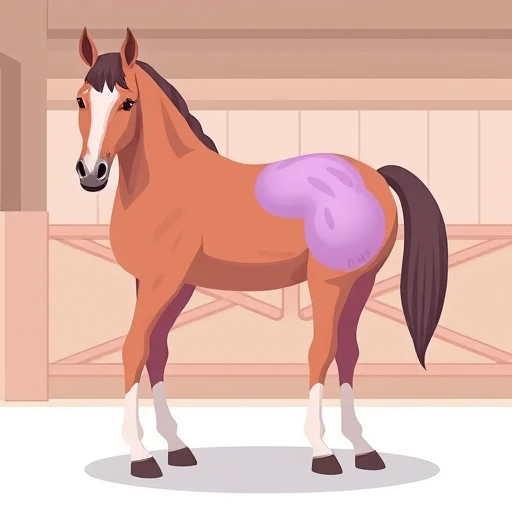
sweeney in 30 Seconds
- Sweeney is the wasting away of shoulder muscles in horses.
- It is caused by damage to the suprascapular nerve.
- The condition creates a visible hollow in the horse's shoulder.
- It was historically common in draft horses due to poor harness fit.
The term sweeney refers to a specific veterinary condition characterized by the atrophy, or wasting away, of the muscles in a horse's shoulder. This physiological decline is not a primary muscle disease but rather a secondary symptom resulting from damage to the suprascapular nerve. When this nerve, which runs across the front of the shoulder blade (scapula), is compressed or injured, it ceases to provide the necessary electrical impulses to the supraspinatus and infraspinatus muscles. Without these signals, the muscles begin to shrink, leading to a very distinct and visible hollow or depression in the horse's shoulder profile. Historically, this was a common ailment in draft horses, often caused by the heavy, ill-fitting collars used for pulling plows or wagons, which would press directly against the vulnerable nerve. In modern equestrianism, it is more frequently seen as a result of trauma, such as a horse running into a fence, being kicked by another horse, or colliding with a solid object. The condition is striking because the bony spine of the scapula becomes prominent, making the shoulder look 'sunken.' While it can cause a 'popping' motion in the shoulder joint during movement, many horses with sweeney remain surprisingly sound for light work, though their pulling power and stability are significantly compromised.
- Clinical Presentation
- The most obvious sign is a deep indentation on either side of the scapular spine, where full, rounded muscle should be.
- Etiology
- Damage to the suprascapular nerve, often through blunt force trauma or chronic pressure from equipment.
After the collision with the gatepost, the stallion developed a noticeable sweeney that required months of physical therapy.
In conversation, you will primarily hear this word among veterinarians, horse breeders, and experienced equestrians. It is a technical term, yet it carries a historical weight, often appearing in older agricultural texts or Western literature. When a horseman says a horse 'has a sweeney,' they are describing a permanent or semi-permanent physical defect that affects the animal's value and utility. The process of atrophy can happen quite rapidly, sometimes within two to three weeks of the initial nerve injury. Understanding sweeney requires a basic grasp of equine anatomy, specifically how nerves control muscle mass and how external pressure can lead to internal damage. It serves as a cautionary example in the horse world for the importance of properly fitting tack and the dangers of paddock accidents. While the term is almost exclusively used for horses, the biological principle of neurogenic muscle atrophy is universal across mammals, though the specific name 'sweeney' remains unique to the stable and the field.
The recovery from sweeney depends heavily on the severity of the nerve damage. If the nerve is merely compressed (neuropraxia), the muscle may return to its former glory once the pressure is removed and the nerve heals. However, if the nerve is severed or severely crushed, the atrophy may be permanent. Modern treatments include surgical decompression of the nerve, electrical stimulation of the muscles, and specialized exercise programs. Despite these advancements, the word 'sweeney' still evokes a sense of misfortune in the horse community, as it represents a loss of the animal's natural, powerful silhouette. It is a word that bridges the gap between old-world farming knowledge and modern veterinary science, maintaining its relevance as long as humans continue to work and ride with horses.
Using the word sweeney correctly requires placing it in a veterinary or equestrian context. It functions as a noun, typically identifying the condition itself. You might say a horse 'has sweeney,' 'is suffering from sweeney,' or 'shows signs of sweeney.' Because it describes a physical state, it often appears in sentences alongside words related to anatomy, injury, and recovery. For instance, 'The vet diagnosed the gelding with sweeney after noticing the hollowed-out shoulder.' Here, the word acts as a clinical diagnosis. It can also be used descriptively to explain why a horse is no longer fit for certain types of work: 'Due to the sweeney in his right shoulder, the horse could no longer pull the heavy carriage comfortably.'
- Diagnostic Context
- 'The ultrasound confirmed nerve damage, explaining the rapid onset of sweeney.'
- Historical Context
- 'In the 19th century, sweeney was a common occupational hazard for plow horses.'
The trainer was concerned that the ill-fitting harness would cause sweeney in the young mare.
When writing about sweeney, it is important to distinguish between the cause (nerve damage) and the result (muscle atrophy). A sentence like 'The sweeney was caused by a kick to the shoulder' is accurate and common. You can also use it in a more technical sense when discussing equine biomechanics: 'Sweeney results in the loss of the lateral stabilizers of the shoulder joint, leading to a characteristic gait abnormality.' In this case, the word is used to introduce a discussion on the functional consequences of the condition. It is rarely used outside of the equine world, so using it to describe human muscle wasting would be considered a metaphorical or highly unusual usage.
Furthermore, sweeney can be used in the context of animal welfare and husbandry. 'Proper harness fitting is essential to prevent sweeney in working animals.' This sentence highlights the preventative aspect of the word. In academic or veterinary writing, the word might be paired with its anatomical cause: 'Suprascapular neuropathy, commonly known as sweeney, remains a challenge for equine practitioners.' By using both terms, the writer connects common stable language with formal medical terminology. Whether you are writing a veterinary report, a historical novel set on a farm, or a guide to horse care, 'sweeney' is the precise term for this specific type of shoulder wasting.
You are most likely to encounter the word sweeney in environments where horses are a central part of life. This includes veterinary clinics specializing in large animals, where a vet might use the term during a lameness exam. 'I'm seeing some significant sweeney here; we need to check the suprascapular nerve,' is a sentence you might hear in such a setting. It is also common in the world of draft horses and heavy pulling. Enthusiasts of breeds like Clydesdales, Shires, and Percherons are very aware of sweeney because of the historical association with harness pressure. At a draft horse show or a plowing competition, old-timers might discuss the 'sweeney' seen in horses of the past compared to the better-fitted equipment of today.
- The Veterinary Clinic
- Veterinarians use it as a shorthand for neurogenic atrophy of the shoulder muscles.
- The Breeding Farm
- Breeders look for sweeney as a sign of past injury that might affect a horse's performance or sale value.
'That old mare has a bit of a sweeney from a kick she took years ago, but she still moves soundly enough for the kids to ride,' the farmer remarked.
Another place you might hear this word is in historical or regional literature, particularly those set in the American West or rural England. Authors who pride themselves on technical accuracy in their depictions of farm life will use 'sweeney' to add a layer of authenticity to their descriptions of livestock. In these contexts, it often serves as a marker of a horse that has worked hard or suffered the rigors of a tough environment. You might also find it in specialized equestrian magazines and online forums dedicated to horse health. If a horse owner notices a strange dip in their horse's shoulder, they might post a photo online asking, 'Does this look like sweeney?' The community response will invariably involve advice on nerve regeneration and vet recommendations.
Finally, sweeney appears in the curriculum of farrier and veterinary technician schools. Students are taught to recognize the 'sweeney gait'—a slight outward swing of the leg caused by the instability of the shoulder joint. While the word is niche, it is deeply embedded in the lexicon of those who care for horses. It is a word that carries the smell of hay, the sound of hooves, and the serious tone of a medical consultation. Even if you never own a horse, knowing the word 'sweeney' gives you a window into a specialized world of animal husbandry and the intricate ways in which anatomy and environment interact.
One of the most frequent mistakes regarding the word sweeney is its spelling. It is often misspelled as 'sweeny,' 'swinney,' or even 'sweenie.' While 'sweeny' is a recognized variant, 'sweeney' is the more traditional and widely accepted spelling in veterinary literature. Another common error is confusing sweeney with general muscle wasting due to malnutrition or old age. It is vital to remember that sweeney is localized atrophy caused by nerve damage. If a horse is thin all over, that is not sweeney; sweeney specifically affects the shoulder muscles (supraspinatus and infraspinatus) while the rest of the horse might be in excellent condition.
- Spelling Error
- Using 'swinney' instead of 'sweeney'.
- Conceptual Error
- Assuming any shoulder lameness is sweeney without the characteristic muscle hollow.
Incorrect: The horse was so old and thin that he had sweeney all over his body.
People also sometimes mistake sweeney for a bone fracture. While a fracture of the scapula can lead to nerve damage and subsequent sweeney, the sweeney itself is the muscle condition, not the bone break. Furthermore, some beginners might use the term to describe humans who have shoulder injuries. While the biological process is similar, the term 'sweeney' is culturally and technically reserved for equines. Using it for a human might cause confusion or be taken as a joke. In the equestrian world, a mistake is often made in assuming that a horse with sweeney is completely 'broken' or unusable. In reality, many horses with mild sweeney can live long, productive lives in roles that don't require heavy pulling or high-level athletic stabilization.
Finally, there is a mistake in timing. Owners might expect sweeney to appear immediately after an injury. However, muscle atrophy takes time to become visible. The 'hollow' usually develops over several weeks following the nerve trauma. Conversely, some expect the muscle to grow back instantly once the nerve starts to heal. Nerve regeneration is a notoriously slow process, often occurring at a rate of only one millimeter per day. Therefore, mismanaging expectations about the appearance and recovery of sweeney is a common pitfall for those unfamiliar with the condition's physiological timeline. By avoiding these spelling, conceptual, and contextual errors, you can use the term 'sweeney' with the precision of a seasoned horseman.
When discussing sweeney, it is helpful to know related terms that describe similar physiological states or medical conditions. The most direct scientific synonym is suprascapular neuropathy. This term is preferred in modern veterinary medicine as it identifies the exact nerve involved and the nature of the problem (neuropathy). Another related term is atrophy, which is the general medical word for the wasting away of body tissue. While sweeney is a type of atrophy, not all atrophy is sweeney. For example, 'disuse atrophy' occurs when a limb is in a cast and the muscles shrink from lack of movement, whereas sweeney is 'neurogenic atrophy,' caused specifically by nerve failure.
- Suprascapular Neuropathy
- The formal medical term for the nerve damage that causes sweeney.
- Muscle Wasting
- A more general, non-technical term for the loss of muscle mass.
The vet explained that the sweeney was a classic case of neurogenic atrophy resulting from a shoulder impact.
In terms of gait and movement, you might hear the word lameness. Sweeney is a cause of lameness, but it is a very specific kind. Unlike 'founder' (laminitis) or 'navicular disease,' which affect the hoof, sweeney is a 'high' lameness, originating in the shoulder. Another term often confused with sweeney is shoulder slip. Shoulder slip is the visual 'popping' or lateral movement of the shoulder joint that occurs because the atrophied muscles are no longer there to hold the joint tightly in place. While sweeney is the muscle loss, shoulder slip is the resulting mechanical instability. In older texts, you might find the term fistulous withers, but this is a completely different condition involving infection and should not be used as an alternative.
If you are looking for a more descriptive, less technical way to say it, you might use phrases like 'sunken shoulder' or 'shoulder wasting.' However, these lack the specific diagnostic weight of 'sweeney.' In the context of nerve damage, you might also hear palsy, as in 'suprascapular nerve palsy.' This emphasizes the paralysis of the nerve. Understanding these alternatives allows you to tailor your language to your audience—using 'sweeney' with a farmer, 'suprascapular neuropathy' with a surgeon, and 'muscle wasting' with a general observer. Each term provides a slightly different perspective on the same unfortunate condition.
How Formal Is It?
Fun Fact
While 'Sweeney' is a common Irish surname, the veterinary term has no relation to the name; it is purely a descriptive term for muscle loss that has been used in English since the 19th century.
Pronunciation Guide
- Pronouncing it like 'swiney' (rhyming with 'tiny').
- Adding an extra syllable like 'swee-ne-y'.
- Confusing it with the name 'Sweeney' and using a different emphasis.
- Muffling the 'w' sound so it sounds like 'seeny'.
- Over-emphasizing the second syllable.
Difficulty Rating
The word is rare but usually appears in clear contexts.
Spelling can be tricky and it's a very niche term.
Pronunciation is straightforward once learned.
Might be confused with the name Sweeney.
What to Learn Next
Prerequisites
Learn Next
Advanced
Grammar to Know
Nouns used as names for medical conditions
The horse has sweeney (no article needed in some contexts).
Using 'due to' for causes
Sweeney due to nerve damage.
Adjectives derived from nouns
A sweenied shoulder (informal).
Passive voice in medical descriptions
The muscle is atrophied by the lack of nerve signals.
Compound adjectives for physical traits
A sweeney-shouldered draft horse.
Examples by Level
The horse has sweeney in its shoulder.
Le cheval a un sweeney à l'épaule.
Sweeney is a noun here.
Is sweeney bad for the horse?
Est-ce que le sweeney est mauvais pour le cheval ?
Used as a subject.
The vet looks at the sweeney.
Le vétérinaire regarde le sweeney.
Direct object of the verb 'looks at'.
Sweeney makes a hole in the muscle.
Le sweeney fait un trou dans le muscle.
Simple present tense.
My horse does not have sweeney.
Mon cheval n'a pas de sweeney.
Negative sentence.
Can a horse get better from sweeney?
Un cheval peut-il guérir du sweeney ?
Question form.
Sweeney comes from a hurt nerve.
Le sweeney vient d'un nerf blessé.
Explaining the cause.
Look at the sweeney on that horse.
Regarde le sweeney sur ce cheval.
Imperative sentence.
The farmer noticed sweeney after the horse hit the fence.
Le fermier a remarqué un sweeney après que le cheval a frappé la clôture.
Past tense 'noticed'.
Sweeney is a very old word for this problem.
Sweeney est un mot très ancien pour ce problème.
Linking verb 'is'.
The muscle is small because of sweeney.
Le muscle est petit à cause du sweeney.
Prepositional phrase 'because of'.
A bad harness can cause sweeney.
Un mauvais harnais peut causer le sweeney.
Modal verb 'can'.
The vet says it is a case of sweeney.
Le vétérinaire dit que c'est un cas de sweeney.
Noun phrase 'a case of sweeney'.
Sweeney makes the shoulder look flat.
Le sweeney rend l'épaule plate.
Object complement structure.
He bought a horse with sweeney by mistake.
Il a acheté un cheval avec un sweeney par erreur.
Prepositional phrase 'with sweeney'.
Sweeney does not usually cause a lot of pain.
Le sweeney ne cause généralement pas beaucoup de douleur.
Adverb 'usually' modifying the verb.
The horse's shoulder showed signs of sweeney, indicating nerve damage.
L'épaule du cheval montrait des signes de sweeney, indiquant des lésions nerveuses.
Participial phrase 'indicating nerve damage'.
If you don't fit the collar correctly, the horse might develop sweeney.
Si vous n'ajustez pas le collier correctement, le cheval pourrait développer un sweeney.
First conditional sentence.
Sweeney is characterized by the atrophy of the shoulder muscles.
Le sweeney se caractérise par l'atrophie des muscles de l'épaule.
Passive voice 'is characterized by'.
The recovery from sweeney can take many months of rest.
La guérison du sweeney peut prendre de nombreux mois de repos.
Noun as the object of a preposition.
Most people recognize sweeney by the hollow look of the shoulder.
La plupart des gens reconnaissent le sweeney à l'aspect creux de l'épaule.
Gerund phrase 'by the hollow look'.
The vet recommended a specific exercise to help the sweeney.
Le vétérinaire a recommandé un exercice spécifique pour aider le sweeney.
Infinitive phrase 'to help'.
Sweeney was more common when horses did all the farm work.
Le sweeney était plus fréquent lorsque les chevaux faisaient tout le travail de la ferme.
Comparative 'more common'.
Although the horse had sweeney, he was still able to trot.
Bien que le cheval ait eu un sweeney, il était encore capable de trotter.
Concession clause with 'although'.
The sudden onset of sweeney suggested an acute injury to the suprascapular nerve.
L'apparition soudaine du sweeney suggérait une lésion aiguë du nerf suprascapulaire.
Complex subject 'The sudden onset of sweeney'.
Chronic pressure from a heavy harness is a classic cause of sweeney in draft breeds.
La pression chronique d'un harnais lourd est une cause classique de sweeney chez les races de trait.
Adjective 'classic' modifying 'cause'.
Sweeney results in a loss of stability in the equine shoulder joint.
Le sweeney entraîne une perte de stabilité dans l'articulation de l'épaule équine.
Phrasal verb 'results in'.
The trainer suspected sweeney when he saw the horse's shoulder 'pop' outward.
L'entraîneur a suspecté un sweeney lorsqu'il a vu l'épaule du cheval 'sauter' vers l'extérieur.
Temporal clause with 'when'.
Surgical intervention is sometimes required to treat severe cases of sweeney.
Une intervention chirurgicale est parfois nécessaire pour traiter les cas graves de sweeney.
Adverb 'sometimes' placed before the verb.
The presence of sweeney significantly devalues a performance horse.
La présence de sweeney dévalue considérablement un cheval de performance.
Adverb 'significantly' modifying 'devalues'.
Identifying sweeney early can lead to a better prognosis for the animal.
Identifier le sweeney tôt peut conduire à un meilleur pronostic pour l'animal.
Gerund as a subject 'Identifying sweeney early'.
Sweeney is often permanent if the nerve has been completely severed.
Le sweeney est souvent permanent si le nerf a été complètement sectionné.
Conditional 'if' with present perfect passive.
The pathognomonic sign of sweeney is the dramatic atrophy of the infraspinatus muscle.
Le signe pathognomonique du sweeney est l'atrophie spectaculaire du muscle sous-épineux.
Use of the technical term 'pathognomonic'.
Differential diagnosis for sweeney includes scapular fractures and deep tissue infections.
Le diagnostic différentiel du sweeney comprend les fractures de l'omoplate et les infections des tissus profonds.
Subject-verb agreement with 'includes'.
The horse exhibited a lateral subluxation of the shoulder, a common sequela of sweeney.
Le cheval présentait une subluxation latérale de l'épaule, une séquelle courante du sweeney.
Appositive phrase 'a common sequela of sweeney'.
Electro-stimulation therapy was initiated to combat the muscle wasting associated with sweeney.
Une thérapie par électrostimulation a été initiée pour lutter contre la fonte musculaire associée au sweeney.
Passive voice with an infinitive of purpose.
Sweeney exemplifies the vulnerability of the suprascapular nerve as it traverses the scapular notch.
Le sweeney illustre la vulnérabilité du nerf suprascapulaire lorsqu'il traverse l'échancrure scapulaire.
Subordinate clause with 'as'.
The historical prevalence of sweeney in agriculture led to innovations in harness design.
La prévalence historique du sweeney dans l'agriculture a conduit à des innovations dans la conception des harnais.
Complex noun phrase as subject.
A horse with sweeney may present with a 'swinging-leg' lameness during the swing phase of the stride.
Un cheval atteint de sweeney peut présenter une boiterie de 'jambe pendante' pendant la phase de balancement de la foulée.
Modal 'may' expressing possibility.
The degree of reinnervation determines the extent to which the sweeney can be reversed.
Le degré de réinnervation détermine dans quelle mesure le sweeney peut être inversé.
Relative clause 'to which...'.
The insidious progression of sweeney can often mask the initial traumatic event that precipitated the nerve damage.
La progression insidieuse du sweeney peut souvent masquer l'événement traumatique initial qui a précipité les lésions nerveuses.
Use of 'insidious' and 'precipitated'.
In veterinary circles, the term sweeney is synonymous with neurogenic scapular muscle atrophy.
Dans les milieux vétérinaires, le terme sweeney est synonyme d'atrophie neurogène des muscles scapulaires.
Prepositional phrase 'In veterinary circles'.
The biomechanical instability inherent in sweeney necessitates a tailored farriery approach to support the limb.
L'instabilité biomécanique inhérente au sweeney nécessite une approche de maréchalerie sur mesure pour soutenir le membre.
Adjective 'inherent' following the noun.
Literature of the 1800s frequently alludes to sweeney as a mark of a poorly managed stable.
La littérature des années 1800 fait souvent allusion au sweeney comme à la marque d'une écurie mal gérée.
Verb 'alludes to'.
The surgical decompression of the suprascapular nerve offers a glimmer of hope for horses afflicted with chronic sweeney.
La décompression chirurgicale du nerf suprascapulaire offre une lueur d'espoir pour les chevaux affligés d'un sweeney chronique.
Metaphorical use of 'glimmer of hope'.
Sweeney remains a poignant reminder of the physical toll that heavy labor once exacted on equine companions.
Le sweeney reste un rappel poignant du tribut physique que le travail lourd exigeait autrefois des compagnons équins.
Relative clause with 'that'.
The morphological changes associated with sweeney are often irreversible if the axonal damage is extensive.
Les changements morphologiques associés au sweeney sont souvent irréversibles si les dommages axonaux sont étendus.
Conditional 'if' with an adjective clause.
To understand the etiology of sweeney is to appreciate the delicate interplay between neural health and muscular integrity.
Comprendre l'étiologie du sweeney, c'est apprécier l'interaction délicate entre la santé neurale et l'intégrité musculaire.
Infinitive phrase as subject 'To understand...'.
Common Collocations
Common Phrases
— A redundant but common way to specify the location of the condition.
The vet confirmed it was a case of shoulder sweeney.
— An informal way to refer to a horse afflicted with the condition.
He's a good sweeney horse, still capable of light trail riding.
— Refers to the physical depression caused by the muscle loss.
You could fit your whole hand in the hollow of the sweeney.
— The specific way a horse walks when it has this condition.
The sweeney gait is easy to spot once you know what to look for.
— A descriptive phrase emphasizing the muscle loss.
The atrophied sweeney was a result of a kick in the paddock.
— Clarifies the cause of the condition.
The nerve-induced sweeney was permanent.
— When the condition affects both shoulders.
Bilateral sweeney is rare and usually caused by very poor harness fit.
— When the condition affects only one shoulder.
The unilateral sweeney made the horse look lopsided.
— Sweeney caused by a sudden injury.
The traumatic sweeney appeared after the horse ran into a tree.
— Sweeney caused specifically by equipment pressure.
Harness sweeney was a major problem in the old days of farming.
Often Confused With
A common Irish name, unrelated to the horse condition.
A common horse ailment, but it affects the feet, not the shoulder.
A general term for muscle loss; sweeney is a specific type.
Idioms & Expressions
— To suffer from the specific shoulder muscle atrophy.
That old gelding has had a sweeney since he was five.
informal— Describing a horse with the characteristic hollow shoulder.
The sweeney-shouldered mare was retired to the pasture.
descriptive— Referring to the shoulder joint instability associated with the condition.
Watch out for that popping sweeney when he turns.
slang— A rare term for a horse that is becoming unusable due to the condition.
He's sweeney-bound if we don't fix that harness.
archaic— Having the visible signs of the condition.
His career was marked by sweeney after the accident.
literary— The physical indentation in the shoulder.
The sweeney dip was quite deep on the right side.
informal— Having recovered muscle mass after nerve healing.
It's rare to be fully cured of sweeney.
neutral— Likely to develop the condition, often due to poor conformation.
Draft horses are more sweeney-prone than light breeds.
technical— A mild case that is not immediately obvious.
The buyer didn't notice the hidden sweeney until the horse moved.
informal— Metaphorically or physically marked by the condition.
The sweeney-scarred horse was a veteran of many harvests.
literaryEasily Confused
It is a variant spelling.
Sweeney is more common in modern texts, but both refer to the same condition.
The book used the spelling 'sweeny' instead of 'sweeney'.
Similar sound.
Swiney relates to pigs; sweeney relates to horse shoulders.
Don't say swiney when you mean the horse's shoulder problem.
Both are horse physical defects.
Swayback affects the spine/back; sweeney affects the shoulder.
The horse was swayback and also had a sweeney.
Both affect the shoulder/wither area.
Fistula is an infection; sweeney is nerve-based muscle loss.
The vet ruled out a fistula and confirmed it was sweeney.
They often occur together.
Sweeney is the muscle loss; shoulder slip is the joint movement.
The sweeney was so bad that it caused a noticeable shoulder slip.
Sentence Patterns
The horse has [condition].
The horse has sweeney.
[Condition] is in the [body part].
Sweeney is in the shoulder.
[Condition] is caused by [cause].
Sweeney is caused by nerve damage.
The [part] shows signs of [condition].
The shoulder shows signs of sweeney.
[Condition] results in [effect].
Sweeney results in muscle atrophy.
The [adjective] [condition] [verb] [consequence].
The insidious sweeney compromised the horse's stability.
If [action], the horse might get [condition].
If the collar is tight, the horse might get sweeney.
Although [condition], the horse [action].
Although he had sweeney, the horse could still walk.
Word Family
Nouns
Adjectives
Related
How to Use It
Rare in general English; common in equestrian and veterinary circles.
-
Spelling it 'Sweeny'.
→
Sweeney
While 'Sweeny' is sometimes used, 'Sweeney' is the standard veterinary spelling.
-
Thinking sweeney is a bone disease.
→
It is a nerve/muscle condition.
Sweeney affects the muscles because of nerve damage, not the bones themselves.
-
Assuming all shoulder dips are sweeney.
→
Check for other causes.
Some horses naturally have less muscle, but sweeney is a specific, pathological wasting.
-
Using sweeney to describe a thin horse.
→
Use 'emaciated' or 'thin'.
Sweeney is localized to the shoulder; a thin horse is thin everywhere.
-
Expecting instant recovery.
→
Understand nerve healing is slow.
Nerves heal at about 1mm per day, so recovery from sweeney takes months.
Tips
Check Your Tack
Always ensure your horse's harness or collar fits perfectly to avoid putting pressure on the shoulder nerve.
Watch the Gait
If you see a horse's shoulder 'popping' out, it might be an early sign of sweeney.
Early Intervention
If a horse hits its shoulder, call a vet immediately. Early treatment can sometimes prevent permanent sweeney.
Inspect the Shoulder
When buying a horse, always check for muscle symmetry in the shoulders to rule out past sweeney.
Physical Therapy
Specific exercises can help keep the remaining muscles strong and support the shoulder joint.
Know the Nerve
The suprascapular nerve is the key. Protecting this area is vital for horse health.
Learn from the Past
Studying how old-time farmers managed sweeney can give you a better appreciation for modern equipment.
Use Precise Terms
Using the word 'sweeney' with your vet shows you are an informed horse owner.
Paddock Safety
Keep fences in good repair to prevent horses from running into them and injuring their shoulders.
Give it Time
Nerve healing is very slow. Don't expect a sweeney to disappear overnight.
Memorize It
Mnemonic
Think of 'Sweeney Todd' the barber. Just as he 'cuts' things away, Sweeney in a horse looks like the muscle has been 'cut' out of the shoulder.
Visual Association
Imagine a horse's shoulder with a deep 'spoon-shaped' hole where the muscle should be. The 'S' in Sweeney can stand for 'Sunken Shoulder'.
Word Web
Challenge
Try to describe a horse with sweeney to a friend without using the word 'hole' or 'empty'. Use 'atrophy' and 'nerve' instead.
Word Origin
The word is believed to be derived from the German word 'schwinden,' which means to dwindle, vanish, or waste away. This perfectly describes the disappearing muscle mass characteristic of the condition.
Original meaning: Wasting away or dwindling of flesh.
GermanicCultural Context
It is a medical condition, so use it with empathy for the animal's state.
Common in rural US, UK, and Australian English among horse owners.
Practice in Real Life
Real-World Contexts
Veterinary Exam
- Check for muscle symmetry
- Palpate the scapular spine
- Assess the nerve function
- Look for shoulder slip
Horse Auction
- Is he sound?
- Any history of injury?
- Notice the shoulder dip
- Price reduction for sweeney
Stable Management
- Check the harness fit
- Avoid shoulder pressure
- Monitor for muscle loss
- Rest the injured horse
Historical Research
- Draft horse ailments
- 19th-century husbandry
- Evolution of the horse collar
- Working horse conditions
Farriery
- Support the limb
- Adjust the shoeing
- Balance the gait
- Compensate for instability
Conversation Starters
"Have you ever seen a horse with a sweeney in its shoulder?"
"Do you know how a bad harness can cause sweeney?"
"What's the best way to treat a horse diagnosed with sweeney?"
"Is sweeney a common problem in draft horses today?"
"How does sweeney affect a horse's ability to pull a carriage?"
Journal Prompts
Describe the physical appearance of a horse with sweeney and how it might feel for the animal.
Research the history of the horse collar and how it helped prevent sweeney.
Imagine you are a vet explaining sweeney to a worried horse owner.
Why do you think specific words like 'sweeney' exist for animal conditions instead of just using general terms?
Write a story about a horse that overcomes the limitations of a sweeney.
Frequently Asked Questions
10 questionsIt depends on the nerve damage. If the nerve is only bruised, the muscle can grow back. If the nerve is dead, the sweeney is usually permanent.
The initial injury is painful, but the resulting muscle loss (the sweeney itself) is usually not painful, though it causes weakness.
In the past, it was bad harnesses. Today, it is usually from a horse hitting something hard or being kicked in the shoulder.
Look for a deep hollow or dip in the shoulder muscle, making the bone in the middle of the shoulder stick out.
Yes, many horses with sweeney can be ridden for light work, but they shouldn't do heavy pulling or jumping.
No, it is a physical injury to a nerve, not an illness you can catch.
It usually takes 2 to 4 weeks after the nerve injury for the muscle to shrink enough to see the sweeney.
Usually only one, unless the horse had an injury to both sides or a very poorly fitted harness.
The formal name is suprascapular neuropathy or neurogenic scapular muscle atrophy.
Draft horses are historically more prone to it because of the heavy work they do and the collars they wear.
Test Yourself 185 questions
Explain what causes sweeney in your own words.
Well written! Good try! Check the sample answer below.
Describe the physical appearance of a horse with sweeney.
Well written! Good try! Check the sample answer below.
How can a farmer prevent sweeney in their working horses?
Well written! Good try! Check the sample answer below.
Why is sweeney called 'neurogenic atrophy'?
Well written! Good try! Check the sample answer below.
Write a sentence using the word 'sweeney' in a veterinary context.
Well written! Good try! Check the sample answer below.
What is the difference between sweeney and general weight loss?
Well written! Good try! Check the sample answer below.
Describe the 'sweeney gait'.
Well written! Good try! Check the sample answer below.
Why was sweeney more common in the 19th century?
Well written! Good try! Check the sample answer below.
Can a horse recover from sweeney? Explain.
Well written! Good try! Check the sample answer below.
Use 'sweeney' and 'atrophy' in the same sentence.
Well written! Good try! Check the sample answer below.
Is sweeney a common word? Why or why not?
Well written! Good try! Check the sample answer below.
What should a buyer do if they see a sweeney on a horse for sale?
Well written! Good try! Check the sample answer below.
How does sweeney affect a horse's performance?
Well written! Good try! Check the sample answer below.
What are the two main muscles affected by sweeney?
Well written! Good try! Check the sample answer below.
Write a short story about a horse with sweeney.
Well written! Good try! Check the sample answer below.
What is the role of the suprascapular nerve?
Well written! Good try! Check the sample answer below.
Explain the etymology of sweeney.
Well written! Good try! Check the sample answer below.
Why is sweeney called a 'high lameness'?
Well written! Good try! Check the sample answer below.
How long does it take for muscle to waste away in sweeney?
Well written! Good try! Check the sample answer below.
Is sweeney painful? Explain.
Well written! Good try! Check the sample answer below.
Describe a horse with sweeney to your partner.
Read this aloud:
You said:
Speech recognition is not supported in your browser. Try Chrome or Edge.
Explain the causes of sweeney.
Read this aloud:
You said:
Speech recognition is not supported in your browser. Try Chrome or Edge.
Discuss if a horse with sweeney should be used for work.
Read this aloud:
You said:
Speech recognition is not supported in your browser. Try Chrome or Edge.
How would you tell a horse owner their horse has sweeney?
Read this aloud:
You said:
Speech recognition is not supported in your browser. Try Chrome or Edge.
Pronounce 'sweeney' correctly three times.
Read this aloud:
You said:
Speech recognition is not supported in your browser. Try Chrome or Edge.
Summarize the history of sweeney in agriculture.
Read this aloud:
You said:
Speech recognition is not supported in your browser. Try Chrome or Edge.
What are the symptoms of sweeney?
Read this aloud:
You said:
Speech recognition is not supported in your browser. Try Chrome or Edge.
Explain the word 'atrophy' in relation to sweeney.
Read this aloud:
You said:
Speech recognition is not supported in your browser. Try Chrome or Edge.
Why is it important to check the harness fit?
Read this aloud:
You said:
Speech recognition is not supported in your browser. Try Chrome or Edge.
Compare sweeney to other types of lameness.
Read this aloud:
You said:
Speech recognition is not supported in your browser. Try Chrome or Edge.
What is the suprascapular nerve?
Read this aloud:
You said:
Speech recognition is not supported in your browser. Try Chrome or Edge.
How does sweeney affect a horse's value?
Read this aloud:
You said:
Speech recognition is not supported in your browser. Try Chrome or Edge.
Can sweeney be treated with surgery?
Read this aloud:
You said:
Speech recognition is not supported in your browser. Try Chrome or Edge.
Describe the 'shoulder slip' motion.
Read this aloud:
You said:
Speech recognition is not supported in your browser. Try Chrome or Edge.
Where does the word sweeney come from?
Read this aloud:
You said:
Speech recognition is not supported in your browser. Try Chrome or Edge.
Is sweeney a common problem today?
Read this aloud:
You said:
Speech recognition is not supported in your browser. Try Chrome or Edge.
What muscles are involved in sweeney?
Read this aloud:
You said:
Speech recognition is not supported in your browser. Try Chrome or Edge.
Why is sweeney localized?
Read this aloud:
You said:
Speech recognition is not supported in your browser. Try Chrome or Edge.
How long is the recovery period for sweeney?
Read this aloud:
You said:
Speech recognition is not supported in your browser. Try Chrome or Edge.
Give a tip for preventing sweeney.
Read this aloud:
You said:
Speech recognition is not supported in your browser. Try Chrome or Edge.
Listen to the description: 'The horse's shoulder has a deep dip.' What condition is being described?
Listen for the cause: 'The injury was to the suprascapular nerve.' What did this cause?
Listen for the historical context: 'Plow horses often got this from heavy collars.' What is 'this'?
Listen for the medical term: 'The horse has neurogenic atrophy of the shoulder.' What is the common name?
Listen for the gait description: 'The shoulder pops out when he walks.' What is this called?
Listen to the vet's advice: 'He needs six months of rest for the nerve to heal.' Why?
Listen for the synonym: 'The shoulder wasting is quite advanced.' What is another word for this?
Listen for the spelling: 'S-W-E-E-N-E-Y'. What word is this?
Listen for the origin: 'It comes from a German word for vanishing.' What word?
Listen for the outcome: 'The horse is sound but has a permanent hollow.' What is the hollow called?
Listen for the treatment: 'We are using electrical stimulation on the shoulder.' What condition are they treating?
Listen for the warning: 'Watch out for that kick, it could cause a sweeney.' What causes the sweeney here?
Listen for the anatomical part: 'The scapula is very prominent now.' Why?
Listen for the breed: 'Draft horses were the most common victims.' Victims of what?
Listen for the prognosis: 'The nerve is severed, so the sweeney is permanent.' Is there hope for recovery?
/ 185 correct
Perfect score!
Summary
Sweeney is a specific type of muscle atrophy in a horse's shoulder caused by nerve damage, often resulting in a permanent physical depression and gait changes. Example: 'The old plow horse developed sweeney from years of wearing a poorly fitted collar.'
- Sweeney is the wasting away of shoulder muscles in horses.
- It is caused by damage to the suprascapular nerve.
- The condition creates a visible hollow in the horse's shoulder.
- It was historically common in draft horses due to poor harness fit.
Check Your Tack
Always ensure your horse's harness or collar fits perfectly to avoid putting pressure on the shoulder nerve.
Watch the Gait
If you see a horse's shoulder 'popping' out, it might be an early sign of sweeney.
Early Intervention
If a horse hits its shoulder, call a vet immediately. Early treatment can sometimes prevent permanent sweeney.
Inspect the Shoulder
When buying a horse, always check for muscle symmetry in the shoulders to rule out past sweeney.