denmark في 30 ثانية
- Denmark is a Northern European country known for its high standard of living, social equality, and being the southernmost of the Scandinavian nations.
- The nation consists of the Jutland Peninsula and hundreds of islands, with its capital city, Copenhagen, located on the largest island, Zealand.
- It is famous for cultural exports like LEGO, the fairy tales of Hans Christian Andersen, and the cozy lifestyle concept known as 'hygge.'
- Denmark is a leader in green energy and sustainable urban planning, often ranking as one of the happiest and least corrupt countries globally.
Denmark is a sovereign state located in Northern Europe, serving as the southernmost of the Scandinavian nations. When people use the word 'Denmark,' they are referring to a country that is geographically unique, consisting of the Jutland Peninsula and an extensive archipelago of 443 named islands, with Zealand, Funen, and Lolland being among the most prominent. In modern discourse, Denmark is frequently cited as a global leader in social welfare, renewable energy, and design. It is a founding member of NATO, the Nordic Council, and the OECD, and it joined the European Economic Community in 1973, though it maintains its own currency, the Danish krone. The term is used in geographical, political, and cultural contexts to describe a nation known for its high level of income equality, its 'hygge' lifestyle, and its historical roots in the Viking Age. Geographically, it shares a land border only with Germany to the south, while it is connected to Sweden via the Øresund Bridge. The use of 'Denmark' often evokes images of flat landscapes, extensive coastlines, and a society that prioritizes community well-being and environmental sustainability.
- Geopolitical Status
- A constitutional monarchy and parliamentary democracy with a high standard of living and extensive social services.
Many travelers visit Denmark to experience the historic charm of Copenhagen and its world-famous Little Mermaid statue.
In a cultural sense, 'Denmark' is synonymous with a specific type of Nordic aesthetic characterized by minimalism and functionality. This is evident in Danish architecture, furniture design, and fashion. When discussing international happiness rankings, Denmark is almost always mentioned near the top, leading to discussions about the 'Danish model' of governance and social cohesion. Historically, the word carries the weight of the Kingdom of Denmark, which once ruled over large parts of the North Atlantic, including Norway, parts of Sweden, and still includes the autonomous territories of the Faroe Islands and Greenland. Therefore, using the word in a formal political context requires an understanding of the 'Unity of the Realm' (Rigsfællesskabet). In everyday conversation, it is used simply to denote the destination for tourism, the origin of a product (like Danish butter or LEGO), or the nationality of a person. The word is a proper noun and must always be capitalized in English.
- Cultural Identity
- Associated with the concept of 'hygge,' representing coziness, contentment, and well-being through simple things.
The agricultural sector in Denmark is highly advanced, producing significant amounts of dairy and pork for export.
Furthermore, Denmark is often used as a benchmark in discussions about green energy transitions. As one of the world's leading nations in wind energy production, 'Denmark' frequently appears in academic and policy papers regarding the 'green transition.' The country's commitment to becoming carbon neutral by 2050 makes it a focal point for environmental scientists and urban planners. When people talk about 'Denmark' in the context of urbanism, they often refer to the cycling culture of its capital, Copenhagen, which is frequently ranked as the most bike-friendly city in the world. This association makes the word a shorthand for progressive urban living and sustainable development. Whether you are discussing the fairy tales of Hans Christian Andersen or the complex maritime history of the Baltic Sea, Denmark remains a central term in European geography and history.
- Economic Profile
- A high-income economy with a flexible labor market known as 'flexicurity,' combining market economy with a welfare state.
Greenland and the Faroe Islands are part of the Kingdom of Denmark but enjoy extensive home rule.
The bridge connecting Denmark to Sweden has significantly boosted regional economic integration.
Viking history is a major part of the cultural heritage found throughout Denmark.
Using 'Denmark' in a sentence is generally straightforward as it functions as a proper noun, but its application varies depending on whether you are discussing geography, politics, or culture. When used as a subject, it often represents the nation's government or its people collectively. For example, 'Denmark has implemented strict environmental regulations' refers to the legislative actions of the state. When used as an object of a preposition, it typically indicates a location: 'We are planning a trip to Denmark this summer.' It is important to distinguish between 'Denmark' (the country) and 'Danish' (the adjective or the language). You would say 'I love Denmark,' but 'I love Danish pastry.' In formal writing, Denmark is often used in the context of international relations, such as 'Denmark's role in the European Union is unique due to its various opt-outs.' This possessive form, 'Denmark's,' is common when attributing characteristics or achievements to the nation.
- Geographical Usage
- Used to specify location, borders, and physical features. Example: 'Denmark is bordered by the Baltic and North Seas.'
The flat terrain of Denmark makes it an ideal place for long-distance cycling.
In academic or journalistic contexts, 'Denmark' might be used to represent a specific socio-economic model. Sentences like 'Researchers often look to Denmark for examples of successful work-life balance' use the country as a case study. When discussing history, 'Denmark' might refer to the historical kingdom, which had different borders than the modern state. For instance, 'In the 11th century, Denmark was the center of a North Sea Empire.' It is also common to see 'Denmark' paired with other Scandinavian countries in comparative sentences: 'Unlike Norway, Denmark does not have high mountains.' In these cases, the word serves as a point of contrast. When referring to the people, one should use 'Danes' or 'the Danish people' rather than 'Denmarks.' For example, 'Danes are known for their love of cycling' is correct, whereas 'Denmarks are known...' is not. Understanding these nuances ensures that the word is used accurately across different registers of English.
- Political Usage
- Used to describe state actions, policies, and international standing. Example: 'Denmark is a member of the United Nations.'
During the winter, the days in Denmark are very short, with the sun setting as early as 3:30 PM.
Another common way to use 'Denmark' is in the context of business and industry. 'Denmark is home to several multinational corporations, including Maersk and Novo Nordisk.' Here, the word identifies the corporate headquarters' location. In travel writing, the word is often used to set a scene: 'The wind-swept beaches of western Denmark offer a stark beauty.' This descriptive use helps the reader visualize the setting. Furthermore, 'Denmark' is often used in compound phrases or as part of a title, such as 'The Kingdom of Denmark' or 'The National Museum of Denmark.' When speaking about the language, remember that 'Denmark' is the place, and 'Danish' is the tongue. 'I am learning Danish because I want to live in Denmark' is a perfect example of using both terms correctly in a single sentence. By mastering these patterns, you can communicate clearly about anything related to this Nordic nation.
- Possessive Form
- Use 'Denmark's' to indicate ownership or association. Example: 'Denmark's coastline is surprisingly long for its size.'
The educational system in Denmark is largely funded by taxes, making university tuition free for EU citizens.
If you travel to Denmark, you will notice that almost everyone speaks excellent English.
The architectural landscape of Denmark blends medieval structures with cutting-edge modern design.
The word 'Denmark' is frequently heard in international news broadcasts, particularly those focusing on European politics, climate change, and social issues. News anchors might say, 'Denmark has announced a new initiative to phase out fossil fuels,' highlighting the country's role as a policy leader. In the world of sports, especially during the FIFA World Cup or the UEFA European Championship, commentators often discuss 'Denmark's national team' and their performance on the global stage. Travel documentaries and vlogs are another common source, where presenters describe the beauty of the Danish countryside or the vibrant life in Copenhagen. In these contexts, the word is usually spoken with a sense of admiration for the country's efficiency and aesthetic appeal. You will also hear it in business news when reporters discuss major Danish companies like Maersk, the shipping giant, or LEGO, the toy manufacturer, which are often referred to as 'Denmark-based' or 'hailing from Denmark.'
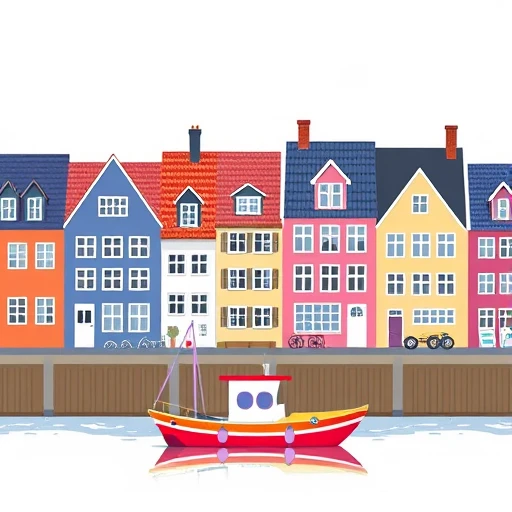
In academic settings, particularly in sociology and political science lectures, 'Denmark' is a common point of reference for the 'Nordic Model.' Professors might discuss how 'Denmark manages to maintain high levels of social trust.' In the culinary world, 'Denmark' is mentioned in discussions about 'New Nordic Cuisine,' with Noma in Copenhagen often being cited as one of the best restaurants in the world. On social media platforms like Instagram or TikTok, the word is used in hashtags like #Denmark, #VisitDenmark, or #Copenhagen, accompanying photos of colorful houses in Nyhavn or the rugged coastlines of Skagen. In these digital spaces, 'Denmark' is often associated with the 'hygge' trend, where users share tips on how to create a cozy atmosphere inspired by Danish culture. Furthermore, in history classes, the word is central to lessons about the Vikings, the Kalmar Union, and the Reformation in Northern Europe.
In literature and film, 'Denmark' serves as a significant setting. Most famously, William Shakespeare's 'Hamlet' begins with the line 'Something is rotten in the state of Denmark,' a phrase that has entered the common lexicon to describe a situation where something is fundamentally wrong. While the play is a work of fiction, it has forever linked the name of the country with themes of existential dread and political intrigue in the English-speaking world. In modern cinema, Danish directors like Lars von Trier and Thomas Vinterberg have brought 'Denmark' to the forefront of the international film festival circuit. Whether it's through a news report on wind turbines, a travel guide to the Baltic, or a discussion of classic literature, the word 'Denmark' is a frequent and versatile term in global communication, representing a small but highly influential nation.
One of the most frequent mistakes learners make is confusing the noun 'Denmark' with the adjective 'Danish.' For example, saying 'I like Denmark food' instead of 'I like Danish food' is a common error. 'Denmark' refers to the country itself, while 'Danish' describes anything originating from that country, including the language, the people, and the culture. Another common mistake is the misuse of articles. Since 'Denmark' is a proper noun for a single country, it does not take a definite article like 'the.' You should say 'I am going to Denmark,' not 'I am going to the Denmark.' This is a rule that applies to most countries (with exceptions like the Netherlands or the United Kingdom). Learners also sometimes struggle with the pronunciation of the word, occasionally emphasizing the second syllable instead of the first. The correct stress is on the first syllable: DEN-mark.
Spelling can also be a hurdle, particularly the 'mark' ending. Some might mistakenly write 'Denmarc' or 'Denmerk.' It is helpful to remember that 'mark' historically refers to a borderland or march, a common element in Germanic place names. Additionally, people often confuse Denmark with other Scandinavian or Nordic countries. While Denmark, Sweden, and Norway are all Scandinavian, Finland and Iceland are Nordic but not Scandinavian. Referring to Finland as part of 'Denmark's region' in a strictly Scandinavian context would be technically incorrect, though in a broader Nordic context, it is acceptable. Another error involves the possessive form; some might write 'Denmarks' culture' instead of 'Denmark's culture.' Always remember the apostrophe when indicating possession. Finally, when referring to the people, use 'Danes' (plural noun) or 'the Danish' (collective noun), but never 'Denmarks' or 'Denmarkians.'
In writing, failing to capitalize the 'D' in 'Denmark' is a grammatical error, as it is a proper noun. This might seem minor, but it is essential for formal and professional communication. Furthermore, some learners might use 'Denmark' when they actually mean 'Copenhagen.' While Copenhagen is the capital and most famous city, it is only one part of the country. Using the name of the country to refer only to the capital can be seen as a lack of geographical awareness. For instance, saying 'Denmark is a city' is a factual error. Lastly, avoid using 'Denmark' as a verb. While some nouns can be 'verbed' in English (like 'to google'), 'to Denmark' is not a recognized or used expression. Sticking to these guidelines will help you avoid the most common pitfalls when using this word in English.
When discussing Denmark, it is often useful to know related terms and alternatives that can provide more specific meaning or variety in your writing. The most direct alternative when referring to the state in a formal or legal context is 'The Kingdom of Denmark.' This title includes not only the peninsula and islands of Denmark proper but also the autonomous territories of Greenland and the Faroe Islands. If you are speaking about the region, terms like 'Scandinavia' or 'The Nordic Countries' are often used. However, these are not synonyms; 'Scandinavia' specifically refers to Denmark, Norway, and Sweden, while 'The Nordic Countries' is a broader term that also includes Finland and Iceland. Using these terms correctly shows a deeper understanding of Northern European geography and culture.
- Denmark vs. Scandinavia
- Denmark is a single country; Scandinavia is a subregion of Northern Europe consisting of Denmark, Norway, and Sweden.
In terms of adjectives, 'Danish' is the primary word used to describe things from Denmark. For example, 'Danish design' or 'Danish history.' If you want to refer to the people specifically, you can use 'Danes.' For example, 'The Danes are known for their social equality.' In some poetic or historical contexts, you might encounter the term 'Daneland,' though this is archaic and rarely used in modern English. Another related term is 'Jutland,' which refers to the large peninsula that makes up the continental part of Denmark. If you are specifically talking about the mainland, 'Jutland' is a more precise term than 'Denmark.' Similarly, 'Zealand' (Sjælland) is the name of the largest island where Copenhagen is located. Using these specific geographical names can add precision to your descriptions.
- Denmark vs. The Nordic Region
- The Nordic region is a broader group including Denmark, Finland, Iceland, Norway, and Sweden, along with their associated territories.
When comparing Denmark to its neighbors, you might use terms like 'Norway' or 'Sweden.' While they share many cultural and linguistic similarities, they are distinct sovereign states. In business, you might hear the term 'The Øresund Region,' which refers to the metropolitan area spanning across the Øresund strait, including both Copenhagen in Denmark and Malmö in Sweden. This term is useful when discussing regional economic development. Lastly, in the context of the European Union, Denmark is often grouped with other 'small member states' or 'Northern member states.' While these are not synonyms for 'Denmark,' they describe the country's role and position within a larger political framework. By using these alternatives and related terms, you can speak and write about Denmark with greater nuance and accuracy.
- Danish vs. Dane
- 'Danish' is the adjective (Danish food); 'Dane' is the noun for a person (He is a Dane).
How Formal Is It?
حقيقة ممتعة
The Danish flag, the Dannebrog, is the oldest continuously used national flag in the world, legendarily falling from the sky during a battle in 1219.
دليل النطق
- Pronouncing it as 'Den-MARK' with stress on the second syllable.
- Adding an 's' at the end when referring to the country (Denmarks).
- Confusing the vowel sound in 'mark' with 'merk'.
- Muttering the 'n' so it sounds like 'Demark'.
- Over-emphasizing the 'd' so it sounds like 'T-enmark'.
مستوى الصعوبة
The word itself is easy to read, but context can be complex.
Simple spelling, but must remember to capitalize.
Easy to pronounce if the stress is placed correctly.
Very distinct sound in English.
ماذا تتعلّم بعد ذلك
المتطلبات الأساسية
تعلّم لاحقاً
متقدم
قواعد يجب معرفتها
Proper Nouns
Denmark must always be capitalized.
Zero Article with Countries
Say 'Denmark is cold,' not 'The Denmark is cold.'
Possessive 's
Use 'Denmark's' to show something belongs to the country.
Adjective vs. Noun
Use 'Danish' for the language/culture and 'Denmark' for the place.
Prepositions of Place
Use 'in' for being inside the country and 'to' for moving toward it.
أمثلة حسب المستوى
Denmark is a small country.
Le Danemark est un petit pays.
Proper noun, no article.
I want to visit Denmark.
Je veux visiter le Danemark.
Verb 'visit' followed by the proper noun.
Copenhagen is in Denmark.
Copenhague est au Danemark.
Preposition 'in' used for countries.
Is Denmark cold in winter?
Est-ce que le Danemark est froid en hiver ?
Question form with 'is'.
Denmark has many islands.
Le Danemark a beaucoup d'îles.
Third-person singular 'has'.
My friend is from Denmark.
Mon ami vient du Danemark.
Preposition 'from' indicates origin.
Denmark is near Sweden.
Le Danemark est près de la Suède.
Preposition 'near' shows location.
The flag of Denmark is red and white.
Le drapeau du Danemark est rouge et blanc.
Possessive 'of' construction.
Denmark is famous for its beautiful coastlines.
Le Danemark est célèbre pour ses magnifiques côtes.
Adjective 'famous for' + possessive 'its'.
Many people in Denmark ride bikes to work.
Beaucoup de gens au Danemark vont au travail à vélo.
Present simple for habitual actions.
Denmark is the southernmost Scandinavian country.
Le Danemark est le pays scandinave le plus au sud.
Superlative 'southernmost'.
You can travel from Denmark to Sweden by bridge.
Vous pouvez voyager du Danemark à la Suède par un pont.
Modal verb 'can' for possibility.
Denmark's capital city is very old and historic.
La capitale du Danemark est très ancienne et historique.
Possessive 's' used with the country name.
LEGO was invented in Denmark many years ago.
Le LEGO a été inventé au Danemark il y a de nombreuses années.
Passive voice 'was invented'.
Denmark is known for being a very safe place.
Le Danemark est connu pour être un endroit très sûr.
Gerund 'being' after a preposition.
Have you ever been to Denmark?
Êtes-vous déjà allé au Danemark ?
Present perfect for life experience.
Denmark has a very high standard of living compared to other nations.
Le Danemark a un niveau de vie très élevé par rapport aux autres nations.
Comparative phrase 'compared to'.
The government of Denmark provides free education for all citizens.
Le gouvernement du Danemark offre une éducation gratuite à tous les citoyens.
Subject-verb agreement with 'government'.
Denmark is a leader in wind energy production.
Le Danemark est un leader dans la production d'énergie éolienne.
Noun phrase 'wind energy production'.
The Kingdom of Denmark includes Greenland and the Faroe Islands.
Le Royaume du Danemark comprend le Groenland et les îles Féroé.
Proper title 'The Kingdom of Denmark'.
Denmark's history is deeply connected to the Viking Age.
L'histoire du Danemark est profondément liée à l'âge des Vikings.
Adverb 'deeply' modifying the adjective 'connected'.
If you live in Denmark, you have to pay high taxes.
Si vous vivez au Danemark, vous devez payer des impôts élevés.
First conditional structure.
Denmark is often ranked as one of the happiest countries in the world.
Le Danemark est souvent classé comme l'un des pays les plus heureux au monde.
Passive voice 'is often ranked'.
The agricultural sector in Denmark is highly efficient.
Le secteur agricole au Danemark est très efficace.
Adjective 'efficient' describing the sector.
Denmark's 'flexicurity' model is studied by economists worldwide.
Le modèle de 'flexicurité' du Danemark est étudié par les économistes du monde entier.
Specific economic terminology in quotes.
Denmark opted out of the Euro, maintaining the Krone as its currency.
Le Danemark a choisi de ne pas adopter l'euro, conservant la couronne comme monnaie.
Phrasal verb 'opt out of'.
The strategic location of Denmark allows it to control the Baltic Sea entrances.
La position stratégique du Danemark lui permet de contrôler les entrées de la mer Baltique.
Verb 'allow' + object + infinitive.
Denmark has a long tradition of design that emphasizes functionalism.
Le Danemark a une longue tradition de design qui met l'accent sur le fonctionnalisme.
Relative clause starting with 'that'.
Social trust in Denmark is among the highest in the global community.
La confiance sociale au Danemark est parmi les plus élevées de la communauté mondiale.
Prepositional phrase 'among the highest'.
Denmark's commitment to carbon neutrality by 2050 is quite ambitious.
L'engagement du Danemark en faveur de la neutralité carbone d'ici 2050 est assez ambitieux.
Noun 'commitment' + preposition 'to'.
Despite its small size, Denmark exerts significant influence in international politics.
Malgré sa petite taille, le Danemark exerce une influence significative dans la politique internationale.
Concession clause starting with 'Despite'.
The architectural landscape of Denmark is a blend of old and new.
Le paysage architectural du Danemark est un mélange d'ancien et de nouveau.
Noun 'blend' used as a metaphor.
Denmark's adherence to the Nordic Model ensures a robust social safety net.
L'adhésion du Danemark au modèle nordique garantit un filet de sécurité sociale robuste.
Formal noun 'adherence'.
The constitutional arrangement of the Kingdom of Denmark is complex due to its autonomous territories.
L'arrangement constitutionnel du Royaume du Danemark est complexe en raison de ses territoires autonomes.
Adjective 'constitutional' and noun 'arrangement'.
Denmark has successfully decoupled economic growth from greenhouse gas emissions.
Le Danemark a réussi à décorréler la croissance économique des émissions de gaz à effet de serre.
Verb 'decouple' used in a technical sense.
The concept of 'Jante Law' is often invoked to explain social behavior in Denmark.
Le concept de 'loi de Jante' est souvent invoqué pour expliquer le comportement social au Danemark.
Passive voice 'is often invoked'.
Denmark's foreign policy is characterized by 'active internationalism.'
La politique étrangère du Danemark se caractérise par un 'internationalisme actif'.
Specific political science terminology.
The linguistic proximity between Denmark, Norway, and Sweden facilitates regional cooperation.
La proximité linguistique entre le Danemark, la Norvège et la Suède facilite la coopération régionale.
Noun 'proximity' and verb 'facilitate'.
Denmark's urban planning serves as a global benchmark for sustainability.
L'urbanisme du Danemark sert de référence mondiale en matière de durabilité.
Noun 'benchmark' used in a professional context.
The historical transition of Denmark from an absolute monarchy to a democracy was relatively peaceful.
La transition historique du Danemark d'une monarchie absolue à une démocratie a été relativement pacifique.
Noun 'transition' with 'from... to...'.
Denmark's socio-economic stability is predicated on a high degree of institutional trust.
La stabilité socio-économique du Danemark repose sur un degré élevé de confiance institutionnelle.
Advanced verb 'predicated on'.
The existentialist philosophy of Kierkegaard remains a cornerstone of Denmark's intellectual heritage.
La philosophie existentialiste de Kierkegaard reste une pierre angulaire de l'héritage intellectuel du Danemark.
Metaphorical use of 'cornerstone'.
Denmark's nuanced position within the EU reflects a delicate balance between integration and sovereignty.
La position nuancée du Danemark au sein de l'UE reflète un équilibre délicat entre intégration et souveraineté.
Adjective 'nuanced' and abstract nouns.
The 'Unity of the Realm' presents unique constitutional challenges for Denmark in the 21st century.
L'unité du Royaume présente des défis constitutionnels uniques pour le Danemark au XXIe siècle.
Formal political term 'Unity of the Realm'.
Scholars often scrutinize Denmark's immigration policies through the lens of welfare chauvinism.
Les chercheurs examinent souvent les politiques d'immigration du Danemark sous l'angle du chauvinisme de l'État-providence.
Academic phrase 'through the lens of'.
Denmark's maritime history is inextricably linked to the evolution of Baltic trade routes.
L'histoire maritime du Danemark est inextricablement liée à l'évolution des routes commerciales de la Baltique.
Adverb 'inextricably' and passive 'linked to'.
The aesthetic of Danish modernism is characterized by an understated elegance and material honesty.
L'esthétique du modernisme danois se caractérise par une élégance discrète et une honnêteté matérielle.
Abstract aesthetic descriptions.
Denmark's role in the Arctic Council is amplified by its sovereign link to Greenland.
Le rôle du Danemark au sein du Conseil de l'Arctique est amplifié par son lien souverain avec le Groenland.
Verb 'amplified' in a geopolitical context.
المرادفات
الأضداد
تلازمات شائعة
العبارات الشائعة
— Indicates that a product was manufactured in Denmark. It is often a sign of high quality.
This furniture is proudly made in Denmark.
— Refers to the country's current political or social condition. Often alludes to Shakespeare.
The state of Denmark is currently very stable.
— The official tourism slogan and organization for the country. Encourages travel.
You should check the Visit Denmark website for travel tips.
— A phrase used to emphasize the archipelago nature of the country. Highlights geography.
Denmark and its islands offer a unique maritime experience.
— Refers to the central or most important part of the country, often Copenhagen. Metaphorical.
Copenhagen is truly the heart of Denmark.
— Refers to the best people or products from the country. Used in praise.
This beer is one of Denmark's finest exports.
— A playful phrase used when sending gifts or messages from the country. Casual.
Here is a postcard from Denmark with love.
— Refers to the specific methods or cultural approaches used in Denmark. Cultural.
They do things the Danish way, with focus on equality.
— Refers to the country's shift toward renewable energy. Environmental.
Denmark's green transition is a model for the world.
— A common way to describe a vacation or journey to the country. Travel-related.
We are planning a trip to Denmark next spring.
يُخلط عادةً مع
People often confuse 'Danish' (from Denmark) with 'Dutch' (from the Netherlands).
As neighbors and fellow Scandinavians, they are sometimes mixed up by those unfamiliar with the region.
Learners sometimes use the capital city's name when they mean the whole country.
تعبيرات اصطلاحية
— A famous line from Shakespeare's Hamlet meaning that something is wrong at the core of a situation. Used globally.
When the company's profits disappeared, we knew something was rotten in the state of Denmark.
Literary/Common— In some contexts, this implies being stoic, pragmatic, or egalitarian. Cultural stereotype.
He handled the crisis with the calm typical of someone who wants to be a Dane.
Informal— Sometimes used similarly to 'Dutch courage,' implying bravery gained from drinking, though less common. Colloquial.
He needed a bit of Danish courage before his speech.
Slang/Rare— A rare idiom describing someone who is perfectly comfortable in cold or difficult conditions. Descriptive.
She walked through the snow like a Dane in a blizzard.
Informal— Refers to the specific socio-economic system of Denmark. Used in policy discussions.
Many countries try to emulate the Danish Model.
Academic/Political— To embrace the Danish concept of hygge. Modern slang.
Let's light some candles and hygge it up tonight.
Informal— A person or thing that is very popular in Denmark. Journalistic.
The young singer has become Denmark's darling.
Journalistic— While primarily a dog breed, it is sometimes used as a pun to describe a famous or influential Danish person. Playful.
Hans Christian Andersen was truly a Great Dane of literature.
Informal/Pun— Refers to the collaborative and innovative atmosphere often found in the capital. Business/Cultural.
The startup was fueled by the Copenhagen Spirit.
Business— A simile used to describe something that has no hills or elevations. Descriptive.
The pancake was as flat as Denmark.
Informalسهل الخلط
It is the adjective form of Denmark.
Denmark is the country (noun); Danish is the language or quality (adjective).
I live in Denmark and speak Danish.
It refers to the person.
Denmark is the place; a Dane is a person from that place.
He is a Dane who was born in Denmark.
Phonetic similarity between 'Danish' and 'Dutch'.
Denmark is in Scandinavia; the Netherlands is in Western Europe.
Denmark is north of Germany, while the Netherlands is west of it.
Denmark is part of it.
Denmark is one country; Scandinavia is a region of three countries.
Denmark is the smallest country in Scandinavia.
It is part of the Kingdom of Denmark.
Denmark is the European part; Greenland is an autonomous territory in North America.
Greenland is much larger than Denmark but has fewer people.
أنماط الجُمل
Denmark is [adjective].
Denmark is small.
I want to go to Denmark to [verb].
I want to go to Denmark to see LEGO.
Denmark is known for [noun/gerund].
Denmark is known for being happy.
Compared to [country], Denmark has [noun].
Compared to Germany, Denmark has more islands.
The socio-economic landscape of Denmark is [adjective].
The socio-economic landscape of Denmark is highly egalitarian.
Denmark's position on [issue] is predicated on [noun].
Denmark's position on the Arctic is predicated on its link to Greenland.
In Denmark, people [verb].
In Denmark, people ride bikes.
Have you been to Denmark?
Have you been to Denmark?
عائلة الكلمة
الأسماء
الأفعال
الصفات
مرتبط
كيفية الاستخدام
High (Commonly used in geography, news, and travel).
-
I am going to the Denmark.
→
I am going to Denmark.
Proper nouns for countries usually don't take the definite article 'the' in English.
-
I like Denmark food.
→
I like Danish food.
Use the adjective 'Danish' to describe things from the country, not the noun 'Denmark.'
-
The Denmarks are very happy.
→
The Danes are very happy.
The people of Denmark are called 'Danes,' not 'Denmarks.'
-
Denmark is a city in Europe.
→
Denmark is a country in Europe.
Denmark is a sovereign nation; Copenhagen is its capital city.
-
He speaks Denmark.
→
He speaks Danish.
The language spoken in Denmark is called 'Danish.'
نصائح
Capitalization
Always capitalize the 'D' in Denmark. As a proper noun referring to a specific nation, it follows the same rules as names of people.
No 'The'
Do not use 'the' before Denmark. It is 'I am going to Denmark,' not 'I am going to the Denmark.' This is a common mistake for speakers of languages where countries always take articles.
Danish vs. Dane
Use 'Danish' as an adjective (Danish food) and 'Dane' as a noun for a person (He is a Dane). Using 'Denmark' as an adjective is incorrect.
Stress the First
The stress in Denmark is on the first syllable. Say 'DEN-mark,' not 'den-MARK.' This helps you sound more natural to native speakers.
Mention Hygge
If you want to sound culturally aware, mention 'hygge' when talking about Denmark. It's a key part of how Danes describe their own lifestyle.
Islands and Peninsula
Remember that Denmark is not just one piece of land. Mentioning its islands shows you have a good grasp of its unique geography.
The Kingdom
In very formal writing, use 'The Kingdom of Denmark' to refer to the state. This is the official title used in international law.
End with 'mark'
The word ends in '-mark,' not '-marc' or '-merk.' Thinking of it as a 'mark' on a map can help you remember the correct spelling.
Cycling Culture
When discussing urban life in Denmark, always mention bicycles. It is a defining feature of Danish cities and a point of national pride.
Viking Roots
Connecting Denmark to its Viking history is a great way to add depth to your writing or conversation about the country's origins.
احفظها
وسيلة تذكّر
Think of a 'DEN' (a cozy room) where you 'MARK' a map of Europe. The cozy room represents 'hygge,' and the mark is the country's location.
ربط بصري
Imagine a red flag with a white cross (the Danish flag) flying over a very flat field full of LEGO bricks and bicycles.
Word Web
تحدٍّ
Try to write three sentences about Denmark using the words 'island,' 'bicycle,' and 'happy' without repeating any other words.
أصل الكلمة
The name 'Denmark' comes from the Old Norse 'Danmörk.' It is a compound of 'Dan,' referring to the Dani (a Germanic tribe), and 'mörk,' meaning 'march' or 'borderland.' This suggests that Denmark was originally the border territory of the Danes.
المعنى الأصلي: The borderland of the Danes.
Germanic / Old Norseالسياق الثقافي
Danes are generally very proud of their country but also very self-critical; avoid overly romanticizing their society without acknowledging its complexities.
In the English-speaking world, Denmark is often viewed as a utopian model for social policy and happiness.
تدرّب في الحياة الواقعية
سياقات واقعية
Travel and Tourism
- Visit Denmark
- Flights to Denmark
- Hotels in Denmark
- Denmark travel guide
Politics and Economics
- The Danish government
- Denmark's GDP
- Trade with Denmark
- Denmark's social model
Culture and History
- Danish history
- Culture of Denmark
- Viking Age in Denmark
- Denmark's monarchy
Environment and Energy
- Wind power in Denmark
- Denmark's green energy
- Sustainability in Denmark
- Denmark's climate goals
Geography
- Map of Denmark
- Islands of Denmark
- Borders of Denmark
- Climate in Denmark
بدايات محادثة
"Have you ever been to Denmark or any other Scandinavian countries?"
"What is the first thing that comes to your mind when you think of Denmark?"
"I heard that Denmark is one of the happiest countries in the world; why do you think that is?"
"Would you like to visit Denmark to see the Viking museums or the modern cities?"
"Denmark is famous for its design; do you like the minimalist style they are known for?"
مواضيع للكتابة اليومية
Imagine you are spending a week in Denmark. Describe your perfect day in Copenhagen or the countryside.
Write about why Denmark's focus on renewable energy is important for the rest of the world.
Compare the culture of Denmark with your own country. What are the biggest differences?
If you could bring one thing from Denmark (like a law, a food, or a tradition) to your country, what would it be?
Discuss the concept of 'hygge' and how you can incorporate it into your daily life.
الأسئلة الشائعة
10 أسئلةYes, Denmark has been a member of the European Union since 1973. However, it has several opt-outs, most notably from the Euro currency and certain justice and home affairs policies. This means it remains integrated into the EU market while maintaining some sovereign control over specific areas.
The official language is Danish, which is a North Germanic language closely related to Swedish and Norwegian. While Danish is the primary language, a vast majority of the population speaks English fluently, making it very easy for English-speaking travelers to navigate the country.
Compared to many other countries, Denmark is considered relatively expensive. Costs for food, accommodation, and transportation are higher than the European average. However, many visitors find the high quality of services and the unique cultural experiences to be worth the extra cost.
Denmark is famous for many things, including LEGO bricks, the fairy tales of Hans Christian Andersen, and its Viking heritage. It is also well-known for its modern design, high levels of social equality, and for being a world leader in wind energy and bicycle-friendly urban planning.
Yes, Denmark is one of the oldest monarchies in the world. It is a constitutional monarchy, meaning the monarch (currently King Frederik X) has a largely ceremonial role, while the political power resides with the democratically elected parliament (the Folketing).
Hygge is a Danish cultural concept that roughly translates to 'coziness' or 'contentment.' it involves creating a warm atmosphere and enjoying the good things in life with good people. It is considered a core part of the Danish identity and a reason for their high happiness rankings.
No, Denmark is one of the flattest countries in the world. Its highest point, Møllehøj, is only about 171 meters (561 feet) above sea level. This flat terrain is one of the reasons why cycling is so popular and practical throughout the country.
The currency of Denmark is the Danish Krone (DKK). Although Denmark is a member of the European Union, it chose not to adopt the Euro. Visitors should be prepared to use Krone, though credit cards are widely accepted almost everywhere.
Denmark is an archipelago consisting of 443 named islands, though only about 70 of them are inhabited. The largest and most populated islands are Zealand (where Copenhagen is), Funen, and Lolland. This geography gives Denmark an incredibly long coastline.
Greenland is an autonomous territory within the Kingdom of Denmark. It has its own domestic government and parliament, but Denmark handles its foreign affairs and defense. It is not a completely independent sovereign state, but it enjoys a high degree of self-rule.
اختبر نفسك 200 أسئلة
Write a short paragraph (3-4 sentences) about why you would like to visit Denmark.
Well written! Good try! Check the sample answer below.
Describe the concept of 'hygge' and how it might be practiced in a Danish home.
Well written! Good try! Check the sample answer below.
Discuss the advantages and disadvantages of Denmark's flat geography.
Well written! Good try! Check the sample answer below.
Explain the 'Nordic Model' and how Denmark implements it in its social policies.
Well written! Good try! Check the sample answer below.
Analyze the historical significance of the Viking Age for modern Danish identity.
Well written! Good try! Check the sample answer below.
Write a travel itinerary for a three-day trip to Copenhagen.
Well written! Good try! Check the sample answer below.
Compare the role of the monarchy in Denmark with that of another country.
Well written! Good try! Check the sample answer below.
Discuss Denmark's contribution to global environmental sustainability.
Well written! Good try! Check the sample answer below.
Write a formal letter to a Danish university inquiring about their programs.
Well written! Good try! Check the sample answer below.
Describe the impact of Hans Christian Andersen's work on world literature.
Well written! Good try! Check the sample answer below.
Explain the relationship between Denmark, Greenland, and the Faroe Islands.
Well written! Good try! Check the sample answer below.
Write a review of a Danish product or design you admire.
Well written! Good try! Check the sample answer below.
Discuss the challenges Denmark faces as a small nation in a globalized economy.
Well written! Good try! Check the sample answer below.
Write a dialogue between two people planning a cycling tour across Denmark.
Well written! Good try! Check the sample answer below.
Describe the traditional food you might find in a Danish restaurant.
Well written! Good try! Check the sample answer below.
Analyze the importance of the Øresund Bridge for regional integration.
Well written! Good try! Check the sample answer below.
Write a short story set in a small Danish village during winter.
Well written! Good try! Check the sample answer below.
Discuss the influence of Kierkegaard's philosophy on modern thought.
Well written! Good try! Check the sample answer below.
Explain why Denmark is often ranked as one of the happiest countries.
Well written! Good try! Check the sample answer below.
Describe the architectural style of a famous building in Denmark.
Well written! Good try! Check the sample answer below.
Introduce yourself and say you are from Denmark (or would like to visit).
Read this aloud:
قلت:
Speech recognition is not supported in your browser. Try Chrome or Edge.
Describe the Danish flag and what it looks like.
Read this aloud:
قلت:
Speech recognition is not supported in your browser. Try Chrome or Edge.
Talk about your favorite Danish product, like LEGO or a certain food.
Read this aloud:
قلت:
Speech recognition is not supported in your browser. Try Chrome or Edge.
Explain why cycling is so popular in Denmark.
Read this aloud:
قلت:
Speech recognition is not supported in your browser. Try Chrome or Edge.
Describe a typical winter day in Denmark.
Read this aloud:
قلت:
Speech recognition is not supported in your browser. Try Chrome or Edge.
Give a short presentation on the life of Hans Christian Andersen.
Read this aloud:
قلت:
Speech recognition is not supported in your browser. Try Chrome or Edge.
Discuss the pros and cons of the Danish welfare system.
Read this aloud:
قلت:
Speech recognition is not supported in your browser. Try Chrome or Edge.
Debate whether the 'Danish Model' can be applied to other countries.
Read this aloud:
قلت:
Speech recognition is not supported in your browser. Try Chrome or Edge.
Analyze the role of Denmark in the Arctic Council.
Read this aloud:
قلت:
Speech recognition is not supported in your browser. Try Chrome or Edge.
Roleplay a tourist asking for directions in Copenhagen.
Read this aloud:
قلت:
Speech recognition is not supported in your browser. Try Chrome or Edge.
Talk about the importance of 'hygge' in your own life.
Read this aloud:
قلت:
Speech recognition is not supported in your browser. Try Chrome or Edge.
Describe the history of the Vikings in Denmark.
Read this aloud:
قلت:
Speech recognition is not supported in your browser. Try Chrome or Edge.
Discuss the impact of Danish design on modern furniture.
Read this aloud:
قلت:
Speech recognition is not supported in your browser. Try Chrome or Edge.
Explain the significance of the Little Mermaid statue.
Read this aloud:
قلت:
Speech recognition is not supported in your browser. Try Chrome or Edge.
Talk about Denmark's relationship with the European Union.
Read this aloud:
قلت:
Speech recognition is not supported in your browser. Try Chrome or Edge.
Describe the geography of Denmark, including its islands.
Read this aloud:
قلت:
Speech recognition is not supported in your browser. Try Chrome or Edge.
Discuss the future of green energy in Denmark.
Read this aloud:
قلت:
Speech recognition is not supported in your browser. Try Chrome or Edge.
Analyze the themes of Shakespeare's 'Hamlet' in relation to Denmark.
Read this aloud:
قلت:
Speech recognition is not supported in your browser. Try Chrome or Edge.
Talk about the differences between Denmark and its Scandinavian neighbors.
Read this aloud:
قلت:
Speech recognition is not supported in your browser. Try Chrome or Edge.
Explain the concept of 'flexicurity' to a peer.
Read this aloud:
قلت:
Speech recognition is not supported in your browser. Try Chrome or Edge.
Listen to a weather report for Denmark and note the temperature in Copenhagen.
Listen to a travel guide describing Nyhavn and list the colors of the houses mentioned.
Listen to a short talk on 'hygge' and identify three ways to achieve it.
Listen to a news segment about Danish wind farms and note the percentage of energy they provide.
Listen to an interview with a Danish designer and summarize their philosophy.
Listen to a lecture on the Viking Age and identify the main trade routes mentioned.
Listen to a political debate about the Danish welfare state and identify the two opposing views.
Listen to a podcast about Kierkegaard and note his views on individual choice.
Listen to a description of the Øresund Bridge and note its length and construction date.
Listen to a folk tale by Hans Christian Andersen and summarize the moral of the story.
Listen to a report on Denmark's education system and note the benefits for students.
Listen to a discussion about the Faroe Islands and their autonomous status.
Listen to a chef talk about 'New Nordic Cuisine' and list the seasonal ingredients mentioned.
Listen to a historical account of King Harald Bluetooth and his achievements.
Listen to a critique of 'Jante Law' and its effect on Danish ambition.
I am living in the Denmark for two years.
The denmark is a very beautiful country.
He speaks denmark very well.
Denmark is more smaller than Sweden.
I like the Denmark's culture.
Denmark have many islands.
The people of Denmark is called Denmarks.
Denmark is located in the South Europe.
I am going to Denmark for see my friend.
Denmark's flag is red with a blue cross.
/ 200 correct
Perfect score!
Summary
Denmark is a small but influential Nordic nation characterized by its flat geography, extensive archipelago, and a highly successful social welfare model. For example, 'Denmark's commitment to wind energy has made it a global leader in the fight against climate change.'
- Denmark is a Northern European country known for its high standard of living, social equality, and being the southernmost of the Scandinavian nations.
- The nation consists of the Jutland Peninsula and hundreds of islands, with its capital city, Copenhagen, located on the largest island, Zealand.
- It is famous for cultural exports like LEGO, the fairy tales of Hans Christian Andersen, and the cozy lifestyle concept known as 'hygge.'
- Denmark is a leader in green energy and sustainable urban planning, often ranking as one of the happiest and least corrupt countries globally.
Capitalization
Always capitalize the 'D' in Denmark. As a proper noun referring to a specific nation, it follows the same rules as names of people.
No 'The'
Do not use 'the' before Denmark. It is 'I am going to Denmark,' not 'I am going to the Denmark.' This is a common mistake for speakers of languages where countries always take articles.
Danish vs. Dane
Use 'Danish' as an adjective (Danish food) and 'Dane' as a noun for a person (He is a Dane). Using 'Denmark' as an adjective is incorrect.
Stress the First
The stress in Denmark is on the first syllable. Say 'DEN-mark,' not 'den-MARK.' This helps you sound more natural to native speakers.