Karneval: A Big Party in Germany
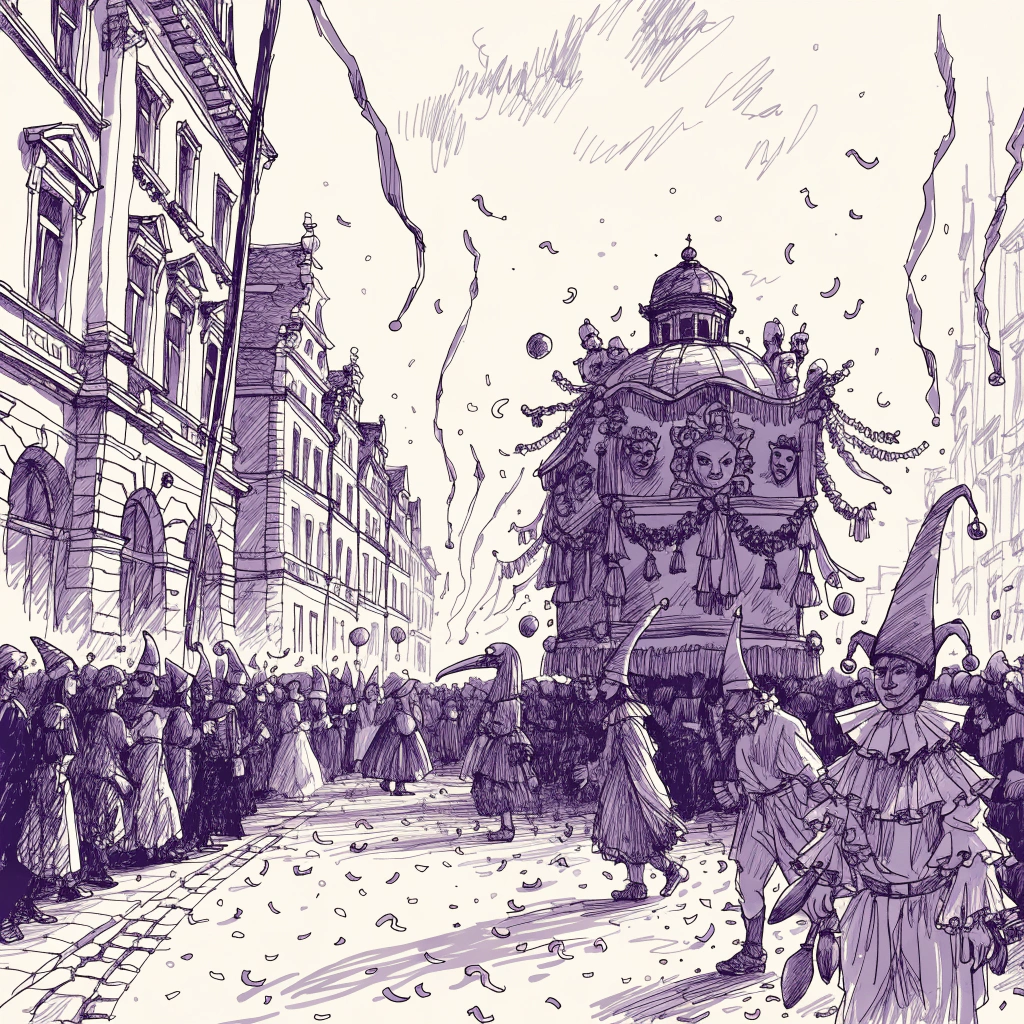
Karneval is a very big party in Germany. People call it the 'Fifth Season.' It starts in November, but the most famous days are in February. People wear colorful costumes. Children dress as superheroes or animals. Adults wear masks and funny hats.
There are big parades in the streets. People throw sweet candy to the children. Music is everywhere. People dance and sing happy songs together. It is a special time for fun and friends. Everyone is very happy before the quiet time of Lent.
Grammar Spotlight
Pattern: Present Simple (To Be)
"Karneval is a very big party in Germany."
We use 'is' with singular subjects like 'Karneval' to describe facts. This pattern helps us give basic information about a topic.
Pattern: Present Simple (Action Verbs)
"People wear colorful costumes."
We use the base form of the verb like 'wear' for plural subjects like 'People'. It describes general habits or truths.
Test Your Understanding
10 questions · A1 Beginner · 1 free preview
Test what you learned from this article. Answer all questions to earn XP!
When are the most famous days of Karneval?
Want to finish the quiz?
9 more questions are waiting for you. Sign up free to unlock the full quiz and earn XP!
Sign Up FreeAlready have an account? Sign In
Question Breakdown
When are the most famous days of Karneval?
Your answer:
Correct answer: February
Only children wear costumes during Karneval.
Your answer:
Correct answer: False
What does 'candy' mean?
Your answer:
Correct answer: Sweet food with sugar
People _____ and sing happy songs together.
Your answer:
Correct answer: dance
Karneval: The Fifth Season in Germany
Karneval is a very special time in Germany. Many people call it the 'Fifth Season'. The season starts on November 11th at 11:11 AM, but the biggest parties happen in February.
During Karneval, people wear colorful costumes and masks. They dress as superheroes, animals, or funny characters. In cities like Cologne, there are big parades in the streets. People throw sweets and flowers from large trucks. Children love catching the candy because it is very tasty.
The festival is older than many other traditions. Long ago, people wore scary masks to drive away the cold spirits of winter. They wanted the spring to come faster. It was also the last time to eat delicious food before Lent. Today, Karneval in the Rhineland is bigger and louder than in other parts of Germany. Everyone sings songs and dances together. It is a happy time for families and friends.
Grammar Spotlight
Pattern: Past Simple
"Long ago, people wore scary masks to drive away the cold spirits of winter."
We use the Past Simple to describe finished actions in the past. Irregular verbs like 'wear' change to 'wore' instead of adding -ed.
Pattern: Comparatives
"Today, Karneval in the Rhineland is bigger and louder than in other parts of Germany."
We use comparatives to compare two things. For short adjectives, we add -er to the end and use 'than' before the second thing.
Test Your Understanding
11 questions · A2 Elementary · 1 free preview
Test what you learned from this article. Answer all questions to earn XP!
When does the Karneval season officially start in Germany?
Want to finish the quiz?
10 more questions are waiting for you. Sign up free to unlock the full quiz and earn XP!
Sign Up FreeAlready have an account? Sign In
Question Breakdown
When does the Karneval season officially start in Germany?
Your answer:
Correct answer: November 11th
People wear masks and costumes during the festival.
Your answer:
Correct answer: True
What does the word 'delicious' mean?
Your answer:
Correct answer: Very tasty
People throw _____ and flowers from large trucks in the parades.
Your answer:
Correct answer: sweets
Why did people wear scary masks in the past?
Your answer:
Correct answer: To drive away winter spirits
Karneval: The Colorful Fifth Season in Germany
Germany is famous for its many traditions, but none are as colorful as Karneval. This festival, which is often called the 'Fifth Season', begins every year on November 11th at 11:11 AM. However, the most exciting celebrations happen during the week before Ash Wednesday. During this time, many cities transform into places of music, dance, and joy.
In many parts of Germany, people have celebrated this tradition for centuries. The roots of Karneval are quite interesting because they combine two different ideas. In the past, ancient Germanic tribes wore masks to drive out the cold spirits of winter. Later, Christian traditions were added to the festival. People wanted to enjoy rich food and big parties before the forty days of Lent began.
The biggest events are held in the Rhineland area, especially in cities like Cologne and Düsseldorf. During these days, the streets are filled with people who wear creative costumes. You might see superheroes, animals, or even traditional characters from history. The highlight of the week is 'Rose Monday'. On this day, huge parades are organized by local clubs. Sweets and flowers are thrown from big decorated wagons to the crowds waiting below.
Although it is a time for fun, Karneval is also an important part of German culture. It is a moment when people can forget their daily problems and enjoy life together. If you visit Germany in February, you will definitely be surprised by the energy of the crowds. It is an experience that you will never forget.
Grammar Spotlight
Pattern: Relative Clauses with 'which' or 'who'
"This festival, which is often called the 'Fifth Season', begins every year on November 11th."
Relative clauses give more information about a noun. Use 'which' for things and 'who' for people to connect ideas without starting a new sentence.
Pattern: Passive Voice (Present Simple)
"The biggest events are held in the Rhineland area..."
The passive voice is used when the action is more important than the person doing it. It is formed using 'am/is/are' plus the past participle.
Test Your Understanding
11 questions · B1 Intermediate · 1 free preview
Test what you learned from this article. Answer all questions to earn XP!
When does the Karneval season officially begin?
Want to finish the quiz?
10 more questions are waiting for you. Sign up free to unlock the full quiz and earn XP!
Sign Up FreeAlready have an account? Sign In
Question Breakdown
When does the Karneval season officially begin?
Your answer:
Correct answer: November 11th
Karneval is a blend of ancient Germanic rituals and Christian traditions.
Your answer:
Correct answer: True
What does the word 'costume' mean in the context of the article?
Your answer:
Correct answer: Special clothes worn for the festival
The biggest events are _____ in the Rhineland area, especially in Cologne.
Your answer:
Correct answer: held
What is the 'highlight' of the week according to the text?
Your answer:
Correct answer: Rose Monday
Germany’s Fifth Season: The Cultural Significance of Karneval
Karneval, often referred to as the 'Fifth Season' (Die fünfte Jahreszeit), represents one of Germany’s most exuberant and culturally significant traditions. Although the season technically commences on November 11th at 11:11 AM, the true festivities reach their pinnacle during the week preceding Ash Wednesday. This vibrant period is characterized by a unique blend of ancient Germanic rituals, intended to expel winter spirits, and Christian traditions of indulgence before the solemn forty days of Lent.
The celebration manifests in distinct ways across different regions. In the Rhineland, particularly in cities like Cologne and Düsseldorf, Karneval is celebrated with massive street parades and elaborate costumes. Conversely, the Swabian-Alemannic Fastnacht in southwestern Germany maintains more traditional, often eerie, wooden masks representing demons and witches. Despite these regional differences, a common thread of social inversion persists, where hierarchies are temporarily dissolved, and citizens are encouraged to satirize political figures through elaborate floats and speeches.
A prominent feature of the Rhenish Karneval is 'Weiberfastnacht' (Women’s Carnival), which marks the transition into the street festivities. Historically, this day allowed women to assert a degree of symbolic power, famously symbolized by the tradition of cutting off men's ties. Furthermore, 'Rosenmontag' (Rose Monday) serves as the highlight of the week, featuring kilometers-long processions. These parades are not merely for entertainment; they often provide a platform for biting political commentary, demonstrating that Karneval is as much about social critique as it is about merriment.
The conclusion of the festivities occurs on Ash Wednesday, marked by the tradition of eating fish and the symbolic 'burning' of the Nubbel—a straw figure representing the sins committed during the week. Consequently, the transition from chaotic revelry to spiritual reflection is completed. For many Germans, Karneval remains an essential communal experience, fostering a sense of identity and continuity. While modern celebrations have become increasingly commercialized, the underlying spirit of collective joy and the subversion of daily norms continue to resonate deeply within the national consciousness.
Grammar Spotlight
Pattern: Passive Voice
"This vibrant period is characterized by a unique blend of ancient Germanic rituals..."
The passive voice is used here to focus on the 'vibrant period' rather than the people who characterize it. It is formed using the verb 'to be' and the past participle of the main verb.
Pattern: Concessive Clauses with 'Although'
"Although the season technically commences on November 11th at 11:11 AM, the true festivities reach their pinnacle during the week preceding Ash Wednesday."
This pattern is used to introduce a contrast between the official start date and the actual peak of the celebrations. 'Although' is followed by a subject and a verb.
Pattern: Present Perfect with 'Become'
"While modern celebrations have become increasingly commercialized..."
The present perfect is used to describe a change that started in the past and has relevance to the present. It emphasizes the current state of Karneval being commercialized.
Test Your Understanding
11 questions · B2 Upper Intermediate · 1 free preview
Test what you learned from this article. Answer all questions to earn XP!
When does the Karneval season officially begin in Germany?
Want to finish the quiz?
10 more questions are waiting for you. Sign up free to unlock the full quiz and earn XP!
Sign Up FreeAlready have an account? Sign In
Question Breakdown
When does the Karneval season officially begin in Germany?
Your answer:
Correct answer: November 11th
The tradition of cutting off men's ties is associated with Rose Monday (Rosenmontag).
Your answer:
Correct answer: False
What does it mean to 'satirize' a political figure?
Your answer:
Correct answer: To use humor to criticize
The symbolic straw figure burned on Ash Wednesday is called the _____.
Your answer:
Correct answer: Nubbel
What is the primary characteristic of the Swabian-Alemannic Fastnacht?
Your answer:
Correct answer: Traditional wooden masks
The Fifth Season: A Socio-Cultural Anatomy of German Karneval
To the uninitiated observer, the German Karneval might appear as nothing more than an unbridled display of hedonism. However, to dismiss it as such would be to overlook the intricate socio-political mechanisms and historical layers at play. Known colloquially as the 'Fifth Season', this period represents a temporal amnesty where societal norms are suspended in favour of ritualised chaos. Not only does this tradition offer a reprieve from the rigours of daily life, but it also functions as a vital outlet for dissent and communal reflection. Never has the distinction between the sacred and the profane been more blurred than during the peak of these festivities, which bridge the gap between ancient folklore and modern political commentary.
The historical evolution of Karneval is a testament to the synthesis of pre-Christian paganism and medieval Catholicism. While the former sought to dispel the winter spirits through cacophonic noise and grotesque masks—a tradition still visible in the Swabian-Alemannic 'Fastnacht'—the latter institutionalised the 'carne vale', or the farewell to meat, prior to the asceticism of Lent. It is this paradoxical blend of the spiritual and the visceral that imbues the festivities with such profound resonance. Although the season officially commences on November 11th at 11:11 AM, the intensification of the celebrations only truly occurs in the week leading up to Ash Wednesday, beginning with 'Weiberfastnacht'.
In the Rhineland, the celebration takes on a particularly satirical edge. The caricature of military uniforms and the inclusion of elaborately designed floats are far from mere ornamentation; they are a vestige of 19th-century resistance against Prussian hegemony. When the Rhineland was under Prussian rule, the locals utilised Karneval to mock the rigid militarism of their occupiers. By mimicking the discipline of the soldiers through 'Guard' dances and parodies, the populace exerted a form of soft power, reclaiming their cultural identity through biting satire. Such subversion remains a cornerstone of the modern Rose Monday parades, where high-profile politicians are frequently subjected to uncompromising visual critiques.
Furthermore, the psychological impact of this communal catharsis cannot be overstated. In an era characterised by increasing social atomisation, the collective immersion in a shared identity—however transient—provides a sense of belonging that transcends class boundaries. The suspension of hierarchy allows for a momentary inversion of power, where the fool becomes king and the king is held to account. It is the deliberate subversion of social hierarchy that defines the core of the Rhineland tradition, allowing for a healthy release of societal tension.
As Ash Wednesday approaches, the atmosphere shifts from the boisterous to the contemplative. The intensification of the revelry in those final hours serves as a poignant reminder of the ephemeral nature of joy. As the masks are finally discarded and the 'Nubbel' (a straw figure representing sins) is burned, the transition into the solemnity of Lent marks a return to the structured reality of the calendar. Thus, Karneval is not merely a sequence of parties; it is a sophisticated cultural performance that navigates the perpetual tension between tradition, modernity, and the human need for release.
Grammar Spotlight
Pattern: Inversion for Emphasis
"Never has the distinction between the sacred and the profane been more blurred than during the peak of these festivities."
When a sentence starts with a negative or restrictive adverb like 'Never', the auxiliary verb comes before the subject. This structure is used in formal writing to add dramatic emphasis to a statement.
Pattern: Cleft Sentences
"It is the deliberate subversion of social hierarchy that defines the core of the Rhineland tradition."
A cleft sentence (starting with 'It is...') focuses on a specific part of the information. Here, it emphasizes 'the deliberate subversion' as the primary defining factor, rather than other elements.
Pattern: Nominalisation
"The intensification of the revelry in those final hours serves as a poignant reminder of the ephemeral nature of joy."
Nominalisation involves turning verbs (intensify) or adjectives (intense) into nouns (intensification). This is a hallmark of C1/C2 English, making the writing more abstract, concise, and academic.
Test Your Understanding
12 questions · C1 Advanced · 1 free preview
Test what you learned from this article. Answer all questions to earn XP!
What historical purpose did military parodies serve in the Rhineland during the 19th century?
Want to finish the quiz?
11 more questions are waiting for you. Sign up free to unlock the full quiz and earn XP!
Sign Up FreeAlready have an account? Sign In
Question Breakdown
What historical purpose did military parodies serve in the Rhineland during the 19th century?
Your answer:
Correct answer: To mock and resist the rigid Prussian hegemony
The primary focus of the Swabian-Alemannic 'Fastnacht' is political satire involving high-profile politicians.
Your answer:
Correct answer: False
Which word describes a situation where societal rules are temporarily ignored or forgiven?
Your answer:
Correct answer: Temporal amnesty
The transition into the _____ of Lent marks the end of the festive chaos.
Your answer:
Correct answer: solemnity
According to the article, what is the psychological benefit of collective immersion during Karneval?
Your answer:
Correct answer: It provides a transient sense of belonging in an atomised era
The term 'carne vale' historically signifies a farewell to the consumption of meat.
Your answer:
Correct answer: True
The Dionysian Mirror: A Socio-Historical Deconstruction of German Karneval
To contemplate the phenomenon of the German 'Fifth Season' is to engage with a sophisticated tapestry of historical vestiges and contemporary sociopolitical catharsis. Often erroneously reduced by the uninitiated to a mere spectacle of fancy dress and unbridled hedonism, Karneval—or Fasching and Fastnacht, as regional nomenclature dictates—serves as a critical temporal interregnum. It is a period during which the normative stratification of society is ostensibly dissolved, allowing for a ritualized inversion of power dynamics that traces its lineage back to both pagan antiquity and medieval ecclesiastical traditions. This phenomenon represents a temporal lacuna where the rigid strictures of Teutonic order are momentarily suspended in favor of a sanctioned subversion.
The inception of this period, punctiliously marked at 11:11 AM on the eleventh of November, signals a subtle shift in the collective German psyche. However, the true Dionysian crescendo occurs during the week preceding Ash Wednesday. This liminal phase allows the 'Jecken' (the fools) to occupy a space between the profane and the sacred. In the Rhineland, this is manifest in the 'Sitzungen'—satirical sessions where the political elite are subjected to iconoclastic mockery under the guise of comedic oratory. Were these festivities to be stripped of their satirical edge, they would arguably lose their primary function as a democratic pressure valve, providing a safe harbor for dissent through the medium of humor.
Historically, the roots of these celebrations are bifurcated. On one hand, we find the atavistic urge to drive out the winter spirits—a motif particularly prevalent in the Swabian-Alemannic Fastnacht, where grotesque wooden masks and the rhythmic 'Narrensprung' evoke a sense of primordial dread and renewal. On the other hand, the liturgical calendar of Christianity necessitated a final indulgence before the rigorous asceticism of Lent. This dual heritage creates a paradoxical environment: one that is simultaneously a preservation of ancient folklore and a modern platform for sociopolitical commentary. The 'Weiberfastnacht', or Women's Carnival, serves as a poignant example of this subversion, wherein women symbolically seize control of the city and truncate the ties of men—literally and figuratively—by snipping off their neckties.
Furthermore, the linguistic nuances of the season reflect a profound regional identity. While Karneval in Cologne or Düsseldorf might emphasize the 'Rosenmontag' parades and cosmopolitan revelry, the Fastnacht of the south remains more tethered to traditional guilds and local mythology. Yet, across all regions, the underlying principle remains the same: the temporary suspension of the status quo. By donning a mask, the individual is permitted to eschew their quotidian identity, engaging in a form of anonymity that facilitates the subversion of social hierarchies. The aesthetic of the parades, characterized by 'Motivwagen' (floats), often tackles global crises with a biting irony that would, in any other context, be deemed inflammatory. It is this unique 'Narrenfreiheit' (fool's freedom) that permits the populace to speak truth to power.
Scarcely had the modern era arrived before critics predicted the demise of such 'archaic' rituals as vestiges of a pre-industrial age. Yet, Karneval has proven remarkably resilient, adapting to the digital age without sacrificing its core tenets. Having navigated the complexities of the 21st century, the tradition continues to thrive, proving that the need for ritualized release is as potent today as it was in the medieval town square. It remains an ephemeral escape, a moment where the world is 'turned upside down' to better understand its mechanics when it rights itself again. Ultimately, the 'Fifth Season' is not merely an exercise in indulgence, but a sophisticated cultural mechanism that allows a society to examine its own contradictions through the distorting, yet revealing, lens of the fool's mirror.
Grammar Spotlight
Pattern: Negative Inversion with 'Scarcely'
"Scarcely had the modern era arrived before critics predicted the demise of such 'archaic' rituals."
When 'scarcely' or 'hardly' starts a sentence for emphasis, the auxiliary verb is placed before the subject. This structure is typically used with the past perfect to describe an event that happened immediately after another.
Pattern: Second Conditional with Inverted 'Were'
"Were these festivities to be stripped of their satirical edge, they would arguably lose their primary function."
This is a formal alternative to 'If these festivities were to be...'. Inverting 'were' and the subject creates a more scholarly or literary tone while maintaining the hypothetical condition.
Pattern: Perfect Participle Clause
"Having navigated the complexities of the 21st century, the tradition continues to thrive."
A perfect participle clause (Having + past participle) shows that one action was completed before another. It serves as a concise way to provide background information or cause for the main clause.
Test Your Understanding
12 questions · C2 Mastery · 1 free preview
Test what you learned from this article. Answer all questions to earn XP!
When does the most intense period (the crescendo) of Karneval occur?
Want to finish the quiz?
11 more questions are waiting for you. Sign up free to unlock the full quiz and earn XP!
Sign Up FreeAlready have an account? Sign In
Question Breakdown
When does the most intense period (the crescendo) of Karneval occur?
Your answer:
Correct answer: The week before Ash Wednesday
The author suggests that Karneval is a purely hedonistic event without deeper meaning.
Your answer:
Correct answer: False
Which word describes the process of releasing strong repressed emotions?
Your answer:
Correct answer: Catharsis
The author describes Karneval as a temporal ______, a period where normal social rules are suspended.
Your answer:
Correct answer: interregnum
What is the primary function of the Rhenish 'Sitzungen' according to the text?
Your answer:
Correct answer: To serve as a democratic pressure valve for political dissent
The 'Weiberfastnacht' tradition involves women symbolically taking control and cutting men's neckties.
Your answer:
Correct answer: True
