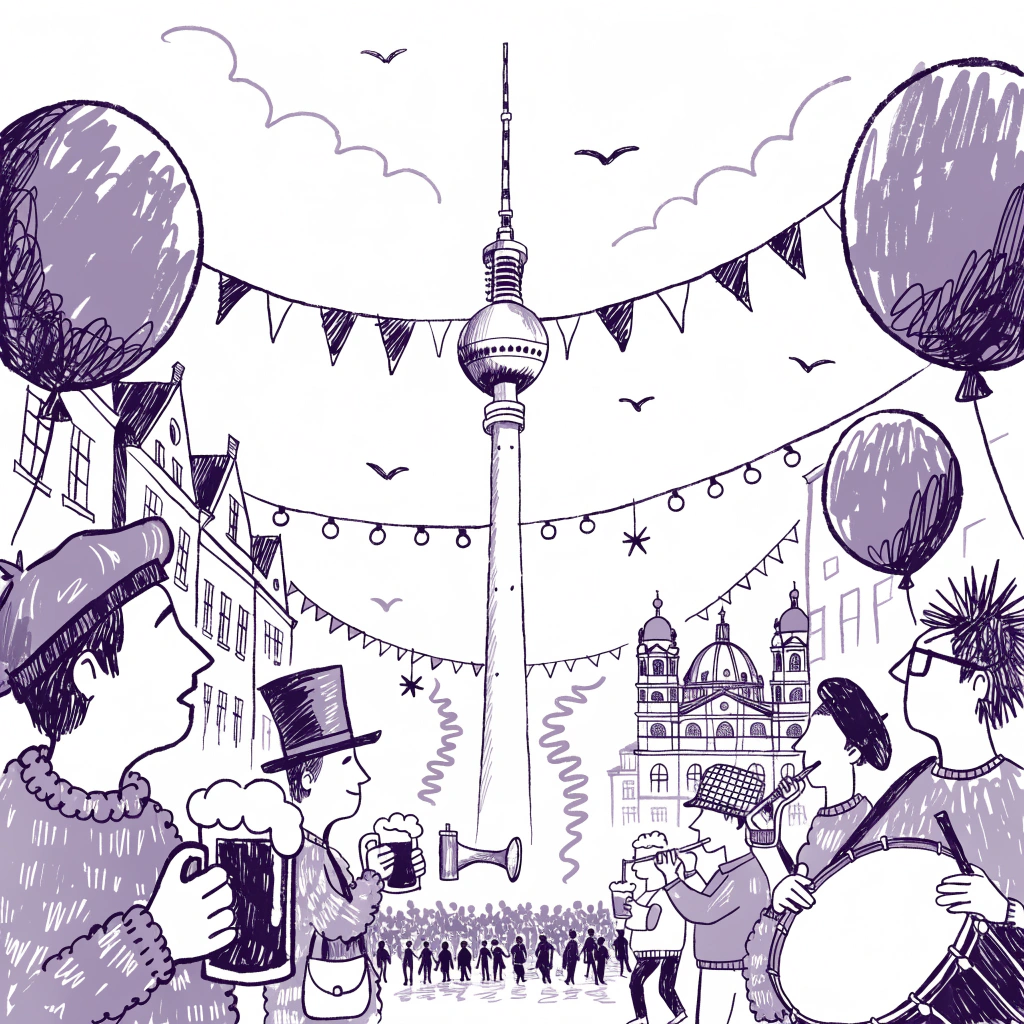
A Special Day in Germany
Germany is a large country in Europe. It has a very special holiday. This day is October 3rd. It is German Unity Day.
In the past, Germany has two different parts. There is East Germany and West Germany. There is a big wall in the city of Berlin. People are not together.
Now, Germany is one country again. People celebrate this day every year. They have big parties with music and food. They visit friends and family. It is a happy day for everyone in Germany.
Grammar Spotlight
Pattern: Present Simple 'Be'
"Germany is a large country in Europe."
We use 'is' with singular subjects like Germany. It describes a fact or a state that is true now.
Pattern: Present Simple (Regular Verbs)
"People celebrate this day every year."
We use the base form of the verb for plural subjects like 'people'. This shows a habit or a repeating event.
Test Your Understanding
10 questions · A1 Beginner · 1 free preview
Test what you learned from this article. Answer all questions to earn XP!
When is German Unity Day?
Want to finish the quiz?
9 more questions are waiting for you. Sign up free to unlock the full quiz and earn XP!
Sign Up FreeAlready have an account? Sign In
Question Breakdown
When is German Unity Day?
Your answer:
Correct answer: October 3rd
Germany is two countries today.
Your answer:
Correct answer: False
What does 'holiday' mean?
Your answer:
Correct answer: A special day for celebration
People _____ this day every year.
Your answer:
Correct answer: celebrate
A Special Day for Germany
Germany is a big country in Europe. Every year on October 3rd, people celebrate German Unity Day. It is a very important national holiday for all Germans.
In the past, Germany was not one country. It was divided into two different parts: East Germany and West Germany. A big wall in the city of Berlin separated the people. Families and friends could not visit each other easily for many years.
In 1989, the Berlin Wall fell. One year later, on October 3, 1990, the two parts became one country again. This was a happy time because Germany was finally united.
Today, people celebrate with big festivals and loud music. There is a special party in a different city every year. People also fly the German flag at their homes. Life in Germany is better now because the country is together. It is a day for peace, freedom, and friendship.
Grammar Spotlight
Pattern: Past Simple with 'be'
"In the past, Germany was not one country."
We use 'was' for singular subjects in the past. It describes a state or situation that finished in the past.
Pattern: Comparatives
"Life in Germany is better now because the country is together."
We use comparatives to compare two situations. 'Better' is the irregular comparative form of the adjective 'good'.
Test Your Understanding
11 questions · A2 Elementary · 1 free preview
Test what you learned from this article. Answer all questions to earn XP!
When is German Unity Day celebrated?
Want to finish the quiz?
10 more questions are waiting for you. Sign up free to unlock the full quiz and earn XP!
Sign Up FreeAlready have an account? Sign In
Question Breakdown
When is German Unity Day celebrated?
Your answer:
Correct answer: October 3rd
Germany was divided into two parts in the past.
Your answer:
Correct answer: True
What does 'united' mean?
Your answer:
Correct answer: Joined together
A big _____ in the city of Berlin separated the people.
Your answer:
Correct answer: wall
How do people celebrate today?
Your answer:
Correct answer: With festivals and music
German Unity Day: A Celebration of a Reunited Nation
Every year on October 3rd, people across Germany celebrate a very significant event. This day is known as 'Tag der Deutschen Einheit,' or German Unity Day. It is the national holiday that marks the moment when East and West Germany were officially reunited in 1990.
After the Second World War, Germany had been divided into two separate countries for forty-five years. The West was democratic, while the East was a communist state. A massive wall, which was built in Berlin, physically separated friends and families. However, everything changed in November 1989 when the Berlin Wall finally fell. Although the fall of the wall was a joyful moment, the official reunification did not happen until the following year.
Since 1990, many celebrations have been held to honor this historic transition. Instead of having a parade in the capital every year, the main festivities are hosted by a different German city each time. This allows different regions to show their unique cultures and traditions. During these festivals, which are called 'Bürgerfeste,' various concerts and speeches are organized for the public. Traditional food is served, and people from all backgrounds come together to celebrate their shared identity.
This holiday is a time for reflection. Significant progress has been made to bridge the gap between the two sides, though some economic differences still exist. Many citizens believe that unity has been achieved through hard work and patience. The holiday remains a symbol of peace and freedom, reminding the world that even the deepest divisions can be overcome. It is a day that is celebrated with pride by millions of people who value their democracy.
Grammar Spotlight
Pattern: Passive Voice
"The main festivities are hosted by a different German city each time."
The passive voice is used when the action is more important than who is performing it. It is formed using 'be' + the past participle (e.g., are hosted).
Pattern: Present Perfect
"Significant progress has been made to bridge the gap between the two sides."
The present perfect connects the past to the present. It is formed with 'have/has' + the past participle and shows that an action happened at an unspecified time or has a current result.
Test Your Understanding
11 questions · B1 Intermediate · 1 free preview
Test what you learned from this article. Answer all questions to earn XP!
When is German Unity Day celebrated?
Want to finish the quiz?
10 more questions are waiting for you. Sign up free to unlock the full quiz and earn XP!
Sign Up FreeAlready have an account? Sign In
Question Breakdown
When is German Unity Day celebrated?
Your answer:
Correct answer: October 3rd
The official reunification of Germany happened exactly on the day the Berlin Wall fell.
Your answer:
Correct answer: False
What does 'divided' mean in the context of the article?
Your answer:
Correct answer: Separated into parts
A massive _____ was built in Berlin to separate friends and families.
Your answer:
Correct answer: wall
Where are the main celebrations held each year?
Your answer:
Correct answer: In a different German city each year
A Nation Reunited: Understanding German Unity Day
Every year on October 3rd, Germany commemorates a pivotal moment in its modern history: the reunification of East and West. Known as 'Tag der Deutschen Einheit,' this national holiday serves as a profound symbol of reconciliation and democratic triumph. While the world vividly remembers the jubilant scenes of November 9, 1989, when the Berlin Wall finally crumbled, the official unification occurred nearly a year later. The selection of October 3rd as the national holiday was a deliberate choice by political leaders. Although November 9th initially seemed the most logical candidate, it was ultimately deemed unsuitable due to its association with more somber historical events, such as the 1923 Beer Hall Putsch and the tragic events of Kristallnacht in 1938. Consequently, the Treaty on German Unity, signed following the Two Plus Four Agreement, established October 3rd as the date when the German Democratic Republic (GDR) formally acceded to the Federal Republic of Germany (FRG).
The transition was not merely a legislative formality; it represented the culmination of intense diplomatic negotiations involving the four occupying powers from World War II. Despite the initial euphoria, the process of integrating two vastly different economic and political systems presented immense challenges. Significant investments were directed toward the 'New States' in the East to modernize infrastructure and harmonize living standards. However, socioeconomic disparities persisted for decades, leading many to observe that while the physical wall had disappeared, an 'invisible wall' in the minds of citizens took longer to dismantle.
Today, the celebrations are characterized by a rotating host city, which organizes the 'Bürgerfest' (Citizens' Festival). This tradition ensures that every region has the opportunity to showcase its local culture while fostering a sense of national identity. During these festivities, political leaders often reflect on the progress made toward 'Inner Unity'—the social and cultural cohesion between the East and West. In conclusion, German Unity Day is more than just a day off work. It is a time for reflection on the resilience of a nation that managed to overcome deep ideological divisions. Although some economic gaps remain, the holiday stands as a testament to the possibility of peaceful transition and the enduring strength of democratic values in a unified Germany.
Grammar Spotlight
Pattern: Passive Voice
"Significant investments were directed toward the 'New States' in the East to modernize infrastructure..."
The passive voice is used here to focus on the action (investing) and the recipient (New States) rather than the specific person or entity performing the action.
Pattern: Concession with 'Despite'
"Despite the initial euphoria, the process of integrating two vastly different economic and political systems presented immense challenges."
The preposition 'despite' is followed by a noun phrase to show contrast between a positive feeling (euphoria) and the difficult reality (challenges).
Pattern: Participle Clauses
"This tradition ensures that every region has the opportunity to showcase its local culture while fostering a sense of national identity."
The present participle '-fostering' acts as a reduced adverbial clause, showing two actions happening at the same time by the same subject.
Test Your Understanding
11 questions · B2 Upper Intermediate · 1 free preview
Test what you learned from this article. Answer all questions to earn XP!
Why was November 9th rejected as the official national holiday?
Want to finish the quiz?
10 more questions are waiting for you. Sign up free to unlock the full quiz and earn XP!
Sign Up FreeAlready have an account? Sign In
Question Breakdown
Why was November 9th rejected as the official national holiday?
Your answer:
Correct answer: It was associated with somber and tragic historical events.
The same city hosts the 'Bürgerfest' every year to maintain tradition.
Your answer:
Correct answer: False
What does the word 'pivotal' mean in the context of the article?
Your answer:
Correct answer: Of crucial importance
The transition was not merely a legislative _____; it represented the culmination of intense negotiations.
Your answer:
Correct answer: formality
What does the term 'Inner Unity' refer to in the text?
Your answer:
Correct answer: The social and cultural cohesion between East and West citizens.
A Nation Reconciled? The Complex Legacy of German Unity Day
Seldom has the cartography of a continent been so fundamentally altered by a single administrative act as it was on October 3, 1990. While the world remembers the euphoric images of citizens dancing atop the Berlin Wall on November 9, 1989, it is the more formal Tag der Deutschen Einheit (German Unity Day) that serves as the nation’s official holiday. This choice was far from arbitrary; it was a calculated avoidance of the somber historical shadows cast by November 9, a date synonymous with both the failed 1923 Beer Hall Putsch and the horrific Kristallnacht of 1938. Thus, October 3 represents a deliberate pivot toward a future defined by democratic sovereignty and legal reunification.
The integration of two disparate economic and political systems was never going to be a seamless endeavor. It was the precipitous collapse of the East German economy that necessitated a swift accession to the Federal Republic, rather than a gradual merger. This haste, while politically expedient, birthed a series of socio-economic challenges that persist to this day. The implementation of the 'solidarity surcharge'—a tax designed to fund the reconstruction of the East—became a symbol of the financial burden of unity, fostering a sense of resentment in the West and a feeling of second-class citizenship in the East. This economic disparity is not merely a matter of statistics; it is reflected in the divergence of political ideologies that currently characterizes the German landscape.
Critically analyzing the past three decades reveals that the 'wall in the head' (Mauer im Kopf) remains a potent psychological barrier. Despite the massive investment in infrastructure and the revitalization of cities like Leipzig and Dresden, a watershed moment of total social cohesion remains elusive. What many observers find striking is the resilience of regional identities. The east continues to grapple with the loss of its industrial base and the subsequent migration of its youth, leading to a demographic imbalance that complicates the process of reconciliation.
Furthermore, the rise of populist movements in the former GDR territories suggests that the promise of 'blooming landscapes'—famously prophesied by Helmut Kohl—has not been universally realized. It is the perceived lack of representation and the erosion of traditional community structures that have fueled contemporary disillusionment. Nevertheless, to view German Unity Day through a lens of pure cynicism would be a mistake. The holiday serves as a vital commemoration of the peaceful revolution that dismantled a dictatorship without a single shot being fired.
Ultimately, German Unity Day is less about celebrating a finished product and more about acknowledging a work in progress. It provides a space for the nation to reflect on its progress toward equality. Only through a nuanced understanding of these historical and economic complexities can one truly appreciate the magnitude of the German achievement. The task of the current generation is to ensure that the sovereignty gained in 1990 translates into a genuine sense of belonging for all citizens, regardless of which side of the former border they inhabit.
Grammar Spotlight
Pattern: Negative Inversion
"Seldom has the cartography of a continent been so fundamentally altered by a single administrative act."
When a sentence starts with a negative or restrictive adverb like 'seldom', the subject and the auxiliary verb are inverted. This adds emphasis and a formal tone to the statement.
Pattern: Cleft Sentences
"It was the precipitous collapse of the East German economy that necessitated a swift accession to the Federal Republic."
Cleft sentences use the structure 'It + is/was + [emphasized part] + that/who' to focus on a specific piece of information. Here, it emphasizes the reason for the quick unification.
Pattern: Nominalization
"The integration of two disparate economic and political systems was never going to be a seamless endeavor."
Nominalization turns verbs or adjectives into nouns (e.g., 'integrate' to 'integration'). This is common in academic and formal English to make the text more concise and objective.
Test Your Understanding
12 questions · C1 Advanced · 1 free preview
Test what you learned from this article. Answer all questions to earn XP!
Why was October 3rd chosen as the national holiday instead of November 9th?
Want to finish the quiz?
11 more questions are waiting for you. Sign up free to unlock the full quiz and earn XP!
Sign Up FreeAlready have an account? Sign In
Question Breakdown
Why was October 3rd chosen as the national holiday instead of November 9th?
Your answer:
Correct answer: To avoid the negative historical associations of November 9th.
The article suggests that the economic merger of East and West Germany was a slow and carefully planned process.
Your answer:
Correct answer: False
What does the word 'disparity' mean in the context of the article?
Your answer:
Correct answer: A significant difference or inequality.
The 'wall in the head' refers to a remaining _____ barrier between citizens.
Your answer:
Correct answer: psychological
According to the text, what has fueled modern disillusionment in former East German territories?
Your answer:
Correct answer: The perceived lack of representation and loss of community structures.
The article argues that viewing German Unity Day with pure cynicism is incorrect because it honors a peaceful revolution.
Your answer:
Correct answer: True
The Dialectics of Reunification: Examining the Socio-Political Tapestry of German Unity Day
The reunification of Germany, formalized on October 3, 1990, represents more than a mere administrative consolidation of disparate territories; it stands as a monumental paradigm shift in the late-twentieth-century geopolitical landscape. While the euphoric images of the Berlin Wall’s breach on November 9, 1989, remain etched in the global consciousness, the selection of October 3 as the official 'Tag der Deutschen Einheit' was a calculated, if not pragmatic, maneuver. This choice was necessitated by the somber historical weight of November 9—a date synonymous with both the failed 1923 Beer Hall Putsch and the harrowing events of Kristallnacht in 1938. Thus, the German state sought to anchor its new identity in a date devoid of such internecine trauma, prioritizing legal stability over populist symbolism.
Seldom has a modern nation-state undergone such a rapid and profound metamorphosis. The constitutional framework of the Federal Republic of Germany was extended eastward, ostensibly providing a seamless transition from a socialist command economy to a social market economy. However, the socio-economic desideratum of total parity remains, even decades later, a work in progress. One might posit that the 'Mauer im Kopf'—the psychological wall—persists as a vestige of the divergent ideologies that governed the two Germanies for nearly half a century. Despite the massive infusion of capital into the new federal states, the economic convergence has been characterized by a certain ambivalence, as structural disparities in productivity and demographic shifts continue to pose significant challenges to the ideal of national homogeneity.
Lest the celebratory fervor should obscure the historical gravity of the process, it is imperative to analyze the nuances of this reintegration. The hegemony of the Western institutional model was almost absolute, leading some scholars to argue that the process was less a merger of equals and more an absorption of the East. This asymmetrical dynamic has occasionally fostered a sense of alienation among those who feel their personal histories and social contributions were devalued in the rush toward unification. Nevertheless, the resilience of the German democratic project is evident in its ability to navigate these internal frictions. The holiday serves not merely as a nostalgic commemoration of a bygone event, but as a critical juncture for reflection on the ongoing evolution of German sovereignty and societal cohesion.
Furthermore, the proclivity for self-examination within German intellectual circles has ensured that the discourse surrounding Unity Day remains intellectually rigorous. Rather than succumbing to uncritical jingoism, the state utilizes the occasion to address contemporary issues such as migration, European integration, and the rise of political polarization. The paradoxical nature of the holiday lies in its dual function: it celebrates the end of a divided past while simultaneously acknowledging the complexities of a unified future. In this context, the concept of 'Innere Einheit' (inner unity) becomes a teleological goal—an aspiration towards which the nation perpetually strives, rather than a static state that has already been achieved.
Ultimately, the significance of October 3 transcends the borders of the Federal Republic. It serves as a testament to the possibility of peaceful reconciliation and the triumph of democratic aspirations over totalitarian constraints. As Germany continues to grapple with the legacies of its past, the annual observance of German Unity Day provides a vital space for the negotiation of national identity in an increasingly fragmented world. It is through this continuous dialogue that the nation seeks to harmonize its diverse regional identities into a coherent, albeit pluralistic, whole, ensuring that the lessons of the twentieth century are not lost on future generations.
Grammar Spotlight
Pattern: Negative Inversion for Rhetorical Emphasis
"Seldom has a modern nation-state undergone such a rapid and profound metamorphosis."
Inversion occurs when the adverbial 'Seldom' is placed at the beginning of the sentence for emphasis. This requires the auxiliary verb 'has' to precede the subject 'a modern nation-state'.
Pattern: Negative Subjunctive with 'Lest'
"Lest the celebratory fervor should obscure the historical gravity of the process, it is imperative to analyze the nuances of this reintegration."
The word 'lest' is used to express a negative purpose or fear. It is often followed by the subjunctive 'should' to indicate a formal, cautionary tone.
Pattern: Modal Hedging for Academic Caution
"One might posit that the 'Mauer im Kopf'—the psychological wall—persists as a vestige of the divergent ideologies."
The modal verb 'might' combined with the academic verb 'posit' allows the author to suggest a theory without stating it as an absolute fact, which is a hallmark of C2-level scholarly writing.
Test Your Understanding
12 questions · C2 Mastery · 1 free preview
Test what you learned from this article. Answer all questions to earn XP!
Why was October 3 chosen over November 9 as the official holiday?
Want to finish the quiz?
11 more questions are waiting for you. Sign up free to unlock the full quiz and earn XP!
Sign Up FreeAlready have an account? Sign In
Question Breakdown
Why was October 3 chosen over November 9 as the official holiday?
Your answer:
Correct answer: To avoid negative historical associations with the 1923 Putsch and Kristallnacht.
The article suggests that economic parity between East and West Germany has been fully achieved.
Your answer:
Correct answer: False
What does the word 'desideratum' refer to in the text?
Your answer:
Correct answer: A desired or essential requirement
The reunification represents a monumental _____ shift in geopolitics.
Your answer:
Correct answer: paradigm
What does the term 'Innere Einheit' imply in the context of the article?
Your answer:
Correct answer: A teleological goal of social and psychological unity.
The author characterizes the German holiday as a space for critical reflection rather than just jingoism.
Your answer:
Correct answer: True
