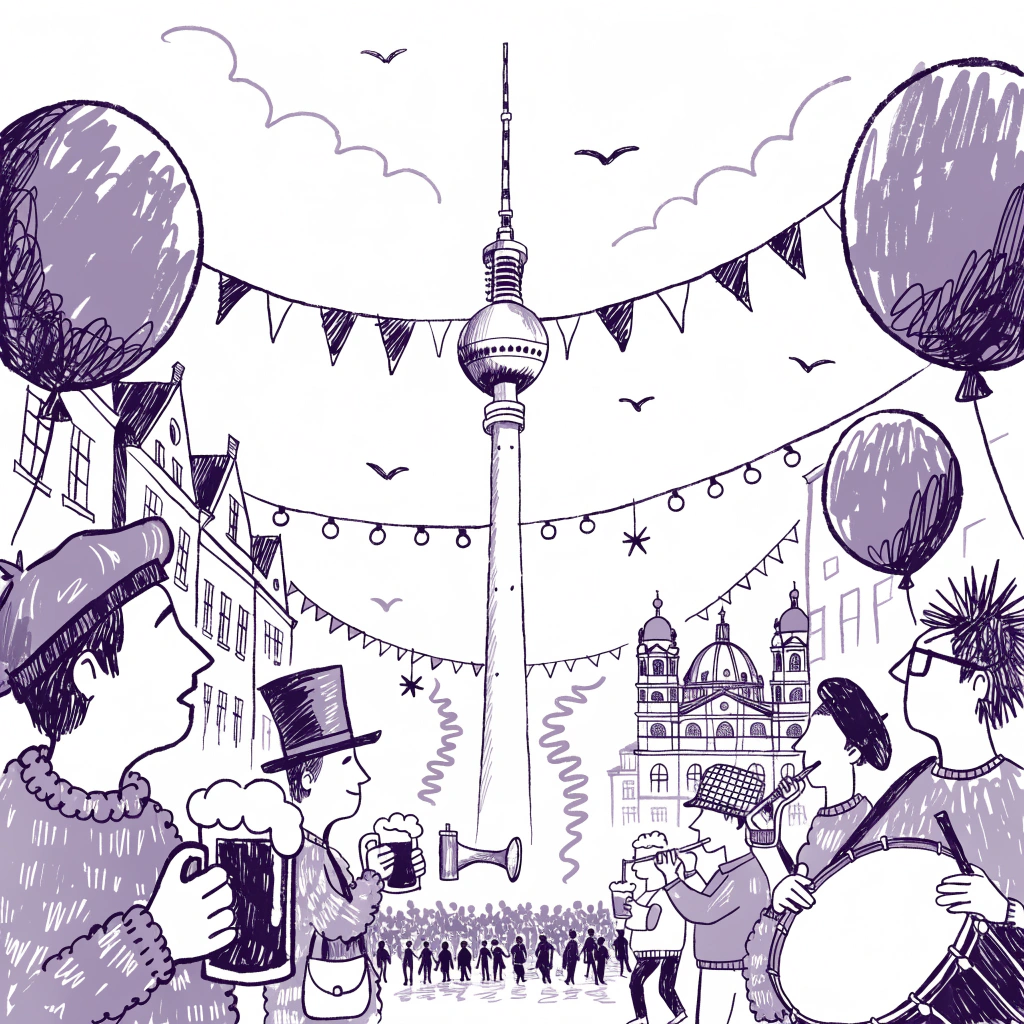
Le Jour de l'Unité Allemande
Le 3 octobre est un jour spécial en Allemagne. C'est la fête nationale. Ce jour s'appelle le "Jour de l'Unité Allemande".
Avant, l'Allemagne est divisée en deux parties : l'Est et l'Ouest. En 1990, le pays devient un seul pays. C'est l'unification.
Aujourd'hui, les gens célèbrent avec des festivals et de la musique. Il y a beaucoup de drapeaux allemands dans les rues. Les familles mangent ensemble. C'est un moment de joie pour tout le monde. C'est un symbole de paix et de liberté.
Point grammaire
Structure: Le présent de l'indicatif
"Le 3 octobre est un jour spécial en Allemagne."
On utilise le présent pour parler de faits réels et de situations actuelles. C'est le temps le plus simple pour donner des informations générales.
Structure: L'article défini
"C'est la fête nationale."
On utilise 'la' devant un nom féminin singulier pour parler d'une chose précise. Ici, on parle d'une fête spécifique.
Teste ta compréhension
10 questions · A1 Débutant · 1 aperçu gratuit
Teste ce que tu as appris dans cet article. Réponds à toutes les questions pour gagner des XP !
Quelle est la date de la fête ?
Tu veux terminer le quiz ?
9 questions supplémentaires t'attendent. Inscris-toi gratuitement pour débloquer le quiz complet et gagner des XP !
S'inscrire gratuitementTu as dj un compte ? Connexion
Bien joué !
Continue à pratiquer !
Déjà terminé — pas de XP supplémentaire
Inscris-toi pour gagner des XPDétail des questions
Quelle est la date de la fête ?
Ta réponse:
Bonne réponse: Le 3 octobre
L'Allemagne est encore divisée en deux parties aujourd'hui.
Ta réponse:
Bonne réponse: Faux
Que signifie le mot 'pays' ?
Ta réponse:
Bonne réponse: Une nation
Les familles mangent _____.
Ta réponse:
Bonne réponse: ensemble
A Special Day for Germany
Germany is a big country in Europe. Every year on October 3rd, people celebrate German Unity Day. It is a very important national holiday for all Germans.
In the past, Germany was not one country. It was divided into two different parts: East Germany and West Germany. A big wall in the city of Berlin separated the people. Families and friends could not visit each other easily for many years.
In 1989, the Berlin Wall fell. One year later, on October 3, 1990, the two parts became one country again. This was a happy time because Germany was finally united.
Today, people celebrate with big festivals and loud music. There is a special party in a different city every year. People also fly the German flag at their homes. Life in Germany is better now because the country is together. It is a day for peace, freedom, and friendship.
Point grammaire
Structure: Past Simple with 'be'
"In the past, Germany was not one country."
We use 'was' for singular subjects in the past. It describes a state or situation that finished in the past.
Structure: Comparatives
"Life in Germany is better now because the country is together."
We use comparatives to compare two situations. 'Better' is the irregular comparative form of the adjective 'good'.
Teste ta compréhension
11 questions · A2 mentaire · 1 aperçu gratuit
Teste ce que tu as appris dans cet article. Réponds à toutes les questions pour gagner des XP !
When is German Unity Day celebrated?
Tu veux terminer le quiz ?
10 questions supplémentaires t'attendent. Inscris-toi gratuitement pour débloquer le quiz complet et gagner des XP !
S'inscrire gratuitementTu as dj un compte ? Connexion
Bien joué !
Continue à pratiquer !
Déjà terminé — pas de XP supplémentaire
Inscris-toi pour gagner des XPDétail des questions
When is German Unity Day celebrated?
Ta réponse:
Bonne réponse: October 3rd
Germany was divided into two parts in the past.
Ta réponse:
Bonne réponse: Vrai
What does 'united' mean?
Ta réponse:
Bonne réponse: Joined together
A big _____ in the city of Berlin separated the people.
Ta réponse:
Bonne réponse: wall
How do people celebrate today?
Ta réponse:
Bonne réponse: With festivals and music
German Unity Day: A Celebration of a Reunited Nation
Every year on October 3rd, people across Germany celebrate a very significant event. This day is known as 'Tag der Deutschen Einheit,' or German Unity Day. It is the national holiday that marks the moment when East and West Germany were officially reunited in 1990.
After the Second World War, Germany had been divided into two separate countries for forty-five years. The West was democratic, while the East was a communist state. A massive wall, which was built in Berlin, physically separated friends and families. However, everything changed in November 1989 when the Berlin Wall finally fell. Although the fall of the wall was a joyful moment, the official reunification did not happen until the following year.
Since 1990, many celebrations have been held to honor this historic transition. Instead of having a parade in the capital every year, the main festivities are hosted by a different German city each time. This allows different regions to show their unique cultures and traditions. During these festivals, which are called 'Bürgerfeste,' various concerts and speeches are organized for the public. Traditional food is served, and people from all backgrounds come together to celebrate their shared identity.
This holiday is a time for reflection. Significant progress has been made to bridge the gap between the two sides, though some economic differences still exist. Many citizens believe that unity has been achieved through hard work and patience. The holiday remains a symbol of peace and freedom, reminding the world that even the deepest divisions can be overcome. It is a day that is celebrated with pride by millions of people who value their democracy.
Point grammaire
Structure: Passive Voice
"The main festivities are hosted by a different German city each time."
The passive voice is used when the action is more important than who is performing it. It is formed using 'be' + the past participle (e.g., are hosted).
Structure: Present Perfect
"Significant progress has been made to bridge the gap between the two sides."
The present perfect connects the past to the present. It is formed with 'have/has' + the past participle and shows that an action happened at an unspecified time or has a current result.
Teste ta compréhension
11 questions · B1 Intermédiaire · 1 aperçu gratuit
Teste ce que tu as appris dans cet article. Réponds à toutes les questions pour gagner des XP !
When is German Unity Day celebrated?
Tu veux terminer le quiz ?
10 questions supplémentaires t'attendent. Inscris-toi gratuitement pour débloquer le quiz complet et gagner des XP !
S'inscrire gratuitementTu as dj un compte ? Connexion
Bien joué !
Continue à pratiquer !
Déjà terminé — pas de XP supplémentaire
Inscris-toi pour gagner des XPDétail des questions
When is German Unity Day celebrated?
Ta réponse:
Bonne réponse: October 3rd
The official reunification of Germany happened exactly on the day the Berlin Wall fell.
Ta réponse:
Bonne réponse: Faux
What does 'divided' mean in the context of the article?
Ta réponse:
Bonne réponse: Separated into parts
A massive _____ was built in Berlin to separate friends and families.
Ta réponse:
Bonne réponse: wall
Where are the main celebrations held each year?
Ta réponse:
Bonne réponse: In a different German city each year
A Nation Reunited: Understanding German Unity Day
Every year on October 3rd, Germany commemorates a pivotal moment in its modern history: the reunification of East and West. Known as 'Tag der Deutschen Einheit,' this national holiday serves as a profound symbol of reconciliation and democratic triumph. While the world vividly remembers the jubilant scenes of November 9, 1989, when the Berlin Wall finally crumbled, the official unification occurred nearly a year later. The selection of October 3rd as the national holiday was a deliberate choice by political leaders. Although November 9th initially seemed the most logical candidate, it was ultimately deemed unsuitable due to its association with more somber historical events, such as the 1923 Beer Hall Putsch and the tragic events of Kristallnacht in 1938. Consequently, the Treaty on German Unity, signed following the Two Plus Four Agreement, established October 3rd as the date when the German Democratic Republic (GDR) formally acceded to the Federal Republic of Germany (FRG).
The transition was not merely a legislative formality; it represented the culmination of intense diplomatic negotiations involving the four occupying powers from World War II. Despite the initial euphoria, the process of integrating two vastly different economic and political systems presented immense challenges. Significant investments were directed toward the 'New States' in the East to modernize infrastructure and harmonize living standards. However, socioeconomic disparities persisted for decades, leading many to observe that while the physical wall had disappeared, an 'invisible wall' in the minds of citizens took longer to dismantle.
Today, the celebrations are characterized by a rotating host city, which organizes the 'Bürgerfest' (Citizens' Festival). This tradition ensures that every region has the opportunity to showcase its local culture while fostering a sense of national identity. During these festivities, political leaders often reflect on the progress made toward 'Inner Unity'—the social and cultural cohesion between the East and West. In conclusion, German Unity Day is more than just a day off work. It is a time for reflection on the resilience of a nation that managed to overcome deep ideological divisions. Although some economic gaps remain, the holiday stands as a testament to the possibility of peaceful transition and the enduring strength of democratic values in a unified Germany.
Point grammaire
Structure: Passive Voice
"Significant investments were directed toward the 'New States' in the East to modernize infrastructure..."
The passive voice is used here to focus on the action (investing) and the recipient (New States) rather than the specific person or entity performing the action.
Structure: Concession with 'Despite'
"Despite the initial euphoria, the process of integrating two vastly different economic and political systems presented immense challenges."
The preposition 'despite' is followed by a noun phrase to show contrast between a positive feeling (euphoria) and the difficult reality (challenges).
Structure: Participle Clauses
"This tradition ensures that every region has the opportunity to showcase its local culture while fostering a sense of national identity."
The present participle '-fostering' acts as a reduced adverbial clause, showing two actions happening at the same time by the same subject.
Teste ta compréhension
11 questions · B2 Intermédiaire supérieur · 1 aperçu gratuit
Teste ce que tu as appris dans cet article. Réponds à toutes les questions pour gagner des XP !
Why was November 9th rejected as the official national holiday?
Tu veux terminer le quiz ?
10 questions supplémentaires t'attendent. Inscris-toi gratuitement pour débloquer le quiz complet et gagner des XP !
S'inscrire gratuitementTu as dj un compte ? Connexion
Bien joué !
Continue à pratiquer !
Déjà terminé — pas de XP supplémentaire
Inscris-toi pour gagner des XPDétail des questions
Why was November 9th rejected as the official national holiday?
Ta réponse:
Bonne réponse: It was associated with somber and tragic historical events.
The same city hosts the 'Bürgerfest' every year to maintain tradition.
Ta réponse:
Bonne réponse: Faux
What does the word 'pivotal' mean in the context of the article?
Ta réponse:
Bonne réponse: Of crucial importance
The transition was not merely a legislative _____; it represented the culmination of intense negotiations.
Ta réponse:
Bonne réponse: formality
What does the term 'Inner Unity' refer to in the text?
Ta réponse:
Bonne réponse: The social and cultural cohesion between East and West citizens.
Le Jour de l'Unité Allemande : Entre Symbole Historique et Réalité Socio-Économique
Le 3 octobre 1990 marque un tournant indélébile dans l'histoire contemporaine de l'Europe. Si, dans l'imaginaire collectif mondial, la chute du Mur de Berlin le 9 novembre 1989 demeure l'image d'Épinal de la liberté retrouvée, c'est pourtant le 3 octobre qui fut officiellement instauré comme le Jour de l'Unité Allemande (Tag der Deutschen Einheit). Ce choix, loin d'être fortuit, résulte d'une volonté politique délibérée d'éviter les résonances tragiques associées au 9 novembre, date anniversaire du putsch de la Brasserie en 1923 et de la funeste Nuit de Cristal en 1938. Ainsi, la célébration de la réunification se devait d'être ancrée dans une temporalité nouvelle, tournée vers la reconstruction.
L'aboutissement juridique de cette union ne fut pas une fusion paritaire, mais bien une adhésion de la République démocratique allemande (RDA) au cadre constitutionnel de la République fédérale d'Allemagne (RFA). Ce processus, bien que garantissant une stabilité institutionnelle immédiate, n'a pas manqué de susciter des débats houleux sur la souveraineté et l'identité culturelle des nouveaux Länder. Le démantèlement des structures étatiques de l'Est a précipité une transition économique brutale, rendant obsolètes des pans entiers de l'industrie socialiste du jour au lendemain. Cette thérapie de choc a engendré un chômage de masse structurel dont les séquelles ne s'estompent que très lentement. C'est dans ce contexte de mutation profonde qu'est apparue l'« Ostalgie », ce sentiment de nostalgie pour certains aspects de la vie quotidienne en ex-RDA.
Trente ans plus tard, si les infrastructures se sont modernisées de façon spectaculaire, le clivage socio-économique entre l'Est et l'Ouest n'est pas totalement résorbé. Les disparités de salaires et de représentation au sein des élites politiques demeurent des sujets de contentieux récurrents. Peut-être cette réunification n’est-elle pas encore totalement achevée dans les esprits, car la construction d'une mémoire commune nécessite plus que de simples transferts financiers. L'ancrage de la démocratie libérale dans les régions orientales fait face à des défis persistants, exacerbés par des sentiments de marginalisation.
Néanmoins, il serait réducteur de ne percevoir ce processus que sous le prisme des difficultés. La réunification a permis à l'Allemagne de retrouver sa pleine souveraineté et de s'affirmer comme le moteur de l'intégration européenne. La liesse qui a accompagné les premiers instants de l'unité a laissé place à une maturité politique nécessaire pour affronter les crises contemporaines. La résorption progressive des frontières mentales est un travail de longue haleine qui émane de la société civile autant que des décisions gouvernementales.
En définitive, le Jour de l'Unité Allemande invite à une réflexion nuancée sur la résilience d'une nation. Il ne s'agit pas seulement de commémorer un événement passé, mais de pérenniser un dialogue interculturel au sein d'un même pays. L'unité n'est pas un état de fait acquis, mais un plébiscite de tous les jours, une volonté constante de surmonter les héritages de la division pour bâtir un avenir solidaire au cœur de l'Europe.
Point grammaire
Structure: L'inversion du sujet après certains adverbes
"Peut-être cette réunification n’est-elle pas encore totalement achevée dans les esprits."
Lorsqu'une phrase commence par 'Peut-être', 'Aussi' ou 'À peine', on inverse souvent le sujet et le verbe pour un style soutenu. Ici, le pronom 'elle' reprend le sujet nominal pour maintenir la structure interrogative-affirmative.
Structure: La mise en relief (phrase clivée)
"C'est pourtant le 3 octobre qui fut officiellement instauré comme le Jour de l'Unité Allemande."
On utilise la structure 'C'est... qui/que' pour mettre l'accent sur un élément précis de la phrase. Cela permet de souligner le contraste avec une autre information (ici, la date du 9 novembre).
Structure: La nominalisation
"L'aboutissement juridique de cette union ne fut pas une fusion paritaire."
L'usage de noms (aboutissement) au lieu de verbes (aboutir) permet de densifier l'information et d'adopter un ton plus académique et formel, typique du niveau C1.
Teste ta compréhension
12 questions · C1 Avancé · 1 aperçu gratuit
Teste ce que tu as appris dans cet article. Réponds à toutes les questions pour gagner des XP !
Pourquoi le 9 novembre n'a-t-il pas été choisi comme fête nationale ?
Tu veux terminer le quiz ?
11 questions supplémentaires t'attendent. Inscris-toi gratuitement pour débloquer le quiz complet et gagner des XP !
S'inscrire gratuitementTu as dj un compte ? Connexion
Bien joué !
Continue à pratiquer !
Déjà terminé — pas de XP supplémentaire
Inscris-toi pour gagner des XPDétail des questions
Pourquoi le 9 novembre n'a-t-il pas été choisi comme fête nationale ?
Ta réponse:
Bonne réponse: Pour éviter des associations avec des événements tragiques de l'histoire allemande.
L'unification a consisté en une fusion paritaire où les deux États ont créé une nouvelle constitution ensemble.
Ta réponse:
Bonne réponse: Faux
Que signifie le terme 'clivage' dans le texte ?
Ta réponse:
Bonne réponse: Une séparation ou division marquée.
Le démantèlement des structures de l'Est a _____ une transition économique brutale.
Ta réponse:
Bonne réponse: précipité
Qu'est-ce que l'« Ostalgie » mentionnée dans l'article ?
Ta réponse:
Bonne réponse: Une nostalgie pour certains aspects de la vie en ex-RDA.
L'article suggère que l'unité allemande est un processus encore en cours dans les mentalités.
Ta réponse:
Bonne réponse: Vrai
The Dialectics of Reunification: Examining the Socio-Political Tapestry of German Unity Day
The reunification of Germany, formalized on October 3, 1990, represents more than a mere administrative consolidation of disparate territories; it stands as a monumental paradigm shift in the late-twentieth-century geopolitical landscape. While the euphoric images of the Berlin Wall’s breach on November 9, 1989, remain etched in the global consciousness, the selection of October 3 as the official 'Tag der Deutschen Einheit' was a calculated, if not pragmatic, maneuver. This choice was necessitated by the somber historical weight of November 9—a date synonymous with both the failed 1923 Beer Hall Putsch and the harrowing events of Kristallnacht in 1938. Thus, the German state sought to anchor its new identity in a date devoid of such internecine trauma, prioritizing legal stability over populist symbolism.
Seldom has a modern nation-state undergone such a rapid and profound metamorphosis. The constitutional framework of the Federal Republic of Germany was extended eastward, ostensibly providing a seamless transition from a socialist command economy to a social market economy. However, the socio-economic desideratum of total parity remains, even decades later, a work in progress. One might posit that the 'Mauer im Kopf'—the psychological wall—persists as a vestige of the divergent ideologies that governed the two Germanies for nearly half a century. Despite the massive infusion of capital into the new federal states, the economic convergence has been characterized by a certain ambivalence, as structural disparities in productivity and demographic shifts continue to pose significant challenges to the ideal of national homogeneity.
Lest the celebratory fervor should obscure the historical gravity of the process, it is imperative to analyze the nuances of this reintegration. The hegemony of the Western institutional model was almost absolute, leading some scholars to argue that the process was less a merger of equals and more an absorption of the East. This asymmetrical dynamic has occasionally fostered a sense of alienation among those who feel their personal histories and social contributions were devalued in the rush toward unification. Nevertheless, the resilience of the German democratic project is evident in its ability to navigate these internal frictions. The holiday serves not merely as a nostalgic commemoration of a bygone event, but as a critical juncture for reflection on the ongoing evolution of German sovereignty and societal cohesion.
Furthermore, the proclivity for self-examination within German intellectual circles has ensured that the discourse surrounding Unity Day remains intellectually rigorous. Rather than succumbing to uncritical jingoism, the state utilizes the occasion to address contemporary issues such as migration, European integration, and the rise of political polarization. The paradoxical nature of the holiday lies in its dual function: it celebrates the end of a divided past while simultaneously acknowledging the complexities of a unified future. In this context, the concept of 'Innere Einheit' (inner unity) becomes a teleological goal—an aspiration towards which the nation perpetually strives, rather than a static state that has already been achieved.
Ultimately, the significance of October 3 transcends the borders of the Federal Republic. It serves as a testament to the possibility of peaceful reconciliation and the triumph of democratic aspirations over totalitarian constraints. As Germany continues to grapple with the legacies of its past, the annual observance of German Unity Day provides a vital space for the negotiation of national identity in an increasingly fragmented world. It is through this continuous dialogue that the nation seeks to harmonize its diverse regional identities into a coherent, albeit pluralistic, whole, ensuring that the lessons of the twentieth century are not lost on future generations.
Point grammaire
Structure: Negative Inversion for Rhetorical Emphasis
"Seldom has a modern nation-state undergone such a rapid and profound metamorphosis."
Inversion occurs when the adverbial 'Seldom' is placed at the beginning of the sentence for emphasis. This requires the auxiliary verb 'has' to precede the subject 'a modern nation-state'.
Structure: Negative Subjunctive with 'Lest'
"Lest the celebratory fervor should obscure the historical gravity of the process, it is imperative to analyze the nuances of this reintegration."
The word 'lest' is used to express a negative purpose or fear. It is often followed by the subjunctive 'should' to indicate a formal, cautionary tone.
Structure: Modal Hedging for Academic Caution
"One might posit that the 'Mauer im Kopf'—the psychological wall—persists as a vestige of the divergent ideologies."
The modal verb 'might' combined with the academic verb 'posit' allows the author to suggest a theory without stating it as an absolute fact, which is a hallmark of C2-level scholarly writing.
Teste ta compréhension
12 questions · C2 Maîtrise · 1 aperçu gratuit
Teste ce que tu as appris dans cet article. Réponds à toutes les questions pour gagner des XP !
Why was October 3 chosen over November 9 as the official holiday?
Tu veux terminer le quiz ?
11 questions supplémentaires t'attendent. Inscris-toi gratuitement pour débloquer le quiz complet et gagner des XP !
S'inscrire gratuitementTu as dj un compte ? Connexion
Bien joué !
Continue à pratiquer !
Déjà terminé — pas de XP supplémentaire
Inscris-toi pour gagner des XPDétail des questions
Why was October 3 chosen over November 9 as the official holiday?
Ta réponse:
Bonne réponse: To avoid negative historical associations with the 1923 Putsch and Kristallnacht.
The article suggests that economic parity between East and West Germany has been fully achieved.
Ta réponse:
Bonne réponse: Faux
What does the word 'desideratum' refer to in the text?
Ta réponse:
Bonne réponse: A desired or essential requirement
The reunification represents a monumental _____ shift in geopolitics.
Ta réponse:
Bonne réponse: paradigm
What does the term 'Innere Einheit' imply in the context of the article?
Ta réponse:
Bonne réponse: A teleological goal of social and psychological unity.
The author characterizes the German holiday as a space for critical reflection rather than just jingoism.
Ta réponse:
Bonne réponse: Vrai

