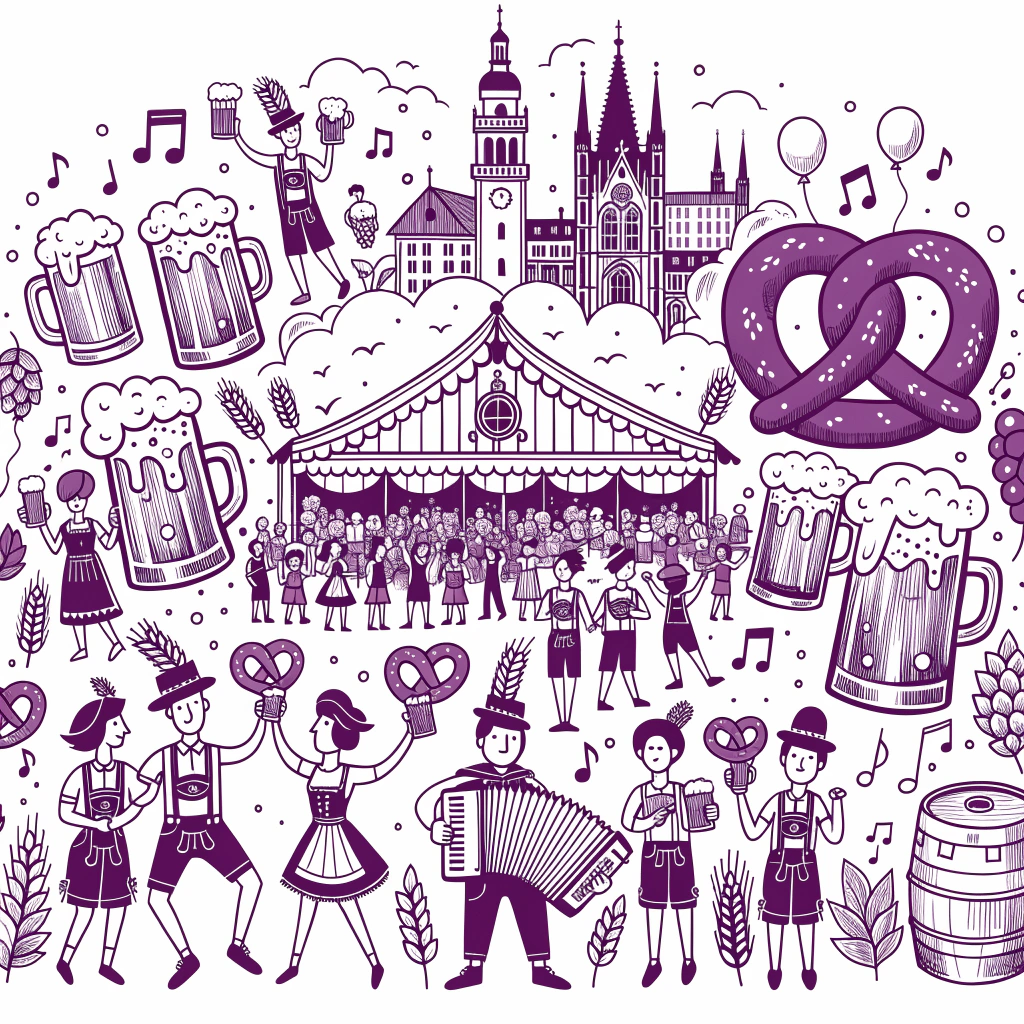
L'Oktoberfest : Une grande fête en Allemagne
L'Oktoberfest est une fête célèbre en Allemagne. Elle se déroule à Munich, sur une grande place. La fête commence en septembre et se termine en octobre.
Chaque année, plus de six millions de personnes visitent l'Oktoberfest. Les visiteurs portent des vêtements traditionnels. Ils mangent du poulet et boivent de la bière. Il y a aussi de la musique et des manèges pour les enfants.
Cette tradition est très ancienne. Elle commence en 1810 pour célébrer un mariage royal. Aujourd'hui, c'est un moment de joie pour les amis et la famille. C'est la plus grande fête populaire du monde.
Point grammaire
Structure: Le présent de l'indicatif
"L'Oktoberfest est une fête célèbre en Allemagne."
On utilise le présent pour parler de faits réels et de traditions. Les verbes comme 'être' ou 'avoir' sont essentiels au niveau A1.
Structure: Les articles définis
"La fête commence en septembre."
En français, on utilise 'le', 'la', 'l'' ou 'les' devant un nom pour désigner une chose spécifique. 'La' est utilisé pour les noms féminins.
Teste ta compréhension
10 questions · A1 Débutant · 1 aperçu gratuit
Teste ce que tu as appris dans cet article. Réponds à toutes les questions pour gagner des XP !
Où se déroule l'Oktoberfest ?
Tu veux terminer le quiz ?
9 questions supplémentaires t'attendent. Inscris-toi gratuitement pour débloquer le quiz complet et gagner des XP !
S'inscrire gratuitementTu as dj un compte ? Connexion
Bien joué !
Continue à pratiquer !
Déjà terminé — pas de XP supplémentaire
Inscris-toi pour gagner des XPDétail des questions
Où se déroule l'Oktoberfest ?
Ta réponse:
Bonne réponse: À Munich
La fête commence en décembre.
Ta réponse:
Bonne réponse: Faux
Que signifie le mot 'fête' ?
Ta réponse:
Bonne réponse: Un événement joyeux
La fête se termine en _____.
Ta réponse:
Bonne réponse: octobre
Oktoberfest: Germany's Famous Festival
Oktoberfest is a very famous festival in Munich, Germany. Every year, more than six million people visit the city for this big event. It started a long time ago in 1810. At first, it was a horse race to celebrate the marriage of a prince and a princess. People liked the party so much that it became a tradition.
Today, the festival is different. It usually starts in September because the weather is warmer than in October. It ends on the first Sunday of October. People wear traditional German clothes and eat delicious food. They also listen to traditional music and dance together.
Oktoberfest is bigger and more famous than other festivals in Germany. It is an important part of German culture. Many tourists travel from other countries because they want to see the fairgrounds. It is a very happy and busy time in Munich.
Point grammaire
Structure: Past Simple
"It started a long time ago in 1810."
The past simple is used to talk about actions that finished in the past. For regular verbs, we usually add '-ed' to the end.
Structure: Comparatives
"Oktoberfest is bigger and more famous than other festivals in Germany."
We use comparatives to compare two things. For short words, we add '-er', and for long words, we use 'more' before the adjective.
Teste ta compréhension
11 questions · A2 mentaire · 1 aperçu gratuit
Teste ce que tu as appris dans cet article. Réponds à toutes les questions pour gagner des XP !
Why did the first Oktoberfest happen in 1810?
Tu veux terminer le quiz ?
10 questions supplémentaires t'attendent. Inscris-toi gratuitement pour débloquer le quiz complet et gagner des XP !
S'inscrire gratuitementTu as dj un compte ? Connexion
Bien joué !
Continue à pratiquer !
Déjà terminé — pas de XP supplémentaire
Inscris-toi pour gagner des XPDétail des questions
Why did the first Oktoberfest happen in 1810?
Ta réponse:
Bonne réponse: To celebrate the marriage of a prince and princess
The festival starts in September because the weather is warmer.
Ta réponse:
Bonne réponse: Vrai
What does the word 'famous' mean?
Ta réponse:
Bonne réponse: Known by many people
People wear _____ German clothes at the festival.
Ta réponse:
Bonne réponse: traditional
How many people visit Munich for Oktoberfest every year?
Ta réponse:
Bonne réponse: More than six million
L'Oktoberfest : Bien plus qu'une simple fête de la bière
L'Oktoberfest est sans doute l'exportation culturelle la plus célèbre d'Allemagne. Chaque année, plus de six millions de visiteurs se rendent à Munich, sur la vaste esplanade appelée Theresienwiese. Bien que son nom suggère le mois d'octobre, la fête commence en réalité à la fin du mois de septembre. Ce choix a été fait pour profiter d'une météo plus clémente et de journées plus longues.
L'origine de cet événement historique remonte au 12 octobre 1810. À cette occasion, une grande course de chevaux a été organisée pour célébrer le mariage du prince héritier Louis de Bavière avec la princesse Thérèse. Les festivités ont été si appréciées par les habitants de la ville qu'elles sont devenues une tradition annuelle incontournable. Avec le temps, la fête a évolué : les courses hippiques ont disparu, laissant la place à des attractions foraines et à d'immenses tentes où l'on sert de la bière locale.
De nos jours, l'Oktoberfest est une expérience immersive qui attire des touristes du monde entier. Les participants s'habillent souvent avec des vêtements traditionnels bavarois : le « Lederhosen » (une culotte en cuir) pour les hommes et le « Dirndl » (une robe colorée) pour les femmes. Dans les tentes, l'ambiance est festive. On y chante des chansons populaires tout en dégustant des spécialités culinaires comme les bretzels géants, le poulet rôti ou les saucisses grillées.
C'est un moment de convivialité unique qui est partagé par des millions de personnes. Cependant, le succès de l'événement est tel qu'il est devenu difficile de trouver un logement ou une place dans une tente sans s'y prendre plusieurs mois à l'avance. Malgré cette affluence, l'esprit de partage et la joie de vivre restent les éléments centraux de cette célébration allemande.
Point grammaire
Structure: La voix passive
"C'est un moment de convivialité unique qui est partagé par des millions de personnes."
La voix passive met l'accent sur l'action subie par le sujet. Elle se forme avec l'auxiliaire « être » suivi du participe passé du verbe principal.
Structure: Le pronom relatif « où »
"...d'immenses tentes où l'on sert de la bière locale."
Le pronom relatif « où » est utilisé pour apporter des précisions sur un lieu ou un moment. Il permet de relier deux propositions de manière fluide.
Teste ta compréhension
11 questions · B1 Intermédiaire · 1 aperçu gratuit
Teste ce que tu as appris dans cet article. Réponds à toutes les questions pour gagner des XP !
Pourquoi la fête commence-t-elle en septembre plutôt qu'en octobre ?
Tu veux terminer le quiz ?
10 questions supplémentaires t'attendent. Inscris-toi gratuitement pour débloquer le quiz complet et gagner des XP !
S'inscrire gratuitementTu as dj un compte ? Connexion
Bien joué !
Continue à pratiquer !
Déjà terminé — pas de XP supplémentaire
Inscris-toi pour gagner des XPDétail des questions
Pourquoi la fête commence-t-elle en septembre plutôt qu'en octobre ?
Ta réponse:
Bonne réponse: Pour profiter d'une météo plus agréable et de journées plus longues.
L'origine de l'Oktoberfest est liée à une course de chevaux pour un mariage royal.
Ta réponse:
Bonne réponse: Vrai
Que signifie le mot 'incontournable' dans le texte ?
Ta réponse:
Bonne réponse: Quelque chose qu'il faut absolument voir ou faire.
Les participants portent souvent des vêtements _____ comme le Lederhosen.
Ta réponse:
Bonne réponse: traditionnels
Qui sont les deux personnes dont le mariage a lancé la tradition ?
Ta réponse:
Bonne réponse: Louis de Bavière et la princesse Thérèse.
Oktoberfest: The Evolution of a Bavarian Cultural Legacy
Oktoberfest is widely regarded as Germany’s most prominent cultural export, attracting over six million enthusiasts to Munich’s Theresienwiese annually. Although the name suggests an autumn celebration, the festivities predominantly occur in September to capitalize on the more favorable weather conditions. This massive undertaking originated on October 12, 1810, when a horse race was organized to commemorate the nuptials of Crown Prince Ludwig of Bavaria and Princess Therese. The event was so well-received by the public that it was transformed into an annual tradition, eventually evolving into the world-renowned folk festival we recognize today.
The sheer scale of Oktoberfest provides a significant boost to the local economy, fostering prosperity throughout the region. Visitors from every corner of the globe converge on Munich, where they are estimated to consume millions of liters of beer. However, the beverages served must adhere to the stringent 'Reinheitsgebot,' or the Beer Purity Law, which dictates that only six specific Munich breweries are permitted to provide their products. This ensures the authenticity of the experience, maintaining a link to Bavarian heritage that has remained unbroken for centuries. Consequently, the festival serves as a prestigious showcase for local craftsmanship.
Furthermore, the festival is not merely about consumption; it represents a complex integration of traditional customs and modern tourism. The opening ceremony is a highlight, marked by the Mayor of Munich tapping the first keg and exclaiming 'O’zapft is!' (It is tapped!). This ritual signals the official beginning of the revelry. Attendees often wear traditional attire, such as Lederhosen and Dirndls, which serves to reinforce a sense of cultural identity. While some critics argue that the event has become overly commercialized, others contend that its transformation has allowed Bavarian culture to be shared with a diverse international audience.
If the original organizers had known how influential the event would become, they might have been astonished by its global reach. Today, the 'Wiesn,' as locals affectionately call the fairgrounds, hosts fourteen large tents and numerous smaller ones, each offering a unique atmosphere. In conclusion, Oktoberfest stands as a testament to the enduring power of tradition. By balancing historical reverence with the demands of modern hospitality, the festival continues to thrive as a unique phenomenon. Whether one is interested in the historical background or the vibrant social atmosphere, the event offers a profound insight into the heart of Bavarian life.
Point grammaire
Structure: The Passive Voice
"The event was so well-received by the public that it was transformed into an annual tradition..."
The passive voice is used here to focus on the event itself rather than the people who changed it. It is formed using 'to be' + past participle.
Structure: The Third Conditional
"If the original organizers had known how influential the event would become, they might have been astonished by its global reach."
This pattern describes a hypothetical situation in the past. It uses 'if' + past perfect in the condition clause and 'might/would have' + past participle in the result clause.
Structure: Non-defining Relative Clauses
"The beverages served must adhere to the stringent 'Reinheitsgebot,' or the Beer Purity Law, which dictates that only six specific Munich breweries are permitted to provide their products."
These clauses provide extra information about a noun. They are separated by commas and use 'which' or 'who' as the relative pronoun.
Teste ta compréhension
11 questions · B2 Intermédiaire supérieur · 1 aperçu gratuit
Teste ce que tu as appris dans cet article. Réponds à toutes les questions pour gagner des XP !
What was the original reason for the first Oktoberfest in 1810?
Tu veux terminer le quiz ?
10 questions supplémentaires t'attendent. Inscris-toi gratuitement pour débloquer le quiz complet et gagner des XP !
S'inscrire gratuitementTu as dj un compte ? Connexion
Bien joué !
Continue à pratiquer !
Déjà terminé — pas de XP supplémentaire
Inscris-toi pour gagner des XPDétail des questions
What was the original reason for the first Oktoberfest in 1810?
Ta réponse:
Bonne réponse: A royal wedding
The festival was moved to September primarily to take advantage of better weather.
Ta réponse:
Bonne réponse: Vrai
What does 'authenticity' mean in the context of the article?
Ta réponse:
Bonne réponse: The quality of being genuine
The Beer Purity Law dictates that only _____ specific Munich breweries are allowed to serve beer at the festival.
Ta réponse:
Bonne réponse: six
What is the 'Reinheitsgebot'?
Ta réponse:
Bonne réponse: A law regarding beer purity
L'Oktoberfest : Entre pérennité d'un mythe bavarois et dérives de la mondialisation festive
Nul ne saurait ignorer l'ampleur de l'Oktoberfest, cette manifestation munichoise qui, chaque année, transforme la Theresienwiese en un épicentre de la culture germanique. Bien que son nom suggère une célébration automnale, c’est dès le mois de septembre que les festivités débutent, une décision pragmatique visant à tirer parti de la douceur climatique de l'été indien bavarois. L’institutionnalisation de cette célébration, loin de n'être qu'un simple prétexte à la libation, s'inscrit dans une dynamique de préservation identitaire qui remonte au début du XIXe siècle.
C’est au mariage du prince héritier Louis de Bavière avec la princesse Thérèse, le 12 octobre 1810, que l’on doit l’acte de naissance de cette tradition. À l'origine, une simple course hippique fut organisée pour marquer l'union royale, mais l'enthousiasme populaire fut tel que l'événement fut reconduit l'année suivante, jetant ainsi les bases d'un rendez-vous annuel incontournable. Au fil des décennies, la foire agricole s’est muée en un mastodonte économique et touristique, attirant plus de six millions de visiteurs venus des quatre coins du globe. Cette métamorphose ne va pas sans soulever des interrogations quant à la dilution de l'authenticité bavaroise face aux assauts du tourisme de masse.
Sur le plan sociologique, l'Oktoberfest offre un spectacle fascinant de contrastes. D'un côté, la persistance des « Trachten » — ces costumes traditionnels tels que le Lederhosen et le Dirndl — témoigne d'un attachement viscéral aux racines locales. De l'autre, la marchandisation du folklore et l'omniprésence des grandes brasseries munichoises imposent une standardisation de l'expérience festive. Les tentes géantes, véritables cathédrales de toile, voient s'affronter deux visions : celle de la « Gemütlichkeit », cette convivialité typiquement allemande, et celle d'une consommation effrénée. Pourtant, malgré cette apparente saturation, la fête parvient à maintenir un équilibre précaire. La création de l'« Oide Wiesn » (la vieille prairie) en 2010 a d'ailleurs permis de réintroduire une dimension historique et nostalgique, offrant un refuge à ceux qui jugent la fête moderne trop bruyante ou dénaturée.
Peut-être cette démesure cache-t-elle une volonté farouche de la Bavière de s'affirmer sur la scène internationale tout en protégeant son ancrage régional. La transformation d'une simple course hippique en un événement planétaire illustre la capacité d'adaptation d'un peuple qui a su faire de sa bière et de ses traditions un soft power redoutable. En définitive, l'Oktoberfest demeure un paradoxe vivant : une vitrine commerciale mondialisée qui refuse de voir son âme s’étioler sous le poids de son propre succès.
Point grammaire
Structure: La mise en relief (Cleft sentences)
"C’est au mariage du prince héritier Louis de Bavière avec la princesse Thérèse que l’on doit l’acte de naissance de cette tradition."
Utilisée pour insister sur un élément précis de la phrase. On utilise la structure 'C'est... que/qui' pour focaliser l'attention sur le complément ou le sujet.
Structure: L'inversion du sujet après certains adverbes
"Peut-être cette démesure cache-t-elle une volonté farouche de préserver un patrimoine."
Après des adverbes comme 'peut-être', 'sans doute' ou 'à peine' placés en début de phrase, le sujet et le verbe s'inversent pour un style plus soutenu.
Structure: La nominalisation
"La transformation d'une simple course hippique en un événement planétaire illustre la capacité d'adaptation de la Bavière."
Consiste à remplacer une proposition verbale par un groupe nominal. Cela permet de densifier l'information et d'adopter un ton plus analytique et formel.
Teste ta compréhension
12 questions · C1 Avancé · 1 aperçu gratuit
Teste ce que tu as appris dans cet article. Réponds à toutes les questions pour gagner des XP !
Quelle était la raison initiale de la première Oktoberfest en 1810 ?
Tu veux terminer le quiz ?
11 questions supplémentaires t'attendent. Inscris-toi gratuitement pour débloquer le quiz complet et gagner des XP !
S'inscrire gratuitementTu as dj un compte ? Connexion
Bien joué !
Continue à pratiquer !
Déjà terminé — pas de XP supplémentaire
Inscris-toi pour gagner des XPDétail des questions
Quelle était la raison initiale de la première Oktoberfest en 1810 ?
Ta réponse:
Bonne réponse: Le mariage d'un prince héritier
L'Oktoberfest commence désormais en septembre principalement pour des raisons météorologiques.
Ta réponse:
Bonne réponse: Vrai
Que signifie le mot 'effrénée' dans le texte ?
Ta réponse:
Bonne réponse: Sans aucune retenue
Le nom du lieu où se déroule l'Oktoberfest à Munich est la _____.
Ta réponse:
Bonne réponse: Theresienwiese
Quel est l'objectif de l'espace 'Oide Wiesn' mentionné dans l'article ?
Ta réponse:
Bonne réponse: Proposer une alternative plus historique et calme
L'auteur suggère que l'Oktoberfest a totalement perdu son âme bavaroise à cause de la mondialisation.
Ta réponse:
Bonne réponse: Faux
The Bacchanalian Paradox: Deconstructing the Socio-Cultural Fabric of Munich’s Oktoberfest
Seldom has a regional celebration transcended its parochial origins with such global resonance as Munich’s Oktoberfest. While ostensibly a mere folk festival, or 'Wiesn' in the local vernacular, its evolution from a nineteenth-century royal nuptial celebration into a multi-billion euro juggernaut offers a compelling study in the juxtaposition of traditionalism and rampant commodification. The festival’s genesis is well-documented: on October 12, 1810, Crown Prince Ludwig of Bavaria wed Princess Therese of Saxe-Hildburghausen, an event commemorated with a horse race on the fields that now bear the princess’s name, the Theresienwiese. Yet, to view the contemporary iteration of Oktoberfest as a vestigial remnant of monarchical pomp would be to overlook the idiosyncratic socio-economic forces that have shaped its current form.
Indeed, the zeitgeist of modern Munich is inextricably linked to this sixteen-day spectacle. Notwithstanding its global reputation for hedonistic excess, the festival remains a bastion of Bavarian identity. It is a space where the ephemeral nature of modern tourism meets the steadfast rigidity of tradition. This is perhaps most evident in the strictures governing the beer itself. It is imperative that the nectar served be brewed strictly according to the Reinheitsgebot, or the Bavarian Purity Law of 1516, and must originate from one of the six traditional Munich breweries. Should the festive veneer be stripped away, one would find an intricate web of mercantile prowess and municipal regulation that ensures the event’s longevity while simultaneously threatening its perceived veracity.
Sociologically, the festival functions as a liminal space where societal hierarchies are momentarily suspended, albeit within a highly commercialized framework. The propensity for visitors to adorn themselves in traditional Tracht—Dirndls and Lederhosen—represents a fascinating performance of collective identity. For some, this is an act of genuine cultural preservation; for others, it is merely a costume for a bacchanalian retreat from the mundane. This tension between authenticity and performance is central to the Oktoberfest experience. Furthermore, the economic impact is staggering, with millions of litres of beer consumed alongside metric tonnes of traditional fare, such as Hendl and Schweinebraten, fueling a local economy that has become increasingly dependent on this autumnal influx.
However, the festival’s success has not been without its detractors. Critics argue that the sheer scale of the event has led to a dilution of its cultural essence, transforming a local tradition into a commodified product for the international masses. They point to the escalating prices and the logistical nightmare of accommodating six million visitors as evidence of a system nearing its breaking point. Yet, the festival persists, seemingly impervious to the shifting tides of global trends. It remains a testament to the enduring power of communal ritual, provided that such rituals can adapt to the demands of the modern age without losing their soul. Ultimately, Oktoberfest stands as a palimpsest of Bavarian history, where each generation adds its own layer of meaning to the hallowed grounds of the Theresienwiese, ensuring that the spirit of 1810 remains alive, however distorted it may appear in the neon glow of the modern fairground.
Point grammaire
Structure: Negative Inversion
"Seldom has a regional celebration transcended its parochial origins with such global resonance as Munich’s Oktoberfest."
When a sentence starts with a negative or restrictive adverbial like 'seldom', the subject and the auxiliary verb are inverted. This is used for rhetorical emphasis in formal or literary English.
Structure: Present Subjunctive
"It is imperative that the nectar served be brewed strictly according to the Reinheitsgebot."
The base form of the verb ('be') is used after certain adjectives of urgency or importance. This formal structure emphasizes a requirement or necessity.
Structure: Inverted Conditionals (Should)
"Should the festive veneer be stripped away, one would find an intricate web of mercantile prowess."
The word 'should' can replace 'if' in a first or second conditional sentence to make the situation sound more hypothetical or formal. The subject and verb are inverted.
Teste ta compréhension
12 questions · C2 Maîtrise · 1 aperçu gratuit
Teste ce que tu as appris dans cet article. Réponds à toutes les questions pour gagner des XP !
What does the author suggest about the modern iteration of Oktoberfest?
Tu veux terminer le quiz ?
11 questions supplémentaires t'attendent. Inscris-toi gratuitement pour débloquer le quiz complet et gagner des XP !
S'inscrire gratuitementTu as dj un compte ? Connexion
Bien joué !
Continue à pratiquer !
Déjà terminé — pas de XP supplémentaire
Inscris-toi pour gagner des XPDétail des questions
What does the author suggest about the modern iteration of Oktoberfest?
Ta réponse:
Bonne réponse: It is a complex mix of tradition and commercial interests.
The Bavarian Purity Law of 1516 dictates which breweries are allowed to serve beer at the festival.
Ta réponse:
Bonne réponse: Vrai
What does 'ephemeral' mean?
Ta réponse:
Bonne réponse: Lasting for a very short time.
The author describes the festival as a _____, implying it has layers of history that have been built upon over time.
Ta réponse:
Bonne réponse: palimpsest
According to the text, what is the sociological function of wearing traditional 'Tracht'?
Ta réponse:
Bonne réponse: It serves as a performance of collective identity.
The author believes that the festival is currently failing due to the logistical challenges of high visitor numbers.
Ta réponse:
Bonne réponse: Faux

