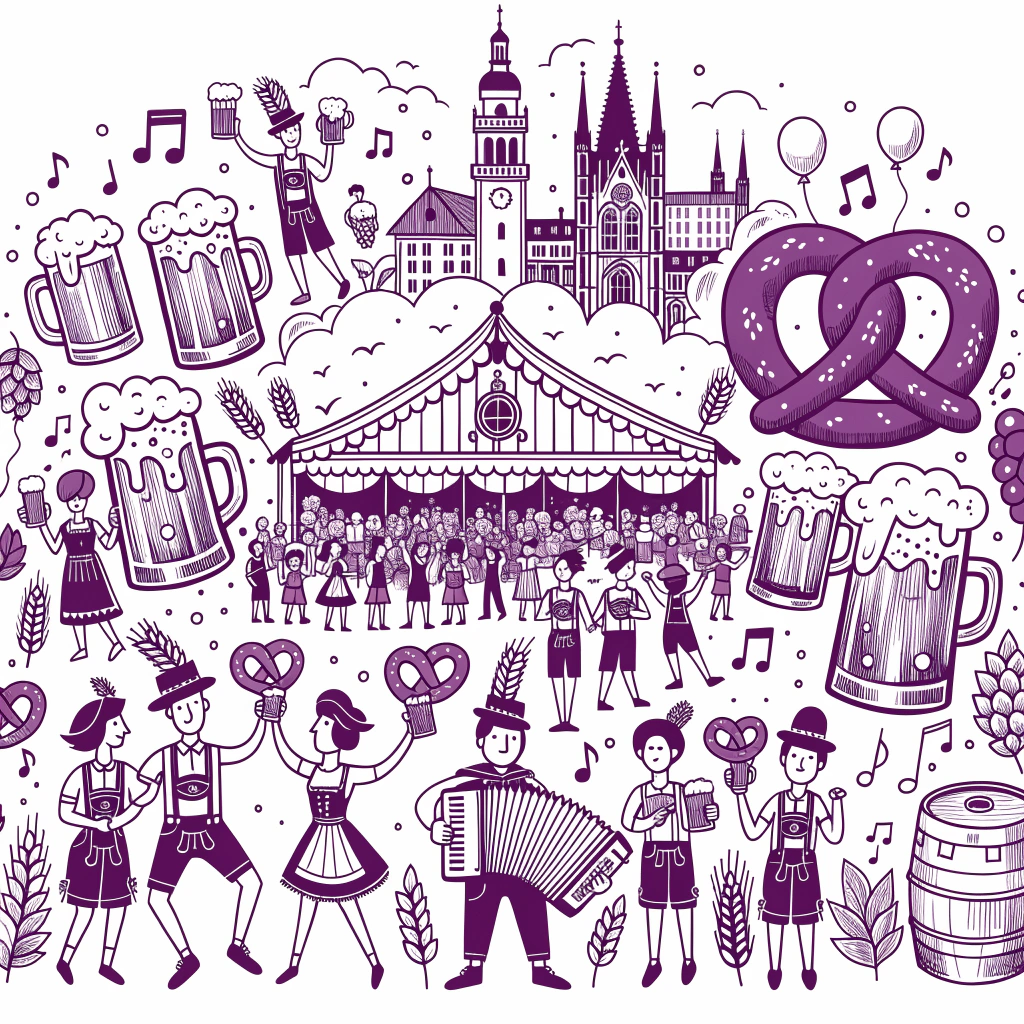
A Big Party in Germany
Oktoberfest is a big festival in Germany. It is in the city of Munich. Many people visit the festival every year. It starts in September and ends in October.
People wear special clothes. Men wear leather trousers and women wear traditional dresses. They eat sausages and bread. They drink and listen to music.
The festival is very old. It started in 1810 for a royal wedding. Today, it is a famous party. People from many countries go to Munich. It is a happy time for everyone.
Grammar Spotlight
Pattern: Present Simple (to be)
"Oktoberfest is a big festival in Germany."
This pattern uses the verb 'to be' to describe a person, place, or thing. In this sentence, 'is' connects the subject to the description. We use 'is' for singular subjects.
Pattern: Present Simple (Action Verbs)
"They eat sausages and bread."
We use the present simple to talk about things that are generally true. For the subject 'they', we use the base form of the verb. This sentence describes a common activity at the festival.
Test Your Understanding
10 questions · A1 Beginner · 1 free preview
Test what you learned from this article. Answer all questions to earn XP!
Where is the Oktoberfest festival?
Want to finish the quiz?
9 more questions are waiting for you. Sign up free to unlock the full quiz and earn XP!
Sign Up FreeAlready have an account? Sign In
Question Breakdown
Where is the Oktoberfest festival?
Your answer:
Correct answer: Munich
Oktoberfest starts in December.
Your answer:
Correct answer: False
What does 'famous' mean?
Your answer:
Correct answer: Known by many people
People wear special _____.
Your answer:
Correct answer: clothes
Oktoberfest: Germany's Famous Festival
Oktoberfest is a very famous festival in Munich, Germany. Every year, more than six million people visit the city for this big event. It started a long time ago in 1810. At first, it was a horse race to celebrate the marriage of a prince and a princess. People liked the party so much that it became a tradition.
Today, the festival is different. It usually starts in September because the weather is warmer than in October. It ends on the first Sunday of October. People wear traditional German clothes and eat delicious food. They also listen to traditional music and dance together.
Oktoberfest is bigger and more famous than other festivals in Germany. It is an important part of German culture. Many tourists travel from other countries because they want to see the fairgrounds. It is a very happy and busy time in Munich.
Grammar Spotlight
Pattern: Past Simple
"It started a long time ago in 1810."
The past simple is used to talk about actions that finished in the past. For regular verbs, we usually add '-ed' to the end.
Pattern: Comparatives
"Oktoberfest is bigger and more famous than other festivals in Germany."
We use comparatives to compare two things. For short words, we add '-er', and for long words, we use 'more' before the adjective.
Test Your Understanding
11 questions · A2 Elementary · 1 free preview
Test what you learned from this article. Answer all questions to earn XP!
Why did the first Oktoberfest happen in 1810?
Want to finish the quiz?
10 more questions are waiting for you. Sign up free to unlock the full quiz and earn XP!
Sign Up FreeAlready have an account? Sign In
Question Breakdown
Why did the first Oktoberfest happen in 1810?
Your answer:
Correct answer: To celebrate the marriage of a prince and princess
The festival starts in September because the weather is warmer.
Your answer:
Correct answer: True
What does the word 'famous' mean?
Your answer:
Correct answer: Known by many people
People wear _____ German clothes at the festival.
Your answer:
Correct answer: traditional
How many people visit Munich for Oktoberfest every year?
Your answer:
Correct answer: More than six million
Oktoberfest: Germany's Famous Cultural Celebration
Oktoberfest is widely known as the world's largest folk festival. It is held annually in Munich, Germany, on a large field called the Theresienwiese. Although many people think it happens only in October, the festival actually begins in September. This change was made because the weather is much warmer during late September, which allows visitors to enjoy the outdoor activities comfortably.
The tradition started on October 12, 1810, to celebrate the marriage of Crown Prince Ludwig and Princess Therese. At first, it was a horse race that was enjoyed by the local citizens. Over time, the event has evolved into a massive cultural celebration that attracts over six million visitors from across the globe. Today, huge tents are constructed specifically for the festival, where traditional food and drinks are served to the crowds.
Many visitors choose to wear traditional Bavarian clothing, such as Lederhosen for men and Dirndls for women. These outfits have become very popular again in recent years. While the festival is famous for its large glasses of beer, it is also a family-friendly event. There are many fairground rides, games, and parades that children can enjoy.
In conclusion, Oktoberfest has remained an important part of German heritage for over 200 years. It is a time when people from different backgrounds come together to celebrate. Whether you are interested in history or just want to experience the lively atmosphere, Oktoberfest offers something for everyone.
Grammar Spotlight
Pattern: Passive Voice
"Today, huge tents are constructed specifically for the festival."
The passive voice is used when the action is more important than who is doing it. It is formed using the verb 'to be' and the past participle of the main verb.
Pattern: Present Perfect
"The event has evolved into a massive cultural celebration."
The present perfect connects the past to the present. It is used here to show a process of change that started in the past and is still relevant today.
Test Your Understanding
11 questions · B1 Intermediate · 1 free preview
Test what you learned from this article. Answer all questions to earn XP!
Where is Oktoberfest held every year?
Want to finish the quiz?
10 more questions are waiting for you. Sign up free to unlock the full quiz and earn XP!
Sign Up FreeAlready have an account? Sign In
Question Breakdown
Where is Oktoberfest held every year?
Your answer:
Correct answer: Munich
The festival starts in September because the weather is usually warmer.
Your answer:
Correct answer: True
What does the word 'tradition' mean?
Your answer:
Correct answer: A custom from the past
Oktoberfest started as a horse _____ to celebrate a royal marriage.
Your answer:
Correct answer: race
How many people visit the festival annually?
Your answer:
Correct answer: Over six million
Oktoberfest: The Evolution of a Bavarian Cultural Legacy
Oktoberfest is widely regarded as Germany’s most prominent cultural export, attracting over six million enthusiasts to Munich’s Theresienwiese annually. Although the name suggests an autumn celebration, the festivities predominantly occur in September to capitalize on the more favorable weather conditions. This massive undertaking originated on October 12, 1810, when a horse race was organized to commemorate the nuptials of Crown Prince Ludwig of Bavaria and Princess Therese. The event was so well-received by the public that it was transformed into an annual tradition, eventually evolving into the world-renowned folk festival we recognize today.
The sheer scale of Oktoberfest provides a significant boost to the local economy, fostering prosperity throughout the region. Visitors from every corner of the globe converge on Munich, where they are estimated to consume millions of liters of beer. However, the beverages served must adhere to the stringent 'Reinheitsgebot,' or the Beer Purity Law, which dictates that only six specific Munich breweries are permitted to provide their products. This ensures the authenticity of the experience, maintaining a link to Bavarian heritage that has remained unbroken for centuries. Consequently, the festival serves as a prestigious showcase for local craftsmanship.
Furthermore, the festival is not merely about consumption; it represents a complex integration of traditional customs and modern tourism. The opening ceremony is a highlight, marked by the Mayor of Munich tapping the first keg and exclaiming 'O’zapft is!' (It is tapped!). This ritual signals the official beginning of the revelry. Attendees often wear traditional attire, such as Lederhosen and Dirndls, which serves to reinforce a sense of cultural identity. While some critics argue that the event has become overly commercialized, others contend that its transformation has allowed Bavarian culture to be shared with a diverse international audience.
If the original organizers had known how influential the event would become, they might have been astonished by its global reach. Today, the 'Wiesn,' as locals affectionately call the fairgrounds, hosts fourteen large tents and numerous smaller ones, each offering a unique atmosphere. In conclusion, Oktoberfest stands as a testament to the enduring power of tradition. By balancing historical reverence with the demands of modern hospitality, the festival continues to thrive as a unique phenomenon. Whether one is interested in the historical background or the vibrant social atmosphere, the event offers a profound insight into the heart of Bavarian life.
Grammar Spotlight
Pattern: The Passive Voice
"The event was so well-received by the public that it was transformed into an annual tradition..."
The passive voice is used here to focus on the event itself rather than the people who changed it. It is formed using 'to be' + past participle.
Pattern: The Third Conditional
"If the original organizers had known how influential the event would become, they might have been astonished by its global reach."
This pattern describes a hypothetical situation in the past. It uses 'if' + past perfect in the condition clause and 'might/would have' + past participle in the result clause.
Pattern: Non-defining Relative Clauses
"The beverages served must adhere to the stringent 'Reinheitsgebot,' or the Beer Purity Law, which dictates that only six specific Munich breweries are permitted to provide their products."
These clauses provide extra information about a noun. They are separated by commas and use 'which' or 'who' as the relative pronoun.
Test Your Understanding
11 questions · B2 Upper Intermediate · 1 free preview
Test what you learned from this article. Answer all questions to earn XP!
What was the original reason for the first Oktoberfest in 1810?
Want to finish the quiz?
10 more questions are waiting for you. Sign up free to unlock the full quiz and earn XP!
Sign Up FreeAlready have an account? Sign In
Question Breakdown
What was the original reason for the first Oktoberfest in 1810?
Your answer:
Correct answer: A royal wedding
The festival was moved to September primarily to take advantage of better weather.
Your answer:
Correct answer: True
What does 'authenticity' mean in the context of the article?
Your answer:
Correct answer: The quality of being genuine
The Beer Purity Law dictates that only _____ specific Munich breweries are allowed to serve beer at the festival.
Your answer:
Correct answer: six
What is the 'Reinheitsgebot'?
Your answer:
Correct answer: A law regarding beer purity
Beyond the Stein: The Socio-Economic Paradox of Oktoberfest
Little did Crown Prince Ludwig of Bavaria imagine in 1810 that his nuptial celebrations would metamorphose into the world’s most recognizable folk festival. Originally conceived as a horse race to commemorate his marriage to Princess Therese, the event has since undergone a profound and multifaceted evolution. Today, the Theresienwiese—named in honor of the royal bride—plays host to over six million visitors annually, serving as a crucible where historical tradition and modern commercialism collide with relentless intensity.
The meticulous organization required to sustain such a massive influx of global tourism is nothing short of staggering. The assembly of the gargantuan beer tents, some capable of seating nearly ten thousand patrons, begins months in advance. This degree of logistical precision epitomizes the German ethos of efficiency, yet it also highlights a complex socio-economic paradox. While the festival generates billions in revenue for the city of Munich, a growing chorus of critics argues that the rampant commercialization threatens to dilute the very cultural authenticity it purports to celebrate. The exorbitant prices of a 'Maß' of beer, combined with the ubiquitous presence of global corporate sponsors, suggest a shift from a community-focused gathering to a commodified tourist spectacle designed for mass consumption.
Furthermore, the global export of the 'Oktoberfest' brand has led to a peculiar cultural homogeneity. From Cincinnati to Blumenau, replicas of the Munich experience have sprouted across the globe, often stripping the event of its nuanced Bavarian context. What remains in these international iterations is frequently a mere vestige of the original sentiment, repackaged as a generic celebration of beer and bratwurst. Within Munich itself, the tension between maintaining local heritage and catering to international expectations is palpable. It is not merely the consumption of Märzen beer that draws the crowds; rather, it is a collective, albeit often commercialized, yearning for 'Gemütlichkeit'—a uniquely German concept encompassing coziness, social acceptance, and a sense of belonging.
In recent years, the festival has also had to grapple with the exigencies of the twenty-first century, most notably environmental sustainability. The sheer volume of waste and energy consumption associated with the two-week event has prompted a radical rethinking of its ecological footprint. Efforts to implement green energy, reduce plastic usage, and prioritize regional organic produce are now central to the festival's administrative discourse. This shift reflects a broader societal movement toward environmental consciousness, proving that even the most entrenched traditions must adapt to survive in a changing world.
The juxtaposition of the 'Oide Wiesn'—the 'Old Meadow' section—against the high-octane atmosphere of the modern tents provides a fascinating study in contrast. Here, historical rides and traditional folk music offer a counter-narrative to the pop-infused revelry elsewhere. This deliberate preservation of the ephemeral charms of yesteryear serves as a reminder of the festival's origins. Ultimately, the modern Oktoberfest is defined by its capacity for reinvention. Whether one views it as a triumph of global marketing or a resilient cultural bastion, its influence on the global perception of German identity remains unparalleled.
Grammar Spotlight
Pattern: Negative Inversion
"Little did Crown Prince Ludwig of Bavaria imagine in 1810 that his nuptial celebrations would metamorphose..."
When we start a sentence with a negative or limiting adverbial like 'Little', 'Never', or 'Rarely', the subject and the auxiliary verb are inverted. This is used in C1 writing to add rhetorical emphasis and dramatic flair.
Pattern: Cleft Sentence
"It is not merely the consumption of Märzen beer that draws the crowds..."
An 'it-cleft' sentence focuses on a specific part of the sentence to emphasize it. It follows the structure: It + be + emphasized part + relative clause.
Pattern: Nominalization
"The assembly of the gargantuan beer tents... begins months in advance."
This involves turning verbs (to assemble) into nouns (assembly). It is a hallmark of academic and advanced C1 English, making the writing more concise and objective.
Test Your Understanding
12 questions · C1 Advanced · 1 free preview
Test what you learned from this article. Answer all questions to earn XP!
What was the primary purpose of the original 1810 event?
Want to finish the quiz?
11 more questions are waiting for you. Sign up free to unlock the full quiz and earn XP!
Sign Up FreeAlready have an account? Sign In
Question Breakdown
What was the primary purpose of the original 1810 event?
Your answer:
Correct answer: To celebrate a royal marriage with a horse race
Oktoberfest has remained largely unchanged since its inception in 1810.
Your answer:
Correct answer: False
What does 'exorbitant' mean in the context of the article?
Your answer:
Correct answer: Unreasonably high or excessive
The global _____ of the festival brand has led to cultural homogeneity.
Your answer:
Correct answer: export
What does the 'Oide Wiesn' represent in the modern festival?
Your answer:
Correct answer: A historical section focused on traditional charm
Environmental sustainability has become a central topic in the festival's management.
Your answer:
Correct answer: True
The Bacchanalian Paradox: Deconstructing the Socio-Cultural Fabric of Munich’s Oktoberfest
Seldom has a regional celebration transcended its parochial origins with such global resonance as Munich’s Oktoberfest. While ostensibly a mere folk festival, or 'Wiesn' in the local vernacular, its evolution from a nineteenth-century royal nuptial celebration into a multi-billion euro juggernaut offers a compelling study in the juxtaposition of traditionalism and rampant commodification. The festival’s genesis is well-documented: on October 12, 1810, Crown Prince Ludwig of Bavaria wed Princess Therese of Saxe-Hildburghausen, an event commemorated with a horse race on the fields that now bear the princess’s name, the Theresienwiese. Yet, to view the contemporary iteration of Oktoberfest as a vestigial remnant of monarchical pomp would be to overlook the idiosyncratic socio-economic forces that have shaped its current form.
Indeed, the zeitgeist of modern Munich is inextricably linked to this sixteen-day spectacle. Notwithstanding its global reputation for hedonistic excess, the festival remains a bastion of Bavarian identity. It is a space where the ephemeral nature of modern tourism meets the steadfast rigidity of tradition. This is perhaps most evident in the strictures governing the beer itself. It is imperative that the nectar served be brewed strictly according to the Reinheitsgebot, or the Bavarian Purity Law of 1516, and must originate from one of the six traditional Munich breweries. Should the festive veneer be stripped away, one would find an intricate web of mercantile prowess and municipal regulation that ensures the event’s longevity while simultaneously threatening its perceived veracity.
Sociologically, the festival functions as a liminal space where societal hierarchies are momentarily suspended, albeit within a highly commercialized framework. The propensity for visitors to adorn themselves in traditional Tracht—Dirndls and Lederhosen—represents a fascinating performance of collective identity. For some, this is an act of genuine cultural preservation; for others, it is merely a costume for a bacchanalian retreat from the mundane. This tension between authenticity and performance is central to the Oktoberfest experience. Furthermore, the economic impact is staggering, with millions of litres of beer consumed alongside metric tonnes of traditional fare, such as Hendl and Schweinebraten, fueling a local economy that has become increasingly dependent on this autumnal influx.
However, the festival’s success has not been without its detractors. Critics argue that the sheer scale of the event has led to a dilution of its cultural essence, transforming a local tradition into a commodified product for the international masses. They point to the escalating prices and the logistical nightmare of accommodating six million visitors as evidence of a system nearing its breaking point. Yet, the festival persists, seemingly impervious to the shifting tides of global trends. It remains a testament to the enduring power of communal ritual, provided that such rituals can adapt to the demands of the modern age without losing their soul. Ultimately, Oktoberfest stands as a palimpsest of Bavarian history, where each generation adds its own layer of meaning to the hallowed grounds of the Theresienwiese, ensuring that the spirit of 1810 remains alive, however distorted it may appear in the neon glow of the modern fairground.
Grammar Spotlight
Pattern: Negative Inversion
"Seldom has a regional celebration transcended its parochial origins with such global resonance as Munich’s Oktoberfest."
When a sentence starts with a negative or restrictive adverbial like 'seldom', the subject and the auxiliary verb are inverted. This is used for rhetorical emphasis in formal or literary English.
Pattern: Present Subjunctive
"It is imperative that the nectar served be brewed strictly according to the Reinheitsgebot."
The base form of the verb ('be') is used after certain adjectives of urgency or importance. This formal structure emphasizes a requirement or necessity.
Pattern: Inverted Conditionals (Should)
"Should the festive veneer be stripped away, one would find an intricate web of mercantile prowess."
The word 'should' can replace 'if' in a first or second conditional sentence to make the situation sound more hypothetical or formal. The subject and verb are inverted.
Test Your Understanding
12 questions · C2 Mastery · 1 free preview
Test what you learned from this article. Answer all questions to earn XP!
What does the author suggest about the modern iteration of Oktoberfest?
Want to finish the quiz?
11 more questions are waiting for you. Sign up free to unlock the full quiz and earn XP!
Sign Up FreeAlready have an account? Sign In
Question Breakdown
What does the author suggest about the modern iteration of Oktoberfest?
Your answer:
Correct answer: It is a complex mix of tradition and commercial interests.
The Bavarian Purity Law of 1516 dictates which breweries are allowed to serve beer at the festival.
Your answer:
Correct answer: True
What does 'ephemeral' mean?
Your answer:
Correct answer: Lasting for a very short time.
The author describes the festival as a _____, implying it has layers of history that have been built upon over time.
Your answer:
Correct answer: palimpsest
According to the text, what is the sociological function of wearing traditional 'Tracht'?
Your answer:
Correct answer: It serves as a performance of collective identity.
The author believes that the festival is currently failing due to the logistical challenges of high visitor numbers.
Your answer:
Correct answer: False
