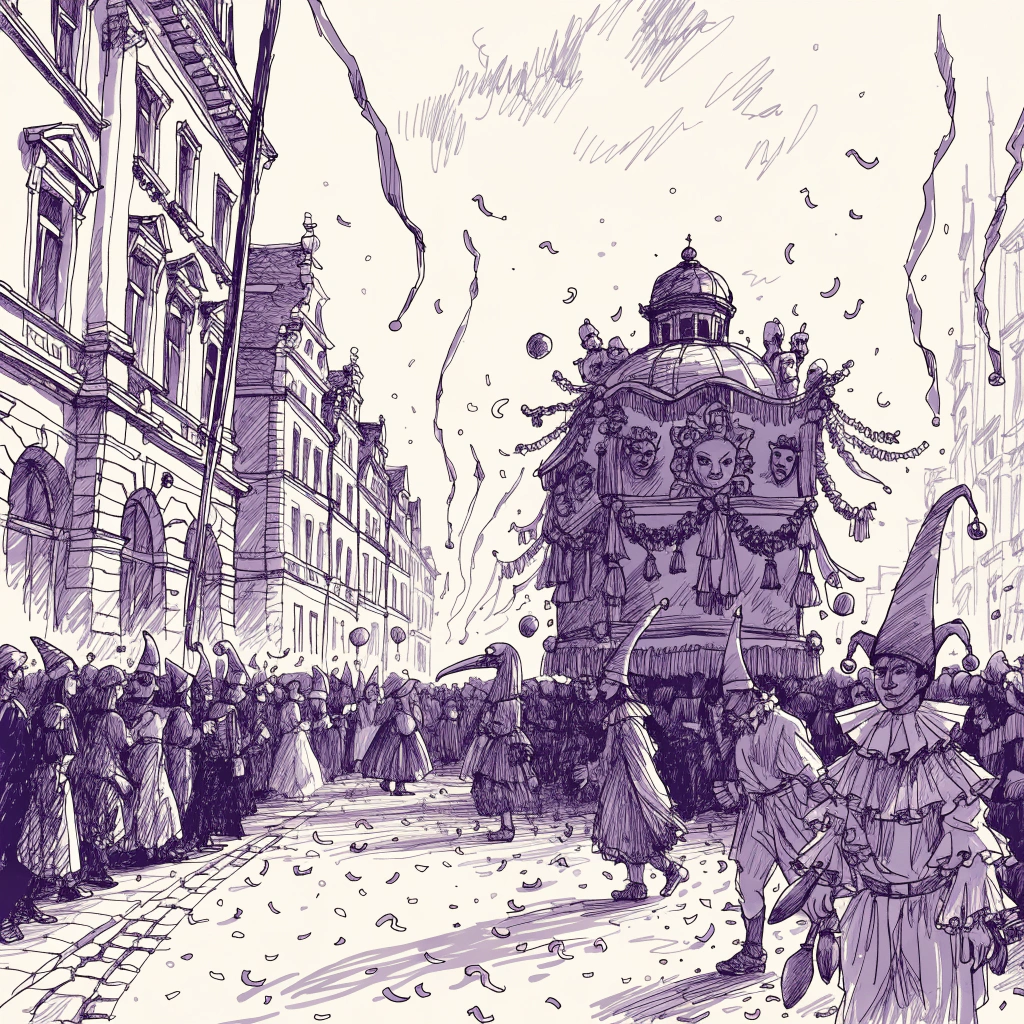
ドイツのカーニバル:楽しいお祭り
ドイツに「カーニバル」というお祭りがあります。これはとても楽しいお祭りです。 カーニバルは冬の終わりにあります。だいたい2月です。 人々は特別な服を着ます。これを「仮装(かそう)」と言います。動物や面白い顔の仮装が多いです。 みんなで歌を歌ったり、ダンスをしたりします。街を歩くパレードもあります。 美味しい食べ物や飲み物もたくさんあります。 たくさんの人が集まって、一緒に楽しみます。カーニバルはドイツの大切な文化です。
文法スポットライト
パターン: N + があります
"ドイツに「カーニバル」というお祭りがあります。"
物や場所の存在を表すときに使います。「〜があります」は「〜がある」の丁寧な形です。人や動物には使いません。
パターン: V-たり V-たりします
"みんなで歌を歌ったり、ダンスをしたりします。"
いくつかの行動を例として挙げるときに使います。「〜たり〜たりします」は、「〜もするし、〜もする」という意味です。
理解度をチェック
10 問 · A1 初級 · 無料プレビュー 1回
この記事で学んだことをテストしよう。全問正解してXPを獲得!
ドイツのカーニバルはいつですか?
問題の内訳
ドイツのカーニバルはいつですか?
あなたの回答:
正解: 冬の終わり
カーニバルでは、人々は特別な服を着ます。
あなたの回答:
正解: 正しい
「仮装(かそう)」は何ですか?
あなたの回答:
正解: 特別な服
みんなで歌を歌ったり、__をしたりします。
あなたの回答:
正解: ダンス
ドイツのカーニバル:第五の季節
ドイツには「カーニバル」という、とても楽しい伝統的なお祭りがあります。ドイツ語では「ファッシング」や「ファストナハト」とも呼ばれます。多くの人はこのお祭りを「第五の季節」と呼んでいます。これは、春、夏、秋、冬とは違う、特別な時期だからです。
カーニバルは、毎年11月11日の午前11時11分に正式に始まります。しかし、一番にぎやかになるのは、2月ごろにある「灰の水曜日」という日の前の週です。この一週間、ドイツの多くの都市、特にケルンやマインツのようなラインラント地方の街では、人々が特別な衣装を着てパレードをしたり、歌ったり踊ったりします。街は色とりどりの飾りでいっぱいになり、とてもお祭り気分になります。
このお祭りの歴史は古いです。昔のドイツの人々は、寒い冬の悪い霊を追い出すために、カーニバルを始めました。また、キリスト教の「レント」という期間の前に、たくさん食べて、楽しく過ごすためのお祭りでもありました。カーニバルは、ドイツの人々にとって、とても大切な文化の一つです。
文法スポットライト
パターン: ~と呼びます
"多くの人はこのお祭りを「第五の季節」と呼んでいます。"
これは、何かを別の名前や呼び方で紹介するときに使います。「AをBと呼びます」で、「AをBという名前で呼びます」という意味です。動詞の辞書形に「と呼びます」をつけたり、名詞の後に使ったりします。
パターン: ~の前に
"「灰の水曜日」という日の前の週です。"
これは、時間や場所の関係を示すときに使う表現です。「Aの前にB」で、「BがAより先に来る」という意味です。名詞の後に「の前に」をつけます。
理解度をチェック
11 問 · A2 初級 · 無料プレビュー 1回
この記事で学んだことをテストしよう。全問正解してXPを獲得!
カーニバルはいつ一番にぎやかになりますか?
問題の内訳
カーニバルはいつ一番にぎやかになりますか?
あなたの回答:
正解: 灰の水曜日の前の週
ドイツ語でカーニバルは「ファッシング」や「ファストナハト」とも言います。
あなたの回答:
正解: 正しい
「伝統的」の意味は何ですか?
あなたの回答:
正解: 昔からあること
カーニバルは、毎年11月11日の午前11時11分に正式に____。
あなたの回答:
正解: 始まります
昔のドイツの人々は、寒い冬の悪い____を追い出すために、カーニバルを始めました。
あなたの回答:
正解: 霊
ドイツのカーニバル:冬を追い払うお祭り
ドイツには「第五の季節」と呼ばれる、とても賑やかなお祭りがあります。それはカーニバル(ファッシングまたはファストナハト)です。このお祭りは、毎年11月11日の午前11時11分に正式に始まるとされています。しかし、本当の盛り上がりは、2月頃の「灰の水曜日」の前の週にやってきます。この期間、人々は仮装をしてパレードに参加したり、歌ったり踊ったりして楽しみます。
カーニバルの歴史は古く、冬の寒い精霊を追い払い、春を迎えるための古いゲルマン民族の儀式にルーツがあると言われています。また、キリスト教の伝統とも深く関係しています。カトリック教会では、灰の水曜日からイースターまでの40日間は「四旬節」という断食期間があります。カーニバルは、この断食期間が始まる前に、人々がおいしいものを食べたり、飲んだり、楽しんだりするための準備期間だったのです。
特に、ドイツ西部のラインラント地方は、カーニバルが大変盛んな地域として知られています。ケルンやデュッセルドルフといった都市では、大規模なパレードやイベントが開催され、多くの人が集まります。カラフルな衣装を身につけた人々が街中を歩き、キャンディを投げたり、陽気な音楽が響き渡ったりします。
この伝統的なお祭りは、何世紀にもわたって受け継がれてきました。近年では、ただ楽しむだけでなく、地域の文化やコミュニティを強くする大切な役割も果たしています。多くの人々が準備に参加し、一緒に思い出を作っています。ドイツのカーニバルは、歴史と文化が詰まった、本当に特別なイベントなのです。
文法スポットライト
パターン: 〜とされています
"このお祭りは、毎年11月11日の午前11時11分に正式に始まるとされています。"
「〜とされています」は、世間一般にそう言われている、そう考えられている、という事実や情報を伝えるときに使います。誰が言ったかではなく、一般的な見解を示す表現です。動詞の辞書形や名詞句の後に続きます。
パターン: 〜と呼ばれるN
"ドイツには「第五の季節」と呼ばれる、とても賑やかなお祭りがあります。"
「〜と呼ばれるN」は、「〜という名前のN」という意味で、Nが何と呼ばれているかを説明するときに使います。Nがどんなものか、より詳しく紹介するのに便利です。名詞や句の後に「と呼ばれる」が続きます。
理解度をチェック
11 問 · B1 中級 · 無料プレビュー 1回
この記事で学んだことをテストしよう。全問正解してXPを獲得!
ドイツのカーニバルは、毎年いつ正式に始まるとされていますか?
問題の内訳
ドイツのカーニバルは、毎年いつ正式に始まるとされていますか?
あなたの回答:
正解: 11月11日の午前11時11分
カーニバルの歴史は、キリスト教の伝統とは全く関係がありません。
あなたの回答:
正解: 間違い
「仮装」とはどういう意味ですか?
あなたの回答:
正解: 特別な服を着て、違う人やキャラクターになること
カーニバルが特に盛んなドイツの地方は、_______地方として知られています。
あなたの回答:
正解: ラインラント
カトリック教会で、イースターまでの40日間続く断食期間を「_______」と言います。
あなたの回答:
正解: 四旬節
ドイツのカーニバル:第五の季節がもたらす文化と歴史
ドイツには「第五の季節」と呼ばれる特別な期間があります。それは、冬の終わりを告げ、春の訪れを祝うかのような、賑やかで色彩豊かな「カーニバル」です。特にラインラント地方を中心に盛大に祝われるこの祝祭は、単なるお祭り騒ぎにとどまらず、深い歴史的・文化的背景を持っています。この期間は、人々が日常の枠を一時的に超え、社会的な役割から解放されることを許容する、ドイツ文化にとって極めて重要な意味合いを持つと言えるでしょう。
カーニバルの正式な開幕は、毎年11月11日の午前11時11分とされており、この時期から準備が始まります。しかし、そのお祭りの熱気が最高潮に達するのは、灰の水曜日の前の週、通常2月頃です。この期間中、ドイツの都市、特にケルン、デュッセルドルフ、マインツなどでは、街全体が変貌し、仮装した人々が通りを埋め尽くします。オフィスや学校も半日休みになることが多く、街中がお祝いムードに包まれるのです。
この祝祭の根源は、古代ゲルマン民族の冬の悪霊を追い払う儀式にまで遡ると言われています。彼らは騒がしい音や恐ろしい仮面を使い、長い冬の闇を払い、春の到来を願いました。これに加えて、キリスト教の伝統が融合し、四旬節(レント)と呼ばれる断食期間に入る前に、人々が心ゆくまで飲食や享楽に浸る期間として発展しました。つまり、厳しい精神的な修行の前に、一時的に世俗的な快楽を許容するという意味合いも含まれているのです。このように、カーニバルは異教徒の慣習とキリスト教の教えが共存する、興味深い文化的な現象であると言えます。
カーニバル期間中には、様々な行事が催されます。仮面舞踏会、コスチュームパーティー、そして最も特徴的なのは、大規模なパレード「ローゼンモンターク(バラの月曜日)」です。このパレードでは、政治や社会を風刺した巨大な山車が練り歩き、観衆に向かってお菓子や花が投げられます。人々は普段の社会的な地位や役割を忘れ、仮装を通して一時的に別の自分を演じることで、日頃のストレスや抑圧から解放される機会を得ます。この解放感と共同体の一体感こそが、カーニバルの持続的な魅力となっているのです。
このように、ドイツのカーニバルは、単なる娯楽的なイベントであるのみならず、古代の信仰、キリスト教の慣習、そして現代社会における人々の心理的解放といった多層的な要素が複雑に絡み合った文化現象と言えるでしょう。この「第五の季節」は、ドイツの多様な文化を理解する上で非常に興味深い側面を提供してくれます。その賑やかさの裏には、長い歴史と人々の願いが込められているのです。
文法スポットライト
パターン: ~とされている
"カーニバルの正式な開幕は、毎年11月11日の午前11時11分とされており、この時期から準備が始まります。"
ある事柄が一般的にそう考えられている、あるいはそのように定められていることを表す表現です。客観的な情報や共通認識を述べる際に用いられます。「~と言われている」と似ていますが、より公式な見解や事実として述べられることが多いです。
パターン: ~のみならず~も
"ドイツのカーニバルは、単なる娯楽的なイベントであるのみならず、古代の信仰、キリスト教の慣習、そして現代社会における人々の心理的解放といった多層的な要素が複雑に絡み合った文化現象と言えるでしょう。"
ある事柄がAであるだけでなく、Bでもあるというように、二つの事柄を並列に強調して述べる際に使われます。後続の「も」は省略されることもありますが、あるとより強調されます。硬い文章でよく使われる表現です。
パターン: ~といった
"仮面舞踏会、コスチュームパーティー、そして最も特徴的なのは、大規模なパレード「ローゼンモンターク(バラの月曜日)」といった様々な行事が催されます。"
複数の具体的な例を挙げた後、それらを包括する一般的な事柄を述べる際に使われます。例示の他にも「~のような」という意味合いで、抽象的な概念を具体的に説明するためにも用いられます。
理解度をチェック
11 問 · B2 中上級 · 無料プレビュー 1回
この記事で学んだことをテストしよう。全問正解してXPを獲得!
ドイツでカーニバルが「第五の季節」と呼ばれるのは、どのような理由からですか?
問題の内訳
ドイツでカーニバルが「第五の季節」と呼ばれるのは、どのような理由からですか?
あなたの回答:
正解: 日常の枠を超えた特別な期間だから
カーニバルの正式な開幕は、毎年2月頃とされている。
あなたの回答:
正解: 間違い
「根源」とは、どのような意味ですか?
あなたの回答:
正解: 物事の始まりや起源
カーニバルの根源には、古代ゲルマン民族の冬の悪霊を追い払う_____にまで遡ると言われています。
あなたの回答:
正解: 儀式
カーニバルが最高潮に達するのは、キリスト教のどの期間の直前ですか?
あなたの回答:
正解: 四旬節
The Fifth Season: A Socio-Cultural Anatomy of German Karneval
To the uninitiated observer, the German Karneval might appear as nothing more than an unbridled display of hedonism. However, to dismiss it as such would be to overlook the intricate socio-political mechanisms and historical layers at play. Known colloquially as the 'Fifth Season', this period represents a temporal amnesty where societal norms are suspended in favour of ritualised chaos. Not only does this tradition offer a reprieve from the rigours of daily life, but it also functions as a vital outlet for dissent and communal reflection. Never has the distinction between the sacred and the profane been more blurred than during the peak of these festivities, which bridge the gap between ancient folklore and modern political commentary.
The historical evolution of Karneval is a testament to the synthesis of pre-Christian paganism and medieval Catholicism. While the former sought to dispel the winter spirits through cacophonic noise and grotesque masks—a tradition still visible in the Swabian-Alemannic 'Fastnacht'—the latter institutionalised the 'carne vale', or the farewell to meat, prior to the asceticism of Lent. It is this paradoxical blend of the spiritual and the visceral that imbues the festivities with such profound resonance. Although the season officially commences on November 11th at 11:11 AM, the intensification of the celebrations only truly occurs in the week leading up to Ash Wednesday, beginning with 'Weiberfastnacht'.
In the Rhineland, the celebration takes on a particularly satirical edge. The caricature of military uniforms and the inclusion of elaborately designed floats are far from mere ornamentation; they are a vestige of 19th-century resistance against Prussian hegemony. When the Rhineland was under Prussian rule, the locals utilised Karneval to mock the rigid militarism of their occupiers. By mimicking the discipline of the soldiers through 'Guard' dances and parodies, the populace exerted a form of soft power, reclaiming their cultural identity through biting satire. Such subversion remains a cornerstone of the modern Rose Monday parades, where high-profile politicians are frequently subjected to uncompromising visual critiques.
Furthermore, the psychological impact of this communal catharsis cannot be overstated. In an era characterised by increasing social atomisation, the collective immersion in a shared identity—however transient—provides a sense of belonging that transcends class boundaries. The suspension of hierarchy allows for a momentary inversion of power, where the fool becomes king and the king is held to account. It is the deliberate subversion of social hierarchy that defines the core of the Rhineland tradition, allowing for a healthy release of societal tension.
As Ash Wednesday approaches, the atmosphere shifts from the boisterous to the contemplative. The intensification of the revelry in those final hours serves as a poignant reminder of the ephemeral nature of joy. As the masks are finally discarded and the 'Nubbel' (a straw figure representing sins) is burned, the transition into the solemnity of Lent marks a return to the structured reality of the calendar. Thus, Karneval is not merely a sequence of parties; it is a sophisticated cultural performance that navigates the perpetual tension between tradition, modernity, and the human need for release.
文法スポットライト
パターン: Inversion for Emphasis
"Never has the distinction between the sacred and the profane been more blurred than during the peak of these festivities."
When a sentence starts with a negative or restrictive adverb like 'Never', the auxiliary verb comes before the subject. This structure is used in formal writing to add dramatic emphasis to a statement.
パターン: Cleft Sentences
"It is the deliberate subversion of social hierarchy that defines the core of the Rhineland tradition."
A cleft sentence (starting with 'It is...') focuses on a specific part of the information. Here, it emphasizes 'the deliberate subversion' as the primary defining factor, rather than other elements.
パターン: Nominalisation
"The intensification of the revelry in those final hours serves as a poignant reminder of the ephemeral nature of joy."
Nominalisation involves turning verbs (intensify) or adjectives (intense) into nouns (intensification). This is a hallmark of C1/C2 English, making the writing more abstract, concise, and academic.
理解度をチェック
12 問 · C1 上級 · 無料プレビュー 1回
この記事で学んだことをテストしよう。全問正解してXPを獲得!
What historical purpose did military parodies serve in the Rhineland during the 19th century?
問題の内訳
What historical purpose did military parodies serve in the Rhineland during the 19th century?
あなたの回答:
正解: To mock and resist the rigid Prussian hegemony
The primary focus of the Swabian-Alemannic 'Fastnacht' is political satire involving high-profile politicians.
あなたの回答:
正解: 間違い
Which word describes a situation where societal rules are temporarily ignored or forgiven?
あなたの回答:
正解: Temporal amnesty
The transition into the _____ of Lent marks the end of the festive chaos.
あなたの回答:
正解: solemnity
According to the article, what is the psychological benefit of collective immersion during Karneval?
あなたの回答:
正解: It provides a transient sense of belonging in an atomised era
The term 'carne vale' historically signifies a farewell to the consumption of meat.
あなたの回答:
正解: 正しい
The Dionysian Mirror: A Socio-Historical Deconstruction of German Karneval
To contemplate the phenomenon of the German 'Fifth Season' is to engage with a sophisticated tapestry of historical vestiges and contemporary sociopolitical catharsis. Often erroneously reduced by the uninitiated to a mere spectacle of fancy dress and unbridled hedonism, Karneval—or Fasching and Fastnacht, as regional nomenclature dictates—serves as a critical temporal interregnum. It is a period during which the normative stratification of society is ostensibly dissolved, allowing for a ritualized inversion of power dynamics that traces its lineage back to both pagan antiquity and medieval ecclesiastical traditions. This phenomenon represents a temporal lacuna where the rigid strictures of Teutonic order are momentarily suspended in favor of a sanctioned subversion.
The inception of this period, punctiliously marked at 11:11 AM on the eleventh of November, signals a subtle shift in the collective German psyche. However, the true Dionysian crescendo occurs during the week preceding Ash Wednesday. This liminal phase allows the 'Jecken' (the fools) to occupy a space between the profane and the sacred. In the Rhineland, this is manifest in the 'Sitzungen'—satirical sessions where the political elite are subjected to iconoclastic mockery under the guise of comedic oratory. Were these festivities to be stripped of their satirical edge, they would arguably lose their primary function as a democratic pressure valve, providing a safe harbor for dissent through the medium of humor.
Historically, the roots of these celebrations are bifurcated. On one hand, we find the atavistic urge to drive out the winter spirits—a motif particularly prevalent in the Swabian-Alemannic Fastnacht, where grotesque wooden masks and the rhythmic 'Narrensprung' evoke a sense of primordial dread and renewal. On the other hand, the liturgical calendar of Christianity necessitated a final indulgence before the rigorous asceticism of Lent. This dual heritage creates a paradoxical environment: one that is simultaneously a preservation of ancient folklore and a modern platform for sociopolitical commentary. The 'Weiberfastnacht', or Women's Carnival, serves as a poignant example of this subversion, wherein women symbolically seize control of the city and truncate the ties of men—literally and figuratively—by snipping off their neckties.
Furthermore, the linguistic nuances of the season reflect a profound regional identity. While Karneval in Cologne or Düsseldorf might emphasize the 'Rosenmontag' parades and cosmopolitan revelry, the Fastnacht of the south remains more tethered to traditional guilds and local mythology. Yet, across all regions, the underlying principle remains the same: the temporary suspension of the status quo. By donning a mask, the individual is permitted to eschew their quotidian identity, engaging in a form of anonymity that facilitates the subversion of social hierarchies. The aesthetic of the parades, characterized by 'Motivwagen' (floats), often tackles global crises with a biting irony that would, in any other context, be deemed inflammatory. It is this unique 'Narrenfreiheit' (fool's freedom) that permits the populace to speak truth to power.
Scarcely had the modern era arrived before critics predicted the demise of such 'archaic' rituals as vestiges of a pre-industrial age. Yet, Karneval has proven remarkably resilient, adapting to the digital age without sacrificing its core tenets. Having navigated the complexities of the 21st century, the tradition continues to thrive, proving that the need for ritualized release is as potent today as it was in the medieval town square. It remains an ephemeral escape, a moment where the world is 'turned upside down' to better understand its mechanics when it rights itself again. Ultimately, the 'Fifth Season' is not merely an exercise in indulgence, but a sophisticated cultural mechanism that allows a society to examine its own contradictions through the distorting, yet revealing, lens of the fool's mirror.
文法スポットライト
パターン: Negative Inversion with 'Scarcely'
"Scarcely had the modern era arrived before critics predicted the demise of such 'archaic' rituals."
When 'scarcely' or 'hardly' starts a sentence for emphasis, the auxiliary verb is placed before the subject. This structure is typically used with the past perfect to describe an event that happened immediately after another.
パターン: Second Conditional with Inverted 'Were'
"Were these festivities to be stripped of their satirical edge, they would arguably lose their primary function."
This is a formal alternative to 'If these festivities were to be...'. Inverting 'were' and the subject creates a more scholarly or literary tone while maintaining the hypothetical condition.
パターン: Perfect Participle Clause
"Having navigated the complexities of the 21st century, the tradition continues to thrive."
A perfect participle clause (Having + past participle) shows that one action was completed before another. It serves as a concise way to provide background information or cause for the main clause.
理解度をチェック
12 問 · C2 マスター · 無料プレビュー 1回
この記事で学んだことをテストしよう。全問正解してXPを獲得!
When does the most intense period (the crescendo) of Karneval occur?
問題の内訳
When does the most intense period (the crescendo) of Karneval occur?
あなたの回答:
正解: The week before Ash Wednesday
The author suggests that Karneval is a purely hedonistic event without deeper meaning.
あなたの回答:
正解: 間違い
Which word describes the process of releasing strong repressed emotions?
あなたの回答:
正解: Catharsis
The author describes Karneval as a temporal ______, a period where normal social rules are suspended.
あなたの回答:
正解: interregnum
What is the primary function of the Rhenish 'Sitzungen' according to the text?
あなたの回答:
正解: To serve as a democratic pressure valve for political dissent
The 'Weiberfastnacht' tradition involves women symbolically taking control and cutting men's neckties.
あなたの回答:
正解: 正しい

