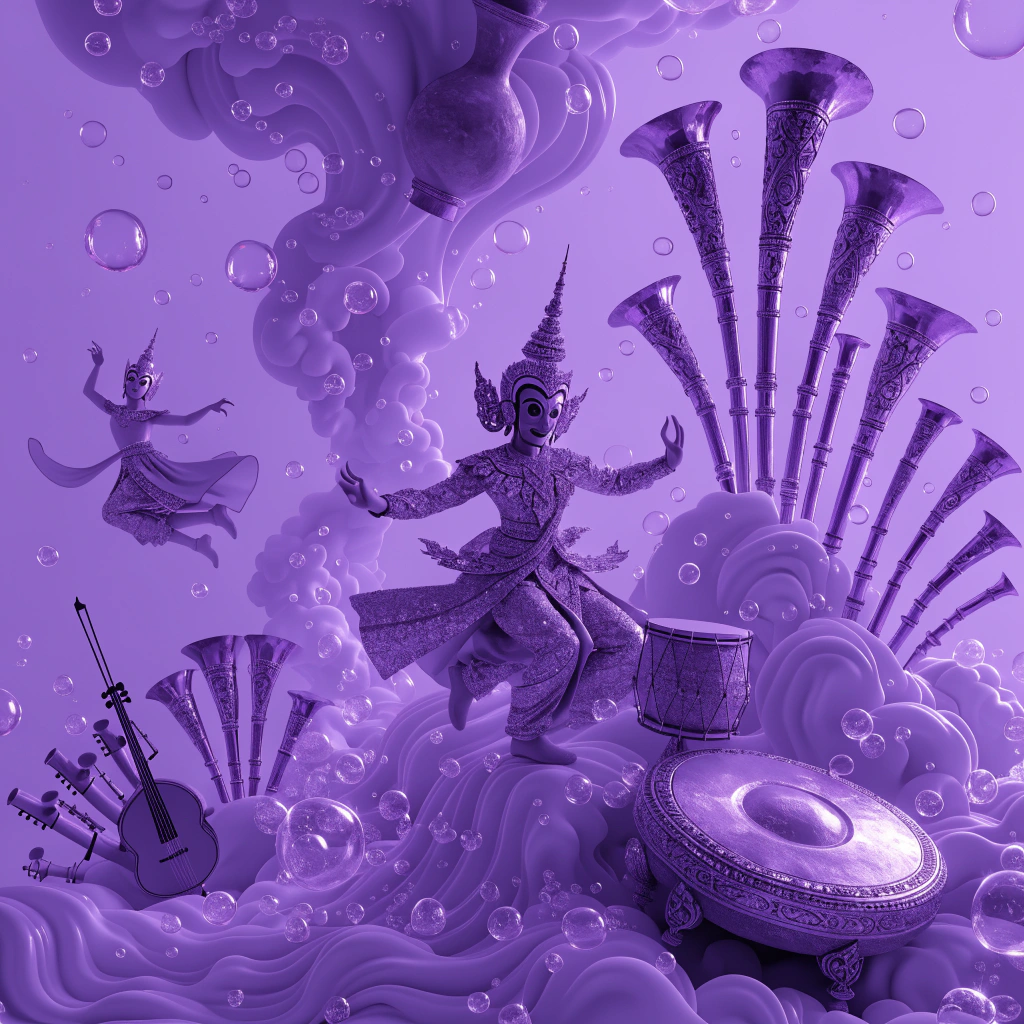
Nora: A Special Dance from Thailand
Nora is a famous dance from Southern Thailand. It is very old and special. Many people in Thailand love this art.
The dancers wear beautiful clothes. Their clothes have many bright colors like red, gold, and green. They wear long, silver nails on their fingers. The dancers move their hands and bodies slowly. They also sing songs and tell stories.
Nora is important for the community. Families watch the dance together. It is a happy time for everyone. Children learn the dance from their parents. This tradition is very famous in the world today.
Grammar Spotlight
Pattern: Present Simple (to be)
"Nora is a famous dance from Southern Thailand."
We use 'is' for one person or thing. It describes facts or states that are always true.
Pattern: Present Simple (Action Verbs)
"The dancers wear beautiful clothes."
We use the base verb for plural subjects like 'dancers'. This describes a regular action or a fact.
Test Your Understanding
10 questions · A1 Beginner · 1 free preview
Test what you learned from this article. Answer all questions to earn XP!
Where is Nora from?
Want to finish the quiz?
9 more questions are waiting for you. Sign up free to unlock the full quiz and earn XP!
Sign Up FreeAlready have an account? Sign In
Question Breakdown
Where is Nora from?
Your answer:
Correct answer: Southern Thailand
The dancers wear silver nails on their fingers.
Your answer:
Correct answer: True
What does 'beautiful' mean?
Your answer:
Correct answer: Very pretty
Families _____ the dance together.
Your answer:
Correct answer: watch
Nora: The Magic Dance of Thailand
Nora is a beautiful and energetic dance from Southern Thailand. It is also called Manohra. This dance is very old, and it is more famous than many other dances in the region. People in the south love Nora because it is an important part of their culture and history.
In the past, dancers performed Nora to tell stories about legends and spirits. Today, performers wear bright costumes with many colors. They also wear long, curved metal fingernails. The dancers move their bodies in amazing ways because the dance is very acrobatic. It is harder than normal dancing, but it looks wonderful.
In 2021, UNESCO added Nora to its special list of world heritage. This happened because Nora is a social pillar for local communities. It brings people together during festivals and ceremonies. Children learn Nora from their parents so the tradition stays alive. Nora is not just a show; it is the heart of Southern Thailand.
Grammar Spotlight
Pattern: Comparatives
"This dance is very old, and it is more famous than many other dances in the region."
We use 'more + adjective + than' to compare two things. This helps show that Nora has a higher level of fame compared to other dances.
Pattern: Conjunctions (because)
"The dancers move their bodies in amazing ways because the dance is very acrobatic."
We use 'because' to explain the reason for an action. It connects the result (moving in amazing ways) with the cause (being acrobatic).
Test Your Understanding
11 questions · A2 Elementary · 1 free preview
Test what you learned from this article. Answer all questions to earn XP!
Where is the Nora dance from?
Want to finish the quiz?
10 more questions are waiting for you. Sign up free to unlock the full quiz and earn XP!
Sign Up FreeAlready have an account? Sign In
Question Breakdown
Where is the Nora dance from?
Your answer:
Correct answer: Southern Thailand
Nora is a very new dance form.
Your answer:
Correct answer: False
What does 'costumes' mean?
Your answer:
Correct answer: Special clothes for a show
The dancers wear long, curved metal _____.
Your answer:
Correct answer: fingernails
Why did UNESCO add Nora to its list?
Your answer:
Correct answer: Because it is a social pillar for communities
Nora: The Magic of Southern Thai Dance
Thailand is a country which is famous for its rich culture and ancient traditions. In the southern part of the country, there is a special dance drama called Nora. It has been part of Thai life for centuries. Recently, this beautiful art form was inscribed on the UNESCO list of Intangible Cultural Heritage because it is so unique.
Nora is not just a simple dance; it is a spiritual performance that connects people to their ancestors. The dancers wear colorful, detailed costumes and long, curved fingernails that are made of silver. They perform acrobatic movements which are very difficult to learn and require many years of practice. The stories are often based on the ancient legend of a bird-princess called Manohra. During the show, the performers also sing beautiful poems. This singing is usually improvised, which means the artists create the words while they are performing on stage.
Community members have always supported Nora because it brings people together. It is often performed at local festivals or religious ceremonies to honor spirits. The skills have been passed down from teachers to students for many generations. Even though modern entertainment is popular now, Nora remains an important pillar of southern Thai society. People believe that Nora can bring good luck and protect the community from harm.
If you visit Southern Thailand, you might see a Nora performance in a small village. It is a unique experience that has been preserved by local people who love their traditions. It is a wonderful example of how art can keep a culture alive.
Grammar Spotlight
Pattern: Passive Voice
"Recently, this beautiful art form was inscribed on the UNESCO list."
The passive voice is used when the action is more important than who did it. It is formed using 'to be' + past participle.
Pattern: Present Perfect
"It has been part of Thai life for centuries."
The present perfect connects the past to the present. We use 'has/have' + past participle to show an action started in the past and continues now.
Test Your Understanding
11 questions · B1 Intermediate · 1 free preview
Test what you learned from this article. Answer all questions to earn XP!
Where does the Nora dance come from?
Want to finish the quiz?
10 more questions are waiting for you. Sign up free to unlock the full quiz and earn XP!
Sign Up FreeAlready have an account? Sign In
Question Breakdown
Where does the Nora dance come from?
Your answer:
Correct answer: Southern Thailand
Nora is only a simple dance for entertainment.
Your answer:
Correct answer: False
What does 'improvised' mean in the text?
Your answer:
Correct answer: Created during the performance
Nora remains an important _____ of southern Thai society.
Your answer:
Correct answer: pillar
What are the dancers' fingernails made of?
Your answer:
Correct answer: Silver
Nora: The Soul of Southern Thailand
Nora, also referred to as Manohra, represents a sophisticated synthesis of dance, drama, and vocal artistry that has flourished in Southern Thailand for centuries. Recently, Nora has been inscribed on the UNESCO Representative List of the Intangible Cultural Heritage of Humanity, proving that this art form transcends mere entertainment. It serves as a vital spiritual and social pillar, deeply embedded in the identity of the southern provinces. The performance is characterized by its highly acrobatic movements and intricate hand gestures. Performers, often dressed in elaborate beaded costumes and winged structures, mirror the graceful movements of a bird. This aesthetic choice is rooted in the legend of Princess Manohra, a mythical half-bird, half-human figure. While the visual spectacle is undeniable, the heart of Nora lies in its improvisational singing. Artists must possess the intellectual agility to compose verses spontaneously, often engaging in witty banter with the audience or addressing contemporary social issues.
Historically, Nora is believed to have predated the arrival of Buddhism in the region. Its origins are shrouded in mystery, yet its influence remains pervasive. Beyond its theatrical appeal, Nora functions as a ritualistic practice. For many communities, it is performed to honor ancestors or as a form of spiritual healing. These ceremonies, known as 'Nora Rong Khru,' facilitate a connection between the living and the spiritual world, reinforcing communal ties and ancestral lineage. The musical accompaniment is equally vital, featuring a rhythmic ensemble of drums, gongs, and a piercing oboe-like instrument called the pi. This music dictates the pace of the dance, requiring the performers to maintain absolute synchronization. The training for Nora is rigorous, beginning in early childhood to achieve the necessary flexibility for the characteristic backward-curving finger movements.
Despite the rapid modernization of Thai society, the preservation of Nora has become a priority for cultural advocates. Traditional masters continue to pass down their knowledge through oral traditions, ensuring that the rhythmic complexity and philosophical depth of the art form are not lost. By integrating Nora into educational curricula and local festivals, Thailand aims to sustain this unique heritage for future generations. Consequently, Nora remains a dynamic and evolving expression of Southern Thai resilience.
Grammar Spotlight
Pattern: Present Perfect Passive
"Recently, Nora has been inscribed on the UNESCO Representative List of the Intangible Cultural Heritage of Humanity."
This is formed using 'has/have + been + past participle'. It is used to describe an action that happened at an unspecified time in the past where the focus is on the result or the object receiving the action.
Pattern: Participle Clauses
"Artists must possess the intellectual agility to compose verses spontaneously, often engaging in witty banter with the audience."
The phrase 'engaging in witty banter' is a present participle clause used to provide additional information about how the main action is performed. It helps create more complex and fluid sentences.
Pattern: Relative Clauses
"...vocal artistry that has flourished in Southern Thailand for centuries."
The word 'that' introduces a defining relative clause which provides essential information about the 'vocal artistry'. This pattern is common in academic writing to specify exactly what is being discussed.
Test Your Understanding
11 questions · B2 Upper Intermediate · 1 free preview
Test what you learned from this article. Answer all questions to earn XP!
What is the primary spiritual purpose of the 'Nora Rong Khru' ceremony?
Want to finish the quiz?
10 more questions are waiting for you. Sign up free to unlock the full quiz and earn XP!
Sign Up FreeAlready have an account? Sign In
Question Breakdown
What is the primary spiritual purpose of the 'Nora Rong Khru' ceremony?
Your answer:
Correct answer: To honor ancestors and provide spiritual healing
Nora performances only use pre-written scripts and no improvisation.
Your answer:
Correct answer: False
What does 'intangible' mean in the context of cultural heritage?
Your answer:
Correct answer: Cultural aspects that are not physical, like songs or dances
Nora is more than just _____; it is a spiritual and social pillar.
Your answer:
Correct answer: entertainment
What does the 'pi' instrument do during a Nora performance?
Your answer:
Correct answer: It dictates the pace of the dance
The Ethereal Resilience of Nora: Southern Thailand’s Living Legacy
Beyond the shimmering facade of Thailand’s tourism industry lies a profound artistic tradition that transcends mere aesthetic appeal. Nora, or Manohra, represents an intricate tapestry of southern Thai identity, weaving together ancestral veneration, improvisational prowess, and acrobatic dexterity. Inscribed upon the UNESCO Representative List of the Intangible Cultural Heritage of Humanity in 2021, this art form serves as a spiritual conduit, bridging the temporal gap between the modern populace and their mythological forebears. Seldom does a performing art encapsulate such a multifaceted synthesis of the sacred and the secular. At its heart lies the legend of the half-bird princess, yet the performance is far from a static reenactment. It is the raw, visceral energy of the dancers—adorned in vibrant, beaded costumes and elongated silver fingernails—that truly mesmerizes.
What makes Nora particularly compelling is its improvisational nature; performers must possess the linguistic agility to compose extemporaneous verses that address contemporary social issues while maintaining the rhythmic integrity of the traditional music. This interplay between the ancient and the current allows Nora to remain relevant in a rapidly changing social landscape. The dancers' movements are characterized by extreme flexibility, where the spine is arched and fingers are curved in ways that seem to defy human anatomy. These physical feats are not merely for show; they signify the dancer's mastery over the physical realm and their readiness to host the divine.
The spiritual underpinnings of Nora are equally significant. For many practitioners, the stage is a hallowed space where the invocation of ancestral spirits is not just symbolic but a lived reality. This metaphysical dimension necessitates a rigorous apprenticeship, often spanning decades, as the transmission of esoteric knowledge is paramount. The relationship between a master and a disciple is sacred, involving not just the teaching of steps, but the passing of a spiritual lineage. However, the commercialization of cultural heritage poses a formidable challenge in the twenty-first century. While international recognition ensures visibility and funding, there is a persistent risk that the commodification of Nora for the global stage might dilute its ritualistic potency.
It is the precarious balance between preservation and evolution that defines the current trajectory of Nora. Critics argue that the institutionalization of the art form within academic settings—while providing a structured environment for learning—may strip it of its organic, communal essence. In traditional settings, Nora is performed in villages, responding to the immediate needs and humors of the local audience. Conversely, without formal frameworks, the survival of these complex oral traditions remains vulnerable to the encroaching tide of globalization and the shifting interests of younger generations. Ultimately, the resilience of Nora lies in its capacity to adapt without forfeiting its core identity. It remains a testament to the enduring power of performance to articulate the collective consciousness of a community, proving that even in an era of rapid digital transformation, the resonance of the human voice and the precision of a gesture can still command profound reverence.
Grammar Spotlight
Pattern: Cleft Sentences (It is... that...)
"It is the raw, visceral energy of the dancers... that truly mesmerizes."
Cleft sentences are used to focus on specific information. By starting with 'It is', the speaker emphasizes the subject (the energy) as the primary cause of the effect (mesmerizing).
Pattern: Negative Inversion
"Seldom does a performing art encapsulate such a multifaceted synthesis of the sacred and the secular."
When using negative or restrictive adverbs like 'seldom' at the beginning of a sentence, the auxiliary verb and subject are inverted. This adds rhetorical emphasis and a formal tone.
Pattern: Nominalisation
"The transmission of esoteric knowledge is paramount."
Nominalisation involves turning verbs (transmit) into nouns (transmission). This is a hallmark of C1 writing, as it allows for more abstract, concise, and objective analysis.
Test Your Understanding
12 questions · C1 Advanced · 1 free preview
Test what you learned from this article. Answer all questions to earn XP!
What is the primary concern regarding the modern trajectory of Nora mentioned in the text?
Want to finish the quiz?
11 more questions are waiting for you. Sign up free to unlock the full quiz and earn XP!
Sign Up FreeAlready have an account? Sign In
Question Breakdown
What is the primary concern regarding the modern trajectory of Nora mentioned in the text?
Your answer:
Correct answer: The precarious balance between preservation and evolution
Nora performances are entirely scripted and do not allow for improvisation.
Your answer:
Correct answer: False
Which word describes something intended for a small group with specialized knowledge?
Your answer:
Correct answer: Esoteric
The article suggests that the _____ of Nora into academic settings might remove its communal essence.
Your answer:
Correct answer: institutionalization
What do the extreme physical movements of Nora signify spiritually?
Your answer:
Correct answer: The dancer's mastery over the physical realm and readiness for the divine
Nora was inscribed on the UNESCO list in 2021.
Your answer:
Correct answer: True
The Ontological Resonance of Nora: A Syncretic Tapestry of Southern Thailand
Seldom does an art form encapsulate the collective psyche of a region as profoundly as Nora, the quintessential dance drama of Southern Thailand. Inscribed upon the UNESCO Representative List of the Intangible Cultural Heritage of Humanity in 2021, Nora—or Manohra—transcends the mere boundaries of aesthetic performance, functioning instead as a liminal bridge between the mundane and the celestial. To witness a Nora performance is to observe a visceral manifestation of history, where the rhythmic cadence of the 'thap' drum and the ethereal wail of the 'pi' oboe orchestrate a narrative that is as much spiritual invocation as it is social commentary. It is an art form rooted in antiquity, possibly predating the hegemony of Buddhism in the Malay Peninsula, yet it remains an indelible pillar of contemporary southern identity.
At the heart of Nora lies a syncretic blend of animist rituals, Hindu-Brahmanical influences, and Buddhist morality tales. The central narrative typically revolves around the legend of Manohra, a kinnari—a half-bird, half-human celestial being—whose capture and subsequent liberation serve as a poignant metaphor for the soul’s journey toward enlightenment. However, the performance is not merely a rote recitation of myth. It demands of its practitioners a formidable level of physical dexterity and improvisational prowess. The dancers, adorned in intricate beaded costumes and winged structures, execute acrobatic contortions that defy the perceived limits of human anatomy. These movements are not intended for gratuitous spectacle; rather, they represent a disciplined mastery over the physical self, a prerequisite for the spiritual communion that the dance facilitates.
The ritualistic dimension of Nora is perhaps most vividly articulated in the 'Nora Rong Khru' ceremony. This multi-day event is designed to propitiate ancestral spirits and seek divine benediction for the community. It is of paramount importance that the practitioner maintain an unwavering focus throughout these rites, as the efficacy of the ceremony is predicated upon the purity of intent. Were the ritual to be performed without the requisite sincerity, its spiritual efficacy would be rendered moot, potentially inviting misfortune rather than merit. This underscores the ontological weight Nora carries; it is not a performance one simply watches, but a cosmic negotiation one participates in.
Despite its deep-seated cultural significance, Nora faces the ephemeral nature of tradition in an increasingly globalized epoch. The encroachment of digital entertainment and the migration of youth to urban centers have threatened to preclude the transmission of this complex heritage to future generations. Nevertheless, there is a burgeoning scholarly interest in Nora as a site of resistance against cultural homogenization. By reclaiming the improvisational verses—often laden with sharp political satire and local dialect—modern Nora troupes are ensuring that the art form remains a living, breathing entity. The challenge, therefore, lies in balancing the preservation of its ancient, sacred tenets with the necessity of evolution. Should the art form fail to adapt, it risks becoming a static museum piece, shorn of the vitality that has sustained it for over a millennium. Ultimately, Nora remains a testament to the enduring power of human expression to navigate the complexities of existence, bridging the gap between the ancestral past and an uncertain future.
Grammar Spotlight
Pattern: Negative Inversion
"Seldom does an art form encapsulate the collective psyche of a region as profoundly as Nora."
Inversion is used for rhetorical emphasis. When a negative or restrictive adverbial (like 'seldom') starts a sentence, the auxiliary verb moves before the subject.
Pattern: Subjunctive Mood
"It is of paramount importance that the practitioner maintain an unwavering focus throughout these rites."
The subjunctive 'maintain' (instead of 'maintains') is used after expressions of necessity or importance to indicate a requirement or desired state.
Pattern: Inverted Mixed Conditional
"Were the ritual to be performed without the requisite sincerity, its spiritual efficacy would be rendered moot."
This uses 'Were' to replace 'If' in a hypothetical conditional, creating a more formal, scholarly tone to discuss a theoretical situation.
Test Your Understanding
12 questions · C2 Mastery · 1 free preview
Test what you learned from this article. Answer all questions to earn XP!
What does the author suggest about the origins of Nora?
Want to finish the quiz?
11 more questions are waiting for you. Sign up free to unlock the full quiz and earn XP!
Sign Up FreeAlready have an account? Sign In
Question Breakdown
What does the author suggest about the origins of Nora?
Your answer:
Correct answer: It likely existed before Buddhism became dominant in the region.
The physical acrobatics in Nora are intended solely for the entertainment of the audience.
Your answer:
Correct answer: False
Which word is synonymous with 'the study of the nature of being' as used in the text?
Your answer:
Correct answer: Ontological
The author argues that globalization might _____ the transmission of Nora to the next generation.
Your answer:
Correct answer: preclude
What is the primary function of the 'Nora Rong Khru' ceremony?
Your answer:
Correct answer: To appease ancestors and seek divine blessings.
The author believes Nora should remain exactly as it was a thousand years ago to survive.
Your answer:
Correct answer: False
