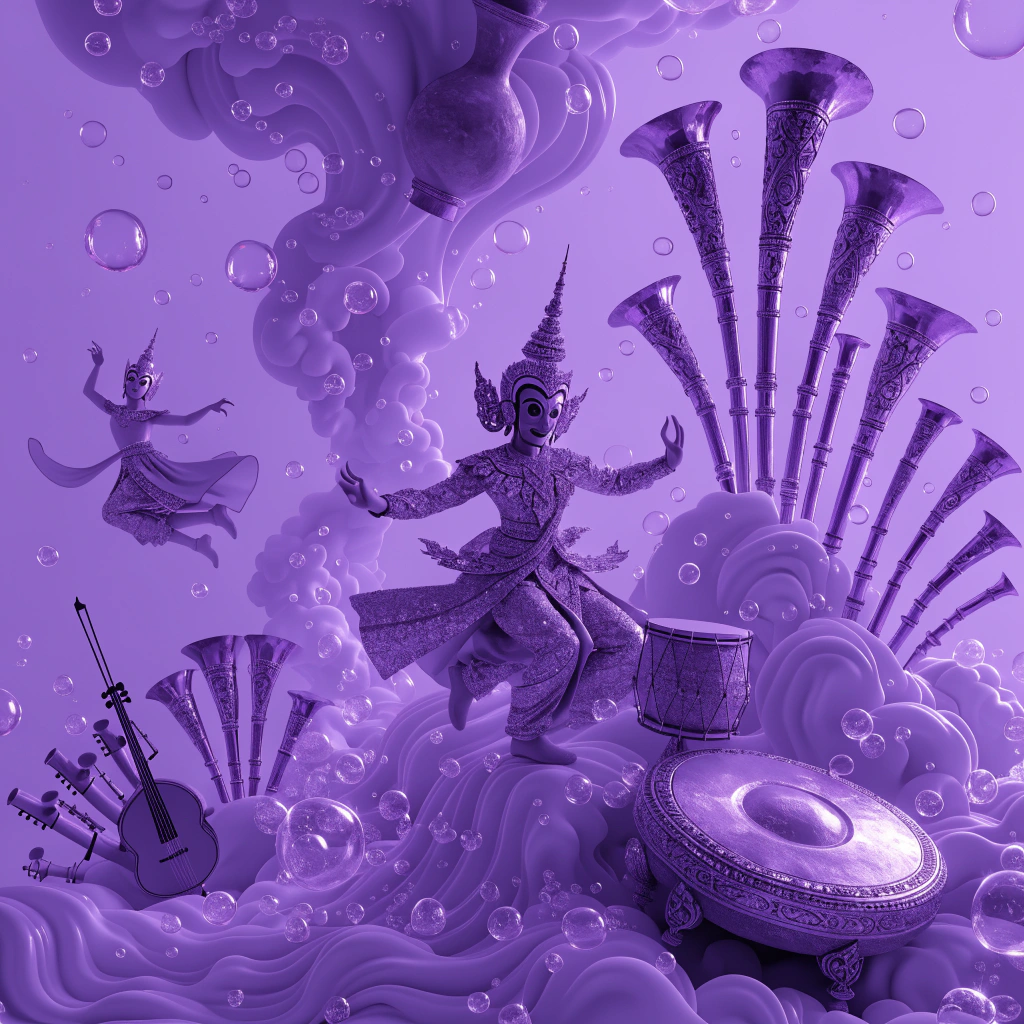
The Beautiful Dance of Thailand
Khon is a special dance from Thailand. It is very old and beautiful. The dancers wear colorful clothes. They also wear big masks. The masks show faces of heroes and monsters.
The dancers do not speak. They move their bodies to music. Other people tell the story and sing. The story is about a king and a queen.
In the past, Khon was only for the king. Today, many people watch it. It is a famous part of Thai culture. People love the bright colors and the music.
Grammatik-Spotlight
Muster: Present Simple (to be)
"Khon is a special dance from Thailand."
We use 'is' with singular subjects like 'Khon'. It is used to state facts or describe things.
Muster: Present Simple (Action Verbs)
"The dancers wear colorful clothes."
When the subject is plural (dancers), the verb stays in its base form. We do not add an 's' to the verb.
Teste dein Verständnis
10 Fragen · A1 Anfänger · 1 kostenlose Vorschau
Teste, was du aus diesem Artikel gelernt hast. Beantworte alle Fragen und sammle XP!
What is Khon?
Möchtest du das Quiz beenden?
9 weitere Fragen warten auf dich. Registriere dich kostenlos, um das vollständige Quiz freizuschalten und XP zu sammeln!
Kostenlos registrierenHast du schon ein Konto? Anmelden
Gut gemacht!
Weiter üben!
Bereits abgeschlossen — keine zusätzlichen XP
Registriere dich, um XP zu verdienenFragenübersicht
What is Khon?
Deine Antwort:
Richtige Antwort: A special dance
The dancers speak during the performance.
Deine Antwort:
Richtige Antwort: Falsch
What is a 'mask'?
Deine Antwort:
Richtige Antwort: Something for the face
The dancers wear _____ clothes.
Deine Antwort:
Richtige Antwort: colorful
Khon: The Beautiful Masked Dance of Thailand
Khon is a very famous and beautiful dance from Thailand. In the past, it was a royal dance. This means only the king and his family watched it in the big palace. Today, many people visit Thailand to see this special show.
The dancers wear amazing masks and bright costumes. The masks are very important because they show different characters. Some masks look like humans, but others look like monkeys or scary demons. The costumes are more colorful than normal clothes because they use gold and silk.
In the performance, the dancers do not speak. Instead, they move their bodies to tell a story. This story is from a famous book called the Ramakien. Singers and musicians sit near the stage and play traditional music. The dance is more difficult than it looks because the dancers must practice for many years.
In 2018, UNESCO said Khon is a special treasure for the world. It is an important part of Thai history. If you visit Bangkok, you should watch a Khon show.
Grammatik-Spotlight
Muster: Past Simple (was)
"In the past, it was a royal dance."
We use 'was' to describe a state or situation that finished in the past. It is the past form of 'is' for singular subjects.
Muster: Comparatives (more + adjective + than)
"The costumes are more colorful than normal clothes because they use gold and silk."
We use 'more' before long adjectives to compare two things. We always use 'than' after the adjective to show what we are comparing it to.
Teste dein Verständnis
11 Fragen · A2 Grundkenntnisse · 1 kostenlose Vorschau
Teste, was du aus diesem Artikel gelernt hast. Beantworte alle Fragen und sammle XP!
Where did the king watch Khon in the past?
Möchtest du das Quiz beenden?
10 weitere Fragen warten auf dich. Registriere dich kostenlos, um das vollständige Quiz freizuschalten und XP zu sammeln!
Kostenlos registrierenHast du schon ein Konto? Anmelden
Gut gemacht!
Weiter üben!
Bereits abgeschlossen — keine zusätzlichen XP
Registriere dich, um XP zu verdienenFragenübersicht
Where did the king watch Khon in the past?
Deine Antwort:
Richtige Antwort: In the palace
The dancers talk to the audience during the show.
Deine Antwort:
Richtige Antwort: Falsch
What is a 'costume'?
Deine Antwort:
Richtige Antwort: Special clothes for actors
The dancers wear _____ to show different characters.
Deine Antwort:
Richtige Antwort: masks
Why are the costumes expensive?
Deine Antwort:
Richtige Antwort: They use gold and silk
Khon: The Royal Masked Dance of Thailand
Khon is one of the most famous and prestigious performing arts in Thailand. Since 2018, it has been recognized by UNESCO as an important part of the world's cultural heritage. This traditional masked dance drama is based on the Ramakien, which is the Thai version of an ancient Indian epic.
In the past, Khon was performed only for the royal court. However, many traditions have changed over the years to make the art more accessible to the public. Today, thousands of people have watched these beautiful shows in modern theaters. The performers wear colorful, handmade costumes and detailed masks that represent different characters, such as brave heroes, scary demons, and clever monkeys.
The actors do not speak or sing while they are dancing on stage. Instead, the story is told by a narrator and a group of musicians who sit at the side. Because the masks cover the actors' faces, they must use specific body movements to express their emotions. For instance, a certain tilt of the head or a hand gesture can show that a character is feeling angry, happy, or sad. These movements are very graceful but require a lot of strength.
Training to become a professional Khon dancer is extremely difficult and usually starts at a young age. Students must practice for many years to master the complex steps and poses. Although modern entertainment is very popular now, Khon remains a significant symbol of Thai identity. It is a beautiful treasure that has been protected by the Thai people for centuries, and it continues to fascinate audiences from all over the world.
Grammatik-Spotlight
Muster: Present Perfect Passive
"Since 2018, it has been recognized by UNESCO as an important part of the world's cultural heritage."
This pattern (has/have + been + past participle) is used to talk about an action that happened at an unspecified time in the past and is still true or relevant now, focusing on the receiver of the action.
Muster: Non-defining Relative Clause
"This traditional masked dance drama is based on the Ramakien, which is the Thai version of an ancient Indian epic."
This is used to give extra information about a noun. It is separated by commas and uses 'which' for things or 'who' for people.
Teste dein Verständnis
11 Fragen · B1 Mittelstufe · 1 kostenlose Vorschau
Teste, was du aus diesem Artikel gelernt hast. Beantworte alle Fragen und sammle XP!
What is the main story used in Khon performances?
Möchtest du das Quiz beenden?
10 weitere Fragen warten auf dich. Registriere dich kostenlos, um das vollständige Quiz freizuschalten und XP zu sammeln!
Kostenlos registrierenHast du schon ein Konto? Anmelden
Gut gemacht!
Weiter üben!
Bereits abgeschlossen — keine zusätzlichen XP
Registriere dich, um XP zu verdienenFragenübersicht
What is the main story used in Khon performances?
Deine Antwort:
Richtige Antwort: The Ramakien
Khon actors speak their lines while they are dancing on stage.
Deine Antwort:
Richtige Antwort: Falsch
What does 'prestigious' mean?
Deine Antwort:
Richtige Antwort: Respected and admired
Because the actors wear masks, they must use body _____ to show emotions.
Deine Antwort:
Richtige Antwort: movements
Where was Khon performed in the past?
Deine Antwort:
Richtige Antwort: In the royal court
Khon: Thailands königliches Maskentanzdrama und sein Erbe als immaterielles Kulturgut
Das Khon, ein faszinierendes und visuell beeindruckendes Maskentanzdrama, repräsentiert eine der prestigeträchtigsten darstellenden Künste Thailands. Seine tiefe kulturelle Bedeutung wurde 2018 durch die Anerkennung der UNESCO als immaterielles Kulturerbe der Menschheit gewürdigt, was seine Stellung als unverzichtbaren Bestandteil des thailändischen Erbes unterstreicht. Diese Würdigung hat nicht nur die internationale Aufmerksamkeit auf das Khon gelenkt, sondern auch die Bemühungen zur Erhaltung und Weitergabe dieses kulturellen Juwels innerhalb Thailands maßgeblich verstärkt.
Im Kern ist Khon eine hochstilisierte Darbietung, die sich durch ihre prunkvollen Masken, opulenten Kostüme und die akribisch choreografierten Bewegungen auszeichnet. Die gesamte narrative Grundlage dieses Dramas entstammt ausschließlich dem Ramakien, der thailändischen Version des altindischen Epos Ramayana. Dieses epische Werk, reich an Göttern, Dämonen, Helden und Prinzessinnen, bietet eine komplexe Handlung, die von den Khon-Tänzern mit beeindruckender Präzision und Ausdruckskraft zum Leben erweckt wird. Jede Figur im Khon ist durch eine spezifische Maske und ein detailliertes Kostüm gekennzeichnet, die nicht nur ihre Identität, sondern auch ihren Charakter und Rang widerspiegeln. Ein weiteres charakteristisches Merkmal ist, dass die Tänzer selbst nicht sprechen; stattdessen werden die Dialoge und Erzählungen von einem Chor im Hintergrund vorgetragen, begleitet von einem traditionellen Orchester, das die dramatische Stimmung untermauert und die Bewegungen der Darsteller rhythmisch führt.
Historisch betrachtet war das Khon primär dem königlichen Hof vorbehalten. Es diente nicht nur der Unterhaltung der Monarchen und ihrer Entourage, sondern auch als Mittel zur Bewahrung und Vermittlung moralischer und religiöser Werte. Die Aufführungen waren oft gigantische Inszenierungen, die Hunderte von Darstellern umfassten und immense Ressourcen an Zeit, Material und menschlicher Arbeitskraft erforderten. Die Ausbildung der Tänzer, Musiker und Maskenbildner war äußerst rigoros und wurde über Generationen hinweg in mündlicher Tradition überliefert. Diese exklusive Verbindung zum Königshaus verlieh dem Khon eine Aura von Erhabenheit und Exklusivität, die bis heute spürbar ist.
Obwohl die traditionellen Aufführungen heute seltener sind und oft in angepasster Form für ein breiteres Publikum dargeboten werden, bleibt die Essenz des Khon unverändert. Moderne Interpretationen versuchen, die Kunstform zugänglicher zu machen, ohne ihre Authentizität zu kompromittieren. Institutionen wie das Fine Arts Department Thailands spielen eine entscheidende Rolle bei der Dokumentation, Lehre und Förderung dieser einzigartigen Kunstform. Sie stellen sicher, dass die komplexen Techniken, die Symbolik der Masken und Gesten sowie die musikalische Begleitung nicht in Vergessenheit geraten und an zukünftige Generationen weitergegeben werden können.
Khon ist somit weit mehr als nur eine Tanzvorführung; es ist ein bewegliches Denkmal der thailändischen Identität und ein Fenster zu einer Welt voller Mythen und Legenden. Die spirituelle und ästhetische Tiefe dieses Maskentanzdramas fasziniert weiterhin Generationen und beweist, dass Tradition und Moderne harmonisch koexistieren können, um ein reiches kulturelles Erbe zu bewahren und zu beleben.
Grammatik-Spotlight
Muster: Vorgangspassiv
"Seine tiefe kulturelle Bedeutung wurde 2018 durch die Anerkennung der UNESCO als immaterielles Kulturerbe der Menschheit gewürdigt..."
Das Vorgangspassiv wird verwendet, um eine Handlung zu beschreiben, bei der der Fokus auf der Handlung selbst liegt und nicht auf dem Handelnden. Es wird mit einer Form von 'werden' und dem Partizip II des Hauptverbs gebildet. Es betont, was getan wird oder geschieht.
Muster: Genitiv
"...was seine Stellung als unverzichtbaren Bestandteil des thailändischen Erbes unterstreicht."
Der Genitiv wird verwendet, um Zugehörigkeit, Besitz oder eine enge Verbindung zwischen zwei Nomen auszudrücken. Er antwortet auf die Frage 'Wessen?'. Oft wird er mit Präpositionen wie 'wegen' oder 'trotz' verwendet, kann aber auch direkt nach dem Nomen stehen, das er näher bestimmt.
Muster: Relativsätze (mit 'der/die/das')
"Jede Figur im Khon ist durch eine spezifische Maske und ein detailliertes Kostüm gekennzeichnet, die nicht nur ihre Identität, sondern auch ihren Charakter und Rang widerspiegeln."
Relativsätze geben zusätzliche Informationen zu einem Nomen. Sie werden mit einem Relativpronomen (der, die, das, welche, welcher, welches) eingeleitet, das sich in Genus und Numerus nach dem Bezugswort richtet und der Funktion im Relativsatz entsprechend dekliniert wird. Sie stehen meist im Nebensatz und sind durch Kommas abgetrennt.
Teste dein Verständnis
11 Fragen · B2 Obere Mittelstufe · 1 kostenlose Vorschau
Teste, was du aus diesem Artikel gelernt hast. Beantworte alle Fragen und sammle XP!
Wann wurde Khon von der UNESCO als immaterielles Kulturerbe anerkannt?
Möchtest du das Quiz beenden?
10 weitere Fragen warten auf dich. Registriere dich kostenlos, um das vollständige Quiz freizuschalten und XP zu sammeln!
Kostenlos registrierenHast du schon ein Konto? Anmelden
Gut gemacht!
Weiter üben!
Bereits abgeschlossen — keine zusätzlichen XP
Registriere dich, um XP zu verdienenFragenübersicht
Wann wurde Khon von der UNESCO als immaterielles Kulturerbe anerkannt?
Deine Antwort:
Richtige Antwort: 2018
Die narrative Grundlage des Khon stammt ausschließlich aus dem Ramakien.
Deine Antwort:
Richtige Antwort: Richtig
Was bedeutet 'akribisch' im Kontext des Artikels?
Deine Antwort:
Richtige Antwort: Mit großer Sorgfalt und Genauigkeit bis ins kleinste Detail ausgeführt
Khon war historisch primär dem königlichen _____ vorbehalten.
Deine Antwort:
Richtige Antwort: Hof
Welches Merkmal ist typisch für Khon-Tänzer?
Deine Antwort:
Richtige Antwort: Sie tragen spezifische Masken und Kostüme.
The Alchemical Fusion of Myth and Movement: The Enduring Legacy of Khon
Recognized by UNESCO in 2018 as part of the Intangible Cultural Heritage of Humanity, Khon stands as the pinnacle of Thai dramatic arts. Not only does Khon represent a sophisticated synthesis of dance and drama, but it also serves as a living vessel for Thailand’s historical and spiritual identity. Traditionally performed within the exclusive confines of the royal court, this masked dance drama draws its narrative exclusively from the Ramakien, the Thai iteration of the ancient Indian epic, the Ramayana.
It is through this meticulous fusion of movement and mask that the narrative transcends linguistic barriers, allowing the audience to witness the cosmic struggle between good and evil. The masks are not merely decorative; they are transformative artifacts that encapsulate the essence of deities, demons, and simians. Seldom does a performance demand such physical and mental fortitude from its practitioners, who often begin their arduous training in early childhood. The dancers must master a lexicon of gestures so precise that every tilt of the head conveys a specific emotional nuance.
The institutionalization of Khon within the royal court ensured the preservation of its most intricate techniques across centuries. Historically, the sheer scale of these productions—involving hundreds of performers and elaborate costumes embroidered with gold thread—rendered them a symbol of the monarch’s prestige and divine mandate. However, the transition from a court-bound spectacle to a public cultural treasure has invited critical analysis regarding its contemporary relevance. Some scholars argue that the rigid adherence to tradition risks making the art form a museum piece, while others maintain that its sanctity lies in its resistance to modernization.
At the heart of Khon lies a profound dualism. The narrative explores the tension between duty and desire, order and chaos. This thematic depth is mirrored in the choreography, where the graceful, fluid movements of the protagonists contrast sharply with the aggressive, staccato rhythms of the antagonists. Furthermore, the performance is traditionally accompanied by a Piphat ensemble and a chorus of singers who narrate the action, as the masked dancers remain silent. This separation of voice and body creates a unique aesthetic distance, emphasizing the archetypal nature of the characters.
Despite the ephemeral nature of live performance, the lineage of Khon is sustained through a deep-seated reverence for the master-student relationship. This bond ensures the transmission of tacit knowledge—those subtle, unwritten cues—that cannot be captured in scripts or recordings alone. In the modern era, Khon faces the dual challenge of maintaining its inherent grandeur while appealing to an increasingly globalized and distracted audience. While some contemporary adaptations have introduced cinematic lighting and streamlined durations to accommodate modern sensibilities, the core of the performance remains a testament to Thai resilience and artistic brilliance. Ultimately, Khon is more than just a visual spectacle; it is a philosophical inquiry into the human condition, elegantly masked in the guise of myth.
Grammatik-Spotlight
Muster: Negative Inversion
"Seldom does a performance demand such physical and mental fortitude from its practitioners..."
When a sentence starts with a negative or restrictive adverbial like 'seldom', the auxiliary verb comes before the subject. This is used in formal writing to add emphasis or dramatic effect.
Muster: Cleft Sentences
"It is through this meticulous fusion of movement and mask that the narrative transcends linguistic barriers..."
A cleft sentence is used to focus on a specific part of the sentence. It starts with 'It is/was' followed by the focused information and a relative clause starting with 'that'.
Muster: Nominalization
"The institutionalization of Khon within the royal court ensured the preservation of its most intricate techniques across centuries."
Nominalization involves turning verbs or adjectives into nouns (e.g., 'institutionalize' to 'institutionalization'). It makes writing sound more academic, objective, and dense by focusing on concepts rather than actions.
Teste dein Verständnis
12 Fragen · C1 Fortgeschritten · 1 kostenlose Vorschau
Teste, was du aus diesem Artikel gelernt hast. Beantworte alle Fragen und sammle XP!
What is the primary narrative source for Khon performances?
Möchtest du das Quiz beenden?
11 weitere Fragen warten auf dich. Registriere dich kostenlos, um das vollständige Quiz freizuschalten und XP zu sammeln!
Kostenlos registrierenHast du schon ein Konto? Anmelden
Gut gemacht!
Weiter üben!
Bereits abgeschlossen — keine zusätzlichen XP
Registriere dich, um XP zu verdienenFragenübersicht
What is the primary narrative source for Khon performances?
Deine Antwort:
Richtige Antwort: The Ramakien
Khon performers traditionally speak their own lines while wearing masks.
Deine Antwort:
Richtige Antwort: Falsch
Which word describes something that lasts for a very short time?
Deine Antwort:
Richtige Antwort: Ephemeral
The _____ of Khon within the royal court helped preserve its complex techniques.
Deine Antwort:
Richtige Antwort: institutionalization
In what year was Khon recognized by UNESCO?
Deine Antwort:
Richtige Antwort: 2018
Some argue that strictly following tradition might turn Khon into a 'museum piece'.
Deine Antwort:
Richtige Antwort: Richtig
The Transcendent Semiotics of Khon: A Synthesis of Cosmology and Corporeality
To behold a performance of Khon is to engage in a profound interrogation of the boundaries between the celestial and the terrestrial. This masked dance-drama, long considered the quintessential expression of Thai high culture, functions as far more than mere spectacle; it is a ritualistic reification of the Ramakien, the Thai iteration of the epic Ramayana. Historically, the staging of Khon was the exclusive prerogative of the royal court, requiring such vast resources and manpower that it served as a potent symbol of the monarch’s merit and majesty. Should one scrutinize the intricate tapestries of its historical development, it becomes manifest that Khon is not merely a static relic of the Ayutthaya period, but rather a dynamic repository of the nation's collective consciousness.
The aesthetic hallmark of Khon is undoubtedly the mask, or 'hua khon.' These artifacts are not merely decorative; they are ontological vessels that facilitate the total effacement of the performer’s individuality. It is the masks themselves—vibrant, formidable, and meticulously crafted—that serve to facilitate a metamorphosis into the archetypal, be it the heroic Phra Ram, the virtuous Nang Sida, or the formidable demon king Thotsakan. By donning these masks, dancers subsume their ego to embody primordial forces. It is imperative that the performer remain entirely silent, for the narrative burden is carried by the 'Chon,' a chorus of singers and reciters who articulate the poetic dialogue. This separation of voice and body creates a hauntingly stylized atmosphere, where the physical form becomes a medium for the divine.
The movements themselves are governed by the 'Mae Bot,' a rigorous choreographic syntax that demands an ascetic level of discipline. Every tilt of the head, every sinuous curve of the fingers, is laden with semiotic significance. To the uninitiated, these gestures might appear merely decorative; however, to the discerning observer, they constitute a sophisticated linguistic system. The interplay between the dancers and the 'Piphat' ensemble—an orchestra of percussion and wind instruments—further elevates the performance, creating a polyphonic texture that mirrors the complexity of the cosmos itself. The dancers do not merely move; they inhabit a space where every posture is a theological statement.
In 2018, the recognition of Khon by UNESCO as part of the Intangible Cultural Heritage of Humanity marked a pivotal moment in its contemporary history. While this designation has undoubtedly bolstered preservation efforts, it also invites scholarly debate regarding the potential ossification of the art form. There is a risk that by institutionalizing Khon, we may inadvertently stifle the organic evolution that once allowed it to adapt to the shifting sensibilities of the royal court. One might argue that for an art form to remain truly vital, it must possess the capacity to breathe and transform, rather than being preserved in amber as a museum piece.
Furthermore, the philosophical underpinnings of Khon deserve closer epistemological scrutiny. The eternal struggle between the forces of 'Dharma' and 'Adharma' is not merely a moralistic fable but a reflection of the Thai worldview regarding the nature of order and chaos. The resolution of the narrative, invariably favoring the restoration of cosmic balance, serves to reinforce the social and spiritual hierarchies of the traditional Thai state. This narrative structure suggests that the preservation of order is the ultimate moral imperative.
Ultimately, the enduring allure of Khon lies in its ability to evoke the sublime. It offers a bridge between the ephemeral nature of human existence and the timeless realm of myth. Whether performed in the hallowed halls of the National Theatre or under the auspices of royal patronage, Khon remains a testament to the enduring power of tradition. It is a palimpsest of history, religion, and artistry, inviting us to contemplate the profound mysteries of the human condition through the lens of a uniquely Thai aesthetic. The experience of Khon is, in essence, an encounter with the eternal.
Grammatik-Spotlight
Muster: Inverted Conditional
"Should one scrutinize the intricate tapestries of its historical development, it becomes manifest that Khon is not merely a static relic."
This construction replaces 'If one should scrutinize' to create a more formal, academic tone. It is used in C2 writing to introduce hypothetical analysis or scrutiny.
Muster: Subjunctive Mood
"It is imperative that the performer remain entirely silent, for the narrative burden is carried by the 'Chon'."
The base form 'remain' (instead of 'remains') is used after adjectives of urgency like 'imperative'. This expresses necessity or a requirement in formal English.
Muster: Cleft Sentence
"It is the masks themselves—vibrant, formidable, and meticulously crafted—that serve to facilitate a metamorphosis into the archetypal."
This 'It is... that...' structure is used to focus on a specific subject (the masks). It provides rhetorical emphasis, highlighting the primary cause or agent in a complex sentence.
Teste dein Verständnis
12 Fragen · C2 Meisterschaft · 1 kostenlose Vorschau
Teste, was du aus diesem Artikel gelernt hast. Beantworte alle Fragen und sammle XP!
According to the article, what is the primary function of the 'hua khon' masks?
Möchtest du das Quiz beenden?
11 weitere Fragen warten auf dich. Registriere dich kostenlos, um das vollständige Quiz freizuschalten und XP zu sammeln!
Kostenlos registrierenHast du schon ein Konto? Anmelden
Gut gemacht!
Weiter üben!
Bereits abgeschlossen — keine zusätzlichen XP
Registriere dich, um XP zu verdienenFragenübersicht
According to the article, what is the primary function of the 'hua khon' masks?
Deine Antwort:
Richtige Antwort: To obscure the performer's identity and allow them to embody an archetype
Historically, Khon was a performance art accessible to all social classes in Thailand.
Deine Antwort:
Richtige Antwort: Falsch
What does 'ossification' refer to in the context of the article?
Deine Antwort:
Richtige Antwort: The process of an art form becoming rigid and unchanging
The rigorous choreographic syntax that governs the movements in Khon is known as the _____.
Deine Antwort:
Richtige Antwort: Mae Bot
Who is responsible for the narrative and dialogue during a Khon performance?
Deine Antwort:
Richtige Antwort: The Chon, a chorus of singers and reciters
The struggle between Dharma and Adharma in Khon reflects the Thai worldview on order and chaos.
Deine Antwort:
Richtige Antwort: Richtig

