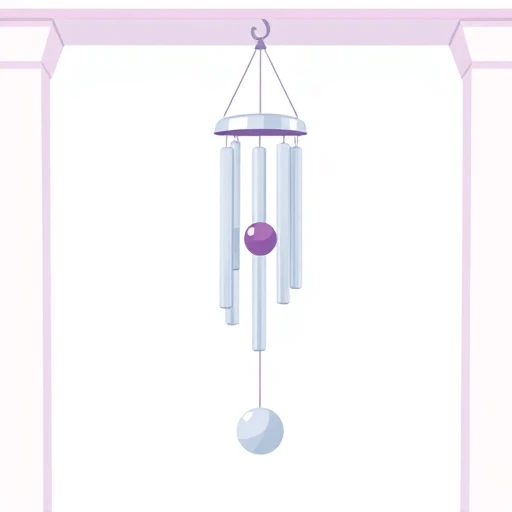
chimes in 30 Sekunden
- Chimes are melodic sounds from bells or tubes, often used in clocks and gardens.
- As a verb, it means to ring musically or to join a conversation ('chime in').
- It can also mean to agree with or match an idea ('chimes with').
- The word carries a positive connotation of harmony, rhythm, and clear sound.
The word chimes is a multifaceted term in the English language, serving as both a plural noun and a third-person singular verb. At its most literal level, it refers to a set of bells or metal tubes, often tuned to a musical scale, that produce harmonious sounds when struck by a hammer or moved by the wind. These objects are common in both domestic and public settings. For instance, wind chimes are frequently hung on porches or in gardens to catch the breeze, creating a soothing, melodic backdrop to outdoor life. In a more formal or architectural context, chimes refer to the mechanism within a clock tower or a cathedral that announces the passage of time. When the clock strikes the hour, the sequence of musical notes it produces is referred to as the chimes. This usage evokes a sense of tradition, order, and the rhythmic nature of human existence. The sound itself is characterized by its clarity and resonance, often described as 'silvery' or 'crystalline.' Beyond the physical object, the word also describes the act of making these sounds. When a clock 'chimes,' it is performing its function of timekeeping through auditory signals. This verb form extends into the metaphorical realm, particularly in the phrasal verb 'chime in.' To chime in means to join a conversation or a discussion, often by adding a comment that agrees with what has already been said or by providing a timely piece of information. This figurative use suggests a sense of harmony, as if the speaker's contribution is a musical note that fits perfectly into the ongoing melody of the dialogue. It is a word that bridges the gap between the physical world of acoustics and the social world of human interaction, always carrying with it an underlying sense of musicality and timing.
- Acoustic Definition
- The physical resonance produced by suspended metal objects designed to vibrate at specific frequencies.
The grandfather clock in the hallway chimes every fifteen minutes, marking the steady progress of the afternoon.
In historical contexts, chimes played a crucial role in community life. Before the ubiquity of personal watches and smartphones, the village chimes were the primary way for people to coordinate their activities. They signaled the start of the workday, the call to prayer, or the occurrence of a significant event like a wedding or a funeral. This deep-rooted history gives the word a nostalgic and somewhat formal quality. Even today, hearing the chimes of a famous clock like Big Ben in London carries a weight of historical continuity. In literature and poetry, chimes are often used to symbolize the inexorable passage of time or the presence of the divine. The sound is seen as something that transcends the mundane, lifting the listener's thoughts to a higher plane. However, the word can also be used in more casual, modern settings. When someone 'chimes in' during a Zoom meeting, they are participating in a very contemporary form of communication, yet the word still retains that essence of adding one's voice to a collective whole. The versatility of 'chimes' allows it to fit into a variety of registers, from the highly poetic to the strictly functional. Whether discussing the intricate mechanics of a carillon or the simple pleasure of a breeze catching a set of bamboo tubes, the word remains anchored in the idea of sound as a carrier of meaning and beauty.
- Social Context
- The act of contributing to a group discussion, often implying agreement or a supportive addition to the topic.
Whenever we discuss the budget, Sarah always chimes in with helpful suggestions on how to save money.
Furthermore, the word 'chimes' can refer to the specific set of bells themselves, known as a carillon or a glockenspiel in musical terminology. These instruments are complex and require significant skill to play. The 'chimes' in an orchestra, also known as tubular bells, are used to create a dramatic, atmospheric effect, often associated with mystery, celebration, or solemnity. This technical usage highlights the word's precision in describing musical equipment. In the realm of interior design, 'chimes' might refer to the decorative elements of a doorbell. A 'door chime' is considered more elegant than a 'doorbell,' suggesting a sequence of notes rather than a single, harsh buzz. This distinction is important for understanding the word's connotation of quality and aesthetic appeal. People use 'chimes' to describe things that are pleasing to the ear and well-crafted. It is rarely used for discordant or annoying noises. If a sound is described as a 'chime,' the listener expects something harmonious. This positive association makes the word useful in marketing and branding, where companies might name a notification sound a 'chime' to make it feel less intrusive and more helpful. In summary, 'chimes' is a word that resonates with history, music, and social harmony, making it a rich addition to any vocabulary.
- Mechanical Usage
- Refers to the internal strikes of a clock's hammer against a bell or rod to indicate time intervals.
The wind chimes outside the window were a constant source of comfort during the long winter nights.
As the meeting drew to a close, the director chimes in with a final word of encouragement for the team.
The cathedral's chimes could be heard across the entire valley, signaling the start of the festival.
Using the word chimes correctly requires an understanding of its dual nature as both a noun and a verb. When used as a noun, it typically refers to the physical objects or the sounds they produce. For example, you might say, 'The silver chimes hung from the ceiling, reflecting the light.' Here, 'chimes' is the subject of the sentence, acting as a plural noun. It is important to remember that 'chimes' is almost always used in the plural when referring to the objects themselves, as a single tube or bell is rarely called a 'chime' unless you are speaking very technically. In the context of timekeeping, you might say, 'I love the sound of the midnight chimes.' This refers to the specific sequence of notes played at twelve o'clock. The noun form is often accompanied by descriptive adjectives like 'melodic,' 'distant,' 'haunting,' or 'cheerful,' which help to convey the specific mood of the sound. When using 'chimes' as a verb, it must agree with a singular subject in the third person. For instance, 'The clock chimes every hour.' In this sentence, 'the clock' is the singular subject, and 'chimes' is the present tense verb. This is a common point of confusion for learners, who might mistakenly use the plural form 'chime' with a singular subject. If the subject is plural, the verb changes: 'The bells chime loudly.' Understanding this grammatical distinction is key to using the word accurately in writing and speech.
- Subject-Verb Agreement
- Singular: The clock chimes. Plural: The clocks chime.
Every morning at eight, the old tower chimes a familiar tune that wakes the village.
Another very common way to use 'chimes' is in the phrasal verb 'chime in.' This is an idiomatic expression that means to join a conversation, often to express agreement or to add a relevant point. It is almost always followed by the preposition 'with' or 'to.' For example, 'He chimed in with a joke to lighten the mood.' In this case, 'chimed' is the past tense of the verb. In the present tense, you might say, 'She always chimes in when we talk about travel.' This usage is very common in both professional and social settings. It suggests a spontaneous but welcome contribution to the dialogue. It is slightly more informal than 'interjected' or 'contributed,' but it is perfectly acceptable in most contexts. When using 'chime in,' it is important to consider the tone. Because the word 'chime' has positive, musical connotations, 'chiming in' usually implies a positive or at least neutral contribution. If someone interrupts rudely, you would be more likely to use a word like 'butted in' or 'interrupted.' Therefore, 'chimes in' is a great way to describe someone participating constructively in a group setting. It captures the idea of voices coming together in a way that is organized and harmonious, much like the notes of a bell.
- Phrasal Verb Usage
- 'Chime in' is used to describe joining a conversation. Example: 'May I chime in here?'
Just as I was about to finish my story, my brother chimes in with his own version of the events.
In more advanced usage, 'chimes' can be used figuratively to describe things that are in agreement or harmony. For example, 'His opinion chimes with the general consensus of the group.' This means his opinion matches or fits well with what everyone else thinks. This usage is more common in British English and in formal writing. It creates a strong mental image of two things vibrating at the same frequency, like two bells ringing in unison. This figurative use is a powerful way to describe alignment in ideas, policies, or feelings. You might say that a new law 'chimes with the public mood,' meaning it is what people want and expect. This adds a layer of sophistication to your language, moving beyond simple words like 'agrees' or 'matches.' When using 'chimes' in this way, it is almost always followed by the preposition 'with.' This structure is very specific and should be practiced to ensure it sounds natural. Whether you are describing the physical sound of a clock, the social act of joining a conversation, or the abstract concept of ideological agreement, 'chimes' is a versatile and evocative word that can enhance the clarity and beauty of your sentences.
- Figurative Agreement
- To be in agreement or to be consistent with something else. Often used in formal or academic writing.
The new evidence chimes perfectly with the theory we developed last year.
As the sun sets, the wind chimes on the balcony begin their nightly song.
The doorbell chimes, announcing the arrival of the first guest at the party.
The word chimes is one you will encounter in a variety of real-world settings, ranging from the domestic to the highly formal. One of the most common places to hear it is in the context of home and garden. Many people have wind chimes hanging outside their homes. These are decorative items made of metal, wood, or glass that make a tinkling sound when the wind blows. You might hear someone say, 'I love the sound of the chimes on a breezy day.' In this setting, the word is associated with relaxation, peace, and the beauty of nature. Similarly, you will hear the word used in relation to doorbells. High-end doorbells are often referred to as 'door chimes' because they play a short melody rather than a simple buzzing sound. When visiting someone's home, you might hear the chimes ring to announce your arrival. This usage is common in interior design and home improvement contexts, where the aesthetic quality of the sound is a selling point. In these everyday situations, 'chimes' is a friendly, accessible word that describes a pleasant auditory experience.
- Domestic Setting
- Wind chimes in gardens and door chimes in entryways are the most common household examples.
The gentle chimes from the neighbor's porch were the only sound in the quiet afternoon.
Moving into the public sphere, 'chimes' is a word frequently heard in cities and towns with historical architecture. Many town halls, cathedrals, and universities have large clock towers that chime the hour. The 'Westminster Chimes' is perhaps the most famous example, a specific sequence of notes played by Big Ben in London and copied by clocks all over the world. In these contexts, the word carries a sense of authority and civic pride. You might hear a tour guide say, 'If you wait a few minutes, you'll hear the tower chimes.' This usage is also common in news reports or documentaries about historical landmarks. The sound of the chimes is often used as a symbolic marker of time and tradition. In literature and film, the sound of distant chimes is a classic trope used to create atmosphere, whether it's the spooky tolling of a bell in a horror movie or the nostalgic ringing of a village clock in a period drama. In these cases, the word is used to evoke a specific emotional response in the audience.
- Civic and Historical
- Clock towers and cathedrals use chimes to mark time and community events.
We knew it was noon because the university chimes began their long, resonant melody.
In the modern workplace and social environments, you will most likely hear the word used in its metaphorical sense. During meetings, brainstorming sessions, or casual conversations, people will 'chime in' with their thoughts. A manager might say, 'Does anyone else want to chime in on this proposal?' This is a very common phrase in professional English, used to encourage participation and collaboration. It is a polite way to invite someone to speak without putting them on the spot. You will also hear it in social settings, such as when a group of friends is telling stories and someone 'chimes in' with a funny detail they remembered. In the digital world, the word is often used to describe notification sounds on computers and smartphones. An app might have a 'chime' to alert you to a new message. This modern usage keeps the word relevant in a world where physical bells are less common. Whether it's the literal sound of a bell or the figurative act of joining a conversation, 'chimes' is a word that appears in many different layers of our daily lives, connecting the past with the present.
- Professional/Social
- The phrasal verb 'chime in' is a staple of collaborative discussion and group interaction.
During the podcast, the host often chimes in with interesting facts that the guest might have missed.
The computer chimes softly whenever a new email arrives in my inbox.
As the orchestra tuned their instruments, the percussionist tested the orchestral chimes.
One of the most frequent mistakes learners make with the word chimes is confusing it with other words that sound similar or have related meanings. A common confusion is between 'chimes' and 'rhymes.' While they sound alike, they have completely different meanings. 'Rhymes' refers to words that have the same ending sound, like 'cat' and 'hat,' whereas 'chimes' refers to the sound of bells. Another common error is using 'chimes' when 'rings' or 'tolls' would be more appropriate. While all three words relate to bells, 'chimes' specifically implies a melodic or musical sequence of sounds. A simple doorbell might 'ring,' but a sophisticated one 'chimes.' A large, heavy bell in a funeral tower 'tolls,' which has a much slower and more somber connotation than 'chimes.' Using 'chimes' for a very loud, harsh, or singular sound can make a sentence feel slightly off. It is best reserved for sounds that have a certain degree of musicality or rhythm. Understanding these subtle differences in connotation is a key part of moving from an intermediate to an advanced level of English proficiency.
- Phonetic Confusion
- Don't confuse 'chimes' (bells) with 'rhymes' (matching word sounds) or 'times' (multiplication/duration).
Incorrect: The poem chimes beautifully. Correct: The poem rhymes beautifully.
Another common pitfall involves subject-verb agreement, particularly with the verb form. As mentioned earlier, 'chimes' is the third-person singular form. Learners often forget to add the 's' when the subject is singular, saying 'The clock chime' instead of 'The clock chimes.' Conversely, they might add an 's' when the subject is plural, saying 'The bells chimes' instead of 'The bells chime.' This is a basic grammatical rule, but it is easy to overlook in the heat of conversation. Additionally, the phrasal verb 'chime in' is sometimes used incorrectly. Some learners might say 'chime on' or 'chime at,' but the correct preposition is almost always 'in.' Furthermore, 'chime in' should be used for joining a conversation, not just for speaking in general. If you are the only one talking, you cannot 'chime in.' It requires a pre-existing dialogue to be valid. Misusing this idiom can lead to confusion about the social context of the interaction. Paying close attention to the prepositions and the social setting will help you avoid these common errors.
- Agreement Errors
- Ensure the verb matches the subject. Singular subject = chimes; Plural subject = chime.
Incorrect: The wind chime through the trees. Correct: The wind chimes through the trees.
Finally, there is the figurative use of 'chimes with,' meaning 'agrees with.' This is a more formal and less common usage, and as a result, it is often misused. Some learners might try to use it with the wrong preposition, such as 'chimes to' or 'chimes for.' The correct form is always 'chimes with.' Also, it is important to note that this expression is typically used for ideas, opinions, or evidence, rather than for physical objects. You wouldn't say 'The blue shirt chimes with the red pants' to mean they look good together; instead, you would use 'matches' or 'complements.' 'Chimes with' is about intellectual or emotional alignment. Using it for physical appearance is a common mistake that can make your English sound unnatural. By understanding the specific domains where 'chimes' and its related phrases are used, you can avoid these subtle errors and communicate more effectively. Always remember that 'chimes' carries a sense of harmony and musicality, and this should guide your choice of when and how to use it.
- Prepositional Accuracy
- Always use 'with' after 'chimes' when expressing agreement or consistency.
Incorrect: Her story chimes to what I heard. Correct: Her story chimes with what I heard.
Incorrect: He chimes in the conversation. Correct: He chimes in to the conversation.
Incorrect: I heard the chime of the clock. Correct: I heard the chimes of the clock.
When looking for alternatives to chimes, it is important to consider the specific context, as different words carry different nuances. If you are referring to the sound of a bell, 'rings' is the most common and versatile alternative. However, 'rings' is much more general and can describe anything from a telephone to a bicycle bell. If you want to emphasize a deep, resonant, and perhaps more solemn sound, 'tolls' is a better choice. 'Tolls' is often associated with church bells and significant events like funerals or the passing of an hour. On the other end of the spectrum, 'tinkles' describes a very light, high-pitched sound, like that of small glass wind chimes or a delicate bell. 'Peals' is another great alternative, often used to describe a loud, joyous, and continuous ringing of bells, such as those heard at a wedding. Each of these words provides a different 'flavor' to the sound, allowing you to be more descriptive in your writing. Choosing the right word can help you create a more vivid and accurate picture for your reader.
- Sound Comparisons
- Chimes: Melodic and rhythmic. Rings: General and functional. Tolls: Deep and solemn. Tinkles: Light and delicate.
Instead of the usual chimes, the cathedral bells began to toll a somber warning.
In the context of the phrasal verb 'chime in,' there are several alternatives depending on the tone of the conversation. 'Interject' is a more formal word that means to say something abruptly, often as an interruption. 'Contribute' is a neutral and professional alternative, suggesting a more substantial addition to the discussion. 'Add' is a simple and direct way to express the same idea. If the person is interrupting rudely, you might use 'butt in' or 'cut in.' If they are joining a conversation that they weren't originally part of, 'jump in' is a common informal expression. 'Chime in' remains unique because of its connotation of harmony and agreement. It suggests that the person's contribution fits well with the existing dialogue. When choosing between these alternatives, consider the relationship between the speakers and the overall mood of the conversation. 'Chime in' is often the best choice for a friendly, collaborative environment where everyone's input is valued.
- Conversation Alternatives
- Chime in: Harmonious addition. Interject: Formal interruption. Jump in: Informal entry. Butt in: Rude interruption.
He didn't just chime in; he completely took over the meeting with his long explanation.
For the figurative 'chimes with,' synonyms include 'accords with,' 'matches,' 'aligns with,' and 'corresponds to.' 'Accords with' is quite formal and often used in legal or official contexts. 'Aligns with' is very common in modern business and political language, suggesting that two things are moving in the same direction or share the same goals. 'Matches' is the most basic and versatile option, suitable for almost any situation. 'Corresponds to' is often used in scientific or technical writing to show a direct relationship between two sets of data. 'Chimes with' is particularly effective when you want to suggest a more natural or intuitive agreement, as if the two things are 'in tune' with each other. It adds a poetic touch to your language that the more technical alternatives lack. By understanding these synonyms and their specific uses, you can choose the word that best fits the tone and purpose of your communication, making your English more precise and expressive.
- Agreement Alternatives
- Chimes with: Intuitive harmony. Aligns with: Strategic agreement. Accords with: Formal consistency. Matches: General similarity.
The CEO's vision chimes with the values that the company has held for decades.
The distant chimes of the ice cream truck brought all the children running into the street.
Her latest research chimes with the findings of several other studies in the field.
How Formal Is It?
Wusstest du?
The 'Westminster Chimes,' the most famous clock melody in the world, was actually written for a church in Cambridge, England, before it was used for Big Ben.
Aussprachehilfe
- Pronouncing the 'ch' as 'sh' (like 'shimes').
- Using a soft 's' instead of a voiced 'z' at the end.
- Confusing the vowel sound with 'chames' or 'chemes'.
- Shortening the 'i' sound too much.
- Adding an extra syllable (e.g., 'chi-mes').
Schwierigkeitsgrad
Easy to recognize in context, but figurative uses require more attention.
Requires correct subject-verb agreement and preposition use ('in', 'with').
The 'ch' and 'i' sounds are standard, but the 'z' ending is often missed.
Can be confused with 'rhymes' or 'times' if not heard clearly.
Was du als Nächstes lernen solltest
Voraussetzungen
Als Nächstes lernen
Fortgeschritten
Wichtige Grammatik
Third-Person Singular 's'
The clock chimes (singular) vs. The clocks chime (plural).
Phrasal Verbs
'Chime in' is an inseparable phrasal verb when used without an object.
Prepositional Idioms
Always use 'with' for agreement: 'It chimes with my views.'
Noun Pluralization
'Chimes' is usually plural when referring to the instrument.
Articles with Unique Objects
Use 'the' for specific chimes: 'The chimes of Big Ben.'
Beispiele nach Niveau
The clock chimes at one.
Le réveil sonne à une heure.
Third-person singular verb.
I hear the wind chimes.
J'entends les carillons éoliens.
Plural noun.
The chimes are loud.
Les carillons sont forts.
Plural noun with 'are'.
Does the clock have chimes?
L'horloge a-t-elle des carillons ?
Question form with 'does'.
The chimes sound nice.
Les carillons sonnent bien.
Plural noun subject.
The bell chimes now.
La cloche sonne maintenant.
Singular subject with 'chimes'.
Look at the pretty chimes.
Regarde les jolis carillons.
Imperative sentence.
The chimes stop at night.
Les carillons s'arrêtent la nuit.
Plural subject with 'stop'.
The clock chimes every fifteen minutes.
L'horloge sonne tous les quarts d'heure.
Present simple for routine.
My grandmother has old wind chimes.
Ma grand-mère a de vieux carillons éoliens.
Possessive 'has'.
The door chimes when you enter.
Le carillon de la porte sonne quand on entre.
Time clause with 'when'.
I like the chimes of the church.
J'aime les carillons de l'église.
Noun phrase with 'of'.
The computer chimes for a new email.
L'ordinateur sonne pour un nouvel e-mail.
Preposition 'for' indicating purpose.
The chimes are made of metal.
Les carillons sont en métal.
Passive voice 'are made of'.
He bought some new garden chimes.
Il a acheté de nouveaux carillons de jardin.
Past simple 'bought'.
The chimes woke me up today.
Les carillons m'ont réveillé aujourd'hui.
Past simple with object pronoun.
Can I chime in with a suggestion?
Puis-je intervenir avec une suggestion ?
Phrasal verb 'chime in'.
The clock chimes were very soothing.
Les sons de l'horloge étaient très apaisants.
Noun used as an adjective/subject.
She often chimes in during our talks.
Elle intervient souvent pendant nos discussions.
Adverb of frequency 'often'.
The wind chimes danced in the storm.
Les carillons éoliens dansaient dans la tempête.
Personification 'danced'.
I heard the chimes from across the park.
J'ai entendu les carillons depuis l'autre côté du parc.
Prepositional phrase 'from across'.
The doorbell chimes a happy melody.
Le carillon de la porte sonne une mélodie joyeuse.
Transitive use of 'chimes'.
He waited for the midnight chimes.
Il a attendu les carillons de minuit.
Specific noun phrase.
The chimes reminded her of home.
Les carillons lui rappelaient sa maison.
Verb 'reminded' with object.
His story chimes with what I saw.
Son histoire concorde avec ce que j'ai vu.
Figurative 'chimes with'.
The town's chimes are famous for their tone.
Les carillons de la ville sont célèbres pour leur tonalité.
Possessive noun 'town's'.
Don't hesitate to chime in if you agree.
N'hésitez pas à intervenir si vous êtes d'accord.
Negative imperative with 'if' clause.
The orchestral chimes added a dramatic effect.
Les carillons orchestraux ont ajouté un effet dramatique.
Compound noun 'orchestral chimes'.
The clock chimes echoed through the hall.
Les sons de l'horloge ont résonné dans le hall.
Verb 'echoed' indicating resonance.
The plan chimes with our long-term strategy.
Le plan concorde avec notre stratégie à long terme.
Abstract subject 'the plan'.
I love how the wind chimes interact with the birdsong.
J'aime la façon dont les carillons interagissent avec le chant des oiseaux.
Complex sentence with 'how' clause.
The chimes of the bells were heard for miles.
Les sons des cloches ont été entendus à des kilomètres.
Passive voice 'were heard'.
The proposal chimes perfectly with the current public mood.
La proposition concorde parfaitement avec l'humeur actuelle du public.
Adverb 'perfectly' modifying 'chimes'.
As the debate heated up, the moderator invited the audience to chime in.
Alors que le débat s'animait, le modérateur a invité le public à intervenir.
Infinitive 'to chime in' after 'invited'.
The haunting chimes of the sunken cathedral are a local legend.
Les carillons hantés de la cathédrale engloutie sont une légende locale.
Participial adjective 'haunting'.
The intricate mechanism that chimes the hour is a marvel of engineering.
Le mécanisme complexe qui sonne l'heure est une merveille d'ingénierie.
Relative clause 'that chimes the hour'.
Her interpretation of the text chimes with recent scholarly findings.
Son interprétation du texte concorde avec les récentes découvertes académiques.
Academic register.
The rhythmic chimes provided a steady pulse to the avant-garde composition.
Les carillons rythmiques ont fourni une impulsion constante à la composition d'avant-garde.
Metaphorical 'pulse'.
The midnight chimes signaled the end of an era for the small community.
Les carillons de minuit ont signalé la fin d'une époque pour la petite communauté.
Symbolic usage.
Every time he chimes in, he brings a wealth of experience to the table.
Chaque fois qu'il intervient, il apporte une grande expérience.
Idiom 'brings to the table'.
The philosophical implications of his work chime with the existentialist tradition.
Les implications philosophiques de son travail concordent avec la tradition existentialiste.
High-level abstract subject.
The delicate chimes of the glass sculpture resonated with the surrounding architecture.
Les carillons délicats de la sculpture en verre résonnaient avec l'architecture environnante.
Focus on aesthetic resonance.
In the silence of the desert, the distant chimes of a camel train were the only sound.
Dans le silence du désert, les carillons lointains d'une caravane de chameaux étaient le seul son.
Evocative literary description.
The way the light chimes against the crystals is truly mesmerizing.
La façon dont la lumière joue contre les cristaux est vraiment fascinante.
Highly metaphorical use of 'chimes'.
The politician's rhetoric rarely chimes with the reality of his actions.
La rhétorique du politicien concorde rarement avec la réalité de ses actions.
Critical/analytical tone.
The carillonneur spent years mastering the complex chimes of the city's great tower.
Le carillonneur a passé des années à maîtriser les carillons complexes de la grande tour de la ville.
Specific professional terminology.
The poem's internal structure chimes with the cyclical nature of the seasons.
La structure interne du poème concorde avec la nature cyclique des saisons.
Literary analysis.
When the lead scientist chimes in, the entire room falls silent in anticipation.
Quand le scientifique principal intervient, toute la salle se tait par anticipation.
Emphasis on social authority.
Häufige Kollokationen
Häufige Phrasen
— To be in agreement or consistent with something.
Her views chime with the rest of the team.
— A poetic way to refer to the passing of time.
The chimes of time wait for no one.
— To play a set of bells (literal or figurative).
The bells ring the chimes of victory.
— The random musical notes produced by wind chimes.
The wind chime melody was peaceful.
— A sound made by a doorbell or security system.
I received a door chime alert on my phone.
— To listen to the sound of bells or a clock.
We stopped to hear the chimes of the cathedral.
— A physical collection of bells or tubes.
He bought a beautiful set of chimes for the garden.
— The collective sound produced by bells.
The chime of bells could be heard for miles.
Wird oft verwechselt mit
Words with the same ending sound. Chimes are bells.
Refers to duration or multiplication. Chimes are sounds.
A poetic word for regions or climates. Chimes are bells.
Redewendungen & Ausdrücke
— To break into a conversation, typically to express agreement.
I'd like to chime in on that point if I may.
neutral— To be consistent or in agreement with something else.
The results chime with our earlier predictions.
formal— Something that is clear, musical, or perfectly timed.
Her voice was like a chime in the dark.
literary— Often used to refer to the start of something new or a deadline.
We must finish before the midnight chimes.
neutral— Related to bell ringing, meaning to vary things to avoid boredom.
We need to ring the changes in our marketing strategy.
informal— Related to the clear sound of chimes, meaning in perfect health.
After the surgery, he was as sound as a bell.
informal— Related to bells, meaning someone who looks exactly like another.
He is a dead ringer for his father.
informal— Saved from a difficult situation at the last moment.
I didn't know the answer, but the class ended—saved by the bell!
informal— Signs that something is wrong (contrast to pleasant chimes).
His behavior started to ring alarm bells.
neutralLeicht verwechselbar
Both involve bells.
'Rings' is general; 'chimes' is melodic and often refers to a set of bells.
The telephone rings, but the cathedral chimes.
Both involve bells.
'Tolls' is slow, deep, and usually for serious occasions like funerals.
The bell tolls for the dead, while the clock chimes the hour.
Both involve bells.
'Peals' are loud, joyous, and continuous, like at a wedding.
The peals of the wedding bells were louder than the garden chimes.
Both are light sounds.
'Tinkles' is very light and informal; 'chimes' is more structured and musical.
The ice in the glass tinkles, but the wind chimes play a song.
Both mean to join a conversation.
'Interject' is formal and can be an interruption; 'chime in' is friendlier and implies agreement.
He interjected a correction, but she chimed in with support.
Satzmuster
The [noun] chimes.
The bell chimes.
The [noun] chimes at [time].
The clock chimes at five.
Can I chime in with [noun]?
Can I chime in with a question?
I like the sound of [adjective] chimes.
I like the sound of distant chimes.
[Subject] chimes with [noun].
This chimes with our plan.
The [noun] chimed [adverb].
The clock chimed loudly.
It was the [adjective] chimes that [verb].
It was the haunting chimes that woke me.
The [abstract noun] chimes with [abstract noun].
The resonance chimes with the tradition.
Wortfamilie
Substantive
Verben
Adjektive
Verwandt
So verwendest du es
Common in daily life and professional settings.
-
The clock chime every hour.
→
The clock chimes every hour.
The subject 'clock' is singular, so the verb must be 'chimes.'
-
I want to chime on the discussion.
→
I want to chime in on the discussion.
The correct phrasal verb is 'chime in,' not 'chime on.'
-
The poem chimes very well.
→
The poem rhymes very well.
Poems 'rhyme' (sound the same); bells 'chime.'
-
His idea chimes to mine.
→
His idea chimes with mine.
The correct preposition for agreement is 'with.'
-
I heard a loud chime of the car crash.
→
I heard a loud clang of the car crash.
'Chime' is for musical sounds; 'clang' is for harsh metallic sounds.
Tipps
Melodic vs. Harsh
Only use 'chimes' for sounds that are pleasant or musical. If a sound is loud and annoying, use 'clangs' or 'bangs' instead.
Singular Subject
Remember: 'The clock chimes' (with an 's') but 'The clocks chime' (without an 's'). This is a common mistake.
Polite Interruption
Use 'Can I chime in?' in meetings to show you want to contribute without being rude. It's a very professional phrase.
Abstract Agreement
Use 'chimes with' in your writing to describe how two ideas or theories match. It sounds more sophisticated than 'is the same as'.
Don't Forget the 'E'
The singular is 'chime' and the plural is 'chimes.' Don't confuse it with 'chimps' (monkeys)!
Global Bells
Many cultures have different types of chimes. Learning about them can help you understand the word's positive connotations.
Atmospheric Detail
Adding 'the distant chimes of a clock' to a story immediately creates a sense of time and place for the reader.
The Voiced Z
The final 's' in 'chimes' is voiced, meaning your throat should vibrate when you say it. It sounds like a 'z'.
Choose Wisely
Use 'tolls' for funerals, 'peals' for weddings, and 'chimes' for clocks and gardens.
Einprägen
Eselsbrücke
Think of 'CHimes' as 'CHurch bells' that make 'CHerful' sounds.
Visuelle Assoziation
Imagine a set of silver tubes hanging in a garden, swaying in the wind and making a clear, musical sound.
Word Web
Herausforderung
Try to use 'chimes' as a noun, a verb, and in the phrase 'chime in' all in one paragraph about a busy office.
Wortherkunft
The word 'chime' comes from the Middle English 'chimbe,' which referred to a cymbal or a bell. This was derived from the Old French 'chimbe,' which in turn came from the Latin 'cymbalum.' The Latin word was borrowed from the Greek 'kymbalon,' meaning a cymbal. Over time, the meaning shifted from the instrument itself to the musical sound it produces.
Ursprüngliche Bedeutung: A cymbal or a small bell used in a set.
Indo-European (via Latin and Greek).Kultureller Kontext
Generally a very positive and safe word to use in all contexts.
Big Ben's chimes are an iconic symbol of London and the UK, broadcast globally on New Year's Eve.
Im Alltag üben
Kontexte aus dem Alltag
At Home
- hang the wind chimes
- the door chime is broken
- I love these chimes
- the clock chimes loudly
In a Meeting
- can I chime in?
- thanks for chiming in
- does anyone want to chime in?
- he chimed in with a point
In a City
- the tower chimes the hour
- hear the cathedral chimes
- the town chimes are famous
- follow the sound of the chimes
Academic Writing
- this chimes with the theory
- the data chimes with our hypothesis
- it chimes with the evidence
- the findings chime with previous work
Music Class
- play the orchestral chimes
- the chimes are out of tune
- strike the chimes gently
- a set of tubular chimes
Gesprächseinstiege
"Do you find the sound of wind chimes relaxing or annoying?"
"Have you ever heard the chimes of a famous clock tower?"
"Is it common for people to chime in during meetings in your culture?"
"What kind of door chime do you have at your house?"
"Does this new plan chime with your personal goals for the year?"
Tagebuch-Impulse
Describe the most beautiful set of chimes you have ever heard and where you were.
Write about a time you chimed in during a conversation and it changed the outcome.
Reflect on an idea you recently heard that chimes with your own personal values.
Imagine a world where there are no chimes or bells. How would life be different?
Write a short story that begins with the sound of midnight chimes.
Häufig gestellte Fragen
10 FragenIt can be both! As a noun, it's a set of bells (The chimes are pretty). As a verb, it's the action of a singular object (The clock chimes).
It means to join a conversation, usually to agree or add something helpful. For example, 'May I chime in here?'
'Chime in' is usually polite and supportive, while 'interrupt' can be rude or disruptive. 'Chime in' suggests harmony.
Yes, you can, but people usually say 'wind chimes' (plural) because the object is made of several tubes or bells.
Yes, but it's more formal and suggests that two ideas fit together perfectly, like musical notes.
They have a long history in ancient China and Japan, where they were used for luck and to ward off spirits.
Yes, many apps and computers use 'chimes' for notifications because the sound is pleasant and not annoying.
It is the famous four-note melody played by Big Ben and many other clocks around the world.
It sounds like 'CH-EYE-MZ.' The 'i' is long, and the 's' sounds like a 'z'.
Yes, it is a CEFR B1 word, meaning it is very common and useful for intermediate learners.
Teste dich selbst 180 Fragen
Write a sentence using 'chimes' as a noun.
Well written! Good try! Check the sample answer below.
Write a sentence using 'chimes' as a verb.
Well written! Good try! Check the sample answer below.
Write a sentence using the phrase 'chime in.'
Well written! Good try! Check the sample answer below.
Write a sentence using 'chimes with' to show agreement.
Well written! Good try! Check the sample answer below.
Describe the sound of chimes using three adjectives.
Well written! Good try! Check the sample answer below.
Write a short paragraph about a clock tower.
Well written! Good try! Check the sample answer below.
Explain the difference between 'chime in' and 'interrupt.'
Well written! Good try! Check the sample answer below.
Write a sentence about a digital chime on a phone.
Well written! Good try! Check the sample answer below.
Use 'midnight chimes' in a sentence about New Year's Eve.
Well written! Good try! Check the sample answer below.
Write a sentence about orchestral chimes.
Well written! Good try! Check the sample answer below.
Describe where you would hang wind chimes.
Well written! Good try! Check the sample answer below.
Write a sentence using 'chimed' (past tense).
Well written! Good try! Check the sample answer below.
Use 'chimes' in a sentence about a cathedral.
Well written! Good try! Check the sample answer below.
Write a sentence about a person who always chimes in.
Well written! Good try! Check the sample answer below.
Explain why 'chimes' is a good word for a notification sound.
Well written! Good try! Check the sample answer below.
Write a sentence using 'distant chimes.'
Well written! Good try! Check the sample answer below.
Use 'chimes' in a sentence about a theory.
Well written! Good try! Check the sample answer below.
Write a sentence about the material of a chime.
Well written! Good try! Check the sample answer below.
Write a sentence using 'quarterly chimes.'
Well written! Good try! Check the sample answer below.
Describe a time you heard chimes at night.
Well written! Good try! Check the sample answer below.
Pronounce 'chimes' clearly.
Read this aloud:
Du hast gesagt:
Speech recognition is not supported in your browser. Try Chrome or Edge.
Use 'chime in' in a sentence about a meeting.
Read this aloud:
Du hast gesagt:
Speech recognition is not supported in your browser. Try Chrome or Edge.
Describe the sound of wind chimes.
Read this aloud:
Du hast gesagt:
Speech recognition is not supported in your browser. Try Chrome or Edge.
Tell a short story about a clock tower.
Read this aloud:
Du hast gesagt:
Speech recognition is not supported in your browser. Try Chrome or Edge.
Ask a colleague if you can join their conversation.
Read this aloud:
Du hast gesagt:
Speech recognition is not supported in your browser. Try Chrome or Edge.
Explain why you like or dislike wind chimes.
Read this aloud:
Du hast gesagt:
Speech recognition is not supported in your browser. Try Chrome or Edge.
Describe a famous clock you know.
Read this aloud:
Du hast gesagt:
Speech recognition is not supported in your browser. Try Chrome or Edge.
Use 'chimes with' to describe an agreement.
Read this aloud:
Du hast gesagt:
Speech recognition is not supported in your browser. Try Chrome or Edge.
Talk about a notification sound on your phone.
Read this aloud:
Du hast gesagt:
Speech recognition is not supported in your browser. Try Chrome or Edge.
What do you do when someone chimes in?
Read this aloud:
Du hast gesagt:
Speech recognition is not supported in your browser. Try Chrome or Edge.
Describe the material of a set of chimes.
Read this aloud:
Du hast gesagt:
Speech recognition is not supported in your browser. Try Chrome or Edge.
Use 'midnight chimes' in a sentence.
Read this aloud:
Du hast gesagt:
Speech recognition is not supported in your browser. Try Chrome or Edge.
Ask someone about their door chime.
Read this aloud:
Du hast gesagt:
Speech recognition is not supported in your browser. Try Chrome or Edge.
Describe the feeling of hearing distant chimes.
Read this aloud:
Du hast gesagt:
Speech recognition is not supported in your browser. Try Chrome or Edge.
Use 'chimed' in a past tense sentence.
Read this aloud:
Du hast gesagt:
Speech recognition is not supported in your browser. Try Chrome or Edge.
Explain the phrase 'ring the changes.'
Read this aloud:
Du hast gesagt:
Speech recognition is not supported in your browser. Try Chrome or Edge.
Describe an orchestral chime.
Read this aloud:
Du hast gesagt:
Speech recognition is not supported in your browser. Try Chrome or Edge.
Use 'chimes' in a sentence about a cathedral.
Read this aloud:
Du hast gesagt:
Speech recognition is not supported in your browser. Try Chrome or Edge.
What is a 'dead ringer'?
Read this aloud:
Du hast gesagt:
Speech recognition is not supported in your browser. Try Chrome or Edge.
Summarize the meaning of 'chimes.'
Read this aloud:
Du hast gesagt:
Speech recognition is not supported in your browser. Try Chrome or Edge.
Listen and write: 'The clock chimes at noon.'
Listen and write: 'I heard the wind chimes.'
Listen and write: 'Can I chime in?'
Listen and write: 'The doorbell chimed.'
Listen and write: 'It chimes with my views.'
Listen and write: 'The distant chimes were soft.'
Listen and write: 'He chimed in with a joke.'
Listen and write: 'The midnight chimes rang out.'
Listen and write: 'The chimes are made of glass.'
Listen and write: 'The clock chimes every hour.'
Listen and write: 'Wait for the chimes.'
Listen and write: 'She often chimes in.'
Listen and write: 'The orchestral chimes sounded.'
Listen and write: 'The door chime is broken.'
Listen and write: 'The chimes echo in the hall.'
/ 180 correct
Perfect score!
Summary
The word 'chimes' is essential for describing musical bell sounds and social interaction. It bridges the gap between physical acoustics and interpersonal communication. Example: 'The clock chimes at noon, and Sarah chimes in with a reminder about lunch.'
- Chimes are melodic sounds from bells or tubes, often used in clocks and gardens.
- As a verb, it means to ring musically or to join a conversation ('chime in').
- It can also mean to agree with or match an idea ('chimes with').
- The word carries a positive connotation of harmony, rhythm, and clear sound.
Melodic vs. Harsh
Only use 'chimes' for sounds that are pleasant or musical. If a sound is loud and annoying, use 'clangs' or 'bangs' instead.
Singular Subject
Remember: 'The clock chimes' (with an 's') but 'The clocks chime' (without an 's'). This is a common mistake.
Polite Interruption
Use 'Can I chime in?' in meetings to show you want to contribute without being rude. It's a very professional phrase.
Abstract Agreement
Use 'chimes with' in your writing to describe how two ideas or theories match. It sounds more sophisticated than 'is the same as'.