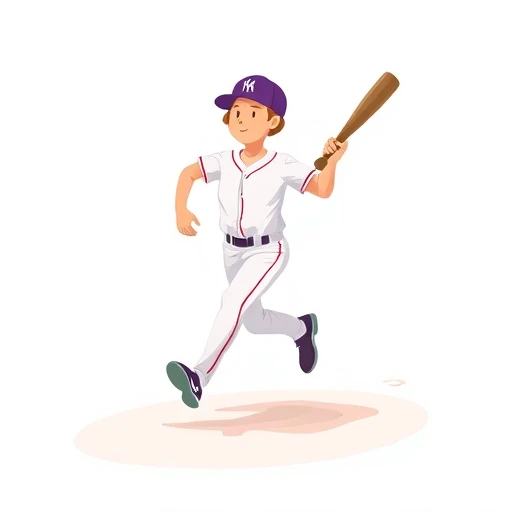
homer in 30 Sekunden
- Informal noun for a baseball home run, where the batter hits the ball out of play and circles all bases.
- Pejorative term for a person (announcer, ref, fan) who shows extreme bias toward a local or home team.
- Commonly used in North American sports culture, especially in media broadcasts and fan discussions on social media.
- Functions as a countable noun and can occasionally be used as a verb in sports reporting contexts.
The term homer is a multifaceted noun primarily rooted in the lexicon of North American sports, specifically baseball. At its most fundamental level, it serves as a colloquial shorthand for a 'home run.' In baseball, a home run occurs when a batter hits the ball in such a way—usually over the outfield fence—that they are able to circle all the bases and reach home plate safely in a single play. This event is the pinnacle of offensive achievement in the sport, often accompanied by explosive crowd reactions and significant shifts in game momentum. When fans or commentators shout, 'That's a homer!' they are using a more intimate, informal version of the formal term, reflecting the deep-seated cultural integration of the sport in society. Beyond the diamond, the word has evolved into a socio-linguistic label for a specific type of individual: the biased observer. In this context, a 'homer' is a person—often a sports broadcaster, journalist, or referee—who demonstrates an undeniable and sometimes irrational prejudice in favor of the local or home team. This usage highlights a psychological phenomenon where one's professional objectivity is compromised by personal or regional loyalty. For example, if a television announcer only praises the local team and ignores the achievements of the visiting team, they are frequently criticized as being a 'homer.' This dual meaning makes the word uniquely versatile, bridging the gap between a physical sporting feat and a character trait involving cognitive bias.
- Sporting Context
- In baseball, it is the ultimate scoring play, resulting in at least one run and potentially up to four if the bases are loaded.
- Social Context
- Refers to a person whose loyalty to a local team clouds their judgment or reporting, often used pejoratively in journalism.
The crowd went wild as the rookie hit a walk-off homer in the bottom of the ninth inning.
The evolution of the word 'homer' reflects the American tendency to shorten frequently used nouns to create a sense of belonging and 'insider' knowledge within a subculture. Using 'homer' instead of 'home run' signals that the speaker is a seasoned fan who is comfortable with the jargon of the game. Interestingly, the second meaning—the biased person—likely emerged from the idea that such a person is always 'rooting for the home' side, regardless of the facts. This transition from a noun describing an event to a noun describing a person's character is a common linguistic path in English slang. In modern digital discourse, you might see the term used on social media platforms like X (formerly Twitter) or Reddit to dismiss a commentator's opinion. If a national analyst predicts the New York Yankees will win every game, fans of rival teams will quickly label that analyst a 'homer.' This usage extends beyond baseball to basketball, American football, and even non-sporting arenas like local politics, where a 'homer' might be someone who always supports local initiatives without considering their flaws. Understanding this word requires a grasp of both the mechanics of a specific game and the nuances of human partiality.
I can't watch the local broadcast; the announcer is such a homer that he never admits when our players commit a foul.
Furthermore, the term 'homer' should not be confused with the Greek poet Homer or the cartoon character Homer Simpson, although the spelling is identical. In the context of CEFR B1 English, the focus is on the everyday informal usage in sports. The word carries a sense of excitement and high energy when referring to the hit, but a sense of frustration or dismissal when referring to the person. In professional baseball statistics, you will often see 'HR' as the abbreviation, but in the 'color commentary'—the descriptive storytelling during a game—'homer' is the preferred stylistic choice. It adds a rhythmic, punchy quality to the narrative. Whether it's a 'solo homer' (one run), a 'two-run homer,' or the rare 'inside-the-park homer,' the word is central to the mythology of the sport. It represents the moment the ball leaves the park and enters the realm of legend, making it one of the most evocative words in the American sporting vocabulary.
Using the word homer correctly depends heavily on whether you are describing an event or a person. As a count noun referring to a home run, it follows standard grammatical rules for objects. You can 'hit a homer,' 'witness a homer,' or 'give up a homer' (if you are the pitcher). Because it is informal, it is most at home in spoken English, sports journalism, or casual writing. In a formal academic paper about the physics of baseball, you would likely stick to 'home run,' but in a blog post or a newspaper's sports section, 'homer' provides a more engaging tone. When used to describe a person, 'homer' functions as a label. You might say, 'He is a total homer,' or 'The officiating was done by a bunch of homers.' In this sense, it acts as a predicate nominative or the object of a sentence, identifying the subject's perceived bias. It is important to note that while 'homer' is a noun, it is frequently modified by adjectives like 'massive,' 'clutch,' 'towering,' or 'unapologetic' to add descriptive weight to the sentence.
- Action-Oriented Usage
- Focuses on the act of hitting the ball. Example: 'He smashed a three-run homer into the upper deck.'
- Character-Oriented Usage
- Focuses on the bias of an individual. Example: 'The radio host is a bit of a homer, but his enthusiasm is infectious.'
After three strikeouts, the slugger finally connected for a 450-foot homer.
Syntactically, 'homer' can also be used as a verb in sports reporting, though this is a slightly different grammatical derivation. A headline might read, 'Judge Homers Twice in Win,' where 'homers' is the third-person singular present tense verb. However, as a noun, it remains the most common form. When constructing sentences, consider the level of formality. In a business meeting, calling someone a 'homer' might be seen as unprofessional or overly aggressive unless the environment is very casual. In contrast, during a weekend game at a bar, it is a standard part of the banter. The word also appears in compound forms and specific phrases. A 'walk-off homer' is one that ends the game immediately because the home team takes the lead in the final inning. An 'opposite-field homer' describes the technical skill of hitting the ball to the side of the field opposite the batter's natural swing. These variations allow for precise descriptions of complex sporting actions while maintaining the informal 'homer' base.
Don't listen to his analysis; he's a homer who thinks the local team can do no wrong.
To master the use of 'homer,' one must also understand its pluralization and possessive forms. 'Homers' is the plural, used when multiple home runs are hit or multiple biased people are present. 'The team's homers accounted for all their runs today.' In the possessive, 'the homer's trajectory' refers to the path of the ball. When referring to the biased person, you might say, 'The homer's bias was obvious to everyone in the room.' This flexibility allows the word to fit into various narrative structures. Whether you are writing a sports recap, a character study of a biased fan, or simply chatting with friends, 'homer' serves as a concise, punchy tool. It encapsulates a specific type of American energy—one that is both celebratory of athletic excellence and critical of blind loyalty. By integrating 'homer' into your vocabulary, you move beyond basic English into the nuanced, culturally rich territory of idiomatic American speech.
The most common environment to encounter the word homer is within the high-energy atmosphere of a baseball stadium. From the public address announcer's booming voice to the excited chatter of fans in the bleachers, 'homer' is the currency of the ballpark. However, its reach extends far beyond the physical stadium. You will hear it constantly on sports television networks like ESPN, Fox Sports, and regional sports networks (RSNs). Commentators use it to keep the broadcast lively and relatable. For instance, during a highlight reel, an anchor might say, 'And here's Ohtani with a monster homer to center field!' This usage is ubiquitous in North America, particularly in the United States and Canada, but it is also heard in baseball-loving nations like Japan, South Korea, and the Dominican Republic, where English sports terminology often blends with local languages. In these contexts, 'homer' signifies a moment of peak excitement, a 'game-changer' that demands a specific, high-impact word.
- Media Broadcasts
- Television and radio announcers use 'homer' to describe home runs with flair and speed.
- Sports Bars & Social Gatherings
- Fans use the term to celebrate their team's hits or to complain about biased commentary from the 'homer' on TV.
'That announcer is such a homer,' grumbled the fan at the bar, 'he didn't even mention the other team's great play.'
Another significant venue for the word is the world of sports journalism and digital media. In the era of podcasts and YouTube sports channels, the term 'homer' is frequently used as a critique. Fans often debate whether a particular host is a 'homer' for a certain team. This has led to the term 'homerism,' which describes the state of being a homer. You might read an article titled 'The Problem with Homerism in Local Sports Media,' which explores how local reporters sometimes struggle to remain objective when they are embedded with a team for years. This usage is common in online forums like Reddit's r/baseball or r/nba, where users call out each other's biases. Even though the word originated in baseball, the 'biased person' meaning has successfully migrated to other sports. You will hear NBA fans call a referee a 'homer' if they seem to be giving all the foul calls to the home team. This cross-sport utility makes 'homer' a vital part of the broader sports fan's vocabulary.
The newspaper columnist was accused of being a homer after he wrote five articles in a row praising the city's struggling quarterback.
Finally, you might encounter 'homer' in casual conversation among friends who are not even talking about sports. Because the concept of 'home team bias' is so relatable, people sometimes use it metaphorically. For example, if someone always defends their hometown's terrible pizza, a friend might jokingly call them a 'homer for Chicago-style.' This metaphorical usage is less common but demonstrates the word's deep roots in the American psyche. It captures the tension between loyalty and truth. Whether it's the crack of the bat signaling a 'homer' over the wall or the frustrated sigh of a fan calling out a 'homer' announcer, the word is a staple of the auditory landscape in any English-speaking environment where competition and community intersect. It is a word that carries the weight of both victory and the human tendency to play favorites.
One of the most frequent mistakes learners make with the word homer is confusing it with its homonyms or similar-sounding words. The most obvious confusion is with 'Homer,' the proper noun referring to the ancient Greek author of the *Iliad* and the *Odyssey*. While the spelling is identical, the context usually makes the difference clear. However, in written English, failing to capitalize the poet's name can lead to humorous misunderstandings, such as a sentence appearing to say that a baseball player hit a 'Greek poet.' Similarly, many people confuse 'homer' with 'homey' (or 'homie'), which is a slang term for a close friend or someone from one's neighborhood. While both words have roots in the concept of 'home,' their meanings are entirely distinct. Calling a baseball hit a 'homey' would be incorrect, just as calling your best friend a 'homer' might imply they are biased rather than just being your pal.
- Confusion with 'Homey'
- 'Homey' is a friend; 'homer' is a home run or a biased person. Do not swap them.
- Capitalization Errors
- Lowercase 'homer' for sports; uppercase 'Homer' for the poet or the Simpson character.
Incorrect: He hit a Homer to win the game. (Unless the ball hit the poet, this should be lowercase.)
Another common error involves the misuse of the 'biased person' meaning. Learners sometimes use 'homer' to describe anyone who likes a team. However, 'homer' specifically implies a *lack of objectivity* or a *blind bias*, often in a professional or semi-professional capacity. A fan who simply loves their team isn't necessarily a 'homer'; a fan who refuses to admit their team committed a clear foul, or a commentator who only talks about one side, is a 'homer.' Using the term too broadly can dilute its meaning. Additionally, there is a grammatical pitfall regarding the verb form. While 'to homer' is a valid verb in sports reporting ('He homered in the fourth'), it is rarely used in everyday conversation. Most people would say 'He hit a homer.' Using 'he homered' in a casual chat might sound a bit like you are reading from a newspaper, which can feel slightly unnatural in a social setting.
Correct: The local news anchor is a total homer; he never criticizes the home team's management.
Finally, be careful with the pluralization and the context of 'homer' in different regions. While it is a standard term in the US and Canada, using it in a country where baseball is not popular might lead to confusion. If you are in the UK and you say, 'That guy is a homer,' people might think you are talking about Homer Simpson or simply be confused. Always consider your audience's cultural background. Furthermore, avoid using 'homer' as an adjective unless it's part of a recognized compound like 'homer call' (a biased decision by a ref). Saying 'that was a homer play' is non-standard; instead, say 'that was a home-run play' or 'that was a play by a homer.' By keeping these distinctions in mind—capitalization, specific bias vs. general liking, and regional relevance—you can use 'homer' with the precision of a native speaker.
Because baseball is a sport rich in slang, there are many synonyms for homer when it refers to a home run. Each alternative carries a slightly different 'flavor' or intensity. For example, a dinger is a very common informal synonym, often used to describe a hit that sounds particularly good coming off the bat. A tater is an older, more 'old-school' slang term, while a moonshot specifically refers to a homer that travels very high into the air. If a hit is particularly powerful and travels a long distance, it might be called a blast or a bomb. In the most dramatic situations, such as a home run that ends the game, it is called a walk-off. Understanding these variations allows you to describe the same event with different levels of excitement and technical detail. While 'homer' is the most versatile and common, these alternatives are what make sports talk so colorful.
- Dinger
- Very similar to 'homer,' often used for a solid, impressive hit.
- Moonshot
- A home run with a very high, arching trajectory.
- Partisan
- A more formal synonym for the 'biased person' meaning of homer.
While 'homer' is informal, calling a journalist partisan is a more serious, formal accusation of bias.
When using 'homer' to mean a biased person, the alternatives shift toward the vocabulary of journalism and logic. A partisan is someone who strongly supports a particular party, cause, or person, though it is often used in politics. A loyalist is someone who remains firm in their support, but this lacks the negative connotation of bias that 'homer' carries. If you want to be more academic, you might use the term subjective or prejudiced. However, in the specific world of sports, 'homer' is the most accurate term for that specific 'home-team-can-do-no-wrong' attitude. Another related term is slanted, used to describe reporting that is not balanced. For example, 'The coverage was very slanted toward the local team.' While 'homer' is a noun for the person, 'slanted' is an adjective for the work they produce. Knowing when to use the informal 'homer' versus the more formal 'biased reporter' is key to mastering English registers.
He hit a dinger! That ball is way out of here!
In summary, if you are looking for alternatives to 'homer,' first identify which meaning you intend. For the baseball hit, choose 'dinger,' 'blast,' or 'home run' depending on the intensity. For the biased person, choose 'partisan,' 'localist,' or simply 'biased' depending on the level of formality required. In a casual sports setting, 'homer' is almost always the best choice because it carries a specific cultural weight that more general words like 'biased' lack. It tells the listener that you understand the unique dynamics of sports culture, where local loyalty is expected from fans but often criticized in professionals. By having this range of synonyms at your disposal, you can tailor your language to fit any situation, from a rowdy sports bar to a professional journalism seminar.
How Formal Is It?
Wusstest du?
The use of 'homer' to mean a biased official or announcer gained widespread popularity in the 1970s and 80s, particularly in basketball circles, to describe referees who were intimidated by loud home crowds.
Aussprachehilfe
- Pronouncing it like 'hammer' (with an 'a' sound).
- Confusing the 'o' sound with 'hummer' (short 'u').
- Over-emphasizing the second syllable.
- Making the 'h' silent (it should be audible).
- In the UK, making the 'r' too strong.
Schwierigkeitsgrad
Easy to read in sports news, but context is needed for the bias meaning.
Spelling is easy, but using it in the 'bias' sense requires nuance.
Very common in casual sports talk.
Can be confused with 'homey' or 'Homer' (proper noun) in fast speech.
Was du als Nächstes lernen solltest
Voraussetzungen
Als Nächstes lernen
Fortgeschritten
Wichtige Grammatik
Clipping
'Homer' is a clipping of 'home run,' common in informal English.
Noun as Adjective
In 'homer call,' the noun 'homer' modifies 'call'.
Zero Derivation
The noun 'homer' becoming the verb 'to homer' without changing form.
Countable Nouns
Using 'a' or 'the' with 'homer' because it can be counted.
Proper vs. Common Nouns
Distinguishing 'homer' (hit) from 'Homer' (the poet).
Beispiele nach Niveau
He hit a big homer.
Il a frappé un grand coup de circuit.
Noun, singular.
The crowd loves a homer.
La foule adore un coup de circuit.
Direct object.
Is that a homer?
Est-ce un coup de circuit ?
Question form.
I want to hit a homer.
Je veux frapper un coup de circuit.
Infinitive phrase.
Look! A homer!
Regarde ! Un coup de circuit !
Exclamation.
The ball is a homer.
La balle est un coup de circuit.
Subject complement.
He has one homer today.
Il a un coup de circuit aujourd'hui.
Countable noun.
We saw a homer.
Nous avons vu un coup de circuit.
Past tense verb with noun.
The player hit a homer in the first inning.
Le joueur a frappé un homer à la première manche.
Prepositional phrase 'in the first inning'.
How many homers did they hit?
Combien de homers ont-ils frappés ?
Plural form 'homers'.
That was a very long homer.
C'était un très long homer.
Adjective 'long' modifying 'homer'.
I missed the homer because I was buying food.
J'ai raté le homer parce que j'achetais de la nourriture.
Conjunction 'because'.
Every fan hopes for a homer.
Chaque fan espère un homer.
Subject 'Every fan'.
The team needs a homer to win.
L'équipe a besoin d'un homer pour gagner.
Purpose clause 'to win'.
He hit his first professional homer last night.
Il a frappé son premier homer professionnel hier soir.
Possessive 'his'.
The ball went over the wall for a homer.
La balle est passée par-dessus le mur pour un homer.
Preposition 'for'.
The local announcer is such a homer; he never says anything bad about the team.
L'annonceur local est un tel 'homer' ; il ne dit jamais rien de mal sur l'équipe.
Using 'homer' to mean a biased person.
He hit a walk-off homer to end the game in the ninth inning.
Il a frappé un 'walk-off homer' pour terminer le match à la neuvième manche.
Compound term 'walk-off homer'.
Don't be such a homer—admit that the other team played better.
Ne sois pas un tel 'homer'—admets que l'autre équipe a mieux joué.
Imperative 'Don't be'.
The referee made a homer call that favored the home side.
L'arbitre a pris une décision de 'homer' qui a favorisé l'équipe à domicile.
Noun used as an adjective 'homer call'.
She hit a solo homer, but the team still lost the game.
Elle a frappé un 'solo homer', mais l'équipe a quand même perdu le match.
Contrast with 'but'.
Is he a real journalist or just a homer for the university team?
Est-il un vrai journaliste ou juste un 'homer' pour l'équipe universitaire ?
Alternative question.
The stadium erupted when the captain hit a towering homer.
Le stade a explosé quand le capitaine a frappé un 'homer' imposant.
Complex sentence with 'when'.
I can't stand listening to homers who ignore the facts of the game.
Je ne supporte pas d'écouter les 'homers' qui ignorent les faits du match.
Relative clause 'who ignore'.
The columnist was criticized for his blatant homerism during the playoffs.
Le chroniqueur a été critiqué pour son 'homerisme' flagrant pendant les séries éliminatoires.
Noun 'homerism' derived from 'homer'.
Despite being a lifelong fan, he tries not to be a homer when he's reporting.
Bien qu'il soit fan depuis toujours, il essaie de ne pas être un 'homer' lorsqu'il fait son reportage.
Concessive clause 'Despite being'.
He homered twice in the double-header, securing his spot in the All-Star game.
Il a frappé deux 'homers' lors du programme double, assurant sa place au match des étoiles.
Verb form 'homered'.
The network is known for hiring homers to appeal to the local fan base.
Le réseau est connu pour embaucher des 'homers' afin de plaire à la base de fans locale.
Infinitive of purpose 'to appeal'.
A late-inning homer changed the entire complexion of the series.
Un 'homer' en fin de manche a changé toute la physionomie de la série.
Subject 'A late-inning homer'.
Critics argue that 'homer' announcers damage the credibility of sports media.
Les critiques soutiennent que les annonceurs 'homers' nuisent à la crédibilité des médias sportifs.
Attributive noun usage.
He's such a homer that he thinks every loss is the referee's fault.
C'est un tel 'homer' qu'il pense que chaque défaite est la faute de l'arbitre.
Result clause 'such... that'.
The rookie's first homer was a 450-foot blast to center field.
Le premier 'homer' de la recrue était une explosion de 450 pieds au champ centre.
Possessive 'rookie's'.
The tension between journalistic integrity and the 'homer' expectations of local fans is palpable.
La tension entre l'intégrité journalistique et les attentes de 'homer' des fans locaux est palpable.
Abstract noun phrase.
He managed to avoid the 'homer' label by providing balanced critiques of the home team's management.
Il a réussi à éviter l'étiquette de 'homer' en fournissant des critiques équilibrées de la direction de l'équipe locale.
Gerund phrase 'by providing'.
The game was decided by a controversial homer that barely cleared the foul pole.
Le match s'est décidé sur un 'homer' controversé qui a tout juste franchi le poteau de fausse balle.
Passive voice 'was decided by'.
His homerism is so ingrained that he views any objective analysis as a personal attack.
Son 'homerisme' est si enraciné qu'il considère toute analyse objective comme une attaque personnelle.
Adjective 'ingrained'.
The broadcast booth was a den of homers, making the game nearly unwatchable for neutral fans.
La cabine de diffusion était un repaire de 'homers', rendant le match presque impossible à regarder pour les fans neutres.
Participial phrase 'making the game...'.
She delivered a clutch homer in the bottom of the ninth, cementing her legacy.
Elle a réussi un 'homer' décisif en fin de neuvième, cimentant son héritage.
Appositive-like participial phrase.
While some enjoy the energy of a homer announcer, others prefer a more clinical approach.
Alors que certains apprécient l'énergie d'un annonceur 'homer', d'autres préfèrent une approche plus clinique.
Contrast with 'While'.
The sheer frequency of homers in the modern era has led to debates about ball aerodynamics.
La fréquence pure et simple des 'homers' à l'ère moderne a mené à des débats sur l'aérodynamisme de la balle.
Noun phrase 'The sheer frequency'.
The commentator's descent into unmitigated homerism alienated the national audience.
La dérive du commentateur vers un 'homerisme' absolu a aliéné le public national.
Complex subject 'The commentator's descent...'.
One might argue that the 'homer' is a necessary archetype in the theater of regional sports.
On pourrait soutenir que le 'homer' est un archétype nécessaire dans le théâtre des sports régionaux.
Subjunctive-like 'One might argue'.
The 'homer' call by the official was the catalyst for a stadium-wide protest.
La décision de 'homer' de l'officiel a été le catalyseur d'une protestation dans tout le stade.
Noun as adjective 'homer call'.
In the annals of baseball history, the 'homer' remains the most visceral expression of power.
Dans les annales de l'histoire du baseball, le 'homer' reste l'expression la plus viscérale de la puissance.
Prepositional phrase 'In the annals...'.
His reputation as a homer preceded him, making every interview a battle for objectivity.
Sa réputation de 'homer' le précédait, faisant de chaque interview une bataille pour l'objectivité.
Absolute construction.
The proliferation of 'homer' media outlets has contributed to the fragmentation of sports discourse.
La prolifération des médias 'homers' a contribué à la fragmentation du discours sportif.
Present perfect 'has contributed'.
To label him a mere homer is to ignore the complex regional identity he represents.
Le qualifier de simple 'homer', c'est ignorer l'identité régionale complexe qu'il représente.
Infinitive as subject.
The game-winning homer was a poetic conclusion to a season fraught with adversity.
Le 'homer' de la victoire était une conclusion poétique à une saison pleine d'adversité.
Adjective phrase 'fraught with adversity'.
Synonyme
Gegenteile
Häufige Kollokationen
Häufige Phrasen
— Exclamation used when a ball is hit out of the park.
The ball is going, going... that's a homer!
— A request for someone to stop being biased and be fair.
Look at the replay; don't be a homer.
— A redundant but common way to describe a biased person.
He's just a homer for the home team.
— To hit the ball with the intention of it being a home run.
He swung hard, trying to hit it for a homer.
— The most impressive or important home run of the season.
That walk-off was the homer of the year.
— A commentator who is biased.
The national fans complained about the broadcast homer.
— A home run that barely cleared a short fence.
It was a cheap homer, but it still counts.
— A home run hit at a very important moment in the game.
His clutch homer won the championship.
— The actual state of being biased toward the home side.
The study examined homer bias in NBA officiating.
Wird oft verwechselt mit
The Greek author of the Iliad. Always capitalized.
A slang term for a friend. Sounds similar but different meaning.
A type of vehicle or a humming sound. Different vowel sound.
Redewendungen & Ausdrücke
— To be very successful at something (related to 'homer').
You really hit a home run with that presentation!
Informal— To do something exceptionally well (related to a homer).
She knocked that interview out of the park.
Informal— To try for a big success even if it's risky (trying for a homer).
In this startup, we are swinging for the fences.
Informal— To deal with every part of a situation (what you do after a homer).
Make sure your report touches all the bases.
Neutral— The benefit of playing in your own stadium (why people become homers).
They have a strong home field advantage.
Neutral— To be objective (the opposite of being a homer).
A good ref should just call it like they see it.
Informal— Happening very close to home (where a homer feels most comfortable).
The problem is right here in our own backyard.
Informal— To support the team expected to lose (opposite of a typical homer).
I always root for the underdog.
Neutral— Honest and without bias (not a homer's way).
They won the game fair and square.
InformalLeicht verwechselbar
Phonetic similarity.
Homey is a person you are friends with; homer is a hit or a biased person.
He's my homey (friend) vs. He's a homer (biased).
Vowel sound similarity.
A hammer is a tool; a homer is a baseball hit.
I need a hammer for this nail vs. He hit a homer.
Spelling/sound in some accents.
Honor is respect; homer is a sports term.
It is an honor to meet you vs. That was a great homer.
First syllable similarity.
Hormone is a biological chemical; homer is a sports term.
Growth hormone vs. Solo homer.
Rhyme and context.
An owner possesses the team; a homer is a biased person or a hit.
The team owner is rich vs. The announcer is a homer.
Satzmuster
He hit a [noun].
He hit a homer.
The team hit [number] [nouns].
The team hit two homers.
The [person] is a [noun].
The announcer is a homer.
Don't be a [noun].
Don't be a homer.
He [verb-ed] in the [inning].
He homered in the fifth.
A [adjective] [noun] won the game.
A clutch homer won the game.
The [noun] of [noun] is [adjective].
The frequency of homers is increasing.
[Gerund] him a [noun] is [adjective].
Labeling him a homer is unfair.
Wortfamilie
Substantive
Verben
Adjektive
Verwandt
So verwendest du es
High in US/Canada sports; Low elsewhere.
-
He hit a Homer.
→
He hit a homer.
Do not capitalize 'homer' unless it's a proper name or the start of a sentence.
-
The ref is a homey.
→
The ref is a homer.
'Homey' means friend; 'homer' means biased person.
-
He homered the ball.
→
He hit a homer.
'Homer' as a verb doesn't take an object like 'the ball.' You just say 'He homered.'
-
I saw a homer poet.
→
I read Homer's poetry.
Confusing the sports term with the Greek author.
-
That was a homer hit.
→
That was a home-run hit.
'Homer' is usually a noun. Use 'home-run' as the adjective for the hit.
Tipps
Use for excitement
When your team hits a home run, 'homer' is the perfect high-energy word to use.
Be careful with bias
Calling a friend a 'homer' is fine, but calling a professional one might be seen as rude.
Count it
Remember that 'homer' is countable. You hit 'a' homer or 'three' homers.
Context is king
If you hear 'homer' and 'referee' in the same sentence, think 'bias,' not 'baseball hit.'
Lowercase for sports
Unless it's the start of a sentence, keep 'homer' lowercase to avoid confusion with the poet.
Learn the family
Learn 'homerism' along with 'homer' to describe the concept of bias.
American focus
Use this word primarily when talking to Americans or Canadians about sports.
Vary your words
Try using 'dinger' or 'blast' sometimes to keep your sports talk interesting.
Identify the 'home'
A 'homer' is always biased toward the 'home' side, not just any side.
Celebrate the hit
A 'homer' is the most exciting play in baseball—use the word with that same energy!
Einprägen
Eselsbrücke
Think of a ball going 'HOME' to score a 'HOMER.' If a person is a 'HOMER,' they only care about their 'HOME' team.
Visuelle Assoziation
Imagine a baseball flying over a fence with a giant 'H' on it. Or imagine a referee wearing a jersey that says 'I LOVE THE HOME TEAM.'
Word Web
Herausforderung
Try to use 'homer' in two different sentences today: one about a sports game and one about someone being biased.
Wortherkunft
The word 'homer' is a clipping of 'home run,' which appeared in the late 19th century as baseball became the American national pastime. The shortened version 'homer' became popular in the early 20th century as a way for fans and journalists to speak more quickly and informally about the game.
Ursprüngliche Bedeutung: A hit that allows the batter to reach home plate.
Germanic (English)Kultureller Kontext
Calling a professional journalist a 'homer' can be seen as an insult to their integrity.
Primarily North American. In the UK, 'homer' is rare and might be confused with the poet or the Simpson.
Im Alltag üben
Kontexte aus dem Alltag
At a Baseball Game
- Did you see that homer?
- He's going for a homer!
- That's his third homer.
- What a homer!
Watching Sports on TV
- This announcer is a total homer.
- I hate homer broadcasts.
- He's such a homer for the Lakers.
- Turn off the homer.
Reading Sports News
- He homered in the fourth.
- A late-inning homer.
- The homer chase.
- Leading the league in homers.
Arguing with Friends
- Stop being a homer.
- You're such a homer.
- That's a homer opinion.
- Only a homer would say that.
Sports History
- The most famous homer.
- A historic homer.
- The era of the homer.
- He was a homer for his city.
Gesprächseinstiege
"Who do you think hit the most impressive homer in baseball history?"
"Do you prefer a neutral announcer or a 'homer' who loves your team?"
"Have you ever been called a 'homer' for your favorite sports team?"
"Is there a 'homer' in your local news who everyone knows is biased?"
"What's the difference between being a loyal fan and being a 'homer'?"
Tagebuch-Impulse
Describe a time you saw a 'homer' (home run) and how the crowd reacted.
Write about a person you know who is a 'homer' for a specific team or brand.
Do you think it's okay for local sports announcers to be 'homers'? Why or why not?
Reflect on a time you were biased (a 'homer') about something in your own life.
How does the word 'homer' change the way we think about sports reporting?
Häufig gestellte Fragen
10 FragenWhile it originated in baseball to mean a home run, the meaning of 'a biased person' is used in many sports, including basketball and football.
When used to describe a person, yes, it is usually a mild insult suggesting they are not being fair or objective.
Probably not. It is very informal and specific to sports culture. Use 'biased' or 'partial' instead.
Not really. British people would say 'home run' and are unlikely to use 'homer' to mean a biased person.
It is the noun form of the behavior of being a homer. It refers to the state of having a strong local bias.
Yes, in sports journalism, you might see 'He homered twice,' but it's less common in speaking.
Because they always side with the 'home' team, no matter what happens in the game.
His name is Homer, but the term 'homer' (biased person) isn't specifically about him, though he is certainly a fan of his local life!
It's a home run hit by the home team in the bottom of the last inning that ends the game immediately.
Yes, it's a great word for intermediate learners to know as they start engaging with real-world American media and sports.
Teste dich selbst 180 Fragen
Write a sentence using 'homer' to mean a home run.
Well written! Good try! Check the sample answer below.
Write a sentence using 'homer' to mean a biased person.
Well written! Good try! Check the sample answer below.
Describe a 'walk-off homer' in your own words.
Well written! Good try! Check the sample answer below.
Explain why calling a journalist a 'homer' might be an insult.
Well written! Good try! Check the sample answer below.
Write a short dialogue between two fans where one is being a 'homer'.
Well written! Good try! Check the sample answer below.
Use the verb 'homered' in a sentence about a sports game.
Well written! Good try! Check the sample answer below.
Write a sentence using 'homerism'.
Well written! Good try! Check the sample answer below.
Compare a 'solo homer' and a 'grand slam'.
Well written! Good try! Check the sample answer below.
Write a headline for a sports newspaper using the word 'homer'.
Well written! Good try! Check the sample answer below.
Explain the etymology of the word 'homer' in two sentences.
Well written! Good try! Check the sample answer below.
Write a sentence using 'homer call'.
Well written! Good try! Check the sample answer below.
Describe the feeling of hitting a homer.
Well written! Good try! Check the sample answer below.
Use 'homer' in a sentence about a non-baseball sport.
Well written! Good try! Check the sample answer below.
Write a sentence with 'towering homer'.
Well written! Good try! Check the sample answer below.
Explain the difference between 'homer' and 'homey'.
Well written! Good try! Check the sample answer below.
Write a sentence using 'monster homer'.
Well written! Good try! Check the sample answer below.
Use 'homer' as a direct object in a sentence.
Well written! Good try! Check the sample answer below.
Write a sentence about a 'homer' announcer.
Well written! Good try! Check the sample answer below.
Use 'homers' (plural) in a sentence.
Well written! Good try! Check the sample answer below.
Write a sentence using 'unapologetic homer'.
Well written! Good try! Check the sample answer below.
Pronounce the word 'homer' correctly.
Read this aloud:
Du hast gesagt:
Speech recognition is not supported in your browser. Try Chrome or Edge.
Explain the two meanings of 'homer' to a friend.
Read this aloud:
Du hast gesagt:
Speech recognition is not supported in your browser. Try Chrome or Edge.
Use 'homer' in an excited exclamation.
Read this aloud:
Du hast gesagt:
Speech recognition is not supported in your browser. Try Chrome or Edge.
Roleplay: Call out a biased friend using the word 'homer'.
Read this aloud:
Du hast gesagt:
Speech recognition is not supported in your browser. Try Chrome or Edge.
Describe your favorite baseball player's most famous homer.
Read this aloud:
Du hast gesagt:
Speech recognition is not supported in your browser. Try Chrome or Edge.
Discuss whether you think sports announcers should be 'homers'.
Read this aloud:
Du hast gesagt:
Speech recognition is not supported in your browser. Try Chrome or Edge.
Use 'homer' and 'bias' in the same sentence.
Read this aloud:
Du hast gesagt:
Speech recognition is not supported in your browser. Try Chrome or Edge.
Tell a short story about a game that ended with a homer.
Read this aloud:
Du hast gesagt:
Speech recognition is not supported in your browser. Try Chrome or Edge.
Explain why 'homer' is an informal word.
Read this aloud:
Du hast gesagt:
Speech recognition is not supported in your browser. Try Chrome or Edge.
Practice the 'o' sound in 'homer'.
Read this aloud:
Du hast gesagt:
Speech recognition is not supported in your browser. Try Chrome or Edge.
Say 'He homered twice' three times fast.
Read this aloud:
Du hast gesagt:
Speech recognition is not supported in your browser. Try Chrome or Edge.
Describe a 'towering homer' using your hands for gestures.
Read this aloud:
Du hast gesagt:
Speech recognition is not supported in your browser. Try Chrome or Edge.
Ask a question using 'homer'.
Read this aloud:
Du hast gesagt:
Speech recognition is not supported in your browser. Try Chrome or Edge.
Explain the difference between 'homer' and 'Homer' (poet) orally.
Read this aloud:
Du hast gesagt:
Speech recognition is not supported in your browser. Try Chrome or Edge.
Use 'homer' in a sentence about a referee.
Read this aloud:
Du hast gesagt:
Speech recognition is not supported in your browser. Try Chrome or Edge.
What is a 'solo homer'?
Read this aloud:
Du hast gesagt:
Speech recognition is not supported in your browser. Try Chrome or Edge.
Give a synonym for 'homer'.
Read this aloud:
Du hast gesagt:
Speech recognition is not supported in your browser. Try Chrome or Edge.
Is 'homer' a positive or negative word?
Read this aloud:
Du hast gesagt:
Speech recognition is not supported in your browser. Try Chrome or Edge.
Where would you hear the word 'homer'?
Read this aloud:
Du hast gesagt:
Speech recognition is not supported in your browser. Try Chrome or Edge.
Why do people hit homers?
Read this aloud:
Du hast gesagt:
Speech recognition is not supported in your browser. Try Chrome or Edge.
Listen for the word 'homer' in a sports clip and identify the context.
Which word did the speaker say: 'homer' or 'hammer'?
Is the speaker happy or frustrated when they say 'homer'?
How many homers did the announcer mention?
What type of homer was it? (Solo, two-run, etc.)
Did the speaker use 'homer' as a noun or a verb?
Who hit the homer according to the speaker?
Was the homer 'walk-off'?
What was the distance of the homer?
Is the announcer being called a 'homer'?
What did the 'homer' hit?
How many runs did the homer score?
What inning did the homer happen in?
Was it a 'monster' homer?
Who is complaining about the 'homer'?
/ 180 correct
Perfect score!
Summary
The word 'homer' captures the excitement of baseball's greatest hit and the frustration of dealing with biased people. Whether you're celebrating a 'walk-off homer' or complaining about a 'homer announcer,' this word is essential for understanding American sports culture and the nuances of partiality.
- Informal noun for a baseball home run, where the batter hits the ball out of play and circles all bases.
- Pejorative term for a person (announcer, ref, fan) who shows extreme bias toward a local or home team.
- Commonly used in North American sports culture, especially in media broadcasts and fan discussions on social media.
- Functions as a countable noun and can occasionally be used as a verb in sports reporting contexts.
Use for excitement
When your team hits a home run, 'homer' is the perfect high-energy word to use.
Be careful with bias
Calling a friend a 'homer' is fine, but calling a professional one might be seen as rude.
Count it
Remember that 'homer' is countable. You hit 'a' homer or 'three' homers.
Context is king
If you hear 'homer' and 'referee' in the same sentence, think 'bias,' not 'baseball hit.'