smith in 30 Sekunden
- A smith is a traditional metalworker who uses heat and hammers to create tools and objects.
- The word is frequently used as a suffix (e.g., blacksmith, wordsmith) to denote a specialist creator.
- It is the most common surname in the English-speaking world, reflecting its historical importance.
- Metaphorically, it refers to anyone who skillfully crafts or shapes something, like language or music.
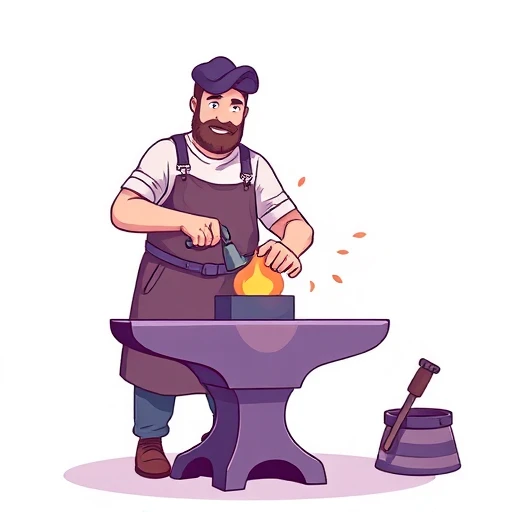
The word smith is one of the oldest and most foundational terms in the English language, rooted deeply in the history of human civilization and technology. At its core, a smith is a person who works with metal. This is not just any kind of work; it involves the intense application of heat to make metal malleable, followed by the rhythmic, forceful use of a hammer against an anvil to forge tools, weapons, or decorative items. Historically, the smith was the heart of every village, the person who created the plows for farmers, the shoes for horses, and the swords for soldiers. When you use the word today, you are often referring to this traditional craft, but the term has also evolved into a versatile suffix that denotes a specialist or a creator in various fields.
- The Traditional Role
- In a historical context, a smith was a master of fire and iron. They understood the properties of different metals and how to manipulate them. This role was so vital that the name became the most common surname in the English-speaking world.
- The Modern Suffix
- Today, we see 'smith' attached to other words to describe specific experts. A 'wordsmith' is someone skilled with language, while a 'tunesmith' creates melodies. This usage highlights the idea of 'crafting' something with precision and skill.
The village smith spent his entire morning at the glowing forge, shaping a new set of hinges for the church doors.
The imagery associated with a smith is powerful. It evokes the sound of metal clanging, the smell of coal smoke, and the sight of orange sparks flying in a dim workshop. Because of this, the word is frequently used in literature, especially in the fantasy and historical fiction genres. When an author describes a character as a smith, they are often signaling that the character is strong, patient, and possesses a deep, practical knowledge of how things are made. It is a word that carries the weight of physical labor and the dignity of expert craftsmanship.
He was a master smith, capable of turning a raw bar of steel into a delicate piece of jewelry.
In modern conversation, you might not encounter a literal smith every day, but the metaphorical usage is thriving. When we call someone a 'wordsmith', we are complimenting their ability to forge sentences that are strong, beautiful, and functional. This transition from the physical forge to the intellectual forge shows how the concept of the smith—someone who takes raw material and transforms it through hard work and skill—remains relevant in the 21st century. Whether it is a software engineer 'smithing' code or a politician 'smithing' a policy, the underlying meaning of deliberate, skillful creation remains constant.
- Artisanal Resurgence
- In recent years, there has been a renewed interest in traditional crafts. Many people are taking up 'smithing' as a hobby, seeking a tangible connection to the physical world in an increasingly digital age.
The young smith used ancient techniques to create a modern sculpture.
The silversmith's hands were calloused from years of working with the smith's tools.
Ultimately, 'smith' is a word about transformation. It is about the power of the human hand and mind to change the world, one hammer blow at a time. It bridges the gap between the ancient past and the creative present, serving as a reminder that all great things are forged with effort and intent.
Using the word smith correctly requires an understanding of its dual nature as both a standalone noun and a productive suffix. When used as a noun, it typically refers to a person who works in a forge. However, because the word is so old, it often appears in specific collocations or within the context of trade history. To use it effectively, you should consider the specific type of metalwork being discussed or the metaphorical 'crafting' taking place.
- As a Standalone Noun
- In historical or fantasy writing, 'smith' is often used alone. 'The smith hammered the iron.' This implies a general metalworker, usually a blacksmith.
- As a Suffix
- This is the most common way to see the word in modern English. You combine a material or object with 'smith' to create a new noun: blacksmith, silversmith, locksmith, gunsmith, or wordsmith.
The smith's shop was the loudest place in the entire village.
When constructing sentences, pay attention to the verbs that naturally accompany 'smith'. Common verbs include 'forge', 'hammer', 'shape', 'heat', 'temper', and 'craft'. These verbs emphasize the physical and technical nature of the work. If you are using the word metaphorically, you might use verbs like 'hone', 'refine', or 'polish'. For example, 'The wordsmith honed his prose until it shone like polished steel.' This creates a vivid comparison between writing and metalworking.
We need to find a skilled smith who can repair this antique iron gate.
In formal contexts, you might use 'smith' to discuss the history of technology or the development of surnames. For example, 'The prevalence of the surname Smith indicates the vital importance of the local smith in medieval society.' In informal contexts, you might use it playfully, such as calling a friend who is good at fixing things a 'gadget-smith'. This flexibility is what makes the word so enduring.
- Possessive Forms
- The possessive 'smith's' is very common, referring to the tools or the shop. 'I'm going to the smith's' is a shortened way of saying 'I'm going to the smith's workshop'.
The smith's anvil rang out with every strike of the hammer.
Every great sword in the legend was forged by a legendary smith.
Finally, remember that 'smith' can also be used as a verb, though this is less common than the noun form. To 'smith' something means to forge it. 'He smithed the iron into a blade.' This usage is quite archaic or specialized, but it can add a touch of flavor to creative writing. By mastering these different patterns, you can use 'smith' to convey both literal craftsmanship and metaphorical skill.
While you might not hear someone shout 'Look, a smith!' on a modern city street, the word smith is everywhere once you know where to look. It survives in our names, our stories, and our specialized industries. Understanding where this word appears in the wild helps you grasp its cultural significance and its staying power in the English language.
- Surnames and Genealogy
- The most obvious place you hear 'Smith' is as a last name. It is the most common surname in the UK, USA, Australia, and Canada. When you meet a Mr. or Ms. Smith, you are hearing a linguistic echo of an ancestor who was likely a metalworker.
- Fantasy and Historical Media
- In movies like 'The Lord of the Rings' or shows like 'Game of Thrones', the smith is a central figure. You will hear characters talk about 'the king's smith' or 'the smithy'. In these contexts, the word represents power, preparation for war, and the creation of magical artifacts.
In the movie, the hero travels to the mountains to find the legendary smith who can reforged the broken blade.
You will also hear the word in the context of high-end craftsmanship. In the world of luxury watches, jewelry, and bespoke knives, 'smith' is a title of honor. A 'bladesmith' who makes hand-forged kitchen knives or a 'goldsmith' who creates custom engagement rings is seen as an artist. In these circles, the word is used to distinguish hand-made quality from mass-produced factory goods. When a salesperson says, 'This was crafted by a master silversmith,' they are using the word to justify a higher price and a sense of heritage.
The documentary followed a modern-day smith who uses traditional charcoal fires to smelt iron.
In the business and creative worlds, you will hear 'wordsmith' used frequently. Editors, copywriters, and speechwriters are often called wordsmiths. It implies that they don't just write; they carefully shape and strengthen language. Similarly, in the music industry, a 'tunesmith' is a songwriter known for crafting catchy, well-constructed melodies. These metaphorical uses are perhaps the most common way you will hear the 'smith' root in daily professional life.
- Museums and Living History
- If you visit a living history museum (like Colonial Williamsburg or a Renaissance Faire), you will hear the term used in its literal, historical sense. Demonstrators will explain the 'smith's art' to tourists, showing how iron was worked before the industrial age.
The museum guide pointed out the smith's marks on the ancient suit of armor.
A talented smith can tell the temperature of the metal just by the color of the glow.
Whether it's in the name of a famous actor (like Will Smith), the title of a fantasy novel, or a job description for a creative professional, 'smith' is a word that signals expertise, durability, and the human touch. It is a word that has survived the transition from the Iron Age to the Information Age by remaining synonymous with the act of making.
While smith is a relatively straightforward word, its age and its use as a suffix can lead to some common pitfalls for English learners. Avoiding these mistakes will help you sound more natural and precise in your communication. The most frequent errors involve confusion with similar-sounding words, incorrect suffix application, and misunderstandings of the word's scope.
- Confusing 'Smith' with 'Smite'
- The verb 'to smite' (past tense 'smote') means to strike with a heavy blow, often in a biblical or epic sense. While a smith does 'smite' the metal, the words are distinct. You cannot say 'He smithed the enemy'; you must say 'He smote the enemy'.
- Overusing 'Smith' as a Suffix
- Not every craft can be turned into a '-smith' word. For example, we don't say 'woodsmith' (we say carpenter), 'breadsmith' (we say baker), or 'clothsmith' (we say tailor). The suffix is almost exclusively reserved for metal or metaphorical creative work.
Incorrect: He is a very good cakesmith.
Correct: He is a very good baker.
Another common mistake is assuming that 'smith' only refers to blacksmiths. While the blacksmith (working with iron) is the most iconic, a 'smith' can work with any metal. If you are talking about someone who makes jewelry, calling them a 'blacksmith' would be incorrect; they are a 'goldsmith' or 'silversmith'. Using the general term 'smith' is safer if you aren't sure of the specific metal, but being specific shows a higher level of English proficiency.
The smith worked in the smithy all night.
Learners also sometimes confuse 'smith' with 'smooth'. While they sound somewhat similar in certain accents, they have completely different meanings. A 'smooth' surface is even and without bumps, while a 'smith' is a person. Additionally, be careful with the plural form. It is simply 'smiths'. Some learners try to add an extra syllable or change the vowel, but it remains a simple one-syllable plural.
- Misusing 'Wordsmith'
- While 'wordsmith' is a compliment, it is usually reserved for people who are exceptionally skilled or professional writers. Calling a child a 'wordsmith' for writing a simple sentence might sound sarcastic or overly formal.
The novelist was a true wordsmith, choosing every adjective with surgical precision.
The smith's strength was legendary in the small town.
Finally, don't forget that 'smith' is almost always a noun. While you can use it as a verb ('to smith iron'), it is much more common to use 'forge' or 'hammer'. If you use 'smith' as a verb in a casual conversation, it might sound a bit strange or poetic. Stick to the noun form for everyday use, and you will avoid most errors.
If you find yourself using the word smith too often, or if you need a word that carries a slightly different nuance, there are several alternatives available. Depending on whether you are talking about the physical act of metalworking or the general concept of craftsmanship, different words will be more appropriate.
- Metalworker
- This is the most direct and modern alternative. It is neutral and professional. Use 'metalworker' in a modern industrial context or when the specific type of metal isn't important.
- Artisan / Craftsman
- These words emphasize the skill and artistic quality of the work. An 'artisan' often creates decorative or high-quality items by hand. 'Craftsman' is a broader term that can apply to wood, metal, or any other material.
The smith was known as the finest artisan in the county.
When looking for more specific terms, you can use words like 'forger' or 'farrier'. A 'forger' is someone who shapes metal (though be careful, as this word also means someone who makes fake documents!). A 'farrier' is a specialist who specifically makes and fits shoes for horses—a job often done by a blacksmith in the past. If you are talking about someone who works with gold, 'goldsmith' is much better than just 'smith'.
Unlike a modern machinist, the traditional smith relies on intuition and the color of the flame.
In a metaphorical sense, if you want to replace 'wordsmith', you might use 'writer', 'author', 'stylist', or 'prose-master'. If you want to replace 'tunesmith', you could use 'composer' or 'songwriter'. These alternatives are often more formal and less descriptive than the '-smith' versions. The '-smith' suffix adds a layer of 'making' and 'shaping' that these other words sometimes lack.
- Fabricator
- In modern engineering, a 'fabricator' is someone who builds structures by cutting, bending, and assembling metal. It is a more technical and less 'romantic' word than smith.
The industrial smith preferred the term 'fabricator' on his business card.
The smith's guild was one of the most powerful organizations in the city.
By choosing the right synonym, you can tailor your language to the specific tone of your writing. Whether you want the rugged, historical feel of 'smith' or the clean, modern feel of 'metalworker', understanding these distinctions is key to advanced English usage.
How Formal Is It?
Wusstest du?
The reason 'Smith' is such a common surname is that in the Middle Ages, every village needed a smith, and the name was often given to anyone who performed that vital role.
Aussprachehilfe
- Pronouncing the 'th' as a 'd' or 't' (e.g., 'smit' or 'smid').
- Using a voiced 'th' like in 'this'.
- Making the 'i' sound too long like 'ee'.
Schwierigkeitsgrad
Common word, easy to recognize in context.
Spelling is easy, but using it as a suffix requires knowledge of specific compounds.
The 'th' sound can be tricky for some learners.
Distinct sound, usually clear in speech.
Was du als Nächstes lernen solltest
Voraussetzungen
Als Nächstes lernen
Fortgeschritten
Wichtige Grammatik
Suffixes for professions
The suffix -smith is used for metalworkers, while -er is used for many other jobs (baker, teacher).
Possessive 's with professions
I am going to the smith's (workshop).
Compound nouns
Black + smith = Blacksmith.
Unvoiced 'th' sound
The 'th' in smith is the same as in 'thin'.
Countable nouns
One smith, two smiths.
Beispiele nach Niveau
The smith makes a horse shoe.
The worker makes a metal shoe for a horse.
Simple subject-verb-object.
My friend's last name is Smith.
My friend has a very common name.
Proper noun usage.
The smith is very strong.
The metalworker has big muscles.
Adjective describing a noun.
Look at the smith's hammer.
See the tool that the worker uses.
Possessive 's.
Is he a smith?
Is his job working with metal?
Question form.
The smith works with fire.
The worker uses hot fire for his job.
Prepositional phrase.
A smith makes tools.
A metalworker creates things like hammers and saws.
General statement.
The smith hits the metal.
The worker strikes the iron with a hammer.
Action verb.
A blacksmith works with iron.
A specific type of smith works with black metal.
Compound noun.
The locksmith fixed our door.
The person who makes keys and locks helped us.
Past tense verb.
There are many smiths in the village.
Many people do this job in the small town.
Plural noun.
The goldsmith made a beautiful ring.
The person who works with gold created jewelry.
Specific smith type.
He wants to be a smith like his father.
He wants the same job as his dad.
Infinitive phrase.
The smith's shop is very hot.
The place where he works has a high temperature.
Possessive noun.
She visited a silversmith in London.
She went to see a person who makes silver items.
Proper noun and specific type.
The smith uses an anvil to shape the iron.
The worker uses a heavy metal block.
Instrumental 'to' phrase.
The master smith forged a legendary sword.
The expert worker created a famous weapon.
Adjective 'master' modifying the noun.
He is a talented wordsmith who writes great stories.
He is very good at using language.
Metaphorical usage.
The gunsmith cleaned the old rifle carefully.
The person who repairs guns worked on the weapon.
Adverb modifying the verb.
Traditional smithing is a dying art in some countries.
The craft of the smith is becoming rare.
Gerund as a subject.
The smith hammered the glowing metal into a curve.
The worker changed the shape of the hot iron.
Resultative prepositional phrase.
You need a skilled smith to repair this antique gate.
Only an expert can fix this old metal fence.
Modal 'need' with an infinitive.
The smithy was filled with the sound of clanging metal.
The workshop was very noisy.
Passive voice 'was filled'.
A coppersmith makes pots and pans from copper.
A specific worker uses reddish metal for kitchenware.
Defining relative clause (implied).
The smith's apprentice learned how to temper the steel.
The student learned how to make the metal strong.
Noun-noun possessive.
As a tunesmith, she has written dozens of hit songs.
As a songwriter, she is very successful.
Prepositional phrase 'As a...'.
The industrial revolution replaced the local smith with factories.
New machines took the job of the village worker.
Historical context.
The smith carefully annealed the metal to make it softer.
The worker heated and cooled the metal to change it.
Technical vocabulary.
He is a fine smith, but his prices are quite high.
He does good work, but it is expensive.
Concessive clause with 'but'.
The smith's mark on the blade proved its authenticity.
The worker's signature showed the sword was real.
Abstract noun 'authenticity'.
The village smith was a pillar of the community.
The worker was a very important person in town.
Metaphorical 'pillar'.
Few people today possess the skills of a traditional smith.
Not many people know how to do this old job.
Quantifier 'Few'.
The novelist is a consummate wordsmith, crafting every sentence with care.
The writer is a complete master of language.
Elevated vocabulary 'consummate'.
The artifact was attributed to a master smith from the 14th century.
Experts believe an expert worker made this long ago.
Passive reporting verb.
Smithing requires an intuitive understanding of thermal dynamics.
Working metal needs a natural feel for heat.
Scientific terminology.
The artisan's shop was a haven for those seeking bespoke smith-work.
The store was a good place for custom metal items.
Adjective 'bespoke'.
He spent years smithing his reputation as a fair and honest dealer.
He worked hard to build a good name for himself.
Verbal use of 'smithing'.
The rhythmic striking of the smith's hammer echoed through the valley.
The sound of the worker was heard far away.
Participial adjective 'rhythmic'.
The guild of smiths maintained strict quality control over all ironwork.
The group of workers made sure everything was good.
Collective noun 'guild'.
The transition from smith to machinist marked a shift in human labor.
The change in jobs showed how work changed.
Parallel structure.
The poet's ability to smith raw emotion into verse is unparalleled.
The writer turns feelings into poetry perfectly.
Abstract verbal usage.
The etymology of 'smith' reveals its origins in the Proto-Germanic 'smithaz'.
The history of the word shows its very old roots.
Linguistic terminology.
In the crucible of the forge, the smith becomes a creator of worlds.
In the hot fire, the worker makes everything.
Highly metaphorical/literary.
The decline of the village smith mirrored the broader urbanization of the era.
The loss of the worker happened as cities grew.
Socio-historical analysis.
One must admire the sheer physical endurance required of a traditional smith.
You have to respect how much strength they need.
Formal 'One must...' construction.
The intricate filigree was the work of a master silversmith's steady hand.
The tiny silver patterns were made by an expert.
Specific technical term 'filigree'.
The smith's role was as much spiritual as it was practical in ancient societies.
The worker was important for the soul and for tools.
Comparative 'as... as' structure.
He is a policy-smith, capable of forging consensus among warring factions.
He makes laws and gets people to agree.
Neologism/compound creation.
Synonyme
Gegenteile
Häufige Kollokationen
Häufige Phrasen
— To forge or shape something through effort.
He smithed the raw iron into a beautiful gate.
— The skill and knowledge of metalworking.
He spent his life mastering the smith's art.
— The light coming from a metalworker's fire.
We could see the smithy's glow from the road.
— A signature stamped into metal.
I found the smith's mark on the bottom of the pot.
— A key process in smithing to increase strength.
The smith tempered the steel in oil.
— Very dirty or covered in soot.
He came home black as a smith after cleaning the chimney.
— A proverb originating from smithing, meaning to act at the right moment.
You should strike while the iron is hot and ask for a raise now.
Wird oft verwechselt mit
Smite is a verb meaning to strike; smith is a noun for the person.
Smooth is an adjective; smith is a noun. They sound slightly similar.
Smith is the person; smithy is the workshop.
Redewendungen & Ausdrücke
— Take advantage of an opportunity immediately.
The market is up, so strike while the iron is hot.
informal— To be involved in too many activities at once.
I can't take on more work; I have too many irons in the fire.
informal— To work hard to reach an agreement.
The lawyers spent all night hammering out a deal.
neutral— To move forward with determination.
Despite the rain, they decided to forge ahead with the hike.
neutral— Made strong through difficult experiences.
Their friendship was forged in fire during the war.
literary— To force something into the correct form.
I need to beat this essay into shape before tomorrow.
informal— The quality of sounding true (like the ring of good metal).
Her story has the ring of truth to it.
neutral— To demonstrate one's courage or strength (mettle is related to metal).
The race will show the runners' mettle.
formal— Being sold at an auction (originally related to the smith's hammer).
The house is going under the hammer next week.
neutralLeicht verwechselbar
Both work with horseshoes.
A farrier specifically shoes horses; a blacksmith works with iron generally.
The farrier put new shoes on the pony.
Both work with metal.
A machinist uses machines to cut metal; a smith uses heat and hammers to shape it.
The machinist programmed the CNC mill.
Both join metal.
A welder uses heat to fuse pieces together; a smith forges a single piece or hammers pieces together.
The welder joined the two pipes.
Both are traditional craftsmen.
A carpenter works with wood; a smith works with metal.
The carpenter built a new table.
Both describe skilled makers.
Artisan is a broad category; smith is a specific type of artisan.
The artisan made beautiful pottery.
Satzmuster
The [smith] is [adjective].
The smith is strong.
A [type]-smith works with [material].
A goldsmith works with gold.
He is a [adjective] wordsmith.
He is a talented wordsmith.
The smith [verb] the [metal] into a [object].
The smith hammered the iron into a sword.
The [noun] was [verb] by a master smith.
The crown was crafted by a master smith.
In the [metaphor], the [noun] acts as a smith.
In the political arena, the leader acts as a policy-smith.
You need a [smith] to [verb] the [object].
You need a locksmith to open the door.
The [smith]'s [noun] is [adjective].
The smith's shop is hot.
Wortfamilie
Substantive
Verben
Adjektive
Verwandt
So verwendest du es
High (mostly as a surname or suffix)
-
He is a woodsmith.
→
He is a carpenter.
The suffix -smith is almost exclusively for metalworkers.
-
The smith smithed the enemy.
→
The warrior smote the enemy.
Don't confuse the noun 'smith' with the verb 'smite' (past tense 'smote').
-
I'm going to the smith.
→
I'm going to the smithy.
The person is the smith; the place is the smithy.
-
He is a blacksmith of gold.
→
He is a goldsmith.
Blacksmiths only work with iron/steel. Other metals have their own names.
-
The smiths hammer is big.
→
The smith's hammer is big.
Don't forget the possessive apostrophe.
Tipps
Use as a Suffix
When you want to describe a specialist, try adding '-smith' to the material they work with. It sounds more traditional and skilled.
Metaphorical Use
Call a great writer a 'wordsmith' to give them a high compliment. It suggests they are masters of their craft.
Surname Context
Remember that many English surnames like Smith, Schmidt, and Ferrari all relate to the job of a smith.
Specific Types
Instead of just saying 'smith', use 'goldsmith' or 'blacksmith' to make your writing more vivid and precise.
Pronunciation
Make sure the 'th' sound is soft and breathy. Don't let it sound like a 't' or 'd'.
Fantasy Tropes
In fantasy games and books, the smith is often the most important person for upgrading your gear.
Possessives
The phrase 'the smith's' often implies the workshop, similar to how 'the baker's' implies the bakery.
Root Word
The root of 'smith' is related to 'smite' (to hit). This helps you remember that a smith's job involves a lot of hitting!
New Compounds
You can sometimes invent your own '-smith' words for fun, like 'codesmith' for a programmer.
Job Titles
In modern times, 'locksmith' is the most common '-smith' job you will actually need to hire.
Einprägen
Eselsbrücke
A **Smith** **Smites** the metal with a hammer.
Visuelle Assoziation
Imagine a man in a dark room with orange sparks flying around him as he hits a glowing piece of iron.
Word Web
Herausforderung
Try to find five different words that end in '-smith' in a dictionary.
Wortherkunft
Derived from the Old English 'smið', which comes from the Proto-Germanic '*smithaz'. It is related to the word 'smite', which means to strike or hit.
Ursprüngliche Bedeutung: A worker in wood or metal; a craftsman.
GermanicKultureller Kontext
No specific sensitivities, though the term is historically gendered (traditionally male).
The surname Smith is ubiquitous and often associated with a 'common man' identity.
Im Alltag üben
Kontexte aus dem Alltag
History
- medieval smith
- village forge
- iron age
- traditional tools
Creative Writing
- talented wordsmith
- crafting prose
- shaping language
- polished style
Home Maintenance
- call a locksmith
- broken key
- lock repair
- security expert
Jewelry
- master goldsmith
- custom ring
- silver work
- fine detail
Fantasy Literature
- magic sword
- dwarven smith
- legendary weapon
- ancient forge
Gesprächseinstiege
"Have you ever seen a real blacksmith working at a forge?"
"Why do you think 'Smith' is the most common last name in English?"
"Who is your favorite 'wordsmith' or author?"
"If you could be a 'smith' of any kind, what would you choose to make?"
"Do you think traditional crafts like smithing are still important today?"
Tagebuch-Impulse
Describe the sounds and smells you would expect to find in a 19th-century smithy.
Write about a time you had to 'forge' something through hard work (a project, a friendship, etc.).
If you were a wordsmith, what kind of stories would you want to shape?
Reflect on the importance of manual labor in a world that is becoming more digital.
Imagine you are a smith in a fantasy world. What magical item are you creating today?
Häufig gestellte Fragen
10 FragenA smith is a general term for anyone who works with metal. A blacksmith is a specific type of smith who works with iron and steel, which turn black when heated and cooled. Most historical village smiths were blacksmiths.
Literal blacksmithing is less common now, but it still exists as an artisanal craft. However, specialized smiths like locksmiths and goldsmiths are still very common in modern society.
In medieval times, every community needed a metalworker to make tools and weapons. Because the job was so essential and found everywhere, many families took 'Smith' as their surname based on their occupation.
While it is occasionally used in modern marketing, the traditional and correct term for someone who works with wood is a 'carpenter' or 'woodworker'. 'Smith' is almost always reserved for metal.
A wordsmith is a person who is very skilled at using language. It implies that they 'craft' their sentences with the same care and precision that a metalworker uses to shape iron.
A smithy is the workshop or place of business where a smith works. It contains the forge, anvil, and all the necessary tools for metalworking.
It is pronounced with a short 'i' (as in 'sit') and an unvoiced 'th' (as in 'think'). It is a single syllable: /smɪθ/.
Yes, it can be a verb meaning 'to treat or shape metal'. For example: 'He smithed the iron into a blade.' However, the noun form is much more common.
The most important tools are the forge (for heating metal), the anvil (the heavy block for hammering), and the hammer. They also use tongs to hold the hot metal.
A silversmith is a person who makes objects out of silver, such as jewelry, cutlery, or decorative items.
Teste dich selbst 190 Fragen
Describe what a blacksmith does in three sentences.
Well written! Good try! Check the sample answer below.
Why is 'Smith' such a common last name? Explain in your own words.
Well written! Good try! Check the sample answer below.
Write a sentence using the word 'wordsmith' metaphorically.
Well written! Good try! Check the sample answer below.
What are the three most important tools for a smith, and what are they used for?
Well written! Good try! Check the sample answer below.
Compare a blacksmith and a goldsmith. How are they similar and different?
Well written! Good try! Check the sample answer below.
Imagine you are a smith in a fantasy world. Describe one item you are making.
Well written! Good try! Check the sample answer below.
What does the idiom 'strike while the iron is hot' mean to you in a modern context?
Well written! Good try! Check the sample answer below.
Describe the atmosphere of a smithy using sensory details (sight, sound, smell).
Well written! Good try! Check the sample answer below.
Is smithing still a relevant skill in the 21st century? Why or why not?
Well written! Good try! Check the sample answer below.
Write a short dialogue between a master smith and his new apprentice.
Well written! Good try! Check the sample answer below.
Explain the difference between a smith and a machinist.
Well written! Good try! Check the sample answer below.
How has the role of the smith changed from the Middle Ages to today?
Well written! Good try! Check the sample answer below.
What does it mean to 'temper' something, both literally and metaphorically?
Well written! Good try! Check the sample answer below.
Write a poem of four lines about a smith.
Well written! Good try! Check the sample answer below.
Why do you think fantasy literature often features smiths as important characters?
Well written! Good try! Check the sample answer below.
Describe a locksmith's job in the modern world.
Well written! Good try! Check the sample answer below.
What qualities (personality traits) do you think a good smith needs to have?
Well written! Good try! Check the sample answer below.
Explain the phrase 'to have too many irons in the fire'.
Well written! Good try! Check the sample answer below.
How would you use the word 'smith' as a verb in a creative sentence?
Well written! Good try! Check the sample answer below.
Summarize the importance of the smith in human history.
Well written! Good try! Check the sample answer below.
Explain what a smith does to a child.
Read this aloud:
Du hast gesagt:
Speech recognition is not supported in your browser. Try Chrome or Edge.
Talk about a famous person with the last name Smith.
Read this aloud:
Du hast gesagt:
Speech recognition is not supported in your browser. Try Chrome or Edge.
Describe the process of making a horseshoe.
Read this aloud:
Du hast gesagt:
Speech recognition is not supported in your browser. Try Chrome or Edge.
Discuss why 'wordsmith' is a good word for a writer.
Read this aloud:
Du hast gesagt:
Speech recognition is not supported in your browser. Try Chrome or Edge.
Have you ever needed a locksmith? What happened?
Read this aloud:
Du hast gesagt:
Speech recognition is not supported in your browser. Try Chrome or Edge.
What are the sounds you hear in a smithy?
Read this aloud:
Du hast gesagt:
Speech recognition is not supported in your browser. Try Chrome or Edge.
Why was the smith so important in a medieval village?
Read this aloud:
Du hast gesagt:
Speech recognition is not supported in your browser. Try Chrome or Edge.
Would you like to try smithing as a hobby? Why or why not?
Read this aloud:
Du hast gesagt:
Speech recognition is not supported in your browser. Try Chrome or Edge.
Explain the idiom 'too many irons in the fire'.
Read this aloud:
Du hast gesagt:
Speech recognition is not supported in your browser. Try Chrome or Edge.
What is the difference between a blacksmith and a silversmith?
Read this aloud:
Du hast gesagt:
Speech recognition is not supported in your browser. Try Chrome or Edge.
How do you pronounce 'smith' correctly?
Read this aloud:
Du hast gesagt:
Speech recognition is not supported in your browser. Try Chrome or Edge.
What does 'forging a friendship' mean?
Read this aloud:
Du hast gesagt:
Speech recognition is not supported in your browser. Try Chrome or Edge.
Describe a master smith's workshop.
Read this aloud:
Du hast gesagt:
Speech recognition is not supported in your browser. Try Chrome or Edge.
Why do you think the name Smith is so common in the US?
Read this aloud:
Du hast gesagt:
Speech recognition is not supported in your browser. Try Chrome or Edge.
What is a 'tunesmith' and where might you find one?
Read this aloud:
Du hast gesagt:
Speech recognition is not supported in your browser. Try Chrome or Edge.
Talk about the importance of an anvil to a smith.
Read this aloud:
Du hast gesagt:
Speech recognition is not supported in your browser. Try Chrome or Edge.
How is a smith different from a welder?
Read this aloud:
Du hast gesagt:
Speech recognition is not supported in your browser. Try Chrome or Edge.
What does it mean to 'hammer out a deal'?
Read this aloud:
Du hast gesagt:
Speech recognition is not supported in your browser. Try Chrome or Edge.
Do you know any other words that end in -smith?
Read this aloud:
Du hast gesagt:
Speech recognition is not supported in your browser. Try Chrome or Edge.
Why is the smith often a strong character in stories?
Read this aloud:
Du hast gesagt:
Speech recognition is not supported in your browser. Try Chrome or Edge.
Listen to the description: 'A man in a leather apron hitting red-hot iron.' Who is he?
Listen to the sound: (Clang! Clang! Clang!). What is happening?
Listen to the sentence: 'The locksmith is here.' What will he do?
Listen to the word: 'Wordsmith'. Does it mean a metalworker?
Listen to the sentence: 'He's a silversmith.' What metal does he use?
Listen to the sentence: 'The smithy was hot.' Where are we?
Listen to the sentence: 'Strike while the iron is hot.' Is this about literal iron?
Listen to the sentence: 'The farrier is coming today.' What animal is involved?
Listen to the sentence: 'The blade was forged in the north.' How was it made?
Listen to the sentence: 'She is a talented tunesmith.' What is her job?
Listen to the sentence: 'The smith's mark was clear.' What did they find?
Listen to the sentence: 'The bellows puffed air.' What was happening to the fire?
Listen to the sentence: 'He is a master goldsmith.' Is he a beginner?
Listen to the sentence: 'The iron was malleable.' Can the smith shape it?
Listen to the sentence: 'The smithy's glow lit the street.' What time of day is it likely?
/ 190 correct
Perfect score!
Summary
The word 'smith' represents the essence of craftsmanship, moving from the literal forging of iron to the metaphorical shaping of ideas. Example: 'The master smith spent years perfecting his technique.'
- A smith is a traditional metalworker who uses heat and hammers to create tools and objects.
- The word is frequently used as a suffix (e.g., blacksmith, wordsmith) to denote a specialist creator.
- It is the most common surname in the English-speaking world, reflecting its historical importance.
- Metaphorically, it refers to anyone who skillfully crafts or shapes something, like language or music.
Use as a Suffix
When you want to describe a specialist, try adding '-smith' to the material they work with. It sounds more traditional and skilled.
Metaphorical Use
Call a great writer a 'wordsmith' to give them a high compliment. It suggests they are masters of their craft.
Surname Context
Remember that many English surnames like Smith, Schmidt, and Ferrari all relate to the job of a smith.
Specific Types
Instead of just saying 'smith', use 'goldsmith' or 'blacksmith' to make your writing more vivid and precise.