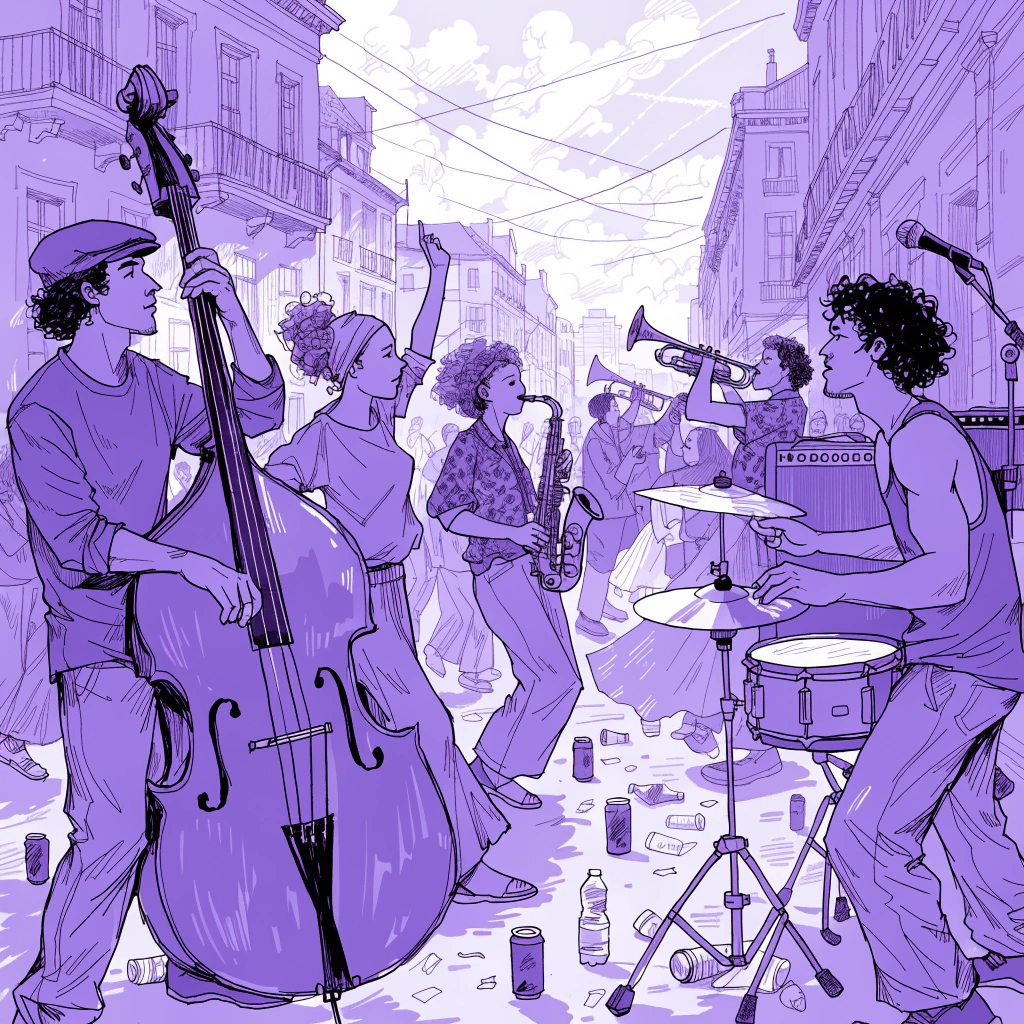
La Fiesta de la Música en Francia
¡Hola! Hoy hablamos de una fiesta muy bonita. Es la Fiesta de la Música. Esta fiesta es en Francia. Es el 21 de junio, cada año.
Muchas personas en Francia aman la música. Ellos tocan instrumentos musicales. Pero no tocan mucho en público.
En 1982, el gobierno de Francia empieza esta fiesta. Ahora, el 21 de junio, toda Francia es una gran sala de conciertos. La gente toca música en las calles. Hay muchos conciertos gratis.
Es un día para celebrar la música. Es muy alegre. ¡Todos escuchan y bailan! Es una fiesta para todos.
Gramática destacada
Patrón: El Presente Simple (verbos regulares)
"Ellos tocan instrumentos musicales."
Usamos el presente simple para hablar de acciones que ocurren ahora o que son hábitos. Para verbos como 'tocar' (terminan en -ar), quitamos '-ar' y añadimos '-an' para 'ellos/ellas/ustedes'. Por ejemplo, 'ellos tocan'.
Patrón: Hay (There is/There are)
"Hay muchos conciertos gratis."
'Hay' significa 'there is' o 'there are' en inglés. Lo usamos para decir que algo existe o está en un lugar. Es la misma forma para singular y plural. Por ejemplo, 'Hay un libro' o 'Hay muchos libros'.
Pon a prueba tu comprensión
10 preguntas · A1 Principiante · 1 vista previa gratis
Pon a prueba lo que aprendiste en este artículo. ¡Responde todas las preguntas para ganar XP!
¿Cuándo es la Fiesta de la Música?
¿Quieres terminar el quiz?
9 preguntas más te esperan. ¡Regístrate gratis para desbloquear el quiz completo y ganar XP!
Regístrate gratis¿Ya tienes cuenta? Acceder
Desglose de preguntas
¿Cuándo es la Fiesta de la Música?
Tu respuesta:
Respuesta correcta: El 21 de junio
La Fiesta de la Música es solo para músicos profesionales.
Tu respuesta:
Respuesta correcta: Falso
¿Qué significa 'gobierno'?
Tu respuesta:
Respuesta correcta: El grupo que organiza un país
En 1982, el ______ de Francia empieza esta fiesta.
Tu respuesta:
Respuesta correcta: gobierno
The Big Music Festival in France
Every year on June 21st, France celebrates a special day called the "Fête de la Musique." This festival started in 1982 because the Minister of Culture wanted more people to play music in public. He believed that music belongs to everyone. Now, it is a very famous event in every city and village across the country.
On this day, the streets are full of music from morning until night. You can hear rock, jazz, and traditional songs. Musicians do not usually play in big theaters on this day. Instead, they play on sidewalks, in parks, and in front of small cafes. Best of all, every concert is completely free for everyone to enjoy.
Professional musicians and amateurs both perform. An amateur is a person who plays music for fun, not for money. Because the music is outside, the atmosphere is happier than a normal concert. People dance in the streets and talk to their neighbors. It is a beautiful way to start the summer season.
Gramática destacada
Patrón: Past Simple
"This festival started in 1982 because the Minister of Culture wanted more people to play music."
We use the Past Simple to talk about finished actions in the past. To form it for regular verbs, we add '-ed' to the base verb.
Patrón: Comparatives
"Because the music is outside, the atmosphere is happier than a normal concert."
We use comparatives to compare two things. For short adjectives like 'happy', we change the 'y' to 'i' and add '-er' followed by 'than'.
Pon a prueba tu comprensión
11 preguntas · A2 Básico · 1 vista previa gratis
Pon a prueba lo que aprendiste en este artículo. ¡Responde todas las preguntas para ganar XP!
When does the Fête de la Musique happen?
¿Quieres terminar el quiz?
10 preguntas más te esperan. ¡Regístrate gratis para desbloquear el quiz completo y ganar XP!
Regístrate gratis¿Ya tienes cuenta? Acceder
Desglose de preguntas
When does the Fête de la Musique happen?
Tu respuesta:
Respuesta correcta: June 21st
People have to pay money to watch the concerts.
Tu respuesta:
Respuesta correcta: Falso
What does 'amateur' mean?
Tu respuesta:
Respuesta correcta: A person who plays music for fun
The streets are full of _____ from morning until night.
Tu respuesta:
Respuesta correcta: music
Where do musicians play during this festival?
Tu respuesta:
Respuesta correcta: On sidewalks and in parks
Fête de la Musique: France's Giant Street Concert
Every year on June 21st, the streets of France are filled with sound and rhythm. This special day is known as the Fête de la Musique, or 'Make Music Day.' It is a national celebration that has been celebrated since 1982. The idea was started by the French Ministry of Culture because they realized that many citizens played instruments but never had a chance to perform in public.
During this event, professional and amateur musicians are invited to play outside. You can find jazz bands on street corners, rock groups in public parks, and classical singers in front of museums. Because the concerts are free for everyone, the atmosphere is always friendly and energetic. The festival is based on the slogan 'Faites de la musique,' which is a play on words in French meaning both 'celebrate music' and 'make music.'
The festival has become a global phenomenon, and it is now organized in more than 120 countries around the world. In France, the music usually continues until late at night. Many people, who might usually stay at home, go out to explore their cities and discover new genres of music. It is a day where the barrier between the artist and the audience is broken. This tradition has changed the way people experience culture in public spaces.
If you visit France in June, you will see that music has been integrated into every part of daily life. Whether you are a talented violinist or someone who just enjoys listening, the Fête de la Musique offers something for everyone. It remains one of the most popular events in the French calendar because it brings people together through the universal language of melody. Many musicians have performed their first public shows during this festival, launching successful careers.
Gramática destacada
Patrón: Present Perfect
"The festival has become a global phenomenon."
We use the present perfect (has/have + past participle) to describe an action that started in the past and continues to be relevant now. It focuses on the result of the action.
Patrón: Passive Voice
"professional and amateur musicians are invited to play outside."
The passive voice is formed using 'to be' and the past participle. We use it when the person receiving the action is more important than the person doing it.
Pon a prueba tu comprensión
11 preguntas · B1 Intermedio · 1 vista previa gratis
Pon a prueba lo que aprendiste en este artículo. ¡Responde todas las preguntas para ganar XP!
When was the Fête de la Musique first established?
¿Quieres terminar el quiz?
10 preguntas más te esperan. ¡Regístrate gratis para desbloquear el quiz completo y ganar XP!
Regístrate gratis¿Ya tienes cuenta? Acceder
Desglose de preguntas
When was the Fête de la Musique first established?
Tu respuesta:
Respuesta correcta: 1982
The public must pay a ticket fee to attend the street concerts.
Tu respuesta:
Respuesta correcta: Falso
What does 'universal' mean in the context of the article?
Tu respuesta:
Respuesta correcta: Common to all people in the world
The festival is based on a _____ that means both 'make music' and 'celebrate music'.
Tu respuesta:
Respuesta correcta: slogan
Where can you find musicians performing during the festival?
Tu respuesta:
Respuesta correcta: In parks, street corners, and museums
A Symphony on the Streets: The Legacy of France’s Fête de la Musique
Every year on June 21st, coinciding with the summer solstice, France undergoes a remarkable transformation. This national phenomenon, known as the Fête de la Musique, turns every corner of the country into a vibrant, open-air concert hall. The event was launched in 1982 by the French Ministry of Culture, specifically under the leadership of Minister Jack Lang and Maurice Fleuret. It was born from the realization that while millions of French citizens played musical instruments, they rarely had the opportunity to perform in a public setting. Consequently, the slogan 'Faites de la musique' (Make music) was introduced, acting as a clever pun that has since resonated across the globe.
The primary objective of this initiative was the democratization of culture. By removing the traditional barriers of entry associated with formal venues, the festival allows amateur and professional musicians to perform side-by-side. On this day, the usual urban infrastructure is repurposed; sidewalks, parks, and even hospitals become stages for diverse musical genres ranging from classical orchestras to electronic DJs. This inclusivity ensures that music is accessible to all, regardless of their socio-economic background. Furthermore, all performances are required to be free of charge to the public, emphasizing the festival’s non-commercial spirit.
Since its inception, the festival has grown exponentially, evolving into a significant manifestation of French cultural identity. It is not merely a series of concerts but a social event that encourages spontaneous interaction among citizens. The festival, which takes place annually on June 21st, transforms the country into a space where social hierarchies are temporarily suspended in favor of collective artistic expression. Millions of citizens have been encouraged to share their talent, contributing to a sense of national unity.
Moreover, the success of the Fête de la Musique has not been confined to French borders. This model of celebrating music has been exported to over 120 countries and hundreds of cities worldwide. It serves as a testament to the power of public policy in fostering creativity and community spirit. Today, the event is considered a vital part of the nation's cultural heritage, illustrating how a simple call to 'make music' can result in a global movement that celebrates human creativity in its most raw and accessible form.
Gramática destacada
Patrón: Passive Voice
"The event was launched in 1982 by the French Ministry of Culture."
The passive voice (be + past participle) is used here to focus on the event itself rather than the people who started it, which is common in formal reporting.
Patrón: Non-defining Relative Clauses
"The festival, which takes place annually on June 21st, transforms the country."
This clause adds extra information about the festival. It is separated by commas and uses 'which' because it refers to a non-human subject.
Patrón: Present Perfect Passive
"Millions of citizens have been encouraged to share their talent."
This structure (have/has + been + past participle) describes an action that started in the past and continues to have an effect in the present, focusing on the people receiving the encouragement.
Pon a prueba tu comprensión
11 preguntas · B2 Intermedio alto · 1 vista previa gratis
Pon a prueba lo que aprendiste en este artículo. ¡Responde todas las preguntas para ganar XP!
What was the primary reason for creating the Fête de la Musique?
¿Quieres terminar el quiz?
10 preguntas más te esperan. ¡Regístrate gratis para desbloquear el quiz completo y ganar XP!
Regístrate gratis¿Ya tienes cuenta? Acceder
Desglose de preguntas
What was the primary reason for creating the Fête de la Musique?
Tu respuesta:
Respuesta correcta: To give amateur musicians a chance to perform in public
Performances during the festival are required to be free for the public.
Tu respuesta:
Respuesta correcta: Verdadero
What does 'democratization' mean in the context of the article?
Tu respuesta:
Respuesta correcta: Making culture accessible to all people
The slogan 'Faites de la musique' is described as a clever _____.
Tu respuesta:
Respuesta correcta: pun
Which date was chosen for the festival and why?
Tu respuesta:
Respuesta correcta: June 21st, to coincide with the summer solstice
The Harmonic Resonance of June 21st: A Sociological Analysis of France's Fête de la Musique
Seldom has a cultural initiative permeated the national consciousness as profoundly as the Fête de la Musique. What began in 1982 as a visionary decree by the French Ministry of Culture has since evolved into a ubiquitous global phenomenon, yet its heart remains firmly rooted in the egalitarian streets of France. It was under the ambitious stewardship of Jack Lang and Maurice Fleuret that this sonic revolution was inaugurated, predicated on the startling realization that while five million French citizens played an instrument, few had ever graced a public stage. The resulting mandate was simple yet revolutionary: to liberate music from the elitist confines of concert halls and return it to the burgeoning grassroots of the community.
The democratization of art is often cited as the event's primary achievement. By inviting both amateur virtuosos and professional ensembles to occupy the public square, the state effectively dismantled the traditional hierarchy of performance. However, the institutionalization of what was intended to be a spontaneous outburst of creativity presents a fascinating paradox. Critics argue that the sheer scale of the event—turning every Parisian corner into a cacophony of competing genres—has diluted the original purity of the 'Faites de la musique' pun, which encouraged citizens to 'make music' rather than merely consume it.
Furthermore, the ephemeral nature of the festival is part of its profound resonance. For twenty-four hours, the rigid structures of urban life are suspended, replaced by a fluid landscape of sound that ignores social strata. Yet, as the event has matured, it has faced scrutiny regarding commercialization. The tension between state-sponsored organization and organic street culture is palpable; where once a lone accordionist might have held court, now massive corporate-sponsored stages often dominate the larger boulevards.
Despite these critiques, the Fête de la Musique remains a masterclass in cultural policy. It demonstrates how a top-down government initiative can successfully foster a bottom-up cultural identity. Not only does it provide a platform for burgeoning talent, but it also reinforces the notion of the city as a shared, living space. Whether one views the event as a triumph of cultural accessibility or a chaotic descent into sonic clutter, its enduring popularity is undeniable. It remains a testament to the power of a collective aesthetic experience to bridge the divide between the individual and the state.
Gramática destacada
Patrón: Negative Inversion
"Seldom has a cultural initiative permeated the national consciousness as profoundly as the Fête de la Musique."
When using negative or restrictive adverbs like 'seldom' at the beginning of a sentence for emphasis, the subject and auxiliary verb are inverted.
Patrón: Cleft Sentences
"It was under the ambitious stewardship of Jack Lang and Maurice Fleuret that this sonic revolution was inaugurated."
Cleft sentences use the structure 'It is/was... that...' to focus on a specific piece of information, highlighting the importance of the creators in this context.
Patrón: Nominalisation
"The institutionalization of what was intended to be a spontaneous outburst of creativity presents a fascinating paradox."
Nominalisation involves turning verbs or adjectives into nouns to create a more formal, academic tone and to focus on the concept rather than the action.
Pon a prueba tu comprensión
12 preguntas · C1 Avanzado · 1 vista previa gratis
Pon a prueba lo que aprendiste en este artículo. ¡Responde todas las preguntas para ganar XP!
What was the primary realization that led to the creation of the Fête de la Musique?
¿Quieres terminar el quiz?
11 preguntas más te esperan. ¡Regístrate gratis para desbloquear el quiz completo y ganar XP!
Regístrate gratis¿Ya tienes cuenta? Acceder
Desglose de preguntas
What was the primary realization that led to the creation of the Fête de la Musique?
Tu respuesta:
Respuesta correcta: Millions of citizens played instruments but lacked public performance opportunities.
The author suggests that the event has successfully maintained its original purity without any commercial influence.
Tu respuesta:
Respuesta correcta: Falso
Which word describes something that is present everywhere at the same time?
Tu respuesta:
Respuesta correcta: Ubiquitous
The author notes that the event has faced _____ regarding its commercialization as it has matured.
Tu respuesta:
Respuesta correcta: scrutiny
According to the text, what paradox exists within the modern festival?
Tu respuesta:
Respuesta correcta: It is a state-organized event that was meant to be a spontaneous outburst.
The phrase 'Faites de la musique' is described as a pun in the article.
Tu respuesta:
Respuesta correcta: Verdadero
The Sonorous Solstice: Analyzing the Socio-Cultural Paradigm of the Fête de la Musique
The summer solstice in France is characterized not merely by the astronomical zenith of the sun, but by a pervasive auditory transformation that permeates the very fabric of the hexagonal landscape. Since its inception in 1982, the Fête de la Musique has transcended its origins as a government-led initiative to become a quintessential manifestation of egalitarian cultural expression. Seldom has a bureaucratic mandate so effectively catalyzed a grassroots upheaval, turning the labyrinthine streets of Paris and the quietude of provincial hamlets into a singular, albeit dissonant, concert hall. The impetus for this phenomenon lay in a startling sociological revelation: while millions of French citizens were proficient in musical instruments, the prevailing cultural infrastructure offered negligible avenues for public performance. Under the stewardship of Jack Lang and Maurice Fleuret, the Ministry of Culture sought a radical democratization of the arts. They envisioned a day where the distinction between the neophyte and the virtuoso would be rendered irrelevant, and the sanctity of the concert hall would be supplanted by the raw vitality of the pavement.
Central to the success of this endeavor is the ethos of total inclusivity. The slogan 'Faites de la musique'—a homophonic pun urging the populace to 'make music'—functions as an imperative that bypasses traditional gatekeeping. It is essential that this sonic landscape be perceived not as a curated festival, but as a heuristic exploration of urban space. On June 21st, the juxtaposition of a conservatory-trained cellist performing Bach alongside a punk rock ensemble in a neighboring alleyway creates a unique cultural palimpsest. This ephemeral transformation of the public sphere challenges the ontological status of music as a commodity. By decreeing that all performances must be free to the public and that musicians receive no remuneration, the state effectively de-commodified the art form, returning it to its primal state as a communal ritual.
Furthermore, the ubiquity of the event has fostered a peculiar sense of national cohesion. In an era often defined by social fragmentation, the Fête de la Musique serves as a momentary suspension of the mundane. Should one venture into any French town on this night, one would encounter a cacophony that defies standard aesthetic categorization. To the uninitiated, this might appear as mere auditory chaos; however, to the analytical observer, it represents the pinnacle of cultural spontaneity. Had the Ministry not intervened in the early eighties, the latent musicality of the French proletariat might have remained perpetually stifled within the domestic sphere. Instead, the event has become a global export, with hundreds of cities worldwide adopting the model, proving that the desire for unmediated creative expression is a universal human constant. Ultimately, the Fête de la Musique stands as a testament to the power of state-sponsored liberty, where the only requirement for participation is the audacity to be heard.
Gramática destacada
Patrón: Inversion with Negative/Restrictive Adverbs
"Seldom has a bureaucratic mandate so effectively catalyzed a grassroots upheaval..."
When 'seldom' or other negative adverbs begin a sentence for emphasis, the subject and auxiliary verb are inverted. This creates a more formal and dramatic tone typical of C2 analytical writing.
Patrón: Present Subjunctive
"It is essential that this sonic landscape be perceived not as a curated festival..."
The subjunctive mood is used after adjectives of necessity (essential, imperative). The base form of the verb 'be' is used regardless of the subject to express a requirement or desire.
Patrón: Third Conditional (Inverted/Formal)
"Had the Ministry not intervened in the early eighties, the latent musicality... might have remained perpetually stifled..."
This structure uses 'Had' at the beginning of the clause to replace 'If', expressing a hypothetical past situation and its potential consequence. It is highly formal and scholarly.
Pon a prueba tu comprensión
12 preguntas · C2 Dominio · 1 vista previa gratis
Pon a prueba lo que aprendiste en este artículo. ¡Responde todas las preguntas para ganar XP!
What was the primary sociological motivation behind the creation of the Fête de la Musique?
¿Quieres terminar el quiz?
11 preguntas más te esperan. ¡Regístrate gratis para desbloquear el quiz completo y ganar XP!
Regístrate gratis¿Ya tienes cuenta? Acceder
Desglose de preguntas
What was the primary sociological motivation behind the creation of the Fête de la Musique?
Tu respuesta:
Respuesta correcta: To address the lack of public performance opportunities for amateur musicians.
The article suggests that the event maintains a strict hierarchy between professional and amateur musicians.
Tu respuesta:
Respuesta correcta: Falso
Which word describes something that is transitory and lasts for a very short duration?
Tu respuesta:
Respuesta correcta: Ephemeral
The state's decision to ban remuneration effectively _____ the art form during the event.
Tu respuesta:
Respuesta correcta: de-commodified
How does the author characterize the 'cacophony' heard during the festival?
Tu respuesta:
Respuesta correcta: As the pinnacle of cultural spontaneity.
The Fête de la Musique has remained a strictly French phenomenon and has not spread internationally.
Tu respuesta:
Respuesta correcta: Falso

