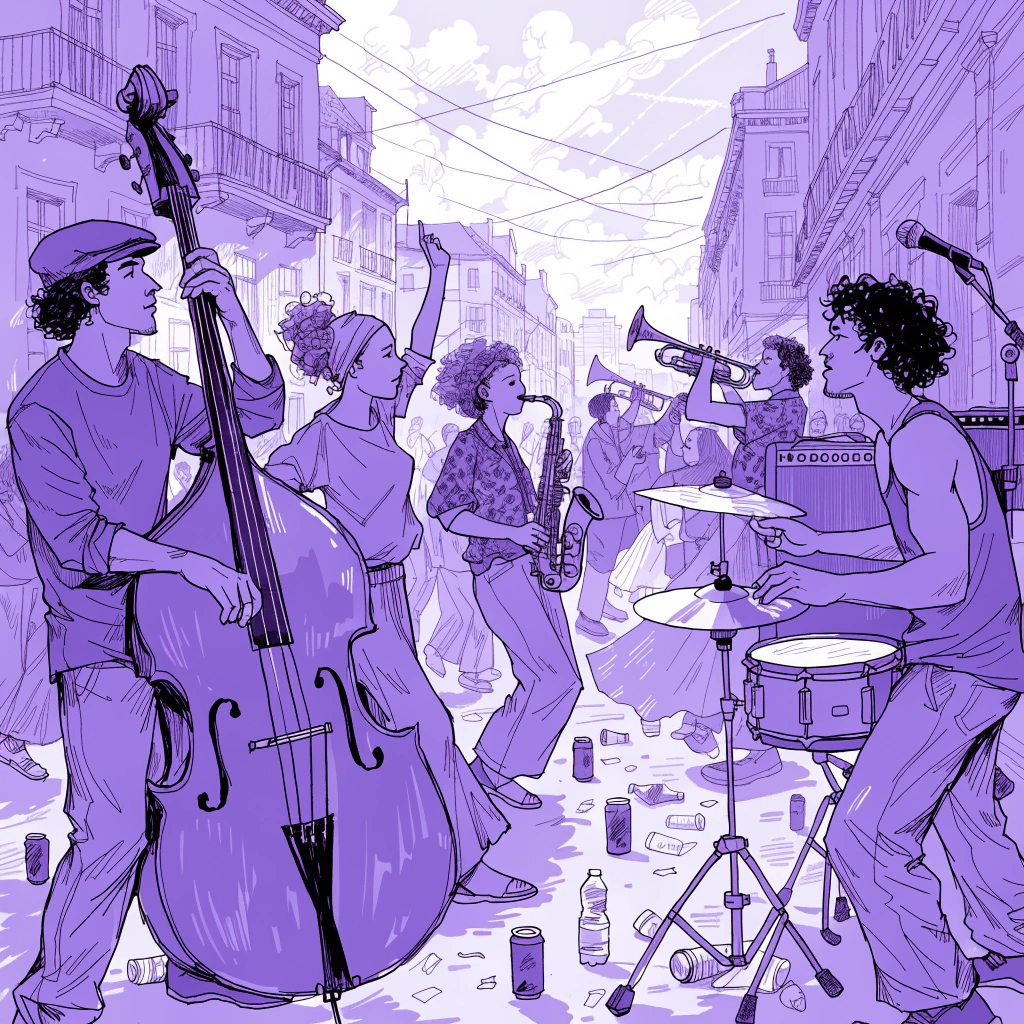
Music Day in France
Every year on June 21st, France has a big party. It is the Fête de la Musique. People call it Music Day. On this day, music is everywhere. You can see musicians in the streets, in the parks, and in the cafes.
Many people play instruments. Some people play the guitar. Other people sing songs. The concerts are free for everyone. You do not need a ticket. It is a happy day for families and friends. They walk around the city and listen to music. It is a special day in France.
문법 스포트라이트
패턴: Present Simple (to be)
"It is a special day in France."
We use 'is' with singular subjects like 'it', 'he', or 'she' to describe facts. It is the most common verb in English.
패턴: Can for Possibility
"You can see musicians in the streets."
We use 'can' to say that something is possible. After 'can', we use the base form of the verb without 'to'.
이해도를 테스트하세요
10 질문 · A1 초급 · 무료 미리보기 1회
이 기사에서 배운 내용을 테스트하세요. 모든 질문에 답하여 XP를 획득하세요!
When is the Fête de la Musique?
문제별 결과
When is the Fête de la Musique?
내 답변:
정답: June 21st
The concerts are free for everyone.
내 답변:
정답: 참
What is an 'instrument'?
내 답변:
정답: A thing used to make music
Some people play the _____.
내 답변:
정답: guitar
The Big Music Festival in France
Every year on June 21st, France celebrates a special day called the "Fête de la Musique." This festival started in 1982 because the Minister of Culture wanted more people to play music in public. He believed that music belongs to everyone. Now, it is a very famous event in every city and village across the country.
On this day, the streets are full of music from morning until night. You can hear rock, jazz, and traditional songs. Musicians do not usually play in big theaters on this day. Instead, they play on sidewalks, in parks, and in front of small cafes. Best of all, every concert is completely free for everyone to enjoy.
Professional musicians and amateurs both perform. An amateur is a person who plays music for fun, not for money. Because the music is outside, the atmosphere is happier than a normal concert. People dance in the streets and talk to their neighbors. It is a beautiful way to start the summer season.
문법 스포트라이트
패턴: Past Simple
"This festival started in 1982 because the Minister of Culture wanted more people to play music."
We use the Past Simple to talk about finished actions in the past. To form it for regular verbs, we add '-ed' to the base verb.
패턴: Comparatives
"Because the music is outside, the atmosphere is happier than a normal concert."
We use comparatives to compare two things. For short adjectives like 'happy', we change the 'y' to 'i' and add '-er' followed by 'than'.
이해도를 테스트하세요
11 질문 · A2 초등급 · 무료 미리보기 1회
이 기사에서 배운 내용을 테스트하세요. 모든 질문에 답하여 XP를 획득하세요!
When does the Fête de la Musique happen?
문제별 결과
When does the Fête de la Musique happen?
내 답변:
정답: June 21st
People have to pay money to watch the concerts.
내 답변:
정답: 거짓
What does 'amateur' mean?
내 답변:
정답: A person who plays music for fun
The streets are full of _____ from morning until night.
내 답변:
정답: music
Where do musicians play during this festival?
내 답변:
정답: On sidewalks and in parks
Fête de la Musique: France's Giant Street Concert
Every year on June 21st, the streets of France are filled with sound and rhythm. This special day is known as the Fête de la Musique, or 'Make Music Day.' It is a national celebration that has been celebrated since 1982. The idea was started by the French Ministry of Culture because they realized that many citizens played instruments but never had a chance to perform in public.
During this event, professional and amateur musicians are invited to play outside. You can find jazz bands on street corners, rock groups in public parks, and classical singers in front of museums. Because the concerts are free for everyone, the atmosphere is always friendly and energetic. The festival is based on the slogan 'Faites de la musique,' which is a play on words in French meaning both 'celebrate music' and 'make music.'
The festival has become a global phenomenon, and it is now organized in more than 120 countries around the world. In France, the music usually continues until late at night. Many people, who might usually stay at home, go out to explore their cities and discover new genres of music. It is a day where the barrier between the artist and the audience is broken. This tradition has changed the way people experience culture in public spaces.
If you visit France in June, you will see that music has been integrated into every part of daily life. Whether you are a talented violinist or someone who just enjoys listening, the Fête de la Musique offers something for everyone. It remains one of the most popular events in the French calendar because it brings people together through the universal language of melody. Many musicians have performed their first public shows during this festival, launching successful careers.
문법 스포트라이트
패턴: Present Perfect
"The festival has become a global phenomenon."
We use the present perfect (has/have + past participle) to describe an action that started in the past and continues to be relevant now. It focuses on the result of the action.
패턴: Passive Voice
"professional and amateur musicians are invited to play outside."
The passive voice is formed using 'to be' and the past participle. We use it when the person receiving the action is more important than the person doing it.
이해도를 테스트하세요
11 질문 · B1 중급 · 무료 미리보기 1회
이 기사에서 배운 내용을 테스트하세요. 모든 질문에 답하여 XP를 획득하세요!
When was the Fête de la Musique first established?
문제별 결과
When was the Fête de la Musique first established?
내 답변:
정답: 1982
The public must pay a ticket fee to attend the street concerts.
내 답변:
정답: 거짓
What does 'universal' mean in the context of the article?
내 답변:
정답: Common to all people in the world
The festival is based on a _____ that means both 'make music' and 'celebrate music'.
내 답변:
정답: slogan
Where can you find musicians performing during the festival?
내 답변:
정답: In parks, street corners, and museums
A Symphony on the Streets: The Legacy of France’s Fête de la Musique
Every year on June 21st, coinciding with the summer solstice, France undergoes a remarkable transformation. This national phenomenon, known as the Fête de la Musique, turns every corner of the country into a vibrant, open-air concert hall. The event was launched in 1982 by the French Ministry of Culture, specifically under the leadership of Minister Jack Lang and Maurice Fleuret. It was born from the realization that while millions of French citizens played musical instruments, they rarely had the opportunity to perform in a public setting. Consequently, the slogan 'Faites de la musique' (Make music) was introduced, acting as a clever pun that has since resonated across the globe.
The primary objective of this initiative was the democratization of culture. By removing the traditional barriers of entry associated with formal venues, the festival allows amateur and professional musicians to perform side-by-side. On this day, the usual urban infrastructure is repurposed; sidewalks, parks, and even hospitals become stages for diverse musical genres ranging from classical orchestras to electronic DJs. This inclusivity ensures that music is accessible to all, regardless of their socio-economic background. Furthermore, all performances are required to be free of charge to the public, emphasizing the festival’s non-commercial spirit.
Since its inception, the festival has grown exponentially, evolving into a significant manifestation of French cultural identity. It is not merely a series of concerts but a social event that encourages spontaneous interaction among citizens. The festival, which takes place annually on June 21st, transforms the country into a space where social hierarchies are temporarily suspended in favor of collective artistic expression. Millions of citizens have been encouraged to share their talent, contributing to a sense of national unity.
Moreover, the success of the Fête de la Musique has not been confined to French borders. This model of celebrating music has been exported to over 120 countries and hundreds of cities worldwide. It serves as a testament to the power of public policy in fostering creativity and community spirit. Today, the event is considered a vital part of the nation's cultural heritage, illustrating how a simple call to 'make music' can result in a global movement that celebrates human creativity in its most raw and accessible form.
문법 스포트라이트
패턴: Passive Voice
"The event was launched in 1982 by the French Ministry of Culture."
The passive voice (be + past participle) is used here to focus on the event itself rather than the people who started it, which is common in formal reporting.
패턴: Non-defining Relative Clauses
"The festival, which takes place annually on June 21st, transforms the country."
This clause adds extra information about the festival. It is separated by commas and uses 'which' because it refers to a non-human subject.
패턴: Present Perfect Passive
"Millions of citizens have been encouraged to share their talent."
This structure (have/has + been + past participle) describes an action that started in the past and continues to have an effect in the present, focusing on the people receiving the encouragement.
이해도를 테스트하세요
11 질문 · B2 중상급 · 무료 미리보기 1회
이 기사에서 배운 내용을 테스트하세요. 모든 질문에 답하여 XP를 획득하세요!
What was the primary reason for creating the Fête de la Musique?
문제별 결과
What was the primary reason for creating the Fête de la Musique?
내 답변:
정답: To give amateur musicians a chance to perform in public
Performances during the festival are required to be free for the public.
내 답변:
정답: 참
What does 'democratization' mean in the context of the article?
내 답변:
정답: Making culture accessible to all people
The slogan 'Faites de la musique' is described as a clever _____.
내 답변:
정답: pun
Which date was chosen for the festival and why?
내 답변:
정답: June 21st, to coincide with the summer solstice
프랑스 '음악 축제': 국경을 넘어선 화합의 선율
매년 6월 21일, 프랑스 전역은 거대한 야외 콘서트장으로 변모합니다. 바로 '페트 드 라 뮤지크(Fête de la Musique)', 즉 '음악 축제'가 열리는 날이기 때문입니다. 이 축제는 단순한 하루짜리 행사를 넘어, 음악의 힘으로 모든 이가 하나 되는 문화적 현상으로 자리매김했습니다. 거리, 광장, 공원, 심지어 박물관이나 병원까지, 프랑스 전역의 모든 공간이 음악으로 가득 차는 이 날은, 음악이 가진 보편적인 언어로서의 가치를 재확인시켜 줍니다.
이 독특하고 고무적인 축제의 기원은 1982년으로 거슬러 올라갑니다. 당시 프랑스 문화부 장관이었던 자크 랑(Jack Lang)과 음악 감독 모리스 플뢰레(Maurice Fleuret)는 뜻밖의 통계에 주목했습니다. 수백만 명의 프랑스인이 악기를 다루지만, 대중 앞에서 자신의 음악을 선보일 기회는 턱없이 부족하다는 인식에서 비롯된 것입니다. 이에 그들은 'Faites de la musique (음악을 만드세요)'라는 슬로건 아래, 누구나 자유롭게 음악을 연주하고 즐길 수 있는 축제를 기획했습니다. 이는 전문가와 아마추어의 경계를 허물고, 모든 계층이 음악을 통해 소통하고 교감할 수 있는 장을 마련하고자 하는 깊은 염원이 담긴 것이었습니다.
'음악 축제'의 가장 큰 특징은 바로 '자발적인 참여'와 '무료 공연'에 있습니다. 클래식, 록, 재즈, 힙합, 전자음악, 전통음악 등 장르를 불문하고 모든 형태의 음악이 거리를 수놓습니다. 어린아이부터 노인까지, 전문 음악인부터 취미로 악기를 다루는 아마추어까지, 누구나 자신의 음악적 열정을 공유할 수 있습니다. 상업성을 철저히 배제하고 순수한 음악적 교류에 초점을 맞춘다는 점은, 이 축제가 다른 여느 축제와 차별화되는 고유한 가치라 할 수 있습니다. 이처럼 음악의 저변 확대와 문화적 포용성을 지향하는 이념은 축제의 성공적인 확산에 결정적인 역할을 했습니다.
이 축제는 프랑스 사회 전반에 걸쳐 문화적 응집력을 강화하는 데 지대한 공헌을 했습니다. 음악을 통한 공동체 의식 함양은 물론, 전 국민이 음악의 향연을 만끽하며 문화적 향유권을 누리게 하는 데 일조하고 있습니다. 음악이 단순히 감상하는 것을 넘어, 적극적으로 창조되고 공유되는 과정의 중요성을 일깨워주는 것이 바로 이 축제가 지향하는 바입니다. 이례적인 것은, 단일 국가에서 시작된 이 행사가 프랑스를 넘어 전 세계 120여 개국으로 파급력을 넓혔다는 사실입니다. 유엔(UN)이 지정한 '세계 음악의 날'과도 날짜가 일치하는 것은 결코 우연이 아닐 것입니다.
결론적으로, 프랑스의 '음악 축제'는 단순한 여흥을 넘어, 음악이 가진 본질적인 힘과 예술의 사회적 역할에 대한 깊은 성찰을 제공합니다. 매년 여름의 시작을 알리는 이 축제는, 음악으로 하나 되는 인류의 꿈을 가시화하는 데 크게 기여하고 있음이 분명하며, 앞으로도 그 영향력은 더욱 확대될 것으로 전망됩니다. 음악을 통해 국경과 언어, 문화의 장벽을 허물고 모두가 함께 어우러지는 화합의 장을 만들어가는 이 축제의 미래가 자못 기대됩니다.
문법 스포트라이트
패턴: A다는 인식에서 비롯되다
"수백만 명의 프랑스인이 악기를 다루지만, 대중 앞에서 자신의 음악을 선보일 기회는 턱없이 부족하다는 인식에서 비롯된 것입니다."
이 문형은 어떤 현상이나 결과가 특정 '인식'이나 '생각'에서 시작되었음을 나타낼 때 사용합니다. 동사나 형용사 뒤에 '-다는 인식'을 붙여 명사화하고, '-에서 비롯되다'는 '그것이 원인이 되어 시작되다'라는 의미를 가집니다. 고급 한국어에서 원인과 결과를 설명할 때 유용하게 쓰입니다.
패턴: A가 지향하는 바는 B이다
"음악이 단순히 감상하는 것을 넘어, 적극적으로 창조되고 공유되는 과정의 중요성을 일깨워주는 것이 바로 이 축제가 지향하는 바입니다."
이 문형은 'A가 목표로 하거나 추구하는 것'이 무엇인지를 강조할 때 사용합니다. '바'는 '것'과 유사하게 쓰이는 의존 명사로, 앞선 문장의 내용을 명사화하여 강조하는 역할을 합니다. 특히 '바로'와 함께 쓰여 뒤따라오는 내용을 강하게 부각시킵니다.
패턴: A을/를 불문하고
"클래식, 록, 재즈, 힙합, 전자음악, 전통음악 등 장르를 불문하고 모든 형태의 음악이 거리를 수놓습니다."
이 문형은 앞에 오는 명사나 명사구에 상관없이 뒤의 내용이 적용됨을 나타냅니다. 'A에 관계없이, A를 따지지 않고'와 같은 의미로, 특정 조건이나 구분을 두지 않는다는 점을 강조할 때 사용합니다. 주로 종류나 범위를 나타내는 명사 뒤에 붙습니다.
이해도를 테스트하세요
12 질문 · C1 고급 · 무료 미리보기 1회
이 기사에서 배운 내용을 테스트하세요. 모든 질문에 답하여 XP를 획득하세요!
'음악 축제'가 매년 열리는 날짜는 언제입니까?
문제별 결과
'음악 축제'가 매년 열리는 날짜는 언제입니까?
내 답변:
정답: 6월 21일
'음악 축제'는 전문가들만을 위한 공연 기회를 제공합니다.
내 답변:
정답: 거짓
다음 중 '고무적'의 의미로 가장 적절한 것은 무엇입니까?
내 답변:
정답: 용기나 의욕을 북돋아 주는
이 축제는 상업성을 철저히 배제하고 순수한 음악적 _______에 초점을 맞춥니다.
내 답변:
정답: 교류
'음악 축제'의 기원에 대한 설명으로 옳지 않은 것은 무엇입니까?
내 답변:
정답: 대규모 상업적 이벤트를 목적으로 기획되었다.
'음악 축제'는 프랑스에서 시작되었지만, 다른 나라로는 확산되지 못했습니다.
내 답변:
정답: 거짓
The Sonorous Solstice: Analyzing the Socio-Cultural Paradigm of the Fête de la Musique
The summer solstice in France is characterized not merely by the astronomical zenith of the sun, but by a pervasive auditory transformation that permeates the very fabric of the hexagonal landscape. Since its inception in 1982, the Fête de la Musique has transcended its origins as a government-led initiative to become a quintessential manifestation of egalitarian cultural expression. Seldom has a bureaucratic mandate so effectively catalyzed a grassroots upheaval, turning the labyrinthine streets of Paris and the quietude of provincial hamlets into a singular, albeit dissonant, concert hall. The impetus for this phenomenon lay in a startling sociological revelation: while millions of French citizens were proficient in musical instruments, the prevailing cultural infrastructure offered negligible avenues for public performance. Under the stewardship of Jack Lang and Maurice Fleuret, the Ministry of Culture sought a radical democratization of the arts. They envisioned a day where the distinction between the neophyte and the virtuoso would be rendered irrelevant, and the sanctity of the concert hall would be supplanted by the raw vitality of the pavement.
Central to the success of this endeavor is the ethos of total inclusivity. The slogan 'Faites de la musique'—a homophonic pun urging the populace to 'make music'—functions as an imperative that bypasses traditional gatekeeping. It is essential that this sonic landscape be perceived not as a curated festival, but as a heuristic exploration of urban space. On June 21st, the juxtaposition of a conservatory-trained cellist performing Bach alongside a punk rock ensemble in a neighboring alleyway creates a unique cultural palimpsest. This ephemeral transformation of the public sphere challenges the ontological status of music as a commodity. By decreeing that all performances must be free to the public and that musicians receive no remuneration, the state effectively de-commodified the art form, returning it to its primal state as a communal ritual.
Furthermore, the ubiquity of the event has fostered a peculiar sense of national cohesion. In an era often defined by social fragmentation, the Fête de la Musique serves as a momentary suspension of the mundane. Should one venture into any French town on this night, one would encounter a cacophony that defies standard aesthetic categorization. To the uninitiated, this might appear as mere auditory chaos; however, to the analytical observer, it represents the pinnacle of cultural spontaneity. Had the Ministry not intervened in the early eighties, the latent musicality of the French proletariat might have remained perpetually stifled within the domestic sphere. Instead, the event has become a global export, with hundreds of cities worldwide adopting the model, proving that the desire for unmediated creative expression is a universal human constant. Ultimately, the Fête de la Musique stands as a testament to the power of state-sponsored liberty, where the only requirement for participation is the audacity to be heard.
문법 스포트라이트
패턴: Inversion with Negative/Restrictive Adverbs
"Seldom has a bureaucratic mandate so effectively catalyzed a grassroots upheaval..."
When 'seldom' or other negative adverbs begin a sentence for emphasis, the subject and auxiliary verb are inverted. This creates a more formal and dramatic tone typical of C2 analytical writing.
패턴: Present Subjunctive
"It is essential that this sonic landscape be perceived not as a curated festival..."
The subjunctive mood is used after adjectives of necessity (essential, imperative). The base form of the verb 'be' is used regardless of the subject to express a requirement or desire.
패턴: Third Conditional (Inverted/Formal)
"Had the Ministry not intervened in the early eighties, the latent musicality... might have remained perpetually stifled..."
This structure uses 'Had' at the beginning of the clause to replace 'If', expressing a hypothetical past situation and its potential consequence. It is highly formal and scholarly.
이해도를 테스트하세요
12 질문 · C2 마스터 · 무료 미리보기 1회
이 기사에서 배운 내용을 테스트하세요. 모든 질문에 답하여 XP를 획득하세요!
What was the primary sociological motivation behind the creation of the Fête de la Musique?
문제별 결과
What was the primary sociological motivation behind the creation of the Fête de la Musique?
내 답변:
정답: To address the lack of public performance opportunities for amateur musicians.
The article suggests that the event maintains a strict hierarchy between professional and amateur musicians.
내 답변:
정답: 거짓
Which word describes something that is transitory and lasts for a very short duration?
내 답변:
정답: Ephemeral
The state's decision to ban remuneration effectively _____ the art form during the event.
내 답변:
정답: de-commodified
How does the author characterize the 'cacophony' heard during the festival?
내 답변:
정답: As the pinnacle of cultural spontaneity.
The Fête de la Musique has remained a strictly French phenomenon and has not spread internationally.
내 답변:
정답: 거짓

