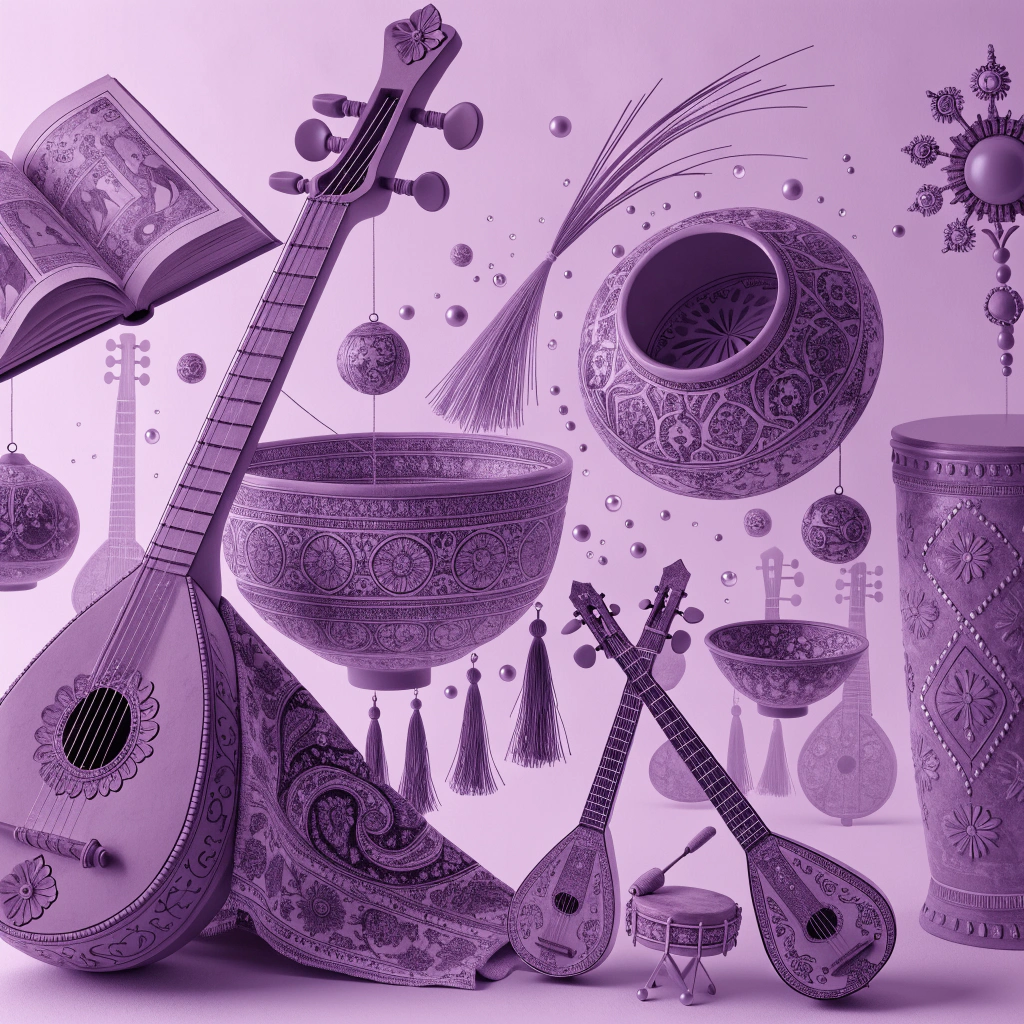
Beautiful Small Paintings from Iran
Persian miniature is a beautiful art from Iran. People draw these small paintings in books. They use bright colors like blue, red, and gold. These colors are very pretty.
The paintings show stories about kings and heroes. The artists do not use shadows. They draw everything very clearly. You can see the flowers, the people, and the horses.
Today, many people in Iran still make this art. It is a very old tradition. Many museums show these small paintings. They are a special part of Iranian history.
Point grammaire
Structure: Present Simple 'to be'
"Persian miniature is a beautiful art from Iran."
We use 'is' with singular subjects like 'miniature' to describe what something is. It is common for facts and descriptions.
Structure: Present Simple (Action Verbs)
"They use bright colors like blue, red, and gold."
For the subject 'they', we use the base form of the verb without adding 's'. This describes a general fact or habit.
Teste ta compréhension
10 questions · A1 Débutant · 1 aperçu gratuit
Teste ce que tu as appris dans cet article. Réponds à toutes les questions pour gagner des XP !
Where is this art from?
Tu veux terminer le quiz ?
9 questions supplémentaires t'attendent. Inscris-toi gratuitement pour débloquer le quiz complet et gagner des XP !
S'inscrire gratuitementTu as dj un compte ? Connexion
Bien joué !
Continue à pratiquer !
Déjà terminé — pas de XP supplémentaire
Inscris-toi pour gagner des XPDétail des questions
Where is this art from?
Ta réponse:
Bonne réponse: Iran
Artists use shadows in these paintings.
Ta réponse:
Bonne réponse: Faux
What does 'bright' mean?
Ta réponse:
Bonne réponse: Strong and colorful
People draw these small paintings in _____.
Ta réponse:
Bonne réponse: books
The Beautiful Persian Miniature Paintings
Persian miniature painting is a very famous art from Iran. These paintings are small, but they have many details. Long ago, artists painted them to tell stories in books. This art was very popular between the 13th and 16th centuries.
The artists used special colors. They used bright blue, red, and even real gold. These paintings are different because they do not use shadows. In European art, things look 3D, but Persian miniatures look flat and beautiful. It is like looking at a world from a bird's eye.
Persian miniatures are more colorful than other old paintings. Many people visited Iran to see these masterpieces. Today, you can see them in museums. They are important because they show the history and the imagination of the Persian people. Artists worked for a long time to finish one small picture because every line was important.
Point grammaire
Structure: Past Simple
"Artists worked for a long time to finish one small picture because every line was important."
We use the past simple to talk about finished actions in the past. For regular verbs, we usually add '-ed' to the end of the verb.
Structure: Comparatives
"Persian miniatures are more colorful than other old paintings."
We use 'more + adjective + than' to compare two things when the adjective is long (like 'colorful'). It shows which one has more of a quality.
Teste ta compréhension
11 questions · A2 mentaire · 1 aperçu gratuit
Teste ce que tu as appris dans cet article. Réponds à toutes les questions pour gagner des XP !
What is a Persian miniature?
Tu veux terminer le quiz ?
10 questions supplémentaires t'attendent. Inscris-toi gratuitement pour débloquer le quiz complet et gagner des XP !
S'inscrire gratuitementTu as dj un compte ? Connexion
Bien joué !
Continue à pratiquer !
Déjà terminé — pas de XP supplémentaire
Inscris-toi pour gagner des XPDétail des questions
What is a Persian miniature?
Ta réponse:
Bonne réponse: A small, detailed painting
Persian miniatures use shadows to look 3D.
Ta réponse:
Bonne réponse: Faux
What does 'century' mean?
Ta réponse:
Bonne réponse: One hundred years
The artists used bright _____ like blue and gold to paint.
Ta réponse:
Bonne réponse: colors
When was this art very popular?
Ta réponse:
Bonne réponse: Between the 13th and 16th centuries
The Magic of Persian Miniature Painting
Persian miniature painting is a beautiful art form that has existed for centuries in Iran. These small, detailed paintings were originally created to illustrate books of poetry and history. During the Timurid and Safavid periods, this art reached its highest level of popularity. It transforms simple paper into a gateway for the imagination.
Unlike Western paintings from the same time, Persian miniatures do not use 3D effects or realistic shadows. Instead, artists use a 'bird's eye view,' which allows the viewer to see everything in the scene at once. The colors are very bright because they are made from natural minerals and plants. These pigments have stayed vibrant for hundreds of years, making the stories on the pages come to life.
The process of making a miniature is very difficult. Tiny brushes, which are often made from squirrel hair, are used to paint incredibly small details. Artists must have a lot of patience and a steady hand to complete a single piece. Many famous stories, like the 'Shahnameh,' have been illustrated with these beautiful paintings over the years.
In modern Iran, this tradition has been kept alive by talented artists who still teach these ancient techniques to new generations. Although the world has changed, the beauty of the Persian miniature remains a symbol of Iranian culture. It is an art form that has been admired by people all over the world for its elegance and imagination.
Point grammaire
Structure: Passive Voice
"These small, detailed paintings were originally created to illustrate books of poetry and history."
The passive voice is formed with 'be' + past participle. It is used here because the paintings (the object) are more important than the specific person who painted them.
Structure: Relative Clauses
"In modern Iran, this tradition has been kept alive by talented artists who still teach these ancient techniques."
Relative clauses start with words like 'who' or 'which' to give more information about a noun. Here, 'who' tells us more about the 'talented artists'.
Teste ta compréhension
11 questions · B1 Intermédiaire · 1 aperçu gratuit
Teste ce que tu as appris dans cet article. Réponds à toutes les questions pour gagner des XP !
What was the original purpose of Persian miniatures?
Tu veux terminer le quiz ?
10 questions supplémentaires t'attendent. Inscris-toi gratuitement pour débloquer le quiz complet et gagner des XP !
S'inscrire gratuitementTu as dj un compte ? Connexion
Bien joué !
Continue à pratiquer !
Déjà terminé — pas de XP supplémentaire
Inscris-toi pour gagner des XPDétail des questions
What was the original purpose of Persian miniatures?
Ta réponse:
Bonne réponse: To illustrate books of poetry and history
Persian miniatures use realistic shadows and 3D effects like Western art.
Ta réponse:
Bonne réponse: Faux
What does 'vibrant' mean in the context of the article?
Ta réponse:
Bonne réponse: Bright and full of color
Artists use tiny _____ made from squirrel hair to paint details.
Ta réponse:
Bonne réponse: brushes
During which periods did this art reach its highest popularity?
Ta réponse:
Bonne réponse: Timurid and Safavid
Beyond the Canvas: The Timeless Art of Persian Miniature Painting
Persian miniature painting represents an extraordinary fusion of artistic precision and poetic imagination. Originating as a decorative accompaniment to literary manuscripts, this exquisite art form reached its zenith during the Timurid and Safavid eras, eventually becoming a cornerstone of Iranian cultural identity. Unlike the Renaissance artists of Europe, who were obsessed with capturing physical depth, Persian masters intentionally avoided linear perspective. Instead, they opted for a "bird’s-eye view," which allowed them to present multiple scenes within a single, two-dimensional composition.
The aesthetic philosophy behind these miniatures is deeply rooted in symbolism. Every element, from the intricate floral patterns to the specific placement of figures, serves a narrative purpose. By utilizing vibrant, saturated pigments derived from minerals and precious stones, artists created worlds that felt more ethereal than real. Gold and silver were frequently applied to highlight the divine or royal nature of the subjects. Consequently, the viewer is not merely looking at a scene but is invited to contemplate a spiritual landscape where time and space function differently than in the physical world.
Furthermore, the production of a miniature was a highly collaborative process. A single manuscript might involve several specialists, including calligraphers, gilders, and the painters themselves. This collective effort ensured that the final product was a masterpiece of harmony. Although the popularity of book illustration declined with the introduction of printing, the influence of the Persian miniature persists. Today, it is recognized by UNESCO as an intangible cultural heritage, serving as a testament to the enduring power of Iranian craftsmanship. While contemporary artists have adapted these traditional techniques to reflect modern themes, the core principles of the miniature remain a vital source of inspiration. In conclusion, Persian miniature painting is not just a relic of the past; it is a sophisticated visual language that continues to bridge the gap between the mundane and the celestial.
Point grammaire
Structure: Non-defining Relative Clauses
"Unlike the Renaissance artists of Europe, who were obsessed with capturing physical depth, Persian masters intentionally avoided linear perspective."
These clauses provide extra information about a noun but are not essential for the sentence's meaning. They are separated by commas and often use 'who' or 'which'.
Structure: Passive Voice
"Gold and silver were frequently applied to highlight the divine or royal nature of the subjects."
The passive voice is used here to focus on the action and the materials rather than the artist. It is formed using the verb 'to be' and the past participle.
Structure: Present Perfect Tense
"While contemporary artists have adapted these traditional techniques to reflect modern themes..."
This tense connects the past to the present. It is used here to show how past traditions continue to influence artists in the current era.
Teste ta compréhension
11 questions · B2 Intermédiaire supérieur · 1 aperçu gratuit
Teste ce que tu as appris dans cet article. Réponds à toutes les questions pour gagner des XP !
What was the original primary function of Persian miniatures?
Tu veux terminer le quiz ?
10 questions supplémentaires t'attendent. Inscris-toi gratuitement pour débloquer le quiz complet et gagner des XP !
S'inscrire gratuitementTu as dj un compte ? Connexion
Bien joué !
Continue à pratiquer !
Déjà terminé — pas de XP supplémentaire
Inscris-toi pour gagner des XPDétail des questions
What was the original primary function of Persian miniatures?
Ta réponse:
Bonne réponse: To accompany and decorate literary manuscripts
Persian miniature artists used linear perspective to create a sense of depth similar to European Renaissance art.
Ta réponse:
Bonne réponse: Faux
What does the word 'zenith' mean in the context of the article?
Ta réponse:
Bonne réponse: The highest point or peak of success
The production of a miniature was a highly _____ process involving various specialists.
Ta réponse:
Bonne réponse: collaborative
How is Persian miniature painting categorized by UNESCO today?
Ta réponse:
Bonne réponse: As an intangible cultural heritage
Beyond the Third Dimension: The Metaphysical Narrative of Persian Miniatures
Seldom has an art form so effectively transcended the mundane constraints of physical space as the Persian miniature. Emerging as a primary medium for book illustration, these intricate paintings reached their aesthetic zenith between the 13th and 16th centuries, particularly under the discerning patronage of the Timurid and Safavid dynasties. While Western contemporaries were preoccupied with the pursuit of photorealism and the mastery of chiaroscuro, Persian artists embarked on an entirely different trajectory, prioritizing the ethereal over the empirical. The result is a visual language that defies the conventional boundaries of time and space, inviting the viewer into a realm of heightened spiritual significance.
It was the deliberate rejection of linear perspective that allowed the Persian miniature to function as a gateway to the 'alam al-mithal', or the world of images. By employing a 'bird’s eye view', the artist invites the viewer into a space where time and distance are suspended. In this realm, the size of a figure is dictated by their narrative importance rather than their proximity to the viewer. Such a departure from realism is not a failure of technique, but rather a sophisticated paradigm shift. The luminosity of the pigments, often derived from ground semi-precious stones like lapis lazuli and malachite, serves to reinforce this sense of otherworldly perfection. The lack of shadows further emphasizes that these scenes do not take place in the physical world, but in a divine, timeless space.
Furthermore, the meticulous detail found within these works demands a level of contemplative engagement that is rare in modern visual consumption. Every leaf, every tile pattern, and every fold of silk is rendered with a precision that borders on the obsessive. This level of detail ensures that the viewer’s eye is never stationary, mirroring the infinite complexity of the divine. The juxtaposition of vibrant, saturated colors creates a visual rhythm that guides the narrative, often illustrating epic poems such as the Shahnameh or the mystical works of Nizami. The systematic rejection of three-dimensional modeling ensures that the surface of the paper remains a flat, sacred space for storytelling.
Crucial to our understanding of this art form is the recognition of its collaborative nature. The production of a manuscript involved a highly specialized workshop where calligraphers, illuminators, and painters worked in unison. This collective effort highlights the cultural imperative placed on the preservation of literary and historical heritage. The resulting miniatures are not merely illustrations; they are philosophical treatises on the nature of beauty and the soul's journey. Through its unique visual language, it challenges the Western-centric notion that artistic progress is synonymous with realistic representation. By embracing abstraction and symbolic depth, Persian artists created a luminous legacy that continues to resonate with those seeking a deeper connection between art and the metaphysical.
Point grammaire
Structure: Inversion with negative adverbials
"Seldom has an art form so effectively transcended the mundane constraints of physical space as the Persian miniature."
Inversion is used after negative or restrictive adverbs like 'seldom' to add emphasis and formal tone. The auxiliary verb comes before the subject.
Structure: Cleft Sentences
"It was the deliberate rejection of linear perspective that allowed the Persian miniature to function as a gateway..."
Cleft sentences are used to focus on a specific piece of information. Here, 'It was... that' emphasizes the specific cause of the art's unique function.
Structure: Nominalisation
"The systematic rejection of three-dimensional modeling ensures that the surface of the paper remains a flat, sacred space."
Nominalisation turns verbs or adjectives into nouns (e.g., 'rejection' instead of 'rejecting'). This creates a more formal, academic, and concise style characteristic of C1 English.
Teste ta compréhension
12 questions · C1 Avancé · 1 aperçu gratuit
Teste ce que tu as appris dans cet article. Réponds à toutes les questions pour gagner des XP !
What primary feature distinguishes Persian miniatures from Western art of the same period?
Tu veux terminer le quiz ?
11 questions supplémentaires t'attendent. Inscris-toi gratuitement pour débloquer le quiz complet et gagner des XP !
S'inscrire gratuitementTu as dj un compte ? Connexion
Bien joué !
Continue à pratiquer !
Déjà terminé — pas de XP supplémentaire
Inscris-toi pour gagner des XPDétail des questions
What primary feature distinguishes Persian miniatures from Western art of the same period?
Ta réponse:
Bonne réponse: The rejection of linear perspective and three-dimensional modeling
In Persian miniatures, the size of a figure is determined by their physical distance from the viewer.
Ta réponse:
Bonne réponse: Faux
What does 'ethereal' mean in the context of the article?
Ta réponse:
Bonne réponse: Delicate and seemingly not of this world
The art form reached its aesthetic _____ during the Timurid and Safavid dynasties.
Ta réponse:
Bonne réponse: zenith
What was the purpose of using ground semi-precious stones for pigments?
Ta réponse:
Bonne réponse: To create a sense of otherworldly luminosity and perfection
The production of Persian miniatures was typically a solo endeavor by a single artist.
Ta réponse:
Bonne réponse: Faux
Au-delà du Réel : L'Art Subtil de la Miniature Persane
La miniature persane, cet art séculaire et raffiné, représente bien plus qu'une simple illustration; elle est une fenêtre démiurgique sur un monde où l'imagination et la spiritualité transcendent la perception matérielle. Loin d'être un art anecdotique, elle constitue un pan paradigmatique de l'histoire de l'art islamique, atteignant son apogée entre les XIIIe et XVIe siècles, sous les fastes des dynasties timouride et safavide, périodes durant lesquelles elle s'est érigée en médium privilégié de l'enluminure et de l'illustration de manuscrits épiques, poétiques et mystiques.
Ce qui frappe d'emblée l'observateur occidental, habitué à la perspective linéaire et au modelé tridimensionnel, c'est le rejet délibéré par la miniature persane de ces conventions réalistes. L'artiste persan ne s'attache point à reproduire fidèlement le monde visible tel qu'il apparaîtrait à l'œil, mais plutôt à en dépeindre l'essence intelligible et symbolique. Les scènes sont souvent représentées en « vue plongeante » ou « à vol d'oiseau », offrant une ubiquité visuelle qui permet de percevoir simultanément plusieurs événements ou perspectives. Cette approche, loin d'être une lacune technique, est une assertion esthétique et philosophique : elle confère à l'œuvre une intemporalité et une universalité, la dépouillant des contingences spatio-temporelles pour l'ancrer dans un éternel présent. Le chromatisme y est également éloquent : des pigments saturés, d'une vivacité éclatante, appliqués en aplats, créent des compositions où la couleur elle-même est porteuse de sens, instaurant une atmosphère onirique et profondément symbolique, à l'opposé de la lumière naturaliste.
L'ingéniosité de la miniature réside également dans sa capacité à narrer sans hiérarchie visuelle. Chaque élément, qu'il s'agisse d'un personnage principal ou d'un détail architectural minime, est traité avec une égale minutie, suggérant que dans l'ordre divin, toute parcelle de la création possède une dignité intrinsèque. Cette absence de point focal unique invite le regard à une déambulation contemplative, une exégèse visuelle où chaque recoin du tableau révèle de nouvelles significations. Il ne s'agit pas d'une représentation mimétique, mais d'une construction allégorique du réel, où les jardins luxuriants, les scènes de banquet ou les batailles héroïques deviennent des métaphores d'états d'âme, de quêtes spirituelles ou de l'ordre cosmique.
Les ateliers royaux, sous le patronage éclairé des souverains, étaient de véritables foyers de création où calligraphes, enlumineurs et peintres collaboraient en symbiose. La miniature était consubstantielle au texte qu'elle illustrait, enrichissant le récit épique du Shâhnâmeh (Livre des Rois) ou les poèmes lyriques de Hâfez et Saadi, leur conférant une dimension visuelle qui amplifiait leur portée herméneutique. L'intégration de la calligraphie, souvent d'une finesse exquise, n'est pas un simple ajout; elle est partie intégrante de la composition, formant un palimpseste où le mot et l'image se répondent et se subliment mutuellement.
La pérennité de la miniature persane, nonobstant les aléas de l'histoire, témoigne de sa force expressive et de son universalité. Elle continue d'inspirer, de fasciner, et d'offrir une perspective unique sur la richesse de la pensée et de l'esthétique persanes. En dépit de sa petitesse physique, chaque miniature est un cosmos en soi, une invitation à la méditation et à la découverte d'une beauté qui défie les conventions et les époques, rappelant que l'art, dans sa forme la plus pure, est avant tout une quête de l'idéal et du sens, bien au-delà de la simple imitation du visible.
Point grammaire
Structure: Le subjonctif pour l'expression de la subjectivité ou de la nécessité
"L'artiste persan ne s'attache point à reproduire fidèlement le monde visible tel qu'il apparaîtrait à l'œil, mais plutôt à en dépeindre l'essence intelligible et symbolique."
Le subjonctif ("apparaîtrait" est en fait au conditionnel ici, je dois corriger l'exemple ou la règle. Let's find a true subjunctive example. Ah, "qu'il s'agisse" est parfait.) Le subjonctif est souvent employé après des expressions de jugement, de nécessité, de doute ou de sentiment. Dans l'exemple "qu'il s'agisse d'un personnage principal ou d'un détail architectural minime", le subjonctif présent du verbe "agir" est utilisé après l'expression impersonnelle "qu'il s'agisse de" pour introduire une alternative ou une généralisation, soulignant une condition ou une possibilité.
Structure: L'inversion du sujet pour l'interrogation ou l'emphase
"Ce qui frappe d'emblée l'observateur occidental, habitué à la perspective linéaire et au modelé tridimensionnel, c'est le rejet délibéré par la miniature persane de ces conventions réalistes."
Bien que l'exemple donné ne soit pas une inversion interrogative classique, la phrase utilise une structure emphatique ("C'est... que/qui") pour mettre en évidence le sujet "le rejet délibéré". Cette construction permet de focaliser l'attention sur l'information essentielle, la rendant plus percutante. En français, l'inversion est également courante dans les questions directes ou après certains adverbes.
Structure: Les participes présents et passés employés comme adjectifs ou compléments
"Les scènes sont souvent représentées en « vue plongeante » ou « à vol d'oiseau », offrant une ubiquité visuelle qui permet de percevoir simultanément plusieurs événements ou perspectives."
Le participe présent ("offrant") est ici utilisé comme un adjectif verbal ou un gérondif, introduisant une conséquence ou une explication de l'action principale. Il est invariable et exprime une action simultanée ou une caractéristique permanente. Le participe passé est également fréquemment employé comme adjectif pour décrire l'état ou la qualité du nom qu'il modifie.
Teste ta compréhension
12 questions · C2 Maîtrise · 1 aperçu gratuit
Teste ce que tu as appris dans cet article. Réponds à toutes les questions pour gagner des XP !
Quelle est l'une des principales caractéristiques stylistiques de la miniature persane mentionnées dans l'article ?
Tu veux terminer le quiz ?
11 questions supplémentaires t'attendent. Inscris-toi gratuitement pour débloquer le quiz complet et gagner des XP !
S'inscrire gratuitementTu as dj un compte ? Connexion
Bien joué !
Continue à pratiquer !
Déjà terminé — pas de XP supplémentaire
Inscris-toi pour gagner des XPDétail des questions
Quelle est l'une des principales caractéristiques stylistiques de la miniature persane mentionnées dans l'article ?
Ta réponse:
Bonne réponse: Le rejet délibéré du modelé tridimensionnel
La miniature persane a atteint son apogée principalement sous les dynasties timouride et safavide.
Ta réponse:
Bonne réponse: Vrai
Que signifie le mot "démiurgique" dans le contexte de l'article ?
Ta réponse:
Bonne réponse: Qui a une puissance créatrice quasi divine
Les scènes dans la miniature persane sont souvent représentées en « vue _________ » ou « à vol d'oiseau ».
Ta réponse:
Bonne réponse: plongeante
Pourquoi la miniature persane évite-t-elle le point focal unique ?
Ta réponse:
Bonne réponse: Pour inviter le regard à une déambulation contemplative et une exégèse visuelle
La calligraphie est considérée comme un simple ajout décoratif à la miniature persane, sans lien intrinsèque avec l'image.
Ta réponse:
Bonne réponse: Faux

