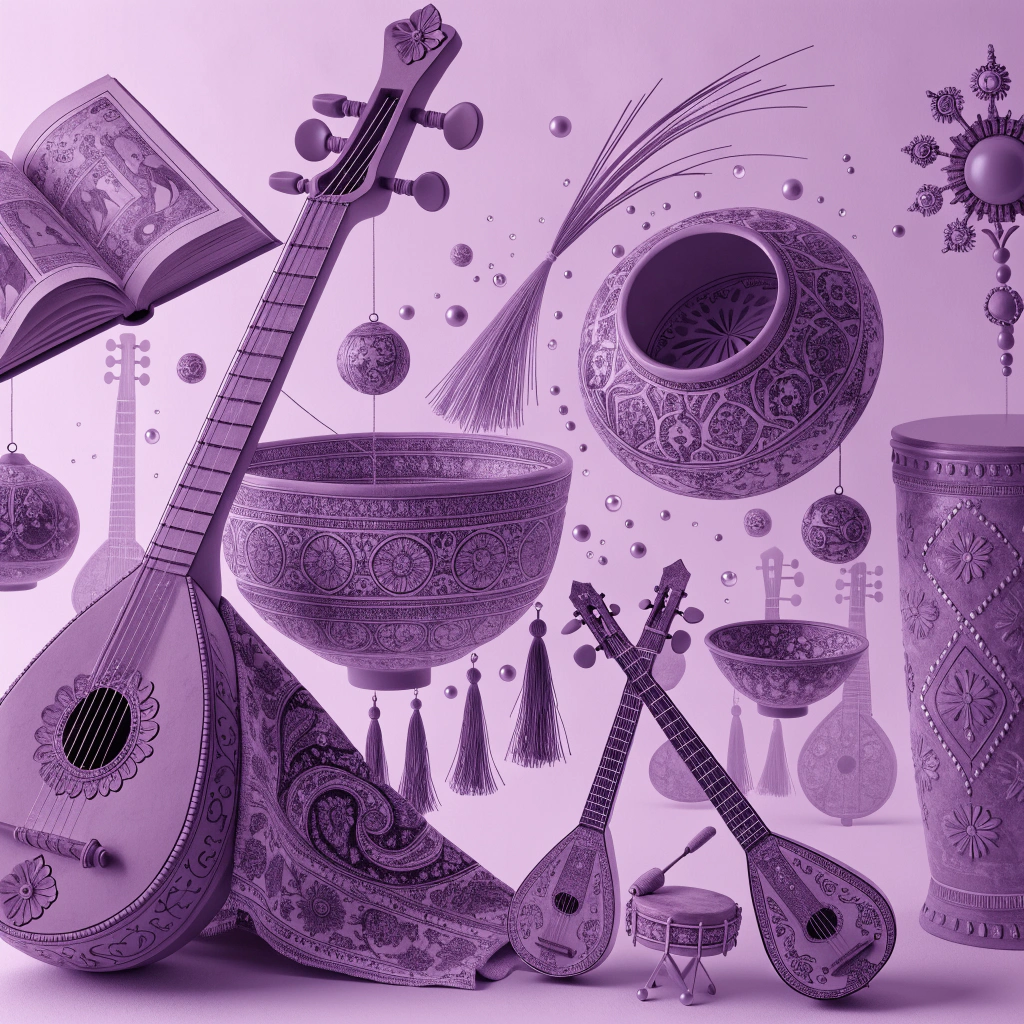
Beautiful Small Paintings from Iran
Persian miniature is a beautiful art from Iran. People draw these small paintings in books. They use bright colors like blue, red, and gold. These colors are very pretty.
The paintings show stories about kings and heroes. The artists do not use shadows. They draw everything very clearly. You can see the flowers, the people, and the horses.
Today, many people in Iran still make this art. It is a very old tradition. Many museums show these small paintings. They are a special part of Iranian history.
Grammar Spotlight
Pattern: Present Simple 'to be'
"Persian miniature is a beautiful art from Iran."
We use 'is' with singular subjects like 'miniature' to describe what something is. It is common for facts and descriptions.
Pattern: Present Simple (Action Verbs)
"They use bright colors like blue, red, and gold."
For the subject 'they', we use the base form of the verb without adding 's'. This describes a general fact or habit.
Test Your Understanding
10 questions · A1 Beginner · 1 free preview
Test what you learned from this article. Answer all questions to earn XP!
Where is this art from?
Want to finish the quiz?
9 more questions are waiting for you. Sign up free to unlock the full quiz and earn XP!
Sign Up FreeAlready have an account? Sign In
Question Breakdown
Where is this art from?
Your answer:
Correct answer: Iran
Artists use shadows in these paintings.
Your answer:
Correct answer: False
What does 'bright' mean?
Your answer:
Correct answer: Strong and colorful
People draw these small paintings in _____.
Your answer:
Correct answer: books
The Beautiful Persian Miniature Paintings
Persian miniature painting is a very famous art from Iran. These paintings are small, but they have many details. Long ago, artists painted them to tell stories in books. This art was very popular between the 13th and 16th centuries.
The artists used special colors. They used bright blue, red, and even real gold. These paintings are different because they do not use shadows. In European art, things look 3D, but Persian miniatures look flat and beautiful. It is like looking at a world from a bird's eye.
Persian miniatures are more colorful than other old paintings. Many people visited Iran to see these masterpieces. Today, you can see them in museums. They are important because they show the history and the imagination of the Persian people. Artists worked for a long time to finish one small picture because every line was important.
Grammar Spotlight
Pattern: Past Simple
"Artists worked for a long time to finish one small picture because every line was important."
We use the past simple to talk about finished actions in the past. For regular verbs, we usually add '-ed' to the end of the verb.
Pattern: Comparatives
"Persian miniatures are more colorful than other old paintings."
We use 'more + adjective + than' to compare two things when the adjective is long (like 'colorful'). It shows which one has more of a quality.
Test Your Understanding
11 questions · A2 Elementary · 1 free preview
Test what you learned from this article. Answer all questions to earn XP!
What is a Persian miniature?
Want to finish the quiz?
10 more questions are waiting for you. Sign up free to unlock the full quiz and earn XP!
Sign Up FreeAlready have an account? Sign In
Question Breakdown
What is a Persian miniature?
Your answer:
Correct answer: A small, detailed painting
Persian miniatures use shadows to look 3D.
Your answer:
Correct answer: False
What does 'century' mean?
Your answer:
Correct answer: One hundred years
The artists used bright _____ like blue and gold to paint.
Your answer:
Correct answer: colors
When was this art very popular?
Your answer:
Correct answer: Between the 13th and 16th centuries
The Magic of Persian Miniature Painting
Persian miniature painting is a beautiful art form that has existed for centuries in Iran. These small, detailed paintings were originally created to illustrate books of poetry and history. During the Timurid and Safavid periods, this art reached its highest level of popularity. It transforms simple paper into a gateway for the imagination.
Unlike Western paintings from the same time, Persian miniatures do not use 3D effects or realistic shadows. Instead, artists use a 'bird's eye view,' which allows the viewer to see everything in the scene at once. The colors are very bright because they are made from natural minerals and plants. These pigments have stayed vibrant for hundreds of years, making the stories on the pages come to life.
The process of making a miniature is very difficult. Tiny brushes, which are often made from squirrel hair, are used to paint incredibly small details. Artists must have a lot of patience and a steady hand to complete a single piece. Many famous stories, like the 'Shahnameh,' have been illustrated with these beautiful paintings over the years.
In modern Iran, this tradition has been kept alive by talented artists who still teach these ancient techniques to new generations. Although the world has changed, the beauty of the Persian miniature remains a symbol of Iranian culture. It is an art form that has been admired by people all over the world for its elegance and imagination.
Grammar Spotlight
Pattern: Passive Voice
"These small, detailed paintings were originally created to illustrate books of poetry and history."
The passive voice is formed with 'be' + past participle. It is used here because the paintings (the object) are more important than the specific person who painted them.
Pattern: Relative Clauses
"In modern Iran, this tradition has been kept alive by talented artists who still teach these ancient techniques."
Relative clauses start with words like 'who' or 'which' to give more information about a noun. Here, 'who' tells us more about the 'talented artists'.
Test Your Understanding
11 questions · B1 Intermediate · 1 free preview
Test what you learned from this article. Answer all questions to earn XP!
What was the original purpose of Persian miniatures?
Want to finish the quiz?
10 more questions are waiting for you. Sign up free to unlock the full quiz and earn XP!
Sign Up FreeAlready have an account? Sign In
Question Breakdown
What was the original purpose of Persian miniatures?
Your answer:
Correct answer: To illustrate books of poetry and history
Persian miniatures use realistic shadows and 3D effects like Western art.
Your answer:
Correct answer: False
What does 'vibrant' mean in the context of the article?
Your answer:
Correct answer: Bright and full of color
Artists use tiny _____ made from squirrel hair to paint details.
Your answer:
Correct answer: brushes
During which periods did this art reach its highest popularity?
Your answer:
Correct answer: Timurid and Safavid
Beyond the Canvas: The Timeless Art of Persian Miniature Painting
Persian miniature painting represents an extraordinary fusion of artistic precision and poetic imagination. Originating as a decorative accompaniment to literary manuscripts, this exquisite art form reached its zenith during the Timurid and Safavid eras, eventually becoming a cornerstone of Iranian cultural identity. Unlike the Renaissance artists of Europe, who were obsessed with capturing physical depth, Persian masters intentionally avoided linear perspective. Instead, they opted for a "bird’s-eye view," which allowed them to present multiple scenes within a single, two-dimensional composition.
The aesthetic philosophy behind these miniatures is deeply rooted in symbolism. Every element, from the intricate floral patterns to the specific placement of figures, serves a narrative purpose. By utilizing vibrant, saturated pigments derived from minerals and precious stones, artists created worlds that felt more ethereal than real. Gold and silver were frequently applied to highlight the divine or royal nature of the subjects. Consequently, the viewer is not merely looking at a scene but is invited to contemplate a spiritual landscape where time and space function differently than in the physical world.
Furthermore, the production of a miniature was a highly collaborative process. A single manuscript might involve several specialists, including calligraphers, gilders, and the painters themselves. This collective effort ensured that the final product was a masterpiece of harmony. Although the popularity of book illustration declined with the introduction of printing, the influence of the Persian miniature persists. Today, it is recognized by UNESCO as an intangible cultural heritage, serving as a testament to the enduring power of Iranian craftsmanship. While contemporary artists have adapted these traditional techniques to reflect modern themes, the core principles of the miniature remain a vital source of inspiration. In conclusion, Persian miniature painting is not just a relic of the past; it is a sophisticated visual language that continues to bridge the gap between the mundane and the celestial.
Grammar Spotlight
Pattern: Non-defining Relative Clauses
"Unlike the Renaissance artists of Europe, who were obsessed with capturing physical depth, Persian masters intentionally avoided linear perspective."
These clauses provide extra information about a noun but are not essential for the sentence's meaning. They are separated by commas and often use 'who' or 'which'.
Pattern: Passive Voice
"Gold and silver were frequently applied to highlight the divine or royal nature of the subjects."
The passive voice is used here to focus on the action and the materials rather than the artist. It is formed using the verb 'to be' and the past participle.
Pattern: Present Perfect Tense
"While contemporary artists have adapted these traditional techniques to reflect modern themes..."
This tense connects the past to the present. It is used here to show how past traditions continue to influence artists in the current era.
Test Your Understanding
11 questions · B2 Upper Intermediate · 1 free preview
Test what you learned from this article. Answer all questions to earn XP!
What was the original primary function of Persian miniatures?
Want to finish the quiz?
10 more questions are waiting for you. Sign up free to unlock the full quiz and earn XP!
Sign Up FreeAlready have an account? Sign In
Question Breakdown
What was the original primary function of Persian miniatures?
Your answer:
Correct answer: To accompany and decorate literary manuscripts
Persian miniature artists used linear perspective to create a sense of depth similar to European Renaissance art.
Your answer:
Correct answer: False
What does the word 'zenith' mean in the context of the article?
Your answer:
Correct answer: The highest point or peak of success
The production of a miniature was a highly _____ process involving various specialists.
Your answer:
Correct answer: collaborative
How is Persian miniature painting categorized by UNESCO today?
Your answer:
Correct answer: As an intangible cultural heritage
Beyond the Third Dimension: The Metaphysical Narrative of Persian Miniatures
Seldom has an art form so effectively transcended the mundane constraints of physical space as the Persian miniature. Emerging as a primary medium for book illustration, these intricate paintings reached their aesthetic zenith between the 13th and 16th centuries, particularly under the discerning patronage of the Timurid and Safavid dynasties. While Western contemporaries were preoccupied with the pursuit of photorealism and the mastery of chiaroscuro, Persian artists embarked on an entirely different trajectory, prioritizing the ethereal over the empirical. The result is a visual language that defies the conventional boundaries of time and space, inviting the viewer into a realm of heightened spiritual significance.
It was the deliberate rejection of linear perspective that allowed the Persian miniature to function as a gateway to the 'alam al-mithal', or the world of images. By employing a 'bird’s eye view', the artist invites the viewer into a space where time and distance are suspended. In this realm, the size of a figure is dictated by their narrative importance rather than their proximity to the viewer. Such a departure from realism is not a failure of technique, but rather a sophisticated paradigm shift. The luminosity of the pigments, often derived from ground semi-precious stones like lapis lazuli and malachite, serves to reinforce this sense of otherworldly perfection. The lack of shadows further emphasizes that these scenes do not take place in the physical world, but in a divine, timeless space.
Furthermore, the meticulous detail found within these works demands a level of contemplative engagement that is rare in modern visual consumption. Every leaf, every tile pattern, and every fold of silk is rendered with a precision that borders on the obsessive. This level of detail ensures that the viewer’s eye is never stationary, mirroring the infinite complexity of the divine. The juxtaposition of vibrant, saturated colors creates a visual rhythm that guides the narrative, often illustrating epic poems such as the Shahnameh or the mystical works of Nizami. The systematic rejection of three-dimensional modeling ensures that the surface of the paper remains a flat, sacred space for storytelling.
Crucial to our understanding of this art form is the recognition of its collaborative nature. The production of a manuscript involved a highly specialized workshop where calligraphers, illuminators, and painters worked in unison. This collective effort highlights the cultural imperative placed on the preservation of literary and historical heritage. The resulting miniatures are not merely illustrations; they are philosophical treatises on the nature of beauty and the soul's journey. Through its unique visual language, it challenges the Western-centric notion that artistic progress is synonymous with realistic representation. By embracing abstraction and symbolic depth, Persian artists created a luminous legacy that continues to resonate with those seeking a deeper connection between art and the metaphysical.
Grammar Spotlight
Pattern: Inversion with negative adverbials
"Seldom has an art form so effectively transcended the mundane constraints of physical space as the Persian miniature."
Inversion is used after negative or restrictive adverbs like 'seldom' to add emphasis and formal tone. The auxiliary verb comes before the subject.
Pattern: Cleft Sentences
"It was the deliberate rejection of linear perspective that allowed the Persian miniature to function as a gateway..."
Cleft sentences are used to focus on a specific piece of information. Here, 'It was... that' emphasizes the specific cause of the art's unique function.
Pattern: Nominalisation
"The systematic rejection of three-dimensional modeling ensures that the surface of the paper remains a flat, sacred space."
Nominalisation turns verbs or adjectives into nouns (e.g., 'rejection' instead of 'rejecting'). This creates a more formal, academic, and concise style characteristic of C1 English.
Test Your Understanding
12 questions · C1 Advanced · 1 free preview
Test what you learned from this article. Answer all questions to earn XP!
What primary feature distinguishes Persian miniatures from Western art of the same period?
Want to finish the quiz?
11 more questions are waiting for you. Sign up free to unlock the full quiz and earn XP!
Sign Up FreeAlready have an account? Sign In
Question Breakdown
What primary feature distinguishes Persian miniatures from Western art of the same period?
Your answer:
Correct answer: The rejection of linear perspective and three-dimensional modeling
In Persian miniatures, the size of a figure is determined by their physical distance from the viewer.
Your answer:
Correct answer: False
What does 'ethereal' mean in the context of the article?
Your answer:
Correct answer: Delicate and seemingly not of this world
The art form reached its aesthetic _____ during the Timurid and Safavid dynasties.
Your answer:
Correct answer: zenith
What was the purpose of using ground semi-precious stones for pigments?
Your answer:
Correct answer: To create a sense of otherworldly luminosity and perfection
The production of Persian miniatures was typically a solo endeavor by a single artist.
Your answer:
Correct answer: False
The Ontological Labyrinth: Transcendence and Spatiality in Persian Miniature Painting
To engage with the Persian miniature is to embark upon a journey through a meticulously curated microcosm, one where the terrestrial and the divine converge in a kaleidoscope of saturated pigments. Emerging as a paramount medium for manuscript illumination, these intricate illustrations reached their aesthetic zenith during the Timurid and Safavid eras. Unlike the contemporaneous Renaissance preoccupations with chiaroscuro and linear perspective, the Persian miniature consciously eschews the illusion of three-dimensional depth, opting instead for a non-Euclidean spatiality that defies the constraints of a single vantage point.
Central to the allure of the Persian miniature is its rejection of the 'window onto the world' paradigm that dominated Western art history for centuries. Were one to scrutinize a 15th-century masterpiece from the Herat school, one would immediately discern a 'bird’s eye view' that presents multiple temporalities and spatial planes simultaneously. This idiosyncratic approach is not a failure of technique but a deliberate ontological statement. By flattening the image, the artist invites the viewer into a realm where the laws of physics are superseded by the laws of poetic logic. Every leaf on a tree, every pattern on a tiled courtyard, is rendered with an egalitarian clarity that suggests an all-encompassing, divine gaze.
The palette employed in these works is equally significant. Saturated, jewel-like pigments—lapis lazuli, malachite, and gold—are applied with such precision that the surface appears to shimmer with an inner light. This luminosity is not merely decorative; it serves to elevate the subject matter from the mundane to the celestial. In the context of Sufi metaphysics, which profoundly influenced Persian artistic production, the miniature functions as a 'mundus imaginalis'—an intermediate world between the material and the spiritual. Thus, the vividness of the colors acts as a catalyst for spiritual transcendence, guiding the observer toward a higher state of consciousness.
Furthermore, the relationship between the written word and the visual image is quintessential to the genre. Miniatures were rarely standalone pieces; they were inextricably bound to the poetic masterpieces of Firdausi, Nizami, or Sa'di. This juxtaposition of calligraphy and painting creates a multi-sensory experience, where the rhythm of the verse is echoed in the flowing lines of the composition. Notwithstanding the historical specificities of their creation, these works possess a timeless quality, inviting modern spectators to reconsider their own perceptions of reality. Lest the viewer should dismiss these works as mere 'illustrations,' it is imperative to recognize them as sophisticated philosophical treatises in their own right.
The spatiality of the Persian miniature also challenges the Western concept of the 'focal point.' In a typical Safavid composition, the eye is encouraged to wander across the page, discovering hidden narratives and minute details that might otherwise remain obscured. This decentralization reflects a worldview that values complexity and interconnectedness over linear progression. It is a visual manifestation of the labyrinthine nature of the human soul, where every corner holds a new revelation.
In conclusion, the Persian miniature remains an enduring testament to the ingenuity of the human spirit. It is an art form that demands intellectual rigor and aesthetic sensitivity in equal measure. While the empires that birthed these treasures have long since passed into the annals of history, the miniatures themselves continue to pulse with an ephemeral beauty that transcends the boundaries of time and culture. By eschewing the mundane for the metaphysical, Persian artists created a visual language that speaks to the universal yearning for beauty, order, and spiritual enlightenment. To study them is not merely to look at history, but to witness the unfolding of a profound artistic legacy that continues to resonate in the contemporary world.
Grammar Spotlight
Pattern: Inverted Conditional (Were + Subject)
"Were one to scrutinize a 15th-century masterpiece from the Herat school, one would immediately discern a 'bird’s eye view'."
This is a formal alternative to 'If one were to...'. It is used in C2 level English to express hypothetical situations with a high degree of formality.
Pattern: Negative Purpose Clause with 'Lest'
"Lest the viewer should dismiss these works as mere 'illustrations,' it is imperative to recognize them as sophisticated philosophical treatises."
The word 'lest' is used to express fear that something undesirable might happen. It is typically followed by the subjunctive 'should' or the base form of the verb.
Pattern: Emphatic Relative Clause (It is... that)
"It is an art form that demands intellectual rigor and aesthetic sensitivity in equal measure."
This structure, often called a cleft sentence, is used to focus on a particular part of the sentence (the art form) to provide emphasis.
Test Your Understanding
12 questions · C2 Mastery · 1 free preview
Test what you learned from this article. Answer all questions to earn XP!
What is the primary difference mentioned between Persian and Western art of the same period?
Want to finish the quiz?
11 more questions are waiting for you. Sign up free to unlock the full quiz and earn XP!
Sign Up FreeAlready have an account? Sign In
Question Breakdown
What is the primary difference mentioned between Persian and Western art of the same period?
Your answer:
Correct answer: The rejection of linear perspective
Persian miniatures were originally created as standalone pieces of art.
Your answer:
Correct answer: False
What does 'eschew' mean in the context of the article?
Your answer:
Correct answer: To deliberately avoid
The miniature reached its _____ during the Timurid and Safavid eras.
Your answer:
Correct answer: zenith
Which philosophical tradition is cited as a major influence on the luminosity of Persian miniatures?
Your answer:
Correct answer: Sufism
The 'bird’s eye view' in Persian art was a deliberate ontological choice rather than a lack of skill.
Your answer:
Correct answer: True
