









orangutans en 30 secondes
- Orangutans are large, intelligent great apes native to the islands of Borneo and Sumatra in Southeast Asia.
- They are primarily arboreal, meaning they spend most of their lives in the forest canopy.
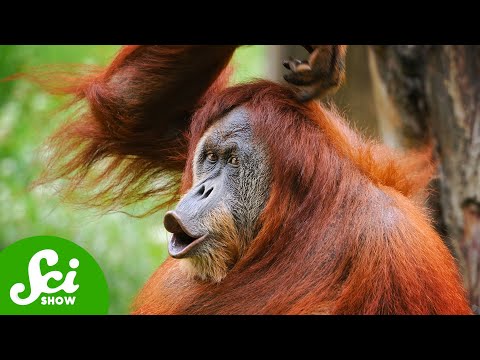
- Known for their shaggy reddish-brown hair and long arms, they are mostly solitary animals.
- All three species of orangutans are currently critically endangered due to habitat loss and deforestation.
The term orangutans refers to a specific genus of great apes, known scientifically as Pongo. These creatures are the only great apes currently found outside of Africa, residing exclusively in the dense, tropical rainforests of Southeast Asia, specifically on the islands of Borneo and Sumatra. The name itself is a fascinating linguistic artifact, derived from the Malay and Indonesian words 'orang' meaning person and 'hutan' meaning forest. Thus, an orangutan is literally a 'person of the forest.' This etymology reflects the deep respect and almost human-like status these animals have held in local cultures for centuries. In modern English, we use this word to describe these reddish-orange primates that are famous for their remarkable intelligence, solitary lifestyles, and incredible ability to navigate the forest canopy. When people use this word, they are often discussing topics ranging from wildlife biology and evolutionary science to environmental conservation and the ethics of habitat preservation. Because orangutans share approximately 97% of their DNA with humans, they are a frequent subject of study in primatology, helping us understand our own evolutionary history. You will hear this word in classrooms when discussing biodiversity, in news reports regarding the palm oil industry's impact on habitats, and in casual conversation when visiting a zoo or watching a nature documentary. The word carries a sense of wonder but also a heavy weight of responsibility, as all three species of orangutans are currently classified as critically endangered.
- Arboreal Lifestyle
- Orangutans are the largest arboreal animals in the world, meaning they spend the vast majority of their lives in trees. Their bodies are perfectly adapted for this, with arms that are significantly longer than their legs, allowing them to swing and climb with ease.
The researchers observed the orangutans building complex nests high in the canopy to stay safe from predators during the night.
Physically, orangutans are unmistakable. They possess long, shaggy, reddish-brown hair that provides camouflage against the bark of tropical trees and protection from the frequent rain. Adult males are particularly striking due to their large size and the development of 'flanges'—fleshy cheek pads that frame their faces and signal their dominance to other males and attractiveness to females. Their hands and feet are shaped like hooks, providing a powerful grip on branches. Unlike many other primates, orangutans are largely solitary. While a mother and her offspring share a deep bond that lasts for many years, adult males generally travel alone, making their presence known through loud, resonant 'long calls' that can carry for miles through the thick vegetation. This solitary nature makes them unique among the great apes, who typically live in more social groups like troops or bands. Using the word 'orangutans' correctly involves recognizing this distinction and appreciating their specific ecological niche as the 'gardeners of the forest,' as they play a vital role in seed dispersal, ensuring the health and regeneration of the rainforest ecosystem.
- Cognitive Ability
- Orangutans are among the most intelligent primates. They have been observed using tools, such as using sticks to extract insects from holes or leaves as umbrellas during heavy downpours.
Many wildlife documentaries highlight how orangutans teach their young the complex skills needed to find food in the jungle.
In a broader cultural context, orangutans have become symbols of the fight against climate change and deforestation. Because their survival is so closely tied to the health of the rainforest, they are often referred to as an 'umbrella species.' This means that by protecting the habitat required for orangutans to thrive, we inadvertently protect thousands of other species of plants and animals that share that same environment. When environmentalists speak about 'saving the orangutans,' they are often using the animal as a flagship for a much larger ecological movement. This usage is common in fundraising campaigns, political lobbying for sustainable palm oil, and educational programs aimed at children. Understanding the word 'orangutans' thus requires an awareness of its biological, linguistic, and environmental layers. It is not just a label for a red ape; it is a word that encapsulates a complex relationship between humanity and the natural world, reminding us of our shared ancestry and the precarious future of the planet's most biodiverse regions.
The sanctuary provides a safe haven for orphaned orangutans to learn how to survive in the wild before being released.
- Sexual Dimorphism
- This term refers to the physical differences between males and females. In orangutans, this is very pronounced, with males being twice the size of females and developing large throat sacs.
Male orangutans use their throat sacs to make booming calls that resonate through the forest to warn off rivals.
Conservationists are working tirelessly to create corridors of forest so that orangutans can travel between fragmented habitats.
Using the word orangutans effectively in a sentence requires an understanding of its role as a plural count noun. It typically functions as the subject or object of a sentence, often paired with verbs that describe movement, behavior, or biological processes. Because orangutans are highly specialized animals, the sentences they appear in are often descriptive, scientific, or advocacy-oriented. For instance, when describing their physical appearance, you might say, 'The orangutans' long, reddish fur stood out against the vibrant green leaves of the canopy.' Here, the word is used as a possessive plural to describe a characteristic. In a more scientific context, you might focus on their classification: 'Biologists have identified three distinct species of orangutans: the Bornean, the Sumatran, and the recently discovered Tapanuli orangutan.' This sentence demonstrates how the word can be used as a general category that is then subdivided into more specific types. It is also important to note that because the word is relatively long and specific, it is rarely used as a metaphor in English, unlike 'monkey' or 'ape,' which can sometimes be used to describe human behavior. Instead, 'orangutans' almost always refers to the actual animals themselves.
- Subject-Verb Agreement
- Since 'orangutans' is plural, it must be paired with plural verb forms. Example: 'Orangutans are' rather than 'Orangutans is.'
In the wild, orangutans spend nearly all their time in the trees, searching for fruit and insects.
When writing about conservation, the word 'orangutans' often appears alongside terms related to environmental threats. A common sentence structure might be: 'The primary threat to wild orangutans is the rapid destruction of their habitat for palm oil plantations.' In this case, 'wild orangutans' acts as the object of the preposition 'to,' specifying which group is being threatened. Another common usage is in the context of animal intelligence and psychology. For example: 'Studies have shown that orangutans possess advanced problem-solving skills, often rivaling those of young human children.' This sentence highlights their cognitive abilities. You can also use the word in the singular form, 'orangutan,' when referring to an individual animal or the species as a whole in a generic sense, such as 'The orangutan is a solitary creature.' However, the plural 'orangutans' is generally preferred when discussing populations, groups in a zoo, or the species' general characteristics across their range. It is also worth noting that the word is often preceded by adjectives that specify their status, such as 'endangered orangutans,' 'captive orangutans,' or 'infant orangutans.'
- Collective Nouns
- While they are solitary, a group of orangutans is sometimes called a 'buffoonery,' though this term is rare and mostly used for humor or in specific literary contexts.
The documentary film followed a group of rescued orangutans as they were reintroduced to the Sumatran jungle.
In creative writing or travelogues, the word can be used to evoke the atmosphere of the jungle. A writer might say, 'The silence of the morning was broken by the distant, haunting call of male orangutans.' This uses the word to build a sensory experience for the reader. In everyday conversation, the word is straightforward: 'Did you see the orangutans at the wildlife park today?' or 'I'm reading a book about how orangutans use tools.' The key is to ensure that the context clearly identifies them as the specific great apes they are. Because the word is quite long, speakers sometimes shorten it to 'orangs' in informal, expert, or conservationist circles, but in formal writing and standard speech, the full word 'orangutans' should always be used. Furthermore, pay attention to the spelling; the common misspelling 'orangutang' (with a 'g' at the end) is technically incorrect in modern English, although it reflects an older phonetic interpretation of the word. Sticking to 'orangutans' ensures clarity and professionalism in your communication.
Scientists are using satellite imagery to track the movement of orangutans across the fragmented forests of Borneo.
- Prepositional Phrases
- Commonly used with 'of' or 'among.' Example: 'The conservation of orangutans' or 'Intelligence among orangutans.'
The local community has started a program to protect the orangutans that live near their village.
It is heart-wrenching to see how the loss of habitat affects the lives of these majestic orangutans.
The word orangutans is most frequently encountered in contexts related to nature, science, and environmental activism. One of the most common places to hear it is in high-quality nature documentaries, such as those narrated by Sir David Attenborough. In series like 'Planet Earth' or 'Our Planet,' the word is used to introduce segments detailing the complex lives of these apes. The narrator might describe the 'elusive orangutans of Sumatra' or the 'ingenious orangutans of Borneo,' using the word to anchor a narrative about survival and intelligence. In these settings, the word is often spoken with a tone of reverence and curiosity, reflecting the awe that these animals inspire in researchers and viewers alike. Beyond television, you will frequently find the word in news articles and reports from major environmental organizations like the World Wildlife Fund (WWF) or Greenpeace. These reports often focus on the 'orangutans' habitat loss' due to illegal logging or the expansion of agricultural land. In this context, the word becomes a rallying cry for conservation efforts, often appearing in headlines and social media campaigns designed to raise awareness and funds.
- Educational Settings
- In biology and ecology classes, students learn about orangutans as part of the Hominidae family. Teachers use the word to explain concepts like evolution, primate behavior, and tropical ecosystems.
During the lecture, the professor explained why orangutans are considered a keystone species in the Indonesian rainforest.
Another significant arena where the word 'orangutans' is heard is in the travel and tourism industry, particularly in Southeast Asia. Tour guides in places like Sepilok in Sabah or Gunung Leuser National Park in Sumatra use the word constantly to manage expectations and educate visitors. They might say, 'We hope to spot some wild orangutans today, but remember they are shy animals.' In these regions, the word is part of the local economic and cultural identity. You will also see it on signs, brochures, and souvenirs. Furthermore, the word appears in the context of ethical consumerism. Many products now carry 'Orangutan Friendly' or 'RSPO' (Roundtable on Sustainable Palm Oil) labels. When shoppers discuss these labels, they are using the word 'orangutans' as a shorthand for their commitment to buying products that do not contribute to the destruction of the rainforest. This shows how the word has transitioned from a purely biological term to a marker of social and ethical values in the modern world.
- Scientific Research
- In academic journals, the word is used in titles of papers exploring genetics, tool use, and social structures. Researchers discuss 'orangutans' vocalizations' or 'orangutans' dietary habits.'
The news report highlighted a new study showing that orangutans can communicate about past events, a trait previously thought to be unique to humans.
Finally, the word is common in zoos and wildlife sanctuaries around the world. Zookeepers give 'orangutan talks' where they explain the daily routines, diets, and enrichment activities of the animals in their care. Parents use the word to point out the animals to their children: 'Look at how the orangutans are swinging!' This early exposure helps the word become a standard part of most people's vocabulary from a young age. In the digital age, 'orangutans' also appears in viral videos—often showing them interacting with humans in surprising ways, such as an orangutan 'driving' a golf cart or mimicking a person's actions. While these videos are popular, they often spark debate among conservationists about the ethics of keeping such intelligent animals in close contact with humans. Regardless of the context, the word 'orangutans' consistently evokes a sense of connection to a wild, intelligent, and increasingly vulnerable part of our planet's heritage.
The zoo's new exhibit aims to educate the public about the natural behaviors of orangutans and the importance of their conservation.
- Environmental Advocacy
- Campaigners use the word to put a 'face' on the issue of deforestation. 'Save the orangutans' is a powerful slogan used globally.
Many people were moved to action after seeing photos of orangutans losing their homes to fire.
The documentary crew spent months in the jungle to capture rare footage of wild orangutans using tools to fish for termites.
One of the most frequent mistakes people make when using the word orangutans is a simple spelling error: adding a 'g' to the end to make it 'orangutang.' While this is a common phonetic misspelling—likely influenced by the word 'tangy' or the rhythm of the word—it is technically incorrect in standard English. The word comes from 'orang' and 'hutan,' and there is no 'g' in the original Malay root for forest. Using the incorrect spelling can make a writer appear less informed, especially in scientific or academic contexts. Another common error is confusing orangutans with monkeys. This is a broader biological mistake; orangutans are apes, not monkeys. The most visible difference is that orangutans (like all apes) do not have tails, whereas most monkeys do. Additionally, orangutans are generally much larger and have more complex cognitive abilities. In a sentence, calling an orangutan a 'monkey' is a factual error that can undermine the credibility of your statement, particularly if you are discussing biology or conservation.
- Spelling Error
- Incorrect: 'orangutang'. Correct: 'orangutan' (singular) or 'orangutans' (plural).
It is a common misconception that orangutans are a type of monkey; they are actually great apes.
Another mistake involves the pluralization of the word. While 'orangutans' is the standard plural form in English, some people mistakenly use 'orangutan' as both singular and plural, similar to words like 'sheep' or 'deer.' While this is sometimes seen in older texts or specific dialects, it is not the standard rule in modern English. You should almost always use 'orangutans' when referring to more than one. Furthermore, there is often confusion regarding their habitat. Many people mistakenly believe that orangutans live in Africa alongside gorillas and chimpanzees. However, orangutans are native only to the islands of Borneo and Sumatra in Asia. Making this geographical error in a presentation or essay can be a significant mistake. It is also important to avoid using the word 'orangutans' as a generic term for any large primate. Each species of great ape has distinct characteristics, and using the specific term 'orangutans' implies you are referring to the red, arboreal apes of Southeast Asia specifically.
- Geographical Error
- Avoid saying orangutans live in the 'African jungle.' They are exclusively Asian primates.
The student lost marks for stating that orangutans share the same habitat as African gorillas.
Finally, a subtle mistake is over-generalizing their behavior. While they are often described as 'gentle,' wild orangutans are powerful wild animals and can be aggressive if they feel threatened or if their territory is invaded. Using the word 'orangutans' in a way that suggests they are like cuddly pets is a common mistake in popular media that can lead to dangerous real-world interactions or support for the illegal pet trade. When using the word, it is best to maintain a tone of respect for their status as wild, complex beings. Additionally, when discussing the different species, people often forget that there are three distinct types. Referring to all of them simply as 'orangutans' is fine for general conversation, but in more detailed discussions, failing to distinguish between the Bornean, Sumatran, and Tapanuli species can be seen as a lack of depth in your knowledge. By avoiding these common pitfalls—spelling, classification, geography, and over-simplification—you can use the word 'orangutans' with confidence and accuracy.
Correctly identifying orangutans as great apes is essential for any basic biology exam.
- Pluralization Rule
- Always add the 's' for the plural form in standard English. 'Three orangutans' is the correct phrasing.
The author corrected the manuscript to ensure orangutans was spelled without a 'g' at the end.
Wildlife experts warn that treating orangutans as pets is harmful to both the animals and the owners.
When discussing orangutans, it is often useful to have a repertoire of similar words and alternatives to avoid repetition or to provide more specific meaning. The most direct scientific alternative is the term 'great apes.' This category includes orangutans, gorillas, chimpanzees, and bonobos (and humans). Using 'great apes' is appropriate when you are making a general statement that applies to all these species, such as their high intelligence or lack of tails. However, if you want to be even more technical, you can use the genus name Pongo. In biological research, you might see phrases like 'the Pongo lineage' or 'Pongo pygmaeus' (the Bornean species). Another related term is 'hominids,' which refers to members of the biological family Hominidae. While 'hominids' is a broader term, it is often used in discussions about evolution and the shared ancestry between orangutans and humans. For a more descriptive, less scientific approach, you might use phrases like 'the red apes' or 'the forest people,' the latter being a direct translation of their Malay name.
- Orangutans vs. Chimpanzees
- While both are great apes, chimpanzees are much more social and live in large groups in Africa, whereas orangutans are solitary and live in Asia.
Unlike the highly social chimpanzees, orangutans prefer a more independent lifestyle in the canopy.
In the context of conservation, you might hear orangutans referred to as a 'flagship species' or an 'umbrella species.' These terms aren't synonyms for the animal itself, but they describe the animal's role in environmental strategy. A 'flagship species' is one chosen to represent an environmental cause, like the panda for the WWF. An 'umbrella species' is one whose protection automatically protects many other species. Using these terms can add professional depth to your writing about orangutans. If you are looking for more informal or poetic alternatives, 'the old man of the forest' is a common literary trope used to describe the wise, patient appearance of an adult male orangutan. However, be careful with the word 'primates.' While orangutans are primates, this category is massive and includes everything from tiny lemurs to massive gorillas. Using 'primates' when you specifically mean 'orangutans' can be too vague and might lead to confusion. Similarly, as mentioned before, 'monkeys' is not a synonym and should be avoided.
- Orangutans vs. Gorillas
- Gorillas are ground-dwelling and live in Africa, while orangutans are tree-dwelling and live in Asia. Gorillas are also much larger and more muscular.
The zoo's 'Great Ape' exhibit features both gorillas and orangutans, allowing visitors to see the differences between these two species.
In some contexts, you might use the term 'anthropoids,' which refers to higher primates (monkeys, apes, and humans). This is a very broad term used mostly in evolutionary biology. If you are writing for a younger audience, you might simply use 'big red apes' to be descriptive and accessible. When discussing the three specific species, it is best to use their full names: 'Bornean orangutans,' 'Sumatran orangutans,' and 'Tapanuli orangutans.' This shows a high level of precision. In summary, while 'orangutans' is the most common and useful word, knowing when to use 'great apes,' 'Pongo,' 'flagship species,' or 'hominids' can help you tailor your language to your audience and the specific point you are trying to make. Always choose the word that provides the most clarity and accuracy for your specific context, and remember that 'orangutans' remains the most recognized and evocative term for these remarkable 'people of the forest.'
By protecting the orangutans, we are also safeguarding the future of the entire rainforest ecosystem.
- Register Check
- Use 'Pongo' in scientific papers, 'Great Apes' in educational contexts, and 'Orangutans' in general and conservationist speech.
The local legend tells of the orangutans as ancient guardians of the deep jungle.
The conservation group released a report on the declining population of orangutans in the wild.
How Formal Is It?
Le savais-tu ?
Interestingly, in the original Malay, the term 'orang hutan' was not used to refer to the ape, but rather to forest-dwelling tribes. The use of the word for the primate was a European adoption that eventually made its way back into local usage.
Guide de prononciation
- Adding a 'g' at the end: /əˈræŋ.uː.tæŋ/ (orangutang).
- Stressing the first syllable: /O-rang-u-tan/.
- Mispronouncing the 'u' as 'you': /əˈræŋ.juː.tæn/.
- Dropping the second 'a' sound: /əˈræŋ.uː.tn/.
- Pronouncing the 'o' as 'oh': /oʊˈræŋ.uː.tæn/.
Niveau de difficulté
The word is long but phonetically regular and common in nature texts.
Spelling is the main challenge, especially the 'u' and 'a' placement and avoiding the 'g' at the end.
Pronunciation is generally straightforward once the stress is learned.
The word is distinctive and easy to recognize in speech.
Quoi apprendre ensuite
Prérequis
Apprends ensuite
Avancé
Grammaire à connaître
Plural Nouns
One orangutan, two orangutans.
Articles with Specific Animals
The orangutan is a smart animal (generic) vs. I saw an orangutan (specific).
Adjectives before Nouns
The intelligent orangutans.
Possessive Plurals
The orangutans' habitat.
Prepositional Phrases
A group of orangutans.
Exemples par niveau
The orangutans are very big and red.
Les orangs-outans sont très grands et roux.
Plural subject 'orangutans' with plural verb 'are'.
I see two orangutans in the tree.
Je vois deux orangs-outans dans l'arbre.
Use 'two' before the plural noun 'orangutans'.
Orangutans like to eat sweet fruit.
Les orangs-outans aiment manger des fruits sucrés.
General statement about a group uses the plural 'orangutans'.
The baby orangutans stay with their mothers.
Les bébés orangs-outans restent avec leurs mères.
Adjective 'baby' modifies the plural noun 'orangutans'.
Orangutans have very long arms.
Les orangs-outans ont de très longs bras.
Plural noun 'orangutans' with the verb 'have'.
Do orangutans have tails? No, they do not.
Est-ce que les orangs-outans ont des queues ? Non, ils n'en ont pas.
Question form using 'Do' for the plural subject.
Orangutans live in the hot forest.
Les orangs-outans vivent dans la forêt chaude.
Present simple tense for a general fact.
We must help the orangutans.
Nous devons aider les orangs-outans.
Modal verb 'must' followed by the base verb 'help'.
Orangutans are very smart animals that use tools.
Les orangs-outans sont des animaux très intelligents qui utilisent des outils.
Relative clause 'that use tools' describes the orangutans.
Wild orangutans live only in Borneo and Sumatra.
Les orangs-outans sauvages ne vivent qu'à Bornéo et Sumatra.
Adjective 'wild' specifies the type of orangutans.
Many orangutans are losing their homes today.
Beaucoup d'orangs-outans perdent leur maison aujourd'hui.
Present continuous 'are losing' shows an ongoing situation.
The orangutans swing from branch to branch easily.
Les orangs-outans se balancent de branche en branche facilement.
Adverb 'easily' describes the action of swinging.
Male orangutans are much bigger than females.
Les orangs-outans mâles sont beaucoup plus grands que les femelles.
Comparative structure 'bigger than'.
People go to the park to see the orangutans.
Les gens vont au parc pour voir les orangs-outans.
Infinitive of purpose 'to see'.
Orangutans sleep in nests they make from leaves.
Les orangs-outans dorment dans des nids qu'ils fabriquent avec des feuilles.
Reduced relative clause '(that) they make'.
The sanctuary helps orphaned orangutans grow up.
Le sanctuaire aide les orangs-outans orphelins à grandir.
Verb 'help' followed by object and base verb 'grow'.
Orangutans are considered the most solitary of the great apes.
Les orangs-outans sont considérés comme les plus solitaires des grands singes.
Passive voice 'are considered' used for general beliefs.
Because of deforestation, orangutans are now critically endangered.
À cause de la déforestation, les orangs-outans sont maintenant en danger critique d'extinction.
Prepositional phrase 'Because of' introduces the cause.
Scientists study how orangutans communicate with each other.
Les scientifiques étudient comment les orangs-outans communiquent entre eux.
Indirect question 'how orangutans communicate'.
The name 'orangutan' literally means 'person of the forest' in Malay.
Le nom 'orang-outan' signifie littéralement 'personne de la forêt' en malais.
Adverb 'literally' emphasizes the exact meaning.
If we don't act soon, wild orangutans might disappear forever.
Si nous n'agissons pas bientôt, les orangs-outans sauvages pourraient disparaître pour toujours.
First conditional 'If we don't... they might'.
Orangutans play a vital role in dispersing seeds throughout the jungle.
Les orangs-outans jouent un rôle vital dans la dispersion des graines à travers la jungle.
Gerund 'dispersing' following the preposition 'in'.
Female orangutans have a very strong bond with their offspring.
Les femelles orangs-outans ont un lien très fort avec leur progéniture.
Adjective 'strong' modifies the noun 'bond'.
Many people avoid palm oil to help protect orangutans.
Beaucoup de gens évitent l'huile de palme pour aider à protéger les orangs-outans.
Infinitive of purpose 'to help protect'.
The physical characteristics of orangutans are perfectly suited for an arboreal life.
Les caractéristiques physiques des orangs-outans sont parfaitement adaptées à une vie arboricole.
Subject-verb agreement with the complex subject 'The physical characteristics of orangutans'.
Male orangutans develop large cheek pads, known as flanges, as they mature.
Les orangs-outans mâles développent de larges coussinets sur les joues, appelés brides, à mesure qu'ils mûrissent.
Appositive phrase 'known as flanges' provides extra information.
Research indicates that orangutans possess a high level of self-awareness.
La recherche indique que les orangs-outans possèdent un haut niveau de conscience de soi.
Noun clause 'that orangutans possess...' acts as the object of 'indicates'.
The habitat of orangutans is being rapidly destroyed by industrial agriculture.
L'habitat des orangs-outans est rapidement détruit par l'agriculture industrielle.
Present continuous passive 'is being destroyed'.
Orangutans are known to exhibit cultural behaviors that vary between populations.
Les orangs-outans sont connus pour présenter des comportements culturels qui varient selon les populations.
Passive construction 'are known to exhibit'.
Despite their size, orangutans are incredibly agile when moving through the canopy.
Malgré leur taille, les orangs-outans sont incroyablement agiles lorsqu'ils se déplacent dans la canopée.
Concession clause starting with 'Despite'.
The conservation of orangutans requires international cooperation and funding.
La conservation des orangs-outans nécessite une coopération et un financement internationaux.
Singular verb 'requires' agrees with the subject 'conservation'.
Orangutans have the longest childhood of any non-human animal.
Les orangs-outans ont l'enfance la plus longue de tous les animaux non humains.
Superlative 'the longest'.
The taxonomic classification of orangutans was recently updated to include three distinct species.
La classification taxonomique des orangs-outans a été récemment mise à jour pour inclure trois espèces distinctes.
Passive voice with an adverb 'recently updated'.
Orangutans serve as a flagship species for the conservation of Southeast Asian rainforests.
Les orangs-outans servent d'espèce phare pour la conservation des forêts tropicales d'Asie du Sud-Est.
Metaphorical use of 'flagship species'.
The semi-solitary nature of orangutans is thought to be an adaptation to low-nutrient environments.
La nature semi-solitaire des orangs-outans est considérée comme une adaptation aux environnements pauvres en nutriments.
Complex passive 'is thought to be'.
Genetic diversity among orangutans is surprisingly high, despite their declining numbers.
La diversité génétique chez les orangs-outans est étonnamment élevée, malgré la diminution de leur nombre.
Preposition 'among' used for groups.
Anthropogenic pressures have pushed orangutans to the very brink of extinction.
Les pressions anthropiques ont poussé les orangs-outans au bord même de l'extinction.
Present perfect 'have pushed' for a current state resulting from past actions.
The study of orangutans provides invaluable data for understanding hominid evolution.
L'étude des orangs-outans fournit des données inestimables pour comprendre l'évolution des hominidés.
Gerund phrase 'understanding hominid evolution' as the object of 'for'.
Orangutans demonstrate a capacity for symbolic thought and complex communication.
Les orangs-outans démontrent une capacité de pensée symbolique et de communication complexe.
Abstract nouns 'capacity', 'thought', and 'communication'.
Efforts to rehabilitate displaced orangutans are often hindered by lack of suitable habitat.
Les efforts pour réhabiliter les orangs-outans déplacés sont souvent entravés par le manque d'habitat approprié.
Passive voice 'are often hindered'.
The intricate social dynamics of orangutans, though less overt than those of chimpanzees, reveal a sophisticated cognitive landscape.
La dynamique sociale complexe des orangs-outans, bien que moins manifeste que celle des chimpanzés, révèle un paysage cognitif sophistiqué.
Concessive clause 'though less overt than...' embedded in the main sentence.
Orangutans' role as keystone seed dispersers is paramount to the ecological integrity of the Sundaland biodiversity hotspot.
Le rôle des orangs-outans en tant que disperseurs de graines clés est primordial pour l'intégrité écologique du point chaud de biodiversité de Sundaland.
Possessive plural 'Orangutans'' used as an adjective.
The divergent evolutionary trajectory of orangutans offers a unique counterpoint to the study of African great apes.
La trajectoire évolutive divergente des orangs-outans offre un contrepoint unique à l'étude des grands singes africains.
Sophisticated vocabulary like 'divergent trajectory' and 'counterpoint'.
Fragmentation of the canopy forces orangutans to descend to the forest floor, increasing their vulnerability to predation and disease.
La fragmentation de la canopée force les orangs-outans à descendre au sol de la forêt, augmentant leur vulnérabilité à la prédation et aux maladies.
Participial phrase 'increasing their vulnerability...' showing a consequence.
The ethical implications of maintaining orangutans in captivity are the subject of intense debate within the primatological community.
Les implications éthiques du maintien des orangs-outans en captivité font l'objet d'un débat intense au sein de la communauté primatologique.
Complex subject 'The ethical implications of maintaining orangutans in captivity'.
Genomic analysis of the Tapanuli orangutans has elucidated the complex history of primate migration in Southeast Asia.
L'analyse génomique des orangs-outans de Tapanuli a élucidé l'histoire complexe de la migration des primates en Asie du Sud-Est.
Scientific verb 'elucidated' used in the present perfect.
Orangutans exhibit a remarkable degree of phenotypic plasticity in response to varying environmental stressors.
Les orangs-outans présentent un degré remarquable de plasticité phénotypique en réponse à divers stress environnementaux.
Technical biological terminology 'phenotypic plasticity'.
The precarious status of wild orangutans serves as a poignant indictment of contemporary land-use policies.
Le statut précaire des orangs-outans sauvages sert d'acte d'accusation poignant des politiques contemporaines d'utilisation des terres.
Metaphorical and critical tone using 'poignant indictment'.
Collocations courantes
Phrases Courantes
— A common slogan used in environmental and conservation campaigns.
The charity's main goal is to save the orangutans from extinction.
— The literal translation of the word 'orangutan' from Malay.
The orangutan is truly the person of the forest, living in harmony with nature.
— Refers to palm oil produced without destroying orangutan habitats.
Always look for products made with orangutan-friendly palm oil.
— The official conservation status of all three orangutan species.
Orangutans are listed as a critically endangered species by the IUCN.
— A technical description of an orangutan's biology and lifestyle.
The orangutan is the world's only truly arboreal great ape.
— A metaphor for their role in seed dispersal and forest health.
Without these gardeners of the forest, many tree species would fail to grow.
— The fleshy structures on the faces of adult male orangutans.
The dominant male showed off his impressive cheek pads.
— A place where rescued orangutans are prepared for release into the wild.
The orangutan was taken to a rehabilitation center after being found in a village.
— The black market where orangutans are sold as pets.
The illegal pet trade is a major threat to young orangutans.
— The upper layer of the forest where orangutans live.
Orangutans spend most of their time high up in the forest canopy.
Souvent confondu avec
Orangutans are apes. Apes are generally larger, have bigger brains, and do not have tails.
Chimpanzees live in Africa and are very social, while orangutans live in Asia and are solitary.
Gorillas are much larger, live on the ground in Africa, and have black fur, unlike the red orangutans.
Expressions idiomatiques
— To behave in a silly or playful way. While not specific to orangutans, it is often associated with all primates.
Stop monkeying around and finish your homework!
Informal— An obvious problem or powerful person that everyone is ignoring. Sometimes used loosely with other apes.
The loss of habitat is the 800-pound gorilla in the room during these talks.
Informal— To become very angry or excited. Often used in general conversation.
The crowd went ape when the band finally took the stage.
Informal— The act of mimicking someone else's actions without understanding them.
It was a case of monkey see, monkey do when the children copied the teacher.
Informal— To make someone look foolish.
He tried to make a monkey out of me in front of the whole class.
Informal— A slang term for a mechanic.
My brother is a real grease monkey; he's always under a car.
Slang— Mischievous or deceitful behavior.
I don't want any monkey business while I'm out of the house.
Informal— Something that is extremely fun or entertaining.
The trip to the theme park was more fun than a barrel of monkeys.
Informal— To cause a disruption that prevents a plan from succeeding.
The sudden rainstorm threw a monkey wrench into our picnic plans.
Informal— A persistent problem or addiction that is difficult to get rid of.
His gambling habit was a real monkey on his back for years.
InformalFacile à confondre
Phonetic similarity.
Orangutang is an incorrect spelling. Orangutan is the correct English spelling.
He wrote 'orangutang' on the poster, but the teacher corrected it to 'orangutan'.
Orangutans are a type of ape.
Ape is a general category; orangutan is a specific species within that category.
All orangutans are apes, but not all apes are orangutans.
Orangutans are primates.
Primate is a very broad order including lemurs and monkeys; orangutan is a specific great ape.
The zoo has many primates, including lemurs, monkeys, and orangutans.
Both are Asian apes.
Gibbons are 'lesser apes,' much smaller, and move by swinging very fast (brachiation).
The gibbons were loud, but the orangutans were quiet and slow.
Scientific classification.
Hominid refers to the family of great apes and humans; orangutan is one member.
Orangutans are the most arboreal of the hominids.
Structures de phrases
The [animal] is [adjective].
The orangutan is red.
[Animal] live in [place].
Orangutans live in the jungle.
[Animal] are known for [characteristic].
Orangutans are known for their intelligence.
The [noun] of [animal] is [verb].
The habitat of orangutans is disappearing.
Despite [fact], [animal] [verb].
Despite being solitary, orangutans have complex social lives.
The [adjective] [noun] of [animal] [verb] [consequence].
The rapid deforestation of orangutans' territory necessitates urgent intervention.
If we [verb], we can [verb] [animal].
If we act now, we can save the orangutans.
I like [animal] because [reason].
I like orangutans because they are smart.
Famille de mots
Noms
Apparenté
Comment l'utiliser
The word is moderately common, appearing frequently in educational and environmental contexts.
-
Spelling it 'orangutang'.
→
orangutan
The 'g' at the end is a common error based on how people mispronounce the word. The original Malay roots do not include a 'g'.
-
Calling them 'monkeys'.
→
apes
Orangutans belong to the great ape family. Unlike monkeys, they do not have tails and have much larger brains.
-
Saying they live in Africa.
→
Asia (Borneo and Sumatra)
Orangutans are the only great apes native to Asia. Gorillas and chimpanzees are the ones that live in Africa.
-
Using 'orangutan' as a plural without an 's'.
→
orangutans
In standard English, 'orangutan' is a countable noun and requires an 's' to become plural.
-
Thinking they live in large social groups.
→
solitary
Unlike other apes, orangutans are mostly solitary, with mothers and offspring being the only consistent social unit.
Astuces
No 'G' at the end
A very common mistake is spelling it 'orangutang.' Remember that the word ends in 'n.' Think of the word 'tan' like the color of their fur (though they are more orange!).
Ape vs Monkey
Always use the word 'ape' or 'great ape' when describing orangutans. Calling them 'monkeys' is a common error that scientists and conservationists will notice immediately.
Mention the Islands
When talking about where they live, always mention Borneo and Sumatra. This shows you have specific knowledge about their habitat and geography.
Stress the 'RANG'
The stress should be on the second syllable. Practice saying o-RANG-u-tan several times until it feels natural and clear.
Palm Oil Connection
If you are discussing orangutans in an essay or presentation, mentioning palm oil is a great way to show you understand the modern threats they face.
Arboreal Adaptation
Use the word 'arboreal' to describe their lifestyle. It's a high-level vocabulary word that perfectly fits the context of orangutans living in trees.
Person of the Forest
Remembering the translation 'person of the forest' can help you remember the name and also give you a great fact to share in conversation.
Use Plurals for General Facts
When talking about the species in general, use the plural 'orangutans.' For example: 'Orangutans are smart.' This is more natural than using the singular.
Listen for 'Pongo'
In very formal or scientific documentaries, you might hear the word 'Pongo.' Knowing this is the genus name for orangutans will help you follow along.
Visual Cue
Associate the word with the color orange. The 'oran' part of the word sounds a bit like 'orange,' which is their most famous feature.
Mémorise-le
Moyen mnémotechnique
Think of an 'ORANGe' 'man' (ORANG) who lives in a 'TAN' forest. Orange + Man + Tan = Orangutan.
Association visuelle
Visualize a large, orange-furred person swinging through the trees like a gymnast. The orange color is the key visual cue.
Word Web
Défi
Try to use the word 'orangutans' in three different sentences today: one about their color, one about their home, and one about their intelligence.
Origine du mot
The word 'orangutan' entered the English language in the late 18th century. It is a compound of two Malay words: 'orang' and 'hutan'.
Sens originel : In Malay, 'orang' means 'person' or 'man', and 'hutan' means 'forest' or 'jungle'. Therefore, the word literally translates to 'person of the forest'.
Austronesian (Malay/Indonesian).Contexte culturel
Avoid using 'orangutan' as a derogatory term for people, as it can be racially insensitive or offensive.
In English-speaking countries, orangutans are primarily known through zoos and nature documentaries. They are often seen as the 'gentle' great ape compared to the 'powerful' gorilla.
Pratique dans la vie réelle
Contextes réels
At the Zoo
- Where are the orangutans?
- Look at the baby orangutan!
- What do the orangutans eat?
- The orangutans are very active today.
Science Class
- Orangutans are great apes.
- They share 97% of our DNA.
- They live in Borneo and Sumatra.
- Orangutans use tools in the wild.
Environmental Discussion
- We must save the orangutans.
- Habitat loss is killing orangutans.
- Avoid palm oil to help orangutans.
- Orangutans are critically endangered.
Nature Documentary
- The elusive orangutan emerges.
- A mother orangutan teaches her young.
- The forest is home to the orangutans.
- Male orangutans call out to rivals.
Travel to Indonesia
- Can we see wild orangutans?
- Is there an orangutan sanctuary nearby?
- The orangutans live deep in the jungle.
- Please don't feed the orangutans.
Amorces de conversation
"Have you ever seen orangutans in real life, or just on TV?"
"Did you know that orangutans are the only great apes native to Asia?"
"What do you think is the best way to protect wild orangutans from extinction?"
"I read that orangutans are as smart as human toddlers; does that surprise you?"
"Do you check for sustainable palm oil to help save the orangutans' habitat?"
Sujets d'écriture
Imagine you are an orangutan living in the canopy of Borneo. Describe your typical day and what you see from the treetops.
Write about why it is important for humans to protect species like orangutans, even if they live far away from us.
If you could spend a day at an orangutan rehabilitation center, what questions would you ask the workers there?
Reflect on the name 'person of the forest.' How does this name change the way you think about orangutans?
Discuss the impact of modern technology and industry on the survival of orangutans in the 21st century.
Questions fréquentes
10 questionsThe main difference is that orangutans are apes, which means they do not have tails and are generally larger and more intelligent than monkeys. Orangutans also have a more solitary lifestyle compared to the social groups of most monkeys. Additionally, their physical structure is adapted for swinging through trees rather than running along branches.
Wild orangutans are found only on two islands in Southeast Asia: Borneo and Sumatra. They live in tropical rainforests, specifically in the canopy of the trees. They are the only great apes native to the Asian continent, as all other great apes like gorillas and chimpanzees are native to Africa.
Their reddish-orange hair provides surprisingly good camouflage in the dappled light of the rainforest. When they are high in the trees, their color blends in with the bark and the shadows, making them difficult for predators to spot. The thick hair also protects them from rain and insects.
Orangutans are generally gentle and shy animals that avoid contact with humans. However, they are incredibly strong—much stronger than an adult human—and can be dangerous if they feel threatened, cornered, or if they are protecting their young. It is always important to keep a respectful distance from them in the wild or in sanctuaries.
Orangutans are primarily frugivores, meaning their diet consists mostly of fruit. They love wild durians, figs, and mangos. However, they also eat leaves, bark, honey, insects, and occasionally small birds or mammals if fruit is scarce. They play a vital role in the forest by spreading seeds through their waste.
Orangutans are among the most intelligent non-human animals. They have been observed using tools, such as using sticks to fish for termites or leaves as umbrellas. They also have excellent memories and can plan for the future. Some studies suggest their cognitive abilities are similar to those of a three-year-old human child.
The biggest threat to orangutans is habitat loss. Large areas of rainforest are being cut down for illegal logging and to make room for palm oil plantations. Other threats include the illegal pet trade and poaching. Because orangutans reproduce very slowly, it is difficult for their populations to recover from these losses.
In the wild, orangutans typically live for 35 to 45 years. In captivity, where they have access to regular food and medical care, they can live into their 50s or even 60s. Their long lifespan is part of why they have such a long childhood and strong bonds with their mothers.
There are three recognized species of orangutans: the Bornean orangutan (Pongo pygmaeus), the Sumatran orangutan (Pongo abelii), and the Tapanuli orangutan (Pongo tapanuliensis). The Tapanuli orangutan was only identified as a separate species in 2017 and is the rarest of the three.
Generally, orangutans cannot swim and are actually quite afraid of deep water. Their heavy bones and lack of body fat make it difficult for them to stay afloat. In the wild, they usually avoid crossing large rivers unless they can find a bridge of fallen trees or branches.
Teste-toi 200 questions
Describe the physical appearance of an orangutan in three sentences.
Well written! Good try! Check the sample answer below.
Why is the name 'person of the forest' appropriate for orangutans?
Well written! Good try! Check the sample answer below.
Explain the impact of the palm oil industry on orangutan populations.
Well written! Good try! Check the sample answer below.
Compare and contrast orangutans with chimpanzees.
Well written! Good try! Check the sample answer below.
Write a short paragraph about the importance of orangutan conservation.
Well written! Good try! Check the sample answer below.
Imagine you are a scientist studying orangutans. What would you observe in a typical day?
Well written! Good try! Check the sample answer below.
How do orangutans use tools in the wild? Provide examples.
Well written! Good try! Check the sample answer below.
Discuss the ethical considerations of keeping orangutans in zoos.
Well written! Good try! Check the sample answer below.
Describe the relationship between a mother orangutan and her offspring.
Well written! Good try! Check the sample answer below.
What are the three species of orangutans and where are they found?
Well written! Good try! Check the sample answer below.
Write a letter to a government official advocating for the protection of orangutan habitats.
Well written! Good try! Check the sample answer below.
Explain the term 'keystone species' in the context of orangutans.
Well written! Good try! Check the sample answer below.
How has genomic research changed our understanding of orangutans?
Well written! Good try! Check the sample answer below.
Describe the adaptations that allow orangutans to live in trees.
Well written! Good try! Check the sample answer below.
What can individuals do to help save orangutans from extinction?
Well written! Good try! Check the sample answer below.
Discuss the role of orangutans in local Southeast Asian folklore.
Well written! Good try! Check the sample answer below.
Explain why orangutans are considered 'gardeners of the forest'.
Well written! Good try! Check the sample answer below.
Describe the 'long call' and its purpose in orangutan society.
Well written! Good try! Check the sample answer below.
What are the primary threats to the Tapanuli orangutan?
Well written! Good try! Check the sample answer below.
Reflect on the shared evolutionary history between humans and orangutans.
Well written! Good try! Check the sample answer below.
Talk about why you think orangutans are interesting animals.
Read this aloud:
Tu as dit :
Speech recognition is not supported in your browser. Try Chrome or Edge.
Describe an orangutan to someone who has never seen one.
Read this aloud:
Tu as dit :
Speech recognition is not supported in your browser. Try Chrome or Edge.
Explain the importance of protecting the rainforest for orangutans.
Read this aloud:
Tu as dit :
Speech recognition is not supported in your browser. Try Chrome or Edge.
Discuss the pros and cons of seeing orangutans in a zoo versus the wild.
Read this aloud:
Tu as dit :
Speech recognition is not supported in your browser. Try Chrome or Edge.
Present a short talk on the three species of orangutans.
Read this aloud:
Tu as dit :
Speech recognition is not supported in your browser. Try Chrome or Edge.
Debate the impact of industrial agriculture on wildlife.
Read this aloud:
Tu as dit :
Speech recognition is not supported in your browser. Try Chrome or Edge.
Role-play a conversation between a tourist and a guide in Borneo.
Read this aloud:
Tu as dit :
Speech recognition is not supported in your browser. Try Chrome or Edge.
Describe the physical adaptations of orangutans for arboreal life.
Read this aloud:
Tu as dit :
Speech recognition is not supported in your browser. Try Chrome or Edge.
Discuss the cognitive abilities of orangutans compared to humans.
Read this aloud:
Tu as dit :
Speech recognition is not supported in your browser. Try Chrome or Edge.
Give a presentation on the 'person of the forest' etymology.
Read this aloud:
Tu as dit :
Speech recognition is not supported in your browser. Try Chrome or Edge.
Explain how orangutans contribute to their ecosystem.
Read this aloud:
Tu as dit :
Speech recognition is not supported in your browser. Try Chrome or Edge.
Talk about a documentary you watched featuring orangutans.
Read this aloud:
Tu as dit :
Speech recognition is not supported in your browser. Try Chrome or Edge.
Discuss the challenges of rehabilitating rescued orangutans.
Read this aloud:
Tu as dit :
Speech recognition is not supported in your browser. Try Chrome or Edge.
Explain why orangutans are considered 'critically endangered'.
Read this aloud:
Tu as dit :
Speech recognition is not supported in your browser. Try Chrome or Edge.
Describe the 'long call' and its significance.
Read this aloud:
Tu as dit :
Speech recognition is not supported in your browser. Try Chrome or Edge.
Discuss the shared DNA between humans and orangutans.
Read this aloud:
Tu as dit :
Speech recognition is not supported in your browser. Try Chrome or Edge.
Talk about the ethics of the illegal pet trade.
Read this aloud:
Tu as dit :
Speech recognition is not supported in your browser. Try Chrome or Edge.
Describe the habitat of an orangutan.
Read this aloud:
Tu as dit :
Speech recognition is not supported in your browser. Try Chrome or Edge.
Explain the concept of an 'umbrella species'.
Read this aloud:
Tu as dit :
Speech recognition is not supported in your browser. Try Chrome or Edge.
Summarize the current state of orangutan conservation.
Read this aloud:
Tu as dit :
Speech recognition is not supported in your browser. Try Chrome or Edge.
Listen to a description of an orangutan and draw what you hear.
Listen to a short news report about orangutans and identify the main topic.
Listen to a guide explaining the rules of an orangutan sanctuary.
Listen to a scientist talk about orangutan tool use and take notes.
Listen to a debate about palm oil and identify the different viewpoints.
Listen to the sound of a male orangutan's long call.
Listen to a story about a rescued orangutan and summarize the plot.
Listen to a lecture on primate evolution and identify where orangutans fit in.
Listen to an interview with a conservationist and list their main concerns.
Listen to a children's song about orangutans and identify the rhyming words.
Listen to a podcast about sustainable shopping and its link to orangutans.
Listen to a description of the three orangutan species and identify the differences.
Listen to a report on the Tapanuli orangutan and identify its location.
Listen to a talk on the 'gardeners of the forest' and explain the metaphor.
Listen to a scientific paper being read and identify the key findings.
/ 200 correct
Perfect score!
Summary
Orangutans are highly intelligent, solitary great apes from Asia, easily identified by their red hair and arboreal lifestyle. They are vital to their ecosystem but face extinction due to habitat destruction. Example: 'Protecting orangutans helps save the entire rainforest.'
- Orangutans are large, intelligent great apes native to the islands of Borneo and Sumatra in Southeast Asia.
- They are primarily arboreal, meaning they spend most of their lives in the forest canopy.
- Known for their shaggy reddish-brown hair and long arms, they are mostly solitary animals.
- All three species of orangutans are currently critically endangered due to habitat loss and deforestation.
No 'G' at the end
A very common mistake is spelling it 'orangutang.' Remember that the word ends in 'n.' Think of the word 'tan' like the color of their fur (though they are more orange!).
Ape vs Monkey
Always use the word 'ape' or 'great ape' when describing orangutans. Calling them 'monkeys' is a common error that scientists and conservationists will notice immediately.
Mention the Islands
When talking about where they live, always mention Borneo and Sumatra. This shows you have specific knowledge about their habitat and geography.
Stress the 'RANG'
The stress should be on the second syllable. Practice saying o-RANG-u-tan several times until it feels natural and clear.
Contenu associé
Voir dans les vidéos
Grammaire lie
Plus de mots sur Animals
albatross
B2Un grand oiseau de mer; au sens figuré, un fardeau pesant.
animal
A1Un animal est un être vivant organisé, généralement capable de se déplacer et de sentir.
animals
A1Les animaux sont des êtres vivants multicellulaires qui se nourrissent de matières organiques.
ant
A1Une fourmi est un petit insecte social vivant en colonies organisées.
antelope
C1Une antilope est un mammifère agile ressemblant à un cerf, avec des cornes permanentes. On les trouve souvent dans les savanes africaines.
antiarchal
C1Relatif aux antiarches, un ordre éteint de poissons placodermes du Dévonien.
antler
C2Un bois est une structure osseuse ramifiée et caduque sur la tête des cervidés. Les cerfs perdent leurs bois chaque année après la saison des amours.
ants
A1Les fourmis sont de petits insectes sociaux qui vivent en colonies organisées.
ape
B2Singer quelqu'un ou quelque chose, souvent de manière maladroite.
arboreal
B2Les animaux arboricoles vivent principalement dans les arbres.

